Effect of tidal gravity and planetary rotation on the retrieved atmospheric abundances of close-in exoplanets
Pith reviewed 2026-06-26 22:39 UTC · model grok-4.3
The pith
Accounting for reduced effective gravity from tides and rotation increases retrieved molecular abundances in close-in exoplanet atmospheres.
A machine-rendered reading of the paper's core claim, the machinery that carries it, and where it could break.
Core claim
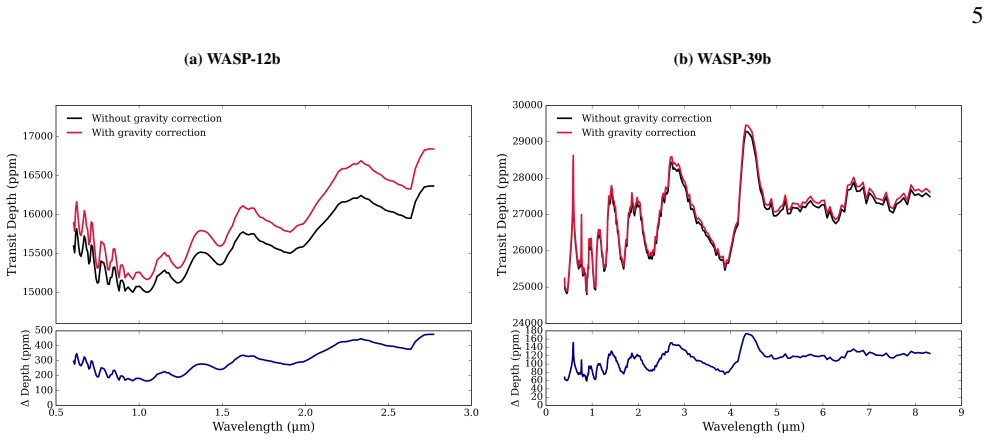
For tidally locked close-in exoplanets the host star's gravity and the planet's spin reduce effective gravity, which enlarges the atmospheric scale height and changes molecular mixing ratios. Forward-model transit depths increase by 150-500 ppm for WASP-12b and 60-180 ppm for WASP-39b. Retrievals performed on the same spectra with and without the correction return higher molecular abundances once the reduced gravity is included.
What carries the argument
A uniform reduction in effective gravity that directly scales atmospheric scale height and mixing ratios inside the forward model.
If this is right
- WASP-12b transit depths rise 150-500 ppm for major molecules once the correction is applied.
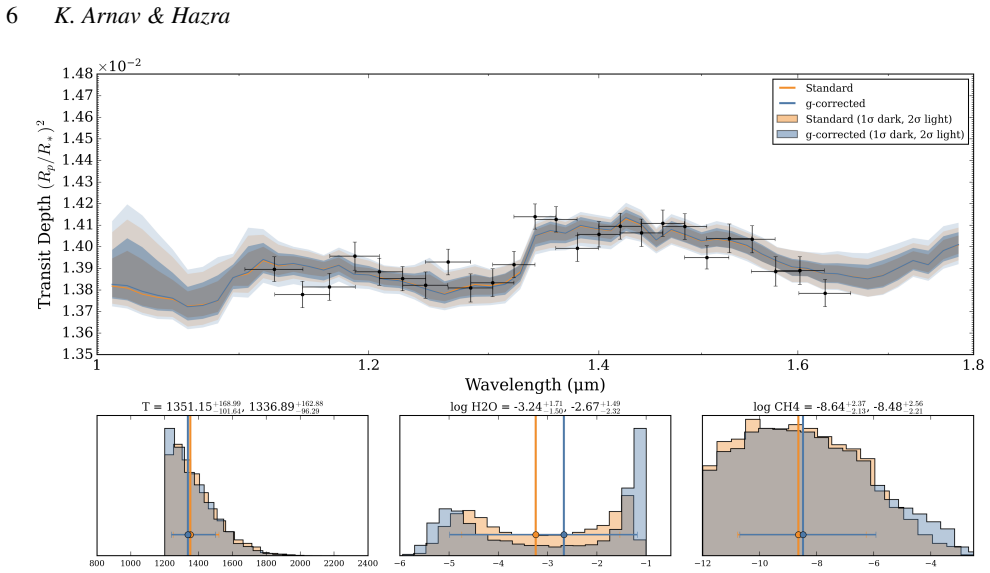
- Retrieved molecular abundances increase for both WASP-12b and WASP-39b when effective gravity is lowered.
- Reducing effective gravity by 20 percent, 30 percent, or 50 percent for WASP-39b produces progressively larger shifts in log-mixing ratios.
- Non-isothermal pressure-temperature profiles yield comparable abundance increases, while clouds suppress the shifts.
Where Pith is reading between the lines
- Retrieval pipelines applied to other close-in planets may systematically underestimate abundances unless the gravity correction is included.
- Direct comparison of observed transit-depth variations with the predicted 60-500 ppm signals could test the correction without relying on retrievals.
- Planets with even stronger tidal distortion than WASP-12b would show still larger abundance offsets.
Load-bearing premise
Tidal and centrifugal effects can be captured by a simple reduction in effective gravity that scales scale height and mixing ratios without full 3D dynamical or radiative-transfer adjustments.
What would settle it
Performing identical retrievals on the same transmission spectra with and without the effective-gravity correction and recovering statistically identical molecular abundances would falsify the claim.
Figures



read the original abstract
Most modern atmospheric retrievals adopt the simplifying assumption that the planetary atmosphere endures no planetary rotation and stellar tidal effect. However, for tidally locked close-in exoplanets, the gravitational influence of the host star and the rapid rotation of the planet can significantly modify the effective gravity, leading to changes in the atmospheric scale height and mixing ratios of molecular abundances. In this work, we develop a combined framework to include these rotation and tidal effects into a forward and retrieval model to study how they affect the molecular abundances of close-in exoplanets. We specifically apply our model to the planet WASP-12b, observed with HST, and WASP-39b, observed with JWST, and investigate how atmospheric retrieval parameters change when tidal and centrifugal corrections to gravity are included. The forward model calculation for strongly affected gravity due to tidal and rotation effects in WASP-12b shows an increment in transit depth in the range of 150-500 ppm for major molecules in the atmosphere, whereas for WASP-39b with small gravity reduction shows variations of 60- 180 ppm. The atmospheric retrievals for WASP-12b using HST and WASP-39b using JWST transmission spectra with and without effective gravity corrections show an increment in the retrieved molecular abundances. A systematic study by reducing the effective gravity by 20%, 30% and an extreme value 50% for WASP-39b shows increasing changes in the inferred log-mixing ratios of various molecules. Our results show a similar trend with non-isothermal P-T profiles, but cloudy models suppress the combined effect of rotation and tidal gravity.
Editorial analysis
A structured set of objections, weighed in public.
Referee Report
Summary. The manuscript develops a combined framework incorporating tidal and centrifugal effects via reduced effective gravity into 1D forward and retrieval models for close-in exoplanets. Applying this to WASP-12b (HST transmission spectra) and WASP-39b (JWST spectra), it reports transit-depth increases of 150-500 ppm and 60-180 ppm respectively when effective-gravity corrections are included, resulting in higher retrieved molecular abundances. Systematic tests reducing g_eff by 20%, 30%, and 50% for WASP-39b show progressively larger shifts in log-mixing ratios; similar trends hold for non-isothermal P-T profiles but are suppressed in cloudy models.
Significance. If the central result holds, the work quantifies a previously neglected bias in standard 1D retrievals for hot Jupiters, showing that neglecting modified scale heights can systematically underestimate molecular abundances. Credit is due for the direct application to real HST and JWST datasets, the explicit ppm-level transit-depth predictions, and the systematic g_eff reduction experiments that make the effect size falsifiable.
major comments (3)
- [Forward model / Methods] Forward-model section: the central claim rests on rescaling the hydrostatic scale height and mixing ratios with a single scalar g_eff. This implicitly assumes a uniform reduction produces the same integrated optical depth as the true position-dependent tidal/centrifugal field across the terminator. Because the tidal potential peaks at the sub-stellar point and centrifugal force varies with latitude, the 1D parameterization may not map accurately to the observed transmission spectrum; if so, the reported 150-500 ppm depth change and subsequent abundance increments could be an artifact of the approximation rather than a robust physical effect.
- [Results / Retrievals] Results for WASP-12b and WASP-39b: the abstract and retrieval sections report specific abundance increments and ppm changes but provide no baseline retrievals without the correction, no posterior distributions, no χ^{2} comparisons, and no error propagation on the reported shifts. Without these, it is impossible to determine whether the correction improves the fit or merely shifts parameters within the same uncertainty.
- [Systematic study] Systematic g_eff study: the 20/30/50 % reductions are presented as producing increasing changes in log-mixing ratios, yet the manuscript does not derive these percentages from the actual tidal/centrifugal potential for WASP-39b or WASP-12b. If the chosen values are arbitrary rather than physically motivated, the trend cannot be used to extrapolate the magnitude of the bias for other planets.
minor comments (2)
- [Abstract] Abstract contains a repeated clause ('an increment in the retrieved molecular abundances') and a typographical space before '180 ppm'.
- [Throughout] Notation for effective gravity should be defined with an explicit equation (e.g., g_eff = g - corrections) and referenced consistently in the text and figures.
Simulated Author's Rebuttal
We thank the referee for their thorough and constructive report. We address each major comment below with point-by-point responses. Revisions will be made to improve clarity, add missing comparisons, and strengthen the physical motivation where possible.
read point-by-point responses
-
Referee: [Forward model / Methods] Forward-model section: the central claim rests on rescaling the hydrostatic scale height and mixing ratios with a single scalar g_eff. This implicitly assumes a uniform reduction produces the same integrated optical depth as the true position-dependent tidal/centrifugal field across the terminator. Because the tidal potential peaks at the sub-stellar point and centrifugal force varies with latitude, the 1D parameterization may not map accurately to the observed transmission spectrum; if so, the reported 150-500 ppm depth change and subsequent abundance increments could be an artifact of the approximation rather than a robust physical effect.
Authors: We acknowledge that the 1D effective-gravity approach is an approximation to the full position-dependent potential. However, transmission spectra probe the terminator region, where an averaged g_eff provides a representative correction to the scale height in standard 1D frameworks. This is consistent with how other gravity modifications (e.g., oblateness) are handled in retrieval codes. Full 3D modeling of the tidal field would be a valuable extension but lies outside the scope of the present work. We will revise the methods section to explicitly state how g_eff is computed from the terminator-averaged potential and add a limitations paragraph discussing the approximation. revision: partial
-
Referee: [Results / Retrievals] Results for WASP-12b and WASP-39b: the abstract and retrieval sections report specific abundance increments and ppm changes but provide no baseline retrievals without the correction, no posterior distributions, no χ^{2} comparisons, and no error propagation on the reported shifts. Without these, it is impossible to determine whether the correction improves the fit or merely shifts parameters within the same uncertainty.
Authors: The referee correctly identifies that direct side-by-side comparisons are needed for a complete assessment. Although retrievals were run both with and without the g_eff correction, the original manuscript emphasized the differences rather than tabulating the baseline results. In the revised manuscript we will include the full baseline retrieval posteriors, χ² values, and propagated uncertainties on the abundance shifts for both planets, allowing readers to evaluate whether the correction yields statistically significant improvements. revision: yes
-
Referee: [Systematic study] Systematic g_eff study: the 20/30/50 % reductions are presented as producing increasing changes in log-mixing ratios, yet the manuscript does not derive these percentages from the actual tidal/centrifugal potential for WASP-39b or WASP-12b. If the chosen values are arbitrary rather than physically motivated, the trend cannot be used to extrapolate the magnitude of the bias for other planets.
Authors: The 20/30/50 % reductions were selected to illustrate the sensitivity of retrieved abundances across a range of plausible corrections, including an extreme case. We agree that anchoring the study to the actual g_eff values computed for each planet would make the results more directly applicable. We will calculate the terminator-averaged tidal plus centrifugal gravity reductions for both WASP-12b and WASP-39b from their known orbital and physical parameters and replace or supplement the arbitrary percentages with these physically derived values in the revised systematic study. revision: yes
Circularity Check
No circularity; derivation applies external data to modified forward model
full rationale
The paper constructs a forward model that incorporates a scalar effective-gravity reduction derived from tidal and centrifugal potentials, then runs retrievals on independent HST and JWST transmission spectra. The reported abundance shifts are direct outputs of this modified 1D calculation applied to external observations; they are not obtained by fitting parameters to the target quantities themselves, nor do they rest on self-citation chains or self-definitional mappings. No equations or steps in the provided text reduce the central claim to its own inputs by construction.
Axiom & Free-Parameter Ledger
free parameters (1)
- effective gravity reduction
axioms (1)
- domain assumption Tidal and centrifugal forces modify effective gravity, leading to changes in atmospheric scale height and molecular mixing ratios
Reference graph
Works this paper leans on
-
[1]
ApJ , fjournal=
Fournier, Paul , title=. ApJ , fjournal=
-
[2]
An important paper , journal=
-
[3]
Another Unreal Paper , journal=
-
[4]
A Last Unreal Paper , journal=
-
[5]
Effect of centrifugal force on transmission spectroscopy of exoplanet atmospheres , volume=
Banerjee, Agnibha and Barstow, Joanna K and Haswell, Carole A and Lewis, Stephen R , year=. Effect of centrifugal force on transmission spectroscopy of exoplanet atmospheres , volume=. Monthly Notices of the Royal Astronomical Society: Letters , publisher=. doi:10.1093/mnrasl/slad058 , number=
-
[6]
doi:10.1093/mnras/stx804 , eprint =
MacDonald, Ryan J. and Madhusudhan, Nikku , year=. HD 209458b in new light: evidence of nitrogen chemistry, patchy clouds and sub-solar water , volume=. Monthly Notices of the Royal Astronomical Society , publisher=. doi:10.1093/mnras/stx804 , number=
-
[7]
Revealing H _ 2 O dissociation in WASP-76 b through combined high- and low-resolution transmission spectroscopy. , keywords =. doi:10.1093/mnras/stae1048 , archivePrefix =. 2405.01933 , primaryClass =
-
[8]
The Journal of Open Source Software , keywords =
POSEIDON: A Multidimensional Atmospheric Retrieval Code for Exoplanet Spectra. The Journal of Open Source Software , keywords =. doi:10.21105/joss.04873 , archivePrefix =. 2410.18181 , primaryClass =
-
[9]
arXiv , author =:2111.05862 , journal =
TRIDENT: A Rapid 3D Radiative-transfer Model for Exoplanet Transmission Spectra. , keywords =. doi:10.3847/1538-4357/ac47fe , archivePrefix =. 2111.05862 , primaryClass =
-
[10]
doi:10.1038/s41586-022-05677-y , eprint =
Early Release Science of the exoplanet WASP-39b with JWST NIRSpec PRISM. , keywords =. doi:10.1038/s41586-022-05677-y , archivePrefix =. 2211.10487 , primaryClass =
-
[11]
A new look into the atmospheric composition of WASP-39 b
A new look into the atmospheric composition of WASP-39 b. arXiv e-prints , keywords =. doi:10.48550/arXiv.2504.07823 , archivePrefix =. 2504.07823 , primaryClass =
work page internal anchor Pith review Pith/arXiv arXiv doi:10.48550/arxiv.2504.07823
-
[12]
On the Dayside Atmosphere of WASP-12b. , keywords =. doi:10.3847/1538-4357/ac1e9f , archivePrefix =. 2205.13392 , primaryClass =
-
[13]
Astronomical Data Analysis Software and Systems XXIX , year = 2020, editor =
The Exo.MAST Portal: An Exoplanet Focused View into MAST Data. Astronomical Data Analysis Software and Systems XXIX , year = 2020, editor =
2020
-
[14]
The GAPS Programme with HARPS-N at TNG . XIV. Investigating giant planet migration history via improved eccentricity and mass determination for 231 transiting planets. , keywords =. doi:10.1051/0004-6361/201629882 , archivePrefix =. 1704.00373 , primaryClass =
work page internal anchor Pith review Pith/arXiv arXiv doi:10.1051/0004-6361/201629882
-
[15]
2014, Statistics and Computing, 26, 383–392, doi: 10.1007/s11222-014-9512-y
Buchner, Johannes , year=. A statistical test for Nested Sampling algorithms , volume=. Statistics and Computing , publisher=. doi:10.1007/s11222-014-9512-y , number=
-
[16]
Nested Sampling. Bayesian Inference and Maximum Entropy Methods in Science and Engineering: 24th International Workshop on Bayesian Inference and Maximum Entropy Methods in Science and Engineering , year = 2004, editor =. doi:10.1063/1.1835238 , adsurl =
-
[17]
Feroz, F. and Hobson, M. P. and Bridges, M. , year=. MultiNest: an efficient and robust Bayesian inference tool for cosmology and particle physics , volume=. Monthly Notices of the Royal Astronomical Society , publisher=. doi:10.1111/j.1365-2966.2009.14548.x , number=
-
[18]
2009 , eprint=
Giant Planets , author=. 2009 , eprint=
2009
-
[19]
Li, Shu-lin and Miller, N. and Lin, Douglas N. C. and Fortney, Jonathan J. , year=. WASP-12b as a prolate, inflated and disrupting planet from tidal dissipation , volume=. Nature , publisher=. doi:10.1038/nature08715 , number=
-
[20]
Ogilvie, G. I. and Lin, D. N. C. , year=. Tidal Dissipation in Rotating Giant Planets , volume=. The Astrophysical Journal , publisher=. doi:10.1086/421454 , number=
-
[21]
Tennyson, Jonathan and Yurchenko, Sergei N. and Al-Refaie, Ahmed F. and Barton, Emma J. and Chubb, Katy L. and Coles, Phillip A. and Diamantopoulou, S. and Gorman, Maire N. and Hill, Christian and Lam, Aden Z. and Lodi, Lorenzo and McKemmish, Laura K. and Na, Yueqi and Owens, Alec and Polyansky, Oleg L. and Rivlin, Tom and Sousa-Silva, Clara and Underwood...
-
[22]
Changeat, Q. and Skinner, J. W. and Cho, J. Y-K. and Nättilä, J. and Waldmann, I. P. and Al-Refaie, A. F. and Dyrek, A. and Edwards, B. and Mikal-Evans, T. and Joshua, M. and Morello, G. and Skaf, N. and Tsiaras, A. and Venot, O. and Yip, K. H. , title =. The Astrophysical Journal Supplement Series , abstract =. 2024 , month =. doi:10.3847/1538-4365/ad119...
-
[23]
2009, ApJ, 707, 24, doi: 10.1088/0004-637X/707/1/24
Madhusudhan, N. and Seager, S. , title =. The Astrophysical Journal , abstract =. 2009 , month =. doi:10.1088/0004-637X/707/1/24 , url =
-
[24]
The Astronomical Journal , abstract =
Welbanks, Luis and Madhusudhan, Nikku , title =. The Astronomical Journal , abstract =. 2019 , month =. doi:10.3847/1538-3881/ab14de , url =
-
[25]
Swain, Mark R. and Line, Michael R. and Deroo, Pieter , year=. ON THE DETECTION OF MOLECULES IN THE ATMOSPHERE OF HD 189733b USINGHSTNICMOS TRANSMISSION SPECTROSCOPY , volume=. The Astrophysical Journal , publisher=. doi:10.1088/0004-637x/784/2/133 , number=
-
[26]
Detectability of shape deformation in short-period exoplanets
Detectability of shape deformation in short-period exoplanets. , keywords =. doi:10.1051/0004-6361/201834215 , archivePrefix =. 1812.04538 , primaryClass =
work page internal anchor Pith review Pith/arXiv arXiv doi:10.1051/0004-6361/201834215
-
[27]
Effects of tidal deformation on planetary phase curves. , keywords =. doi:10.1051/0004-6361/202347739 , archivePrefix =. 2310.03553 , primaryClass =
-
[28]
The tidal deformation and atmosphere of WASP-12 b from its phase curve★. , keywords =. doi:10.1051/0004-6361/202348502 , archivePrefix =. 2402.10486 , primaryClass =
-
[29]
Orbital Decay of the Ultra-hot Jupiter TOI-2109b: Tidal Constraints and Transit-timing Analysis. , keywords =. doi:10.3847/1538-4357/ade057 , archivePrefix =. 2505.18941 , primaryClass =
-
[30]
Detection of the tidal deformation of WASP-103b at 3 with CHEOPS. , keywords =. doi:10.1051/0004-6361/202142196 , archivePrefix =. 2201.03328 , primaryClass =
-
[31]
Tidally Distorted Exoplanets: Density Corrections for Short-period Hot-Jupiters Based Solely on Observable Parameters. , keywords =. doi:10.1088/0004-637X/789/2/113 , archivePrefix =. 1405.1839 , primaryClass =
work page internal anchor Pith review Pith/arXiv arXiv doi:10.1088/0004-637x/789/2/113
-
[32]
Correia, Alexandre C. M. and Laskar, Jacques , title =. Journal of Geophysical Research: Planets , volume =. doi:https://doi.org/10.1029/2003JE002059 , url =. https://agupubs.onlinelibrary.wiley.com/doi/pdf/10.1029/2003JE002059 , abstract =
-
[33]
Gibson, N. P. and Aigrain, S. and Pont, F. and Sing, D. K. and Désert, J.-M. and Evans, T. M. and Henry, G. and Husnoo, N. and Knutson, H. , title =. Monthly Notices of the Royal Astronomical Society , volume =. 2012 , month =. doi:10.1111/j.1365-2966.2012.20655.x , url =
-
[34]
Reviews of Modern Plasma Physics , keywords =
Atmospheric escape from exoplanets: recent observations and theoretical models. Reviews of Modern Plasma Physics , keywords =. doi:10.1007/s41614-025-00195-6 , archivePrefix =. 2502.18124 , primaryClass =
-
[35]
RUBIS: A simple tool for calculating the centrifugal deformation of stars and planets. , keywords =. doi:10.1051/0004-6361/202346403 , archivePrefix =. 2303.08077 , primaryClass =
-
[36]
Clouds in the atmosphere of the super-Earth exoplanet GJ 1214b
Clouds in the atmosphere of the super-Earth exoplanet GJ1214b. , keywords =. doi:10.1038/nature12888 , archivePrefix =. 1401.0022 , primaryClass =
work page internal anchor Pith review Pith/arXiv arXiv doi:10.1038/nature12888
-
[37]
Water, High-altitude Condensates, and Possible Methane Depletion in the Atmosphere of the Warm Super-Neptune WASP-107b. , keywords =. doi:10.3847/2041-8213/aabfce , archivePrefix =. 1709.08635 , primaryClass =
work page internal anchor Pith review Pith/arXiv arXiv doi:10.3847/2041-8213/aabfce 2041
-
[38]
NGTS-10b: the shortest period hot Jupiter yet discovered. , keywords =. doi:10.1093/mnras/staa115 , archivePrefix =. 1909.12424 , primaryClass =
-
[39]
HST Transmission Spectra of the Hot Neptune HD 219666 b: Detection of Water and the Challenge of Constraining Both Water and Methane. , keywords =. doi:10.3847/1538-3881/adc684 , archivePrefix =. 2503.03895 , primaryClass =
-
[40]
Helium in the eroding atmosphere of an exoplanet
Helium in the eroding atmosphere of an exoplanet. , keywords =. doi:10.1038/s41586-018-0067-5 , archivePrefix =. 1805.01298 , primaryClass =
work page internal anchor Pith review Pith/arXiv arXiv doi:10.1038/s41586-018-0067-5
discussion (0)
Sign in with ORCID, Apple, or X to comment. Anyone can read and Pith papers without signing in.