Polarized emission of orbiting hot-spots near Sagittarius A*: effects of electromagnetic interaction
Pith reviewed 2026-06-26 23:02 UTC · model grok-4.3
The pith
Electromagnetic interaction between charged hot-spots and external magnetic fields modifies observed polarization loops around Sagittarius A* and creates ambiguity in orbital parameters.
A machine-rendered reading of the paper's core claim, the machinery that carries it, and where it could break.
Core claim
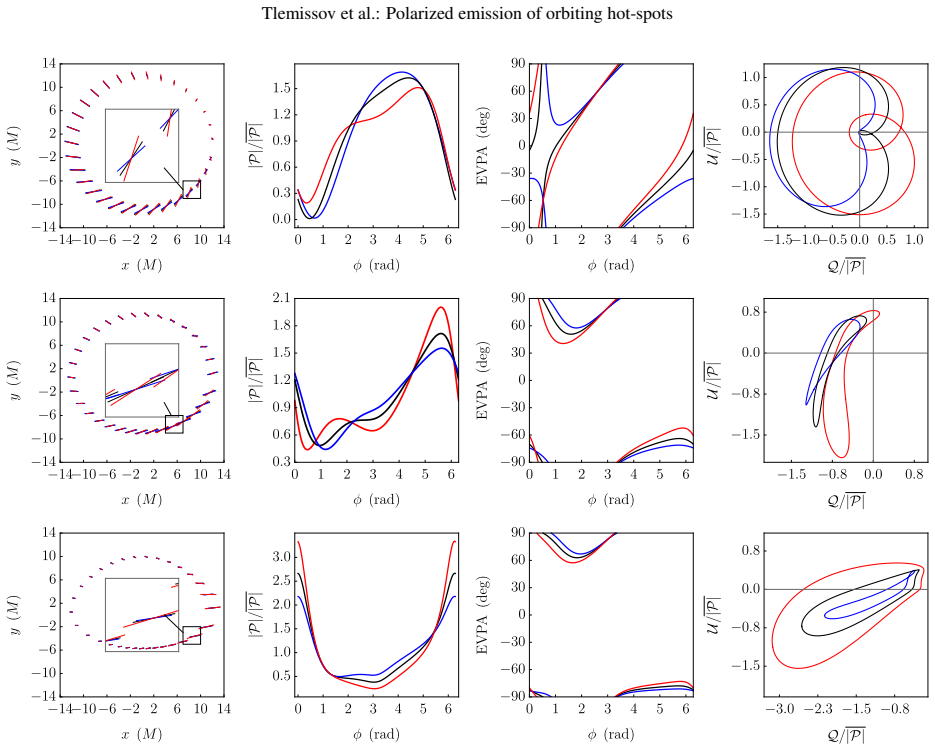
Accounting for the electromagnetic interaction between the charged emitter and the external magnetic field modifies the observed polarization patterns of orbiting hot-spots. A small positive value of the interaction parameter increases the symmetry of the polarization loops and the time ratio, allowing better reproduction of ALMA data for Sgr A*, while negative values fail to match the observations and introduce strong asymmetry. This interaction leads to ambiguity in estimating orbital inclination or hot-spot velocity.
What carries the argument
The electromagnetic interaction parameter that alters the trajectory and synchrotron emission of charged hot-spots orbiting a Schwarzschild black hole in an external magnetic field, embedded in a ray-tracing polarization calculation.
If this is right
- A small positive interaction parameter increases the symmetry of the loops and the time ratio.
- A negative interaction parameter introduces strong asymmetry and fails to reproduce the ALMA data.
- Electromagnetic interaction creates ambiguity in estimates of orbital inclination and hot-spot velocity.
- The model can be used to explore the parameter space that reproduces asymmetry, time ratio, and area ratio of the observed loops.
Where Pith is reading between the lines
- Standard hot-spot models that omit electromagnetic interaction may systematically misestimate orbital parameters when applied to Sgr A* data.
- Higher-precision multi-epoch polarimetry could break the degeneracy between interaction strength and orbital geometry.
- The same interaction term may affect polarization signatures in other accreting systems with strong magnetic fields.
Load-bearing premise
The observed polarization loops from ALMA data of Sgr A* can be reproduced by varying the electromagnetic interaction parameter together with standard orbital parameters, and the synchrotron emission plus ray-tracing model accurately captures the relevant physics without significant unmodeled effects.
What would settle it
New high-cadence polarimetric observations that yield polarization loop asymmetry, time ratio, or area ratio values lying outside the ranges achievable by any combination of positive interaction parameter and orbital parameters would falsify the claim.
Figures



read the original abstract
We investigate the polarimetric signatures of orbiting hot-spots around a Schwarzschild black hole in the presence of an external magnetic field, accounting for the electromagnetic interaction between the charged emitter and the field. Using a general-relativistic model that incorporates synchrotron emission and ray-tracing of light propagation, we analyze how the electromagnetic interaction parameter modifies the observed polarization patterns, with particular emphasis on the behavior of the electric vector position angle (EVPA) and the time-evolving polarization loops in the $Q$-$U$ plane. Applying the model to millimeter wavelength ALMA observations of Sagittarius~A*, we explore the parameter space that best reproduces the asymmetry, time ratio, and area ratio of the observed polarization loops. We find that the inclusion of a small positive interaction parameter increases the symmetry of the loops and the time ratio, while a negative magnetic parameter introduces strong asymmetry and fails to reproduce the data. Our results indicate that electromagnetic interaction can lead to ambiguity in the estimation of the system parameters such as orbital inclination or hot-spot velocity.
Editorial analysis
A structured set of objections, weighed in public.
Referee Report
Summary. The manuscript develops a general-relativistic ray-tracing and synchrotron emission model for charged hot-spots orbiting a Schwarzschild black hole, augmented by an electromagnetic interaction term with an external magnetic field. The model is applied to ALMA polarimetric observations of Sgr A* to examine how the interaction parameter alters EVPA evolution and the symmetry, time ratio, and area ratio of loops in the Q-U plane. The central finding is that a small positive value of the interaction parameter improves agreement with the observed loop properties while negative values produce unacceptable asymmetry, implying degeneracies with orbital inclination and hot-spot velocity.
Significance. If the reported effects of the interaction parameter hold under independent constraints, the work would demonstrate an additional source of degeneracy in hot-spot parameter estimation from polarimetric data, with potential implications for interpreting near-horizon dynamics at Sgr A*. The model combines standard GR ray-tracing with an added force term, but the significance is tempered by the parameter's status as a free variable tuned to the same dataset used to validate the fit.
major comments (2)
- [Results and parameter exploration (likely §4–5)] The electromagnetic interaction parameter is introduced as a tunable quantity and varied to reproduce the asymmetry, time ratio, and area ratio of the ALMA polarization loops. This fitting procedure makes the claim that positive values increase symmetry and time ratio (while negative values fail) potentially circular, since the parameter lacks independent external constraints and is adjusted specifically to match the target observables. A demonstration that the same parameter range is preferred under a different dataset or physical prior would be required to establish the effect as non-circular.
- [Model description (likely §2)] The manuscript should provide the explicit equation of motion or force term by which the interaction parameter modifies the hot-spot trajectory (e.g., the Lorentz force contribution or equivalent). Without this, it is difficult to assess whether the reported changes in loop symmetry arise from the interaction itself or from compensatory adjustments in orbital velocity or inclination.
minor comments (2)
- [Abstract and §2] Notation for the interaction parameter should be defined once at first use and used consistently; the abstract refers to both 'interaction parameter' and 'magnetic parameter,' which may confuse readers.
- [Figures in results section] Figure captions for the Q-U loops should explicitly state the values of the interaction parameter, inclination, and velocity used in each panel to facilitate direct comparison with the text claims.
Simulated Author's Rebuttal
We thank the referee for the constructive review and for highlighting points that improve the clarity and scope of the manuscript. We address each major comment below and have revised the text accordingly where possible.
read point-by-point responses
-
Referee: [Results and parameter exploration (likely §4–5)] The electromagnetic interaction parameter is introduced as a tunable quantity and varied to reproduce the asymmetry, time ratio, and area ratio of the ALMA polarization loops. This fitting procedure makes the claim that positive values increase symmetry and time ratio (while negative values fail) potentially circular, since the parameter lacks independent external constraints and is adjusted specifically to match the target observables. A demonstration that the same parameter range is preferred under a different dataset or physical prior would be required to establish the effect as non-circular.
Authors: We acknowledge that the interaction parameter functions as a free parameter in the model and that the presented exploration is performed by matching the ALMA polarization-loop observables. The manuscript does not claim that a particular positive value is physically preferred on independent grounds; rather, it demonstrates that electromagnetic interaction introduces additional degeneracies with inclination and velocity, and that negative values produce asymmetries incompatible with the data while small positive values can restore symmetry. To address the concern, we have added a paragraph in the discussion section noting the absence of external constraints and outlining how future work could incorporate plasma-physics priors or multi-epoch/multi-wavelength datasets to test the parameter range. revision: partial
-
Referee: [Model description (likely §2)] The manuscript should provide the explicit equation of motion or force term by which the interaction parameter modifies the hot-spot trajectory (e.g., the Lorentz force contribution or equivalent). Without this, it is difficult to assess whether the reported changes in loop symmetry arise from the interaction itself or from compensatory adjustments in orbital velocity or inclination.
Authors: We agree that the explicit force term is necessary for reproducibility. In the revised manuscript we have inserted the modified equation of motion in Section 2: the four-acceleration satisfies a^μ = -Γ^μ_αβ u^α u^β + (q/m) F^μ_ν u^ν, where the second term is the Lorentz force arising from the external magnetic field in the Schwarzschild background. This addition makes clear that the reported changes in loop symmetry originate directly from the electromagnetic term rather than from ad-hoc adjustments to velocity or inclination. revision: yes
Circularity Check
No significant circularity; model uses external ALMA data for fitting
full rationale
The derivation introduces a physically motivated electromagnetic interaction parameter into a standard general-relativistic ray-tracing plus synchrotron emission framework for orbiting hot-spots. Parameter exploration is performed to match observed EVPA loop properties (asymmetry, time ratio, area ratio) from independent ALMA observations of Sgr A*. This is ordinary model calibration against external benchmarks rather than any self-referential step in which a prediction or result reduces by construction to the fitted inputs. No self-citations, uniqueness theorems, or ansatzes are invoked as load-bearing elements in the abstract or described construction. The reported effects on symmetry and parameter degeneracy follow directly from the model equations without circular reduction.
Axiom & Free-Parameter Ledger
free parameters (1)
- electromagnetic interaction parameter =
small positive
axioms (2)
- domain assumption Synchrotron emission produces the polarized radiation from charged particles in a magnetic field
- standard math Light rays follow null geodesics in the Schwarzschild metric
invented entities (1)
-
electromagnetic interaction parameter
no independent evidence
Reference graph
Works this paper leans on
-
[1]
Beloborodov, A. M. 2002, ApJ, 566, L85
2002
-
[2]
Blandford, R. D. & Znajek, R. L. 1977, MNRAS, 179, 433
1977
-
[3]
Chen, F. F. 2016, Introduction to Plasma Physics and Controlled Fusion
2016
-
[4]
N., et al
Eckart, A., García-Marín, M., V ogel, S. N., et al. 2012, A&A, 537, A52 Event Horizon Telescope Collaboration, Akiyama, K., Alberdi, A., et al. 2024a, ApJ, 964, L25 Event Horizon Telescope Collaboration, Akiyama, K., Alberdi, A., et al. 2024b, ApJ, 964, L26 Event Horizon Telescope Collaboration, Akiyama, K., Alberdi, A., et al. 2022a, ApJ, 930, L13 Event ...
2012
-
[5]
Frolov, V . P. & Shoom, A. A. 2010, Phys. Rev. D, 82, 084034
2010
-
[6]
D., & Palumbo, D
Gelles, Z., Himwich, E., Johnson, M. D., & Palumbo, D. C. M. 2021, Phys. Rev. D, 104, 044060
2021
-
[7]
2021, ApJ, 910, L14
Goddi, C., Martí-Vidal, I., Messias, H., et al. 2021, ApJ, 910, L14
2021
-
[8]
& Julian, W
Goldreich, P. & Julian, W. H. 1969, ApJ, 157, 869 Gravity Collaboration, Abuter, R., Aimar, N., et al. 2023, A&A, 677, L10 Gravity Collaboration, Abuter, R., Amorim, A., et al. 2018, A&A, 618, L10 GRA VITY Collaboration, Bauböck, M., Dexter, J., et al. 2020a, A&A, 635, A143 GRA VITY Collaboration, Jiménez-Rosales, A., Dexter, J., et al. 2020b, A&A, 643, A56
1969
-
[9]
Hazeltine, R. D. & Waelbroeck, F. L. 2004, The Framework of Plasma Physics, 1st edn. (Boca Raton: CRC Press), 344
2004
-
[10]
2024, MNRAS, 532, 1522
Jacquemin-Ide, J., Rincon, F., Tchekhovskoy, A., & Liska, M. 2024, MNRAS, 532, 1522
2024
-
[11]
D., Fish, V
Johnson, M. D., Fish, V . L., Doeleman, S. S., et al. 2015, Science, 350, 1242 Kološ, M., Stuchlík, Z., & Tursunov, A. 2015, Classical and Quantum Gravity, 32, 165009
2015
-
[12]
Komissarov, S. S. 2022, MNRAS, 512, 2798
2022
-
[13]
A., Bouman, K
Levis, A., Chael, A. A., Bouman, K. L., Wielgus, M., & Srinivasan, P. P. 2024, Nature Astronomy, 8, 765
2024
-
[14]
Muslimov, A. G. & Tsygan, A. I. 1992, MNRAS, 255, 61
1992
-
[15]
Narayan, R., Palumbo, D. C. M., Johnson, M. D., et al. 2021, ApJ, 912, 35
2021
-
[16]
& Wilson, J
Ruffini, R. & Wilson, J. R. 1975, Phys. Rev. D, 12, 2959
1975
-
[17]
Thorne, K. S. & MacDonald, D. 1982, MNRAS, 198, 339
1982
-
[18]
& Dadhich, N
Tursunov, A. & Dadhich, N. 2019, Universe, 5, 125
2019
-
[19]
2016, Phys
Tursunov, A., Stuchlík, Z., & Kološ, M. 2016, Phys. Rev. D, 93, 084012
2016
-
[20]
2020, ApJ, 897, 99
Tursunov, A., Zajaˇcek, M., Eckart, A., et al. 2020, ApJ, 897, 99
2020
-
[21]
H., Wielgus, M., Aimar, N., Paumard, T., & Perrin, G
Vincent, F. H., Wielgus, M., Aimar, N., Paumard, T., & Perrin, G. 2024, A&A, 684, A194 V os, J., Mo´scibrodzka, M. A., & Wielgus, M. 2022, A&A, 668, A185
2024
-
[22]
Wald, R. M. 1974, Phys. Rev. D, 10, 1680
1974
-
[23]
Wald, R. M. 1984, General Relativity
1984
-
[24]
& Penrose, R
Walker, M. & Penrose, R. 1970, Communications in Mathematical Physics, 18, 265
1970
-
[25]
2024, A&A, 682, A97
Wielgus, M., Issaoun, S., Martí-Vidal, I., et al. 2024, A&A, 682, A97
2024
-
[26]
2003, ApJ, 598, 301 Zajaˇcek, M., Tursunov, A., Eckart, A., & Britzen, S
Yuan, F., Quataert, E., & Narayan, R. 2003, ApJ, 598, 301 Zajaˇcek, M., Tursunov, A., Eckart, A., & Britzen, S. 2018, MNRAS, 480, 4408 Article number, page 10
2003
discussion (0)
Sign in with ORCID, Apple, or X to comment. Anyone can read and Pith papers without signing in.