IMPart: Integration of Memetic Operations into Multi-Level Framework for Large-k-Way Hypergraph Partitioning
Pith reviewed 2026-06-26 21:53 UTC · model grok-4.3
The pith
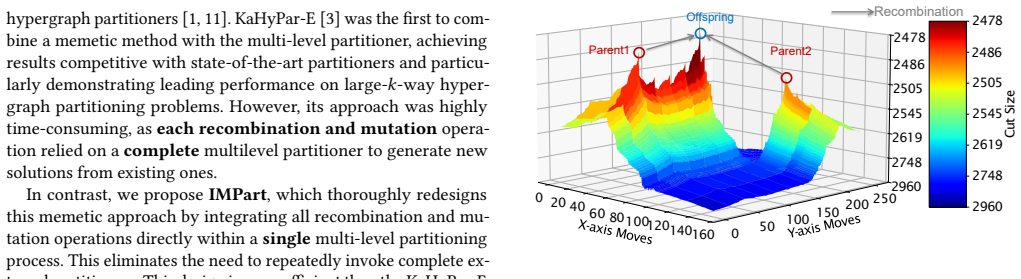
Integrating recombination and mutation operators directly into the uncoarsening phase of a single multi-level framework produces higher-quality partitions for large-k hypergraph problems than either standard multi-level methods or standalon
A machine-rendered reading of the paper's core claim, the machinery that carries it, and where it could break.
Core claim
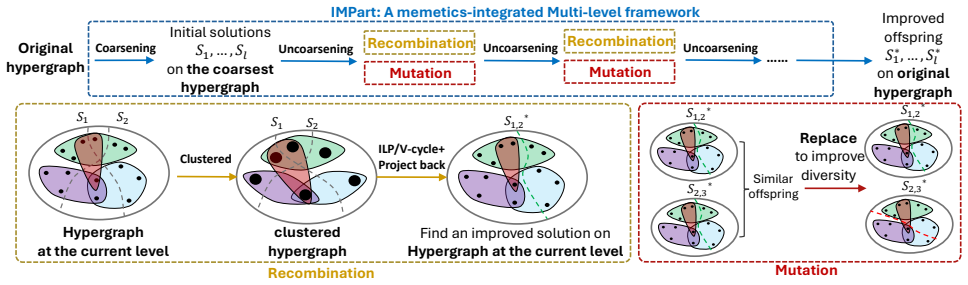
Novel recombination and mutation operators can be integrated directly into the uncoarsening phase of a single multi-level hypergraph partitioning framework; this integration turns the local searches of different granularities into a collaborative search that escapes local optima more effectively and explores the global solution space, yielding substantially higher-quality solutions for large-k-way hypergraph partitioning than all existing methods.
What carries the argument
The integration of novel recombination and mutation operators into the uncoarsening phase of one multi-level framework.
If this is right
- The single-framework design removes the runtime penalty that previously made memetic hypergraph partitioners impractical for large k.
- Local searches at successive uncoarsening levels now cooperate rather than operate in isolation, enabling broader exploration of the solution space.
- The approach outperforms every prior hypergraph partitioner on standard benchmarks for large-k instances.
- A new development paradigm is opened in which memetic-style operators are fused inside the multi-level loop instead of being run as external black boxes.
Where Pith is reading between the lines
- The same operator-insertion pattern could be tested on graph partitioning or clustering tasks that already rely on multi-level coarsening.
- If the quality gain holds at still larger k, the method might lower the total compute budget required for high-quality partitioning inside VLSI design flows.
- One could measure whether the integrated operators also improve convergence speed on instances where the uncoarsening phase dominates runtime.
Load-bearing premise
That novel recombination and mutation operators can be inserted into the uncoarsening phase of a single multi-level framework while retaining the quality gains of standalone memetic methods without adding their runtime overhead.
What would settle it
A direct comparison on the same large-k benchmark instances in which IMPart produces partitions whose cut size or balance is no better than the best existing multi-level or memetic partitioner.
Figures



read the original abstract
The problem of k-way hypergraph partitioning is fundamental with significant applications in various fields, including VLSI design and scientific computing. State-of-the-art hypergraph partitioners commonly employ a multi-level framework encompassing coarsening, initial partitioning, uncoarsening, and refinement phases. However, many existing methods do not scale well to problems requiring a large number of partitions (i.e., large k). In pursuit of exceptionally high solution quality, existing memetic approaches often execute their two key operations, recombination and mutation, by invoking separate, standalone multi-level partitioners. This design choice, however, renders them significantly more time-consuming than standard multi-level partitioners. To make such memetic approaches more practical, we propose an advanced memetic framework, IMPart, which introduces novel recombination and mutation operators and integrates them directly into the uncoarsening phase of a single multi-level framework. This transforms the local searches of different granularities in the traditional multi-level framework into a sophisticated, collaborative search. Experimental results on multiple standard benchmarks demonstrate our framework more effectively escapes local optima and explores the global solution space for higher-quality solutions, substantially outperforming all existing hypergraph partitioners for large-$k$-way hypergraph partitioning. Our framework highlights a new paradigm for the development of advanced hypergraph partitioners.
Editorial analysis
A structured set of objections, weighed in public.
Referee Report
Summary. The paper proposes IMPart, an advanced memetic framework for large-k-way hypergraph partitioning. It introduces novel recombination and mutation operators integrated directly into the uncoarsening phase of a single multi-level framework (coarsening, initial partitioning, uncoarsening, refinement), transforming local searches of different granularities into collaborative search. The central claim is that this enables better escape from local optima and global exploration, yielding substantially higher-quality solutions than existing hypergraph partitioners on standard benchmarks while avoiding the time cost of standalone memetic methods that invoke separate multi-level partitioners for recombination/mutation.
Significance. If the experimental claims and the integration mechanism hold, the work would demonstrate a viable path to combine the efficiency of multi-level frameworks with the exploration power of memetic algorithms for large k, potentially improving solution quality in applications such as VLSI design and scientific computing. The embedding of memetic operations within uncoarsening represents a distinct paradigm that could influence future partitioner designs.
major comments (2)
- [Abstract] Abstract: The assertion of 'substantially outperforming all existing hypergraph partitioners' and 'more effectively escapes local optima' is presented without any quantitative results, baseline descriptions, error bars, or exclusion rules, so the central experimental claim cannot be evaluated from the provided evidence.
- [Framework description (operators integration)] Description of operators: No concrete mechanism, pseudocode, or adaptation details are supplied showing how the novel recombination and mutation operators operate across hierarchy levels during uncoarsening without full re-coarsening or repeated standalone multi-level invocations; without this, it is unclear why the approach avoids the quality-time tradeoff of prior memetic methods or delivers the claimed global-search advantage.
minor comments (1)
- [Abstract] The abstract would benefit from naming the specific benchmarks and the range of k values evaluated to allow readers to immediately assess the scope of the claimed outperformance.
Simulated Author's Rebuttal
We thank the referee for the detailed and constructive feedback. We address each major comment below, proposing revisions to improve clarity and completeness where the concerns are valid.
read point-by-point responses
-
Referee: [Abstract] Abstract: The assertion of 'substantially outperforming all existing hypergraph partitioners' and 'more effectively escapes local optima' is presented without any quantitative results, baseline descriptions, error bars, or exclusion rules, so the central experimental claim cannot be evaluated from the provided evidence.
Authors: The abstract is intended as a concise summary of the work. The full manuscript provides quantitative experimental results in Section 5, including direct comparisons against baselines (e.g., KaHyPar, hMETIS), performance metrics on standard benchmarks, and analysis of solution quality improvements for large k. To make the central claims more evaluable at a glance, we will revise the abstract to include a brief statement of key quantitative gains (e.g., average improvement percentages) while respecting length constraints. revision: partial
-
Referee: [Framework description (operators integration)] Description of operators: No concrete mechanism, pseudocode, or adaptation details are supplied showing how the novel recombination and mutation operators operate across hierarchy levels during uncoarsening without full re-coarsening or repeated standalone multi-level invocations; without this, it is unclear why the approach avoids the quality-time tradeoff of prior memetic methods or delivers the claimed global-search advantage.
Authors: Section 3 describes the integration of recombination and mutation directly into the uncoarsening phase of the single multi-level framework, with explanations of how operators are adapted to hierarchy levels to enable collaborative search without separate invocations. We agree that explicit pseudocode and finer-grained adaptation details would strengthen the presentation and better illustrate the avoidance of repeated coarsening. In the revised manuscript we will add pseudocode for both operators together with a step-by-step description of their level-wise application and the resulting efficiency advantage. revision: yes
Circularity Check
No circularity; claims rest on external benchmark experiments, not internal derivations or self-referential fits.
full rationale
The paper proposes an algorithmic integration of memetic operators into a multi-level hypergraph partitioner and supports its central claim solely via experimental comparisons on standard benchmarks. No equations, parameter fits, or derivation chains appear in the abstract or description. No self-citations are invoked as load-bearing uniqueness theorems or ansatzes. The performance advantage is presented as an empirical outcome, externally falsifiable against other partitioners, satisfying the criteria for a self-contained, non-circular result.
Axiom & Free-Parameter Ledger
Reference graph
Works this paper leans on
-
[1]
Utku Umur Acikalin and Bugra Caskurlu. 2022. Multilevel memetic hyper- graph partitioning with greedy recombination. InProceedings of the Genetic and Evolutionary Computation Conference Companion. 168–171
2022
-
[2]
Charles J Alpert. 1998. The ISPD98 circuit benchmark suite. InProceedings of the 1998 international symposium on Physical design. 80–85
1998
-
[3]
Robin Andre, Sebastian Schlag, and Christian Schulz. 2018. Memetic multi- level hypergraph partitioning. InProceedings of the Genetic and Evolutionary Computation Conference. 347–354
2018
-
[4]
Shawki Areibi and Zhen Yang. 2004. Effective memetic algorithms for VLSI design= genetic algorithms+ local search+ multi-level clustering.Evolutionary Computation12, 3 (2004), 327–353
2004
-
[5]
Ismail Bustany, Grigor Gasparyan, Andrew B Kahng, Ioannis Koutis, Bodhisatta Pramanik, and Zhiang Wang. 2023. An open-source constraints-driven general partitioning multi-tool for VLSI physical design. In2023 IEEE/ACM International Conference on Computer Aided Design (ICCAD). IEEE, 1–9
2023
-
[6]
Ismail Bustany, Andrew B Kahng, Ioannis Koutis, Bodhisatta Pramanik, and Zhiang Wang. 2022. SpecPart: A supervised spectral framework for hyper- graph partitioning solution improvement. InProceedings of the 41st IEEE/ACM International Conference on Computer-Aided Design. 1–9
2022
-
[7]
Ismail Bustany, Andrew B Kahng, Ioannis Koutis, Bodhisatta Pramanik, and Zhiang Wang. 2023. K-SpecPart: Supervised embedding algorithms and cut overlay for improved hypergraph partitioning.IEEE Transactions on Computer- Aided Design of Integrated Circuits and Systems43, 4 (2023), 1232–1245
2023
-
[8]
Ümit V Çatalyürek and Cevdet Aykanat. 2011. PaToH (Partitioning Tool for Hypergraphs)
2011
-
[9]
Heming Chan and Pinaki Mazumder. 1993. A systolic architecture for high speed hypergraph partitioning using a genetic algorithm. InWorkshop on Evolutionary Computation. Springer, 109–126
1993
-
[10]
Magi Chen and Ting-Chi Wang. 2024. A Hypergraph Partitioner Utilizing a Novel Graph Generative Model. InProceedings of the 43rd IEEE/ACM International Conference on Computer-Aided Design. 1–9
2024
-
[11]
James Cohoon, John Kairo, and Jens Lienig. 2003. Evolutionary algorithms for the physical design of VLSI circuits. InAdvances in evolutionary computing: theory and applications. Springer, 683–711
2003
-
[12]
Charles M Fiduccia and Robert M Mattheyses. 1988. A linear-time heuristic for improving network partitions. InPapers on Twenty-five years of electronic design automation. 241–247
1988
-
[13]
Lars Gottesbüren, Michael Hamann, and Dorothea Wagner. 2019. Evaluation of a flow-based hypergraph bipartitioning algorithm.arXiv preprint arXiv:1907.02053 (2019)
work page internal anchor Pith review Pith/arXiv arXiv 2019
-
[14]
Lars Gottesbüren, Tobias Heuer, Nikolai Maas, Peter Sanders, and Sebastian Schlag. 2024. Scalable high-quality hypergraph partitioning.ACM Transactions on Algorithms20, 1 (2024), 1–54
2024
- [15]
-
[16]
Lars Gottesbüren, Tobias Heuer, Peter Sanders, and Sebastian Schlag. 2021. Scal- able Shared-Memory Hypergraph Partitioning. In2021 Proceedings of the Work- shop on Algorithm Engineering and Experiments (ALENEX). SIAM, 16–30
2021
-
[17]
Juris Hartmanis. 1982. Computers and intractability: a guide to the theory of np-completeness (michael r. garey and david s. johnson).Siam Review24, 1 (1982), 90
1982
-
[18]
Alexandra Henzinger, Alexander Noe, and Christian Schulz. 2020. ILP-based local search for graph partitioning.Journal of Experimental Algorithmics (JEA) 25 (2020), 1–26
2020
-
[19]
George Karypis, Rajat Aggarwal, Vipin Kumar, and Shashi Shekhar. 1997. Multi- level hypergraph partitioning: Application in VLSI domain. InProceedings of the 34th annual Design Automation Conference. 526–529
1997
-
[20]
Brian W Kernighan and Shen Lin. 1970. An efficient heuristic procedure for partitioning graphs.The Bell system technical journal49, 2 (1970), 291–307
1970
-
[21]
Rongjian Liang, Anthony Agnesina, and Haoxing Ren. 2024. Medpart: A multi- level evolutionary differentiable hypergraph partitioner. InProceedings of the 2024 International Symposium on Physical Design. 3–11
2024
-
[22]
Kevin E Murray, Scott Whitty, Suya Liu, Jason Luu, and Vaughn Betz. 2013. Titan: Enabling large and complex benchmarks in academic cad. In2013 23rd International Conference on Field programmable Logic and Applications. IEEE, 1–8
2013
-
[23]
David A Papa and Igor L Markov. 2007. Hypergraph Partitioning and Clustering. Handbook of Approximation Algorithms and Metaheuristics20073547 (2007), 61–1
2007
-
[24]
Sebastian Schlag, Tobias Heuer, Lars Gottesbüren, Yaroslav Akhremtsev, Chris- tian Schulz, and Peter Sanders. 2023. High-quality hypergraph partitioning.ACM Journal of Experimental Algorithmics27 (2023), 1–39
2023
-
[25]
Josef Schwarz and Jiří Očenášek. 1999. Experimental study: Hypergraph parti- tioning based on the simple and advanced genetic algorithm BMDA and BOA. InProceedings of the Mendel, Vol. 99. 124–130
1999
-
[26]
Justin Sybrandt, Ruslan Shaydulin, and Ilya Safro. 2020. Hypergraph partitioning with embeddings.IEEE Transactions on Knowledge and Data Engineering34, 6 (2020), 2771–2782
2020
-
[27]
Dengyong Zhou, Jiayuan Huang, and Bernhard Schölkopf. 2006. Learning with hypergraphs: Clustering, classification, and embedding.Advances in neural information processing systems19 (2006)
2006
discussion (0)
Sign in with ORCID, Apple, or X to comment. Anyone can read and Pith papers without signing in.