Predicting Immune Biomarkers with MultiModal Mixture-of-Expert Pathology Foundation Models Empowers Precision Oncology
Pith reviewed 2026-06-27 01:47 UTC · model grok-4.3
The pith
MixTIME uses a mixture-of-experts router to fuse three pathology foundation models and predict expression levels for 17 immune protein markers directly from routine H&E slides.
A machine-rendered reading of the paper's core claim, the machinery that carries it, and where it could break.
Core claim
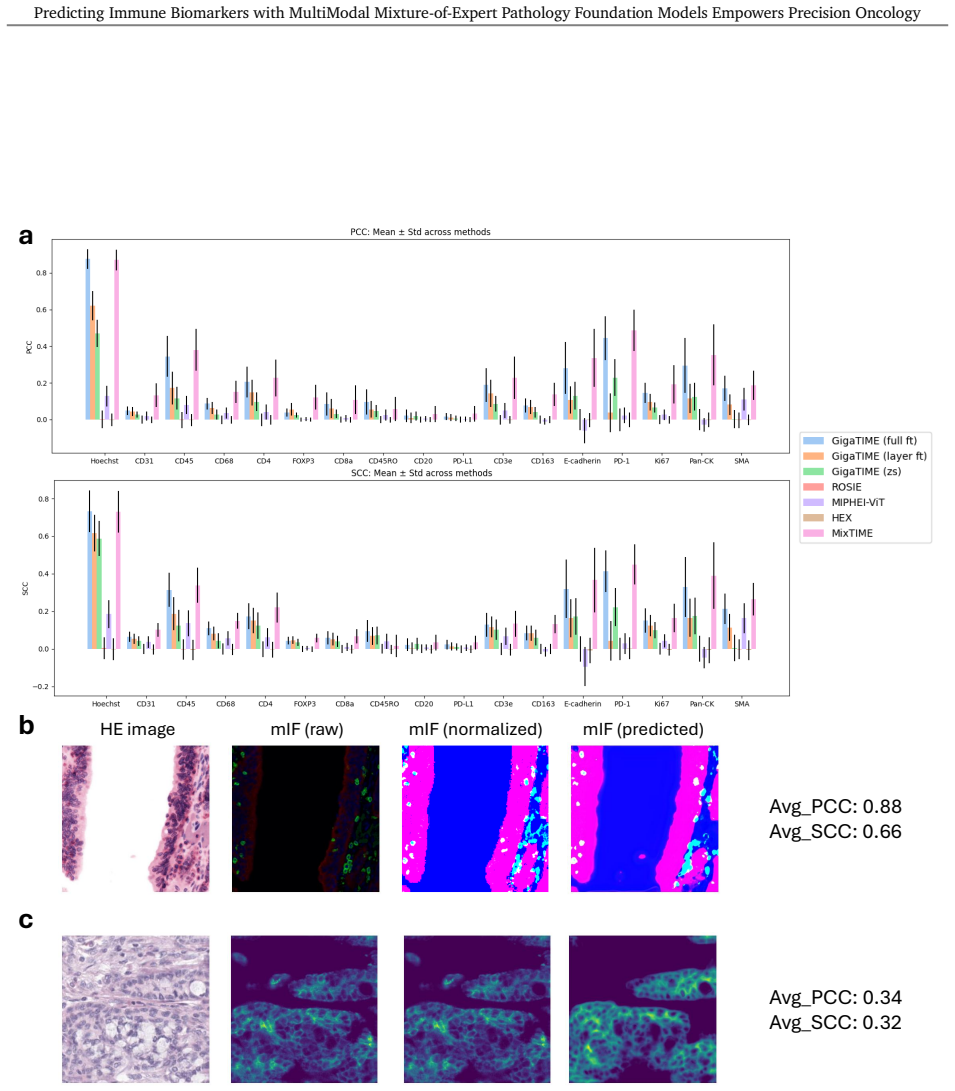
MixTIME is a multimodal foundation model that leverages a mixture-of-experts architecture to integrate pathology foundation models trained across distinct modalities—image only (UNIv2), image text (CONCHv1.5), and image transcriptomic (STPath) representations—for pixel-level and slide-level prediction of multiplex immunofluorescence protein expression from hematoxylin and eosin whole-slide images, achieving state-of-the-art performance across 17 protein markers as measured by correlation metrics.
What carries the argument
The mixture-of-experts architecture with a learnable router that dynamically weights expert contributions from the three modality-specific models, trained with a distribution- and tendency-aware loss function.
If this is right
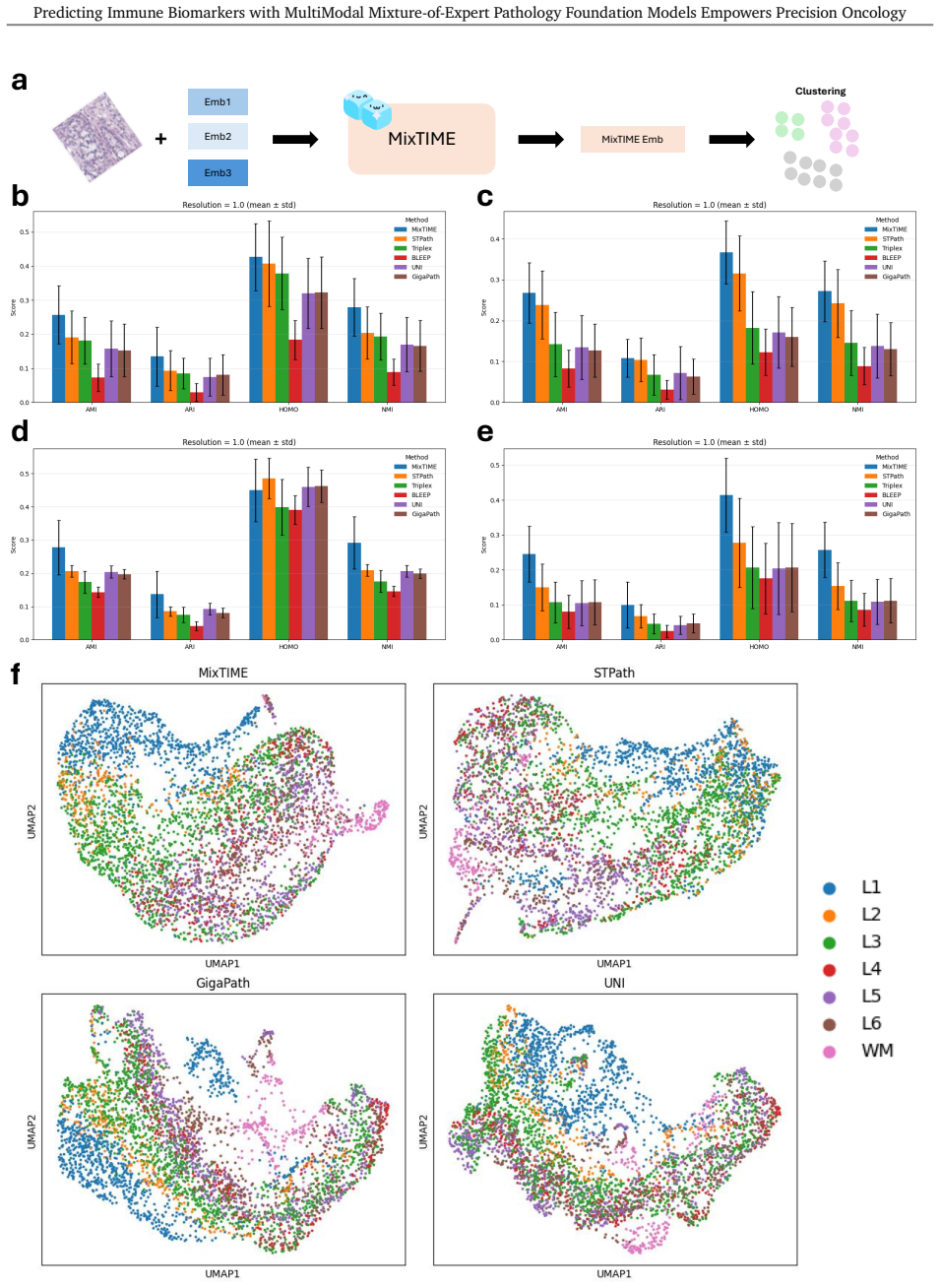
- The predicted mIF profiles improve accuracy of spatial domain identification in tumor tissue.
- The profiles increase performance of survival prediction models.
- The profiles support generation of AI-assisted pathology reports that receive validation from expert pathologists at multiple institutes.
- The model enables longitudinal tracking of protein expression changes across clinical time points.
- The outputs reveal protein-gene interaction patterns associated with drug resistance and immune suppression.
Where Pith is reading between the lines
- The same router mechanism could be tested on additional imaging modalities such as CT or MRI to see whether further gains appear outside pure pathology.
- If the predicted profiles generalize, clinical workflows could substitute or reduce the frequency of multiplex immunofluorescence assays for initial immune profiling.
- The identified resistance-linked interaction patterns suggest a route to stratify patients for targeted combination therapies without new wet-lab experiments.
- Extending the framework to predict continuous rather than discrete marker levels might allow finer monitoring of treatment response over serial biopsies.
Load-bearing premise
The learnable router and distribution-aware loss will successfully exploit complementary information across the three modality-specific foundation models on new, unseen clinical cohorts without the integration introducing systematic bias or overfitting to the two benchmark datasets.
What would settle it
Measure correlation between MixTIME predictions and actual multiplex immunofluorescence values on a held-out multi-institutional cohort collected after model training and check whether performance remains at or above the reported state-of-the-art levels.
Figures



read the original abstract
Predicting immune biomarkers associated with the tumor immune microenvironment (TIME) is critical for advancing precision oncology, yet existing approaches are largely limited to single image modalities and suffer from insufficient resolution and incomplete utilization of complementary clinical and biological information. Here we introduce MixTIME, a multimodal foundation model that leverages a mixture-of-experts (MoE) architecture to integrate pathology foundation models trained across distinct modalities: image only (UNIv2), image text (CONCHv1.5), and image transcriptomic (STPath) representations for pixel-level and slide-level prediction of multiplex immunofluorescence (mIF) protein expression from hematoxylin and eosin (HE) whole-slide images. MixTIME employs a learnable router to dynamically weight expert contributions and is trained with a distribution- and tendency-aware loss function. Benchmarked on two datasets of different scales, MixTIME achieves state-of-the-art performance across 17 protein markers as measured by correlation metrics. The predicted mIF profiles substantially enhance downstream tasks, including spatial domain identification, survival prediction, and AI-assisted pathology report generation validated by expert pathologists from multiple institutes across the world. Furthermore, MixTIME enables longitudinal tracking of protein expression dynamics across clinical time points and reveals protein gene interaction patterns linked to drug resistance and immune suppression in tumor microenvironments. Collectively, MixTIME provides a scalable framework for multimodal biomarker discovery and clinical translation in computational pathology.
Editorial analysis
A structured set of objections, weighed in public.
Referee Report
Summary. The manuscript introduces MixTIME, a multimodal mixture-of-experts (MoE) foundation model that integrates three pathology models (UNIv2 for image-only, CONCHv1.5 for image-text, STPath for image-transcriptomic) via a learnable router and distribution-aware loss to predict pixel- and slide-level multiplex immunofluorescence (mIF) protein expression from H&E whole-slide images. It reports state-of-the-art correlation performance across 17 protein markers on two benchmark datasets of different scales, shows gains in downstream tasks (spatial domain identification, survival prediction, AI-assisted report generation validated by multi-institute pathologists), enables longitudinal tracking, and identifies protein-gene interactions linked to drug resistance.
Significance. If the performance and generalization claims hold, the work could meaningfully advance precision oncology by enabling non-invasive, high-resolution immune biomarker prediction from routine H&E slides, supporting better spatial analysis, prognosis, and clinical reporting. The multi-institute expert pathologist validation for report generation is a positive aspect that strengthens the translational angle.
major comments (2)
- [Results (benchmarking experiments)] The central generalization claim—that the learnable router and distribution-aware loss successfully exploit complementary information across modalities on unseen clinical cohorts—is load-bearing for the SOTA and clinical translation assertions, yet all quantitative results (correlations, downstream gains) and the pathologist validation are confined to the two benchmark datasets. No external validation cohort or cross-institute hold-out set is described.
- [Abstract and Results] The abstract and results sections assert SOTA performance and substantial downstream enhancements but supply no specific quantitative values (e.g., correlation coefficients per marker, dataset sizes, statistical tests, ablation results on the router/loss), preventing evaluation of whether the MoE integration actually outperforms single-modality baselines without introducing bias.
minor comments (2)
- [Methods] Notation for the router weighting and loss terms should be defined more explicitly with equations to aid reproducibility.
- [Figures] Figure legends for the mIF prediction visualizations would benefit from scale bars and clearer indication of which modality experts contributed to each region.
Simulated Author's Rebuttal
We thank the referee for the constructive and detailed feedback. We address each major comment point-by-point below, providing clarifications from the manuscript and indicating where revisions will be made.
read point-by-point responses
-
Referee: [Results (benchmarking experiments)] The central generalization claim—that the learnable router and distribution-aware loss successfully exploit complementary information across modalities on unseen clinical cohorts—is load-bearing for the SOTA and clinical translation assertions, yet all quantitative results (correlations, downstream gains) and the pathologist validation are confined to the two benchmark datasets. No external validation cohort or cross-institute hold-out set is described.
Authors: We appreciate the referee's focus on external validation for the generalization claims. The manuscript evaluates performance on two benchmark datasets of different scales drawn from distinct clinical sources, with consistent gains across both; the AI-assisted report generation is further validated by pathologists from multiple institutes worldwide. We agree that an additional dedicated external cohort would provide stronger support for claims about unseen clinical cohorts. In the revised manuscript we will add an explicit limitations paragraph in the Discussion section addressing the current scope of evaluation and outlining plans for future external validation. revision: partial
-
Referee: [Abstract and Results] The abstract and results sections assert SOTA performance and substantial downstream enhancements but supply no specific quantitative values (e.g., correlation coefficients per marker, dataset sizes, statistical tests, ablation results on the router/loss), preventing evaluation of whether the MoE integration actually outperforms single-modality baselines without introducing bias.
Authors: We agree that the abstract and high-level results summary would benefit from explicit quantitative anchors. The full manuscript already contains per-marker Pearson/Spearman correlations, exact dataset sizes (slides/patients), statistical significance tests, and ablation tables comparing the full MixTIME MoE against single-modality baselines (UNIv2, CONCHv1.5, STPath) as well as ablations removing the learnable router or distribution-aware loss. We will revise the abstract to include key quantitative highlights (e.g., mean correlation improvement across the 17 markers) and ensure the results section cross-references the ablation results demonstrating the contribution of the multimodal router and loss. revision: yes
- Absence of an external validation cohort or cross-institute hold-out set beyond the two benchmark datasets used for all quantitative results.
Circularity Check
No circularity: empirical ML model with no derivations or self-referential predictions
full rationale
The paper describes an empirical multimodal MoE architecture (MixTIME) that integrates three pre-existing foundation models via a learnable router and a custom loss, then reports benchmark correlations and downstream task improvements on two datasets. No equations, first-principles derivations, or claimed predictions are present that could reduce to inputs by construction. All performance claims rest on standard held-out evaluation rather than any fitted parameter being relabeled as a prediction or any self-citation chain substituting for independent justification. The work is therefore self-contained against external benchmarks with no detectable circular steps.
Axiom & Free-Parameter Ledger
Reference graph
Works this paper leans on
-
[1]
Chemokines in the cancer microenviron- ment and their relevance in cancer immunotherapy.Nature Reviews Immunology, 17(9):559– 572, 2017
Nisha Nagarsheth, Max S Wicha, and Weiping Zou. Chemokines in the cancer microenviron- ment and their relevance in cancer immunotherapy.Nature Reviews Immunology, 17(9):559– 572, 2017
2017
-
[2]
Immunotherapy and the ovarian cancer microenvironment: exploring potential strate- gies for enhanced treatment efficacy.Immunology, 173(1):14–32, 2024
Zhi-Bin Wang, Xiu Zhang, Chao Fang, Xiao-Ting Liu, Qian-Jin Liao, Nayiyuan Wu, and Jing Wang. Immunotherapy and the ovarian cancer microenvironment: exploring potential strate- gies for enhanced treatment efficacy.Immunology, 173(1):14–32, 2024
2024
-
[3]
Conserved pan-cancer mi- croenvironment subtypes predict response to immunotherapy.Cancer cell, 39(6):845–865, 2021
AlexanderBagaev,NikitaKotlov,KrystleNomie,ViktorSvekolkin,AzamatGafurov,OlgaIsaeva, Nikita Osokin, Ivan Kozlov, Felix Frenkel, Olga Gancharova, et al. Conserved pan-cancer mi- croenvironment subtypes predict response to immunotherapy.Cancer cell, 39(6):845–865, 2021
2021
-
[4]
Computer- aided prognosis on breast cancer with hematoxylin and eosin histopathology images: A review
Jia-Mei Chen, Yan Li, Jun Xu, Lei Gong, Lin-Wei Wang, Wen-Lou Liu, and Juan Liu. Computer- aided prognosis on breast cancer with hematoxylin and eosin histopathology images: A review. Tumor Biology, 39(3):1010428317694550, 2017
2017
-
[5]
Understanding the tumor immune microenvironment (time) for effective ther- apy.Nature medicine, 24(5):541–550, 2018
Mikhail Binnewies, Edward W Roberts, Kelly Kersten, Vincent Chan, Douglas F Fearon, Miriam Merad, Lisa M Coussens, Dmitry I Gabrilovich, Suzanne Ostrand-Rosenberg, Catherine C Hedrick, et al. Understanding the tumor immune microenvironment (time) for effective ther- apy.Nature medicine, 24(5):541–550, 2018
2018
-
[6]
Multimodal ai generates virtual population for tumor microenvironment modeling.Cell, 189(2):386–400, 2026
Jeya Maria Jose Valanarasu, Hanwen Xu, Naoto Usuyama, Chanwoo Kim, Cliff Wong, Pe- niel Argaw, Racheli Ben Shimol, Angela Crabtree, Kevin Matlock, Alexandra Q Bartlett, et al. Multimodal ai generates virtual population for tumor microenvironment modeling.Cell, 189(2):386–400, 2026
2026
-
[7]
Stpath: a generative foundation model for integrating spatial transcriptomics and whole-slide images.NPJ Digital Medicine, 8(1):659, 2025
Tinglin Huang, Tianyu Liu, Mehrtash Babadi, Rex Ying, and Wengong Jin. Stpath: a generative foundation model for integrating spatial transcriptomics and whole-slide images.NPJ Digital Medicine, 8(1):659, 2025
2025
-
[8]
Leveraging multi-modal foundation models for analysing spatial multi-omic and histopathology data.Nature Biomedical Engineering, pages 1–18, 2026
Tianyu Liu, Tinglin Huang, Tong Ding, Hao Wu, Peter Humphrey, Sudhir Perincheri, Kurt Schalper, Rex Ying, Hua Xu, James Zou, et al. Leveraging multi-modal foundation models for analysing spatial multi-omic and histopathology data.Nature Biomedical Engineering, pages 1–18, 2026
2026
-
[9]
A visual–omics foundation model to bridge histopathology with spatial transcriptomics.Nature Methods, 22(7):1568–1582, 2025
Weiqing Chen, Pengzhi Zhang, Tu N Tran, Yiwei Xiao, Shengyu Li, Vrutant V Shah, Hao Cheng, Kristopher W Brannan, Keith Youker, Li Lai, et al. A visual–omics foundation model to bridge histopathology with spatial transcriptomics.Nature Methods, 22(7):1568–1582, 2025
2025
-
[10]
A visual-language foundation model for computational pathology.Nature medicine, 30(3):863–874, 2024
MingYLu,BowenChen,DrewFKWilliamson,RichardJChen,IvyLiang,TongDing,Guillaume Jaume, Igor Odintsov, Long Phi Le, Georg Gerber, et al. A visual-language foundation model for computational pathology.Nature medicine, 30(3):863–874, 2024
2024
-
[11]
Immunofluorescence techniques.Journal of Investigative Der- matology, 133(1):1–4, 2013
Ian D Odell and Deborah Cook. Immunofluorescence techniques.Journal of Investigative Der- matology, 133(1):1–4, 2013
2013
-
[12]
Miphei-vit: Multiplex immunofluorescence prediction from h&e images using vit foundation models.Computers in Biology and Medicine, 206:111564, 2026
Guillaume Balezo, Roger Trullo, Albert Pla Planas, Etienne Decencière, and Thomas Walter. Miphei-vit: Multiplex immunofluorescence prediction from h&e images using vit foundation models.Computers in Biology and Medicine, 206:111564, 2026. 18 Predicting Immune Biomarkers with MultiModal Mixture-of-Expert Pathology Foundation Models Empowers Precision Oncology
2026
-
[13]
Rosie: Ai gener- ation of multiplex immunofluorescence staining from histopathology images.Nature Commu- nications, 16(1):7633, 2025
Eric Wu, Matthew Bieniosek, Zhenqin Wu, Nitya Thakkar, Gregory W Charville, Ahmad Makky, Christian M Schürch, Jeroen R Huyghe, Ulrike Peters, Christopher I Li, et al. Rosie: Ai gener- ation of multiplex immunofluorescence staining from histopathology images.Nature Commu- nications, 16(1):7633, 2025
2025
-
[14]
Ai-enabled virtual spatial proteomics from histopathol- ogy for interpretable biomarker discovery in lung cancer.Nature Medicine, pages 1–14, 2026
ZheLi,YuchenLi,JinxiXiang,XiyueWang,SenYang,XiaomingZhang,FeyisopeEweje,Yijiang Chen, Xiangde Luo, Yuanyuan Li, et al. Ai-enabled virtual spatial proteomics from histopathol- ogy for interpretable biomarker discovery in lung cancer.Nature Medicine, pages 1–14, 2026
2026
-
[15]
Outrageously Large Neural Networks: The Sparsely-Gated Mixture-of-Experts Layer
Noam Shazeer, Azalia Mirhoseini, Krzysztof Maziarz, Andy Davis, Quoc Le, Geoffrey Hinton, and Jeff Dean. Outrageously large neural networks: The sparsely-gated mixture-of-experts layer.arXiv preprint arXiv:1701.06538, 2017
work page internal anchor Pith review Pith/arXiv arXiv 2017
-
[16]
Towardsageneral- purpose foundation model for computational pathology.Nature medicine, 30(3):850–862, 2024
Richard J Chen, Tong Ding, Ming Y Lu, Drew FK Williamson, Guillaume Jaume, Andrew H Song,BowenChen,AndrewZhang,DanielShao,MuhammadShaban,etal. Towardsageneral- purpose foundation model for computational pathology.Nature medicine, 30(3):850–862, 2024
2024
-
[17]
Hemit: H&e to multiplex- immunohistochemistry image translation with dual-branch pix2pix generator
Chang Bian, Beth Phillips, Tim Cootes, and Martin Fergie. Hemit: H&e to multiplex- immunohistochemistry image translation with dual-branch pix2pix generator. InInternational Conference on Medical Image Computing and Computer-Assisted Intervention, pages 184–197. Springer, 2024
2024
-
[18]
High-plex immunofluores- cence imaging and traditional histology of the same tissue section for discovering image-based biomarkers.Nature cancer, 4(7):1036–1052, 2023
Jia-Ren Lin, Yu-An Chen, Daniel Campton, Jeremy Cooper, Shannon Coy, Clarence Yapp, Ju- liann B Tefft, Erin McCarty, Keith L Ligon, Scott J Rodig, et al. High-plex immunofluores- cence imaging and traditional histology of the same tissue section for discovering image-based biomarkers.Nature cancer, 4(7):1036–1052, 2023
2023
-
[19]
Curran Associates Inc., Red Hook, NY, USA, 2019
Adam Paszke, Sam Gross, Francisco Massa, Adam Lerer, James Bradbury, Gregory Chanan, Trevor Killeen, Zeming Lin, Natalia Gimelshein, Luca Antiga, Alban Desmaison, Andreas Köpf, Edward Yang, Zach DeVito, Martin Raison, Alykhan Tejani, Sasank Chilamkurthy, Benoit Steiner, Lu Fang, Junjie Bai, and Soumith Chintala.PyTorch: an imperative style, high- performa...
2019
-
[20]
Unicorn: Towards universal cellular expression prediction with a multi-task learning framework.Nature Communications, 16(1):9455, 2025
Tianyu Liu, Tinglin Huang, Lijun Wang, Yingxin Lin, Rex Ying, and Hongyu Zhao. Unicorn: Towards universal cellular expression prediction with a multi-task learning framework.Nature Communications, 16(1):9455, 2025
2025
-
[21]
Stimage- 1k4m: A histopathology image-gene expression dataset for spatial transcriptomics.Advances in neural information processing systems, 37:35796–35823, 2024
Jiawen Chen, Muqing Zhou, Wenrong Wu, Jinwei Zhang, Yun Li, and Didong Li. Stimage- 1k4m: A histopathology image-gene expression dataset for spatial transcriptomics.Advances in neural information processing systems, 37:35796–35823, 2024
2024
-
[22]
Scikit- learn: Machine learning in python.the Journal of machine Learning research, 12:2825–2830, 2011
Fabian Pedregosa, Gaël Varoquaux, Alexandre Gramfort, Vincent Michel, Bertrand Thirion, Olivier Grisel, Mathieu Blondel, Peter Prettenhofer, Ron Weiss, Vincent Dubourg, et al. Scikit- learn: Machine learning in python.the Journal of machine Learning research, 12:2825–2830, 2011
2011
-
[23]
Accurate spatial gene expression prediction by integrating multi-resolution features
Youngmin Chung, Ji Hun Ha, Kyeong Chan Im, and Joo Sang Lee. Accurate spatial gene expression prediction by integrating multi-resolution features. InProceedings of the IEEE/CVF Conference on Computer Vision and Pattern Recognition, pages 11591–11600, 2024
2024
-
[24]
Spatially resolved gene expression prediction from histology images via bi-modal con- trastive learning.Advances in Neural Information Processing Systems, 36:70626–70637, 2023
Ronald Xie, Kuan Pang, Sai Chung, Catia Perciani, Sonya MacParland, Bo Wang, and Gary Bader. Spatially resolved gene expression prediction from histology images via bi-modal con- trastive learning.Advances in Neural Information Processing Systems, 36:70626–70637, 2023. 19 Predicting Immune Biomarkers with MultiModal Mixture-of-Expert Pathology Foundation ...
2023
-
[25]
A whole-slide foundation model for digital pathology from real-world data.Nature, 630(8015):181–188, 2024
Hanwen Xu, Naoto Usuyama, Jaspreet Bagga, Sheng Zhang, Rajesh Rao, Tristan Naumann, Cliff Wong, Zelalem Gero, Javier González, Yu Gu, et al. A whole-slide foundation model for digital pathology from real-world data.Nature, 630(8015):181–188, 2024
2024
-
[26]
The cancer imaging archive (tcia): maintaining and operating a public information repository.Journal of digital imaging, 26(6):1045–1057, 2013
Kenneth Clark, Bruce Vendt, Kirk Smith, John Freymann, Justin Kirby, Paul Koppel, Stephen Moore, Stanley Phillips, David Maffitt, Michael Pringle, et al. The cancer imaging archive (tcia): maintaining and operating a public information repository.Journal of digital imaging, 26(6):1045–1057, 2013
2013
-
[27]
Cancer-induced nerve injury promotes resistance to anti-pd-1 therapy.Nature, 646(8084):462–473, 2025
Erez N Baruch, Frederico O Gleber-Netto, Priyadharsini Nagarajan, Xiayu Rao, Shamima Akhter, Tuany Eichwald, Tongxin Xie, Mohammad Balood, Adebayo Adewale, Shorook Naara, et al. Cancer-induced nerve injury promotes resistance to anti-pd-1 therapy.Nature, 646(8084):462–473, 2025
2025
-
[28]
Regulatory t cells and foxp3.Immunological reviews, 241(1):260–268, 2011
Alexander Y Rudensky. Regulatory t cells and foxp3.Immunological reviews, 241(1):260–268, 2011
2011
-
[29]
Pecam-1: regulatorof endothelialjunctional integrity
Jamie RPrivratsky andPeter JNewman. Pecam-1: regulatorof endothelialjunctional integrity. Cell and tissue research, 355(3):607–619, 2014
2014
-
[30]
Chen-Feng Qi, Zhaoyang Li, Mark Raffeld, Hongsheng Wang, Alexander L Kovalchuk, and Her- bert C Morse III. Differential expression of irf8 in subsets of macrophages and dendritic cells and effects of irf8 deficiency on splenic b cell and macrophage compartments.Immunologic research, 45(1):62–74, 2009
2009
-
[31]
Cd163 and ccr7 as markers for macrophage polari- sation in lung cancer microenvironment.Central European Journal of Immunology, 44(4):395– 402, 2019
Iwona Kwiecień, Małgorzata Polubiec-Kownacka, Dariusz Dziedzic, Dominika Wołosz, Piotr Rzepecki, and Joanna Domagała-Kulawik. Cd163 and ccr7 as markers for macrophage polari- sation in lung cancer microenvironment.Central European Journal of Immunology, 44(4):395– 402, 2019
2019
-
[32]
Expression of naive/memory(cd45ra/cd45ro)markersbyperipheralbloodcd4+andcd8+tcellsinchildren with asthma.Archivum immunologiae et therapiae experimentalis, 56(1):55–62, 2008
Edyta Machura, Bogdan Mazur, Wojciech Pieniążek, and Krystyna Karczewska. Expression of naive/memory(cd45ra/cd45ro)markersbyperipheralbloodcd4+andcd8+tcellsinchildren with asthma.Archivum immunologiae et therapiae experimentalis, 56(1):55–62, 2008
2008
-
[34]
Video-assisted thoracic surgery lobectomy (vats), open tho- racotomy, and the robot for lung cancer.The Annals of thoracic surgery, 85(2):S710–S715, 2008
Raja M Flores and Naveed Alam. Video-assisted thoracic surgery lobectomy (vats), open tho- racotomy, and the robot for lung cancer.The Annals of thoracic surgery, 85(2):S710–S715, 2008
2008
-
[35]
Ccnet: Criss-cross attention for semantic segmentation
Zilong Huang, Xinggang Wang, Lichao Huang, Chang Huang, Yunchao Wei, and Wenyu Liu. Ccnet: Criss-cross attention for semantic segmentation. InProceedings of the IEEE/CVF inter- national conference on computer vision, pages 603–612, 2019
2019
-
[36]
Decoupled Weight Decay Regularization
Ilya Loshchilov and Frank Hutter. Decoupled weight decay regularization.arXiv preprint arXiv:1711.05101, 2017
work page internal anchor Pith review Pith/arXiv arXiv 2017
-
[37]
Andrew Zhang, Guillaume Jaume, Anurag Vaidya, Tong Ding, and Faisal Mahmood. Ac- celerating data processing and benchmarking of ai models for pathology.arXiv preprint arXiv:2502.06750, 2025. 20 Predicting Immune Biomarkers with MultiModal Mixture-of-Expert Pathology Foundation Models Empowers Precision Oncology
-
[38]
Molecular-driven foundation model for oncologic pathology.arXiv preprint arXiv:2501.16652, 2025
Anurag Vaidya, Andrew Zhang, Guillaume Jaume, Andrew H Song, Tong Ding, Sophia J Wag- ner, Ming Y Lu, Paul Doucet, Harry Robertson, Cristina Almagro-Perez, et al. Molecular-driven foundation model for oncologic pathology.arXiv preprint arXiv:2501.16652, 2025
-
[39]
Aaditya Singh, Adam Fry, Adam Perelman, Adam Tart, Adi Ganesh, Ahmed El-Kishky, Aidan McLaughlin, Aiden Low, AJ Ostrow, Akhila Ananthram, et al. Openai gpt-5 system card.arXiv preprint arXiv:2601.03267, 2025. 21 Predicting Immune Biomarkers with MultiModal Mixture-of-Expert Pathology Foundation Models Empowers Precision Oncology A. Supplementary figures S...
work page internal anchor Pith review Pith/arXiv arXiv 2025
discussion (0)
Sign in with ORCID, Apple, or X to comment. Anyone can read and Pith papers without signing in.