Detailed Timing, Spectral, and Polarimetric Analysis of Magnetar 1RXS J170849.0-400910
Pith reviewed 2026-06-26 22:58 UTC · model grok-4.3
The pith
Broadband phase-resolved spectropolarimetry reveals multiple distinct emitting regions in magnetar 1RXS J170849.0-400910.
A machine-rendered reading of the paper's core claim, the machinery that carries it, and where it could break.
Core claim
The phase-averaged spectrum fits an absorbed blackbody at kT = 0.468 keV plus two power laws with photon indices 2.63 and 0.5. Phase-resolved spectroscopy shows the thermal flux modulated by a factor of about five in projected area, the soft power law displaying two phase-offset peaks with distinct energy evolution, and the 10-70 keV flux anticorrelated with the soft power-law index. Polarization is anticorrelated with intensity in the 2-3 keV band, consistent with a magnetized atmosphere, but reaches 64 plus or minus 10 percent in the 4-8 keV band during the nonthermal peak, which is reproduced by magnetospheric quantum pair-synchrotron emission.
What carries the argument
Phase-resolved broadband spectropolarimetry that decomposes the emission into thermal, soft nonthermal, and hard nonthermal components whose polarization signatures vary independently with phase and energy.
If this is right
- Thermal modulation arises from a factor of five change in projected emitting area rather than temperature variation.
- The soft power-law component originates from at least two distinct regions or mechanisms with different phases and energy dependences.
- Hard X-ray flux increases are tied directly to spectral hardening through the anticorrelation with photon index.
- The observed 64 percent polarization in the 4-8 keV band is produced by magnetospheric quantum pair-synchrotron emission during the nonthermal peak.
Where Pith is reading between the lines
- Applying the same multi-instrument phase-resolved approach to other magnetars would test whether multi-component emission structures are common.
- Higher-precision polarization measurements could map the geometry of the emitting regions by tracking how the polarization angle changes across the pulse.
- If the two-power-law separation holds, the soft and hard tails likely arise from physically separate particle acceleration sites in the magnetosphere.
Load-bearing premise
The two-power-law spectral model cleanly isolates the nonthermal component that produces the 64 percent polarization without significant contamination from thermal or other processes.
What would settle it
A new observation showing polarization in the 4-8 keV band that deviates substantially from the 64 percent value or from the pair-synchrotron prediction once the fitted power-law component is isolated, or a spectral fit that replaces the two-power-law model and removes the polarization match.
Figures





read the original abstract
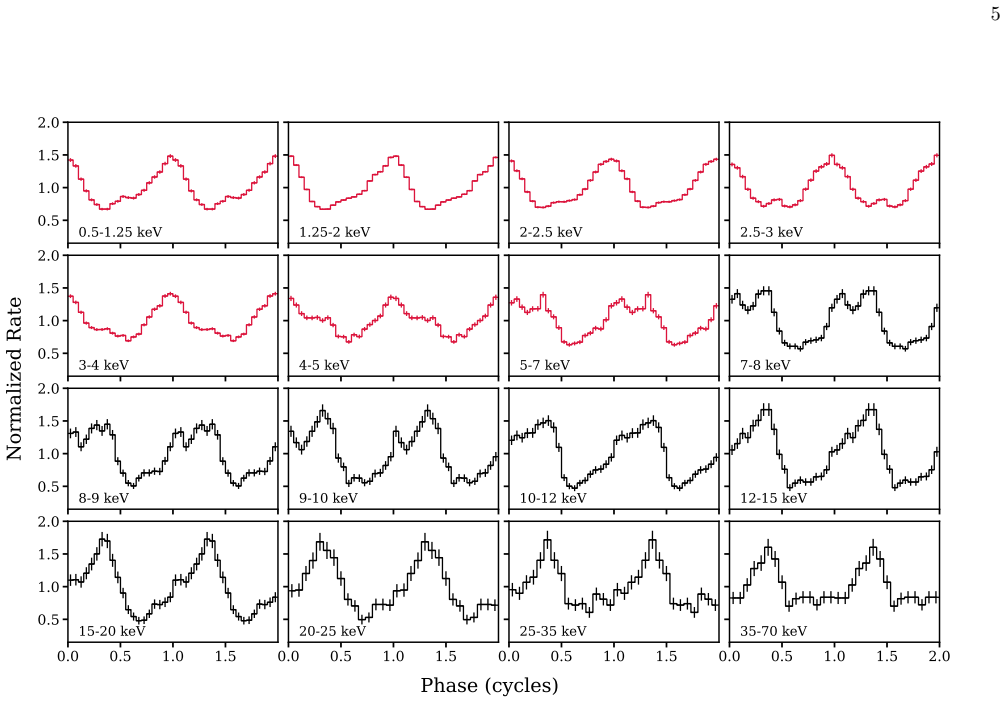
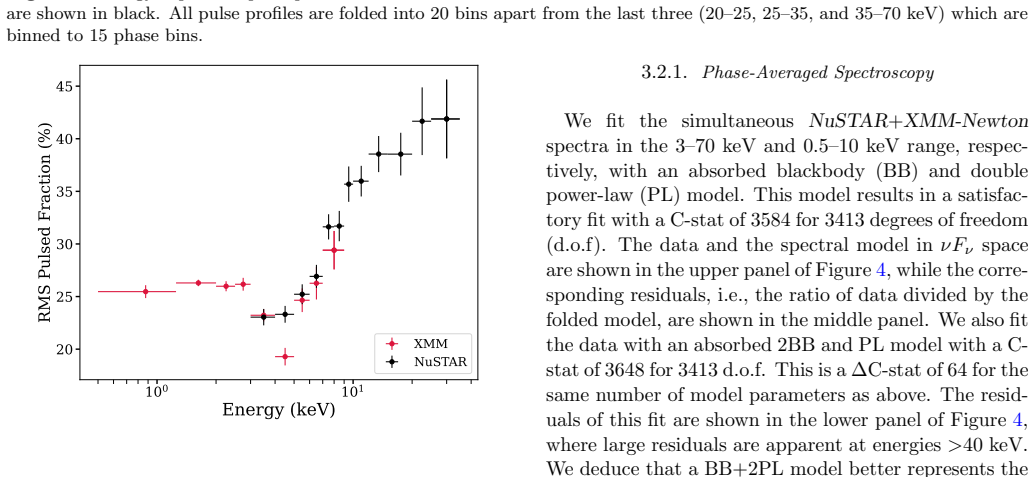
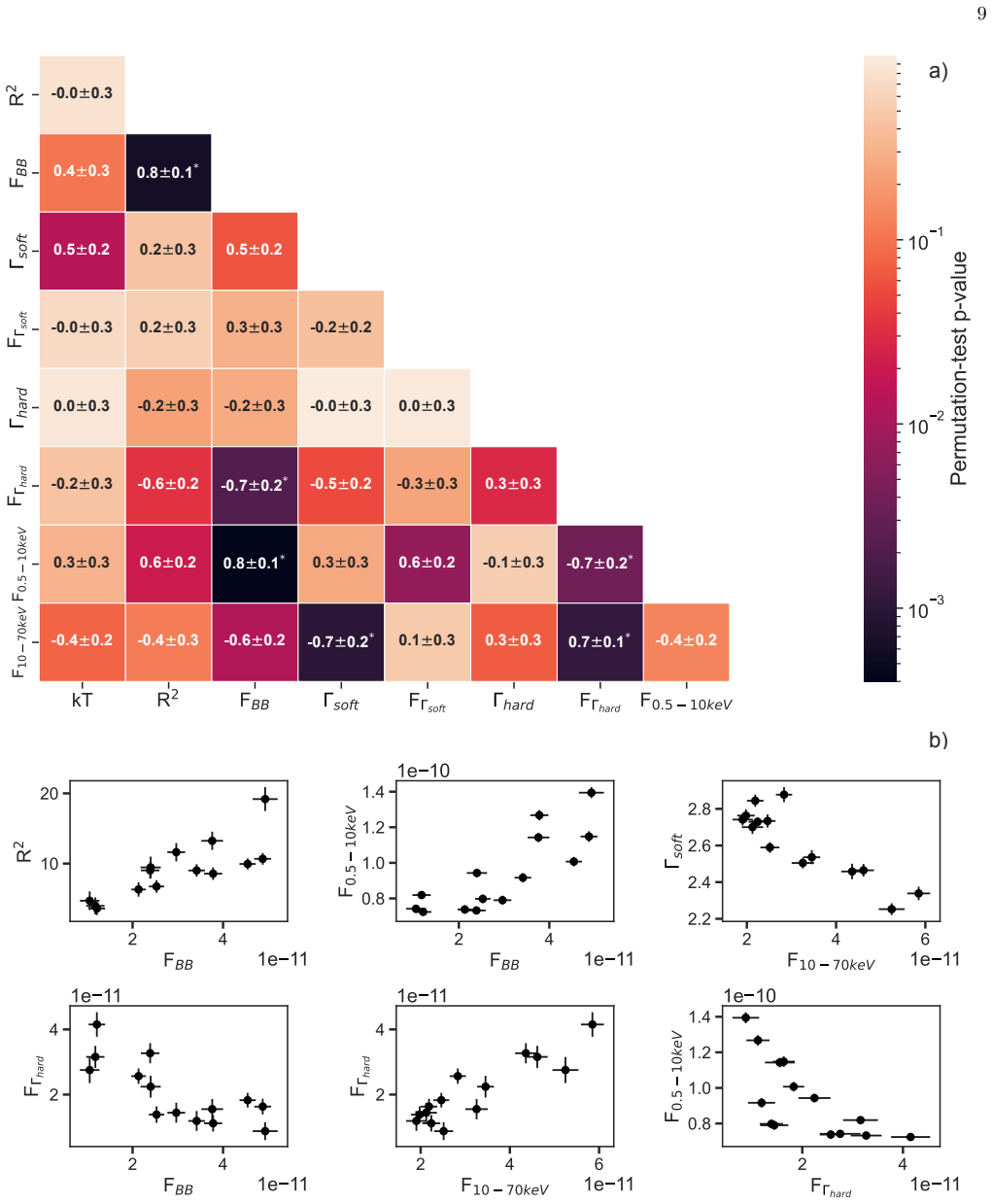
We present a broadband timing, spectral, and polarimetric study of the magnetar 1RXS~J170849.0-400910 using XMM-Newton, NuSTAR, and IXPE. The pulse morphology evolves strongly across 0.5-70 keV. Below 3 keV, the emission is dominated by a broad soft pulse with a leading shoulder that develops into a faint interpulse near 3 keV, while the pulse fraction remains $\approx$25%. The profile becomes increasingly double-peaked between 3 and 20 keV and returns to a single peak at higher energies. The pulse fraction dips to $\sim$20% near 4 keV and rises to $\sim$42% above 25 keV. The phase-averaged spectrum is well described by an absorbed blackbody plus two power-laws, with $kT=0.468\pm0.003$ keV, $\Gamma_{\rm soft}=2.63\pm0.04$, and $\Gamma_{\rm hard}=0.5\pm0.1$. Phase-resolved spectroscopy reveals distinct soft and hard pulse components. The thermal modulation is driven primarily by a factor of $\sim$5 variation in projected emitting area, whereas the soft power-law exhibits two peaks with different phase and energy evolution, suggesting distinct emission regions or mechanisms. The 10-70 keV flux is strongly anticorrelated with the soft power-law photon index, linking spectral hardening to the hard pulse. The polarization degree also varies strongly with phase and energy. In the 2-3 keV band, it is anticorrelated with the intensity profile, consistent with magnetized-atmosphere emission, whereas in the 4-8 keV band it reaches $64\pm10$% during the nonthermal power-law-dominated peak. This high polarization can be reproduced by magnetospheric quantum pair-synchrotron emission. Together, these results reveal an intricate, phase-dependent superposition of emitting regions and radiative processes whose complexity emerges only through broadband, phase-resolved spectropolarimetry.
Editorial analysis
A structured set of objections, weighed in public.
Referee Report
Summary. The paper presents a broadband timing, spectral, and polarimetric analysis of magnetar 1RXS J170849.0-400910 using XMM-Newton, NuSTAR, and IXPE observations. It reports strong energy-dependent evolution of the pulse profile (broad soft pulse below 3 keV transitioning to double-peaked between 3-20 keV and single-peaked above), with pulse fractions varying from ~20% near 4 keV to ~42% above 25 keV. The phase-averaged spectrum is fit by an absorbed blackbody plus two power laws (kT=0.468±0.003 keV, Γ_soft=2.63±0.04, Γ_hard=0.5±0.1). Phase-resolved spectroscopy shows distinct soft and hard pulse components, with thermal emission varying mainly in projected area and the 10-70 keV flux anticorrelated with the soft power-law index. Polarization degree varies with phase and energy, reaching 64±10% in the 4-8 keV band during the nonthermal peak, which is attributed to magnetospheric quantum pair-synchrotron emission. The central claim is that these data reveal an intricate phase-dependent superposition of emitting regions and processes.
Significance. If the two-power-law decomposition and polarization attribution are robust, the work demonstrates the diagnostic power of broadband phase-resolved spectropolarimetry for magnetar emission, linking specific polarization signatures to quantum pair-synchrotron processes and highlighting distinct soft/hard components. The multi-instrument dataset and detailed phase-energy mapping are clear strengths that advance understanding of magnetar radiative mechanisms beyond single-instrument studies.
major comments (2)
- [phase-averaged spectrum] Phase-averaged spectrum description: The absorbed blackbody plus two power-laws model (with reported parameters kT=0.468 keV, Γ_soft=2.63, Γ_hard=0.5) is presented as well-describing the data, but no χ² values, degrees of freedom, or comparisons to alternative models (such as blackbody plus cutoff power-law or resonant Compton scattering) are provided. This is load-bearing for the claim that the decomposition cleanly isolates the non-thermal component responsible for the 64% polarization peak in 4-8 keV without cross-contamination.
- [polarization results] Polarization results paragraph: The attribution of the 64±10% polarization degree in the 4-8 keV band to magnetospheric quantum pair-synchrotron emission from the hard power-law component rests on the assumption that the two-PL model uniquely separates components, yet no polarization transfer calculations, alternative decomposition tests, or explicit checks that other models fail to reproduce the observed PD and phase-energy evolution are shown.
minor comments (1)
- [abstract] The abstract states the pulse fraction remains ≈25% below 3 keV but does not explicitly specify the exact energy band or reference the corresponding figure/table for this value.
Simulated Author's Rebuttal
We thank the referee for their thorough review and insightful comments on our manuscript. We address each major comment below with point-by-point responses and indicate where revisions have been made to strengthen the presentation.
read point-by-point responses
-
Referee: [phase-averaged spectrum] Phase-averaged spectrum description: The absorbed blackbody plus two power-laws model (with reported parameters kT=0.468 keV, Γ_soft=2.63, Γ_hard=0.5) is presented as well-describing the data, but no χ² values, degrees of freedom, or comparisons to alternative models (such as blackbody plus cutoff power-law or resonant Compton scattering) are provided. This is load-bearing for the claim that the decomposition cleanly isolates the non-thermal component responsible for the 64% polarization peak in 4-8 keV without cross-contamination.
Authors: We agree that explicit reporting of fit statistics and model comparisons strengthens the manuscript. In the revised version, we now include the χ²/dof for the phase-averaged fit and direct comparisons to a blackbody plus cutoff power-law model as well as resonant Compton scattering models from the literature. These show that the two power-law decomposition remains preferred and supports the separation of components used in the polarization analysis. revision: yes
-
Referee: [polarization results] Polarization results paragraph: The attribution of the 64±10% polarization degree in the 4-8 keV band to magnetospheric quantum pair-synchrotron emission from the hard power-law component rests on the assumption that the two-PL model uniquely separates components, yet no polarization transfer calculations, alternative decomposition tests, or explicit checks that other models fail to reproduce the observed PD and phase-energy evolution are shown.
Authors: The attribution is observationally grounded in the precise phase and energy coincidence between the 64% PD peak and the hard power-law dominance, as established by the phase-resolved spectroscopy. While new polarization transfer calculations are not performed here (as this is an observational study), the measured PD and its variation are consistent with existing theoretical predictions for quantum pair-synchrotron emission in magnetar magnetospheres. We have expanded the discussion to reference these models and to note that alternative single-component decompositions cannot reproduce the observed pulse-profile evolution or the reported flux-index anticorrelation. Full radiative-transfer simulations for this specific source geometry lie beyond the scope of the present work. revision: no
Circularity Check
No significant circularity; results are direct observational fits and measurements
full rationale
The paper reports timing, spectral fitting (absorbed BB + two power-laws with explicit parameters kT=0.468 keV, Γ_soft=2.63, Γ_hard=0.5), phase-resolved spectroscopy, and polarization degree measurements (e.g., 64±10% in 4-8 keV) directly from XMM-Newton, NuSTAR, and IXPE data. The statement that high polarization 'can be reproduced by magnetospheric quantum pair-synchrotron emission' is a consistency note, not a derivation that reduces by the paper's own equations to quantities defined by the same fitted parameters. No self-definitional loops, fitted inputs renamed as predictions, or load-bearing self-citations appear in the abstract or described chain. The central claim of phase-dependent superposition emerges from the data analysis itself and remains self-contained against external benchmarks.
Axiom & Free-Parameter Ledger
free parameters (3)
- kT =
0.468 keV
- Gamma_soft =
2.63
- Gamma_hard =
0.5
axioms (2)
- domain assumption An absorbed blackbody plus two power-laws adequately describes the phase-averaged spectrum
- domain assumption Polarization degree measurements can be directly compared to magnetized-atmosphere and pair-synchrotron models
Reference graph
Works this paper leans on
-
[1]
Albano, A., Turolla, R., Israel, G. L., et al. 2010, ApJ, 722, 788, doi: 10.1088/0004-637X/722/1/788 3.4.1, 5.1
-
[2]
Arnaud, K. A. 1996, in Astronomical Society of the Pacific Conference Series, Vol. 101, Astronomical Data Analysis Software and Systems V, ed. G. H. Jacoby & J. Barnes, 17 3.2, 7 Astropy Collaboration, Robitaille, T. P., Tollerud, E. J., et al. 2013, A&A, 558, A33, doi: 10.1051/0004-6361/201322068 7
-
[3]
arXiv , author =:2203.06384 , journal =
Baldini, L., Bucciantini, N., Lalla, N. D., et al. 2022a, SoftwareX, 19, 101194, doi: 10.1016/j.softx.2022.101194 2.3, 7 —. 2022b, SoftwareX, 19, 101194, doi: 10.1016/j.softx.2022.101194 2.3, 3.3
-
[4]
Barchas, J. A., Hu, K., & Baring, M. G. 2021, MNRAS, 500, 5369, doi: 10.1093/mnras/staa3541 3.4.1
-
[5]
Baring, M. G., & Harding, A. K. 2007, Ap&SS, 308, 109, doi: 10.1007/s10509-007-9326-x 5.3
-
[6]
G., Wadiasingh, Z., & Gonthier, P
Baring, M. G., Wadiasingh, Z., & Gonthier, P. L. 2011, ApJ, 733, 61, doi: 10.1088/0004-637X/733/1/61 5.3
-
[7]
Beloborodov, A. M. 2009, ApJ, 703, 1044, doi: 10.1088/0004-637X/703/1/1044 5.1 —. 2013, ApJ, 762, 13, doi: 10.1088/0004-637X/762/1/13 5.3
-
[8]
Bernardini, F., Perna, R., Gotthelf, E. V., et al. 2011, MNRAS, 418, 638, doi: 10.1111/j.1365-2966.2011.19513.x 3.4.1, 5.1 den Hartog, P. R., Kuiper, L., & Hermsen, W. 2008a, A&A, 489, 263, doi: 10.1051/0004-6361:200809772 1, 4, 5.3 den Hartog, P. R., Kuiper, L., Hermsen, W., et al. 2008b, A&A, 489, 245, doi: 10.1051/0004-6361:200809390 5.3
-
[9]
Dib, R., & Kaspi, V. M. 2014, ApJ, 784, 37, doi: 10.1088/0004-637X/784/1/37 1, 3.1, 4 Dinh Thi, H., Baring, M. G., Hu, K., Harding, A. K., &
-
[10]
Barchas, J. A. 2025, ApJ, 992, 188, doi: 10.3847/1538-4357/adf742 3.4.1 Dinh Thi, H., Baring, M. G., Hu, K., et al. 2026, ApJ, 1000, 73, doi: 10.3847/1538-4357/ae313c 3.4.1
-
[11]
Duncan, R. C., & Thompson, C. 1992, ApJL, 392, L9, doi: 10.1086/186413 1
-
[12]
Durant, M., & van Kerkwijk, M. H. 2006, ApJ, 650, 1070, doi: 10.1086/506380 3.2.1, 3.2.2, 4 Fern´ andez, R., & Thompson, C. 2007, ApJ, 660, 615, doi: 10.1086/511810 5.2
-
[13]
Gavriil, F. P., & Kaspi, V. M. 2002, ApJ, 567, 1067, doi: 10.1086/338698 1
-
[14]
Gourgouliatos, K. N., Wood, T. S., & Hollerbach, R. 2016, Proceedings of the National Academy of Science, 113, 3944, doi: 10.1073/pnas.1522363113 5.1
-
[15]
Harding, A. K., & Lai, D. 2006, Reports on Progress in Physics, 69, 2631, doi: 10.1088/0034-4885/69/9/R03 1, 5.2
-
[16]
K., Wadiasingh, Z., & Baring, M
Harding, A. K., Wadiasingh, Z., & Baring, M. G. 2025, ApJ, 991, 178, doi: 10.3847/1538-4357/adfa06 3.4.2, 5.3
-
[17]
, archivePrefix = "arXiv", eprint =
Harrison, F. A., Craig, W. W., Christensen, F. E., et al. 2013, ApJ, 770, 103, doi: 10.1088/0004-637X/770/2/103 2.1
-
[18]
2024, MNRAS, 527, 12219, doi: 10.1093/mnras/stad3680 5.4 22
Heyl, J., Taverna, R., Turolla, R., et al. 2024, MNRAS, 527, 12219, doi: 10.1093/mnras/stad3680 5.4 22
-
[19]
Heyl, J. S., & Shaviv, N. J. 2000, MNRAS, 311, 555, doi: 10.1046/j.1365-8711.2000.03076.x 1, 3.4.1 —. 2002, PhRvD, 66, 023002, doi: 10.1103/PhysRevD.66.023002 1, 3.4.1
-
[20]
Hu, K., Baring, M. G., Barchas, J. A., & Younes, G. 2022, ApJ, 928, 82, doi: 10.3847/1538-4357/ac4ae8 3.4.1
-
[21]
2001, ApJL, 560, L65, doi: 10.1086/324169 4
Israel, G., Oosterbroek, T., Stella, L., et al. 2001, ApJL, 560, L65, doi: 10.1086/324169 4
-
[22]
L., Covino, S., Stella, L., et al
Israel, G. L., Covino, S., Stella, L., et al. 1999, ApJL, 518, L107, doi: 10.1086/312077 1
-
[23]
L., Covino, S., Perna, R., et al
Israel, G. L., Covino, S., Perna, R., et al. 2003, ApJL, 589, L93, doi: 10.1086/375832 3.1
-
[24]
2001, A&A, 365, L1, doi: 10.1051/0004-6361:20000036
Jansen, F., Lumb, D., Altieri, B., et al. 2001, A&A, 365, L1, doi: 10.1051/0004-6361:20000036 2.2
-
[25]
Kaspi, V. M., & Beloborodov, A. M. 2017, ARA&A, 55, 261, doi: 10.1146/annurev-astro-081915-023329 1
-
[26]
Kelly, R. M. E., Zane, S., Turolla, R., & Taverna, R. 2024, MNRAS, 528, 3927, doi: 10.1093/mnras/stae159 3.4.1
-
[27]
1998, Nature, 393, 235, doi: 10.1038/30410 1
Kouveliotou, C., Dieters, S., Strohmayer, T., et al. 1998, Nature, 393, 235, doi: 10.1038/30410 1
-
[28]
Kuiper, L., Hermsen, W., den Hartog, P. R., & Collmar, W. 2006, ApJ, 645, 556, doi: 10.1086/504317 1
-
[29]
2023, PNAS, 120, e2216534120, doi: 10.1073/pnas.2216534120 3.4.1
Lai, D. 2023, PNAS, 120, e2216534120, doi: 10.1073/pnas.2216534120 3.4.1
-
[30]
Lai, D., & Ho, W. C. 2003a, Physical Review Letters, 91, 071101, doi: 10.1103/PhysRevLett.91.071101 3.4.1
-
[31]
Lai, D., & Ho, W. C. G. 2003b, ApJ, 588, 962, doi: 10.1086/374334 3.4.1
-
[32]
Laken, B. A., & ˇCalogovi´ c, J. 2013, Journal of Space Weather and Space Climate, 3, A29, doi: 10.1051/swsc/2013051 3.2.2
-
[33]
Lyutikov, M., & Gavriil, F. P. 2006, MNRAS, 368, 690, doi: 10.1111/j.1365-2966.2006.10140.x 5.2
-
[34]
K., Forster, K., Grefenstette, B., Harrison, F
Madsen, K. K., Forster, K., Grefenstette, B., Harrison, F. A., & Miyasaka, H. 2022, Journal of Astronomical
2022
-
[35]
Telescopes, Instruments, and Systems, 8, 034003, doi: 10.1117/1.JATIS.8.3.034003 3.2
-
[36]
Nobili, L., Turolla, R., & Zane, S. 2008, MNRAS, 386, 1527, doi: 10.1111/j.1365-2966.2008.13125.x 5.2
-
[37]
2001, ApJ, 557, 18, doi: 10.1086/321569 4
Chakrabarty, D. 2001, ApJ, 557, 18, doi: 10.1086/321569 4
-
[38]
Revnivtsev, M. G., Sunyaev, R. A., Varshalovich, D. A., et al. 2004, Astronomy Letters, 30, 382, doi: 10.1134/1.1764884 1
-
[39]
2025, ApJL, 985, L34, doi: 10.3847/2041-8213/adbffb 5.4
Rigoselli, M., Taverna, R., Mereghetti, S., et al. 2025, ApJL, 985, L34, doi: 10.3847/2041-8213/adbffb 5.4
-
[40]
Scholz, P., Archibald, R. F., Kaspi, V. M., et al. 2014, ApJ, 783, 99, doi: 10.1088/0004-637X/783/2/99 3.3, 4
-
[41]
Stewart, R., Younes, G. A., Harding, A. K., et al. 2025, ApJL, 985, L35, doi: 10.3847/2041-8213/adbffa 5.4
-
[42]
1997, IAUC, 6585, 2 1
Sugizaki, M., Nagase, F., Yamauchi, S., et al. 1997, IAUC, 6585, 2 1
1997
-
[43]
2024, Galaxies, 12, 6, doi: 10.3390/galaxies12010006 1, 5.2
Taverna, R., & Turolla, R. 2024, Galaxies, 12, 6, doi: 10.3390/galaxies12010006 1, 5.2
-
[44]
Thompson, C., & Beloborodov, A. M. 2005, ApJ, 634, 565, doi: 10.1086/432245 5.3
-
[45]
Thompson, C., & Duncan, R. C. 1993, ApJ, 408, 194, doi: 10.1086/172580 1 —. 1996, ApJ, 473, 322, doi: 10.1086/178147 5.1
-
[46]
Thompson, C., Lyutikov, M., & Kulkarni, S. R. 2002, ApJ, 574, 332, doi: 10.1086/340586 5.2
-
[47]
2023, PoS, ICRC2023, 745, doi: 10.22323/1.444.0745 5.3
Tomsick, J., Boggs, S., Zoglauer, A., et al. 2023, PoS, ICRC2023, 745, doi: 10.22323/1.444.0745 5.3
-
[48]
Turolla, R., Zane, S., & Watts, A. L. 2015, Reports on Progress in Physics, 78, 116901, doi: 10.1088/0034-4885/78/11/116901 1
-
[49]
Verner, D. A., Ferland, G. J., Korista, K. T., & Yakovlev, D. G. 1996, ApJ, 465, 487, doi: 10.1086/177435 3.2 Vigan` o, D., Rea, N., Pons, J. A., et al. 2013, MNRAS, 434, 123, doi: 10.1093/mnras/stt1008 4, 5.1
work page internal anchor Pith review doi:10.1086/177435 1996
-
[50]
1996, in Roentgenstrahlung from the Universe, ed
Voges, W., Boller, T., Dennerl, K., et al. 1996, in Roentgenstrahlung from the Universe, ed. H. U
1996
-
[51]
2022, in AAS/High Energy Astrophysics Division, Vol
Wadiasingh, Z., Baring, M., Hu, K., et al. 2022, in AAS/High Energy Astrophysics Division, Vol. 19, AAS/High Energy Astrophysics Division, 110.47 5.3
2022
-
[52]
Wadiasingh, Z., Baring, M. G., Gonthier, P. L., & Harding, A. K. 2018, ApJ, 854, 98, doi: 10.3847/1538-4357/aaa460 3.4.2, 5.3
-
[53]
Wadiasingh, Z., Younes, G., Baring, M. G., et al. 2019, BAAS, 51, 292, doi: 10.48550/arXiv.1903.05648 5.3
work page internal anchor Pith review Pith/arXiv arXiv doi:10.48550/arxiv.1903.05648 2019
-
[54]
The Imaging X-Ray Polarimetry Explorer (IXPE): Pre-Launch.J
Weisskopf, M. C., Soffitta, P., Baldini, L., et al. 2022, Journal of Astronomical Telescopes, Instruments, and Systems, 8, 026002, doi: 10.1117/1.JATIS.8.2.026002 2.3
-
[55]
2000, ApJ, 542, 914, doi: 10.1086/317016
Wilms, J., Allen, A., & McCray, R. 2000, ApJ, 542, 914, doi: 10.1086/317016 3.2
work page internal anchor Pith review doi:10.1086/317016 2000
-
[56]
Younes, G., Baring, M. G., Kouveliotou, C., et al. 2020, ApJL, 889, L27, doi: 10.3847/2041-8213/ab629f 2.1, 3.4.1
-
[57]
2023, ApJL, 944, L27, doi: 10.3847/2041-8213/acb703 1, 3.3, 3.3, 4, 5.4
Zane, S., Taverna, R., Gonz´ alez-Caniulef, D., et al. 2023, ApJL, 944, L27, doi: 10.3847/2041-8213/acb703 1, 3.3, 3.3, 4, 5.4
-
[58]
2019, Science China Physics, Mechanics, and Astronomy, 62, 29502, doi: 10.1007/s11433-018-9309-2 6
Zhang, S., Santangelo, A., Feroci, M., et al. 2019, Science China Physics, Mechanics, and Astronomy, 62, 29502, doi: 10.1007/s11433-018-9309-2 6
discussion (0)
Sign in with ORCID, Apple, or X to comment. Anyone can read and Pith papers without signing in.