ComPart: Community-Guided Post-Coarsening for High-Quality Hypergraph Partitioning
Pith reviewed 2026-06-26 21:50 UTC · model grok-4.3
The pith
ComPart integrates community detection after coarsening to guide refinements and improve hypergraph partition quality.
A machine-rendered reading of the paper's core claim, the machinery that carries it, and where it could break.
Core claim
ComPart establishes a new paradigm that leverages community structures detected during uncoarsening to escape local optima and explore globally meaningful solution subspaces, while generalizing locally-dense decomposition to the hypergraph domain to guide initial partitioning, and experimental results on standard benchmarks show consistent outperformance of state-of-the-art methods.
What carries the argument
The ComPart framework that detects community structures in post-coarsening phases to provide structural guidance for refinement and initial partitioning.
If this is right
- Community structures from uncoarsening enable escape from local optima beyond standard local refinements.
- The framework flexibly accommodates both existing and future community detection methods.
- The generalized locally-dense decomposition guides initial partitioning toward superior starting points.
- The approach yields higher-quality partitions on standard benchmarks compared to prior methods.
Where Pith is reading between the lines
- The post-coarsening guidance idea could extend to other multilevel optimization problems that use coarsening-uncoarsening cycles.
- Different community detectors might be paired with specific hypergraph types to further tune partition quality.
- The method's emphasis on global subspaces suggests potential for hybrid approaches combining it with global search techniques.
Load-bearing premise
Community structures detected by arbitrary methods during uncoarsening reliably improve global partition quality without introducing bias or excessive computation.
What would settle it
If experiments on standard hypergraph benchmarks show no consistent quality improvement over existing methods, or if the hypergraph extension of locally-dense decomposition fails to yield better starting points, the central claims would not hold.
Figures


read the original abstract
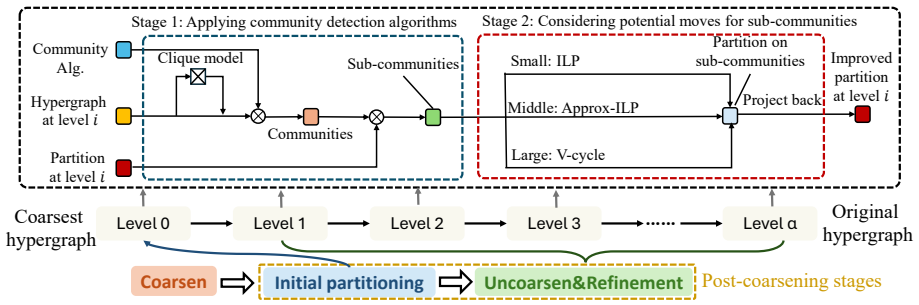
Hypergraph partitioning is a critical step in the design of complex embedded systems, essential for optimizing task mapping on heterogeneous MPSoCs and enabling multi-FPGA prototyping. Many existing methods rely on community detection to identify modules with dense internal and sparse external connections, typically utilizing them to constrain the coarsening phase--a widely adopted paradigm. In this work, we propose ComPart, a generalized framework that integrates diverse community detection methods to uncover high-quality clusterings throughout the post-coarsening stages (i.e., initial partitioning and uncoarsening). These discovered clusterings serve as distinct structural guides, enabling the refinement process to identify superior partitioning solutions. Our framework offers two key advantages: (1) it establishes a new paradigm that leverages community structures detected during uncoarsening to escape local optima and explore globally meaningful solution subspaces, transcending the limitations of standard local refinements; and (2) it flexibly accommodates both existing and future community detection methods. Furthermore, we theoretically generalize locally-dense decomposition--originally from graphs--to the hypergraph domain. We provide the formal extension and necessary proofs to apply this technique to hypergraphs, marking its first application in hypergraph partitioning. Specifically, we utilize this rigorously derived decomposition to guide the initial partitioning phase toward superior starting points. Experimental results on standard benchmarks demonstrate that our method consistently outperforms state-of-the-art methods in solution quality.
Editorial analysis
A structured set of objections, weighed in public.
Referee Report
Summary. The paper proposes ComPart, a generalized framework for hypergraph partitioning that applies community detection methods during post-coarsening stages (initial partitioning and uncoarsening) to provide structural guidance for refinement, thereby escaping local optima. It also presents a formal generalization of locally-dense decomposition from graphs to hypergraphs, including proofs, and uses this to guide initial partitioning. Experiments on standard benchmarks claim consistent quality improvements over state-of-the-art methods for applications such as MPSoC task mapping and multi-FPGA prototyping.
Significance. If the central claims hold, the work introduces a new paradigm for leveraging community structures in uncoarsening to improve global partition quality beyond standard local search, with potential impact on embedded system design. The theoretical generalization of locally-dense decomposition to hypergraphs, with provided proofs and first application to partitioning, represents a clear methodological contribution that could be adopted by future methods.
major comments (2)
- [§5] §5 (Experimental Results): The manuscript reports consistent outperformance over SOTA but does not describe an ablation that disables only the community-guided refinement component during uncoarsening while holding fixed the generalized locally-dense decomposition, coarsening, and other refinements. Without this isolation, it is impossible to verify that the reported quality gains are driven by the claimed new paradigm rather than by the initial-partitioning step or implementation details.
- [§3, §4] §3 (Framework Description) and §4 (Theoretical Generalization): The central claim that community structures detected by arbitrary methods during uncoarsening reliably improve global quality without introducing bias rests on the assumption that these structures provide structural guidance superior to standard local refinements; however, no quantitative analysis or counterexample analysis is provided to bound the conditions under which this holds.
minor comments (1)
- The abstract and introduction would benefit from explicit citation of the specific community detection methods tested and the hypergraph benchmarks used, to allow immediate reproducibility assessment.
Simulated Author's Rebuttal
We thank the referee for the constructive feedback highlighting the need for clearer isolation of contributions and analysis of conditions for the community-guided approach. We address each major comment below and will incorporate revisions to strengthen the manuscript.
read point-by-point responses
-
Referee: [§5] §5 (Experimental Results): The manuscript reports consistent outperformance over SOTA but does not describe an ablation that disables only the community-guided refinement component during uncoarsening while holding fixed the generalized locally-dense decomposition, coarsening, and other refinements. Without this isolation, it is impossible to verify that the reported quality gains are driven by the claimed new paradigm rather than by the initial-partitioning step or implementation details.
Authors: We agree that isolating the effect of community-guided refinement specifically during uncoarsening is important to attribute gains to the proposed paradigm. In the revised manuscript, we will add an ablation study comparing the full ComPart framework against a variant that disables community detection only in the uncoarsening phase (while retaining the generalized locally-dense decomposition for initial partitioning, the same coarsening, and other refinements). This will be presented in §5 with quantitative results on the benchmarks to verify the contribution. revision: yes
-
Referee: [§3, §4] §3 (Framework Description) and §4 (Theoretical Generalization): The central claim that community structures detected by arbitrary methods during uncoarsening reliably improve global quality without introducing bias rests on the assumption that these structures provide structural guidance superior to standard local refinements; however, no quantitative analysis or counterexample analysis is provided to bound the conditions under which this holds.
Authors: The experimental results across standard benchmarks demonstrate consistent quality improvements, supporting that the detected community structures provide effective guidance in practice. However, we acknowledge the value of explicit analysis to bound the conditions. In the revision, we will expand §3 and §4 with a discussion of the conditions under which the approach is expected to hold, drawing on the properties proven in the generalization of locally-dense decomposition, and include a brief analysis of potential edge cases or limitations based on hypergraph density and community detection method characteristics. revision: yes
Circularity Check
No circularity in claimed derivations or generalizations
full rationale
The paper introduces a framework integrating community detection post-coarsening and provides formal proofs for generalizing locally-dense decomposition from graphs to hypergraphs as its first hypergraph application. No equations, predictions, or central claims reduce by construction to fitted parameters, self-definitions, or load-bearing self-citations. The advantages are framed as a new paradigm accommodating external methods, with the derivation chain remaining self-contained against external benchmarks and independent proofs.
Axiom & Free-Parameter Ledger
Reference graph
Works this paper leans on
-
[1]
Utku Umur Acikalin and Bugra Caskurlu. 2022. Multilevel memetic hyper- graph partitioning with greedy recombination. InProceedings of the Genetic and Evolutionary Computation Conference Companion. 168–171
2022
-
[2]
Ali Aghdaei and Zhuo Feng. 2022. HyperEF: Spectral hypergraph coarsening by effective-resistance clustering. InProceedings of the 41st IEEE/ACM International Conference on Computer-Aided Design. 1–9
2022
-
[3]
Robin Andre, Sebastian Schlag, and Christian Schulz. 2018. Memetic multi- level hypergraph partitioning. InProceedings of the Genetic and Evolutionary Computation Conference. 347–354
2018
-
[4]
Vincent D Blondel, Jean-Loup Guillaume, Renaud Lambiotte, and Etienne Lefeb- vre. 2008. Fast unfolding of communities in large networks.Journal of statistical mechanics: theory and experiment2008, 10 (2008), P10008
2008
-
[5]
2004.Convex optimization
Stephen Boyd and Lieven Vandenberghe. 2004.Convex optimization. Cambridge university press
2004
-
[6]
Ismail Bustany, Andrew B Kahng, Ioannis Koutis, Bodhisatta Pramanik, and Zhiang Wang. 2022. SpecPart: A supervised spectral framework for hyper- graph partitioning solution improvement. InProceedings of the 41st IEEE/ACM International Conference on Computer-Aided Design. 1–9
2022
-
[7]
Ismail Bustany, Andrew B Kahng, Ioannis Koutis, Bodhisatta Pramanik, and Zhiang Wang. 2023. K-SpecPart: Supervised embedding algorithms and cut overlay for improved hypergraph partitioning.IEEE Transactions on Computer- Aided Design of Integrated Circuits and Systems43, 4 (2023), 1232–1245
2023
-
[8]
Ümit V Çatalyürek and Cevdet Aykanat. 2011. PaToH (Partitioning Tool for Hypergraphs)
2011
-
[9]
Magi Chen and Ting-Chi Wang. 2024. A Hypergraph Partitioner Utilizing a Novel Graph Generative Model. InProceedings of the 43rd IEEE/ACM International Conference on Computer-Aided Design. 1–9
2024
-
[10]
Aaron Clauset, Mark EJ Newman, and Cristopher Moore. 2004. Finding commu- nity structure in very large networks.Physical Review E—Statistical, Nonlinear, and Soft Matter Physics70, 6 (2004), 066111
2004
-
[11]
Maximilien Danisch, T-H Hubert Chan, and Mauro Sozio. 2017. Large scale density-friendly graph decomposition via convex programming. InProceedings of the 26th International Conference on World Wide Web. 233–242
2017
-
[12]
Robert P Dick, David L Rhodes, and Wayne Wolf. 1998. TGFF: task graphs for free. InProceedings of the Sixth International Workshop on Hardware/Software Codesign.(CODES/CASHE’98). IEEE, 97–101
1998
-
[13]
Charles M Fiduccia and Robert M Mattheyses. 1988. A linear-time heuristic for improving network partitions. InPapers on Twenty-five years of electronic design automation. 241–247
1988
-
[14]
Lars Gottesbüren, Michael Hamann, and Dorothea Wagner. 2019. Evaluation of a flow-based hypergraph bipartitioning algorithm.arXiv preprint arXiv:1907.02053 (2019)
work page internal anchor Pith review Pith/arXiv arXiv 2019
-
[15]
2018.Kronecker products and matrix calculus with applications
Alexander Graham. 2018.Kronecker products and matrix calculus with applications. Courier Dover Publications
2018
-
[16]
2015.Engineering initial partitioning algorithms for direct k-way hypergraph partitioning
Tobias Heuer. 2015.Engineering initial partitioning algorithms for direct k-way hypergraph partitioning. Ph. D. Dissertation. Karlsruher Institut für Technologie (KIT)
2015
-
[17]
George Karypis, Rajat Aggarwal, Vipin Kumar, and Shashi Shekhar. 1997. Multi- level hypergraph partitioning: Application in VLSI domain. InProceedings of the 34th annual Design Automation Conference. 526–529
1997
-
[18]
Brian W Kernighan and Shen Lin. 1970. An efficient heuristic procedure for partitioning graphs.The Bell system technical journal49, 2 (1970), 291–307
1970
-
[19]
Benzheng Li, Shunyang Bi, Hailong You, Zhongdong Qi, Guangxin Guo, Richard Sun, and Yuming Zhang. 2024. MaPart: An Efficient Multi-FPGA System-Aware Hypergraph Partitioning Framework.IEEE Transactions on Computer-Aided Design of Integrated Circuits and Systems43, 10 (2024), 3212–3225
2024
-
[20]
Rongjian Liang, Anthony Agnesina, and Haoxing Ren. 2024. Medpart: A multi- level evolutionary differentiable hypergraph partitioner. InProceedings of the 2024 International Symposium on Physical Design. 3–11
2024
-
[21]
Pascal Pons and Matthieu Latapy. 2005. Computing communities in large net- works using random walks. InInternational symposium on computer and infor- mation sciences. Springer, 284–293
2005
-
[22]
Merten Popp, Sebastian Schlag, Christian Schulz, and Daniel Seemaier. 2021. Multilevel Acyclic Hypergraph Partitioning. In2021 Proceedings of the Workshop on Algorithm Engineering and Experiments (ALENEX). SIAM, 1–15
2021
-
[23]
Usha Nandini Raghavan, Réka Albert, and Soundar Kumara. 2007. Near linear time algorithm to detect community structures in large-scale networks.Physical Review E—Statistical, Nonlinear, and Soft Matter Physics76, 3 (2007), 036106
2007
-
[24]
Hamed Sajadinia, Ali Aghdaei, and Zhuo Feng. 2025. SHyPar: A Spectral Coarsen- ing Approach to Hypergraph Partitioning.IEEE Transactions on Computer-Aided Design of Integrated Circuits and Systems(2025)
2025
-
[25]
Sebastian Schlag, Tobias Heuer, Lars Gottesbüren, Yaroslav Akhremtsev, Chris- tian Schulz, and Peter Sanders. 2023. High-quality hypergraph partitioning.ACM Journal of Experimental Algorithmics27 (2023), 1–39
2023
-
[26]
Shengbo Tong, Haoyuan Li, Jiahao Xu, Chunyan Pei, Wenjian Yu, Shengjun Liu, and Jian Shen. 2024. EasyPart: An effective and comprehensive hypergraph partitioner for FPGA-based emulation. InProceedings of the 43rd IEEE/ACM International Conference on Computer-Aided Design. 1–9
2024
-
[27]
Wayne Wolf, Ahmed Amine Jerraya, and Grant Martin. 2008. Multiprocessor system-on-chip (MPSoC) technology.IEEE transactions on computer-aided design of integrated circuits and systems27, 10 (2008), 1701–1713
2008
- [28]
discussion (0)
Sign in with ORCID, Apple, or X to comment. Anyone can read and Pith papers without signing in.