Spatial and Temporal Generalization of CSI-based Neural Positioning
Pith reviewed 2026-06-26 22:45 UTC · model grok-4.3
The pith
Neural networks map CSI measurements to positions and generalize to unseen spaces and times one week apart, with a transformer outperforming MLPs at lower parameter count.
A machine-rendered reading of the paper's core claim, the machinery that carries it, and where it could break.
Core claim
CSI-based neural positioning learns a mapping from CSI measurements to UE positions using neural networks. Most existing evaluations rely on randomly partitioned train/test splits that do not reflect practical generalization requirements. On three real-world CSI datasets from indoor and outdoor environments acquired with standard-compliant Wi-Fi and 5G NR systems, both an MLP and a novel transformer architecture generalize well to unseen spatial regions, unseen UE trajectories, and CSI measurement campaigns separated by one week. The transformer consistently outperforms the MLP in positioning accuracy while requiring fewer model parameters.
What carries the argument
Transformer architecture for mapping CSI measurements to UE position estimates, compared directly to an MLP baseline on spatial and temporal hold-out sets.
If this is right
- Positioning models trained on one set of locations or times can be deployed without immediate retraining when users move to adjacent areas or return after several days.
- Transformer models can replace MLPs in CSI positioning systems when lower parameter counts and higher accuracy are both required.
- Standard-compliant Wi-Fi and 5G NR CSI measurements contain enough information for neural models to handle both spatial and temporal shifts.
- Unseen trajectories within the same environment do not cause large drops in positioning performance for either architecture.
Where Pith is reading between the lines
- The results imply that periodic retraining may be needed only on longer time scales or when the physical environment changes substantially.
- Lower-parameter transformer models could enable on-device or edge inference for real-time positioning without cloud offload.
- The same generalization test protocol could be applied to other CSI-based sensing tasks such as activity recognition or beam prediction.
- Future datasets collected with longer temporal gaps or across more building types would provide a stronger test of the claimed robustness.
Load-bearing premise
The three real-world CSI datasets together with the chosen definitions of unseen regions, trajectories, and one-week separation are representative of the generalization requirements that arise in practical deployments.
What would settle it
Acquire a fourth CSI dataset in a new environment with measurements taken more than one week after the training collection and check whether reported accuracy levels are preserved.
Figures




read the original abstract
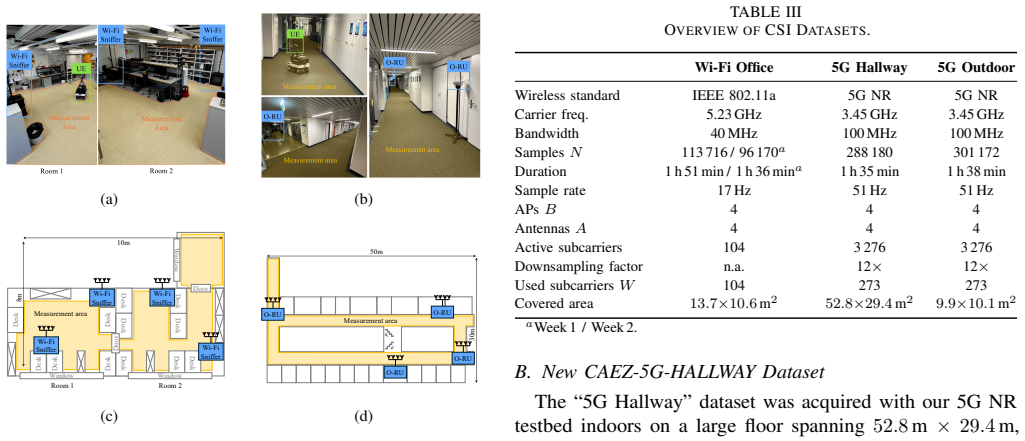
Channel state information (CSI)-based neural positioning learns a mapping from CSI measurements to user equipment (UE) positions using neural networks. However, most existing performance evaluations utilize randomly partitioned train/test CSI-dataset splits, which fail to reflect the generalization requirements of practical deployments and present optimistic results. In this paper, we study the spatial and temporal generalization of neural positioning with standard-compliant Wi-Fi and 5G NR systems for three real-world CSI datasets acquired in indoor and outdoor environments. We assess generalization with two different architectures, a conventional multilayer perceptron (MLP) and a novel transformer architecture, to unseen spatial regions, unseen UE trajectories, and CSI measurement campaigns separated by one week. Our experiments show that both architectures generalize well in space and time, and the proposed transformer consistently outperforms the MLP in positioning accuracy while requiring fewer model parameters.
Editorial analysis
A structured set of objections, weighed in public.
Referee Report
Summary. The paper claims that CSI-based neural positioning with MLP and a proposed transformer architecture generalizes well to unseen spatial regions, unseen UE trajectories, and one-week temporal separations across three real-world indoor/outdoor datasets from standard-compliant Wi-Fi and 5G NR systems; the transformer is reported to outperform the MLP in positioning accuracy while using fewer parameters.
Significance. If the empirical results hold under rigorous splits, the work would be significant for highlighting the gap between random train/test splits and practical generalization requirements in CSI positioning, a key barrier to deployment. Use of multiple real-world datasets and two architectures provides a useful comparison; the focus on standard-compliant systems is a strength.
major comments (2)
- [Abstract, evaluation description] Abstract and evaluation description: the claim that both architectures 'generalize well in time' rests on CSI campaigns separated by one week, but no quantification of distribution shift (e.g., CSI drift metrics, comparison to longer gaps, or sensitivity analysis) is provided to show this interval is representative of practical long-term changes such as seasonal effects or hardware drift over months; this directly affects the load-bearing temporal generalization result.
- [Evaluation section] Evaluation section (dataset splits): the definitions of 'unseen spatial regions' and 'unseen UE trajectories' must be specified with explicit rules for train/test partitioning (e.g., contiguous vs. random blocks, trajectory overlap checks) to rule out leakage; without this, the reported positive results across datasets cannot be verified as true out-of-distribution generalization.
minor comments (2)
- Clarify the exact positioning error metric (e.g., mean Euclidean distance, CDF at 1 m) and any statistical significance tests used for the transformer vs. MLP comparisons.
- Add a reference or brief discussion of prior work on CSI temporal drift to contextualize the one-week choice.
Simulated Author's Rebuttal
We thank the referee for the constructive feedback. We address the major comments point by point below, indicating planned revisions where appropriate.
read point-by-point responses
-
Referee: [Abstract, evaluation description] Abstract and evaluation description: the claim that both architectures 'generalize well in time' rests on CSI campaigns separated by one week, but no quantification of distribution shift (e.g., CSI drift metrics, comparison to longer gaps, or sensitivity analysis) is provided to show this interval is representative of practical long-term changes such as seasonal effects or hardware drift over months; this directly affects the load-bearing temporal generalization result.
Authors: Our temporal generalization experiments use the one-week separation available in the three real-world datasets and show that both models maintain performance across this gap. We will revise the manuscript to add explicit CSI drift metrics between the campaigns and a dedicated limitations discussion on the scope of the temporal results. Because the datasets contain no longer separations, we cannot supply comparisons to seasonal effects or multi-month hardware drift and will state this limitation clearly. revision: partial
-
Referee: [Evaluation section] Evaluation section (dataset splits): the definitions of 'unseen spatial regions' and 'unseen UE trajectories' must be specified with explicit rules for train/test partitioning (e.g., contiguous vs. random blocks, trajectory overlap checks) to rule out leakage; without this, the reported positive results across datasets cannot be verified as true out-of-distribution generalization.
Authors: We agree that explicit partitioning rules are required for verifiability. The evaluation section already outlines the splits, but we will expand it with precise rules: spatial regions are partitioned into contiguous blocks with no shared measurement locations, and trajectories are checked for zero overlap between train and test sets. These details will be added for all three datasets. revision: yes
- We cannot supply empirical quantification or sensitivity analysis for temporal gaps longer than one week, as none of the collected CSI datasets include such separations.
Circularity Check
Empirical evaluation with no derivation chain
full rationale
The paper reports experimental results comparing MLP and transformer models on three real-world CSI datasets for spatial and temporal generalization. Generalization performance is measured directly on held-out splits (unseen regions, trajectories, one-week campaigns) with no claimed first-principles derivation, uniqueness theorem, or fitted parameter renamed as prediction. No equations reduce reported accuracy to inputs by construction; the work is self-contained empirical comparison.
Axiom & Free-Parameter Ledger
axioms (1)
- domain assumption The three acquired CSI datasets and the spatial/temporal splits used for testing reflect the generalization demands of practical deployments.
Reference graph
Works this paper leans on
-
[2]
6G white paper on localization and sensing,
[Online]. Available: https://arxiv.org/abs/2006.01779
-
[3]
Integrated sensing and communications: Toward dual-functional wireless networks for 6G and beyond,
F. Liu, Y . Cui, C. Masouros, J. Xu, T. X. Han, Y . C. Eldar, and S. Buzzi, “Integrated sensing and communications: Toward dual-functional wireless networks for 6G and beyond,”IEEE J. Sel. Areas Commun., vol. 40, no. 6, pp. 1728–1767, 2022
2022
-
[4]
Challenges in indoor global navigation satellite systems: Unveiling its core features in signal processing,
G. Seco-Granados, J. López-Salcedo, D. Jiménez-Baños, and G. López- Risueño, “Challenges in indoor global navigation satellite systems: Unveiling its core features in signal processing,”IEEE Signal Process. Mag., vol. 29, no. 2, pp. 108–131, 2012
2012
-
[5]
Novel massive MIMO channel sounding data applied to deep learning-based indoor positioning,
M. Arnold, J. Hoydis, and S. ten Brink, “Novel massive MIMO channel sounding data applied to deep learning-based indoor positioning,” inSCC Int. ITG Conf. on Systems, Communications and Coding, Feb. 2019
2019
-
[6]
Deep convolutional neural networks for massive MIMO fingerprint-based positioning,
J. Vieira, E. Leitinger, M. Sarajlic, X. Li, and F. Tufvesson, “Deep convolutional neural networks for massive MIMO fingerprint-based positioning,” inProc. IEEE Int. Symp. Personal, Indoor , Mobile Radio Commun. (PIMRC), Oct. 2017
2017
-
[7]
CSI-fingerprinting indoor localization via attention-augmented residual convolutional neural network,
B. Zhang, H. Sifaou, and G. Y . Li, “CSI-fingerprinting indoor localization via attention-augmented residual convolutional neural network,”IEEE Trans. Wireless Commun., vol. 22, no. 8, pp. 5583–5597, 2023
2023
-
[8]
Fingerprinting-based positioning in distributed massive MIMO systems,
V . Savic and E. G. Larsson, “Fingerprinting-based positioning in distributed massive MIMO systems,” inProc. IEEE V eh. Technol. Conf. (VTC), Sep. 2015
2015
-
[10]
Available: https://arxiv.org/abs/2511.16352
[Online]. Available: https://arxiv.org/abs/2511.16352
-
[11]
CSI-based multi-antenna and multi-point indoor positioning using probability fusion,
E. Gönülta¸ s, E. Lei, J. Langerman, H. Huang, and C. Studer, “CSI-based multi-antenna and multi-point indoor positioning using probability fusion,” IEEE Trans. Wireless Commun., vol. 21, no. 4, pp. 2162–2176, 2022
2022
-
[12]
Feature learning for neural-network-based positioning with channel state information,
E. Gönülta¸ s, S. Taner, H. Huang, and C. Studer, “Feature learning for neural-network-based positioning with channel state information,” in Asilomar Conf. Signals, Syst., Comput., Nov. 2021
2021
-
[13]
Attacking and defending deep-learning-based off-device wireless positioning systems,
P. Huang, E. Gönülta¸ s, M. Arnold, K. P. Srinath, J. Hoydis, and C. Studer, “Attacking and defending deep-learning-based off-device wireless positioning systems,”IEEE Trans. Wireless Commun., vol. 23, no. 8, pp. 8883–8895, 2024
2024
-
[14]
CSI-based user positioning, channel charting, and device classification with an NVIDIA 5G testbed,
R. Wiesmayr, F. Zumegen, S. Taner, C. Dick, and C. Studer, “CSI-based user positioning, channel charting, and device classification with an NVIDIA 5G testbed,” inProc. Asilomar Conf. Signals, Syst., Comput., Oct. 2025
2025
-
[15]
Resilient channel charting under varying radio link availability,
J. Pirkl, J. Ott, M. Stahlke, G. Yammine, T. Feigl, and C. Mutschler, “Resilient channel charting under varying radio link availability,” inProc. Asilomar Conf. Signals, Syst., Comput., Oct. 2025
2025
-
[16]
Towards CSI localization at scale: Unsupervised representation learning for fingerprint retrieval,
T. Zhang, D. Zhang, and Y . Chen, “Towards CSI localization at scale: Unsupervised representation learning for fingerprint retrieval,”IEEE Trans. Mobile Comput., vol. 25, no. 2, pp. 1–14, 2026
2026
-
[17]
Lightweight channel chart informed transformer for localization,
H. Park, P. Garau Burguera, and H. Al-Tous, “Lightweight channel chart informed transformer for localization,” inProc. IEEE V eh. Technol. Conf. (VTC), Jan. 2026
2026
-
[18]
Generalization aspect of accurate machine learning models for CSI-based localization,
A. Sobehy, E. Renault, and P. Mühlethaler, “Generalization aspect of accurate machine learning models for CSI-based localization,”Annals of Telecommunications, vol. 77, no. 5–6, pp. 345–357, 2022
2022
-
[19]
Delving deep into rectifiers: Surpassing human-level performance on ImageNet classification,
K. He, X. Zhang, S. Ren, and J. Sun, “Delving deep into rectifiers: Surpassing human-level performance on ImageNet classification,” in Proc. IEEE Int. Conf. Computer Vision (ICCV), Dec. 2015
2015
-
[20]
Adam: A method for stochastic optimization,
D. P. Kingma and J. Ba, “Adam: A method for stochastic optimization,” inInt. Conf. on Learning Representations, May 2015
2015
-
[21]
PyTorch: An imperative style, high- performance deep learning library,
A. Paszke, S. Gross, F. Massa, A. Lerer, J. Bradbury, G. Chanan, T. Killeen, Z. Lin, N. Gimelshein, L. Antiga, A. Desmaison, A. Kopf, E. Yang, Z. DeVito, M. Raison, A. Tejani, S. Chilamkurthy, B. Steiner, L. Fang, J. Bai, and S. Chintala, “PyTorch: An imperative style, high- performance deep learning library,” inAdvances in Neural Information Processing S...
2019
-
[22]
Sur le point pour lequel la somme des distances de n points donnés est minimum,
E. Weiszfeld, “Sur le point pour lequel la somme des distances de n points donnés est minimum,”Tôhoku Mathematical Journal, vol. 43, pp. 355–386, 1937
1937
-
[23]
A software-defined and distributed Wi-Fi channel-state information acquisition testbed,
F. Zumegen and C. Studer, “A software-defined and distributed Wi-Fi channel-state information acquisition testbed,” inAsilomar Conf. Signals, Syst., Comput., Oct 2024
2024
discussion (0)
Sign in with ORCID, Apple, or X to comment. Anyone can read and Pith papers without signing in.