Resolving the smallest scales of massive star formation: A case for next-generation thermal-infrared interferometers
Pith reviewed 2026-06-26 22:29 UTC · model grok-4.3
The pith
Heterodyne-based long-baseline thermal-infrared interferometry at high dry sites will resolve the accretion and fragmentation processes within the innermost 100 au of massive star formation.
A machine-rendered reading of the paper's core claim, the machinery that carries it, and where it could break.
Core claim
The paper asserts that only heterodyne-based, long-baseline interferometry operating in the thermal-infrared L, M, N and Q bands from high, dry sites can deliver the sub-milliarcsecond resolution and rich molecular spectroscopy required to observe warm dust, hot gas and embedded protostars inside the high-mass star-disk interaction zone, thereby revealing the accretion, ejection and fragmentation processes that current facilities cannot access.
What carries the argument
Heterodyne-based long-baseline interferometry in the thermal infrared, which supplies both the angular resolution to reach sub-milliarcsecond scales and the spectral resolution to separate molecular lines despite high extinction.
If this is right
- Direct imaging of accretion streams and disk winds on dynamical timescales inside 100 au.
- Spatially resolved spectroscopy that separates molecular species in the high-mass star-disk zone.
- Observation of fragmentation and ejection processes currently hidden by extinction.
- A complete observational picture of how massive stars assemble their mass.
Where Pith is reading between the lines
- The same heterodyne approach could later be adapted to study embedded stages of lower-mass star and planet formation.
- Facility planning would need to prioritise site selection at high, dry locations to minimise atmospheric interference.
- Success would shift the limiting factor in massive-star studies from angular resolution to the availability of long-baseline thermal-infrared arrays.
Load-bearing premise
Current facilities cannot achieve the combination of sub-milliarcsecond resolution, thermal-infrared access and high spectral resolution needed to observe the critical 100 au zone around massive protostars.
What would settle it
A demonstration that ALMA or an existing near-infrared interferometer can already map accretion streams and disk winds at sub-milliarcsecond scales with clear molecular-line spectroscopy around an embedded high-mass protostar.
Figures
read the original abstract
This white paper was submitted to the European Southern Observatory (ESO) as part of the "Expanding horizons: transforming astronomy in the 2040s" call. Understanding how massive stars assemble their mass is a major astrophysical challenge, primarily because the critical accretion, ejection, and fragmentation processes occurring within the innermost 100 au remain largely inaccessible. Current facilities, such as ALMA and near-infrared interferometers, either lack the resolution to probe the compact high-mass star-disk interaction zone or are severely hindered by high extinction and marginal spectral resolution. To bridge this observational gap, this white paper advocates for next-generation thermal-infrared interferometers operating in the L, M, N, and Q bands to directly observe warm dust, hot gas, and embedded protostars at sub-milliarcsecond scales. These advanced capabilities will provide unprecedented access to a rich molecular inventory and spatially resolved spectroscopy, which are crucial for disentangling accretion streams, disk winds, and fragmentation mechanisms on dynamical timescales. We propose that developing heterodyne-based, long-baseline interferometry at high, dry sites represents the most transformative and realistic pathway to finally unveil the complete picture of massive star formation.
Editorial analysis
A structured set of objections, weighed in public.
Referee Report
Summary. This white paper advocates for next-generation thermal-infrared interferometers operating in the L, M, N, and Q bands via heterodyne-based long-baseline techniques at high, dry sites to resolve sub-milliarcsecond scales of massive star formation, arguing that ALMA lacks sufficient resolution at relevant wavelengths while near-IR interferometers are limited by extinction and spectral resolution.
Significance. The manuscript correctly identifies well-established observational gaps in probing the inner ~100 au of high-mass star formation and contributes to strategic discussions on 2040s instrumentation. Its value is primarily as an advocacy document highlighting the potential for spatially resolved molecular spectroscopy of accretion, winds, and fragmentation; however, the absence of any new quantitative feasibility assessment, sensitivity modeling, or comparative analysis reduces its immediate scientific impact.
major comments (1)
- [Abstract] Abstract: the central assertion that heterodyne long-baseline thermal-IR interferometry at high, dry sites 'represents the most transformative and realistic pathway' is presented without any supporting calculations (e.g., required baseline lengths, sensitivity in Jy, or atmospheric transmission models at candidate sites), rendering the comparative claim unevaluable.
minor comments (1)
- The text would be strengthened by adding at least one concrete science case with predicted observables (e.g., expected line widths or continuum fluxes at 10 mas scales) to illustrate the proposed capabilities.
Simulated Author's Rebuttal
We thank the referee for their review. We address the single major comment below, noting that this is a strategic advocacy white paper rather than a technical feasibility study.
read point-by-point responses
-
Referee: [Abstract] Abstract: the central assertion that heterodyne long-baseline thermal-IR interferometry at high, dry sites 'represents the most transformative and realistic pathway' is presented without any supporting calculations (e.g., required baseline lengths, sensitivity in Jy, or atmospheric transmission models at candidate sites), rendering the comparative claim unevaluable.
Authors: We agree that the abstract advances a strong comparative claim without accompanying quantitative calculations. The manuscript is submitted as a high-level strategic document to the ESO 2040s call, with the intent of identifying observational gaps and motivating a conceptual approach based on the documented limitations of ALMA and near-IR interferometers (detailed in the main text). Detailed modeling of baselines, sensitivities, and site transmission is outside the scope of this advocacy paper and would belong in a dedicated technical study. We will revise the abstract to moderate the language (e.g., changing the quoted phrase to 'a promising pathway') while retaining the core scientific motivation. revision: partial
Circularity Check
No significant circularity
full rationale
This is an ESO white-paper advocacy document proposing future instrumentation for massive star formation studies. It contains no equations, derivations, fitted parameters, quantitative predictions, or self-referential logic. The central claim is a policy recommendation based on established limitations of ALMA and NIR interferometers, which are external facts not derived from or reduced to any inputs within the paper itself. No load-bearing steps exist that could be circular by the defined criteria.
Axiom & Free-Parameter Ledger
axioms (1)
- domain assumption Critical accretion, ejection, and fragmentation processes in massive star formation occur within the innermost 100 au and remain largely inaccessible with existing facilities.
Reference graph
Works this paper leans on
-
[1]
arXiv:2606.18178v1 [astro-ph.IM] 16 Jun 2026 Resolving the smallest scales of massive star formation: A case for next-generation thermal-infrared interferometers E. Bordier 1, E. Koumpia 2, L. Labadie 1, J. Sanchez-Bermudez3, ´A. S´ anchez-Monge4, J.-P. Berger5 1 I. Physikalisches Institut, Universitat zu K¨ oln, Zulpicher Str. 77, Cologne, 50937, Germany...
Pith/arXiv arXiv 2026
-
[2]
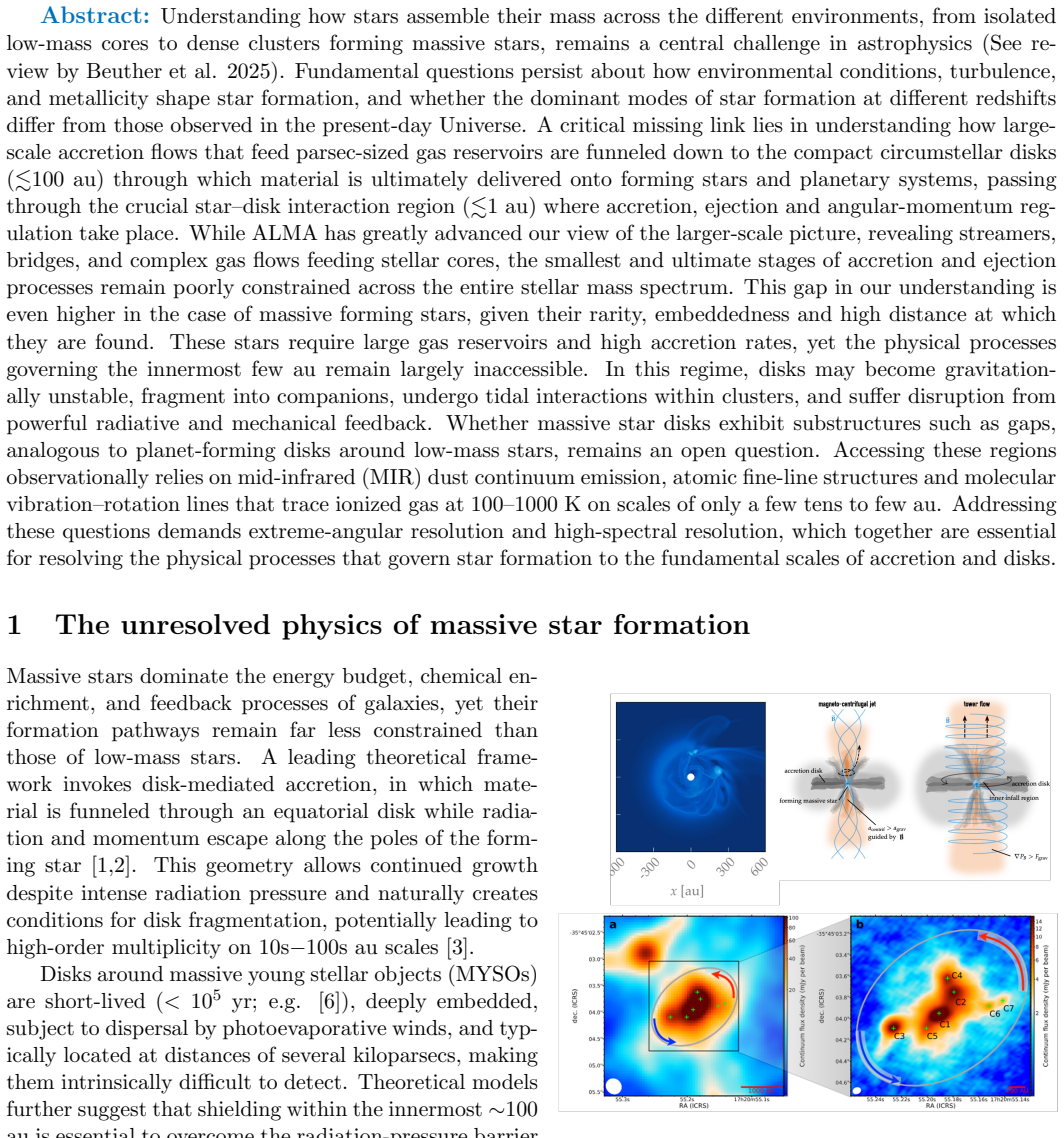
and schematic of massive protostellar outflows in the case of magneto-centrifugal and tower flow mechanisms (Courtesy: A. Oliva).Bottom: NGC 6334IN ALMA low- and high-resolution 1.3mm continuum im- ages highlighting that fragmentation is a viable mechanism for the formation of extreme high-order multiplicity [5]. Massive stars dominate the energy budget, ...
arXiv 2015
discussion (0)
Sign in with ORCID, Apple, or X to comment. Anyone can read and Pith papers without signing in.