Vision AI Agent for Continuous Material Monitoring of LEGEND-1000 LoFi Reentrant Tube
Pith reviewed 2026-06-27 02:16 UTC · model grok-4.3
The pith
Vision AI agent extracts cylinder diameters from video to reconstruct hoop stress-strain curves and yield strengths matching simulations.
A machine-rendered reading of the paper's core claim, the machinery that carries it, and where it could break.
Core claim
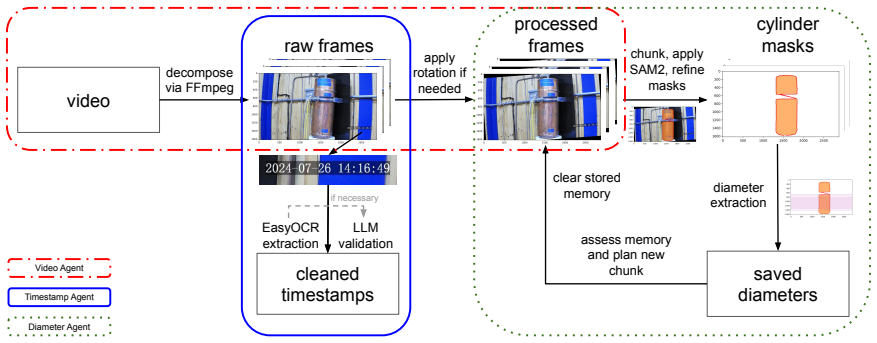
The agent pipeline, built with LangChain and Claude Haiku as the reasoning engine, uses FFmpeg for rotation correction, SAM2 for spatiotemporal segmentation with automated dynamic chunking, and a hybrid OCR-LLM pipeline for timestamps. This setup obtains continuous cylinder diameter profiles from video data. When synchronized to pressure measurements, the profiles support reconstruction of hoop stress-strain curves and calculation of yield strengths via the 0.2% offset, 0.5% EUL, and Johnson-Cook methods. Results from two independent tests cross-validate against Ansys mechanical simulations and a separate non-agentic pipeline at the plus or minus 5 pixel agreement level.
What carries the argument
SAM2 spatiotemporal segmentation with automated memory-informed dynamic chunking to extract consistent cylinder boundaries from video frames for diameter measurement.
If this is right
- Hoop stress-strain curves can be reconstructed from video data synchronized to pressure without contact sensors.
- Yield strengths can be obtained consistently using three independent calculation methods from the same diameter profiles.
- The pipeline autonomously manages corrupted frames and memory constraints during processing.
- Material properties from the video method match finite-element simulations for the tested copper cylinders.
Where Pith is reading between the lines
- The approach could apply to other hydrostatic or high-pressure tests where attaching sensors is difficult or unreliable.
- Agentic vision systems might enable continuous monitoring in experiments that currently rely on single-point measurements.
- Combining extracted diameters with pressure in real time could support adaptive test protocols.
Load-bearing premise
SAM2 segmentation with dynamic chunking produces accurate and consistent cylinder boundaries across all frames despite corrupted frames and memory limits, so that extracted diameters support reliable strain calculations.
What would settle it
Direct comparison of the agent's diameter measurements against manual frame-by-frame annotation on the same videos, showing systematic differences larger than 5 pixels or yield strengths that deviate from Ansys predictions beyond the reported agreement.
Figures


read the original abstract
We report on a vision AI agent pipeline for non-contact material strain and property extraction from video data, demonstrated on video taken during hydrostatic testing of four OFHC copper cylinders conducted as part of the LEGEND-1000 hardware validation campaign. Traditional strain gauge measurements proved unreliable, motivating a fully-automated agentic alternative. The agent was built on the LangChain framework with Claude Haiku 4.5 as its central reasoning engine, integrating a specialized suite of computer vision tools: FFmpeg for video preprocessing and rotation correction via Hough Line Transform, the Segment Anything Model 2 (SAM2) for spatiotemporal segmentation with automated memory-informed dynamic chunking, and a hybrid EasyOCR and LLM-based timestamp validation pipeline. Three specialized sub-agents were developed to process the video data and obtain cylinder diameters and timestamps while autonomously handling obstacles such as corrupted frames and memory limits. From the diameter profiles synchronized to pressure data, hoop stress--strain curves were reconstructed and yield strengths were calculated using the 0.2\% offset, 0.5\% EUL, and Johnson-Cook methods across two independent tests. Cross-validation against a non-agentic pipeline confirmed agreement for the diameter extraction at the $\pm$5 pixel level. The material properties and testing results were further compared to Ansys mechanical simulations performed as part of the LEGEND-1000 reentrant tube design campaign. This work showcases the power of agentic pipelines to extract materials data from video alone.
Editorial analysis
A structured set of objections, weighed in public.
Referee Report
Summary. The manuscript describes a LangChain-based vision AI agent pipeline (Claude Haiku 4.5 core, SAM2 spatiotemporal segmentation with dynamic chunking, FFmpeg/Hough preprocessing, hybrid OCR/LLM timestamping) that extracts cylinder diameters from hydrostatic-test video of four OFHC copper reentrant tubes. From synchronized diameter and pressure time series the authors reconstruct hoop stress–strain curves and compute yield strengths via 0.2 % offset, 0.5 % EUL, and Johnson-Cook methods; these values are stated to agree with Ansys simulations and with an independent non-agentic pipeline at the ±5-pixel level.
Significance. If the diameter-extraction accuracy can be shown to support reliable small-strain measurements, the work would demonstrate a practical non-contact alternative for material-property extraction when conventional strain gauges fail, with direct relevance to specialized hardware validation campaigns such as LEGEND-1000. The agentic architecture and autonomous handling of corrupted frames and memory limits are technically interesting, but the absence of quantitative validation metrics currently limits the strength of the claim.
major comments (3)
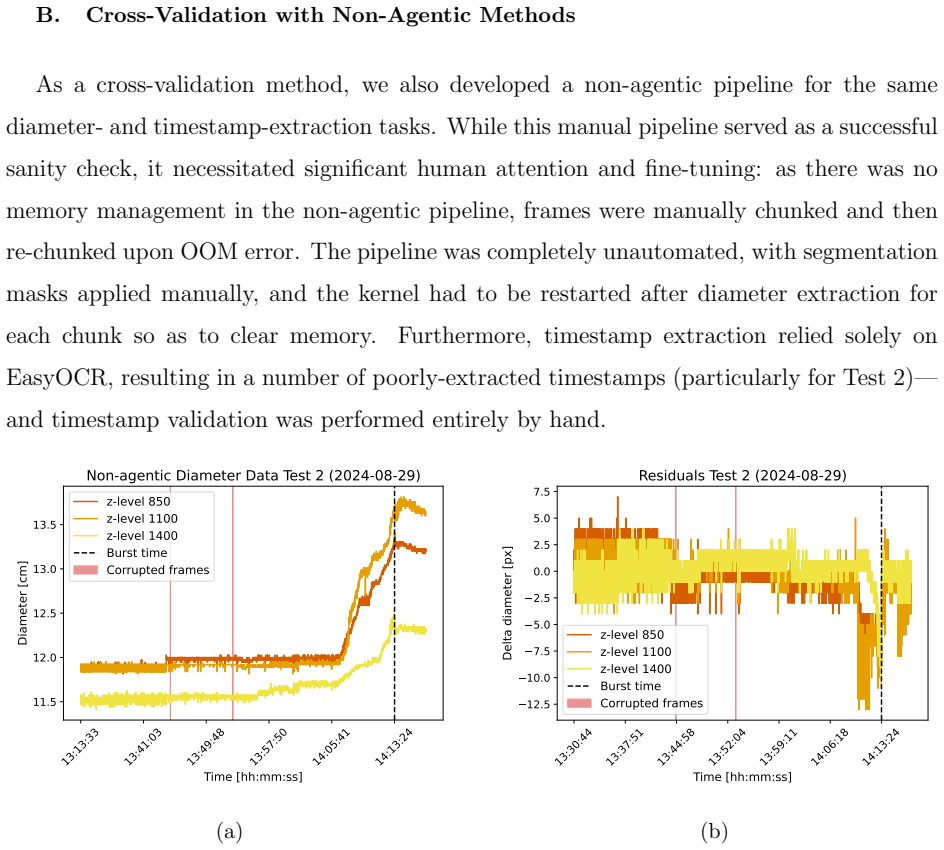
- [Abstract / results] Abstract and results section: the only quantitative accuracy metric supplied is “agreement … at the ±5 pixel level” with a non-agentic pipeline. Because the 0.2 % offset method operates in the small-strain regime, a few-pixel bias or frame-to-frame jitter can shift the reported yield point by an amount comparable to the claimed agreement with Ansys; no pixel-to-mm calibration, no manual ground-truth annotations on held-out frames, and no propagation of diameter uncertainty into strain or yield uncertainty are described.
- [Methods] Methods (SAM2 segmentation paragraph): the claim that automated dynamic chunking “produces sufficiently accurate and consistent cylinder boundaries across all frames” is load-bearing for the central claim, yet the manuscript provides neither a quantitative segmentation metric (e.g., IoU or boundary RMSE on a validation set) nor an external ground-truth benchmark. Internal consistency with a second pipeline does not substitute for absolute accuracy.
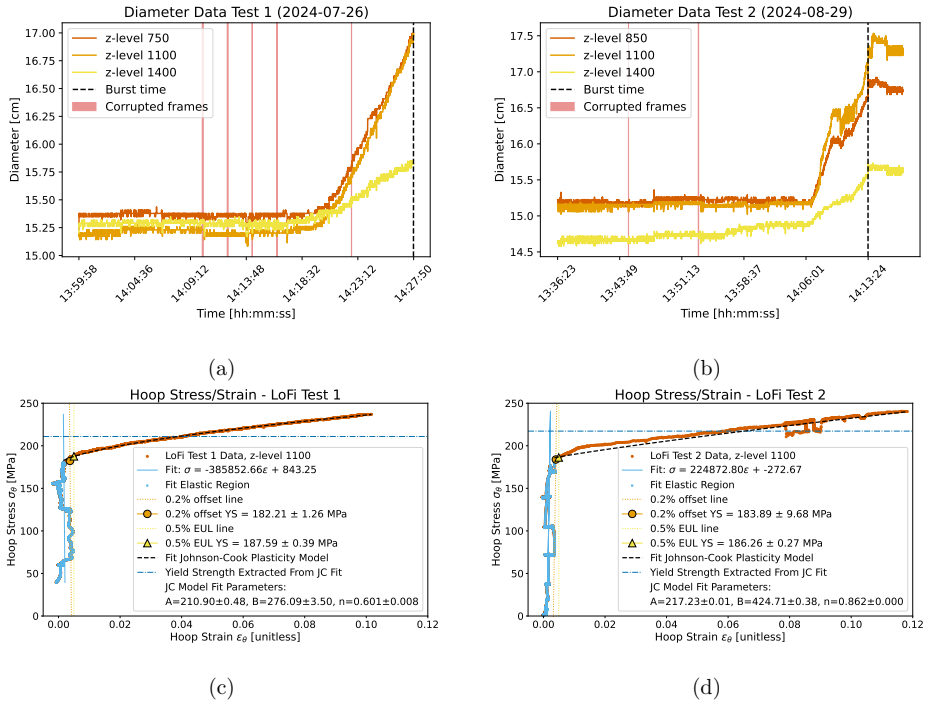
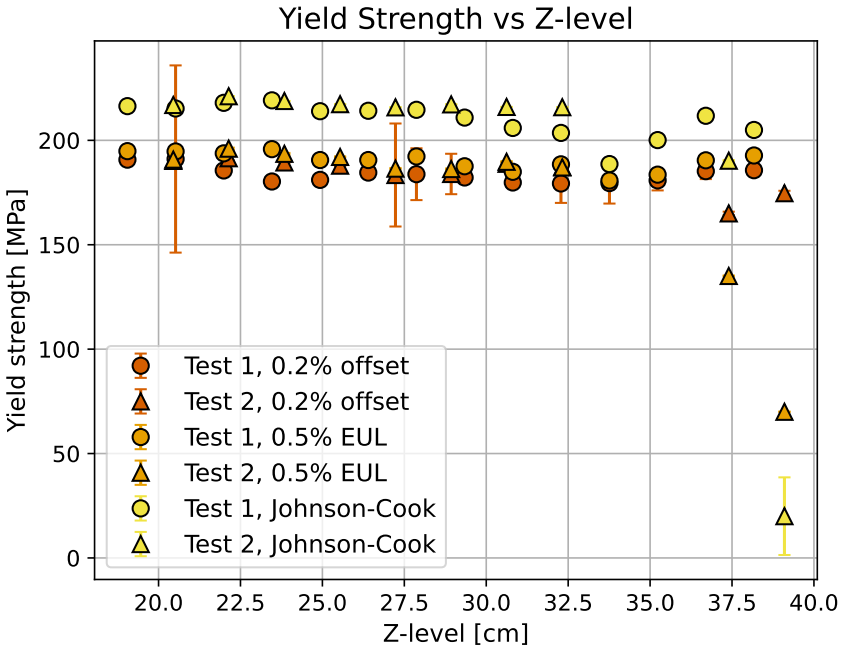
- [Results / yield calculations] Yield-calculation subsection: the three yield-strength values (0.2 % offset, 0.5 % EUL, Johnson-Cook) are reported to agree with simulation, but no numerical values, error bars, or goodness-of-fit statistics are given in the visible text, preventing assessment of whether the ±5-pixel diameter agreement is actually sufficient for the stated material-property conclusions.
minor comments (2)
- [Methods] The manuscript would benefit from an explicit statement of the camera resolution, working distance, and resulting mm-per-pixel scale so that ±5 pixels can be converted to physical strain uncertainty.
- [Figures] Figure captions should indicate whether error bands or representative frames from the SAM2 output are shown; current captions are terse.
Simulated Author's Rebuttal
We thank the referee for the constructive and detailed comments, which highlight important aspects of validation needed to strengthen the claims. We address each major comment below and will incorporate revisions to provide the requested quantitative metrics and numerical details.
read point-by-point responses
-
Referee: [Abstract / results] Abstract and results section: the only quantitative accuracy metric supplied is “agreement … at the ±5 pixel level” with a non-agentic pipeline. Because the 0.2 % offset method operates in the small-strain regime, a few-pixel bias or frame-to-frame jitter can shift the reported yield point by an amount comparable to the claimed agreement with Ansys; no pixel-to-mm calibration, no manual ground-truth annotations on held-out frames, and no propagation of diameter uncertainty into strain or yield uncertainty are described.
Authors: We agree that the current ±5-pixel internal consistency metric is insufficient by itself to demonstrate reliability in the small-strain regime. In the revised manuscript we will add an explicit pixel-to-mm calibration derived from the known initial tube diameter, include manual ground-truth diameter annotations on a held-out frame subset with reported agreement statistics, and propagate the ±5-pixel uncertainty into the strain and yield calculations, supplying error bars on all reported material properties. revision: yes
-
Referee: [Methods] Methods (SAM2 segmentation paragraph): the claim that automated dynamic chunking “produces sufficiently accurate and consistent cylinder boundaries across all frames” is load-bearing for the central claim, yet the manuscript provides neither a quantitative segmentation metric (e.g., IoU or boundary RMSE on a validation set) nor an external ground-truth benchmark. Internal consistency with a second pipeline does not substitute for absolute accuracy.
Authors: We acknowledge that absolute segmentation accuracy metrics are required. The revised Methods section will report Intersection-over-Union (IoU) and boundary RMSE values computed on a manually annotated validation subset of frames, together with the external ground-truth comparison, to substantiate the dynamic-chunking claim. revision: yes
-
Referee: [Results / yield calculations] Yield-calculation subsection: the three yield-strength values (0.2 % offset, 0.5 % EUL, Johnson-Cook) are reported to agree with simulation, but no numerical values, error bars, or goodness-of-fit statistics are given in the visible text, preventing assessment of whether the ±5-pixel diameter agreement is actually sufficient for the stated material-property conclusions.
Authors: We will expand the Results section to tabulate the numerical yield-strength values obtained by each method, the corresponding Ansys simulation values, the derived error bars from diameter uncertainty, and any available goodness-of-fit statistics (e.g., R² for the linear regime of the stress–strain curves). revision: yes
Circularity Check
No circularity; extraction and validation chain is independent of fitted inputs
full rationale
The paper extracts cylinder diameters via SAM2 spatiotemporal segmentation on video frames, synchronizes to pressure data, reconstructs hoop stress-strain curves, and computes yield strengths using standard 0.2% offset, 0.5% EUL, and Johnson-Cook methods. These outputs are cross-validated against external Ansys simulations and a separate non-agentic pipeline at the ±5 pixel level. No equations or steps reduce a claimed prediction to a parameter fitted from the same video data, no self-citation chain supports a uniqueness claim, and no ansatz or renaming is invoked. The derivation remains self-contained against external benchmarks.
Axiom & Free-Parameter Ledger
axioms (2)
- domain assumption SAM2 segmentation produces reliable spatiotemporal masks for cylindrical objects under the lighting and motion conditions of the hydrostatic tests.
- standard math Standard 0.2% offset and Johnson-Cook yield definitions apply directly to the video-derived strain data.
Reference graph
Works this paper leans on
-
[1]
LoFi tests
that would help answer several important outstanding questions in the field of neutrino physics and cosmology. The observation of 0νββdecay would prove the Majorana nature of the neutrino and provide an avenue for leptogenesis [3], a model explaining the observed matter–antimatter asymmetry of the universe. 0νββdecay has yet to be observed and presents a ...
2024
-
[2]
This agent operates as a highly-configurable pipeline, allowing the LLM to define parameters such as frame extraction rates, output direc- tory structures, and visualization
Video Agent The first component of our workflow is the Video Agent, which was tasked with the ini- tial preprocessing of raw LoFi testing footage. This agent operates as a highly-configurable pipeline, allowing the LLM to define parameters such as frame extraction rates, output direc- tory structures, and visualization. To execute these tasks, the agent i...
-
[3]
chunking
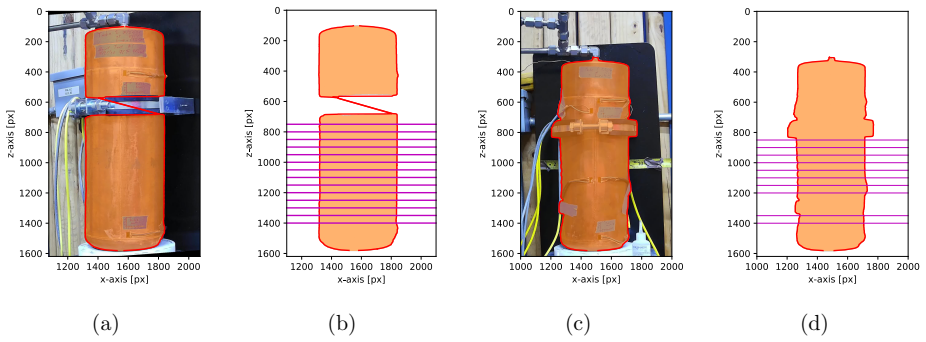
Diameter Agent The Diameter Agent is the most sophisticated component of the workflow, tasked with supervising the core segmentation and analysis pipeline. It operates in the following steps: (i) initialization of the SAM2 inference state, (ii) mask refinement, (iii) temporal propagation, and (iv) final diameter extraction. Following the output of the Vid...
2000
-
[4]
9” as the lowercase letter “g
Timestamp Agent The final component of our pipeline, the Timestamp Agent, was tasked with synchro- nizing the extracted tube diameter profiles with their corresponding time recorded by the camera. This required the precise retrieval of alphanumeric timestamps embedded in the bottom-right corner of each video frame (e.g., see Fig. 2). While standard Python...
1966
-
[5]
top” region near the clamp (red), the middle region (orange), and the “bottom
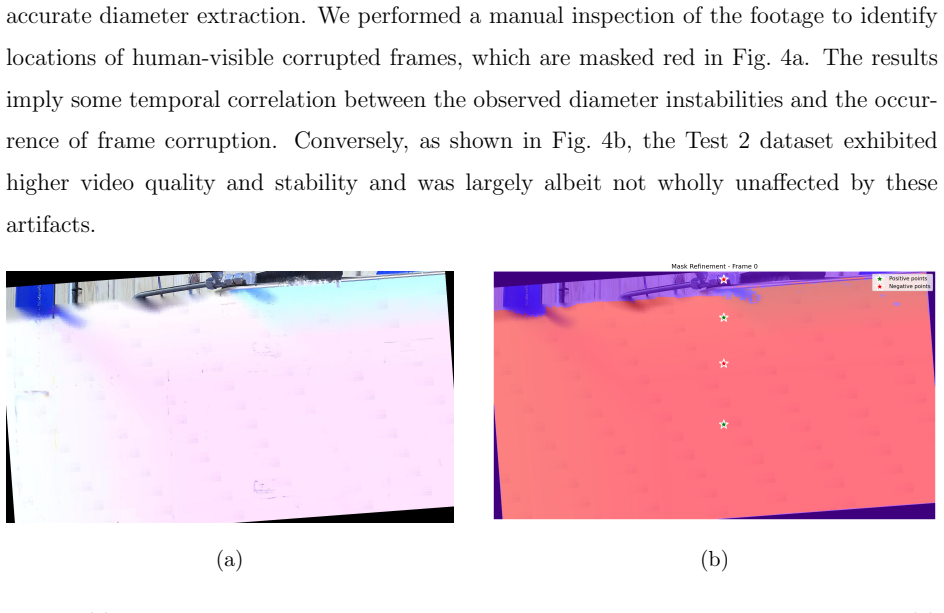
In the top panels, diameters are tracked at three representative heights: the “top” region near the clamp (red), the middle region (orange), and the “bottom” region near the bottom (yellow). The specific pixel z-levels correspond to 750, 1100, and 1400 for Test 1, and 850, 1100, and 1400 for Test 2. The vertical dashed black line denotes the moment of cyl...
2024
-
[6]
Agostini, G
M. Agostini, G. Benato, J. A. Detwiler, J. Men´ endez, and F. Vissani, Toward the discovery of matter creation with neutrinolessββdecay, Rev. Mod. Phys.95, 025002 (2023)
2023
-
[7]
M. J. Dolinski, A. W. Poon, and W. Rodejohann, Neutrinoless Double-Beta Decay: Status and Prospects, Annu. Rev. Nucl. Part. Sci.69, 219 (2019)
2019
-
[8]
Fukugita and T
M. Fukugita and T. Yanagida, Baryogenesis without grand unification, Physics Letters B174, 45 (1986)
1986
-
[9]
D. Q. Adams and Others, New Direct Limit on Neutrinoless Double Beta Decay Half-Life of Te 128 with CUORE, Physical Review Letters129, 222501 (2022)
2022
-
[10]
C. E. Aalseth and Others, Search for Neutrinoless Double-βDecay in 76Ge with theMajo- rana Demonstrator, Phys. Rev. Lett.120, 132502 (2018), arXiv:1710.11608 [nucl-ex]
Pith/arXiv arXiv 2018
-
[11]
S. Abe, S. Asami, M. Eizuka, S. Futagi, and Others, First Search for the Majorana Nature of Neutrinos in the Inverted Mass Ordering Region with KamLAND-Zen (2022), arXiv:2203.02139 [hep-ex]
arXiv 2022
-
[12]
Agostini, G
M. Agostini, G. R. Araujo, A. M. Bakalyarov, M. Balata, I. Barabanov, L. Baudis, C. Bauer, and Others, Final Results of GERDA on the Search for Neutrinoless Double-βDecay, Phys. Rev. Lett.125, 252502 (2020)
2020
-
[13]
Acharya, N
H. Acharya, N. Ackermann, M. Agostini, A. Alexander, and Others, First Results on the Search for Lepton Number Violating Neutrinoless Double-βDecay with the LEGEND-200 Experiment, Phys. Rev. Lett.136, 22701 (2026)
2026
-
[14]
N. Abgrall and Others, The Large Enriched Germanium Experiment for Neutrinolessββ Decay: LEGEND-1000 Preconceptual Design Report (2021), arXiv:2107.11462 [physics.ins- det]
arXiv 2021
-
[15]
S. Yao, J. Zhao, D. Yu, N. Du, I. Shafran, K. Narasimhan, and Y. Cao, React: Synergizing reasoning and acting in language models, arXiv 10.48550/arxiv.2210.03629 (2022)
work page internal anchor Pith review Pith/arXiv arXiv doi:10.48550/arxiv.2210.03629 2022
-
[16]
Y. Shen, K. Song, X. Tan, D. Li, W. Lu, and Y. Zhuang, Hugginggpt: Solving ai tasks with chatgpt and its friends in hugging face, arXiv 10.48550/arxiv.2303.17580 (2023)
work page internal anchor Pith review Pith/arXiv arXiv doi:10.48550/arxiv.2303.17580 2023
-
[17]
KGaA, Lindenallee 22, 39288 Burg, Germany
pro-beam GmbH & Co. KGaA, Lindenallee 22, 39288 Burg, Germany
-
[18]
ANSYS, Inc., Ansys®Academic Research Mechanical, Release 2024 R1 (2024). 22
2024
-
[19]
Pneumatic and Hydraulic Company, LLC Website, 20500 Clay Center Dr, Katy, TX 77449, USA
-
[20]
Micro-Measurements, 951 Wendell Blvd., Wendell, NC 27591, USA
-
[21]
Chase, Langchain, GitHub repository (2022)
H. Chase, Langchain, GitHub repository (2022)
2022
-
[22]
Anthropic,The Claude 3 Model Family: Opus, Sonnet, Haiku, Tech. Rep. (Anthropic, 2024)
2024
-
[23]
JaidedAI, Easyocr, GitHub repository (2020)
2020
-
[24]
N. Ravi, V. Gabeur, Y.-T. Hu, R. Hu, C. Ryali, T. Ma, H. Khedr, R. R¨ adle, C. Rolland, L. Gustafson, E. Mintun, J. Pan, K. V. Alwala, N. Carion, C.-Y. Wu, R. Girshick, P. Doll´ ar, and C. Feichtenhofer, SAM 2: Segment Anything in Images and Videos, arXiv preprint arXiv:2408.00714 (2024)
Pith/arXiv arXiv 2024
-
[25]
Coudurier, C
B. Coudurier, C. E. Hoyos, M. Niedermayer, T. Borgmann, T. H¨ ardin, S. Liu, G. Doshi, and Others, Ffmpeg, GitHub repository (2026)
2026
-
[26]
R. O. Duda and P. E. Hart, Use of the hough transformation to detect lines and curves in pictures, Commun. ACM15, 11–15 (1972)
1972
-
[27]
K. S. Stopka, J. Smallwood, A. Chokshi, S. D. Heister, and M. D. Sangid,Structural and Fatigue Analysis of a Rotating Detonation Rocket Engine, Tech. Rep
-
[28]
G. Z. Voyiadjis and F. H. Abed,Arch. Mech, Tech. Rep. (2005). 23 Appendix A: AI Glossary We present a short glossary of AI-related terms mentioned in this work. Terms are listed hierarchically relative to one another, not in order of appearance. •Foundation model: a large-scale AI system trained on various unlabeled data (e.g., text, images, audio) to ser...
2005
discussion (0)
Sign in with ORCID, Apple, or X to comment. Anyone can read and Pith papers without signing in.