Chaos from quantum bath fluctuations
Pith reviewed 2026-06-27 00:36 UTC · model grok-4.3
The pith
Quantum noise from the bath generates a strange attractor with positive Lyapunov exponent in the classically regular superradiant regime of the dissipative Dicke model at large but finite spin.
A machine-rendered reading of the paper's core claim, the machinery that carries it, and where it could break.
Core claim
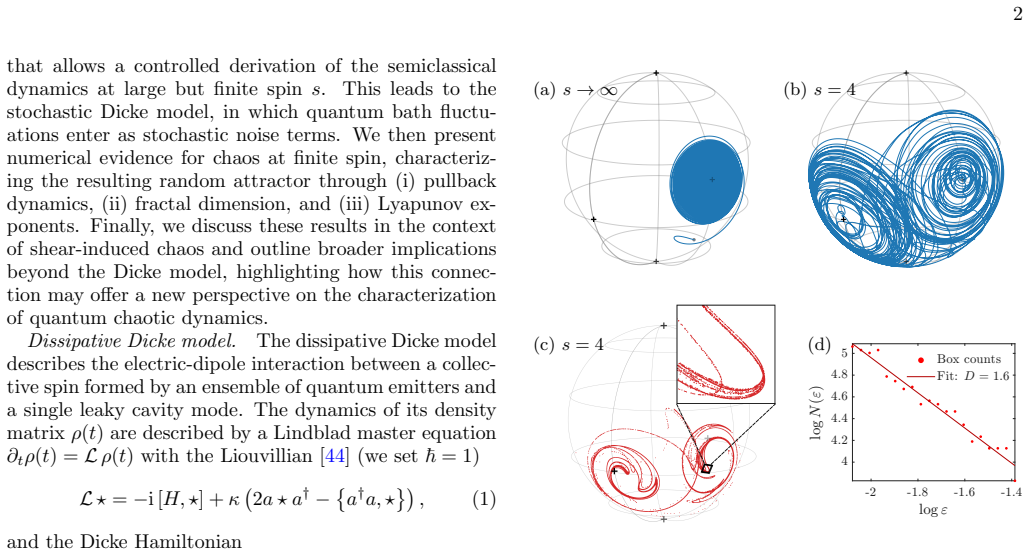
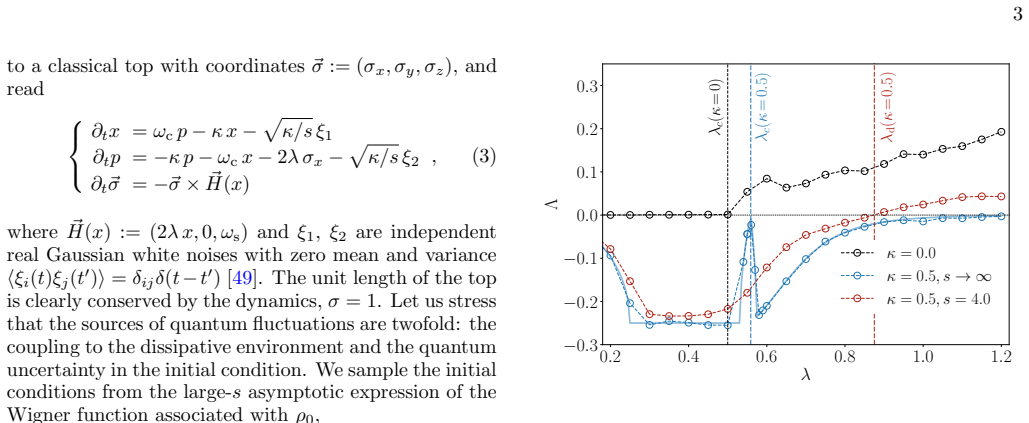
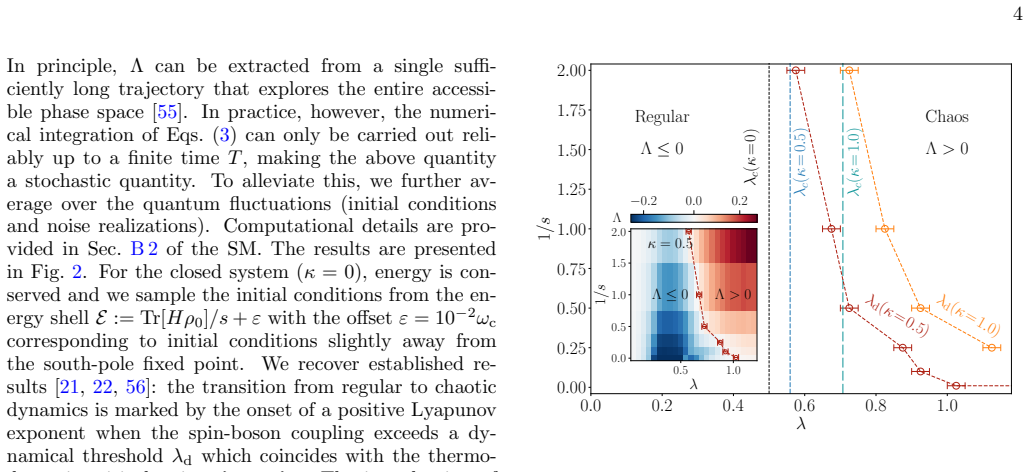
Starting from a classically regular phase space in the superradiant regime, quantum noise generates a strange attractor with fractal dimension and a positive Lyapunov exponent in the dissipative Dicke model at large but finite spin.
What carries the argument
Semiclassical stochastic equations for the dissipative Dicke model at large but finite spin, whose quantum noise term drives shear-induced chaos.
If this is right
- The superradiant phase of the dissipative Dicke model becomes chaotic once quantum fluctuations are retained at finite spin.
- A positive Lyapunov exponent and fractal dimension appear directly from the quantum noise term.
- The same mechanism connects the model to shear-induced chaos studied in the mathematical literature.
- Dissipation alone does not guarantee regularity when quantum fluctuations are present.
Where Pith is reading between the lines
- Similar quantum-noise-induced chaos may appear in other open quantum optical models once treated at finite but large system size.
- Experiments in cavity QED with controlled dissipation could test whether the predicted strange attractor is observable.
- The result raises the question of how quantum fluctuations affect long-time predictability in other dissipative many-body systems.
Load-bearing premise
The semiclassical regime at large but finite spin is enough to capture how quantum bath fluctuations produce chaos without needing a full quantum many-body treatment.
What would settle it
Numerical integration of the stochastic semiclassical equations at large but finite spin that yields only regular bounded orbits with zero or negative Lyapunov exponents instead of a strange attractor.
Figures
read the original abstract
The effect of a large environment on a finite-size quantum mechanical system is two-fold: It brings dissipation, but also fluctuations of thermal and quantum origin. While dissipation tends to stabilize the dynamics, we question if and how environmental quantum fluctuations can generate chaos in an otherwise classically non-chaotic system. We work out a paradigmatic model of quantum optics: the dissipative Dicke model, where a large spin interacts with a dissipative harmonic mode. We dial in the classical/quantum correspondence by working in the semiclassical regime at large but finite spin. We demonstrate that, starting from a classically regular phase space in the superradiant regime, quantum noise can generate a strange attractor with fractal dimension and a positive Lyapunov exponent. We unveil the deep connection with shear-induced chaos that was recently developed in the mathematical community.
Editorial analysis
A structured set of objections, weighed in public.
Referee Report
Summary. The manuscript examines the dissipative Dicke model in the semiclassical regime at large but finite spin. It claims that quantum bath fluctuations generate a strange attractor possessing a fractal dimension and a positive Lyapunov exponent in the superradiant regime, which is classically regular, and links the mechanism to shear-induced chaos developed in the mathematical literature.
Significance. If the central numerical observation holds after methodological clarification, the result would illustrate how quantum environmental fluctuations can induce chaos in an otherwise non-chaotic dissipative quantum-optical system. The explicit connection to shear-induced chaos supplies a concrete mathematical interpretation and is a positive feature. The semiclassical truncation at large but finite spin is a standard and appropriate bridge between quantum and classical descriptions.
major comments (2)
- [Abstract] Abstract: the central numerical observation is stated without any description of the integration scheme, the algorithm used to extract the Lyapunov exponent, the method for estimating the fractal dimension, or the controls applied for finite-size effects; these omissions leave the primary claim without a verifiable computational foundation.
- [Model setup] Model setup and semiclassical regime: the effective stochastic differential equations obtained from the quantum truncation can be reproduced by classical additive or multiplicative noise whose second moments are matched to the quantum ones; no test is reported that isolates the quantum origin of the fluctuations from a purely classical stochastic drive, which is load-bearing for the claim that quantum bath fluctuations are essential.
minor comments (1)
- [Introduction] The introduction would benefit from a concise paragraph summarizing the key mathematical result on shear-induced chaos before invoking it to interpret the numerics.
Simulated Author's Rebuttal
We thank the referee for the careful reading and constructive comments on our manuscript. We address each major comment point by point below.
read point-by-point responses
-
Referee: [Abstract] Abstract: the central numerical observation is stated without any description of the integration scheme, the algorithm used to extract the Lyapunov exponent, the method for estimating the fractal dimension, or the controls applied for finite-size effects; these omissions leave the primary claim without a verifiable computational foundation.
Authors: We agree that the abstract would benefit from a concise mention of the numerical methods to strengthen the presentation of the central claim. In the revised manuscript we will add one sentence to the abstract noting the integration scheme for the stochastic differential equations, the algorithm employed for the Lyapunov exponent, the estimator used for the fractal dimension, and that finite-size effects were controlled via explicit scaling checks with system size. Full technical details remain in the Methods section. revision: yes
-
Referee: [Model setup] Model setup and semiclassical regime: the effective stochastic differential equations obtained from the quantum truncation can be reproduced by classical additive or multiplicative noise whose second moments are matched to the quantum ones; no test is reported that isolates the quantum origin of the fluctuations from a purely classical stochastic drive, which is load-bearing for the claim that quantum bath fluctuations are essential.
Authors: This is a substantive point. The stochastic terms in our equations are obtained by truncating the quantum master equation at large but finite spin; their second moments therefore inherit the specific structure dictated by the quantum bath operators. While classical noise with identical second moments could in principle be written down, the quantum derivation fixes both the form and the higher-order correlations that are not arbitrary. We did not perform an explicit side-by-side comparison with purely classical noise in the submitted version. In the revision we will add a paragraph clarifying this origin and, space permitting, include a short numerical comparison to classical noise with matched moments to illustrate the distinction. revision: partial
Circularity Check
No significant circularity; derivation remains self-contained against external benchmarks
full rationale
The paper's central demonstration proceeds from the dissipative Dicke model in the semiclassical large-but-finite-spin regime, replacing quantum dynamics with stochastic differential equations whose noise statistics are fixed by the truncation (e.g., truncated Wigner). The emergence of a strange attractor and positive Lyapunov exponent is then shown numerically and linked to the independently developed mathematical theory of shear-induced chaos. No step reduces a claimed prediction to a fitted parameter by construction, no load-bearing uniqueness theorem is imported from the authors' own prior work, and the shear-chaos connection is invoked as an external insight rather than a self-citation that closes the argument. The result is therefore falsifiable against classical stochastic models of matched noise strength and does not collapse to its inputs.
Axiom & Free-Parameter Ledger
axioms (1)
- domain assumption The semiclassical regime at large but finite spin captures the essential quantum noise effects without full quantum many-body treatment.
Reference graph
Works this paper leans on
-
[1]
L. S` a, P. Ribeiro, and S. Denisov, What we talk about when we talk about dissipative quantum chaos (2026), arXiv:2605.21628 [quant-ph]
Pith/arXiv arXiv 2026
-
[2]
Dittrich and R
T. Dittrich and R. Graham, Quantum effects in the steady state of the dissipative standard map, Europhys. Lett.4, 263 (1987)
1987
-
[3]
Braun,Dissipative Quantum Chaos and Decoherence, Springer Tracts in Modern Physics (Springer Berlin Hei- delberg, 2003)
D. Braun,Dissipative Quantum Chaos and Decoherence, Springer Tracts in Modern Physics (Springer Berlin Hei- delberg, 2003)
2003
-
[4]
A. M. Garc´ ıa-Garc´ ıa, J. J. M. Verbaarschot, and J.-P. Zheng, Lyapunov exponent as a signature of dissipative many-body quantum chaos, Phys. Rev. D110, 086010 (2024)
2024
-
[5]
L. S´ a, P. Ribeiro, and T. Prosen, Complex spacing ratios: A signature of dissipative quantum chaos, Phys. Rev. X 10, 021019 (2020)
2020
-
[6]
S´ a, Signatures of dissipative quantum chaos (2023), arXiv:2311.01518 [cond-mat.stat-mech]
L. S´ a, Signatures of dissipative quantum chaos (2023), arXiv:2311.01518 [cond-mat.stat-mech]
arXiv 2023
-
[7]
Kawabata, A
K. Kawabata, A. Kulkarni, J. Li, T. Numasawa, and S. Ryu, Symmetry of open quantum systems: Classifi- cation of dissipative quantum chaos, PRX Quantum4, 030328 (2023)
2023
-
[8]
Shiokawa and B
K. Shiokawa and B. L. Hu, Decoherence, delocalization, and irreversibility in quantum chaotic systems, Phys. Rev. E52, 2497 (1995)
1995
-
[9]
Gupta, H
S. Gupta, H. K. Yadalam, M. Kulkarni, and C. Aron, Quantum jumps in driven-dissipative disordered many- body systems, Phys. Rev. A109, L050201 (2024)
2024
-
[10]
R. H. Dicke, Coherence in spontaneous radiation pro- cesses, Phys. Rev.93, 99 (1954)
1954
-
[11]
Gross and S
M. Gross and S. Haroche, Superradiance: An essay on the theory of collective spontaneous emission, Phys. Rep. 93, 301 (1982)
1982
-
[13]
Baumann, C
K. Baumann, C. Guerlin, F. Brennecke, and T. Esslinger, Dicke quantum phase transition with a superfluid gas in an optical cavity, Nature464, 1301 (2010)
2010
-
[14]
Jaako, Z.-L
T. Jaako, Z.-L. Xiang, J. J. Garcia-Ripoll, and P. Rabl, Ultrastrong-coupling phenomena beyond the Dicke model, Phys. Rev. A94, 033850 (2016)
2016
-
[15]
M. P. Baden, K. J. Arnold, A. L. Grimsmo, S. Parkins, and M. D. Barrett, Realization of the Dicke model using cavity-assisted Raman transitions, Phys. Rev. Lett.113, 020408 (2014)
2014
-
[16]
Klinder, H
J. Klinder, H. Keßler, M. Wolke, L. Mathey, and A. Hem- merich, Dynamical phase transition in the open Dicke model, Proc. Nat. Ac. Sci112, 3290 (2015)
2015
-
[17]
Zhiqiang, C
Z. Zhiqiang, C. H. Lee, R. Kumar, K. J. Arnold, S. J. Masson, A. S. Parkins, and M. D. Barrett, Nonequilib- rium phase transition in a spin-1 Dicke model, Optica4, 424 (2017). 6
2017
-
[18]
Zhang, C
Z. Zhang, C. H. Lee, R. Kumar, K. J. Arnold, S. J. Mas- son, A. L. Grimsmo, A. S. Parkins, and M. D. Barrett, Dicke-model simulation via cavity-assisted Raman tran- sitions, Phys. Rev. A97, 043858 (2018)
2018
-
[19]
J. Cohn, A. Safavi-Naini, R. J. Lewis-Swan, J. G. Bohnet, M. G¨ arttner, K. A. Gilmore, J. E. Jordan, A. M. Rey, J. J. Bollinger, and J. K. Freericks, Bang-bang shortcut to adiabaticity in the Dicke model as realized in a Penning trap experiment, New J. Phys.20, 055013 (2018)
2018
-
[20]
Safavi-Naini, R
A. Safavi-Naini, R. J. Lewis-Swan, J. G. Bohnet, M. G¨ arttner, K. A. Gilmore, J. E. Jordan, J. Cohn, J. K. Freericks, A. M. Rey, and J. J. Bollinger, Verification of a many-ion simulator of the Dicke model through slow quenches across a phase transition, Phys. Rev. Lett.121, 040503 (2018)
2018
-
[21]
Emary and T
C. Emary and T. Brandes, Chaos and the quantum phase transition in the Dicke model, Phys. Rev. E67, 066203 (2003)
2003
-
[22]
Emary and T
C. Emary and T. Brandes, Quantum chaos triggered by precursors of a quantum phase transition: The Dicke model, Phys. Rev. Lett.90, 044101 (2003)
2003
-
[23]
M. V. Berry and M. Tabor, Level clustering in the regular spectrum, Proc. R. Soc. Lond. A356, 375 (1977)
1977
-
[24]
Bohigas, M
O. Bohigas, M. J. Giannoni, and C. Schmit, Character- ization of chaotic quantum spectra and universality of level fluctuation laws, Phys. Rev. Lett.52, 1 (1984)
1984
-
[25]
Prasad, H
M. Prasad, H. K. Yadalam, C. Aron, and M. Kulka- rni, Dissipative quantum dynamics, phase transitions, and non-Hermitian random matrices, Phys. Rev. A105, L050201 (2022)
2022
-
[26]
Villase˜ nor, L
D. Villase˜ nor, L. F. Santos, and P. Barberis-Blostein, Breakdown of the quantum distinction of regular and chaotic classical dynamics in dissipative systems, Phys. Rev. Lett.133, 240404 (2024)
2024
-
[27]
Grobe, F
R. Grobe, F. Haake, and H.-J. Sommers, Quantum dis- tinction of regular and chaotic dissipative motion, Phys. Rev. Lett.61, 1899 (1988)
1988
-
[28]
Villase˜ nor, H
D. Villase˜ nor, H. Yan, M. Orel, and M. Robnik, Corre- spondence principle, dissipation, and Ginibre ensemble, Phys. Rev. E112, L042204 (2025)
2025
-
[29]
Ferrari, L
F. Ferrari, L. Gravina, D. Eeltink, P. Scarlino, V. Savona, and F. Minganti, Dissipative quantum chaos unveiled by stochastic quantum trajectories, Phys. Rev. Res.7, 013276 (2025)
2025
-
[30]
Mondal, L
D. Mondal, L. F. Santos, and S. Sinha, Transient and steady-state chaos in dissipative quantum systems, Phys. Rev. Lett.136, 040401 (2026)
2026
-
[31]
J. P. Eckmann and D. Ruelle, Ergodic theory of chaos and strange attractors, Rev. Mod. Phys.57, 617 (1985)
1985
-
[32]
A. M. Lyapunov, The general problem of the stability of motion, Int. J. Control55, 531 (1992)
1992
-
[33]
Arnold and V
L. Arnold and V. Wihstutz,Lyapunov Exponents, Lec- ture Notes in Mathematics (Springer-Verlag, 1986)
1986
-
[34]
T´ el, M
T. T´ el, M. Gruiz, K. Kulacsy, and S. Hadobas,Chaotic Dynamics: An Introduction Based on Classical Mechan- ics(Cambridge University Press, 2006)
2006
-
[35]
Lakshmanan and S
M. Lakshmanan and S. Rajaseekar,Nonlinear dynam- ics: Integrability, chaos and patterns(Springer Science & Business Media, 2012)
2012
-
[36]
K. K. Lin and L.-S. Young, Shear-induced chaos, Nonlin- earity21, 899 (2008)
2008
-
[37]
P. H. Baxendale, A stochastic Hopf bifurcation, Probab. Theory Relat. Fields99, 581 (1994)
1994
-
[38]
Ott, Strange attractors in periodically-kicked degen- erate Hopf bifurcations, Commun
W. Ott, Strange attractors in periodically-kicked degen- erate Hopf bifurcations, Commun. Math. Phys.281, 775 (2008)
2008
-
[39]
T. S. Doan, M. Engel, J. S. W. Lamb, and M. Rasmussen, Hopf bifurcation with additive noise, Nonlinearity31, 4567 (2018)
2018
-
[40]
Engel, J
M. Engel, J. S. W. Lamb, and M. Rasmussen, Bifurcation analysis of a stochastically driven limit cycle, Commun. Math. Phys.365, 935 (2019)
2019
-
[41]
P. H. Baxendale, Lyapunov exponents and shear-induced chaos for a Hopf bifurcation with additive noise (2023), arXiv:2312.03962 [math.DS]
arXiv 2023
-
[42]
Chemnitz and M
D. Chemnitz and M. Engel, Positive lyapunov exponent in the Hopf normal form with additive noise, Commun. Math. Phys.402, 1807 (2023)
2023
-
[43]
Blumenthal, M
A. Blumenthal, M. Engel, and A. Neamt ¸u, On the pitch- fork bifurcation for the chafee–infante equation with additive noise, Probab. Theory Relat. Fields187, 603 (2023)
2023
-
[44]
Breuer and F
H.-P. Breuer and F. Petruccione,The theory of open quantum systems(Oxford University Press, 2002)
2002
-
[45]
Dimer, B
F. Dimer, B. Estienne, A. S. Parkins, and H. J. Carmichael, Proposed realization of the Dicke-model quantum phase transition in an optical cavity QED sys- tem, Phys. Rev. A75, 013804 (2007)
2007
-
[46]
Kirton, M
P. Kirton, M. M. Roses, J. Keeling, and E. G. Dalla Torre, Introduction to the Dicke model: From equi- librium to nonequilibrium, and vice versa, Adv. Quantum Technol.2, 1800043 (2019)
2019
-
[47]
M. M. Roses and E. G. Dalla Torre, Dicke model, PLoS One15, 1 (2020)
2020
-
[48]
Polkovnikov, Phase space representation of quantum dynamics, Ann
A. Polkovnikov, Phase space representation of quantum dynamics, Ann. Phys.325, 1790 (2010)
2010
-
[49]
Gelhausen and M
J. Gelhausen and M. Buchhold, Dissipative Dicke model with collective atomic decay: Bistability, noise-driven ac- tivation, and the nonthermal first-order superradiance transition, Phys. Rev. A97, 023807 (2018)
2018
-
[50]
white noise
A. Bogoi, C.-I. Dan, S. Str˘ atil˘ a, G. Cican, and D.-E. Crunteanu, Assessment of stochastic numerical schemes for stochastic differential equations with “white noise” using Itˆ o’s integral, Symmetry15, 2038 (2023)
2038
-
[51]
Mannella, Numerical integration of stochastic differ- ential equations: The Heun algorithm revisited and the Itˆ o-Stratonovich calculus, Entropy27, 910 (2025)
R. Mannella, Numerical integration of stochastic differ- ential equations: The Heun algorithm revisited and the Itˆ o-Stratonovich calculus, Entropy27, 910 (2025)
2025
-
[52]
Crauel and F
H. Crauel and F. Flandoli, Additive noise destroys a pitchfork bifurcation, J. Dyn. Differ. Equ.10, 259 (1998)
1998
-
[53]
Scheutzow, Comparison of various concepts of a ran- dom attractor: A case study, Arch
M. Scheutzow, Comparison of various concepts of a ran- dom attractor: A case study, Arch. Math.78, 233 (2002)
2002
-
[54]
Crauel and P
H. Crauel and P. E. Kloeden, Nonautonomous and ran- dom attractors, Jahresber. Dtsch. Math.-Ver.117, 173 (2015)
2015
-
[55]
Arnold,Random Dynamical Systems(Springer Berlin Heidelberg, Berlin, Heidelberg, 1998)
L. Arnold,Random Dynamical Systems(Springer Berlin Heidelberg, Berlin, Heidelberg, 1998)
1998
-
[56]
Ch´ avez-Carlos, M
J. Ch´ avez-Carlos, M. A. Bastarrachea-Magnani, S. Lerma-Hern´ andez, and J. G. Hirsch, Classical chaos in atom-field systems, Phys. Rev. E94, 022209 (2016)
2016
-
[57]
T. Xu, T. Scaffidi, and X. Cao, Does scrambling equal chaos?, Phys. Rev. Lett.124, 140602 (2020)
2020
-
[58]
¨Oztop, M
B. ¨Oztop, M. Bordyuh, ¨O. E. M¨ ustecaplıo˘ glu, and H. E. T¨ ureci, Excitations of optically driven atomic conden- sate in a cavity: Theory of photodetection measurements, New J. Phys.14, 085011 (2012). 7
2012
-
[59]
Aedo and L
I. Aedo and L. Lamata, Analog quantum simulation of generalized Dicke models in trapped ions, Phys. Rev. A 97, 042317 (2018)
2018
-
[60]
Tiwari and S
D. Tiwari and S. Banerjee, Quantum chaos in the Dicke model and its variants, Proc. R. Soc. A479, 20230431 (2023)
2023
-
[61]
Vivek, D
G. Vivek, D. Mondal, S. Chakraborty, and S. Sinha, Self- trapping phenomenon, multistability and chaos in open anisotropic Dicke dimer, Phys. Rev. Lett.134, 113404 (2025)
2025
-
[62]
K. C. Stitely, A. Giraldo, B. Krauskopf, and S. Parkins, Nonlinear semiclassical dynamics of the unbalanced, open Dicke model, Phys. Rev. Res.2, 033131 (2020)
2020
-
[63]
Cohen, A
J. Cohen, A. Petrescu, R. Shillito, and A. Blais, Reminis- cence of classical chaos in driven transmons, PRX Quan- tum4, 020312 (2023)
2023
-
[64]
Altland and F
A. Altland and F. Haake, Quantum chaos and effective thermalization, Phys. Rev. Lett.108, 073601 (2012)
2012
-
[65]
Altland and F
A. Altland and F. Haake, Equilibration and macroscopic quantum fluctuations in the Dicke model, New J. Phys. 14, 073011 (2012)
2012
-
[66]
Chaos from quantum bath fluctuations
A. Altland, V. Gurarie, T. Kriecherbauer, and A. Polkovnikov, Nonadiabaticity and large fluctuations in a many-particle Landau-Zener problem, Phys. Rev. A 79, 042703 (2009). Supplemental Material “Chaos from quantum bath fluctuations” Ilan Baud,1 Tamoghna Ray,2 Mahaveer Prasad,3,4 Manas Kulkarni,2 and Camille Aron 5,1 1Institute of Physics, ´Ecole Polytec...
2009
-
[67]
Schwinger boson representation 1
-
[68]
Phase space formalism 2
-
[69]
Truncated Wigner Approximation 3
-
[70]
Stochastic Dicke Model 4
-
[71]
Pullback attractor 5
-
[72]
Numerical methods 8
Classical limit 6 B. Numerical methods 8
-
[73]
Stochastic Heun scheme 8
-
[74]
Shear-induced chaos 11
Lyapunov exponents 8 C. Shear-induced chaos 11
-
[75]
2D stochastic toy model 11
-
[76]
Random strange attractor 12
-
[77]
Fractal dimension 13
-
[78]
Lyapunov exponent 14 Appendix A: Semiclassical approach In this Section, we construct the Wigner phase-space representation of the dissipative Dicke model defined in Eqs. (1) and (2) of the main text, and we carefully take its large spin limits≫1 to arrive at a semiclassical description of the dynamics which retains quantum fluctuations to the first non-t...
-
[79]
Schwinger boson representation Let us first use the Schwinger boson representation of the spin degrees of freedom. It involves two auxiliary bosonic degrees of freedom,b ↓ (b† ↓) andb ↑ (b† ↑), and the mapping Sz = n↑ −n ↓ 2 , S + =b † ↑b↓,withn ↑ :=b † ↑b↑, n ↓ :=b † ↓b↓,(A.1) where the total number of Schwinger bosonsN b :=n ↑ +n ↓ is constrained:N b = ...
-
[80]
We refer the reader to Ref
Phase space formalism We briefly construct the phase space representation of quantum mechanics based on the Wigner representation. We refer the reader to Ref. [48] for a pedagogical introduction. Wigner transform.Collecting the different bosonic degrees of freedom in a vector fashion, ⃗ α:= (α, β↑, β↓) and⃗ α ∗ := (α∗, β∗ ↑ , β∗ ↓),(A.3) the density matri...
-
[81]
+ 1 2 ωs(β∗ ↑ β↑ −β ∗ ↓ β↓) + λ√ 2s(α+α ∗)(β∗ ↑ β↓ +β ∗ ↓ β↑),(A.8) and the Lindblad master equation is mapped to the partial differential equation (PDE) i∂tW= ωcα∗∂α∗ + 1 2 ωs(β∗ ↑ ∂β∗ ↑ −β ∗ ↓ ∂β∗ ↓) + λ√ 2s(α+α †)(β∗ ↑ ∂β∗ ↓ +β ∗ ↓ ∂β∗ ↑) + λ√ 2s(β∗ ↑ β↓ +β ∗ ↓ β↑)∂α∗ −c.c. W+ iκ h 2 +α∂ α +α ∗∂α∗ +∂ α∂α∗ i W − 1 4 λ√ 2s (∂α −∂ α∗) ∂β↑∗ ∂β↓ +∂ β↓∗ ∂β↑ ...
discussion (0)
Sign in with ORCID, Apple, or X to comment. Anyone can read and Pith papers without signing in.