Correcting Sensor-Induced Distribution Drift with Wasserstein Adversarial Learning
Pith reviewed 2026-06-26 22:03 UTC · model grok-4.3
The pith
Wasserstein adversarial training lets a generator network learn physically meaningful sensor calibration parameters from distribution shifts alone.
A machine-rendered reading of the paper's core claim, the machinery that carries it, and where it could break.
Core claim
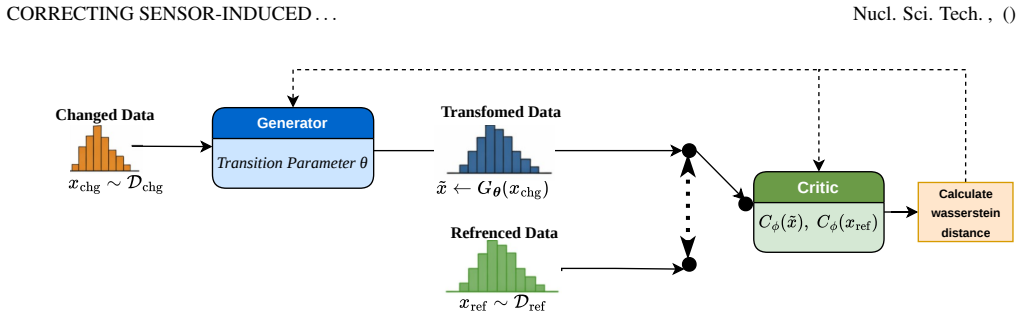
The generator is used as a learnable calibration transformation whose trainable weights represent the sought parameters, while the critic provides a distributional distance signal via the Wasserstein objective. This enables unsupervised inference of transformation parameters that map changed detector responses back to nominal distributions, as validated by recovering aging coefficients with correlation to ground truth on calorimeter data.
What carries the argument
Generator network as calibration transformation with weights as degradation parameters, trained using Wasserstein distance from the critic network.
If this is right
- Recovers aging coefficients for individual cells correlating with ground truth.
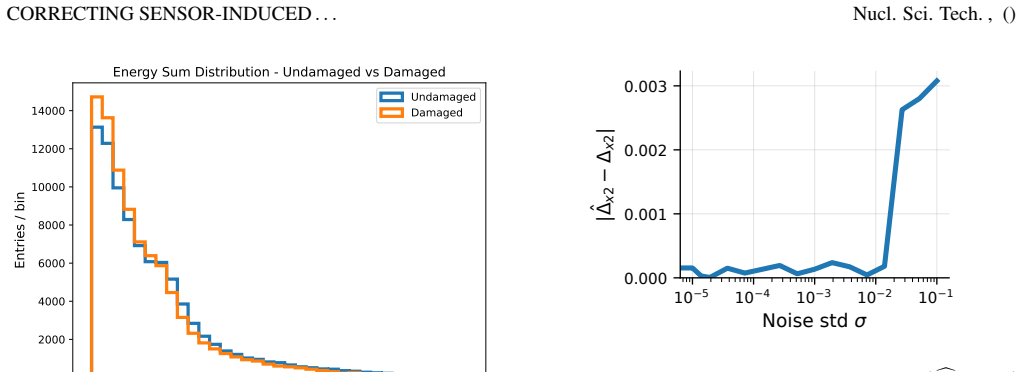
- Improves agreement between calibrated and reference energy-sum distributions.
- Exhibits expected performance degradation at higher channel-to-channel noise levels.
- Can serve as data-driven component in calibration strategies without direct labels for degradation parameters.
Where Pith is reading between the lines
- This approach could extend to correcting drifts in other types of detectors or sensors beyond calorimeters.
- Real-time application might be possible if the training can be made efficient enough for ongoing data streams.
- Similar adversarial setups could handle combined effects of aging and motion in the same model.
Load-bearing premise
That the weights of the trained generator directly represent the physical degradation parameters of the sensor cells rather than serving only as a statistical matching function.
What would settle it
A lack of correlation between the parameters learned by the generator and independently measured aging effects in the individual calorimeter cells would falsify the claim that the weights carry physical meaning.
Figures


read the original abstract
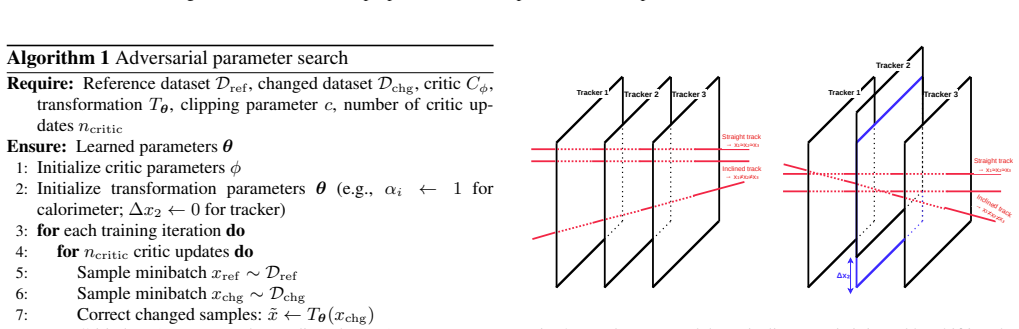
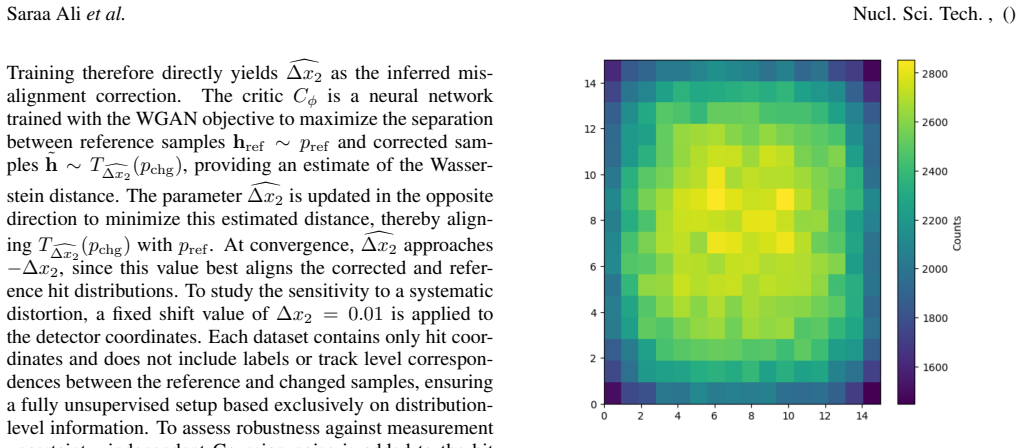
The quality of recorded data depends on the stability of the sensor system that acquires it. Sensor motion and aging can degrade the performance and stability of downstream data-driven methods. We present a Wasserstein-GAN-inspired approach for unsupervised inference of physically interpretable transformation parameters that map a changed detector response distribution back to a nominal reference distribution. In contrast to standard generative modeling, the generator is used as a learnable calibration transformation whose trainable weights represent the sought parameters, while the critic provides a distributional distance signal via the Wasserstein objective. We validate the approach on a tracking-detector toy model with controlled layer shifts and demonstrate its application on high-granularity Geant4-simulated calorimeter data with cell-wise aging effects. The method recovers aging coefficients for individual cells with correlation to ground truth and improves agreement between calibrated and reference energy-sum distributions, while exhibiting the expected degradation at increasing channel-to-channel noise levels. These results indicate that adversarial distribution matching can serve as a data-driven component of calibration strategies in settings where direct labels for degradation parameters are unavailable.
Editorial analysis
A structured set of objections, weighed in public.
Referee Report
Summary. The paper proposes a Wasserstein-GAN-inspired unsupervised method in which the generator network functions as a learnable calibration transformation whose trainable weights are interpreted as physically meaningful sensor degradation (aging) parameters. The critic supplies a distributional distance signal via the Wasserstein objective to map drifted detector responses back to a nominal reference. Validation occurs on a controlled tracking-detector toy model with layer shifts and on Geant4-simulated high-granularity calorimeter data with cell-wise aging; the method reports correlation between recovered and ground-truth aging coefficients together with improved agreement on energy-sum distributions, with expected performance degradation under increasing channel noise.
Significance. If the recovered weights can be shown to correspond to the true physical parameters rather than any distribution-matching transformation, the approach could supply a practical data-driven component for calibration pipelines in settings lacking direct labels for degradation. The controlled toy-model and Geant4 simulations with known ground truth constitute a clear strength, enabling quantitative checks of correlation and distributional improvement.
major comments (2)
- [Abstract and Geant4 validation] Abstract and Geant4 validation section: the claim that generator weights recover the true per-cell aging coefficients is supported only by correlation on aggregate energy-sum distributions. Because the inverse problem is underdetermined (distinct aging vectors can yield statistically indistinguishable sums given heterogeneous occupancies or noise), the reported correlation does not establish uniqueness; no theoretical argument, per-cell observable ablation, or identifiability analysis is supplied.
- [Method] Method section (generator parameterization): the architecture and hyper-parameters of the generator are listed among free parameters, yet no ablation or sensitivity study demonstrates that the learned weights converge to the physical degradation factors rather than an arbitrary function achieving equivalent Wasserstein match.
minor comments (2)
- Abstract provides limited detail on the precise extraction of transformation parameters from the trained generator weights.
- Figure captions and text should explicitly state the noise levels and occupancy heterogeneity used in the Geant4 experiments to allow readers to assess the under-determination concern.
Simulated Author's Rebuttal
We thank the referee for the constructive feedback on our manuscript. We address each major comment below, providing clarifications on the validation approach and agreeing to strengthen the discussion of limitations where appropriate.
read point-by-point responses
-
Referee: [Abstract and Geant4 validation] Abstract and Geant4 validation section: the claim that generator weights recover the true per-cell aging coefficients is supported only by correlation on aggregate energy-sum distributions. Because the inverse problem is underdetermined (distinct aging vectors can yield statistically indistinguishable sums given heterogeneous occupancies or noise), the reported correlation does not establish uniqueness; no theoretical argument, per-cell observable ablation, or identifiability analysis is supplied.
Authors: We agree that the inverse problem is underdetermined in general and that aggregate energy sums alone would not suffice to establish uniqueness. However, our reported per-cell correlation is computed directly between the learned generator weights and the known ground-truth aging coefficients in the controlled Geant4 simulation (not inferred from sums). The energy-sum agreement is presented as a downstream validation metric. While no formal identifiability theorem is provided, the specific diagonal parameterization of the generator (per-cell multiplicative factors) combined with the Wasserstein critic constrains the solution toward the physical parameters in the simulated regimes. We will add a dedicated paragraph in the revised Geant4 validation section discussing the underdetermined nature of the problem, the role of the parameterization in promoting recovery, and expected degradation under higher noise or heterogeneous occupancy. revision: partial
-
Referee: [Method] Method section (generator parameterization): the architecture and hyper-parameters of the generator are listed among free parameters, yet no ablation or sensitivity study demonstrates that the learned weights converge to the physical degradation factors rather than an arbitrary function achieving equivalent Wasserstein match.
Authors: The generator is deliberately restricted to a diagonal scaling transformation whose weights are the aging coefficients; this is not an arbitrary network but a physically motivated parameterization chosen to ensure interpretability. Hyper-parameters were selected for training stability on the toy model before application to Geant4 data. We acknowledge that an explicit ablation comparing this parameterization against a more general generator architecture would provide stronger evidence that the recovered weights correspond to degradation factors rather than any distribution-matching solution. We will include such a sensitivity study in the revised Method section. revision: yes
Circularity Check
No significant circularity; derivation is self-contained
full rationale
The paper defines the generator architecture such that its weights are the aging parameters and trains it via the standard Wasserstein objective to match distributions; validation then compares the resulting weights against independently known ground-truth values in controlled simulation. This is an external empirical check rather than a quantity defined by construction from the target parameters themselves. No self-citations appear load-bearing, no fitted inputs are renamed as predictions, no uniqueness theorems are imported from prior author work, and no ansatz is smuggled via citation. The central claim therefore rests on the properties of adversarial distribution matching and does not reduce to its own inputs.
Axiom & Free-Parameter Ledger
free parameters (1)
- generator network architecture and hyperparameters
axioms (1)
- domain assumption The Wasserstein distance between corrected and reference distributions can be minimized to recover physically meaningful degradation parameters
Reference graph
Works this paper leans on
-
[1]
Cross-industry review of autonomous alignment technolo- gies: Adaptation potential for modular construction.Journal of Cleaner Production, 495:145101, 2025
Sulemana Fatoama Abdulai, Tarek Zayed, Ibrahim Yahaya Wuni, Maxwell Fordjour Antwi-Afari, and Abdul-Mugis Yus- sif. Cross-industry review of autonomous alignment technolo- gies: Adaptation potential for modular construction.Journal of Cleaner Production, 495:145101, 2025
2025
-
[2]
Ai-based real-time anomaly detection in industrial engineering: A structured literature review, taxonomy, and research agenda
Philip Stahmann, Maximilian Nebel, and Christian Janiesch. Ai-based real-time anomaly detection in industrial engineering: A structured literature review, taxonomy, and research agenda. Computers & Industrial Engineering, 207:111236, 2025
2025
-
[3]
Ai-driven sensing technology: Review.Sensors, 24(10), 2024
Long Chen, Chenbin Xia, Zhehui Zhao, Haoran Fu, and Yun- min Chen. Ai-driven sensing technology: Review.Sensors, 24(10), 2024
2024
-
[4]
Alignment of the Silicon Tracking Detector using Survey Constraints
T Golling. Alignment of the Silicon Tracking Detector using Survey Constraints. Technical report, CERN, Geneva, 2006
2006
-
[5]
Calibration, alignment and long-term performance of the cms silicon tracking detector, May 2009
Erik Butz. Calibration, alignment and long-term performance of the cms silicon tracking detector, May 2009
2009
-
[6]
Cms ecal monitoring and calibration in lhc run ii.Journal of Physics: Conference Series, 1162(1):012002, jan 2019
Tanmay Mudholkar and on behalf of the CMS Collaboration. Cms ecal monitoring and calibration in lhc run ii.Journal of Physics: Conference Series, 1162(1):012002, jan 2019
2019
-
[7]
G. Aad, B. Abbott, J. Abdallah, et al. ATLAS data quality op- erations and performance for 2015-2018 data-taking.Journal of Instrumentation, 15(04):P04003, 2020
2015
-
[8]
Cms sili- con strip tracker calibration workflow and tools.Journal of Physics: Conference Series, 331(3):032044, dec 2011
Tapio Lamp ´en and (forthe CMS Collaboration). Cms sili- con strip tracker calibration workflow and tools.Journal of Physics: Conference Series, 331(3):032044, dec 2011
2011
-
[9]
ATLAS conditions database experience with the LCG COOL conditions database project.J
M Verducci. ATLAS conditions database experience with the LCG COOL conditions database project.J. Phys.: Conf. Ser., 119:042031, 2008
2008
-
[10]
Track-Based Alignment of the Inner Detector of ATLAS
Ana Ovcharova. Track-Based Alignment of the Inner Detector of ATLAS. Technical report, CERN, Geneva, 2012
2012
-
[11]
Atlas data preparation in run 2.Journal of Physics: Conference Series, 898(4):042050, oct 2017
PJ Laycock, MA Chelstowska, TC Donszelmann, J Guenther, A Nairz, R Nikolaidou, E Shabalina, J Strandberg, A Taffard, S Wang, and on behalf of the ATLAS Collaboration. Atlas data preparation in run 2.Journal of Physics: Conference Series, 898(4):042050, oct 2017
2017
-
[12]
Align- ment data streams for the atlas inner detector.Journal of Physics: Conference Series, 119(2):022030, jul 2008
B Pinto, A Amorim, P Pereira, M Elsing, R Hawkings, J Schieck, S Garcia, A Schaffer, H Ma, and A Anjos. Align- ment data streams for the atlas inner detector.Journal of Physics: Conference Series, 119(2):022030, jul 2008
2008
-
[13]
Domain-adversarial training of neural net- works.Journal of Machine Learning Research, 17(59):1–35, 2016
Yaroslav Ganin, Evgeniya Ustinova, Hana Ajakan, Pascal Ger- main, Hugo Larochelle, Franc ¸ois Laviolette, Mario March, and Victor Lempitsky. Domain-adversarial training of neural net- works.Journal of Machine Learning Research, 17(59):1–35, 2016
2016
-
[14]
Jun-Yan Zhu, Taesung Park, Phillip Isola, and Alexei A. Efros. Unpaired image-to-image translation using cycle-consistent adversarial networks. In2017 IEEE International Conference on Computer Vision (ICCV), pages 2242–2251, 2017
2017
-
[15]
The fron- tier of simulation-based inference.Proceedings of the Na- tional Academy of Sciences of the United States of America, 117(48):30055–30062, December 2020
Kyle Cranmer, Johann Brehmer, and Gilles Louppe. The fron- tier of simulation-based inference.Proceedings of the Na- tional Academy of Sciences of the United States of America, 117(48):30055–30062, December 2020
2020
-
[16]
Adversarial variational optimization of non-differentiable simulators
Gilles Louppe, Joeri Hermans, and Kyle Cranmer. Adversarial variational optimization of non-differentiable simulators. In The 22nd international conference on artificial intelligence and statistics, pages 1438–1447. PMLR, 2019
2019
-
[17]
Lawrence, editors.Dataset Shift in Machine Learning
Joaquin Quinonero-Candela, Masashi Sugiyama, Anton Schwaighofer, and Neil D. Lawrence, editors.Dataset Shift in Machine Learning. Neural Information Processing Series. The MIT Press, Cambridge, MA, 2008. Hardcover edition
2008
-
[18]
One or two things we know about concept drift—a survey on monitor- ing in evolving environments
Fabian Hinder, Valerie Vaquet, and Barbara Hammer. One or two things we know about concept drift—a survey on monitor- ing in evolving environments. part a: detecting concept drift. Frontiers in Artificial Intelligence, V olume 7 - 2024, 2024
2024
-
[19]
Domain-adversarial training of neural net- works.Journal of machine learning research, 17(59):1–35, 2016
Yaroslav Ganin, Evgeniya Ustinova, Hana Ajakan, Pascal Ger- main, Hugo Larochelle, Franc ¸ois Laviolette, Mario March, and Victor Lempitsky. Domain-adversarial training of neural net- works.Journal of machine learning research, 17(59):1–35, 2016
2016
-
[20]
Wasser- stein generative adversarial networks
Martin Arjovsky, Soumith Chintala, and L´eon Bottou. Wasser- stein generative adversarial networks. InInternational confer- ence on machine learning, pages 214–223. Pmlr, 2017
2017
-
[21]
Technical design report
ATLAS Collaboration.ATLAS inner detector. Technical design report. ATLAS. CERN, Geneva, 1997
1997
-
[22]
Technical design report
ATLAS Collaboration.ATLAS detector and physics perfor- mance. Technical design report. ATLAS. CERN, Geneva, 1999
1999
-
[23]
C. W. Fabjan and F. Gianotti. Calorimetry for particle physics. Reviews of Modern Physics, 75:1243–1286, 2003
2003
-
[24]
S. S. Korpachov and M. V . Chadeeva. Study of the unifor- mity of the response of scintillation tiles for high-granularity calorimeters.Brief Communications on Physics of Lebedev In- stitute, (10):52–56, 2018
2018
-
[25]
A. A. Alves, E. Ben-Haim, D. Bettinardi, et al. The lhcb detec- tor at the lhc.Journal of Instrumentation, 3:S08005, 2008
2008
-
[26]
Aamodt, A
K. Aamodt, A. Abrahantes Quintana, R. Acosta, et al. The alice experiment at the cern lhc.Journal of Instrumentation, 3:S08002, 2008. -9 Saraa Aliet al. Nucl. Sci. Tech. , ()
2008
-
[27]
G. Aad, B. Abbott, J. Abdallah, et al. The atlas experiment at the cern large hadron collider.Journal of Instrumentation, 3:S08003, 2008
2008
-
[28]
Deep generative models for detector signature simulation: A taxonomic review.Re- views in Physics, 12:100092, 2024
Baran Hashemi and Claudius Krause. Deep generative models for detector signature simulation: A taxonomic review.Re- views in Physics, 12:100092, 2024
2024
-
[29]
Learning particle physics by example: Location-aware genera- tive adversarial networks for physics synthesis.Computing and Software for Big Science, 1(1):4, 2017
Luke de Oliveira, Michela Paganini, and Benjamin Nachman. Learning particle physics by example: Location-aware genera- tive adversarial networks for physics synthesis.Computing and Software for Big Science, 1(1):4, 2017
2017
-
[30]
GANplifying event sam- ples.SciPost Phys., 10:139, 2021
Anja Butter, Sascha Diefenbacher, Gregor Kasieczka, Ben- jamin Nachman, and Tilman Plehn. GANplifying event sam- ples.SciPost Phys., 10:139, 2021
2021
-
[31]
Auto-encoding varia- tional bayes, 2022
Diederik P Kingma and Max Welling. Auto-encoding varia- tional bayes, 2022
2022
-
[32]
Generative adversarial nets.Advances in neu- ral information processing systems, 27, 2014
Ian J Goodfellow, Jean Pouget-Abadie, Mehdi Mirza, Bing Xu, David Warde-Farley, Sherjil Ozair, Aaron Courville, and Yoshua Bengio. Generative adversarial nets.Advances in neu- ral information processing systems, 27, 2014
2014
-
[33]
Prince, and Marcus A
Ivan Kobyzev, Simon J.D. Prince, and Marcus A. Brubaker. Normalizing flows: An introduction and review of current methods.IEEE Transactions on Pattern Analysis and Machine Intelligence, 43(11):3964–3979, 2021
2021
-
[34]
Denoising dif- fusion probabilistic models
Jonathan Ho, Ajay Jain, and Pieter Abbeel. Denoising dif- fusion probabilistic models. In H. Larochelle, M. Ranzato, R. Hadsell, M.F. Balcan, and H. Lin, editors,Advances in Neu- ral Information Processing Systems, volume 33, pages 6840–
-
[35]
Curran Associates, Inc., 2020
2020
-
[36]
Dual-parameterized quantum circuit gan model in high energy physics
Su Yeon Chang, Steven Herbert, Sofia Vallecorsa, El´ıas F Com- barro, and Ross Duncan. Dual-parameterized quantum circuit gan model in high energy physics. InEPJ Web of Conferences, volume 251, page 03050. EDP Sciences, 2021
2021
-
[37]
Fedor Ratnikov, Alexander Rogachev, Sergey Mokhnenko, Artem Maevskiy, Denis Derkach, Adam Davis, Nikita Kazeev, Lucio Anderlini, Matteo Barbetti, and Benedetto Gianluca Siddi. A full detector description using neural network driven simulation.Nuclear Instruments and Methods in Physics Re- search Section A: Accelerators, Spectrometers, Detectors and Associ...
2023
-
[38]
The LHCb ultra-fast simulation option, Lamarr: design and validation.EPJ Web of Conferences, 295:03040, May 2024
Lucio Anderlini, Matteo Barbetti, Simone Capelli, Glo- ria Corti, Adam Davis, Denis Derkach, Nikita Kazeev, Artem Maevskiy, Maurizio Martinelli, Sergei Mokhnenko, Benedetto Gianluca Siddi, and Zehua Xu. The LHCb ultra-fast simulation option, Lamarr: design and validation.EPJ Web of Conferences, 295:03040, May 2024. Proceedings of the 26th International Co...
2024
-
[39]
Uncertainties associated with gan-generated datasets in high energy physics.SciPost Physics, 12(3):104, 2022
Konstantin T Matchev, Alexander Roman, and Prasanth Shyamsundar. Uncertainties associated with gan-generated datasets in high energy physics.SciPost Physics, 12(3):104, 2022
2022
-
[40]
Su Yeon Chang, Sofia Vallecorsa, El´ıas F Combarro, and Fed- erico Carminati. Quantum generative adversarial networks in a continuous-variable architecture to simulate high energy physics detectors.arXiv preprint arXiv:2101.11132, 2021
arXiv 2021
-
[41]
Anomaly detection with conditional variational autoencoders
Adrian Alan Pol, Victor Berger, Cecile Germain, Gianluca Cerminara, and Maurizio Pierini. Anomaly detection with conditional variational autoencoders. In2019 18th IEEE in- ternational conference on machine learning and applications (ICMLA), pages 1651–1657. IEEE, 2019
2019
-
[42]
A variational autoencoder for model indepen- dent searches of new physics at lhc
Giulia Lavizzari, Giacomo Boldrini, Simone Gennai, and Pietro Govoni. A variational autoencoder for model indepen- dent searches of new physics at lhc. InInternational Con- ference on Image Analysis and Processing, pages 159–169. Springer, 2023
2023
-
[43]
Markus Stoye, Johann Brehmer, Gilles Louppe, Juan Pavez, and Kyle Cranmer. Likelihood-free inference with an improved cross-entropy estimator.arXiv preprint arXiv:1808.00973, 2018
Pith/arXiv arXiv 2018
-
[44]
Global optimisation of black-box functions with generative models in the wasserstein space
Tigran Ramazyan, Mikhail Hushchyn, and Denis Derkach. Global optimisation of black-box functions with generative models in the wasserstein space. InECAI 2024, pages 2394–
2024
-
[45]
The parameter estimation of logistic regression with maximum likelihood method and score function modification
Risma Febrianti, Yekti Widyaningsih, and Saskya Soemartojo. The parameter estimation of logistic regression with maximum likelihood method and score function modification. InJournal of physics: Conference series, volume 1725, page 012014. IOP Publishing, 2021
2021
-
[46]
Parameter estimation using neural networks in the presence of detector effects.Phys- ical Review D, 103(3):036001, 2021
Anders Andreassen, Shih-Chieh Hsu, Benjamin Nachman, Natchanon Suaysom, and Adi Suresh. Parameter estimation using neural networks in the presence of detector effects.Phys- ical Review D, 103(3):036001, 2021
2021
-
[47]
Alignment of the ATLAS Inner Detec- tor Tracking System with 2010 LHC proton-proton collisions at √s= 7 TeV
ATLAS Collaboration. Alignment of the ATLAS Inner Detec- tor Tracking System with 2010 LHC proton-proton collisions at √s= 7 TeV. Technical report, CERN, Geneva, 2011
2010
-
[48]
Global chi2 ap- proach to the Alignment of the ATLAS Silicon Tracking De- tectors
P Br ¨uckman, A Hicheur, and S J Haywood. Global chi2 ap- proach to the Alignment of the ATLAS Silicon Tracking De- tectors. Technical report, CERN, Geneva, 2005
2005
-
[49]
TRT Alignment For SR1 Cosmics and Beyond
A Bocci and W Hulsbergen. TRT Alignment For SR1 Cosmics and Beyond. Technical report, CERN, Geneva, 2007
2007
-
[50]
Dual distribution matching gan
Zhiwen Zuo, Lei Zhao, Ailin Li, Zhizhong Wang, Haibo Chen, Wi Xing, and Dongming Lu. Dual distribution matching gan. Neurocomputing, 478:37–48, 2022
2022
-
[51]
Wasser- stein generative adversarial networks
Martin Arjovsky, Soumith Chintala, and L´eon Bottou. Wasser- stein generative adversarial networks. In Doina Precup and Yee Whye Teh, editors,Proceedings of the 34th International Conference on Machine Learning, volume 70 ofProceedings of Machine Learning Research, pages 214–223. PMLR, 06–11 Aug 2017
2017
-
[52]
Improved training of wasser- stein gans.Advances in neural information processing systems, 30, 2017
Ishaan Gulrajani, Faruk Ahmed, Martin Arjovsky, Vincent Du- moulin, and Aaron C Courville. Improved training of wasser- stein gans.Advances in neural information processing systems, 30, 2017
2017
-
[53]
Spectral normalization for generative adver- sarial networks.arXiv preprint arXiv:1802.05957, 2018
Takeru Miyato, Toshiki Kataoka, Masanori Koyama, and Yuichi Yoshida. Spectral normalization for generative adver- sarial networks.arXiv preprint arXiv:1802.05957, 2018
Pith/arXiv arXiv 2018
-
[54]
Study of alignment-related systematic effects on the ATLAS Inner Detector tracking
ATLAS Collaboration. Study of alignment-related systematic effects on the ATLAS Inner Detector tracking. Technical re- port, CERN, Geneva, 2012
2012
-
[55]
Agostinelli et al
S. Agostinelli et al. GEANT4–a simulation toolkit.Nucl. In- strum. Meth. A, 506:250–303, 2003. -10
2003
discussion (0)
Sign in with ORCID, Apple, or X to comment. Anyone can read and Pith papers without signing in.