Dyck paths on black-and-white lattices
Pith reviewed 2026-06-26 20:40 UTC · model grok-4.3
The pith
Dyck paths with equal black and white cells beneath them are enumerated for chessboard and column-alternating grid colorings.
A machine-rendered reading of the paper's core claim, the machinery that carries it, and where it could break.
Core claim
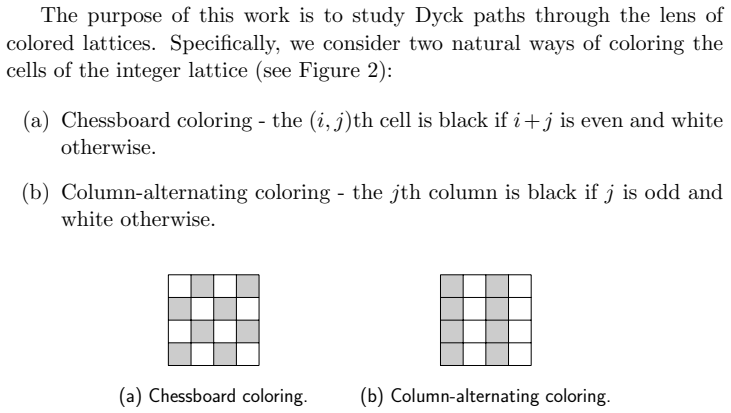
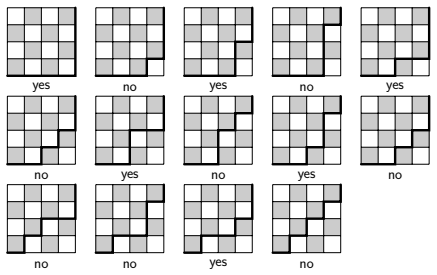
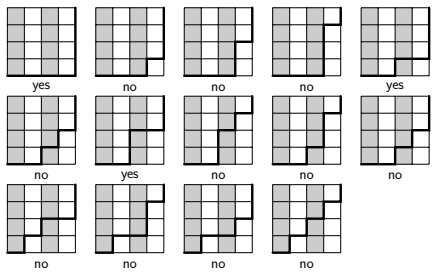
We color the cells of the integer grid in black and white according to two natural patterns, namely chessboard and column-alternating, and enumerate the Dyck paths having equal numbers of black and white cells beneath them.
What carries the argument
The chessboard coloring and the column-alternating coloring of the integer grid, which define the numbers of black and white cells beneath a Dyck path and allow the equality condition to be imposed.
If this is right
- The enumeration supplies explicit sequences counting the balanced paths for each of the two colorings.
- These sequences refine the Catalan numbers by the additional color-balance constraint.
- The balance condition partitions the full set of Dyck paths into those with equal black and white cells and those without.
Where Pith is reading between the lines
- Similar balance conditions could be imposed on other families of lattice paths such as Motzkin or Schröder paths.
- The column-alternating coloring introduces a periodic flavor that might link to generating functions with roots of unity or periodic coefficients.
- Bijective proofs connecting the balanced paths to other Catalan objects counted by the same numbers would strengthen the results.
Load-bearing premise
The two colorings are well-defined on the integer grid such that the number of cells of each color beneath any given Dyck path is unambiguously determined.
What would settle it
For small fixed n, compute by hand or program the exact number of Dyck paths satisfying the equal-color condition under each coloring and check whether the numbers match the paper's enumeration formula.
Figures

read the original abstract
A Dyck path of semilength $n$ is a lattice path from $(0,0)$ to $(n,n)$ consisting of $n$ right-steps $(1,0)$ and $n$ up-steps $(0,1)$ that never rises above the line $y=x$. These paths are enumerated by the Catalan numbers and play a central role in enumerative combinatorics. We color the cells of the integer grid in black and white according to two natural patterns, namely chessboard and column-alternating, and enumerate the Dyck paths having equal numbers of black and white cells beneath them.
Editorial analysis
A structured set of objections, weighed in public.
Referee Report
Summary. The manuscript defines Dyck paths of semilength n (lattice paths from (0,0) to (n,n) with right and up steps never rising above y=x) and two grid colorings (chessboard via parity of i+j, column-alternating via parity within each fixed-x column). It enumerates those paths for which the number of black and white unit squares in the region beneath the path are equal.
Significance. If explicit formulas or generating functions are derived and verified, the results would refine the Catalan numbers by a color-balance statistic under two natural colorings, adding to the body of work on weighted or colored Dyck paths and potentially yielding new bijections or q-analogues.
minor comments (2)
- [Abstract] Abstract: the claim of enumeration is stated without any explicit formula, generating function, or proof outline, which slows assessment of the central contribution even though the full text presumably supplies these.
- The region 'beneath' the path is described as standard, but a brief sentence confirming it consists of unit squares strictly below the path (with no boundary ambiguity for the equality condition) would aid readers.
Simulated Author's Rebuttal
We thank the referee for their concise summary of the manuscript and for recommending minor revision. No major comments were listed in the report, so there are no specific points requiring point-by-point response or revision.
Circularity Check
No significant circularity
full rationale
The paper is a direct combinatorial enumeration of Dyck paths (semilength n) satisfying an equality condition on the number of black and white unit squares beneath the path, under two explicitly defined grid colorings (chessboard by (i+j) parity; column-alternating by column parity). Both colorings and the 'beneath' region are standard, unambiguous lattice definitions independent of the enumeration result itself. No equations, fitted parameters, self-citations, or ansatzes are present in the provided text that would reduce the claimed counts to the inputs by construction. The derivation chain is therefore self-contained.
Axiom & Free-Parameter Ledger
Reference graph
Works this paper leans on
-
[1]
S.-E. Cheng, S.-P. Eu, and T.-S. Fu, Area of Catalan paths on a checkerboard,European J. Combin.28(2007), no. 4, 1331–1344. https://doi.org/10.1016/j.ejc.2006.01.006
-
[2]
S. Fried, Black-white cell capacity ink-ary words and permutations, arXiv preprint arXiv:2509.07533 [math.CO], 2025.https://arxiv. org/abs/2509.07533
arXiv 2025
-
[3]
R. P. Stanley,Catalan Numbers, Cambridge University Press, 2015
2015
-
[4]
N. J. A. Sloane, The On-Line Encyclopedia of Integer Sequences, OEIS Foundation Inc.,https://oeis.org
-
[5]
R. A. Sulanke, Moments, Narayana numbers, and the cut and paste for lattice paths,J. Statist. Plann. Inference135(2005), no. 1, 229–244. https://doi.org/10.1016/j.jspi.2005.02.016 8
discussion (0)
Sign in with ORCID, Apple, or X to comment. Anyone can read and Pith papers without signing in.