Lifecycle-Aware Dynamic Analysis for Secure ML Model Execution
Pith reviewed 2026-06-26 20:32 UTC · model grok-4.3
The pith
Dynamic monitoring of structured host interactions during ML model lifecycle phases detects every evaluated attack class with near-zero false positives.
A machine-rendered reading of the paper's core claim, the machinery that carries it, and where it could break.
Core claim
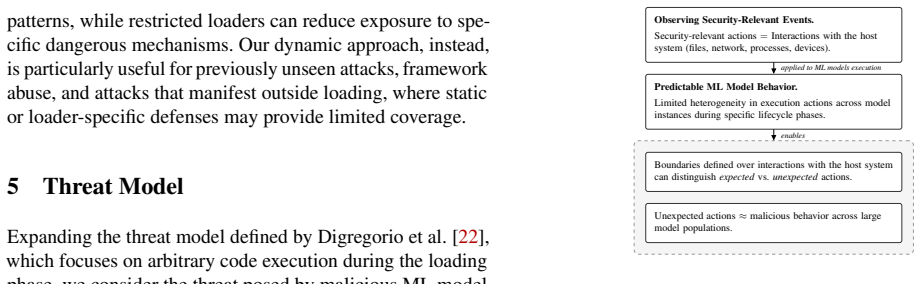
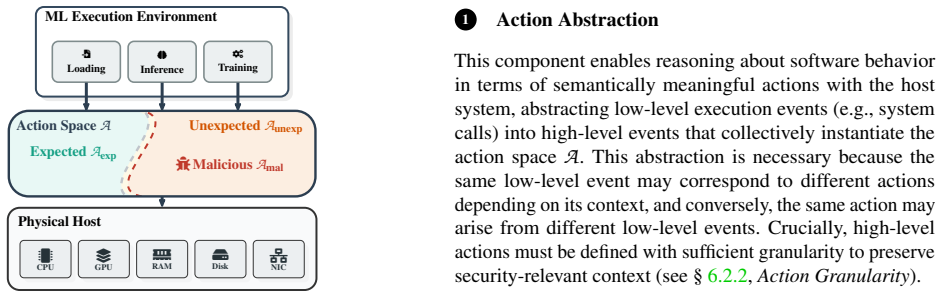
By translating the observation that ML models operate in well-defined lifecycle phases with highly structured and predictable host-system interactions into a dynamic analysis design, the approach detects all evaluated attack classes while maintaining a close-to-zero false-positive rate across multiple frameworks, real-world model collections, and known attack proofs-of-concept.
What carries the argument
Moat, the dynamic lifecycle-aware monitor that observes effects on the host system during each execution phase instead of relying on static signatures.
If this is right
- All tested attack classes are detected regardless of the ML framework used.
- False-positive rate stays close to zero on large collections of real-world models.
- The method generalizes beyond the limitations of static, format-specific scanners.
- Dynamic analysis is motivated as a viable direction for securing ML model execution.
- Evaluation covers 77,974 Hugging Face models plus CVE PoCs and an established attack dataset.
Where Pith is reading between the lines
- The same phase-based monitoring idea could be applied to other executable artifacts whose runtime behavior follows repeatable stages.
- Runtime security layers in ML serving platforms might adopt similar checks without requiring per-framework static parsers.
- Extending the approach to track additional host resources such as network or GPU activity could catch a broader range of side effects.
- Organizations hosting model repositories could integrate the monitor into upload pipelines to flag suspicious artifacts before distribution.
Load-bearing premise
ML models operate within well-defined lifecycle phases and within each phase their interactions with the host system are highly structured and predictable.
What would settle it
A single CVE-style attack that alters model behavior without producing detectable deviations from the expected host-system interactions in any lifecycle phase, or a set of legitimate models that trigger repeated false positives under the same monitoring rules.
Figures



read the original abstract
The growing reliance on pre-trained Machine Learning (ML) models has introduced new attack surfaces. Recent vulnerabilities demonstrate that malicious behavior can be embedded within model artifacts, often bypassing existing defenses. Current model-scanning solutions primarily rely on static, format-specific rules or known attack signatures, which limit their ability to generalize across frameworks and to detect novel exploitation paths. In contrast, we propose a solution that focuses on the effects an attack has on the host system executing the model and builds on foundational intuitions about ML model execution. In particular, we observe that ML models operate within well-defined lifecycle phases and that, within each phase, interactions with the host system are highly structured and predictable. We translate these intuitions into Moat, a dynamic lifecycle-aware approach for securing ML model execution, and instantiate this design in Re-Moat, our reference implementation. We evaluate Re-Moat across multiple ML frameworks using 77,974 real-world model artifacts from the Hugging Face Hub, 31 Proofs-of-Concept (PoCs) from CVEs, and 334 models from a state-of-the-art dataset, and compare it against state-of-the-art model-scanning solutions. Our results show that our approach detects all evaluated attack classes while maintaining a close-to-zero false-positive rate, validating our intuitions and motivating dynamic analysis for securing ML model execution.
Editorial analysis
A structured set of objections, weighed in public.
Referee Report
Summary. The paper proposes Moat, a dynamic lifecycle-aware approach for securing ML model execution by monitoring the effects of model interactions with the host system during well-defined lifecycle phases, where such interactions are assumed to be structured and predictable. It is instantiated as Re-Moat and evaluated on 77,974 real-world models from the Hugging Face Hub, 31 CVE PoCs, and 334 models from a state-of-the-art dataset, claiming to detect all evaluated attack classes with a close-to-zero false-positive rate while outperforming static, signature-based scanners.
Significance. If the empirical results hold under scrutiny, the work would be significant for ML security by shifting focus from static format-specific rules to dynamic, framework-agnostic analysis of runtime effects. The large-scale evaluation on real-world artifacts and CVE PoCs is a strength that supports claims of generalizability to novel attacks.
major comments (1)
- [Abstract] Abstract: the central claim that the approach 'detects all evaluated attack classes while maintaining a close-to-zero false-positive rate' on 77,974 models, 31 CVEs, and 334 dataset models cannot be assessed because the provided text contains no description of the detection mechanism, phase definitions, dynamic features monitored, statistical methods, error bars, or exclusion criteria used to support this result.
Simulated Author's Rebuttal
We thank the referee for the review and the opportunity to clarify the presentation of our results. We address the single major comment below.
read point-by-point responses
-
Referee: [Abstract] Abstract: the central claim that the approach 'detects all evaluated attack classes while maintaining a close-to-zero false-positive rate' on 77,974 models, 31 CVEs, and 334 dataset models cannot be assessed because the provided text contains no description of the detection mechanism, phase definitions, dynamic features monitored, statistical methods, error bars, or exclusion criteria used to support this result.
Authors: We agree the abstract is too terse to allow standalone assessment of the central claim. The full manuscript defines the three lifecycle phases (loading, initialization, inference) and the monitored dynamic features (file-system writes/reads, process creation, network sockets, and memory mappings) in Section 3; the detection logic (phase-specific behavioral baselines derived from 1,000 benign models, followed by per-phase deviation scoring with a fixed threshold) is in Section 4. No error bars appear because each model produces a deterministic outcome under our sandboxed execution. We will revise the abstract to add one sentence summarizing the phase definitions, the dynamic features, and the deviation-based detection rule, while preserving the length constraint. This change will make the claim evaluable from the abstract alone. revision: yes
Circularity Check
No significant circularity
full rationale
The paper states its foundational intuitions explicitly (ML models have well-defined lifecycle phases with predictable host interactions), translates them into the Moat design and Re-Moat implementation, then reports an empirical evaluation on 77,974 real-world models, 31 CVEs, and 334 dataset models that measures detection of attack classes against a near-zero false-positive baseline. No equations, fitted parameters, or self-citations appear as load-bearing steps in the provided material; the central claim is presented as an external validation of the stated assumptions rather than a reduction to those assumptions by construction. The evaluation design directly tests the claimed distinction between attack effects and normal behavior, rendering the derivation self-contained against the reported benchmarks.
Axiom & Free-Parameter Ledger
Reference graph
Works this paper leans on
-
[1]
Murray, Benoit Steiner, Paul Tucker, Vijay Vasudevan, Pete Warden, Martin Wicke, Yuan Yu, and Xiaoqiang Zheng
Martín Abadi, Paul Barham, Jianmin Chen, Zhifeng Chen, Andy Davis, Jeffrey Dean, Matthieu Devin, San- jay Ghemawat, Geoffrey Irving, Michael Isard, Man- junath Kudlur, Josh Levenberg, Rajat Monga, Sherry Moore, Derek G. Murray, Benoit Steiner, Paul Tucker, Vijay Vasudevan, Pete Warden, Martin Wicke, Yuan Yu, and Xiaoqiang Zheng. TensorFlow: a system for l...
2016
-
[2]
Malware Dynamic Analysis Eva- sion Techniques: A Survey.ACM Comput
Amir Afianian, Salman Niksefat, Babak Sadeghiyan, and David Baptiste. Malware Dynamic Analysis Eva- sion Techniques: A Survey.ACM Comput. Surv., 52(6), November 2019
2019
-
[3]
A Comprehen- sive Review on Malware Detection Approaches.IEEE Access, 8:6249–6271, 2020
Ömer Aslan Aslan and Refik Samet. A Comprehen- sive Review on Malware Detection Approaches.IEEE Access, 8:6249–6271, 2020
2020
-
[4]
Wild patterns: Ten years after the rise of adversarial machine learning.Pattern Recognition, 84:317–331, 2018
Battista Biggio and Fabio Roli. Wild patterns: Ten years after the rise of adversarial machine learning.Pattern Recognition, 84:317–331, 2018
2018
-
[5]
Bridges, Tarrah R
Robert A. Bridges, Tarrah R. Glass-Vanderlan, Michael D. Iannacone, Maria S. Vincent, and Qian (Guenevere) Chen. A survey of intrusion detec- tion systems leveraging host data.ACM Comput. Surv., 52(6), November 2019
2019
-
[6]
Hugging face and virustotal collaborate to strengthen ai security
Adrien Carreira and Bernardo Quintero. Hugging face and virustotal collaborate to strengthen ai security. Hug- ging Face Blog, October 2025. Accessed: 2026-06-03
2025
-
[7]
Beatrice Casey, Joanna C. S. Santos, and Mehdi Mi- rakhorli. A Large-Scale Exploit Instrumentation Study of AI/ML Supply Chain Attacks in Hugging Face Mod- els.arXiv preprint, abs/2410.04490, 2024
arXiv 2024
-
[8]
Towards an understanding of anti- virtualization and anti-debugging behavior in modern malware
Xu Chen, Jon Andersen, Z Morley Mao, Michael Bailey, and Jose Nazario. Towards an understanding of anti- virtualization and anti-debugging behavior in modern malware. In2008 IEEE international conference on dependable systems and networks with FTCS and DCC (DSN), pages 177–186. IEEE, 2008
2008
-
[9]
Keras, 2015
François Chollet et al. Keras, 2015. https://keras. io
2015
-
[10]
ClamA V: Open-Source Antivirus Toolkit
Cisco Talos (ClamA V Team). ClamA V: Open-Source Antivirus Toolkit. https://docs.clamav.net/, 2025. Accessed: 2025-12-30
2025
-
[11]
CVE-2024-3660
CVE Program. CVE-2024-3660. https://www.cve. org/CVERecord?id=CVE-2024-3660, 2024
2024
-
[12]
CVE-2025-12058
CVE Program. CVE-2025-12058. https://www.cve. org/CVERecord?id=CVE-2025-12058, 2025
2025
-
[13]
CVE-2025-1550
CVE Program. CVE-2025-1550. https://www.cve. org/CVERecord?id=CVE-2025-1550, 2025
2025
-
[14]
CVE-2025-32434
CVE Program. CVE-2025-32434. https://www.cve. org/CVERecord?id=CVE-2025-32434, 2025
2025
-
[15]
CVE-2025-49655
CVE Program. CVE-2025-49655. https://www.cve. org/CVERecord?id=CVE-2025-49655, 2025
2025
-
[16]
CVE-2025-8747
CVE Program. CVE-2025-8747. https://www.cv e.org/CVERecord?id=CVE-2025-8747 , 2025. Ac- cessed: 2025-12-30
2025
-
[17]
CVE-2025-9905
CVE Program. CVE-2025-9905. https://www.cve. org/CVERecord?id=CVE-2025-9905, 2025
2025
-
[18]
CVE-2025-9906
CVE Program. CVE-2025-9906. https://www.cve. org/CVERecord?id=CVE-2025-9906, 2025
2025
-
[19]
CVE-2025-1550 - Bypassing Keras safe_mode for Arbitrary Code Execution
Gabriele Digregorio. CVE-2025-1550 - Bypassing Keras safe_mode for Arbitrary Code Execution. https: //github.com/io- no/CVE- Reports/issues/2 ,
2025
-
[20]
Accessed: 2025-12-30
2025
-
[21]
libdebug: Build Your Own Debugger
Gabriele Digregorio, Roberto Alessandro Bertolini, Francesco Panebianco, and Mario Polino. libdebug: Build Your Own Debugger. https://libdebug.org, 2024
2024
-
[22]
Poster: lib- debug, Build Your Own Debugger for a Better (Hello) World
Gabriele Digregorio, Roberto Alessandro Bertolini, Francesco Panebianco, and Mario Polino. Poster: lib- debug, Build Your Own Debugger for a Better (Hello) World. InProceedings of the 2024 on ACM SIGSAC Conference on Computer and Communications Security, CCS ’24, page 4976–4978, New York, NY , USA, 2024. Association for Computing Machinery
2024
-
[23]
On the (In)Security of Loading Machine Learning Models
Gabriele Digregorio, Marco Di Gennaro, Stefano Zanero, Stefano Longari, and Michele Carminati. On the (In)Security of Loading Machine Learning Models . In2026 IEEE Symposium on Security and Privacy (SP), pages 214–231, Los Alamitos, CA, USA, May 2026. IEEE Computer Society. 15
2026
-
[24]
Towards Measuring Supply Chain Attacks on Package Managers for Interpreted Languages
Ruian Duan, Omar Alrawi, Ranjita Pai Kasturi, Ryan El- der, Brendan Saltaformaggio, and Wenke Lee. Towards Measuring Supply Chain Attacks on Package Managers for Interpreted Languages. InNDSS 2021, 2021
2021
-
[25]
A survey on automated dynamic malware-analysis techniques and tools.ACM Comput
Manuel Egele, Theodoor Scholte, Engin Kirda, and Christopher Kruegel. A survey on automated dynamic malware-analysis techniques and tools.ACM Comput. Surv., 44(2), March 2008
2008
-
[26]
Falco: Cloud Native Runtime Security
Falco Project. Falco: Cloud Native Runtime Security. https://github.com/falcosecurity/falco, 2025. Version 0.42.0
2025
-
[27]
Forrest, S.A
S. Forrest, S.A. Hofmeyr, A. Somayaji, and T.A. Longstaff. A sense of self for unix processes. InPro- ceedings 1996 IEEE Symposium on Security and Pri- vacy, pages 120–128, 1996
1996
-
[28]
Daniel Gibert, Carles Mateu, and Jordi Planes. The rise of machine learning for detection and classification of malware: Research developments, trends and chal- lenges.Journal of Network and Computer Applications, 153:102526, 2020
2020
-
[29]
Install TensorFlow with pip
Google. Install TensorFlow with pip. https://ww w.tensorflow.org/install/pip , 2025. Accessed: 2025-12-29
2025
-
[30]
TensorFlow Hub: Reusable Machine Learning Modules
Google Research, Brain Team. TensorFlow Hub: Reusable Machine Learning Modules. https://ww w.tensorflow.org/hub , 2025. Accessed: 2025-12- 12
2025
-
[31]
Security and Pickle Files — Hug- ging Face Hub Documentation
Hugging Face, Inc. Security and Pickle Files — Hug- ging Face Hub Documentation. https://huggingf ace.co/docs/hub/en/security-pickle, 2024. Ac- cessed: 2025-12-30
2024
-
[32]
Hugging Face Hub Documentation
Hugging Face Inc. Hugging Face Hub Documentation. https://huggingface.co/docs/hub/index , 2025. Accessed: 2025-12-12
2025
-
[33]
Python Developers Survey 2024
JetBrains. Python Developers Survey 2024. https: //lp.jetbrains.com/python-developers-surve y-2024/, 2024. Accessed: 2026-01-15
2024
-
[34]
Software Supply Chain Solutions for DevOps and Security — JFrog
JFrog Ltd. Software Supply Chain Solutions for DevOps and Security — JFrog. https://jfrog.com/ , 2025. Accessed: 2025-12-30
2025
-
[35]
Schorlemmer, Rohan Sethi, Yung-Hsiang Lu, George K
Wenxin Jiang, Nicholas Synovic, Matt Hyatt, Taylor R. Schorlemmer, Rohan Sethi, Yung-Hsiang Lu, George K. Thiruvathukal, and James C. Davis. An Empirical Study of Pre-Trained Model Reuse in the Hugging Face Deep Learning Model Registry. InProceedings of the 45th In- ternational Conference on Software Engineering, ICSE ’23, page 2463–2475. IEEE Press, 2023
2023
-
[36]
Schorlemmer, George K
Wenxin Jiang, Nicholas Synovic, Rohan Sethi, Aryan Indarapu, Matt Hyatt, Taylor R. Schorlemmer, George K. Thiruvathukal, and James C. Davis. An Empirical Study of Artifacts and Security Risks in the Pre-trained Model Supply Chain. InSCORED 2022, pages 105–114, 2022
2022
-
[37]
Safe Harbor or Hostile Waters: Unveiling the Hidden Perils of the TorchScript Engine in PyTorch
Zhou Ji’an and Song Lishuo. Safe Harbor or Hostile Waters: Unveiling the Hidden Perils of the TorchScript Engine in PyTorch. Presentation at Black Hat USA - https://i.blackhat.com/BH-USA-25/Presenta tions/US-25-Jian-Lishuo-Safe-Harbor-or-Hos tile-Waters.pdf, August 2025. Accessed: 2026-06- 03
2025
-
[38]
Kaggle Models
Kaggle, Inc. Kaggle Models. https://www.kaggle.c om/models, 2025. Accessed: 2025-12-12
2025
-
[39]
Kellas, Neophytos Christou, Wenxin Jiang, Penghui Li, Laurent Simon, Yaniv David, Vasileios P
Andreas D. Kellas, Neophytos Christou, Wenxin Jiang, Penghui Li, Laurent Simon, Yaniv David, Vasileios P. Kemerlis, James C. Davis, and Junfeng Yang. Pickle- Ball: Secure Deserialization of Pickle-based Machine Learning Models. InProceedings of the 2025 ACM SIGSAC Conference on Computer and Communications Security, CCS ’25, page 3341–3355, New York, NY , ...
2025
-
[40]
Serialization and Saving — Keras Documentation
Keras Developers. Serialization and Saving — Keras Documentation. https://keras.io/guides/serial ization_and_saving/, 2023. Accessed: 2025-12-30
2023
-
[41]
Model Training APIs — Keras Doc- umentation
Keras Developers. Model Training APIs — Keras Doc- umentation. https://keras.io/api/models/mode l_training_apis/, 2025. Accessed: 2025-12-30
2025
-
[42]
Whole model saving & loading - Keras
Keras Developers. Whole model saving & loading - Keras. https://keras.io/api/models/model_ saving_apis/model_saving_and_loading/ , 2025. Accessed: 2025-12-12
2025
-
[43]
SoK: Taxonomy of Attacks on Open- Source Software Supply Chains
Piergiorgio Ladisa, Henrik Plate, Matias Martinez, and Olivier Barais. SoK: Taxonomy of Attacks on Open- Source Software Supply Chains . In2023 IEEE Sympo- sium on Security and Privacy (SP), pages 1509–1526, Los Alamitos, CA, USA, May 2023. IEEE Computer Society
2023
-
[44]
ptrace(2) — Linux manual page
Linux Developers. ptrace(2) — Linux manual page. https://man7.org/linux/man-pages/man2/ptra ce.2.html, 2024. Accessed: 2025-12-29
2024
-
[45]
seccomp(2) — Linux manual page
Linux Developers. seccomp(2) — Linux manual page. https://man7.org/linux/man-pages/man2/secc omp.2.html, 2025. Accessed: 2025-12-29
2025
-
[46]
The art of hide and seek: Making pickle-based model supply chain poisoning stealthy again, 2025
Tong Liu, Guozhu Meng, Peng Zhou, Zizhuang Deng, Shuaiyin Yao, and Kai Chen. The art of hide and seek: Making pickle-based model supply chain poisoning stealthy again, 2025. 16
2025
-
[47]
Position: Machine Learning Models Have a Supply Chain Problem
Sarah Meiklejohn, Hayden Blauzvern, Mihai Maruseac, Spencer Schrock, Laurent Simon, and Ilia Shumailov. Position: Machine Learning Models Have a Supply Chain Problem. InForty-second International Confer- ence on Machine Learning Position Paper Track, 2025
2025
-
[48]
Sysmon for Linux
Microsoft. Sysmon for Linux. https://github.com /microsoft/SysmonForLinux, 2025
2025
-
[49]
Sysmon v15.15
Microsoft Sysinternals. Sysmon v15.15. https://le arn.microsoft.com/en-us/sysinternals/downl oads/sysmon, 2024. Accessed: 2025-12-27
2024
-
[50]
2022 Kaggle Machine Learning & Data Science Survey
Paul Mooney. 2022 Kaggle Machine Learning & Data Science Survey. https://kaggle.com/competition s/kaggle-survey-2022, 2022. Kaggle
2022
-
[51]
4M Models Scanned: Protect AI + Hug- ging Face 6 Months In
Sean Morgan. 4M Models Scanned: Protect AI + Hug- ging Face 6 Months In. https://huggingface.co/b log/pai-6-month, April 2025. Accessed: 2025-12-30
2025
-
[52]
Backstabber’s Knife Collection: A Review of Open Source Software Supply Chain Attacks
Marc Ohm, Henrik Plate, Arnold Sykosch, and Michael Meier. Backstabber’s Knife Collection: A Review of Open Source Software Supply Chain Attacks. InDIMVA 2020, pages 23–43, 2020
2020
-
[53]
Loading Models, Launching Shells: Abusing AI File Formats for Code Execution
Cyrus Parzian. Loading Models, Launching Shells: Abusing AI File Formats for Code Execution. Pre- sentation at the DEF CON 33 Hacking Conference - https://media.defcon.org/DEF%20CON%2033/DE F%20CON%2033%20presentations/Cyrus%20Parzi an%20-%20Loading%20Models%2C%20Launching% 20Shells%20Abusing%20AI%20File%20Formats%2 0for%20Code%20Execution.pdf , 2025. Acc...
2033
-
[54]
TESSERACT: Eliminating Experimental Bias in Malware Classifica- tion across Space and Time
Feargus Pendlebury, Fabio Pierazzi, Roberto Jordaney, Johannes Kinder, and Lorenzo Cavallaro. TESSERACT: Eliminating Experimental Bias in Malware Classifica- tion across Space and Time. In28th USENIX Secu- rity Symposium (USENIX Security 19), pages 729–746, Santa Clara, CA, August 2019. USENIX Association
2019
-
[55]
ModelScan: Open source protection against model serialization attacks
Protect AI. ModelScan: Open source protection against model serialization attacks. https://github.com/p rotectai/modelscan, 2025. Accessed: 2025-12-30
2025
-
[56]
Protect AI — The Platform for AI Security
Protect AI. Protect AI — The Platform for AI Security. https://protectai.com/, 2025. Accessed: 2025-12- 30
2025
-
[57]
pickle — Python object serialization
Python Software Foundation. pickle — Python object serialization. https://docs.python.org/3/librar y/pickle.html, 2025. Accessed: 2025-12-12
2025
-
[58]
Serialization semantics — Py- Torch Documentation
PyTorch Developers. Serialization semantics — Py- Torch Documentation. https://docs.pytorch.o rg/docs/2.7/notes/serialization.html , 2025. Accessed: 2025-12-12
2025
-
[59]
Save and Load the Model — Py- Torch Tutorials 2.7.0+cu126 documentation
PyTorch developers. Save and Load the Model — Py- Torch Tutorials 2.7.0+cu126 documentation. https: //docs.pytorch.org/tutorials/beginner/basi cs/saveloadrun_tutorial.html , 2026. Accessed: 2026-01-31
2026
-
[60]
PyTorch Hub
PyTorch Foundation. PyTorch Hub. https://pytorc h.org/hub/, 2025. Accessed: 2025-12-12
2025
-
[61]
A systematic literature review on host-based intrusion de- tection systems.IEEE Access, 12:27237–27266, 2024
Hami Satilmi¸ s, Sedat Akleylek, and Zaliha Yüce Tok. A systematic literature review on host-based intrusion de- tection systems.IEEE Access, 12:27237–27266, 2024
2024
-
[62]
Extended berkeley packet filter: An application perspec- tive.IEEE Access, 10:126370–126393, 2022
Husain Sharaf, Imtiaz Ahmad, and Tassos Dimitriou. Extended berkeley packet filter: An application perspec- tive.IEEE Access, 10:126370–126393, 2022
2022
-
[63]
Sysdig: Cloud Security Starts at Runtime
Sysdig Inc. Sysdig: Cloud Security Starts at Runtime. https://sysdig.com/, 2025. Accessed: 2025-12-27
2025
-
[64]
SavedModel format guide — TensorFlow Documentation
TensorFlow Developers. SavedModel format guide — TensorFlow Documentation. https://www.tensor flow.org/guide/saved_model , 2024. Accessed: 2025-12-12
2024
-
[65]
Training checkpoints — Ten- sorFlow Documentation
TensorFlow Developers. Training checkpoints — Ten- sorFlow Documentation. https://www.tensorflow .org/guide/checkpoint, 2024. Accessed: 2025-12- 12
2024
-
[66]
tf.keras.models.load_model — TensorFlow API Documentation
TensorFlow Developers. tf.keras.models.load_model — TensorFlow API Documentation. https://www.tens orflow.org/api_docs/python/tf/keras/models /load_model, 2025. Accessed: 2025-12-30
2025
-
[67]
TensorFlow I/O: Dataset, streaming, and file system extensions maintained by TensorFlow SIG-IO
TensorFlow I/O Contributors. TensorFlow I/O: Dataset, streaming, and file system extensions maintained by TensorFlow SIG-IO. https://github.com/tensorf low/io, 2018
2018
-
[68]
TensorFlow Security Policy
TensorFlow Security Team. TensorFlow Security Policy. https://github.com/tensorflow/tensorflow/b lob/master/SECURITY.md, 2025. Accessed: 2025-01- 18
2025
-
[69]
Fickling: A Tool for Manipulating and Analyzing Python Pickle Programs
Trail of Bits. Fickling: A Tool for Manipulating and Analyzing Python Pickle Programs. https://github .com/trailofbits/fickling . Accessed: 2025-12- 30
2025
-
[70]
VirusTotal
VirusTotal. VirusTotal. https://www.virustotal.c om/, 2025. Accessed: 2025-12-30
2025
-
[71]
Linux Security Mod- ules: General Security Support for the Linux Kernel
Chris Wright, Crispin Cowan, Stephen Smalley, James Morris, and Greg Kroah-Hartman. Linux Security Mod- ules: General Security Support for the Linux Kernel. In 11th USENIX Security Symposium (USENIX Security 02), San Francisco, CA, August 2002. USENIX Associ- ation. 17
2002
-
[72]
Models Are Codes: Towards Measur- ing Malicious Code Poisoning Attacks on Pre-trained Model Hubs
Jian Zhao, Shenao Wang, Yanjie Zhao, Xinyi Hou, Kai- long Wang, Peiming Gao, Yuanchao Zhang, Chen Wei, and Haoyu Wang. Models Are Codes: Towards Measur- ing Malicious Code Poisoning Attacks on Pre-trained Model Hubs. InProceedings of the 39th IEEE/ACM International Conference on Automated Software En- gineering, ASE ’24, page 2087–2098, New York, NY , USA...
2087
-
[73]
outside the standard library
Ruofan Zhu, Ganhao Chen, Wenbo Shen, Xiaofei Xie, and Rui Chang. My Model is Malware to You: Trans- forming AI Models into Malware by Abusing Tensor- Flow APIs. In2025 IEEE Symposium on Security and Privacy (SP), pages 486–503, 2025. A Tracer Implementations In this appendix, we survey concrete mechanisms that can be used to observe system-level interacti...
2025
discussion (0)
Sign in with ORCID, Apple, or X to comment. Anyone can read and Pith papers without signing in.