JWST-TST High Contrast: First Direct Spectroscopy of GJ 504 b reveals Clouds and Possible Metal Enrichment
Pith reviewed 2026-06-26 19:30 UTC · model grok-4.3
The pith
The first moderate-resolution spectrum of GJ 504 b shows water, methane, carbon monoxide and other molecules along with metal enrichment and salt clouds.
A machine-rendered reading of the paper's core claim, the machinery that carries it, and where it could break.
Core claim
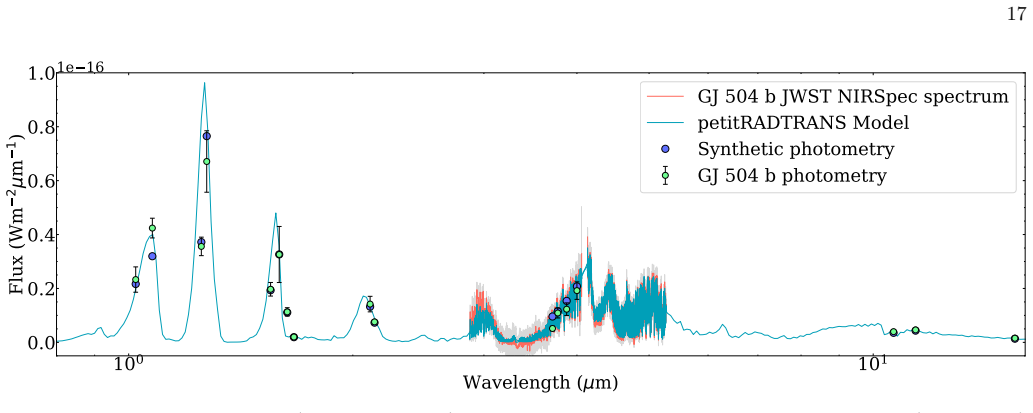
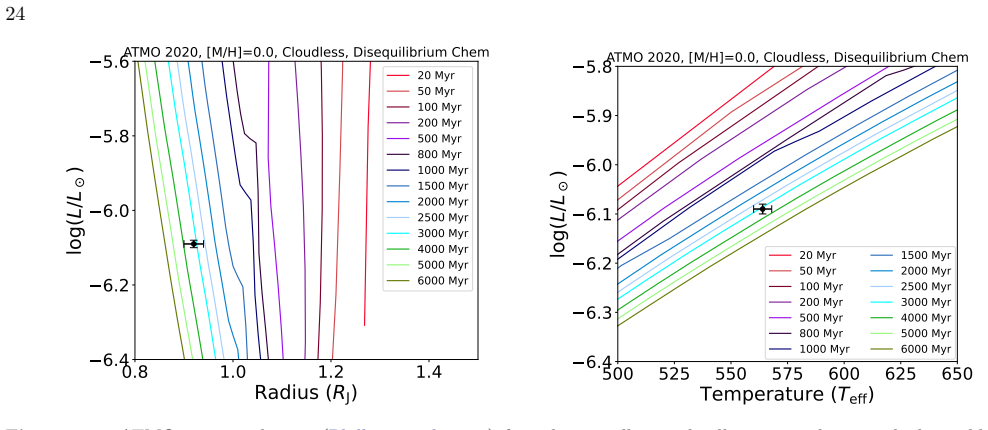
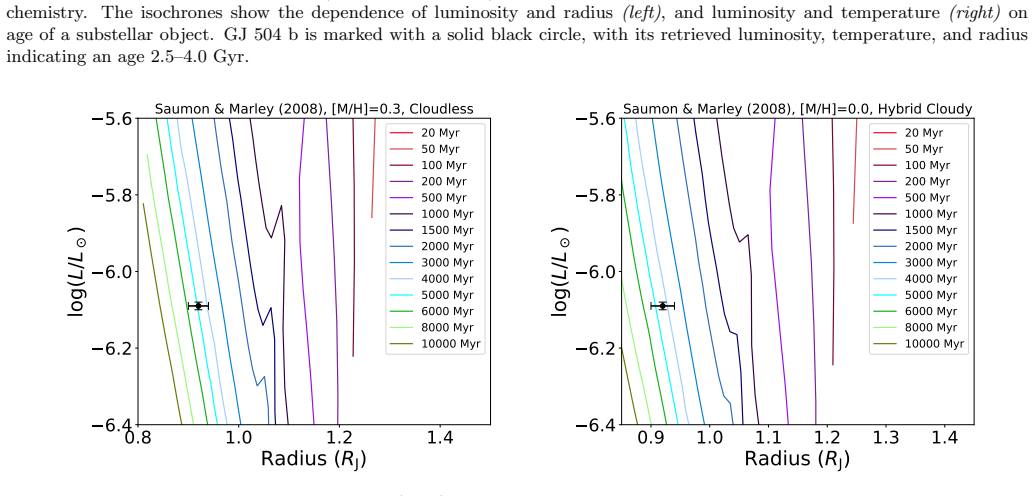
The authors extract the 2.9--5.3 μm spectrum of GJ 504 b at high signal-to-noise and identify absorption from H₂O, ¹²C¹⁶O, CH₄, CO₂, NH₃, H₂S and isotopologues. Retrievals give an effective temperature of 564 K, surface gravity log g of 4.87, metallicity [M/H] of 0.67, C/O ratio of 0.64, interstellar isotopologue ratios, and evidence for disequilibrium chemistry plus salt clouds. The implied mass of 25 Jupiter masses agrees with evolutionary models for an age of 2.5--4 Gyr, while the metal enrichment relative to the primary tentatively favors planet-like formation.
What carries the argument
The forward-modeling framework with angular differential imaging applied to the NIRSpec point cloud, which isolates the companion spectrum from the star.
If this is right
- The retrieved mass of about 25 Jupiter masses lies within the range predicted by evolutionary models for an age of 2.5 to 4 billion years.
- The atmosphere shows super-stellar carbon and possibly oxygen relative to the host star, with sulfur abundances matching the star.
- Strong signs of disequilibrium chemistry and salt clouds appear in the retrieved atmospheric structure.
- The overall metal enrichment is consistent with planet-like formation but does not rule out stellar-like abundances.
Where Pith is reading between the lines
- Similar spectral extraction on other faint companions could produce a larger sample of directly measured atmospheric metallicities.
- The measured isotopologue ratios could be compared with disk chemistry models to test formation location if additional data become available.
- Confirmation that the companion is enriched relative to the star would favor core-accretion scenarios over disk fragmentation.
Load-bearing premise
The post-processing and forward modeling steps isolate the companion spectrum without introducing significant artificial signals or biases.
What would settle it
An independent spectrum of GJ 504 b at similar wavelengths that fails to recover the reported molecular absorption bands would falsify the extracted spectrum and derived abundances.
Figures





read the original abstract
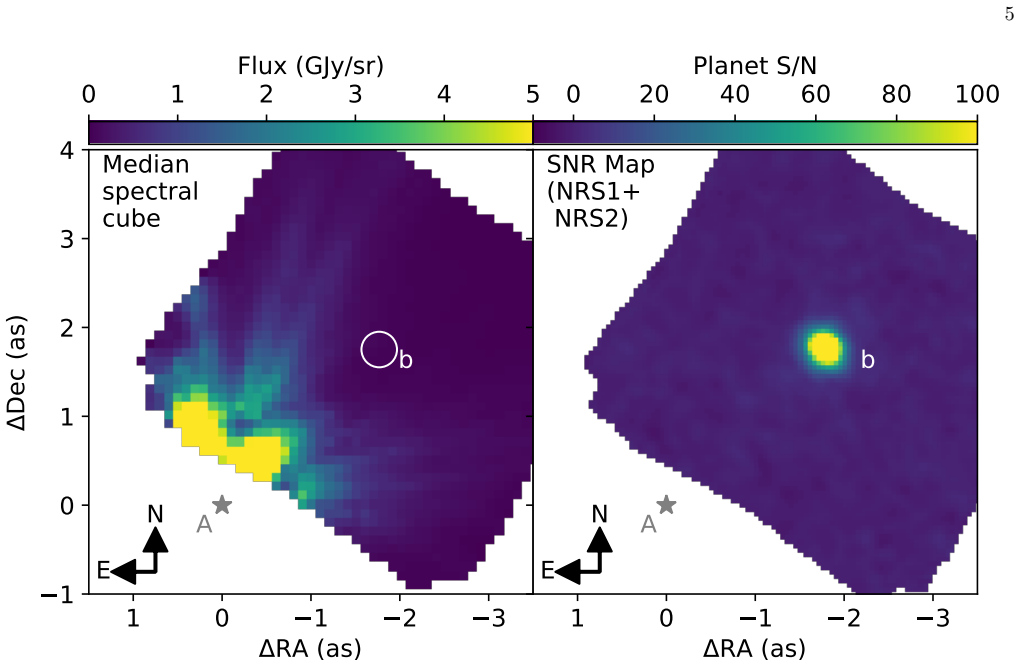
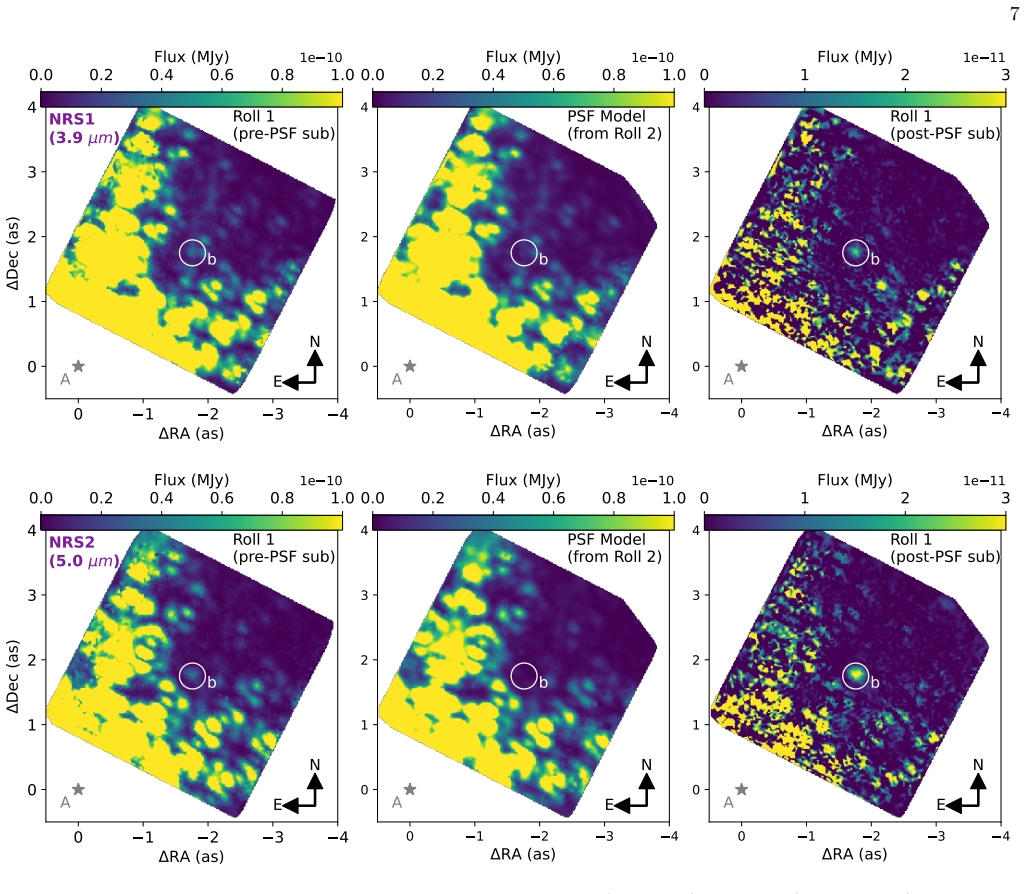
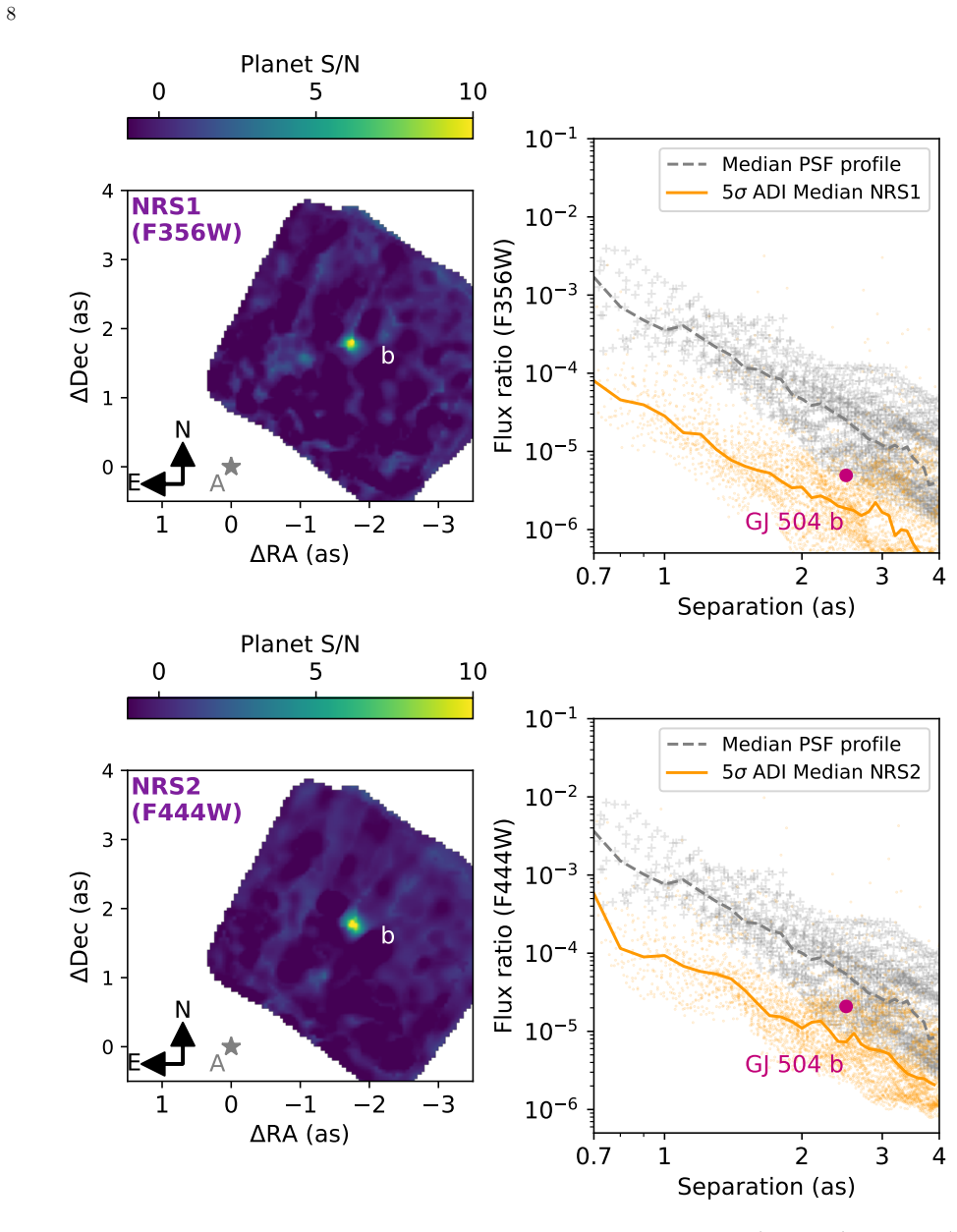
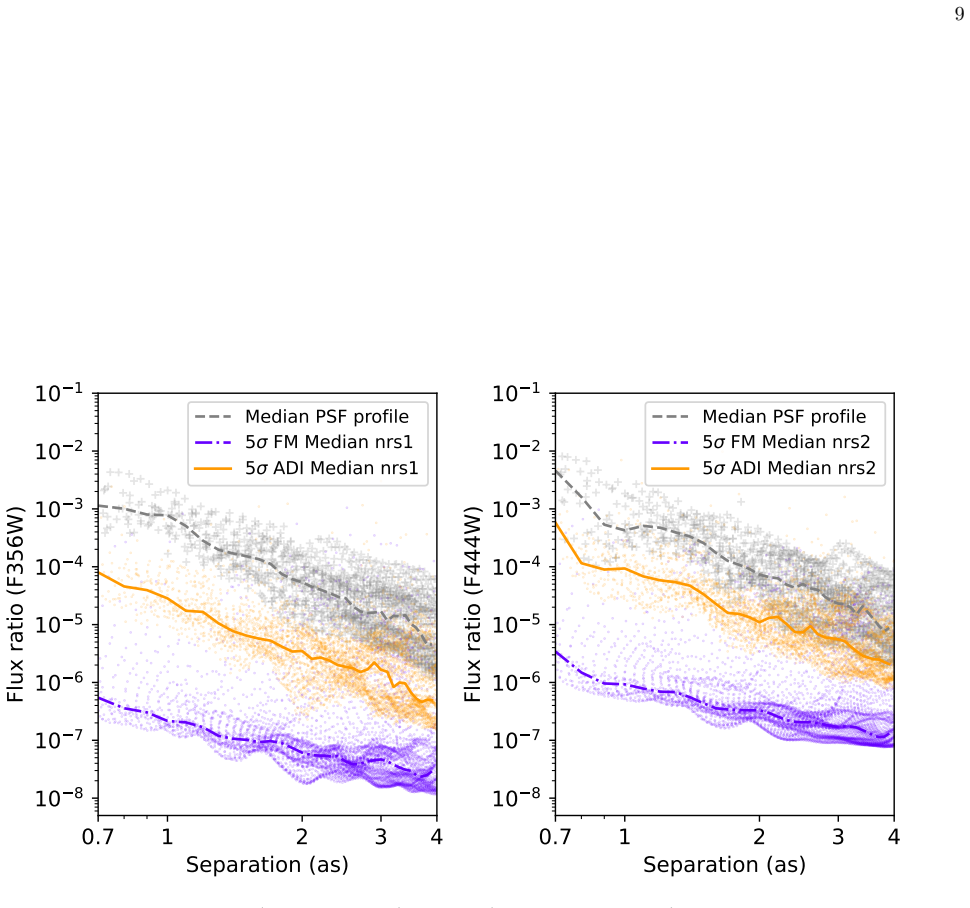
Characterizing the coldest directly imaged companions through direct spectroscopy has only recently become possible with the James Webb Space Telescope. We present moderate-resolution (R $\sim$ 2,700) spectroscopic observations of the directly imaged planetary-mass companion (PMC), GJ 504 b, using the $JWST$/NIRSpec. As the coldest imaged PMC of the pre-JWST era GJ 504 b is too faint for ground-based spectroscopy, with only photometric observations possible. Leveraging advanced post-processing techniques with a forward modeling framework, we detect the companion at high signal-to-noise (S/N$>$300). We also present the first successful PSF subtraction with angular differential imaging (ADI) in the NIRSpec point cloud, detecting GJ 504 b at S/N$>10$ and reaching contrast limits $<10^{-4}$. The extracted 2.9--5.3 $\mu m$ spectra show strong signatures of several molecular species, including H$_2$O, $^{12}$C$^{16}$O, CH$_4$, CO$_2$, NH$_3$, H$_2$S, $^{13}$C$^{16}$O, and $^{12}$C$^{18}$O. Atmospheric modeling of the spectra using \texttt{petitRADTRANS}, yields an effective temperature = 564$\pm$4 K, surface gravity $\log{g}$ = 4.87$^{+0.13}_{-0.12}$, metallicity [M/H] = 0.67$^{+0.13}_{-0.12}$, C/O ratio = 0.64$^{+0.02}_{-0.02}$, interstellar $^{12}$C/$^{13}$C and $^{16}$O/$^{18}$O isotopologue ratios, and strong evidence of disequilibrium chemistry and salt clouds. The retrieved parameters indicate a mass 25.2$^{+8.4}_{-6.0}$ $M_\mathrm{Jup}$, which is in agreement with the mass range (19--27 $M_\mathrm{Jup}$) obtained from ATMO evolutionary models, implying an age of 2.5--4.0 Gyr. Lastly, we compare the abundances of GJ 504 b to its primary, obtaining a stellar abundance of sulfur (S), super-stellar carbon (C), and possibly, oxygen (O). The observed metal enrichment tentatively supports planet-like formation, but does not entirely exclude stellar abundances for GJ 504 b.
Editorial analysis
A structured set of objections, weighed in public.
Referee Report
Summary. The manuscript reports the first moderate-resolution (R~2700) 2.9-5.3 μm JWST/NIRSpec spectrum of the directly imaged planetary-mass companion GJ 504 b. Leveraging forward modeling and the first application of angular differential imaging (ADI) in the NIRSpec point cloud, the authors detect the companion at S/N>10 (overall detection S/N>300), extract a spectrum showing absorption from H₂O, ¹²C¹⁶O, CH₄, CO₂, NH₃, H₂S, ¹³C¹⁶O and ¹²C¹⁸O, and perform petitRADTRANS retrievals yielding Teff=564±4 K, log g=4.87^{+0.13}_{-0.12}, [M/H]=0.67^{+0.13}_{-0.12}, C/O=0.64^{+0.02}_{-0.02} together with evidence for disequilibrium chemistry and salt clouds. The implied mass (25.2^{+8.4}_{-6.0} M_Jup) is consistent with ATMO evolutionary models (age 2.5-4.0 Gyr), and the abundances are compared to the primary to discuss formation pathways.
Significance. If the extracted spectrum is free of post-processing artifacts, the result is significant: it constitutes the first direct spectroscopy of a cold directly imaged exoplanet and demonstrates a new ADI capability in NIRSpec that could be applied to other faint companions. The precise retrievals and tentative metal-enrichment constraint provide concrete data for testing planet-formation scenarios.
major comments (2)
- [§3 (post-processing/ADI description)] §3 (post-processing/ADI description): The manuscript presents the first successful ADI in the NIRSpec point cloud but provides no quantification of residual speckle power after subtraction and no injection-recovery tests at the reported contrast (<10^{-4}). Because the molecular detections and the retrieved [M/H] and C/O values rest directly on the fidelity of this spectrum, the absence of these validation metrics is load-bearing.
- [§4 (atmospheric retrievals)] §4 (atmospheric retrievals): The reported parameter uncertainties (e.g., Teff ±4 K, C/O ±0.02) are extremely small. The text does not describe how systematic errors arising from the spectrum extraction or from the choice of forward-model assumptions are propagated into the posterior; this directly affects the strength of the claims on metallicity, disequilibrium chemistry, and formation implications.
minor comments (1)
- [Abstract] Abstract: The statement that the retrieved isotopologue ratios are 'interstellar' should be accompanied by the actual numerical values and their uncertainties for immediate clarity.
Simulated Author's Rebuttal
We thank the referee for their constructive comments and positive assessment of the significance of our results. We address each major comment below.
read point-by-point responses
-
Referee: [§3 (post-processing/ADI description)] The manuscript presents the first successful ADI in the NIRSpec point cloud but provides no quantification of residual speckle power after subtraction and no injection-recovery tests at the reported contrast (<10^{-4}). Because the molecular detections and the retrieved [M/H] and C/O values rest directly on the fidelity of this spectrum, the absence of these validation metrics is load-bearing.
Authors: We agree that additional quantitative validation of the ADI subtraction is warranted given the importance of the extracted spectrum. In the revised manuscript we will add (i) maps and power spectra quantifying residual speckle noise after subtraction and (ii) injection-recovery tests performed at contrasts below 10^{-4} to demonstrate the fidelity of the detection and spectrum. These additions will directly support the robustness of the molecular identifications and retrieved abundances. revision: yes
-
Referee: [§4 (atmospheric retrievals)] The reported parameter uncertainties (e.g., Teff ±4 K, C/O ±0.02) are extremely small. The text does not describe how systematic errors arising from the spectrum extraction or from the choice of forward-model assumptions are propagated into the posterior; this directly affects the strength of the claims on metallicity, disequilibrium chemistry, and formation implications.
Authors: The quoted uncertainties are the statistical 1σ intervals from the petitRADTRANS posterior. We will revise the text to state this explicitly and add a new subsection that (a) discusses possible systematic contributions from the ADI extraction and from model assumptions (cloud prescription, line lists, disequilibrium chemistry) and (b) presents retrievals on perturbed versions of the spectrum to quantify the effect on [M/H] and C/O. This will allow a more balanced assessment of the formation implications. revision: yes
Circularity Check
No significant circularity in spectral extraction or atmospheric retrieval
full rationale
The paper reports new JWST/NIRSpec observations of GJ 504 b and applies standard forward-modeling plus ADI post-processing to extract the 2.9–5.3 μm spectrum at S/N > 10. Atmospheric parameters are then retrieved by fitting the petitRADTRANS grid to that extracted spectrum. No step reduces by construction to its own inputs, no fitted parameter is relabeled as a prediction, and no load-bearing premise rests on a self-citation chain. The derivation chain is therefore self-contained against external data and established modeling tools.
Axiom & Free-Parameter Ledger
free parameters (4)
- effective temperature =
564 K
- surface gravity =
4.87
- metallicity =
0.67
- C/O ratio =
0.64
axioms (2)
- domain assumption The petitRADTRANS code accurately models the radiative transfer in the atmosphere under the assumed conditions.
- domain assumption The post-processing techniques correctly subtract the PSF and extract the companion signal.
Reference graph
Works this paper leans on
-
[1]
Ackerman, A. S., & Marley, M. S. 2001, ApJ, 556, 872, doi: 10.1086/321540
doi:10.1086/321540 2001
-
[2]
Sappey, B. 2024, jruffio/breads: Accepted HD19467B paper, 0.2, Zenodo, doi: 10.5281/zenodo.11391503 4 https://whereistheplanet.com/ 5 https://docs.h5py.org/ Aguilera-G´ omez, C., Ram´ ırez, I., & Chanam´ e, J. 2018, A&A, 614, A55, doi: 10.1051/0004-6361/201732209
-
[3]
Rajpurohit, A. S. 2013, Memorie della Societa Astronomica Italiana Supplementi, 24, 128, doi: 10.48550/arXiv.1302.6559
-
[4]
F., Spiegelman, F., Leininger, T., & Molliere, P
Allard, N. F., Spiegelman, F., Leininger, T., & Molliere, P. 2019, A&A, 628, A120, doi: 10.1051/0004-6361/201935593 28
-
[5]
Allers, K. N., & Liu, M. C. 2013, ApJ, 772, 79, doi: 10.1088/0004-637X/772/2/79 Astropy Collaboration, Robitaille, T. P., Tollerud, E. J., et al. 2013, A&A, 558, A33, doi: 10.1051/0004-6361/201322068 Astropy Collaboration, Price-Whelan, A. M., Sip˝ ocz, B. M., et al. 2018, AJ, 156, 123, doi: 10.3847/1538-3881/aabc4f Astropy Collaboration, Price-Whelan, A....
-
[6]
Gerasimov, R., & Hoch, K. K. W. 2026, AJ, 171, 21, doi: 10.3847/1538-3881/ae1a6b
-
[7]
Baburaj, A., Konopacky, Q. M., Theissen, C. A., et al. 2025, AJ, 169, 55, doi: 10.3847/1538-3881/ad8dfc
-
[8]
O., Franson, K., Chomez, A., et al
Balmer, W. O., Franson, K., Chomez, A., et al. 2025, AJ, 169, 30, doi: 10.3847/1538-3881/ad9265
-
[9]
Hauschildt, P. H. 2003, A&A, 402, 701, doi: 10.1051/0004-6361:20030252 Bardalez Gagliuffi, D. C., Balmer, W. O., Pueyo, L., et al. 2025, ApJL, 988, L18, doi: 10.3847/2041-8213/ade30f
-
[10]
2015, A&A, 582, A83, doi: 10.1051/0004-6361/201526332
Baudino, J.-L., B´ ezard, B., Boccaletti, A., et al. 2015, A&A, 582, A83, doi: 10.1051/0004-6361/201526332
-
[11]
Beiler, S. A., Mukherjee, S., Cushing, M. C., et al. 2024, ApJ, 973, 60, doi: 10.3847/1538-4357/ad6759
-
[12]
2026, arXiv e-prints, arXiv:2602.22979, doi: 10.48550/arXiv.2602.22979
Bellotti, S., Pezzotti, C., Buldgen, G., et al. 2026, arXiv e-prints, arXiv:2602.22979, doi: 10.48550/arXiv.2602.22979
-
[13]
Bernath, P. F. 2020, JQSRT, 240, 106687, doi: 10.1016/j.jqsrt.2019.106687 B¨ oker, T., Arribas, S., L¨ utzgendorf, N., et al. 2022, A&A, 661, A82, doi: 10.1051/0004-6361/202142589
-
[14]
Bonnefoy, M., Perraut, K., Lagrange, A. M., et al. 2018, A&A, 618, A63, doi: 10.1051/0004-6361/201832942
-
[15]
2004, The Messenger, 117, 17
Bonnet, H., Abuter, R., Baker, A., et al. 2004, The Messenger, 117, 17
2004
-
[16]
Bowler, B. P., Blunt, S. C., & Nielsen, E. L. 2020, AJ, 159, 63, doi: 10.3847/1538-3881/ab5b11
-
[17]
Burgasser, A. J. 2007, ApJ, 659, 655, doi: 10.1086/511027
doi:10.1086/511027 2007
-
[18]
Burgasser, A. J., Kirkpatrick, J. D., Cruz, K. L., et al. 2006, ApJS, 166, 585, doi: 10.1086/506327
doi:10.1086/506327 2006
-
[19]
2024, JWST Calibration Pipeline, 1.15.1, Zenodo, doi: 10.5281/zenodo.12692459
Bushouse, H., Eisenhamer, J., Dencheva, N., et al. 2024, JWST Calibration Pipeline, 1.15.1, Zenodo, doi: 10.5281/zenodo.12692459
-
[20]
Canty, J. I., Lucas, P. W., Roche, P. F., & Pinfield, D. J. 2013, MNRAS, 435, 2650, doi: 10.1093/mnras/stt1477
-
[21]
2025, ApJ, 994, 43, doi: 10.3847/1538-4357/ae0cbf
Murray-Clay, R. 2025, ApJ, 994, 43, doi: 10.3847/1538-4357/ae0cbf
-
[22]
A., Lothringer, J., & Blake, G
Chachan, Y., Knutson, H. A., Lothringer, J., & Blake, G. A. 2023, ApJ, 943, 112, doi: 10.3847/1538-4357/aca614
-
[23]
Chachan, Y., & Lee, E. J. 2023, ApJL, 952, L20, doi: 10.3847/2041-8213/ace257
-
[24]
2018, ApJ, 854, 172, doi: 10.3847/1538-4357/aaac7d
Charnay, B., B´ ezard, B., Baudino, J.-L., et al. 2018, ApJ, 854, 172, doi: 10.3847/1538-4357/aaac7d
-
[25]
I., & Goldreich, P
Chiang, E. I., & Goldreich, P. 1997, The Astrophysical
1997
-
[26]
368-376., 490, 368, doi: 10.1086/304869
Journal, Volume 490, Issue 1, pp. 368-376., 490, 368, doi: 10.1086/304869
-
[27]
2016, ApJ, 823, 102, doi: 10.3847/0004-637X/823/2/102
Choi, J., Dotter, A., Conroy, C., et al. 2016, ApJ, 823, 102, doi: 10.3847/0004-637X/823/2/102
-
[28]
Cleeves, L. I., Bergin, E. A., Alexander, C. M. O. D., et al. 2014, Science, 345, 1590, doi: 10.1126/science.1258055
-
[29]
Crossfield, I. J. M. 2023, ApJL, 952, L18, doi: 10.3847/2041-8213/ace35f da Silva, R., Porto de Mello, G. F., Milone, A. C., et al. 2012, A&A, 542, A84, doi: 10.1051/0004-6361/201118751 de Regt, S., Gandhi, S., Snellen, I. A. G., et al. 2024, Astron. Astrophys., 688, A116, doi: 10.1051/0004-6361/202348508 Di Mauro, M. P., Reda, R., Mathur, S., et al. 2022...
-
[30]
Beichman, C. A. 2009, ApJ, 707, 79, doi: 10.1088/0004-637X/707/1/79 D’Orazi, V., Desidera, S., Gratton, R. G., et al. 2017, A&A, 598, A19, doi: 10.1051/0004-6361/201629283
-
[31]
Dupuy, T. J., Liu, M. C., Leggett, S. K., et al. 2015, ApJ, 805, 56, doi: 10.1088/0004-637X/805/1/56
-
[32]
1993, A&A, 275, 101
Edvardsson, B., Andersen, J., Gustafsson, B., et al. 1993, A&A, 275, 101
1993
-
[33]
2003, in Society of Photo-Optical Instrumentation Engineers (SPIE) Conference Series, Vol
Eisenhauer, F., Abuter, R., Bickert, K., et al. 2003, in Society of Photo-Optical Instrumentation Engineers (SPIE) Conference Series, Vol. 4841, Instrument Design and Performance for Optical/Infrared Ground-based Telescopes, ed. M. Iye & A. F. M. Moorwood, 1548–1561, doi: 10.1117/12.459468
-
[34]
C., Balfe, J., Loomis, R., et al
Fayolle, E. C., Balfe, J., Loomis, R., et al. 2016, 816, L28, doi: 10.3847/2041-8205/816/2/L28
-
[35]
2013, A&A, 551, A126, doi: 10.1051/0004-6361/201220857
Feuchtgruber, H., Lellouch, E., Orton, G., et al. 2013, A&A, 551, A126, doi: 10.1051/0004-6361/201220857
-
[36]
2016, The Journal of Open Source Software, 1, 24, doi: 10.21105/joss.00024
Foreman-Mackey, D. 2016, The Journal of Open Source Software, 1, 24, doi: 10.21105/joss.00024
-
[37]
2015, ApJ, 806, 163, doi: 10.1088/0004-637X/806/2/163 Gaia Collaboration
Fuhrmann, K., & Chini, R. 2015, ApJ, 806, 163, doi: 10.1088/0004-637X/806/2/163 Gaia Collaboration. 2020, VizieR Online Data Catalog: Gaia EDR3 (Gaia Collaboration, 2020), VizieR On-line Data Catalog: I/350. Originally published in: 2021A&A...649A...1G, doi: 10.26093/cds/vizier.1350 29
-
[38]
2023, ApJL, 957, L36, doi: 10.3847/2041-8213/ad07e2
Gandhi, S., de Regt, S., Snellen, I., et al. 2023, ApJL, 957, L36, doi: 10.3847/2041-8213/ad07e2
-
[39]
Ginsburg, A., Sip˝ ocz, B. M., Brasseur, C. E., et al. 2019, AJ, 157, 98, doi: 10.3847/1538-3881/aafc33
-
[40]
Gonzalez, G., Carlson, M. K., & Tobin, R. W. 2010, MNRAS, 403, 1368, doi: 10.1111/j.1365-2966.2009.16195.x Gonz´ alez Picos, D., Snellen, I. A. G., de Regt, S., et al. 2025, A&A, 693, A298, doi: 10.1051/0004-6361/202451936
-
[41]
2016, Astronomy and Computing, 16, 41, doi: 10.1016/j.ascom.2016.04.001
Greenfield, P., & Miller, T. 2016, Astronomy and Computing, 16, 41, doi: 10.1016/j.ascom.2016.04.001
-
[42]
Hargreaves, R. J., Gordon, I. E., Rey, M., et al. 2020, ApJS, 247, 55, doi: 10.3847/1538-4365/ab7a1a
-
[43]
Harris, C. R., Millman, K. J., van der Walt, S. J., et al. 2020, Nature, 585, 357, doi: 10.1038/s41586-020-2649-2
-
[44]
Harris, G. J., Tennyson, J., Kaminsky, B. M., Pavlenko, Y. V., & Jones, H. R. A. 2006, MNRAS, 367, 400, doi: 10.1111/j.1365-2966.2005.09960.x
-
[45]
Hirsch, L. A., Rosenthal, L., Fulton, B. J., et al. 2021, AJ, 161, 134, doi: 10.3847/1538-3881/abd639
-
[46]
Hoch, K. K. W., Konopacky, Q. M., Theissen, C. A., et al. 2023, AJ, 166, 85, doi: 10.3847/1538-3881/ace442
-
[47]
Hoch, K. K. W., Theissen, C. A., Barman, T. S., et al. 2024, AJ, 168, 187, doi: 10.3847/1538-3881/ad6cd3
-
[48]
Hunter, J. D. 2007, Computing in Science & Engineering, 9, 90, doi: 10.1109/MCSE.2007.55
-
[49]
2016, A&A, 591, A72, doi: 10.1051/0004-6361/201628099
Ida, S., Guillot, T., & Morbidelli, A. 2016, A&A, 591, A72, doi: 10.1051/0004-6361/201628099
-
[50]
2022, A&A, 661, A80, doi: 10.1051/0004-6361/202142663
Jakobsen, P., Ferruit, P., Alves de Oliveira, C., et al. 2022, A&A, 661, A80, doi: 10.1051/0004-6361/202142663
-
[51]
Janson, M., Brandt, T. D., Kuzuhara, M., et al. 2013, ApJL, 778, L4, doi: 10.1088/2041-8205/778/1/L4
-
[52]
Kama, M., Shorttle, O., Jermyn, A. S., et al. 2019, ApJ, 885, 114, doi: 10.3847/1538-4357/ab45f8
-
[53]
Kammerer, J., Lawson, K., Perrin, M. D., et al. 2024, AJ, 168, 51, doi: 10.3847/1538-3881/ad4ffe
-
[54]
Kiman, R., Beichman, C. A., Ruiz Diaz, A., et al. 2026, AJ, 171, 60, doi: 10.3847/1538-3881/ae230f
-
[55]
2013, Science, 339, 1398, doi: 10.1126/science.1232003
Marois, C. 2013, Science, 339, 1398, doi: 10.1126/science.1232003
-
[56]
2016, ARA&A, 54, 271, doi: 10.1146/annurev-astro-081915-023307
Kratter, K., & Lodato, G. 2016, ARA&A, 54, 271, doi: 10.1146/annurev-astro-081915-023307
-
[57]
2013, ApJ, 774, 11, doi: 10.1088/0004-637X/774/1/11
Kuzuhara, M., Tamura, M., Kudo, T., et al. 2013, ApJ, 774, 11, doi: 10.1088/0004-637X/774/1/11
-
[58]
2025, Nature, 642, 905, doi: 10.1038/s41586-025-09150-4
Lagrange, A.-M., Wilkinson, C., Mˆ alin, M., et al. 2025, Nature, 642, 905, doi: 10.1038/s41586-025-09150-4
-
[59]
Laird, J. B. 1985, ApJ, 289, 556, doi: 10.1086/162916
doi:10.1086/162916 1985
-
[60]
2006, in Society of Photo-Optical Instrumentation Engineers (SPIE) Conference Series, Vol
Larkin, J., Barczys, M., Krabbe, A., et al. 2006, in Society of Photo-Optical Instrumentation Engineers (SPIE) Conference Series, Vol. 6269, Ground-based and Airborne Instrumentation for Astronomy, ed. I. S. McLean & M. Iye, 62691A, doi: 10.1117/12.672061
-
[61]
Law, D. R., E. Morrison, J., Argyriou, I., et al. 2023, AJ, 166, 45, doi: 10.3847/1538-3881/acdddc
-
[62]
Leggett, S. K., Marley, M. S., Freedman, R., et al. 2007, ApJ, 667, 537, doi: 10.1086/519948
doi:10.1086/519948 2007
-
[63]
Leggett, S. K., Tremblin, P., Esplin, T. L., Luhman, K. L., & Morley, C. V. 2017, ApJ, 842, 118, doi: 10.3847/1538-4357/aa6fb5
-
[64]
2024, arXiv e-prints, arXiv:2410.21364, doi: 10.48550/arXiv.2410.21364
Lei, E., & Molli` ere, P. 2024, arXiv e-prints, arXiv:2410.21364, doi: 10.48550/arXiv.2410.21364
-
[65]
Lew, B. W. P., Roellig, T., Batalha, N. E., et al. 2024, AJ, 167, 237, doi: 10.3847/1538-3881/ad3425
-
[66]
2020, Nature Astronomy, 4, 609, doi: 10.1038/s41550-020-1009-3
Li, C., Ingersoll, A., Bolton, S., et al. 2020, Nature Astronomy, 4, 609, doi: 10.1038/s41550-020-1009-3
-
[67]
Liu, M. C., Leggett, S. K., Golimowski, D. A., et al. 2006, ApJ, 647, 1393, doi: 10.1086/505561
doi:10.1086/505561 2006
-
[68]
Luck, R. E. 2017, AJ, 153, 21, doi: 10.3847/1538-3881/153/1/21
-
[69]
2019, ARA&A, 57, 617, doi: 10.1146/annurev-astro-081817-051846
Madhusudhan, N. 2019, ARA&A, 57, 617, doi: 10.1146/annurev-astro-081817-051846
-
[70]
Madhusudhan, N., Mousis, O., Johnson, T. V., & Lunine, J. I. 2011, ApJ, 743, 191, doi: 10.1088/0004-637X/743/2/191
-
[71]
Mora, A. 2012, A&A, 541, A40, doi: 10.1051/0004-6361/201218800 Mˆ alin, M., Boccaletti, A., Charnay, B., Kiefer, F., & B´ ezard, B. 2023, A&A, 671, A109, doi: 10.1051/0004-6361/202245094 Mˆ alin, M., Boccaletti, A., Perrot, C., et al. 2025a, A&A, 693, A315, doi: 10.1051/0004-6361/202452695 Mˆ alin, M., Ward-Duong, K., Grant, S. L., et al. 2025b, A&A, 704,...
-
[72]
2006, ApJ, 641, 556, doi: 10.1086/500401
Nadeau, D. 2006, ApJ, 641, 556, doi: 10.1086/500401
doi:10.1086/500401 2006
-
[73]
2018, in Society of Photo-Optical Instrumentation Engineers (SPIE) Conference Series, Vol
Marston, A., Hargis, J., Levay, K., et al. 2018, in Society of Photo-Optical Instrumentation Engineers (SPIE) Conference Series, Vol. 10704, Observatory Operations:
2018
-
[74]
Strategies, Processes, and Systems VII, 1070413, doi: 10.1117/12.2311973
-
[75]
Martin, E. C., Mace, G. N., McLean, I. S., et al. 2017, ApJ, 838, 73, doi: 10.3847/1538-4357/aa6338
-
[76]
Matthews, E. C., Carter, A. L., Pathak, P., et al. 2024, Nature, 633, 789, doi: 10.1038/s41586-024-07837-8
-
[77]
McGovern, M. R., Kirkpatrick, J. D., McLean, I. S., et al. 2004, ApJ, 600, 1020, doi: 10.1086/379849 30
doi:10.1086/379849 2004
-
[78]
Meynardie, W. W., Meyer, M. R., MacDonald, R. J., et al. 2025, ApJ, 994, 237, doi: 10.3847/1538-4357/ae0ad0
-
[79]
2005, ApJ, 634, 1126, doi: 10.1086/497123
Wyckoff, S. 2005, ApJ, 634, 1126, doi: 10.1086/497123
doi:10.1086/497123 2005
-
[80]
Miles, B. E., Biller, B. A., Patapis, P., et al. 2023, ApJL, 946, L6, doi: 10.3847/2041-8213/acb04a
discussion (0)
Sign in with ORCID, Apple, or X to comment. Anyone can read and Pith papers without signing in.