A Unified Framework for Efficient Remote Sensing Visual Question Answering: Adapting Dual, Hybrid, and Encoder-Decoder Architectures
Pith reviewed 2026-06-26 21:25 UTC · model grok-4.3
The pith
Hybrid FLAVA adapted with lightweight adapters outperforms dual-encoder and encoder-decoder models on remote sensing VQA.
A machine-rendered reading of the paper's core claim, the machinery that carries it, and where it could break.
Core claim
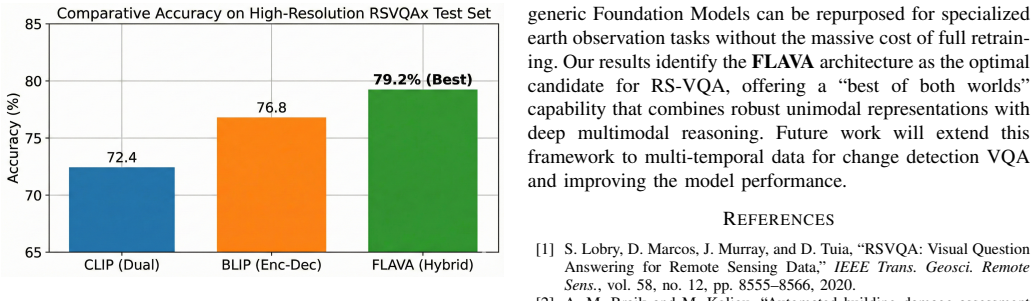
Applying RS Adapter across CLIP, BLIP, and FLAVA enables adaptation of frozen backbones with less than 5 percent trainable parameters through a unified pipeline that injects lightweight bottleneck adapters into attention and MLP layers; on the high resolution RSVQA x dataset all models converge, but the hybrid FLAVA architecture supplies a superior balance of multimodal reasoning and retrieval capabilities compared to its unimodal counterparts.
What carries the argument
RS Adapter, a parameter-efficient fine-tuning strategy that injects lightweight bottleneck adapters into the attention and MLP layers of frozen vision-language backbones.
Load-bearing premise
The RSVQA x dataset and the chosen evaluation metrics are sufficient to establish the hybrid architecture's superiority for real-world remote sensing VQA tasks.
What would settle it
Repeating the adaptation experiments on a separate remote sensing VQA dataset and observing that CLIP or BLIP matches or exceeds FLAVA performance.
Figures

read the original abstract
Visual Question Answering (VQA) in the Remote Sensing (RS) domain presents unique challenges due to the high resolution, multi scale object distribution, and semantic complexity of aerial imagery. While general domain Foundation Models have achieved remarkable success, their direct application to RSVQA is hindered by massive domain shifts and the computationally prohibitive nature of full fine tuning. This study presents a comparative analysis of RS Adapter, a Parameter Efficient Fine Tuning (PEFT) strategy, applied across three distinct Vision Language Model (VLM) architectures: the Dual Encoder CLIP, the Encoder Decoder BLIP, and the Hybrid FLAVA. We introduce a unified architectural surgery pipeline that injects lightweight bottleneck adapters into the attention and MLP layers of frozen backbones, enabling rapid adaptation with less than 5 percent of trainable parameters. Experimental results on the high resolution RSVQA x dataset demonstrate that while all adapted models achieve convergence, the Hybrid FLAVA architecture offers a superior balance of multimodal reasoning and retrieval capabilities compared to its unimodal counterparts. Our findings establish a new baseline for resource efficient VQA in disaster assessment and urban monitoring.
Editorial analysis
A structured set of objections, weighed in public.
Referee Report
Summary. The paper introduces RS Adapter, a PEFT strategy that injects lightweight bottleneck adapters into frozen VLM backbones (CLIP dual-encoder, BLIP encoder-decoder, FLAVA hybrid), enabling adaptation with <5% trainable parameters. It presents a unified architectural surgery pipeline and claims that, on the high-resolution RSVQA x dataset, all adapted models converge while the Hybrid FLAVA variant achieves a superior balance of multimodal reasoning and retrieval capabilities for remote-sensing VQA tasks such as disaster assessment.
Significance. If the empirical superiority claim is substantiated with full experimental protocols, the work would supply a practical, resource-efficient baseline for domain adaptation of VLMs in remote sensing, where full fine-tuning is prohibitive. The unified adapter pipeline across three distinct architectures is a potentially reusable contribution, but the current lack of supporting data prevents assessment of whether it advances the state of the art.
major comments (1)
- [Abstract] Abstract: the central claim that 'Experimental results on the high resolution RSVQA x dataset demonstrate that ... the Hybrid FLAVA architecture offers a superior balance of multimodal reasoning and retrieval capabilities' is unsupported. No train/val/test splits, class balance, exact metrics (accuracy, F1, etc.), number of runs, variance, ablation tables, or statistical comparisons against CLIP/BLIP baselines are supplied, rendering the superiority statement unverifiable and load-bearing for the paper's contribution.
minor comments (2)
- [Abstract] Abstract: 'RSVQA x' appears to be an incomplete or typographical reference; provide the precise dataset name, citation, and characteristics (resolution, number of images/questions, etc.).
- [Abstract] Abstract: the phrase 'unified architectural surgery pipeline' is introduced without a forward reference to the section that defines the injection points in attention and MLP layers.
Simulated Author's Rebuttal
We thank the referee for the careful reading and the specific feedback on the abstract. We address the major comment below and will revise the manuscript accordingly.
read point-by-point responses
-
Referee: [Abstract] Abstract: the central claim that 'Experimental results on the high resolution RSVQA x dataset demonstrate that ... the Hybrid FLAVA architecture offers a superior balance of multimodal reasoning and retrieval capabilities' is unsupported. No train/val/test splits, class balance, exact metrics (accuracy, F1, etc.), number of runs, variance, ablation tables, or statistical comparisons against CLIP/BLIP baselines are supplied, rendering the superiority statement unverifiable and load-bearing for the paper's contribution.
Authors: We agree that the abstract's superiority claim for the Hybrid FLAVA model is currently unsupported by any experimental details within the manuscript. The provided text contains only the high-level claim without splits, metrics, run counts, variance, ablations, or baseline comparisons. We will revise the abstract to remove the specific claim of superiority and instead state only that all adapted models achieve convergence on the RSVQA x dataset, directing readers to the experimental section for any further results. This ensures the abstract makes no unverifiable assertions. revision: yes
Circularity Check
No circularity: empirical comparison of PEFT-adapted VLMs with no derivation chain
full rationale
The paper performs an empirical study adapting CLIP, BLIP, and FLAVA via bottleneck adapters on the RSVQA x dataset and reports that the hybrid FLAVA variant shows superior balance. No equations, uniqueness theorems, fitted parameters renamed as predictions, or self-citation chains appear in the abstract or described content. The central claim rests on experimental convergence and performance comparison rather than any step that reduces by construction to its own inputs, satisfying the default expectation of no significant circularity.
Axiom & Free-Parameter Ledger
axioms (1)
- domain assumption The RSVQA x dataset constitutes a representative benchmark for remote sensing visual question answering.
invented entities (1)
-
RS Adapter
no independent evidence
Reference graph
Works this paper leans on
-
[1]
RSVQA: Visual Question Answering for Remote Sensing Data,
S. Lobry, D. Marcos, J. Murray, and D. Tuia, “RSVQA: Visual Question Answering for Remote Sensing Data,”IEEE Trans. Geosci. Remote Sens., vol. 58, no. 12, pp. 8555–8566, 2020
2020
-
[2]
Automated building damage assessment and large-scale mapping by integrating satellite imagery, GIS, and deep learning,
A. M. Braik and M. Koliou, “Automated building damage assessment and large-scale mapping by integrating satellite imagery, GIS, and deep learning,”Comput.-Aided Civil Infrastruct. Eng., vol. 39, no. 15, pp. 2389–2404, 2024
2024
-
[3]
Remote Sensing Image Scene Classifi- cation: Benchmark and State of the Art,
G. Cheng, J. Han, and X. Lu, “Remote Sensing Image Scene Classifi- cation: Benchmark and State of the Art,”Proc. IEEE, vol. 105, no. 10, pp. 1865-1883, 2017
2017
-
[4]
A unified framework of intelli- gent vehicle damage assessment based on computer vision technology,
X. Zhu, S. Liu, P. Zhang, and Y . Duan, “A unified framework of intelli- gent vehicle damage assessment based on computer vision technology,” in2019 IEEE 2nd Int. Conf. Autom. Electron. Electr. Eng. (AUTEEE), 2019, pp. 124–128
2019
-
[5]
SAM-VQA: Super- vised attention-based visual question answering model for post-disaster damage assessment on remote sensing imagery,
A. Sarkar, M. Rahnemoonfar, and A. B. M. Musa, “SAM-VQA: Super- vised attention-based visual question answering model for post-disaster damage assessment on remote sensing imagery,”IEEE Trans. Geosci. Remote Sens., vol. 61, pp. 1–16, 2023
2023
-
[6]
A question-type guided and progressive self-attention network for remote sensing visual question answering,
J. Feng, H. Wang, and S. Dong, “A question-type guided and progressive self-attention network for remote sensing visual question answering,” Earth Sci. Inform., vol. 18, no. 2, p. 409, 2025
2025
-
[7]
Fawakherji, J
M. Fawakherji, J. Blay, M. Anokye, L. Hashemi-Beni, J. Dorton, Deep- Flood for Inundated Vegetation High-Resolution Dataset for Accurate Flood Mapping and Segmentation, Scientific Data 12 (2025) 271
2025
-
[8]
Creating xBD: A Dataset for Assessing Building Damage from Satellite Imagery,
R. Gupta, B. Goodman, N. Patel, R. Hosfelt, S. Sajeev, E. Heim, J. Doshi, K. Lucas, H. Choset, and M. Gaston, “Creating xBD: A Dataset for Assessing Building Damage from Satellite Imagery,” inProc. CVPR Workshops, 2019, pp. 10–17
2019
-
[9]
RSAdapter: Adapting multimodal models for remote sensing visual question answering,
Y . Wang and P. Ghamisi, “RSAdapter: Adapting multimodal models for remote sensing visual question answering,”IEEE Trans. Geosci. Remote Sens., vol. 62, pp. 1–13, 2024
2024
-
[10]
Learning Transferable Visual Models From Natural Language Super- vision,
A. Radford, J. W. Kim, C. Hallacy, A. Ramesh, G. Goh, S. Agarwal, G. Sastry, A. Askell, P. Mishkin, J. Clark, G. Krueger, and I. Sutskever, “Learning Transferable Visual Models From Natural Language Super- vision,” inProc. ICML, 2021, pp. 8748–8763
2021
-
[11]
BLIP: Bootstrapping Language- Image Pre-training for Unified Vision-Language Understanding and Generation,
J. Li, D. Li, C. Xiong, and S. Hoi, “BLIP: Bootstrapping Language- Image Pre-training for Unified Vision-Language Understanding and Generation,” inProc. ICML, 2022
2022
-
[12]
FLA V A: A Foundational Language and Vision Alignment Model,
A. Singh, R. Hu, V . Goswami, G. Couairon, W. Galuba, M. Rohrbach, and D. Kiela, “FLA V A: A Foundational Language and Vision Alignment Model,” inProc. CVPR, 2022, pp. 15638–15650
2022
-
[13]
ViLT: Vision-and-Language Transformer Without Convolution or Region Supervision,
W. Kim, B. Son, and I. Kim, “ViLT: Vision-and-Language Transformer Without Convolution or Region Supervision,” inProc. ICML, 2021
2021
-
[14]
Parameter-Efficient Transfer Learning for NLP,
N. Houlsby, A. Giurgiu, S. Jastrzebski, B. Morrone, Q. De Laroussilhe, A. Gesmundo, M. Attariyan, and S. Gelly, “Parameter-Efficient Transfer Learning for NLP,” inProc. ICML, 2019, pp. 2790–2799
2019
-
[15]
An Image is Worth 16x16 Words: Transformers for Image Recognition at Scale,
A. Dosovitskiy, L. Beyer, A. Kolesnikov, D. Weissenborn, X. Zhai, T. Unterthiner, M. Dehghani, M. Minderer, G. Heigold, S. Gelly, J. Uszkor- eit, and N. Houlsby, “An Image is Worth 16x16 Words: Transformers for Image Recognition at Scale,”arXiv preprint arXiv:2010.11929, 2020
Pith/arXiv arXiv 2010
-
[16]
BERT: Pre-training of Deep Bidirectional Transformers for Language Understanding,
J. Devlin, M. Chang, K. Lee, and K. Toutanova, “BERT: Pre-training of Deep Bidirectional Transformers for Language Understanding,” inProc. NAACL, 2019
2019
-
[17]
Attention Is All You Need,
A. Vaswani, N. Shazeer, N. Parmar, J. Uszkoreit, L. Jones, A. N. Gomez, L. Kaiser, and I. Polosukhin, “Attention Is All You Need,”Adv. Neural Inf. Process. Syst., vol. 30, 2017
2017
-
[18]
Deep Residual Learning for Image Recognition,
K. He, X. Zhang, S. Ren, and J. Sun, “Deep Residual Learning for Image Recognition,” inProc. CVPR, 2016
2016
discussion (0)
Sign in with ORCID, Apple, or X to comment. Anyone can read and Pith papers without signing in.