A New Methodology for Classifying Eclipsing Binaries with Kepler Data and Deep Learning
Pith reviewed 2026-06-26 19:17 UTC · model grok-4.3
The pith
Chi-square versus box-size plots from Kepler light curves classify eclipsing binaries at 90 percent accuracy.
A machine-rendered reading of the paper's core claim, the machinery that carries it, and where it could break.
Core claim
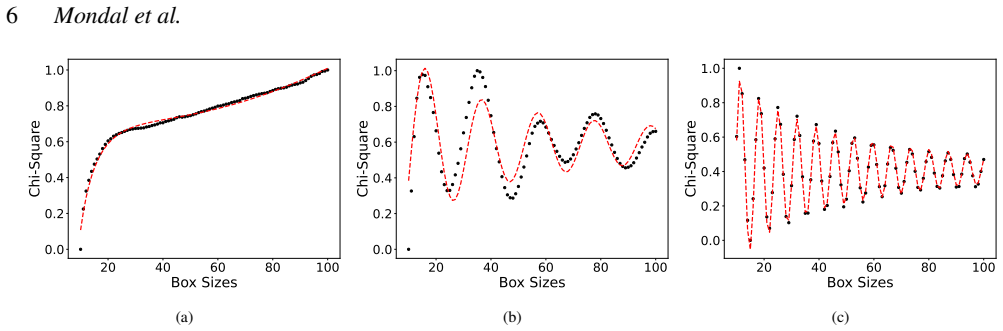
Phase-folded Kepler light curves produce chi-square versus box-size plots whose morphologies are distinct for contact, detached, and semi-detached eclipsing binaries; these morphologies are first summarized by the period of a fitted polynomial damped sinusoidal function to achieve 86.5 percent classification accuracy, then supplied as input to a convolutional neural network that reaches 90 percent accuracy overall and 99 percent when distinguishing only contact from detached systems after supplementation with PHOEBE simulations, while a subset of systems exhibit quarter-to-quarter changes in chi-square trends that are isolated by a normalized-spread threshold and attributed to magnetic activ
What carries the argument
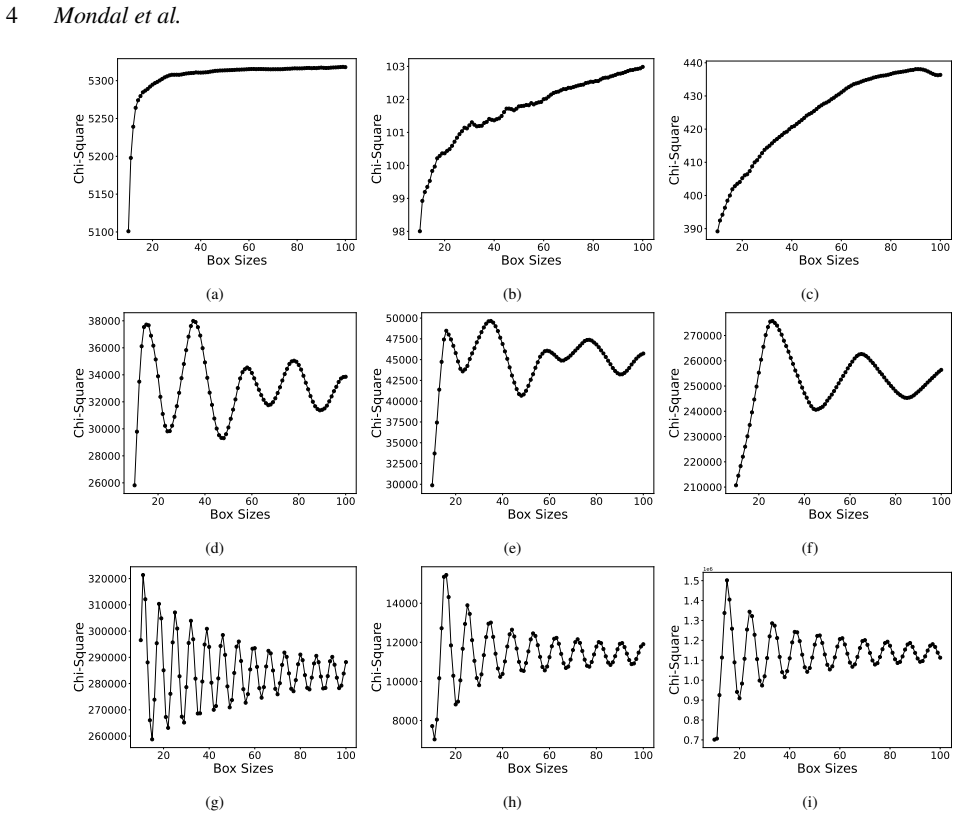
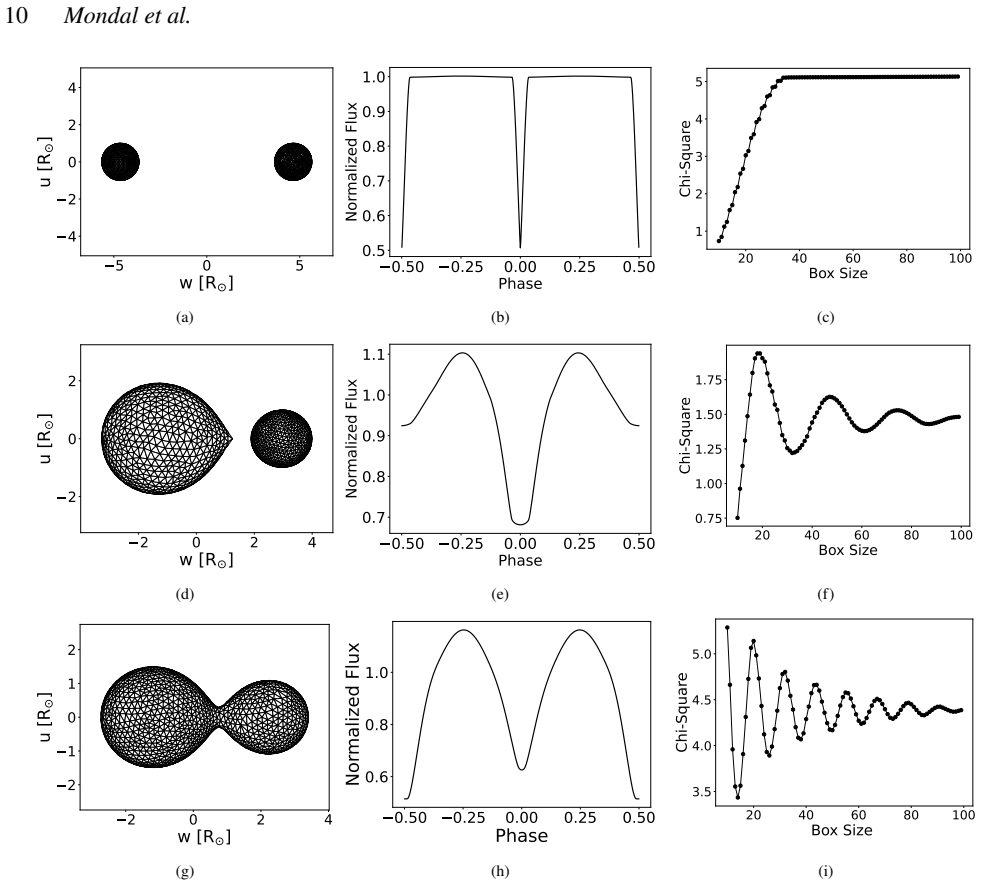
The chi-square versus box-size plot, obtained by comparing flux values in phase-folded light curves against median flux, whose class-specific shape serves as the primary input feature for both damped-sinusoid fitting and convolutional neural network classification.
If this is right
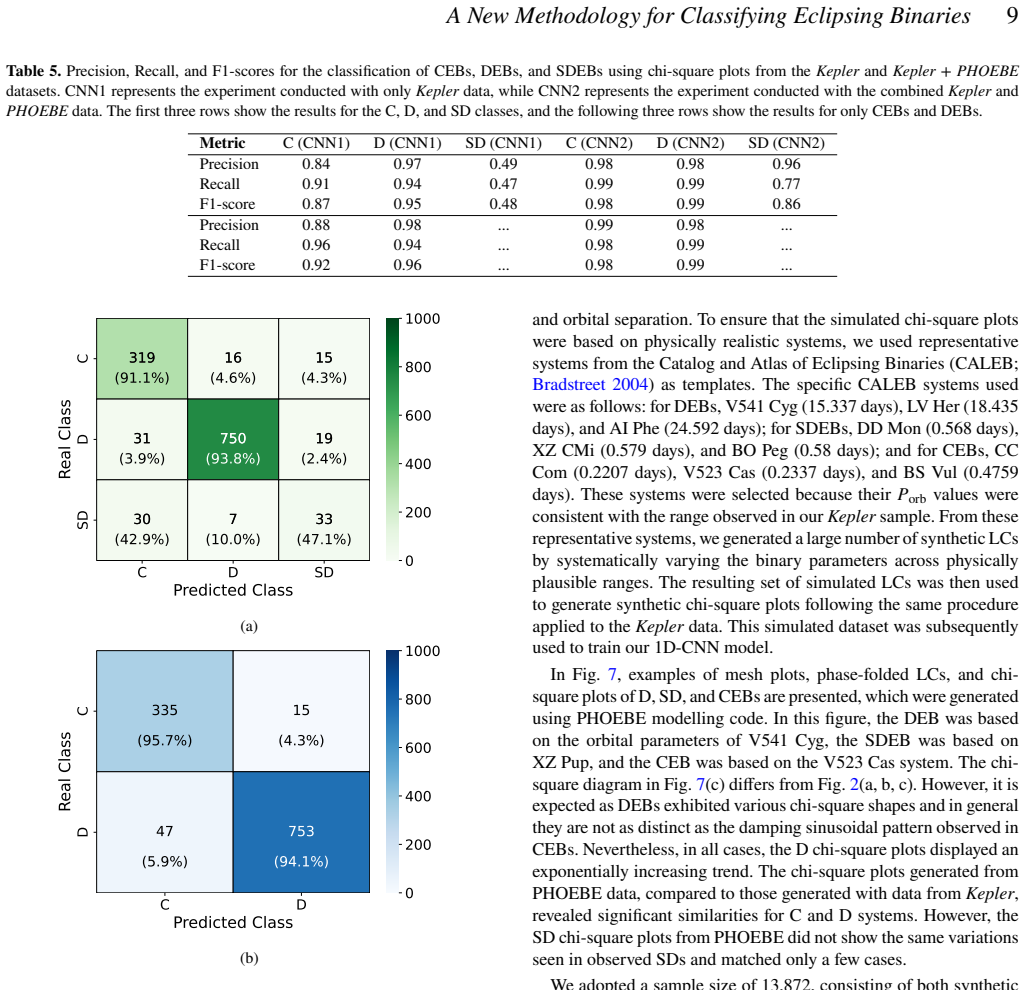
- The CNN reaches 47 percent accuracy on semi-detached systems and 99 percent on the contact-versus-detached distinction after PHOEBE augmentation.
- Chi-square morphology correlates strongly with orbital period.
- Cooler late-F, G, K, and M stars show systematically higher chi-square variability than hotter stars.
- Four previously unreported temporally varying systems are identified whose magnetic activity requires further study.
Where Pith is reading between the lines
- The same chi-square construction could be applied directly to light curves from TESS or other wide-field surveys to classify many more binaries without new training data.
- The measured rise in variability with decreasing stellar temperature suggests the plots could serve as an automatic flag for magnetic activity across large catalogs.
- Quarterly changes in the chi-square period may allow time-resolved tracking of starspot or flare evolution using only the existing photometry.
Load-bearing premise
The chi-square versus box-size plots from actual Kepler observations display stable class-specific shapes that PHOEBE simulations can reproduce closely enough to support reliable feature extraction and network training without introducing new biases.
What would settle it
Manual reclassification of several hundred Kepler eclipsing binaries by independent visual inspection or an established catalog yields an overall accuracy below 80 percent when compared against the CNN outputs.
Figures



read the original abstract
We present a new method for the automated classification of eclipsing binaries, into contact, detached, and semi-detached types using Kepler data. Phase-folded light curves are generated and chi-square vs. box size plots are constructed by comparing flux values to the median flux, revealing distinct class patterns. These patterns were first modelled using a polynomial damped sinusoidal function, whose period served as classification feature, achieving an overall accuracy of 86.5 percent. To capture more features and enhance accuracy, we trained a convolutional neural network, which improved the total accuracy to 90 percent, including 47 percent for the challenging semi-detached systems. However, several binaries displayed irregular chi-square signatures. To mitigate this, we incorporated simulated light curves generated with the PHOEBE modelling code, achieving 99 per cent accuracy in distinguishing contact and detached binaries. The resulting chi-square morphologies show a strong correlation with orbital period, and a subset of systems exhibit quarterly variability in their light curves and chi-square trends. We designate these as Temporally Varying systems. By measuring the normalized spread of the chi-square period across quarters, we define a statistical threshold that separates these systems from stable binaries. We reported four Temporally Varying systems not previously noted in the literature with magnetic activity that requires further investigation. Furthermore, cooler stars, namely late-F, G, K, and M types, display systematically higher variability than hotter stars. Cross-matching with catalogues of magnetically active stars indicates that stellar flares and starspots are the most likely causes of this enhanced variability.
Editorial analysis
A structured set of objections, weighed in public.
Referee Report
Summary. The manuscript presents a methodology for automated classification of Kepler eclipsing binaries into contact, detached, and semi-detached types. Phase-folded light curves yield chi-square versus box-size plots whose morphologies are first fit by a polynomial damped sinusoidal function (using the period as a feature for 86.5% accuracy), then fed to a CNN (raising overall accuracy to 90%, with 47% on semi-detached systems). PHOEBE-generated simulations are added to reach 99% accuracy on contact versus detached binaries. A normalized-spread threshold on quarterly chi-square periods flags Temporally Varying systems; four previously unreported examples are identified and linked to magnetic activity, with cooler stars showing higher variability.
Significance. If the reported accuracies are shown to be robust on held-out real Kepler data without simulation augmentation and if the PHOEBE light curves are demonstrated to reproduce the relevant noise and systematics properties, the pipeline could supply a scalable classification tool for future photometric surveys. The identification of Temporally Varying systems and the reported correlation between variability and stellar effective temperature would constitute an incremental observational result worthy of follow-up.
major comments (3)
- [Abstract / CNN results] Abstract and results section on CNN training: the jump from 90% to 99% accuracy on contact/detached binaries after adding PHOEBE simulations is load-bearing for the headline performance claim, yet no quantitative comparison of simulated versus real Kepler noise properties (e.g., correlated noise, quarter-to-quarter systematics, or flare statistics) is provided, nor is an explicit test reported on a held-out set of real data only.
- [Abstract] Abstract: the 47% accuracy reported for semi-detached systems is low enough to indicate that the assumed class-specific morphologies in the chi-square versus box-size plots are not stable for this category; this directly weakens the claim that the method provides reliable classification across all three types.
- [Temporally Varying systems section] Section describing the Temporally Varying threshold: the normalized-spread threshold used to flag the four new systems is defined from the same chi-square period measurements whose stability is questioned by the simulation-augmentation step; without an independent validation set or cross-check against known active binaries, the threshold risks being tuned to simulation artifacts.
minor comments (2)
- [Abstract] Abstract: accuracy figures are given without error bars, cross-validation details, or the size of the training/test splits.
- [Methods] The manuscript should clarify whether the CNN was trained and tested on real data alone before the PHOEBE augmentation step, and whether any overlap exists between the simulation training set and the real test objects.
Simulated Author's Rebuttal
We thank the referee for the constructive comments on our manuscript. We respond point by point to the major comments below, indicating where revisions are planned.
read point-by-point responses
-
Referee: [Abstract / CNN results] Abstract and results section on CNN training: the jump from 90% to 99% accuracy on contact/detached binaries after adding PHOEBE simulations is load-bearing for the headline performance claim, yet no quantitative comparison of simulated versus real Kepler noise properties (e.g., correlated noise, quarter-to-quarter systematics, or flare statistics) is provided, nor is an explicit test reported on a held-out set of real data only.
Authors: We agree that a quantitative comparison of noise properties between the PHOEBE simulations and real Kepler data was not provided. In revision we will add such a comparison (e.g., via residual distributions and power spectra) and will also report CNN performance on a held-out real Kepler subset without any simulation augmentation. revision: yes
-
Referee: [Abstract] Abstract: the 47% accuracy reported for semi-detached systems is low enough to indicate that the assumed class-specific morphologies in the chi-square versus box-size plots are not stable for this category; this directly weakens the claim that the method provides reliable classification across all three types.
Authors: The lower accuracy for semi-detached systems is already noted in the manuscript as reflecting their morphological variability. We will revise the abstract to report per-class accuracies explicitly and qualify the overall claim to reflect stronger performance on contact and detached systems. revision: yes
-
Referee: [Temporally Varying systems section] Section describing the Temporally Varying threshold: the normalized-spread threshold used to flag the four new systems is defined from the same chi-square period measurements whose stability is questioned by the simulation-augmentation step; without an independent validation set or cross-check against known active binaries, the threshold risks being tuned to simulation artifacts.
Authors: The PHOEBE simulations were used exclusively to augment CNN training for contact/detached separation and played no role in computing the chi-square periods or the normalized-spread threshold on real Kepler quarters. The four systems and the temperature correlation were identified in real data, supported by cross-matching to active-star catalogs. We will clarify this separation in the revised text. revision: partial
Circularity Check
Classification pipeline is self-contained with no circular reductions
full rationale
The paper constructs chi-square vs. box-size plots from phase-folded Kepler light curves, fits a damped sinusoidal function to extract a period feature (yielding 86.5% accuracy), trains a CNN on these plus PHOEBE simulations (to 90% overall, 99% contact/detached), and defines a variability threshold via normalized spread of the chi-square period across quarters. These steps rely on external Kepler observations, standard fitting, external simulation code, and empirical accuracy measurements. No equations equate a reported result to its own fitted inputs by construction, and no self-citations are invoked as load-bearing uniqueness theorems. The derivation chain is independent of the target classifications.
Axiom & Free-Parameter Ledger
free parameters (2)
- polynomial damped sinusoidal function coefficients
- normalized spread threshold for Temporally Varying label
axioms (2)
- domain assumption Phase-folded Kepler light curves yield reliable median fluxes and chi-square deviations that reflect binary morphology.
- domain assumption PHOEBE-generated light curves reproduce the statistical properties of real Kepler eclipsing-binary observations sufficiently for training augmentation.
invented entities (1)
-
Temporally Varying systems
no independent evidence
Reference graph
Works this paper leans on
-
[1]
Andersen, J. , title =. A&ARv , year =. doi:10.1007/BF00873538 , url =
-
[2]
2010, A&A Rv, 18, 67, doi: 10.1007/s00159-009-0025-1 van der Walt, S., Colbert, S
Torres, G. and Andersen, J. and Gim. Accurate masses and radii of normal stars: modern results and applications , journal =. 2010 , volume =. doi:10.1007/s00159-009-0025-1 , url =
-
[3]
Revisiting Physical Parameters of the Benchmark Brown Dwarf LHS 6343 C through a Hubble Space Telescope/WFC3 Secondary-eclipse Observation , journal =
Frost, William and Albert, Lo. Revisiting Physical Parameters of the Benchmark Brown Dwarf LHS 6343 C through a Hubble Space Telescope/WFC3 Secondary-eclipse Observation , journal =. 2024 , month = sep, volume =
2024
-
[4]
and Milone, E
Kallrath, J. and Milone, E. F. , title =. 2009 , doi =
2009
-
[5]
Sarro, L. M. and S. Automatic classification of eclipsing binaries light curves using neural networks , journal =. 2006 , month =. doi:10.1051/0004-6361:20052830 , archivePrefix =. astro-ph/0511346 , primaryClass =
work page internal anchor Pith review Pith/arXiv arXiv doi:10.1051/0004-6361:20052830 2006
-
[6]
Matijevi. Kepler Eclipsing Binary Stars. III. Classification of Kepler Eclipsing Binary Light Curves with Locally Linear Embedding , journal =. 2012 , month = may, volume =. doi:10.1088/0004-6256/143/5/123 , archivePrefix=. 1204.2113 , primaryClass =
work page internal anchor Pith review Pith/arXiv arXiv doi:10.1088/0004-6256/143/5/123 2012
-
[7]
Slawson, Robert W. and Pr. Kepler Eclipsing Binary Stars. II. 2165 Eclipsing Binaries in the Second Data Release , journal =. 2011 , month = nov, volume =. doi:10.1088/0004-6256/142/5/160 , archivePrefix=. 1103.1659 , primaryClass =
work page internal anchor Pith review Pith/arXiv arXiv doi:10.1088/0004-6256/142/5/160 2011
-
[8]
and Saul, Lawrence K
Roweis, Sam T. and Saul, Lawrence K. , title =. Science , volume =. 2000 , doi =
2000
-
[9]
and Duin, R
de Ridder, S. and Duin, R. , title =
-
[10]
Automatic classification of eclipsing binary stars using deep learning methods , journal =. 2021 , month =. doi:10.1016/j.ascom.2021.100488 , archivePrefix =. 2108.01640 , primaryClass =
-
[11]
Daza-Perilla, I. V. and Gramajo, L. V. and Lares, M. and Palma, T. and Ferreira Lopes, C. E. and Minniti, D. and Clari\'. Automated classification of eclipsing binary systems in the VVV Survey , journal =. 2023 , month =. doi:10.1093/mnras/stad141 , archivePrefix =. 2302.01200 , primaryClass =
-
[12]
and Lucas, P
Minniti, D. and Lucas, P. W. and Emerson, J. P. and Saito, R. K. and Hempel, M. and Pietrukowicz, P. and Ahumada, A. V. and Alonso, M. V. and Alonso-Garcia, J. and Arias, J. I. and et al. , title =. New Astron. , year =
-
[13]
Saito, R. K. and Hempel, M. and Minniti, D. and Lucas, P. W. and Rejkuba, M. and Toledo, I. and Gonzalez, O. A. and Alonso-Garcia, J. and Irwin, M. J. and Gonzalez-Solares, E. and et al. , title =. A&A , year =. doi:10.1051/0004-6361/201118407 , archivePrefix =. 1111.5511 , primaryClass =
work page internal anchor Pith review Pith/arXiv arXiv doi:10.1051/0004-6361/201118407
-
[14]
VISTA Variables in the V\'ia L\'actea (VVV): Halfway Status and Results
Hempel, M. and Minniti, D. and D\'. VISTA Variables in the V\'. Messenger , year =. doi:10.48550/arXiv.1406.3241 , archivePrefix =. 1406.3241 , primaryClass =
work page internal anchor Pith review Pith/arXiv arXiv doi:10.48550/arxiv.1406.3241
-
[15]
A new near-IR window of low extinction in the Galactic plane
Minniti, D. and Saito, R. K. and Gonzalez, O. A. and Alonso-Garc\'. A new near-IR window of low extinction in the Galactic plane , journal =. 2018 , month =. doi:10.1051/0004-6361/201732099 , archivePrefix =. 1804.07785 , primaryClass =
work page internal anchor Pith review Pith/arXiv arXiv doi:10.1051/0004-6361/201732099 2018
-
[16]
Ding, Xu and Ji, KaiFan and Cheng, QiYuan and Song, ZhiMing and Wang, JinLiang and Tian, XueFen and Wang, ChuanJun , title =. AJ , year =. doi:10.3847/1538-3881/adb846 , archivePrefix=. 2504.14612 , primaryClass =
-
[17]
Cruz, P. and Aguilar, J. F. and Garrido, H. E. and Diaz, M. P. and Solano, E. , title =. MNRAS , year =. doi:10.1093/mnras/stac1707 , archivePrefix =. 2206.08708 , primaryClass =
-
[18]
Kirk, B. and Conroy, K. and Pr. Kepler Eclipsing Binary Stars. VII. The Catalog of Eclipsing Binaries Found in the Entire Kepler Data Set , journal =. 2016 , month =. doi:10.3847/0004-6256/151/3/68 , archivePrefix =. 1512.08830 , primaryClass =
work page internal anchor Pith review Pith/arXiv arXiv doi:10.3847/0004-6256/151/3/68 2016
-
[19]
Morris, R. L. and Twicken, J. D. and Smith, J. C. and Clarke, B. D. and Jenkins, J. M. and Bryson, S. T. and Girouard, F. and Klaus, T. C. , title =. 2020 , editor =
2020
-
[20]
and Christiansen, Jessie L
Van Cleve, Jeffrey E. and Christiansen, Jessie L. and Jenkins, Jon M. and Caldwell, Douglas A. and Barclay, Thomas and Bryson, Stephen T. and Burke, Christopher J. and Cambell, Jennifer and Catanzarite, Joseph and Clarke, Bruce D. and et al. , title =. 2016 , month = dec, pages =
2016
-
[21]
Murphy, Simon J. , title =. MNRAS , year =. doi:10.1111/j.1365-2966.2012.20644.x , url =
-
[22]
and Haberland, Matt and Reddy, Tyler and Cournapeau, David and Burovski, Evgeni and Peterson, Pearu and Weckesser, Warren and Bright, Jonathan and van der Walt, St
Virtanen, Pauli and Gommers, Ralf and Oliphant, Travis E. and Haberland, Matt and Reddy, Tyler and Cournapeau, David and Burovski, Evgeni and Peterson, Pearu and Weckesser, Warren and Bright, Jonathan and van der Walt, St. Nature Methods , volume =. 2020 , doi =
2020
-
[23]
Machine learning , volume=
Random forests , author=. Machine learning , volume=. 2001 , publisher=
2001
-
[24]
Scikit-learn: Machine Learning in Python , journal =
Pedregosa, Fabian and Varoquaux, Ga. Scikit-learn: Machine Learning in Python , journal =. 2011 , volume =
2011
-
[25]
Evaluating Time-series Augmentation Techniques for Deep Learning Based Solar Flare Prediction. , keywords =. doi:10.3847/1538-4365/adfa2a , adsurl =
-
[26]
Kingma, Diederik P. and Ba, Jimmy , title =. arXiv e-prints , year =. 1412.6980 , archivePrefix=
-
[27]
Focal Loss for Dense Object Detection , journal =
Lin, Tsung-Yi and Goyal, Priya and Girshick, Ross and He, Kaiming and Doll. Focal Loss for Dense Object Detection , journal =. 2020 , volume =
2020
-
[28]
Prsa, Andrej and Matijevic, Gal and Latkovic, Olivera and Vilardell, Francesc and Wils, Patrick , title =
-
[29]
Physics of Eclipsing Binaries
Pr. Physics of Eclipsing Binaries. II. Toward the Increased Model Fidelity , journal =. 2016 , volume =
2016
-
[30]
and Devinney, Edward J
Wilson, Robert E. and Devinney, Edward J. , title =. ApJ , volume =
-
[31]
Bradstreet, D. H. , title =
-
[32]
Scikit-learn: Machine Learning in Python , year =
Pedregosa, Fabian and Varoquaux, Ga. Scikit-learn: Machine Learning in Python , year =. 1201.0490 , archivePrefix=
-
[33]
Turkish Journal of Astronomy and Astrophysics , year=
A Deep Learning Neural Network Algorithm for Classification of Eclipsing Binary Light Curves , author=. Turkish Journal of Astronomy and Astrophysics , year=
-
[34]
, title =
MacQueen, J. , title =. Proceedings of the 5th Berkeley Symposium on Mathematical Statistics and Probability, Volume 1 , editor =. 1967 , publisher =
1967
-
[35]
Knote, Matthew F. and Caballero-Nieves, Saida M. and Gokhale, Vayujeet and Johnston, Kyle B. and Perlman, Eric S. , title =. ApJS , year =. doi:10.3847/1538-4365/ac770f , url =
-
[36]
Weibull, Waloddi , title =. J. Appl. Mech. , year =
-
[37]
Davenport, James R. A. , title =. ApJ , year =. doi:10.3847/0004-637X/829/1/23 , archivePrefix=. 1607.03494 , primaryClass =
work page internal anchor Pith review Pith/arXiv arXiv doi:10.3847/0004-637x/829/1/23
-
[38]
Tidal Synchronization and Differential Rotation of Kepler Eclipsing Binaries
Lurie, John C. and Vyhmeister, Karl and Hawley, Suzanne L. and Adilia, Jamel and Chen, Andrea and Davenport, James R. A. and Juri. Tidal Synchronization and Differential Rotation of Kepler Eclipsing Binaries , journal =. 2017 , month = dec, volume =. doi:10.3847/1538-3881/aa974d , archivePrefix=. 1710.07339 , primaryClass =
work page internal anchor Pith review Pith/arXiv arXiv doi:10.3847/1538-3881/aa974d 2017
-
[39]
Global stellar variability study in the field-of-view of the Kepler satellite
Debosscher, J. and Blomme, J. and Aerts, C. and De Ridder, J. , title =. A&A , year =. doi:10.1051/0004-6361/201015647 , archivePrefix=. 1102.2319 , primaryClass =
work page internal anchor Pith review Pith/arXiv arXiv doi:10.1051/0004-6361/201015647
-
[40]
Tracking the Stellar Longitudes of Starspots in Short-Period Kepler Binaries
Balaji, Bhaskaran and Croll, Bryce and Levine, Alan M. and Rappaport, Saul , title =. MNRAS , year =. doi:10.1093/mnras/stv031 , archivePrefix=. 1412.8101 , primaryClass =
work page internal anchor Pith review Pith/arXiv arXiv doi:10.1093/mnras/stv031
-
[41]
White-Light Flares on Close Binaries Observed with Kepler
Gao, Qing and Xin, Yu and Liu, Ji-Feng and Zhang, Xiao-Bin and Gao, Shuang , title =. ApJS , year =. doi:10.3847/0067-0049/224/2/37 , archivePrefix=. 1602.07972 , primaryClass =
work page internal anchor Pith review Pith/arXiv arXiv doi:10.3847/0067-0049/224/2/37
-
[42]
Armstrong, D. J. and G. A catalogue of temperatures for Kepler eclipsing binary stars , journal =. 2013 , month = dec, volume =. doi:10.1093/mnras/stt2146 , url =
-
[43]
Strassmeier, Klaus G. , title =. Astron. Astrophys. Rev. , year =. doi:10.1007/s00159-009-0020-6 , adsurl =
-
[44]
Vaiana, G. S. and Cassinelli, J. P. and Fabbiano, G. and Giacconi, R. and Golub, L. and Gorenstein, P. and Haisch, B. M. and Harnden, Jr., F. R. and Johnson, H. M. and Linsky, J. L. and Maxson, C. W. and Mewe, R. and Rosner, R. and Seward, F. and Topka, K. and Zwaan, C. , title =. ApJ , year =. doi:10.1086/158797 , adsurl =
-
[45]
Wright, Nicholas J. and Drake, Jeremy J. and Mamajek, Eric E. and Henry, Gregory W. , title =. ApJ , year =. doi:10.1088/0004-637X/743/1/48 , url =
-
[46]
Pan, Yang and Zhang, Xiaobin , title =. AJ , year =. doi:10.3847/1538-3881/accfa1 , url =
discussion (0)
Sign in with ORCID, Apple, or X to comment. Anyone can read and Pith papers without signing in.