Optimal Ansatz-free Hamiltonian Learning In Situ
Pith reviewed 2026-06-26 20:35 UTC · model grok-4.3
The pith
A control-free protocol learns any bounded Hamiltonian from real-time evolution data in optimal total time using only Pauli preparations and measurements.
A machine-rendered reading of the paper's core claim, the machinery that carries it, and where it could break.
Core claim
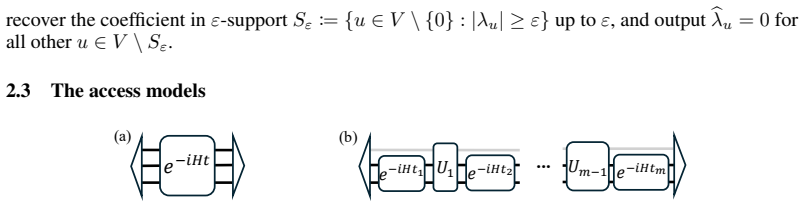
There exists a computationally efficient, control-free and ancilla-free algorithm that uses only Pauli product state preparation and measurement to learn an ansatz-free Hamiltonian H with ||H||≤Λ to additive error ε in total evolution time Θ(Λ/ε² log(Λ/ε)). This scaling is optimal for control-free protocols, as shown by a matching lower bound Ω(Λ/ε² log(Λ/ε)). The algorithm employs a randomized-sampling framework that combines band-limited kernel-based time sampling with a displacement sieve; its characteristic probe time resolution depends only on Λ rather than ε. The same asymptotic cost is retained under state-preparation-and-measurement noise provided the Hamiltonian is local after calib
What carries the argument
Randomized-sampling framework that combines band-limited kernel-based time sampling with a displacement sieve for Hamiltonian structure learning
If this is right
- The total evolution time is optimal among all control-free protocols.
- The probe time resolution depends only on the Hamiltonian norm Λ, not on the target precision ε.
- The same asymptotic total evolution time holds under SPAM noise when the Hamiltonian is local after calibration.
- The method supplies a practical route to rigorous in-situ characterization without deep circuits or interleaving controls.
Where Pith is reading between the lines
- The optimality result implies that further improvements in evolution time for control-free settings must come from relaxing the no-control assumption rather than from sampling refinements.
- The locality-after-calibration condition for noise robustness suggests that an initial rough calibration step may be necessary before applying the protocol in noisy hardware.
- The independence of time resolution from ε could allow the same sampling schedule to be reused across multiple precision targets in a single experimental run.
- Because the method is ancilla-free and uses only Pauli states, it may integrate directly with existing calibration routines that already prepare such states.
Load-bearing premise
The protocol assumes accurate preparation and measurement of Pauli product states.
What would settle it
A control-free protocol that learns a bounded Hamiltonian to precision ε using total evolution time o(Λ/ε² log(Λ/ε)) would falsify the claimed lower bound and optimality.
Figures
read the original abstract
Characterizing the features of a Hamiltonian that governs a quantum system serves as a fundamental subroutine of quantum device calibration, signal sensing, and error correction. Recent works proposed protocols have achieved the optimal Heisenberg-limited scaling learning ansatz-free Hamiltonians from their real-time evolutions without fully specifying interaction structures. However, these protocols rely on both deep circuits with interleaving probes and control, and extremely short time resolution, making them difficult to implement on near- and intermediate-term in situ quantum experiments. In this work, we propose a computationally efficient, control-free, and ancilla-free algorithm that uses only Pauli product state preparation and measurement, and learns an ansatz-free Hamiltonian $H$ with $||H||\leq\Lambda$ in total evolution time of $\Theta(\frac{\Lambda}{\epsilon^2}\log(\frac{\Lambda}{\epsilon}))$. The evolution time cost of our algorithm is optimal for any control-free protocols as we further prove a lower bound of $\Omega(\frac{\Lambda}{\epsilon^2}\log(\frac{\Lambda}{\epsilon}))$. Technically, our method introduces a randomized-sampling framework that combines band-limited kernel-based time sampling with a displacement sieve for Hamiltonian structure learning. The characteristic probe time resolution depends only on $\Lambda$ instead of $\varepsilon$, which makes our protocol especially appealing in the high-precision regime for sensing and calibration applications. We also show that the algorithm maintains the same asymptotic total evolution time in the presence of state-preparation-and-measurement (SPAM) noise when the Hamiltonian is local after calibration. Our results demonstrate the fundamental cost of experimentally friendly Hamiltonian learning and provide a practical route to rigorous in situ characterization of near-term quantum platforms.
Editorial analysis
A structured set of objections, weighed in public.
Referee Report
Summary. The paper claims an explicit control-free, ancilla-free protocol for learning any ansatz-free Hamiltonian H with ||H|| ≤ Λ that uses only Pauli product state preparation and measurement. The protocol achieves total evolution time Θ(Λ/ε² log(Λ/ε)) via a randomized-sampling framework that combines band-limited kernel time sampling (with resolution depending only on Λ) and a displacement sieve; a matching Ω(Λ/ε² log(Λ/ε)) lower bound is proven for any control-free protocol. The same asymptotic cost is claimed to hold under SPAM noise when the Hamiltonian is local after calibration.
Significance. If the upper and lower bounds hold, the work establishes the fundamental cost of experimentally friendly (control-free, ancilla-free) Hamiltonian learning and supplies a concrete, computationally efficient protocol whose time resolution depends only on the norm bound Λ rather than the target precision ε. This is particularly relevant for high-precision sensing and calibration on near-term devices. The matching bounds, the explicit randomized-sampling construction, and the conditional SPAM-robustness statement are all strengths that would be credited in a published version.
minor comments (4)
- §3 (Algorithm description): the precise definition of the band-limited kernel and the choice of its cutoff frequency are stated only in prose; an explicit formula or pseudocode block would improve reproducibility.
- Theorem 1 (upper bound): the dependence of the logarithmic factor on the number of qubits or on the locality of H after calibration is not stated explicitly, even though the abstract claims the scaling is independent of system size.
- §5 (Lower-bound proof): the reduction from the control-free setting to a communication or query-complexity problem is sketched at a high level; a short paragraph clarifying the precise model of allowed operations would help readers verify the Ω bound applies exactly to the protocol class considered.
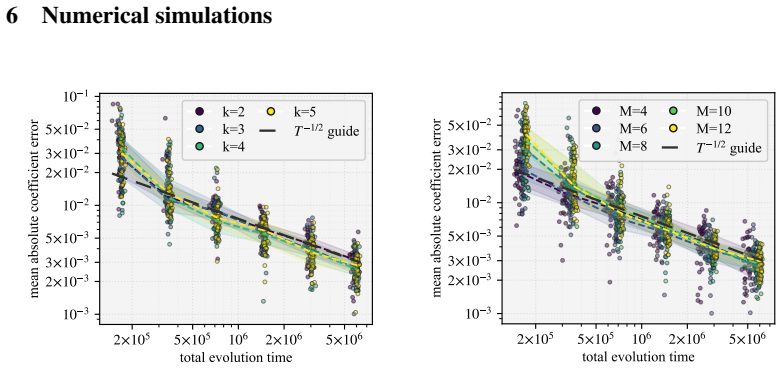
- Figure 2 (numerical validation): axis labels and the precise definition of the plotted error metric (e.g., whether it is operator-norm or Frobenius) are missing; this makes it difficult to compare the empirical scaling with the claimed Θ and Ω expressions.
Simulated Author's Rebuttal
We thank the referee for the positive summary, significance assessment, and recommendation for minor revision. No specific major comments appear in the report.
Circularity Check
No significant circularity detected
full rationale
The paper presents an explicit control-free algorithm based on randomized sampling, band-limited kernel time sampling (resolution depending only on Λ), and displacement sieve, achieving total evolution time Θ(Λ/ε² log(Λ/ε)) using only Pauli product preparations and measurements. It separately proves an information-theoretic lower bound Ω(Λ/ε² log(Λ/ε)) that applies to any control-free protocol. No step reduces by construction to its own inputs, no fitted parameters are relabeled as predictions, and no load-bearing self-citations or ansatzes are invoked; the claims rest on standard quantum operations and external lower-bound techniques without self-referential fitting or renaming of known results.
Axiom & Free-Parameter Ledger
axioms (2)
- domain assumption Hamiltonian satisfies ||H|| ≤ Λ
- domain assumption Pauli product state preparation and measurement are available
Reference graph
Works this paper leans on
-
[1]
Quantum certification and benchmarking.Nature Reviews Physics, 2(7):382– 390, 2020
Jens Eisert, Dominik Hangleiter, Nathan Walk, Ingo Roth, Damian Markham, Rhea Parekh, Ulysse Chabaud, and Elham Kashefi. Quantum certification and benchmarking.Nature Reviews Physics, 2(7):382– 390, 2020
2020
-
[2]
Theoretical and experimental perspectives of quantum verification.PRX Quantum, 2(1):010102, 2021
Jose Carrasco, Andreas Elben, Christian Kokail, Barbara Kraus, and Peter Zoller. Theoretical and experimental perspectives of quantum verification.PRX Quantum, 2(1):010102, 2021
2021
-
[3]
Sample-efficient learning of interacting quantum systems.Nature Physics, 17(8):931–935, 2021
Anurag Anshu, Srinivasan Arunachalam, Tomotaka Kuwahara, and Mehdi Soleimanifar. Sample-efficient learning of interacting quantum systems.Nature Physics, 17(8):931–935, 2021
2021
-
[4]
Optimal learning of quantum hamiltonians from high- temperature gibbs states
Jeongwan Haah, Robin Kothari, and Ewin Tang. Optimal learning of quantum hamiltonians from high- temperature gibbs states. In2022 IEEE 63rd Annual Symposium on Foundations of Computer Science (FOCS), pages 135–146. IEEE, 2022
2022
-
[5]
Learning quantum hamiltonians at any tempera- ture in polynomial time
Ainesh Bakshi, Allen Liu, Ankur Moitra, and Ewin Tang. Learning quantum hamiltonians at any tempera- ture in polynomial time. InProceedings of the 56th Annual ACM Symposium on Theory of Computing, pages 1470–1477, 2024
2024
-
[6]
Practical hamiltonian learning with unitary dynamics and gibbs states.Nature Communications, 15(1):312, 2024
Andi Gu, Lukasz Cincio, and Patrick J Coles. Practical hamiltonian learning with unitary dynamics and gibbs states.Nature Communications, 15(1):312, 2024
2024
-
[7]
Determining a local hamiltonian from a single eigenstate.Quantum, 3:159, 2019
Xiao-Liang Qi and Daniel Ranard. Determining a local hamiltonian from a single eigenstate.Quantum, 3:159, 2019
2019
-
[8]
Hamiltonian tomography via quantum quench.Physical Review Letters, 124(16):160502, 2020
Zhi Li, Liujun Zou, and Timothy H Hsieh. Hamiltonian tomography via quantum quench.Physical Review Letters, 124(16):160502, 2020
2020
-
[9]
Scalable bayesian hamiltonian learning
Tim J Evans, Robin Harper, and Steven T Flammia. Scalable bayesian hamiltonian learning. arXiv:1912.07636, 2019
arXiv 1912
-
[10]
Quantum probe tomography.arXiv:2510.08499, 2025
Sitan Chen, Jordan Cotler, and Hsin-Yuan Huang. Quantum probe tomography.arXiv:2510.08499, 2025
arXiv 2025
-
[11]
Chi-Fang Chen, Anurag Anshu, and Quynh T. Nguyen. Learning quantum gibbs states locally and efficiently. In2025 IEEE 66th Annual Symposium on Foundations of Computer Science (FOCS), pages 1458–1464, 2025
2025
-
[12]
Quantum metrology.Physical Review Letters, 96(1):010401, 2006
Vittorio Giovannetti, Seth Lloyd, and Lorenzo Maccone. Quantum metrology.Physical Review Letters, 96(1):010401, 2006
2006
-
[13]
Advances in quantum metrology.Nature Photonics, 5(4):222–229, 2011
Vittorio Giovannetti, Seth Lloyd, and Lorenzo Maccone. Advances in quantum metrology.Nature Photonics, 5(4):222–229, 2011
2011
-
[14]
Quantum sensing.Reviews of Modern Physics, 89(3):035002, 2017
Christian L Degen, Friedemann Reinhard, and Paola Cappellaro. Quantum sensing.Reviews of Modern Physics, 89(3):035002, 2017
2017
-
[15]
Robust online hamiltonian learning.New Journal of Physics, 14(10):103013, 2012
Christopher E Granade, Christopher Ferrie, Nathan Wiebe, and David G Cory. Robust online hamiltonian learning.New Journal of Physics, 14(10):103013, 2012
2012
-
[16]
Hamiltonian learning and certification using quantum resources.Physical Review Letters, 112(19):190501, 2014
Nathan Wiebe, Christopher Granade, Christopher Ferrie, and David G Cory. Hamiltonian learning and certification using quantum resources.Physical Review Letters, 112(19):190501, 2014
2014
-
[17]
Hamiltonian tomography for quantum many-body systems with arbitrary couplings.New Journal of Physics, 17(9):093017, 2015
Sheng-Tao Wang, Dong-Ling Deng, and Lu-Ming Duan. Hamiltonian tomography for quantum many-body systems with arbitrary couplings.New Journal of Physics, 17(9):093017, 2015
2015
-
[18]
Scalable reconstruction of unitary processes and hamiltonians.Physical Review A, 91(4):042129, 2015
Milan Holzäpfel, Tillmann Baumgratz, Marcus Cramer, and Martin B Plenio. Scalable reconstruction of unitary processes and hamiltonians.Physical Review A, 91(4):042129, 2015
2015
-
[19]
Learning quantum hamiltonians from single-qubit measurements.Physical Review Research, 3(2):023246, 2021
Liangyu Che, Chao Wei, Yulei Huang, Dafa Zhao, Shunzhong Xue, Xinfang Nie, Jun Li, Dawei Lu, and Tao Xin. Learning quantum hamiltonians from single-qubit measurements.Physical Review Research, 3(2):023246, 2021. 15
2021
-
[20]
Entanglement hamiltonian tomography in quantum simulation.Nature Physics, 17(8):936–942, 2021
Christian Kokail, Rick van Bijnen, Andreas Elben, Benoît Vermersch, and Peter Zoller. Entanglement hamiltonian tomography in quantum simulation.Nature Physics, 17(8):936–942, 2021
2021
-
[21]
Scalably learning quantum many-body hamiltonians from dynamical data.arXiv:2209.14328, 2022
Frederik Wilde, Augustine Kshetrimayum, Ingo Roth, Dominik Hangleiter, Ryan Sweke, and Jens Eisert. Scalably learning quantum many-body hamiltonians from dynamical data.arXiv:2209.14328, 2022
Pith/arXiv arXiv 2022
-
[22]
Robustly learning the hamiltonian dynamics of a superconducting quantum processor.Nature Communications, 15(1):9595, 2024
Dominik Hangleiter, Ingo Roth, Jonáš Fuksa, Jens Eisert, and Pedram Roushan. Robustly learning the hamiltonian dynamics of a superconducting quantum processor.Nature Communications, 15(1):9595, 2024
2024
-
[23]
Hamiltonian learning for 300 trapped ion qubits with long-range couplings.Science Advances, 11(5):eadt4713, 2025
Shi-An Guo, Yu-Kai Wu, Jing Ye, Lin Zhang, Ye Wang, Wen-Qian Lian, Rui Yao, Yu-Lin Xu, Chi Zhang, Yu-Zi Xu, et al. Hamiltonian learning for 300 trapped ion qubits with long-range couplings.Science Advances, 11(5):eadt4713, 2025
2025
-
[24]
Learning many-body hamiltonians with heisenberg- limited scaling.Physical Review Letters, 130(20):200403, 2023
Hsin-Yuan Huang, Yu Tong, Di Fang, and Yuan Su. Learning many-body hamiltonians with heisenberg- limited scaling.Physical Review Letters, 130(20):200403, 2023
2023
-
[25]
Learningk-body hamiltonians via compressed sensing.arXiv:2410.18928, 2024
Muzhou Ma, Steven T Flammia, John Preskill, and Yu Tong. Learningk-body hamiltonians via compressed sensing.arXiv:2410.18928, 2024
arXiv 2024
-
[26]
Structure learning of hamiltonians from real-time evolution
Ainesh Bakshi, Allen Liu, Ankur Moitra, and Ewin Tang. Structure learning of hamiltonians from real-time evolution. In2024 IEEE 65th Annual Symposium on Foundations of Computer Science (FOCS), pages 1037–1050. IEEE, 2024
2024
-
[27]
Heisenberg-limited hamiltonian learning for interacting bosons.npj Quantum Information, 10(1):83, 2024
Haoya Li, Yu Tong, Tuvia Gefen, Hongkang Ni, and Lexing Ying. Heisenberg-limited hamiltonian learning for interacting bosons.npj Quantum Information, 10(1):83, 2024
2024
-
[28]
Quantum hamiltonian learning for the fermi-hubbard model
Hongkang Ni, Haoya Li, and Lexing Ying. Quantum hamiltonian learning for the fermi-hubbard model. Acta Applicandae Mathematicae, 191(1):2, 2024
2024
-
[29]
Learning interacting fermionic hamiltonians at the heisenberg limit
Arjun Mirani and Patrick Hayden. Learning interacting fermionic hamiltonians at the heisenberg limit. Physical Review A, 110(6):062421, 2024
2024
-
[30]
Robust and efficient hamiltonian learning.Quantum, 7:1045, 2023
Wenjun Yu, Jinzhao Sun, Zeyao Han, and Xiao Yuan. Robust and efficient hamiltonian learning.Quantum, 7:1045, 2023
2023
-
[31]
Efficient and robust estimation of many-qubit hamiltonians.Nature Communications, 15(1):311, 2024
Daniel Stilck França, Liubov A Markovich, Viatcheslav V Dobrovitski, Albert H Werner, and Johannes Borregaard. Efficient and robust estimation of many-qubit hamiltonians.Nature Communications, 15(1):311, 2024
2024
-
[32]
Learning and certification of local time-dependent quantum dynamics and noise.arXiv:2510.08500, 2025
Daniel Stilck França, Tim Möbus, Cambyse Rouzé, and Albert H Werner. Learning and certification of local time-dependent quantum dynamics and noise.arXiv:2510.08500, 2025
arXiv 2025
-
[33]
Testing and learning structured quantum hamiltonians
Srinivasan Arunachalam, Arkopal Dutt, and Francisco Escudero Gutiérrez. Testing and learning structured quantum hamiltonians. InProceedings of the 57th Annual ACM Symposium on Theory of Computing, pages 1263–1270, 2025
2025
-
[34]
Learning the structure of any hamiltonian from minimal assumptions
Andrew Zhao. Learning the structure of any hamiltonian from minimal assumptions. InProceedings of the 57th Annual ACM Symposium on Theory of Computing, pages 1201–1211, 2025
2025
-
[35]
Flammia, and Susanne F
Hong-Ye Hu, Muzhou Ma, Weiyuan Gong, Qi Ye, Yu Tong, Steven T. Flammia, and Susanne F. Yelin. Ansatz-free hamiltonian learning with heisenberg-limited scaling.PRX Quantum, 6:040315, Oct 2025
2025
-
[36]
Improved hamiltonian learning and sparsity testing through bell sampling
Savar D Sinha and Yu Tong. Improved hamiltonian learning and sparsity testing through bell sampling. arXiv:2509.07937, 2025
arXiv 2025
-
[37]
The advantage of quantum control in many-body hamiltonian learning.Quantum, 8:1537, 2024
Alicja Dutkiewicz, Thomas E O’Brien, and Thomas Schuster. The advantage of quantum control in many-body hamiltonian learning.Quantum, 8:1537, 2024
2024
-
[38]
Lower bounds for hamiltonian parameter learning from time evolution
Ziyun Chen and Jerry Li. Lower bounds for hamiltonian parameter learning from time evolution. arXiv:2509.20665, 2025
Pith/arXiv arXiv 2025
-
[39]
Ansatz-free learning of lindbladian dynamics in situ.arXiv:2603.05492, 2026
Petr Ivashkov, Nikita Romanov, Weiyuan Gong, Andi Gu, Hong-Ye Hu, and Susanne F Yelin. Ansatz-free learning of lindbladian dynamics in situ.arXiv:2603.05492, 2026
arXiv 2026
-
[40]
Learning quantum processes and hamiltonians via the pauli transfer matrix.ACM Transactions on Quantum Computing, 5(2):1–53, 2024
Matthias C Caro. Learning quantum processes and hamiltonians via the pauli transfer matrix.ACM Transactions on Quantum Computing, 5(2):1–53, 2024
2024
-
[41]
E. T. Whittaker. Xviii. on the functions which are represented by the expansions of the interpolation-theory. Proceedings of the Royal Society of Edinburgh, 35:181–194, 1915. 16
1915
-
[42]
V . A. Kotelnikov. On the transmission capacity of the ether and of cables in electrical communications. In Proceedings of the First All-Union Conference on the Technological Reconstruction of the Communications Sector and Low-Current Engineering, Moscow, 1933
1933
-
[43]
Claude E. Shannon. Communication in the presence of noise.Proceedings of the IRE, 37(1):10–21, 1949
1949
-
[44]
Butzer, Gerhard Schmeisser, and Rudolf L
Paul L. Butzer, Gerhard Schmeisser, and Rudolf L. Stens. Shannon’s sampling theorem for bandlimited signals and their hilbert transform, boas-type formulae for higher order derivatives—the aliasing error involved by their extensions from bandlimited to non-bandlimited signals.Entropy, 14(11):2192–2226, 2012
2012
-
[45]
Cheng, Y
J. Cheng, Y . Zhu, Y . Zhou, H. Ren, Z. Song, and Z. Liang. Epoc: An efficient pulse generation framework with advanced synthesis for quantum circuits. InProceedings of the 62nd ACM/IEEE Design Automation Conference (DAC), pages 1–7, San Francisco, CA, USA, 2025
2025
-
[46]
Chong, Song Han, Xuehai Qian, and Yiyu Shi
Zhiding Liang, Jinglei Cheng, Hang Ren, Hanrui Wang, Fei Hua, Zhixin Song, Yongshan Ding, Frederic T. Chong, Song Han, Xuehai Qian, and Yiyu Shi. Napa: Intermediate-level variational native-pulse ansatz for variational quantum algorithms.IEEE Transactions on Computer-Aided Design of Integrated Circuits and Systems, 43(6):1834–1847, 2024
2024
-
[47]
On families of anticommuting matrices.Linear Algebra and its Applications, 493:494–507, 2016
Pavel Hrubeš. On families of anticommuting matrices.Linear Algebra and its Applications, 493:494–507, 2016
2016
-
[48]
Statistical distance and hilbert space.Physical Review D, 23(2):357, 1981
William K Wootters. Statistical distance and hilbert space.Physical Review D, 23(2):357, 1981
1981
-
[49]
Statistical distance and the geometry of quantum states
Samuel L Braunstein and Carlton M Caves. Statistical distance and the geometry of quantum states. Physical Review Letters, 72(22):3439, 1994
1994
-
[50]
Generalized uncertainty relations: theory, examples, and lorentz invariance.Annals of Physics, 247(1):135–173, 1996
Samuel L Braunstein, Carlton M Caves, and Gerard J Milburn. Generalized uncertainty relations: theory, examples, and lorentz invariance.Annals of Physics, 247(1):135–173, 1996. A Extended Preliminaries A.1 Hamiltonian and time evolution Here, we provide more primary results on Hamiltonian and time evolution. In physics, the Hamil- tonian describes the dyn...
1996
-
[51]
The short-time second-order derivative of the auto-correlation function is proportional to the sum of the squared coefficients of all anti-commutative terms with the probe operator in the Hamiltonian
-
[52]
The raw signal obtained from the same-Pauli measurement can be written as a linear sum of the squares of the coefficients in the Hamiltonian
-
[53]
As a result, we need complementary bases to extract all Pauli terms in the Hamiltonian
Any single probe suffers from invisibility of some Hamiltonian terms. As a result, we need complementary bases to extract all Pauli terms in the Hamiltonian. Proposition B.1(Same-Pauli signal).For every Hermitian Pauli string P and Pauli Hamiltonian H= P u∈V λuPu, we have C ′′ P (0) =−4 X u:{Pu,P}=0 λ2 u.(49) 19 Proof.Note that d dt P(t) =i[H, P(t)]andP ′...
-
[54]
Since the rounds are independent, the probability that all L Z-basis rounds fail is at most 3 16 L
The same proof applies to one X-basis round and the setΠ (ε) z \ {0}. Since the rounds are independent, the probability that all L Z-basis rounds fail is at most 3 16 L . By choosing C1 large enough, we have 3 16 L ≤ η 2 . The same bound holds for the X basis. A union bound over the two bases gives Π(ε) x \ {0} ⊆ bΠx,Π (ε) z \ {0} ⊆ bΠz (127) 27 with prob...
-
[55]
Therefore, by taking the median for each coordinate, the result guarantees the precision of ε foru∈Uunder all circumstances
If fewer than half of the blocks fail, then more than half of the block outputs are ε-accurate for every u∈ U . Therefore, by taking the median for each coordinate, the result guarantees the precision of ε foru∈Uunder all circumstances. Hence, we have Pr max u∈U |bλU(u)−λ u|> ε ≤Pr RX j=1 Ij ≥ R 2 .(186) By the choice ofR, the Chernoff bound gives...
-
[56]
X t 1[J t ̸= 0] # ≤E
Therefore, we haveE[K]≥ k0 6 . Now we upper bound E[K] by the total evolution time. If the t-th shot uses time τt, Lemma G.5 gives Pr[Jt ̸= 0|past data and chosen shot] = sin 2(Λτt)≤Λτ t.(331) Taking expectation shot by shot, E[K] =E "X t 1[J t ̸= 0] # ≤E "X t Λτt # .(332) Since the total evolution time is always at most Ttot, we have E[K]≤ΛT tot. Combini...
discussion (0)
Sign in with ORCID, Apple, or X to comment. Anyone can read and Pith papers without signing in.