Uncertainty-Aware Reward Modeling for Stable RLHF
Pith reviewed 2026-06-26 18:11 UTC · model grok-4.3
The pith
Equipping reward models with conformal uncertainty estimates and reweighting GRPO advantages reduces reward hacking in RLHF.
A machine-rendered reading of the paper's core claim, the machinery that carries it, and where it could break.
Core claim
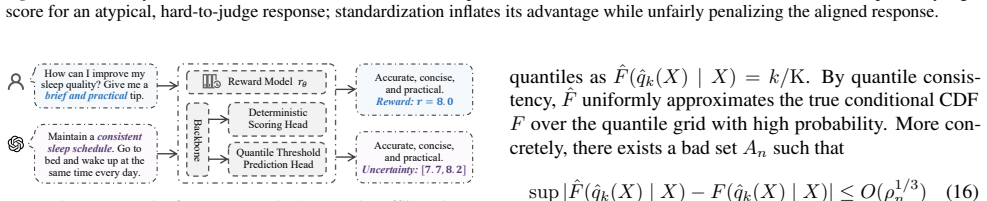
UARM equips reward models with calibrated uncertainty via quantile-based conformal prediction and reweights GRPO advantages through heteroscedastic variance decomposition. Experiments across HelpSteer, UltraFeedback, and PKU-SafeRLHF demonstrate that UARM significantly improves reward model calibration, reduces reward hacking, and enhances downstream alignment quality compared to standard GRPO and uncertainty-agnostic baselines.
What carries the argument
UARM mechanism that pairs quantile-based conformal prediction for uncertainty calibration in reward models with heteroscedastic variance decomposition to reweight advantages inside GRPO.
If this is right
- Reward models produce both a point estimate and a calibrated uncertainty interval on each preference pair.
- GRPO advantage estimates become inversely weighted by the heteroscedastic variance of the reward prediction.
- Unreliable reward signals exert less influence on policy updates, limiting reward hacking.
- Downstream policies achieve higher alignment quality on the same preference datasets.
- The approach applies directly to any group-based policy optimizer that computes advantages from reward scores.
Where Pith is reading between the lines
- The same conformal-plus-variance pipeline could be tested inside PPO or other non-group RLHF variants.
- If the uncertainty estimates remain calibrated at larger model scales, the method may support more aggressive exploration schedules.
- Preference datasets that contain many low-consensus items would benefit most from the reweighting step.
Load-bearing premise
The assumption that quantile-based conformal prediction yields well-calibrated uncertainty estimates on preference data and that heteroscedastic variance decomposition correctly isolates unreliable signals for reweighting inside GRPO advantage computation.
What would settle it
A held-out preference dataset where the conformal prediction intervals show poor coverage or where down-weighting by the estimated variance fails to reduce observed reward hacking in a GRPO run.
Figures

read the original abstract
Reinforcement learning from human feedback (RLHF) aligns large language models by training reward models on preference data and optimizing policies to maximize predicted rewards. However, this pipeline faces two fundamental challenges: (1) reward models cannot signal when their predictions are unreliable, since they usually act as deterministic point estimators; and (2) modern group-based policy optimization can amplify unreliable reward signals, as exemplified by GRPO's uniform treatment of rewards during advantage computation. As policies explore increasingly diverse responses, these two limitations create a critical vulnerability: unreliable reward estimates may be granted disproportionate influence, triggering severe reward hacking. We propose Uncertainty-Aware Reward Modeling (UARM), which equips reward models with calibrated uncertainty via quantile-based conformal prediction and reweights GRPO advantages through heteroscedastic variance decomposition. Experiments across HelpSteer, UltraFeedback, and PKU-SafeRLHF demonstrate that UARM significantly improves reward model calibration, reduces reward hacking, and enhances downstream alignment quality compared to standard GRPO and uncertainty-agnostic baselines.
Editorial analysis
A structured set of objections, weighed in public.
Referee Report
Summary. The manuscript proposes Uncertainty-Aware Reward Modeling (UARM) for RLHF. It equips reward models with calibrated uncertainty estimates via quantile-based conformal prediction and reweights advantages inside GRPO using heteroscedastic variance decomposition. The central claim is that this addresses reward hacking arising from unreliable point-estimate rewards, with experiments on HelpSteer, UltraFeedback, and PKU-SafeRLHF showing improved calibration, reduced hacking, and better downstream alignment relative to standard GRPO and uncertainty-agnostic baselines.
Significance. If the experimental claims hold and the conformal coverage remains valid under policy-induced distribution shift, UARM would constitute a practical, additive improvement to existing RLHF pipelines that directly targets a known source of instability. The approach reuses standard conformal prediction and GRPO machinery without introducing new free parameters, which is a strength.
major comments (2)
- [Experiments] Experiments section: The abstract states that UARM 'significantly improves reward model calibration, reduces reward hacking, and enhances downstream alignment quality' yet supplies no quantitative results, error bars, ablation details, or implementation specifics. This absence makes it impossible to verify whether the data support the central claim.
- [Method] Method section (conformal prediction and reweighting): The assumption that quantile-based conformal prediction produces well-calibrated uncertainty estimates on fixed preference data, and that heteroscedastic variance decomposition then correctly isolates unreliable signals for GRPO advantage reweighting, is load-bearing. Standard conformal guarantees require exchangeability between calibration and test points; the policy's shifting response distribution during GRPO violates this, risking miscalibrated uncertainties that could amplify rather than mitigate reward hacking.
Simulated Author's Rebuttal
We thank the referee for their insightful comments on our work. We address each major comment in detail below, providing clarifications and indicating where revisions will be made to strengthen the manuscript.
read point-by-point responses
-
Referee: [Experiments] Experiments section: The abstract states that UARM 'significantly improves reward model calibration, reduces reward hacking, and enhances downstream alignment quality' yet supplies no quantitative results, error bars, ablation details, or implementation specifics. This absence makes it impossible to verify whether the data support the central claim.
Authors: The full manuscript's experiments section (Section 4) presents quantitative results across the three datasets, including calibration metrics (e.g., expected calibration error), reward hacking indicators, and downstream performance with error bars from multiple random seeds. Ablations on the conformal prediction quantiles and the variance decomposition are included in the appendix. Implementation details such as model architectures, training hyperparameters, and conformal calibration set sizes are provided in Section 3 and the appendix. To make these more prominent and address the concern, we will add a summary table of key quantitative improvements with error bars directly in the main experiments section and expand the ablation studies. revision: yes
-
Referee: [Method] Method section (conformal prediction and reweighting): The assumption that quantile-based conformal prediction produces well-calibrated uncertainty estimates on fixed preference data, and that heteroscedastic variance decomposition then correctly isolates unreliable signals for GRPO advantage reweighting, is load-bearing. Standard conformal guarantees require exchangeability between calibration and test points; the policy's shifting response distribution during GRPO violates this, risking miscalibrated uncertainties that could amplify rather than mitigate reward hacking.
Authors: We agree that the exchangeability assumption is formally violated due to the non-stationary policy distribution during training. However, the quantile-based conformal prediction is applied to the fixed preference dataset for calibration, and the uncertainty is used to reweight advantages in a way that downweights high-uncertainty predictions via the heteroscedastic decomposition. Our experiments demonstrate that this leads to reduced reward hacking rather than amplification, suggesting practical robustness despite the theoretical gap. We will add a dedicated paragraph in the discussion section acknowledging this limitation and outlining why the empirical results support the approach, along with suggestions for future adaptive conformal techniques. revision: partial
Circularity Check
No significant circularity in derivation chain
full rationale
The paper presents UARM as an additive method combining standard quantile-based conformal prediction for uncertainty estimation with heteroscedastic variance decomposition for GRPO reweighting. No equations or derivations are provided that reduce claimed improvements to fitted parameters, self-referential quantities, or self-citation chains. The central claims rest on experimental validation across datasets rather than any self-definitional or fitted-input-called-prediction structure. External conformal prediction guarantees and GRPO baselines are invoked as independent foundations, with no load-bearing uniqueness theorems or ansatzes imported from the authors' prior work.
Axiom & Free-Parameter Ledger
Reference graph
Works this paper leans on
-
[1]
L., Almeida, D., Altenschmidt, J., Altman, S., Anadkat, S., et al
Achiam, J., Adler, S., Agarwal, S., Ahmad, L., Akkaya, I., Aleman, F. L., Almeida, D., Altenschmidt, J., Altman, S., Anadkat, S., et al. Gpt-4 technical report.arXiv preprint arXiv:2303.08774,
-
[2]
Concrete problems in ai safety
Amodei, D., Olah, C., Steinhardt, J., Christiano, P., Schul- man, J., and Man ´e, D. Concrete problems in ai safety. arXiv preprint arXiv:1606.06565,
-
[3]
8 Uncertainty-Aware Reward Modeling for Stable RLHF Comanici, G., Bieber, E., Schaekermann, M., Pasupat, I., Sachdeva, N., Dhillon, I., Blistein, M., Ram, O., Zhang, D., Rosen, E., et al. Gemini 2.5: Pushing the frontier with advanced reasoning, multimodality, long context, and next generation agentic capabilities.arXiv preprint arXiv:2507.06261,
-
[4]
Reward model ensembles help mitigate overoptimization.arXiv preprint arXiv:2310.02743,
Coste, T., Anwar, U., Kirk, R., and Krueger, D. Reward model ensembles help mitigate overoptimization.arXiv preprint arXiv:2310.02743,
-
[5]
Ultrafeedback: Boosting language models with scaled ai feedback.arXiv preprint arXiv:2310.01377,
Cui, G., Yuan, L., Ding, N., Yao, G., He, B., Zhu, W., Ni, Y ., Xie, G., Xie, R., Lin, Y ., et al. Ultrafeedback: Boosting language models with scaled ai feedback.arXiv preprint arXiv:2310.01377,
-
[6]
Rlhf workflow: From reward modeling to online rlhf.arXiv preprint arXiv:2405.07863,
Dong, H., Xiong, W., Pang, B., Wang, H., Zhao, H., Zhou, Y ., Jiang, N., Sahoo, D., Xiong, C., and Zhang, T. Rlhf workflow: From reward modeling to online rlhf.arXiv preprint arXiv:2405.07863,
-
[7]
Eisenstein, J., Nagpal, C., Agarwal, A., Beirami, A., D’Amour, A., Dvijotham, D., Fisch, A., Heller, K., Pfohl, S., Ramachandran, D., et al. Helping or herding? reward model ensembles mitigate but do not eliminate reward hacking.arXiv preprint arXiv:2312.09244,
-
[8]
Reward shaping to mitigate reward hacking in rlhf.arXiv preprint arXiv:2502.18770,
Fu, J., Zhao, X., Yao, C., Wang, H., Han, Q., and Xiao, Y . Reward shaping to mitigate reward hacking in rlhf.arXiv preprint arXiv:2502.18770,
-
[9]
Lambert, N., Pyatkin, V ., Morrison, J., Miranda, L. J. V ., Lin, B. Y ., Chandu, K., Dziri, N., Kumar, S., Zick, T., Choi, Y ., et al. Rewardbench: Evaluating reward models for language modeling. InFindings of the Association for Computational Linguistics: NAACL 2025, pp. 1755– 1797,
2025
-
[10]
Lei, J., G’Sell, M., Rinaldo, A., Tibshirani, R. J., and Wasserman, L. Distribution-free predictive inference for regression.Journal of the American Statistical Associa- tion, 113(523):1094–1111, 2018a. Lei, J., G’Sell, M., Rinaldo, A., Tibshirani, R. J., and Wasserman, L. Distribution-free predictive inference for regression.Journal of the American Stati...
-
[11]
Estimating conditional quantiles with the help of the pinball loss.Bernoulli, 17(1), 2011
doi: 10.3150/10-BEJ267. Tibshirani, R. J., Foygel Barber, R., Candes, E., and Ramdas, A. Conformal prediction under covariate shift.Proc. Adv. Neural Inf. Process. Syst., 32,
-
[12]
Wang, H., Pan, L., Chen, Z., Zheng, C., Chu, Z., Li, X., Lu, Y ., Liu, X., Li, H., and Lin, Z. Causalrm: Causal- theoretic reward modeling for rlhf from observational user feedbacks.arXiv preprint arXiv:2603.18736,
-
[13]
N., Egert, D., Delalleau, O., Scowcroft, J., Kant, N., Swope, A., et al
Wang, Z., Dong, Y ., Zeng, J., Adams, V ., Sreedhar, M. N., Egert, D., Delalleau, O., Scowcroft, J., Kant, N., Swope, A., et al. Helpsteer: Multi-attribute helpfulness dataset for steerlm. InProceedings of the 2024 Conference of the North American Chapter of the Association for Com- putational Linguistics: Human Language Technologies (Volume 1: Long Paper...
2024
-
[14]
Group sequence policy optimization.arXiv preprint arXiv:2507.18071,
Zheng, C., Liu, S., Li, M., Chen, X.-H., Yu, B., Gao, C., Dang, K., Liu, Y ., Men, R., Yang, A., et al. Group sequence policy optimization.arXiv preprint arXiv:2507.18071,
discussion (0)
Sign in with ORCID, Apple, or X to comment. Anyone can read and Pith papers without signing in.