On the impact of the carbon fusion rate over the properties of superbursts -- Numerical simulations of superbursts with MESA
Pith reviewed 2026-06-26 16:14 UTC · model grok-4.3
The pith
Enhancing the carbon fusion rate by a factor of 1000 at low temperatures shortens superburst recurrence times and reduces ignition depth on neutron stars.
A machine-rendered reading of the paper's core claim, the machinery that carries it, and where it could break.
Core claim
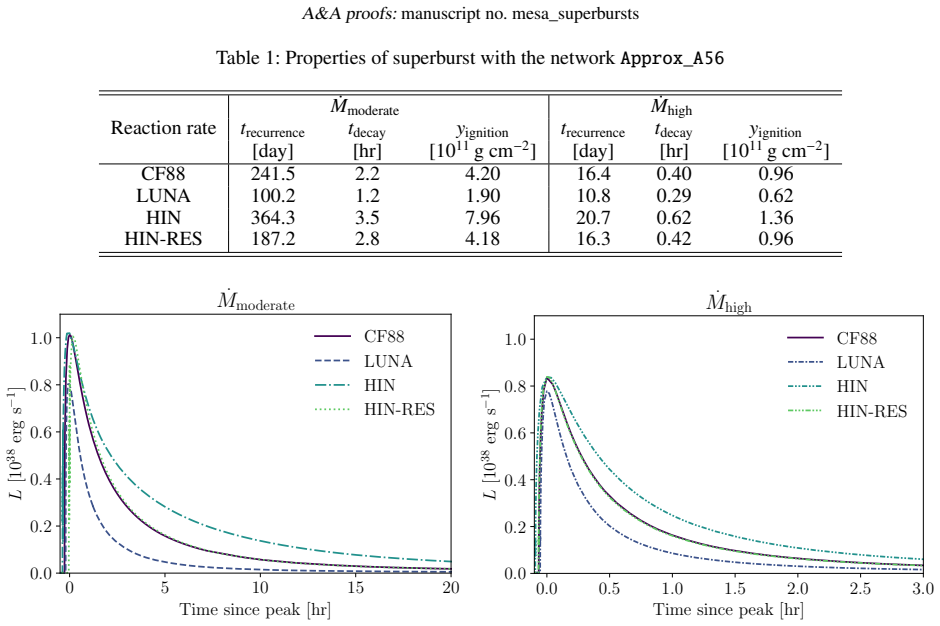
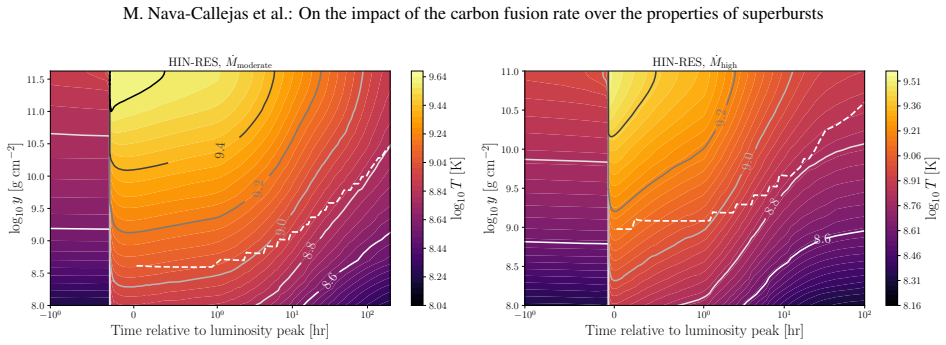
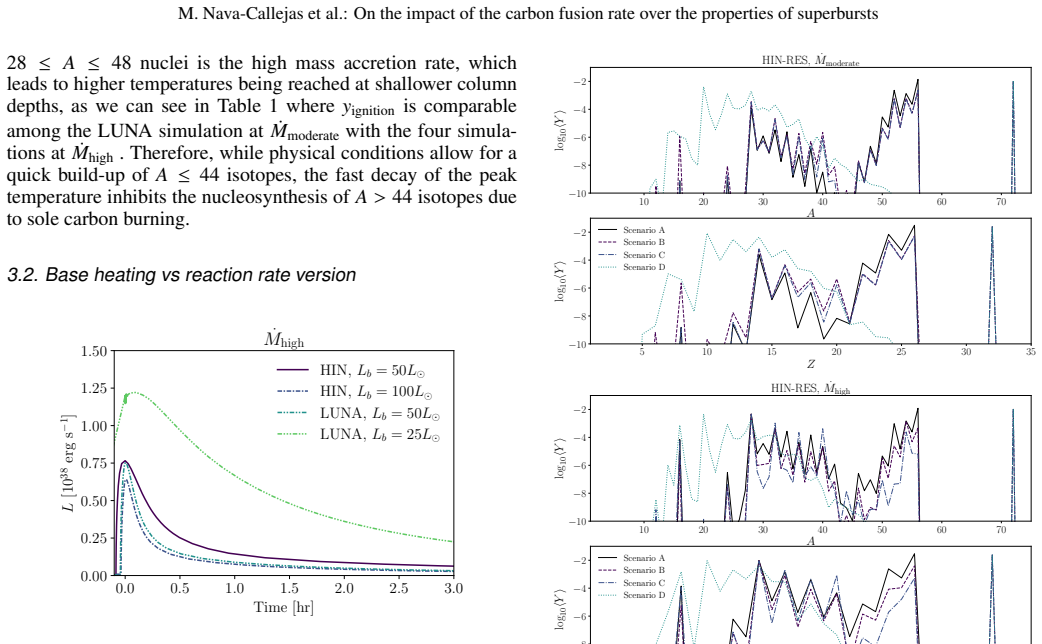
An enhancement of the reaction rate by a factor of 10^3 at T ≤ 10^9 K reduces the recurrence and decay times of the superburst, as well as the column depth at ignition. The opposite behavior is observed when the carbon fusion rate is reduced by the same factor. The maximum temperature reached during the explosion is also sensitive to these changes, leading to either an enhancement or a reduction in the synthesis of α-nuclides. These changes are comparable to the effect of reducing the amount of base heating at the bottom of the envelope.
What carries the argument
MESA numerical simulations of superburst ignition and propagation using four different carbon fusion reaction rate tables at temperatures below 10^9 K.
If this is right
- A 1000-fold higher carbon fusion rate produces shorter superburst recurrence and decay times.
- Ignition occurs at lower column depths when the rate is enhanced.
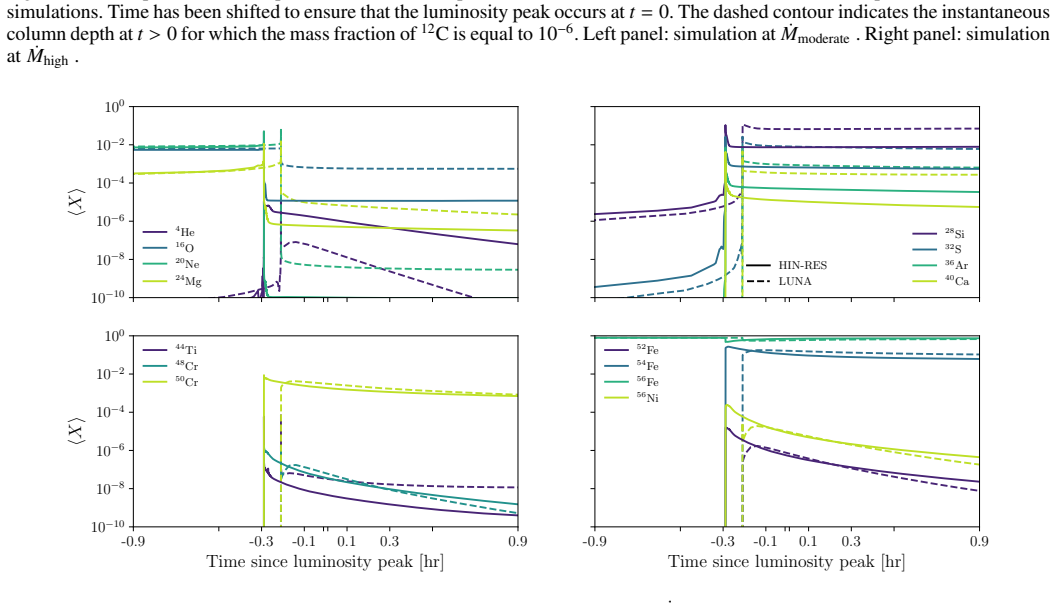
- Peak temperature during the burst rises or falls with the rate, changing alpha-nuclide production.
- The size of the rate-induced changes equals the size of changes from reduced base heating.
- A lower rate lengthens both recurrence and decay times while increasing ignition depth.
Where Pith is reading between the lines
- Observational catalogs of superburst intervals from multiple LMXBs could distinguish among the rate tables if the model assumptions hold.
- Altered alpha yields would change the long-term composition of the accreted crust, potentially affecting subsequent bursts or cooling curves.
- The same rate uncertainty at these temperatures could influence models of other low-temperature carbon-burning episodes in compact objects.
Load-bearing premise
The MESA simulations accurately model the conditions for carbon ignition, the propagation of the burning front, and the resulting nucleosynthesis in the neutron-star crust.
What would settle it
Measured recurrence times and ignition depths from a specific observed superburst source compared against the four simulated rate cases would show whether the claimed sensitivity holds.
Figures





read the original abstract
Context: Superbursts are very energetic explosions in the crust of neutron stars in Low-Mass X-ray Binaries (LMXBs). These are triggered by unstable carbon burning at $T\leq 10^{9}$ K. In recent years, there has been a re-examination of the carbon fusion rate, finding that at these temperatures it might be either smaller or higher with respect to the classic rate from Caughler \& Fowler (1988) by a factor $10^{3}$. Aims: We explore the consequences changing the carbon fusion rate has over the physics of superbursts. Methods: For simulating superbursts, we employ the public code MESA v.24.08.1, as well as four versions of the carbon fusion reaction rate. Results: An enhancement of the reaction rate by a factor $10^{3}$ at $T\leq 10^9$~K reduces the recurrence and decay times of the superburst, as well as the column depth at ignition. The opposite behavior is observed when the carbon fusion rate is reduced by the same factor. The maximum temperature reached during the explosion is also sensitive to these changes, leading to either an enhancement or a reduction in the synthesis of $\alpha$-nuclides. These changes are comparable to the effect of reducing the amount of base heating at the bottom of the envelope.
Editorial analysis
A structured set of objections, weighed in public.
Referee Report
Summary. The manuscript uses MESA v.24.08.1 to perform 1D numerical simulations of superbursts triggered by unstable carbon burning in neutron-star envelopes. It compares four carbon-fusion rate tables (the standard CF88 rate plus three variants scaled by multiplicative factors of 10^3 at T ≤ 10^9 K) while holding other inputs fixed, and reports that rate enhancement shortens recurrence time, decay time and ignition column depth, lowers peak temperature and reduces α-nuclide yields, with the opposite trends for rate reduction; these shifts are stated to be comparable to the effect of lowering base heating.
Significance. If the reported directional changes prove robust, the work supplies a concrete, reproducible demonstration that plausible factor-of-10^3 uncertainties in the low-temperature carbon fusion rate translate into order-unity changes in observable superburst properties. The use of a public code and a controlled, single-parameter sensitivity study is a clear methodological strength that supports direct follow-up by other groups.
major comments (2)
- [Methods] Methods section: the manuscript provides no convergence tests (spatial resolution, time-step criteria, or envelope zoning) for the reported ignition column depths or recurrence times. Because the central claim rests on quantitative differences between rate tables, absence of demonstrated numerical convergence leaves open the possibility that the magnitude of the reported shifts depends on discretization choices.
- [Results] Results section: the claim that rate-induced changes are 'comparable' to those from reduced base heating is presented without quantitative metrics (relative differences, overlap in parameter space, or tabulated values). This comparison is used to contextualize the main findings and therefore requires supporting numbers or figures to be load-bearing.
minor comments (1)
- [Abstract] Abstract and Results: the four rate tables are described only qualitatively; a short table or explicit functional form for each multiplier would improve clarity and reproducibility.
Simulated Author's Rebuttal
We thank the referee for the constructive comments and positive assessment of the methodological approach. We address the two major comments point by point below.
read point-by-point responses
-
Referee: [Methods] Methods section: the manuscript provides no convergence tests (spatial resolution, time-step criteria, or envelope zoning) for the reported ignition column depths or recurrence times. Because the central claim rests on quantitative differences between rate tables, absence of demonstrated numerical convergence leaves open the possibility that the magnitude of the reported shifts depends on discretization choices.
Authors: We agree that explicit convergence tests are needed to support the quantitative differences reported. In the revised manuscript we will add an appendix presenting resolution, time-step, and zoning convergence tests for ignition column depth and recurrence time across the four rate tables, confirming that the reported shifts remain stable under the adopted numerical settings. revision: yes
-
Referee: [Results] Results section: the claim that rate-induced changes are 'comparable' to those from reduced base heating is presented without quantitative metrics (relative differences, overlap in parameter space, or tabulated values). This comparison is used to contextualize the main findings and therefore requires supporting numbers or figures to be load-bearing.
Authors: We accept that the comparability statement requires explicit quantitative support. The revised version will include a new table (or supplementary figure panels) that tabulates the relative changes in recurrence time, decay time, ignition depth, peak temperature, and alpha yields for both the rate variations and the base-heating variation, allowing direct numerical comparison. revision: yes
Circularity Check
No significant circularity
full rationale
The paper performs a controlled numerical sensitivity study in MESA v.24.08.1 by running otherwise identical envelope models with four supplied carbon-fusion rate tables (CF88 baseline plus uniform multiplicative factors of 10^3 above and below T=10^9 K). All reported changes in recurrence time, ignition column depth, decay time, peak temperature, and alpha yields are direct numerical outputs of the altered energy-generation rate inside the public code; no equations, fitted parameters, or self-citations reduce these outputs to quantities defined inside the paper itself. The derivation chain is therefore self-contained against external benchmarks.
Axiom & Free-Parameter Ledger
axioms (1)
- domain assumption MESA v.24.08.1 accurately models the thermal and compositional evolution of the neutron-star envelope during unstable carbon burning.
Reference graph
Works this paper leans on
-
[1]
2011, A&A, 535, A114
Bravo, E., Piersanti, L., Domínguez, I., et al. 2011, A&A, 535, A114
2011
-
[2]
D., Fang, X., et al
Bucher, B., Tang, X. D., Fang, X., et al. 2015, Phys. Rev. Lett., 114, 251102
2015
-
[3]
Caughlan, G. R. & Fowler, W. A. 1988, Atomic Data and Nuclear Data Tables, 40, 283
1988
-
[4]
K., Heger, A., et al
Cavecchi, Y ., Galloway, D. K., Heger, A., et al. 2026, The Astrophysical Journal, 998, 25
2026
-
[5]
Chieffi, A. et al. 2025, Eur. Phys. J. A, 61, 280
2025
-
[6]
L., Steiner, A
Cooper, R. L., Steiner, A. W., & Brown, E. F. 2009, The Astrophysical Journal, 702, 660
2009
-
[7]
& Bildsten, L
Cumming, A. & Bildsten, L. 2001, The Astrophysical Journal, 559, L127
2001
-
[8]
& Macbeth, J
Cumming, A. & Macbeth, J. 2004, The Astrophysical Journal, 603, L37
2004
-
[9]
Cumming, A., Macbeth, J., Zand, J. J. M. i., & Page, D. 2006, The Astrophysical Journal, 646, 429
2006
-
[10]
H., Amthor, A
Cyburt, R. H., Amthor, A. M., Ferguson, R., et al. 2010, The Astrophysical Jour- nal Supplement Series, 189, 240
2010
-
[11]
H., Amthor, A
Cyburt, R. H., Amthor, A. M., Heger, A., et al. 2016, The Astrophysical Journal, 830, 55
2016
-
[12]
L., Görres, J., Wiescher, M., & Davids, B
Fisker, J. L., Görres, J., Wiescher, M., & Davids, B. 2006, ApJ, 650, 332
2006
-
[13]
Galloway, D. K. & Keek, L. 2021, in Astrophysics and Space Science Library, V ol. 461, Timing Neutron Stars: Pulsations, Oscillations and Explosions, ed. T. M. Belloni, M. Méndez, & C. Zhang, 209–262
2021
-
[14]
Gusakov, M. E. & Chugunov, A. I. 2021, Phys. Rev. D, 103, L101301
2021
-
[15]
& Zdunik, J
Haensel, P. & Zdunik, J. L. 2008, A&A, 480, 459 in’t Zand, J. 2017, in 7 years of MAXI: monitoring X-ray Transients, ed. M. Serino, M. Shidatsu, W. Iwakiri, & T. Mihara, 121 in’t Zand, J. J. M., Cornelisse, R., & Cumming, A. 2004, A&A, 426, 257
2008
-
[16]
F., Schatz, H., et al
Jain, R., Brown, E. F., Schatz, H., et al. 2025, Phys. Rev. Lett., 135, 162701
2025
-
[17]
S., Bauer, E
Jermyn, A. S., Bauer, E. B., Schwab, J., et al. 2023, ApJS, 265, 15
2023
-
[18]
Johnston, Z., Heger, A., & Galloway, D. K. 2018, Monthly Notices of the Royal Astronomical Society, 477, 2112
2018
-
[19]
Johnston, Z., Heger, A., & Galloway, D. K. 2020, Monthly Notices of the Royal Astronomical Society, 494, 4576
2020
-
[20]
& Heger, A
Keek, L. & Heger, A. 2011, The Astrophysical Journal, 743, 189
2011
-
[21]
Keek, L., Heger, A., & in’t Zand, J. J. M. 2012, ApJ, 752, 150
2012
-
[22]
2004, Nuclear Physics B Proceedings Supplements, 132, 466
Kuulkers, E. 2004, Nuclear Physics B Proceedings Supplements, 132, 466
2004
-
[23]
2009, The Astronomer’s Telegram, 2140, 1
Kuulkers, E. 2009, The Astronomer’s Telegram, 2140, 1
2009
-
[24]
2004, in American Institute of Physics Conference Series, V ol
Kuulkers, E., in’t Zand, J., Homan, J., et al. 2004, in American Institute of Physics Conference Series, V ol. 714, X-ray Timing 2003: Rossi and Beyond, ed. P. Kaaret, F. K. Lamb, & J. H. Swank (AIP), 257–260
2004
-
[25]
S., et al
Lau, R., Beard, M., Gupta, S. S., et al. 2018, The Astrophysical Journal, 859, 62
2018
-
[26]
2018, The Astrophysical Journal, 860, 147 Article number, page 10 M
Meisel, Z. 2018, The Astrophysical Journal, 860, 147 Article number, page 10 M. Nava-Callejas et al.: On the impact of the carbon fusion rate over the properties of superbursts
2018
-
[27]
2022, A&A, 660, A47
Monpribat, E., Martinet, S., Courtin, S., et al. 2022, A&A, 660, A47
2022
-
[28]
2025, The Astrophysical Journal, 991, 62 Noël, C., Goriely, S., Busegnies, Y ., & Papalexandris, M
Nava-Callejas, M., Page, D., & Cavecchi, Y . 2025, The Astrophysical Journal, 991, 62 Noël, C., Goriely, S., Busegnies, Y ., & Papalexandris, M. V . 2008, A&A, 483, 7
2025
-
[29]
2022, The Astrophysical Journal, 933, 216
Page, D., Homan, J., Nava-Callejas, M., et al. 2022, The Astrophysical Journal, 933, 216
2022
-
[30]
2011, ApJS, 192, 3
Paxton, B., Bildsten, L., Dotter, A., et al. 2011, ApJS, 192, 3
2011
-
[31]
2013, ApJS, 208, 4
Paxton, B., Cantiello, M., Arras, P., et al. 2013, ApJS, 208, 4
2013
-
[32]
2015, ApJS, 220, 15
Paxton, B., Marchant, P., Schwab, J., et al. 2015, ApJS, 220, 15
2015
-
[33]
B., et al
Paxton, B., Schwab, J., Bauer, E. B., et al. 2018, ApJS, 234, 34
2018
-
[34]
2019, ApJS, 243, 10
Paxton, B., Smolec, R., Schwab, J., et al. 2019, ApJS, 243, 10
2019
-
[35]
2013, ApJ, 762, 31
Pignatari, M., Hirschi, R., Wiescher, M., et al. 2013, ApJ, 762, 31
2013
-
[36]
Potekhin, A. Y . & Yakovlev, D. G. 2001, A&A, 374, 213
2001
-
[37]
2017, ApJ, 835, 119
Poutanen, J. 2017, ApJ, 835, 119
2017
-
[38]
2020, Essentials of Nucleosynthesis and Theoretical Nuclear Astro- physics, 2514-3433 (IOP Publishing)
Rauscher, T. 2020, Essentials of Nucleosynthesis and Theoretical Nuclear Astro- physics, 2514-3433 (IOP Publishing)
2020
-
[39]
2001, Phys
Schatz, H., Aprahamian, A., Barnard, V ., et al. 2001, Phys. Rev. Lett., 86, 3471
2001
-
[40]
1999, ApJ, 524, 1014
Schatz, H., Bildsten, L., Cumming, A., & Wiescher, M. 1999, ApJ, 524, 1014
1999
-
[41]
N., Gusakov, M
Shchechilin, N. N., Gusakov, M. E., & Chugunov, A. I. 2021, MNRAS, 507, 3860
2021
-
[42]
N., Gusakov, M
Shchechilin, N. N., Gusakov, M. E., & Chugunov, A. I. 2022, MNRAS, 515, L6
2022
-
[43]
2007, Phys
Spillane, T., Raiola, F., Rolfs, C., et al. 2007, Phys. Rev. Lett., 98, 122501
2007
-
[44]
F., Cumming, A., Cyburt, R., & Schatz, H
Stevens, J., Brown, E. F., Cumming, A., Cyburt, R., & Schatz, H. 2014, ApJ, 791, 106
2014
-
[45]
Strohmayer, T. E. & Brown, E. F. 2002, The Astrophysical Journal, 566, 1045
2002
-
[46]
Strohmayer, T. E. & Markwardt, C. B. 2002, ApJ, 577, 337
2002
-
[47]
2018, Nature, 557, 687
Tumino, A., Spitaleri, C., La Cognata, M., et al. 2018, Nature, 557, 687
2018
-
[48]
Wallace, R. K. & Woosley, S. E. 1981, ApJS, 45, 389
1981
-
[49]
Weinberg, N. N. & Bildsten, L. 2007, ApJ, 670, 1291
2007
-
[50]
N., Bildsten, L., & Brown, E
Weinberg, N. N., Bildsten, L., & Brown, E. F. 2006, The Astrophysical Journal, 650, L119
2006
-
[51]
2001, The Astrophysical Journal, 554, L59
Wijnands, R. 2001, The Astrophysical Journal, 554, L59
2001
-
[52]
the chemical compositon of the ashes from a burst/superburst
Zamfir, M., Cumming, A., & Niquette, C. 2014, MNRAS, 445, 3278 Article number, page 11 A&A proofs:manuscript no. mesa_superbursts Appendix A: Calculation of the mass fraction averages 10.75 11.00 11.25 11.50 11.75 12.00 log10 y [g cm □2] □8 □6 □4 □2 0 log10 X HIN-RES, ˙Mmoderate 12C 28Si 40Ca 52Cr 56Fe Fig. A.1: Mass fractions of a selected set of nuclide...
2014
discussion (0)
Sign in with ORCID, Apple, or X to comment. Anyone can read and Pith papers without signing in.