On representation of macroscopic crack in periodic fine-scale discrete mechanical models
Pith reviewed 2026-06-26 16:22 UTC · model grok-4.3
The pith
Tessellation boundary conditions produce a single well-defined localization band whose length depends only on model geometry in discrete models of concrete under tension.
A machine-rendered reading of the paper's core claim, the machinery that carries it, and where it could break.
Core claim
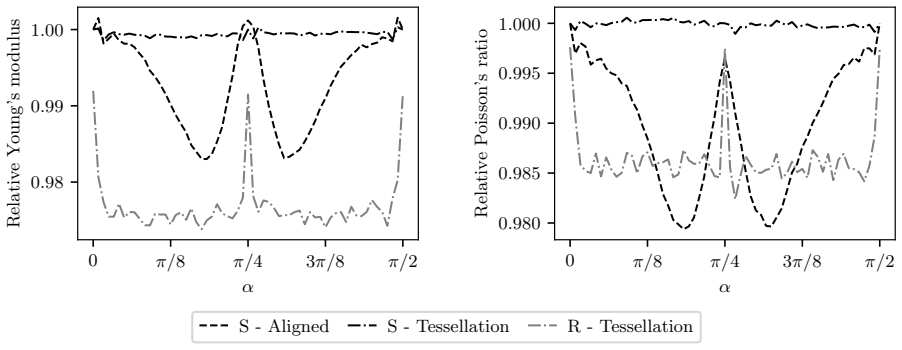
Tessellation BCs consistently yield a well-defined localization band, whose length is determined solely by the model geometry, making it straightforward to account for in post-processing. Percolation-path-aligned BCs exhibit major shortcomings: they can lead to multiple localization bands due to uneven straining of the two boundary sections and their weakly constrained section can be prone to spurious strain localization. Periodic boundary conditions augmented with a displacement jump applied to a circular model sometimes incorrectly produce crack patterns similar to those under the standard Periodic BCs.
What carries the argument
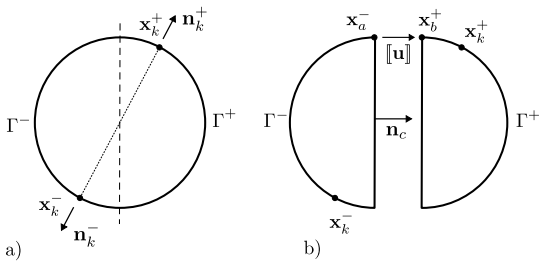
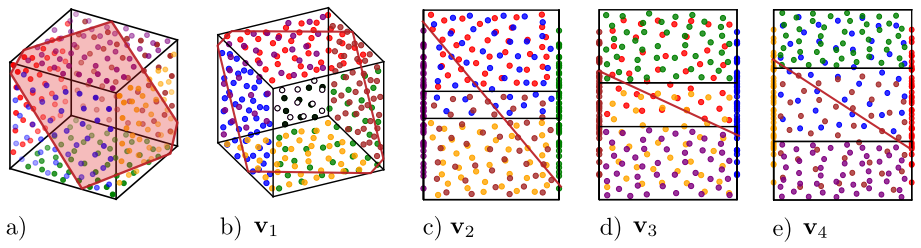
Tessellation boundary conditions that adapt the periodicity frame to the localization band, contrasted with percolation-path-aligned boundary conditions and displacement-jump-augmented spherical periodic boundary conditions.
If this is right
- Tessellation boundary conditions make the localization band length depend only on model geometry and therefore easy to correct in post-processing.
- Percolation-path-aligned boundary conditions can create multiple localization bands because of uneven straining between the two boundary sections.
- The weakly constrained section in percolation-path-aligned setups is susceptible to spurious strain localization.
- Modified spherical periodic boundary conditions with an added displacement jump can still reproduce the incorrect patterns seen under standard periodic conditions.
Where Pith is reading between the lines
- The geometry-only dependence of band length under tessellation conditions could simplify calibration of macroscopic fracture energy in multiscale simulations.
- The same boundary-condition comparison might be applied to other softening materials whose fine-scale models use periodic domains.
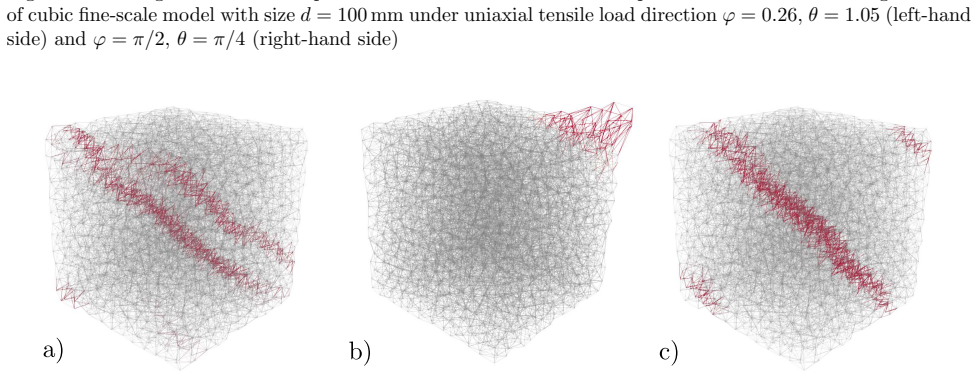
- Three-dimensional extensions already performed in the paper suggest the shortcomings of percolation-path-aligned conditions persist when localization bands are not aligned with coordinate planes.
Load-bearing premise
The mesoscale discrete particle model of concrete under uniaxial tension produces localization patterns that correspond to physically meaningful macroscopic cracks, and observed differences between boundary conditions are not artifacts of specific particle arrangements.
What would settle it
Repeated simulations with varied random particle placements that show percolation-path-aligned boundary conditions always producing exactly one band and no spurious localization, or tessellation boundary conditions producing multiple bands, would falsify the reported performance differences.
Figures





read the original abstract
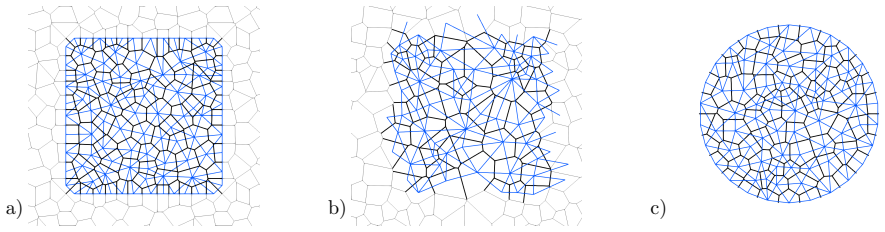
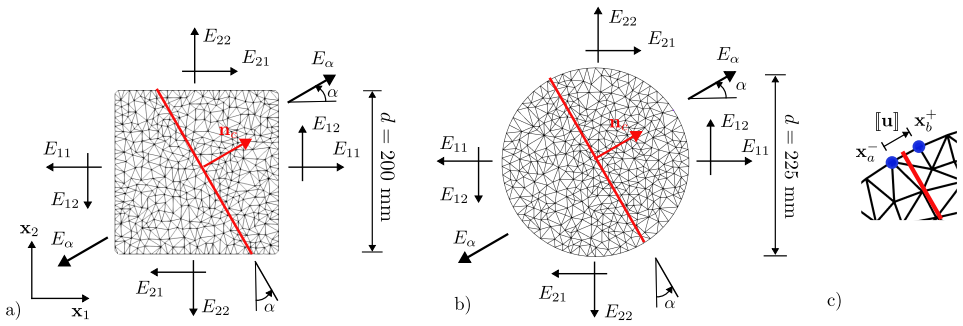
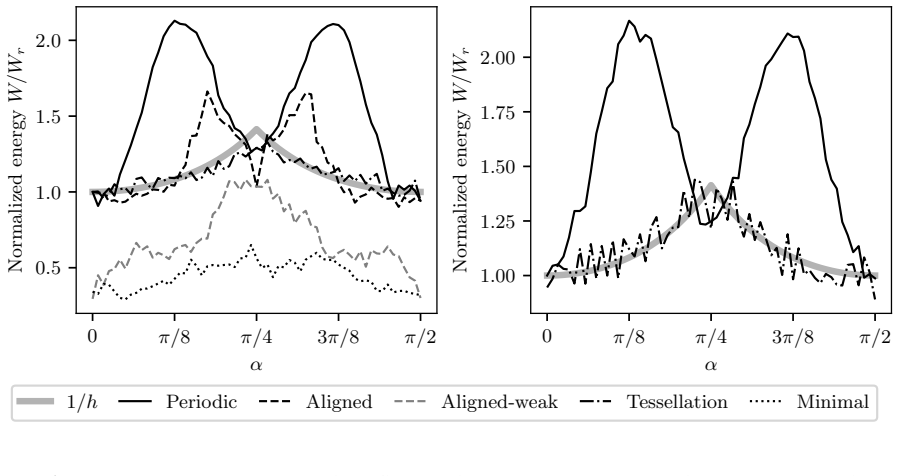
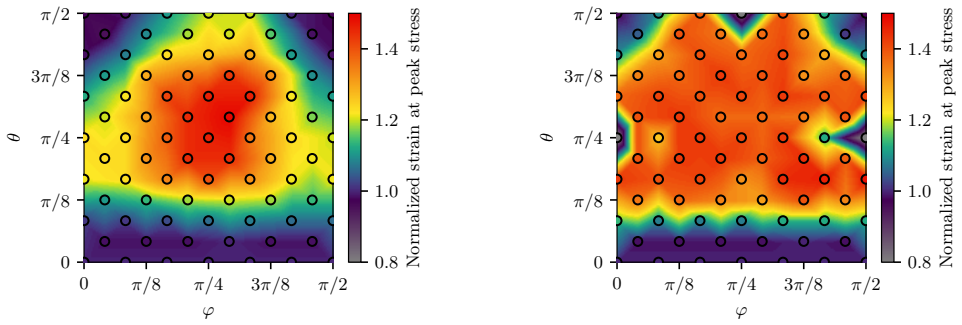
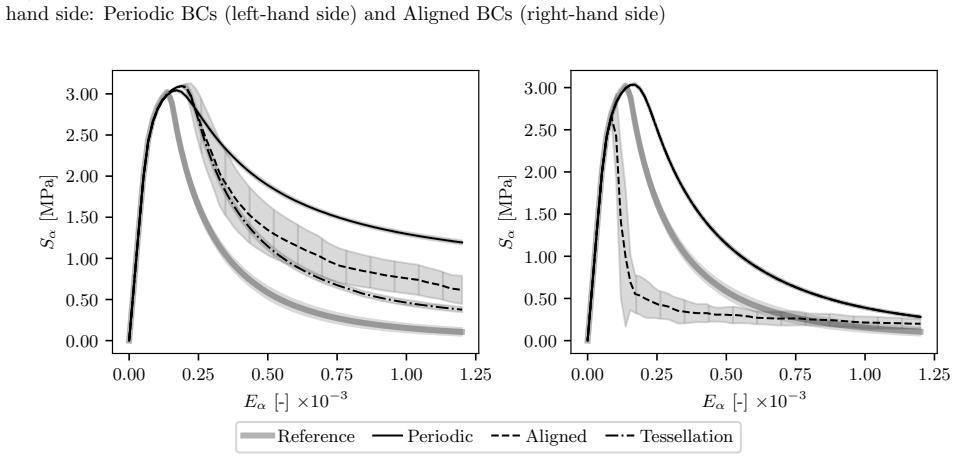
In multiscale modeling of heterogeneous softening materials, boundary conditions (BC) in the fine-scale model strongly influence the strain localization pattern and the macroscopic response. For rectilinear models (e.g., squares or cubes), standard Periodic BCs produce artificially ductile behavior with excessive energy dissipation when the localization band inclination does not match the periodicity directions. Recently proposed Tessellation and Percolation-path-aligned BCs promise to address this by adapting the periodicity frame to align with the evolving localization bands. Alternatively, spherical/circular models provide an orientation independent response by design. Unfortunately, the standard Periodic BCs do not allow development of proper localization band crossing spherical model's boundaries. A recently proposed modification addresses this by adding a displacement jump to the spherical periodic BCs. This study evaluates the applicability of these novel BCs to a mesoscale discrete particle model of concrete. Two-dimensional square and circular models under uniaxial tension with different loading directions are analyzed, with the selected approaches extended to three-dimensional cube models. Results show that Percolation-path-aligned BCs exhibit major shortcomings: they can lead to multiple localization bands due to uneven straining of the two boundary sections and their weakly constrained section can be prone to spurious strain localization. In contrast, Tessellation BCs consistently yield a well-defined localization band, whose length is determined solely by the model geometry, making it straightforward to account for in post-processing. Periodic boundary conditions augmented with a displacement jump applied to a circular model sometimes incorrect produce crack patterns similar to those under the standard Periodic BCs.
Editorial analysis
A structured set of objections, weighed in public.
Referee Report
Summary. The manuscript evaluates several boundary condition formulations (Tessellation BCs, Percolation-path-aligned BCs, and periodic BCs with displacement jump on circular models) for a 2D and 3D mesoscale discrete particle model of concrete under uniaxial tension. The central claim is that Percolation-path-aligned BCs suffer from producing multiple localization bands and spurious strain localization due to uneven boundary straining, while Tessellation BCs produce a single, geometry-determined localization band. Modified circular periodic BCs sometimes fail to produce correct crack patterns.
Significance. The work addresses an important issue in multiscale modeling of softening materials where BC choice affects localization and energy dissipation. If the comparative shortcomings are general, it provides useful guidance for practitioners. The identification of Tessellation BCs as reliable is a positive contribution, but the assessment relies on qualitative observations from limited simulations.
major comments (3)
- Abstract and Results: The evaluation of BC performance is based solely on visual comparison of crack patterns without any quantitative metrics (e.g., band inclination angle, dissipated energy, peak load, or convergence with mesh refinement). This makes it difficult to objectively assess the 'major shortcomings' claimed for Percolation-path-aligned BCs.
- Methods/Results: All simulations appear to be performed on a single random realization of the particle arrangement. No ensemble statistics or tests with varied particle size distributions are reported, leaving open the possibility that the observed differences between BCs are artifacts of the specific heterogeneity realization rather than intrinsic to the BC formulations.
- Abstract: The 3D extension is mentioned but no results or figures are referenced, making it unclear if the 2D findings generalize to 3D cubes.
minor comments (2)
- Abstract: Typo: 'sometimes incorrect produce' should be 'sometimes incorrectly produce'.
- Clarify the exact implementation details of the 'displacement jump' in the modified spherical periodic BCs.
Simulated Author's Rebuttal
We thank the referee for the constructive comments. We address each major comment below and have revised the manuscript where appropriate to strengthen the presentation.
read point-by-point responses
-
Referee: Abstract and Results: The evaluation of BC performance is based solely on visual comparison of crack patterns without any quantitative metrics (e.g., band inclination angle, dissipated energy, peak load, or convergence with mesh refinement). This makes it difficult to objectively assess the 'major shortcomings' claimed for Percolation-path-aligned BCs.
Authors: The shortcomings of Percolation-path-aligned BCs, including multiple localization bands and spurious strain localization, are directly observable in the crack patterns as clear deviations from the single, geometry-determined band. These qualitative differences are intrinsic to the BC formulation and sufficient to demonstrate the central claim. To improve objectivity, we have added quantitative comparisons of dissipated energy and peak load values between the BC formulations in the revised results section. revision: partial
-
Referee: Methods/Results: All simulations appear to be performed on a single random realization of the particle arrangement. No ensemble statistics or tests with varied particle size distributions are reported, leaving open the possibility that the observed differences between BCs are artifacts of the specific heterogeneity realization rather than intrinsic to the BC formulations.
Authors: The identified shortcomings arise from structural aspects of the Percolation-path-aligned BC formulation itself (uneven boundary straining and weak constraints on one section), which are independent of any particular particle arrangement. Nevertheless, to address the concern, we have incorporated results from an additional independent realization in the revised manuscript. revision: yes
-
Referee: Abstract: The 3D extension is mentioned but no results or figures are referenced, making it unclear if the 2D findings generalize to 3D cubes.
Authors: The manuscript extends the analysis to 3D cube models in the results section and confirms that the 2D observations hold. We agree that explicit referencing improves clarity and have updated the abstract to reference the 3D results while adding a corresponding figure. revision: yes
Circularity Check
No circularity: claims rest on direct numerical comparisons of BC implementations
full rationale
The paper evaluates Tessellation, Percolation-path-aligned, and modified spherical periodic BCs by applying them to the same underlying 2D/3D discrete particle model of concrete under uniaxial tension. Localization patterns and shortcomings (multiple bands, spurious localization, geometry-determined band length) are reported as simulation outcomes. No equations, fitted parameters, or self-citations are invoked to derive the comparative results; the central claims do not reduce to inputs by construction. The study is self-contained against external benchmarks via explicit model realizations.
Axiom & Free-Parameter Ledger
axioms (1)
- domain assumption The discrete particle model with chosen interaction laws reproduces realistic softening and localization in concrete under tension.
Reference graph
Works this paper leans on
-
[1]
Coarse-graining of multiscale crack propagation
Ted Belytschko and Jeong-Hoon Song. “Coarse-graining of multiscale crack propagation”. In:International Journal for Numerical Methods in Engineering81.5 (2010), pp. 537–563.doi:10.1002/nme.2694
-
[2]
Alain Bensoussan, Jacques-Louis Lions, and George Papanicolaou.Asymptotic Analysis for Periodic Struc- tures. Vol. 5. Studies in Mathematics and its Applications. Amsterdam: North-Holland, 1978
1978
-
[3]
T. Bhaduri, S. Gomaa, and M. Alnaggar. “Coupled Experimental and Computational Investigation of the Interplay Between Discrete and Continuous Reinforcement in Ultra-High Performance Concrete Beams. II: Mesoscale Modeling”. In:J Eng Mech147 (9 2021), p. 04021050.issn: 0733-9399.doi:10 . 1061 / (ASCE)EM.1943-7889.0001941
arXiv 2021
-
[4]
Fracture analysis using spring network with random geometry
J. E. Bolander and S. Saito. “Fracture analysis using spring network with random geometry”. In:Engi- neering Fracture Mechanics61(5-6) (1998), pp. 569–591
1998
-
[5]
Discrete mechanical models of concrete fracture
John E. Bolander et al. “Discrete mechanical models of concrete fracture”. In:Engineering Fracture Mechanics257 (2021), p. 108030.issn: 0013-7944.doi:10.1016/j.engfracmech.2021.108030
-
[6]
Multi-scale computational homogenization–localization for propagating discontinuities using X-FEM
E. Bosco, V. G. Kouznetsova, and M. G. D. Geers. “Multi-scale computational homogenization–localization for propagating discontinuities using X-FEM”. In:International Journal for Numerical Methods in Engi- neering102.3-4 (2015), pp. 496–527.doi:10.1002/nme.4838
-
[7]
A multiscale framework for localizing microstructures towards the onset of macroscopic discontinuity
E. Bosco et al. “A multiscale framework for localizing microstructures towards the onset of macroscopic discontinuity”. In:Computational Mechanics54 (2014), pp. 299–319.issn: 1432-0924.doi:10 . 1007 / s00466-014-0986-4
2014
-
[8]
Novel boundary conditions for strain localiza- tion analyses in microstructural volume elements
Erica Coenen, Varvara Kouznetsova, and Marc Geers. “Novel boundary conditions for strain localiza- tion analyses in microstructural volume elements”. In:International Journal for Numerical Methods in Engineering90 (2012), pp. 1–21.doi:10.1002/nme.3298
-
[9]
Two-scale study of concrete fracturing behavior
Gianluca Cusatis and Luigi Cedolin. “Two-scale study of concrete fracturing behavior”. In:Engineering Fracture Mechanics74.1 (2007). Fracture of Concrete Materials and Structures, pp. 3–17.issn: 0013-7944. doi:https://doi.org/10.1016/j.engfracmech.2006.01.021.url:https://www.sciencedirect. com/science/article/pii/S0013794406000440
work page doi:10.1016/j.engfracmech.2006.01.021.url:https://www.sciencedirect 2007
-
[10]
Lattice discrete particle model (LDPM) for failure behavior of concrete. I: Theory
Gianluca Cusatis, Daniele Pelessone, and Andrea Mencarelli. “Lattice discrete particle model (LDPM) for failure behavior of concrete. I: Theory”. In:Cement and Concrete Composites33.9 (2011), pp. 881–890. doi:10.1016/j.cemconcomp.2011.02.011
-
[11]
Adaptive Technique for Discrete Models of Fracture
Jan Eli´ aˇ s. “Adaptive Technique for Discrete Models of Fracture”. In:International Journal of Solids and Structures100–101 (2016), pp. 376–387.issn: 0020-7683.doi:10.1016/j.ijsolstr.2016.09.008
-
[12]
Boundary Layer Effect on Behavior of Discrete Models
Jan Eli´ aˇ s. “Boundary Layer Effect on Behavior of Discrete Models”. In:Materials10.2 (2017).issn: 1996-1944.doi:10.3390/ma10020157.url:https://www.mdpi.com/1996-1944/10/2/157
work page doi:10.3390/ma10020157.url:https://www.mdpi.com/1996-1944/10/2/157 2017
-
[13]
Jan Eli´ aˇ s and Gianluca Cusatis. “Do Discrete Fine-Scale Mechanical Models with Rotational Degrees of Freedom Homogenize Into a Cosserat or a Cauchy Continuum?” In:Journal of the Mechanics and Physics of Solids207 (2026), p. 106422.issn: 0022-5096.doi:10.1016/j.jmps.2025.106422. Jan Raisinger, Jan Eli´ aˇ s, VUT FAST, 202525
-
[14]
Jan Eli´ aˇ s and Gianluca Cusatis. “Homogenization of discrete mesoscale model of concrete for coupled mass transport and mechanics by asymptotic expansion”. In:Journal of the Mechanics and Physics of Solids167 (2022), p. 105010.issn: 0022-5096.doi:10.1016/j.jmps.2022.105010
-
[15]
Jan Eli´ aˇ s and Gianluca Cusatis. “Macroscopic Stress, Couple Stress and Flux Tensors Derived Through Energetic Equivalence from Microscopic Continuous and Discrete Heterogeneous Finite Representative Volumes”. In:Computer Methods in Applied Mechanics and Engineering436 (2025), p. 117688.issn: 0045-7825.doi:10.1016/j.cma.2024.117688
-
[16]
Asymptotic analysis of heterogeneous Cosserat media
Samuel Forest, Francis Pradel, and Karam Sab. “Asymptotic analysis of heterogeneous Cosserat media”. In:International Journal of Solids and Structures38.26 (2001), pp. 4585–4608.issn: 0020-7683.doi: 10.1016/S0020-7683(00)00295-X
-
[17]
Stress-controlled weakly periodic boundary conditions: Axial stress under varying orientations
Erik Giesen Loo and Frans P. van der Meer. “Stress-controlled weakly periodic boundary conditions: Axial stress under varying orientations”. In:International Journal for Numerical Methods in Engineering121.19 (2020), pp. 4458–4470.doi:https://doi.org/10.1002/nme.6441. eprint:https://onlinelibrary. wiley.com/doi/pdf/10.1002/nme.6441.url:https://onlinelibra...
-
[18]
Coupled-volume multi-scale modelling of quasi-brittle material
I.M. Gitman, H. Askes, and L.J. Sluys. “Coupled-volume multi-scale modelling of quasi-brittle material”. In:European Journal of Mechanics - A/Solids27.3 (2008), pp. 302–327.issn: 0997-7538.doi:https: //doi.org/10.1016/j.euromechsol.2007.10.004.url:https://www.sciencedirect.com/science/ article/pii/S0997753807000976
work page doi:10.1016/j.euromechsol.2007.10.004.url:https://www.sciencedirect.com/science/ 2008
-
[19]
Representative volume: Existence and size determination
I.M. Gitman, H. Askes, and L.J. Sluys. “Representative volume: Existence and size determination”. In: Engineering Fracture Mechanics74.16 (2007), pp. 2518–2534.issn: 0013-7944.doi:https://doi.org/ 10.1016/j.engfracmech.2006.12.021.url:https://www.sciencedirect.com/science/article/ pii/S0013794406004772
work page doi:10.1016/j.engfracmech.2006.12.021.url:https://www.sciencedirect.com/science/article/ 2007
-
[20]
R. Gl¨ uge, M. Weber, and A. Bertram. “Comparison of spherical and cubical statistical volume elements with respect to convergence, anisotropy, and localization behavior”. In:Computational Materials Science 63 (2012), pp. 91–104.issn: 0927-0256.doi:https://doi.org/10.1016/j.commatsci.2012.05.063. url:https://www.sciencedirect.com/science/article/pii/S0927...
-
[21]
On boundary conditions for homogenization of volume elements undergoing localization
Joseph Goldmann, J¨ org Brummund, and Volker Ulbricht. “On boundary conditions for homogenization of volume elements undergoing localization”. In:International Journal for Numerical Methods in Engineering 113.1 (2018), pp. 1–21
2018
-
[22]
Circular representative volume elements for strain localization problems
Pieter Hofman, Lu Ke, and Frans P. van der Meer. “Circular representative volume elements for strain localization problems”. In:International Journal for Numerical Methods in Engineering124.4 (2023), pp. 784–807.doi:https://doi.org/10.1002/nme.7142. eprint:https://onlinelibrary.wiley.com/ doi/pdf/10.1002/nme.7142.url:https://onlinelibrary.wiley.com/doi/ab...
-
[23]
Lu Ke and Frans P van Der Meer. “A computational homogenization framework with enhanced localization criterion for macroscopic cohesive failure in heterogeneous materials”. In:Computer Methods in Applied Mechanics and Engineering2 (2022), pp. 1–28.doi:10.46298/jtcam.7707. Jan Raisinger, Jan Eli´ aˇ s, VUT FAST, 202526
-
[24]
Computational homogenization based on a weak format of micro-periodicity for RVE- problems
F. Larsson et al. “Computational homogenization based on a weak format of micro-periodicity for RVE- problems”. In:Computer Methods in Applied Mechanics and Engineering200.1 (2011), pp. 11–26.issn: 0045-7825.doi:https://doi.org/10.1016/j.cma.2010.06.023.url:https://www.sciencedirect. com/science/article/pii/S0045782510001908
work page doi:10.1016/j.cma.2010.06.023.url:https://www.sciencedirect 2011
-
[25]
Minimal kinematic boundary conditions for simulations of disor- dered microstructures
Sinisa Mesarovic and Jagan Padbidri. “Minimal kinematic boundary conditions for simulations of disor- dered microstructures”. In:Philosophical Magazine85 (Jan. 2005), pp. 65–78.doi:10.1080/14786430412331313321
-
[26]
Continuum approach to computational multiscale modeling of propagating fracture
J. Oliver et al. “Continuum approach to computational multiscale modeling of propagating fracture”. In: Computer Methods in Applied Mechanics and Engineering294 (2015), pp. 384–427.issn: 0045-7825.doi: 10.1016/j.cma.2015.05.012
-
[27]
Simulating heterogeneity within elastic and inelastic discrete mechanical models
Jan Raisinger et al. “Simulating heterogeneity within elastic and inelastic discrete mechanical models”. In:Engineering Fracture Mechanics326 (2025), p. 111362.issn: 0013-7944.doi:https://doi.org/10. 1016/j.engfracmech.2025.111362.url:https://www.sciencedirect.com/science/article/pii/ S0013794425005636
arXiv 2025
-
[28]
Roozbeh Rezakhani and Gianluca Cusatis. “Asymptotic expansion homogenization of discrete fine-scale models with rotational degrees of freedom for the simulation of quasi-brittle materials”. In:Journal of the Mechanics and Physics of Solids88 (2016), pp. 320–345.issn: 0022-5096.doi:10.1016/j.jmps.2016. 01.001
-
[29]
Adaptive multiscale homogenization of the lattice discrete particle model for the analysis of damage and fracture in concrete
Roozbeh Rezakhani, Xinwei Zhou, and Gianluca Cusatis. “Adaptive multiscale homogenization of the lattice discrete particle model for the analysis of damage and fracture in concrete”. In:International Journal of Solids and Structures125 (2017), pp. 50–67.issn: 0020-7683.doi:h10.1016/j.ijsolstr. 2017.07.016
2017
-
[30]
Enrique S´ anchez-Palencia.Non-Homogeneous Media and Vibration Theory. Vol. 127. Lecture Notes in Physics. Berlin: Springer-Verlag, 1980
1980
-
[31]
Strain localization in reduced-order asymptotic homogenization
Harpreet Singh and Puneet Mahajan. “Strain localization in reduced-order asymptotic homogenization”. In:Mathematics and Mechanics of Solids25 (4 2019), pp. 913–936.issn: 1081-2865.doi:10 . 1177 / 1081286519892655
2019
-
[32]
Calibration of particle-based models using cells with periodic boundary conditions
Jan Stransky and Milan Jir´ asek. “Calibration of particle-based models using cells with periodic boundary conditions”. In: Oct. 2011
2011
-
[33]
Two-scale modeling of fracturing solids using a smeared macro-to-micro discontinuity transition
Erik Svenning, Fredrik Larsson, and Martin Fagerstr¨ om. “Two-scale modeling of fracturing solids using a smeared macro-to-micro discontinuity transition”. In:Comput. Mech.60.4 (Oct. 2017), pp. 627–641.issn: 0178-7675.doi:10.1007/s00466-017-1426-z.url:https://doi.org/10.1007/s00466-017-1426-z
work page doi:10.1007/s00466-017-1426-z.url:https://doi.org/10.1007/s00466-017-1426-z 2017
-
[34]
S. Toro et al. “A two-scale failure model for heterogeneous materials: numerical implementation based on the finite element method”. In:International Journal for Numerical Methods in Engineering97.5 (2014), pp. 313–351.doi:10.1002/nme.4576
-
[35]
Matthew Troemner, Erol Lale, and Gianluca Cusatis. “Lattice discrete particle model simulations of energetic size effect and its implications for shear design specifications of reinforced concrete squat walls”. In:Engineering Structures322 (2025), p. 119085.issn: 0141-0296.doi:10.1016/j.engstruct.2024. 119085. Jan Raisinger, Jan Eli´ aˇ s, VUT FAST, 202527
-
[36]
Sergio Turteltaub et al. “Multiscale analysis of mixed-mode fracture and effective traction-separation relations for composite materials”. In:Journal of the Mechanics and Physics of Solids117 (2018), pp. 88– 109.issn: 0022-5096.doi:10.1016/j.jmps.2018.04.009
-
[37]
An FE2-X1 approach for multiscale localization phenomena
J¨ org F. Unger. “An FE2-X1 approach for multiscale localization phenomena”. In:Journal of the Mechanics and Physics of Solids61.4 (2013), pp. 928–948.issn: 0022-5096.doi:10.1016/j.jmps.2012.12.010
-
[38]
Yingbo Zhu, John Brigham, and Alessandro Fascetti. “Data-driven multiscale lattice discrete particle model for digital twin modeling of concrete structures”. In:Computer Methods in Applied Mechanics and Engineering445 (2025), p. 118183.issn: 0045-7825.doi:10.1016/j.cma.2025.118183
-
[39]
Zhongfeng Zhu et al. “Lattice Discrete Particle Modeling of concrete under cyclic tension–compression with multi-axial confinement”. In:Construction and Building Materials352 (2022), p. 128985.issn: 0950- 0618.doi:10.1016/j.conbuildmat.2022.128985. Jan Raisinger, Jan Eli´ aˇ s, VUT FAST, 202528
discussion (0)
Sign in with ORCID, Apple, or X to comment. Anyone can read and Pith papers without signing in.