Closed-Loop L4S-as-a-Service in 5G-Advanced: NEF-PCF Control with NWDAF-Driven Assurance
Pith reviewed 2026-06-30 23:40 UTC · model grok-4.3
The pith
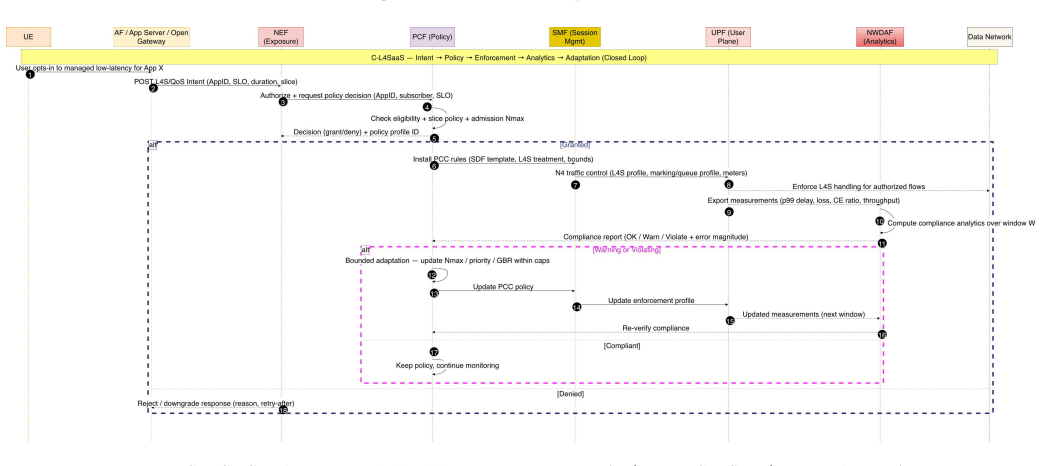
Orchestrating NEF, PCF, and NWDAF creates a closed-loop framework for assured L4S low-latency services in 5G-Advanced.
A machine-rendered reading of the paper's core claim, the machinery that carries it, and where it could break.
Core claim
The central claim is that the C-L4SaaS framework orchestrates the Network Exposure Function to expose capabilities, the Policy Control Function to install PCC rules, and the Network Data Analytics Function to supply compliance analytics from User Plane Function measurements; these analytics trigger bounded policy adaptations, and the resulting interaction is modeled as a discrete-time feedback system whose stability conditions and signaling overhead bounds can be derived to support operation under volatile wireless conditions.
What carries the argument
The discrete-time feedback system that models NEF-PCF-NWDAF interactions and supplies the stability conditions and signaling overhead bounds used to select operating parameters.
If this is right
- High-level service intent is translated into enforceable PCC rules through NEF exposure.
- NWDAF analytics from UPF measurements drive bounded policy adaptations that keep the loop inside stability limits.
- Stability conditions and signaling overhead bounds become available to guide parameter choice for volatile conditions.
- The overall orchestration supplies a standards-aligned method to expose, assure, and govern managed low-latency services.
Where Pith is reading between the lines
- The same feedback modeling could be reused for closed-loop assurance of other 5G quality-of-service targets beyond L4S.
- Operators might reduce manual policy tuning if the derived bounds prove portable across different radio environments.
- Future 3GPP releases could adopt the NEF-PCF-NWDAF loop pattern for additional automated service governance use cases.
Load-bearing premise
NWDAF-driven compliance analytics derived from UPF measurements can reliably trigger bounded policy adaptations that maintain stability under volatile wireless conditions.
What would settle it
A 5G-Advanced testbed run in which NWDAF analytics fail to produce timely bounded adaptations, resulting in latency variance that exceeds the derived stability bounds under measured wireless volatility.
Figures

read the original abstract
Ultra-low latency services in 5G-Advanced demand deterministic delay and high-fidelity congestion signaling beyond peak throughput. While the Low Latency, Low Loss, Scalable Throughput (L4S) architecture enables sub-millisecond queuing through ECN-based feedback and Dual-Queue Coupled AQM, its integration within the 5G Core (5GC) remains functionally siloed. Current 3GPP Release 18/19 specifications provide mechanisms for L4S enablement, but they do not define a unified closed-loop framework that links application intent to verified service outcomes. To address this gap, we propose Closed-Loop L4S-as-a-Service (C-L4SaaS), an architectural framework that orchestrates the Network Exposure Function (NEF), Policy Control Function (PCF), and Network Data Analytics Function (NWDAF) for automated latency assurance. The framework translates high-level intent into enforceable PCC rules and uses NWDAF-driven compliance analytics, derived from User Plane Function (UPF) measurements, to trigger bounded policy adaptations. We model this interaction as a discrete-time feedback system and derive stability conditions and signaling overhead bounds to guide parameter selection under volatile wireless conditions. The proposed core-driven orchestration provides a standards-aligned path to expose, assure, and govern managed low-latency services in 5G-Advanced ecosystems.
Editorial analysis
A structured set of objections, weighed in public.
Referee Report
Summary. The manuscript proposes Closed-Loop L4S-as-a-Service (C-L4SaaS), an architectural framework that orchestrates the Network Exposure Function (NEF), Policy Control Function (PCF), and Network Data Analytics Function (NWDAF) to translate high-level intent into PCC rules and use NWDAF-driven compliance analytics from UPF measurements for bounded policy adaptations in 5G-Advanced L4S deployments. It models the NEF-PCF-NWDAF interaction as a discrete-time feedback system and states that stability conditions plus signaling overhead bounds are derived to guide parameter selection under volatile wireless conditions.
Significance. If the stability conditions can be shown to hold and the bounded-adaptation guarantee validated, the work would supply a standards-aligned closed-loop control path for deterministic low-latency services that current 3GPP Release 18/19 specifications leave functionally siloed. The explicit linkage of application intent to NWDAF-triggered PCF adaptations is a constructive contribution to 5G core orchestration.
major comments (2)
- [Abstract] Abstract (final paragraph) and modeling description: the central claim that NWDAF analytics from UPF measurements can trigger bounded PCF policy changes while preserving stability rests on unshown derivations of the discrete-time feedback system; no state equations, characteristic polynomial, eigenvalue bounds, or gain-margin analysis appear, so it is impossible to confirm whether the derived region accommodates the heavy-tailed latency, handover, and interference effects noted in the skeptic note.
- [Abstract] Stability and overhead analysis (referenced in abstract): the statement that stability conditions and signaling overhead bounds are derived to guide selection under volatility is load-bearing for the assurance path, yet no explicit model (e.g., delay operator, noise variance bound, or adaptation rule) or verification (analytic, numeric, or simulation) is supplied, leaving the weakest assumption—that analytics variance remains within modeled bounds—untested.
minor comments (2)
- The manuscript would benefit from a dedicated section or appendix containing the discrete-time model equations and the derivation steps for the stability criteria.
- Clarify the exact mapping from NWDAF compliance analytics output to the PCF policy adaptation rule; the current description remains at the architectural level.
Simulated Author's Rebuttal
We thank the referee for the constructive feedback highlighting the need for explicit modeling details. We address each major comment below and will revise the manuscript to include the requested derivations and verifications.
read point-by-point responses
-
Referee: [Abstract] Abstract (final paragraph) and modeling description: the central claim that NWDAF analytics from UPF measurements can trigger bounded PCF policy changes while preserving stability rests on unshown derivations of the discrete-time feedback system; no state equations, characteristic polynomial, eigenvalue bounds, or gain-margin analysis appear, so it is impossible to confirm whether the derived region accommodates the heavy-tailed latency, handover, and interference effects noted in the skeptic note.
Authors: We agree that the submitted manuscript does not present the state equations, characteristic polynomial, eigenvalue bounds, or gain-margin analysis. This omission prevents independent verification of the stability region under the cited wireless impairments. In the revised manuscript we will add a dedicated modeling subsection that supplies the discrete-time state equations, derives the characteristic polynomial, provides eigenvalue bounds, and includes gain-margin analysis. The section will also incorporate stochastic terms for heavy-tailed latency, handover-induced discontinuities, and interference to demonstrate that the derived stability region remains valid under these conditions. revision: yes
-
Referee: [Abstract] Stability and overhead analysis (referenced in abstract): the statement that stability conditions and signaling overhead bounds are derived to guide selection under volatility is load-bearing for the assurance path, yet no explicit model (e.g., delay operator, noise variance bound, or adaptation rule) or verification (analytic, numeric, or simulation) is supplied, leaving the weakest assumption—that analytics variance remains within modeled bounds—untested.
Authors: The referee is correct that the current draft supplies neither the explicit delay operator, noise variance bound, adaptation rule, nor any analytic/numeric verification. We will therefore expand the modeling section to define the delay operator and noise variance bound, state the adaptation rule, derive the stability conditions and signaling-overhead bounds analytically, and add numerical simulations that test the assumption that NWDAF analytics variance stays within the modeled bounds under volatile channel conditions. revision: yes
Circularity Check
No circularity in derivation chain
full rationale
The provided abstract and context describe a proposed framework that models the NEF-PCF-NWDAF interaction as a discrete-time feedback system and derives stability conditions plus overhead bounds. No equations, parameter fits, self-citations, or ansatzes are quoted that reduce any claimed prediction or result to the inputs by construction. The derivations are presented as independent outputs from the model rather than tautological renamings or fitted-input predictions. This is the common case of a self-contained architectural proposal without load-bearing circular steps visible in the text.
Axiom & Free-Parameter Ledger
free parameters (1)
- feedback loop parameters
axioms (2)
- domain assumption NWDAF measurements from UPF can produce compliance analytics that trigger bounded policy adaptations
- domain assumption Discrete-time feedback system model accurately captures the NEF-PCF-NWDAF interaction under volatile conditions
Reference graph
Works this paper leans on
-
[1]
Low Latency, Low Loss, Scalable Throughput (L4S) Internet Standard,
B. Briscoe et al., “Low Latency, Low Loss, Scalable Throughput (L4S) Internet Standard,” RFC 9330, IETF, 2023. [Online]. A vailable:https://www.rfc-editor.org/rfc/rfc9330
2023
-
[2]
The L4S Architecture and Its Use in the Internet,
B. Briscoe et al., “The L4S Architecture and Its Use in the Internet,” RFC 9331, IETF, 2023. [Online]. A vailable: https: //www.rfc-editor.org/rfc/rfc9331
2023
-
[3]
System Architecture for the 5G System (Release 18),
European Telecommunications Standards Institute (ETSI), “System Architecture for the 5G System (Release 18),” ETSI TS 123 501 V18.5.0, 2023
2023
-
[4]
APIs enabling seamless access to Telco network capabilities (CAMARA),
Linux Foundation, “APIs enabling seamless access to Telco network capabilities (CAMARA),” [Online]. A vailable: https: //camaraproject.org/. Accessed: Feb. 2026
2026
-
[5]
5G; Policy and charging control framework for the 5G System (5GS); Stage 2,
ETSI, “5G; Policy and charging control framework for the 5G System (5GS); Stage 2,” ETSI TS 123 503 (3GPP TS 23.503), V18.5.0, May 2024
2024
-
[6]
Zero-touch network and Service Management (ZSM); Reference Architecture,
ETSI, “Zero-touch network and Service Management (ZSM); Reference Architecture,” ETSI GS ZSM 002, V1.1.1, Aug
-
[7]
A vailable: https://www.etsi.org/deliver/etsi_ gs/ZSM/001_099/002/01.01.01_60/gs_ZSM002v010101p.pdf
[Online]. A vailable: https://www.etsi.org/deliver/etsi_ gs/ZSM/001_099/002/01.01.01_60/gs_ZSM002v010101p.pdf
-
[8]
O-RAN Slicing Architecture (O-RAN.WG1.Slicing- Architecture-R003-v11.00),
ETSI, “O-RAN Slicing Architecture (O-RAN.WG1.Slicing- Architecture-R003-v11.00),” ETSI TS 104 041, V11.0.0, Mar
-
[9]
A vailable:https://www.etsi.org/deliver/etsi_ts/ 104000_104099/104041/11.00.00_60/ts_104041v110000p.pdf
[Online]. A vailable:https://www.etsi.org/deliver/etsi_ts/ 104000_104099/104041/11.00.00_60/ts_104041v110000p.pdf
-
[10]
Congestion Con- trol as a Service: Towards Low Latency Mobile Upload- ing,
H. Xu, L. Li, L. Wang, and F. Song, “Congestion Con- trol as a Service: Towards Low Latency Mobile Upload- ing,” in Proc. IEEE/ACM IWQoS, 2024, pp. 1–10, doi: 10.1109/IWQoS61813.2024.10682903
-
[11]
[Ameer Shohail and Goswami, Ashish and Rashid], “A novel NaaS API framework for L4S enforcement: Enhancing traffic management through NEF, PCC, and AI-driven UPF in 5G net- works,” in Proc. IEEE Future Networks World Forum (FNWF), 2025, pp. 1–6, doi: 10.1109/FNWF66845.2025.11317283
-
[12]
5G System; Session Management Policy Control Service; Stage 3,
ETSI, “5G System; Session Management Policy Control Service; Stage 3,” ETSI TS 129 512 (3GPP TS 29.512), V18.10.0, Jun. 2025
2025
-
[13]
System Architecture for the 5G System (5GS),
3GPP, “System Architecture for the 5G System (5GS),” 3GPP TS 23.501, Release 18, 2023
2023
-
[14]
A Data-Driven Framework for TCP to Achieve Flexible QoS Control in Mobile Data Networks,
J. Yao, K. Liu, T. Liang, T. A. Benson, J. Y. B. Lee, V. Aggarwal, Y. Bao, and M. Chen, “A Data-Driven Framework for TCP to Achieve Flexible QoS Control in Mobile Data Networks,” in Proc. IEEE/ACM IWQoS, 2023, pp. 1–11, doi: 10.1109/IWQoS57198.2023.10188765
-
[15]
L4S: Low Latency, Low Loss and Scalable Throughput,
Bell Labs, “L4S: Low Latency, Low Loss and Scalable Throughput,” 2024. [Online]. A vailable: https://www.bell-labs.com/institute/white-papers/ l4s-low-latency-low-loss-and-scalable-throughput/ . Accessed: Dec. 13, 2024
2024
-
[16]
[Authors], “Optimizing 3GPP 5G NEF integration: Enhancing programmable networks through NEF and UPF interoperabil- ity,” in Proc. IEEE Future Networks World Forum (FNWF), 2024, pp. 423–427, doi: 10.1109/FNWF63303.2024.11028837
discussion (0)
Sign in with ORCID, Apple, or X to comment. Anyone can read and Pith papers without signing in.