Can Quantum Receiver Beat the SIC Limit in Multiple Access Networks?
Pith reviewed 2026-06-26 14:58 UTC · model grok-4.3
The pith
A quantum receiver using simple qubit ensembles can exceed the SIC channel capacity limit in multiple access networks.
A machine-rendered reading of the paper's core claim, the machinery that carries it, and where it could break.
Core claim
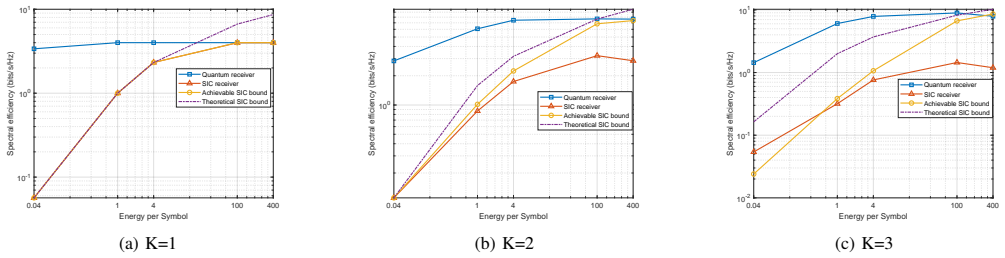
The proposed technique leverages simple qubit ensembles without using any complex entanglement resources to parallelly extract interfering multiuser signals, with a channel capacity beyond the limit of SIC in some operational corners. In performance evaluation, notable quantum advantage is reported over the ultimate multiple-access channel capacity limit and practical SIC algorithms in low-SNR regimes in terms of spectral efficiency and detection efficiency due to the receiver's ability to exploit quantum correlated measurements and superposition-enabled parallel processing.
What carries the argument
Full-stack quantum receiver that integrates front-end quantum sensing with back-end quantum signal processing using simple qubit ensembles for parallel extraction of multiuser signals.
If this is right
- Spectral efficiency exceeds the SIC limit in low-SNR multiple-access settings.
- Detection efficiency improves through superposition-enabled parallel processing.
- Quantum advantage appears without requiring complex entanglement resources.
- The receiver outperforms both the ultimate multiple-access channel capacity and practical SIC algorithms at low SNR.
Where Pith is reading between the lines
- Hardware advances that reduce decoherence could make the approach viable for dense 5G/B5G deployments.
- The same qubit-ensemble approach might extend to optical or radar multi-target scenarios with similar interference limits.
- If the capacity gain holds, network designers could relax power or bandwidth constraints in low-SNR cells.
Load-bearing premise
The quantum sensing front-end and signal processing back-end can be practically integrated into a receiver that exploits quantum correlated measurements and superposition without decoherence or other physical limitations invalidating the capacity claims.
What would settle it
A detailed simulation or hardware test showing that realistic decoherence or integration losses eliminate any capacity gain over SIC in the claimed low-SNR regimes.
Figures





read the original abstract
Successive interference cancellation (SIC) is an important technique for 5G/B5G wireless receivers to resolve interfering signals from multiple users. While SIC has been proven to approach the channel capacity limit in many settings of multiple access networks, it remains unknown if this limit can be surpassed by an advanced yet practically implementable quantum receiver technique. In this work, we answer this quest by proposing a full-stack quantum receiver that integrates front-end quantum sensing with back-end quantum signal processing. The proposed technique leverages simple qubit ensembles without using any complex entanglement resources to parallelly extract interfering multiuser signals, with a channel capacity beyond the limit of SIC in some operational corners. In performance evaluation, we report notable quantum advantage over the ultimate multiple-access channel capacity limit and practical SIC algorithms in low-SNR regimes in terms of spectral efficiency and detection efficiency due to the receiver's ability to exploit quantum correlated measurements and superposition-enabled parallel processing.
Editorial analysis
A structured set of objections, weighed in public.
Referee Report
Summary. The paper proposes a full-stack quantum receiver for multiple access networks integrating a quantum sensing front-end with quantum signal processing back-end. Using simple qubit ensembles without entanglement, it enables parallel extraction of multiuser interfering signals via superposition and quantum-correlated measurements. The central claim is that this yields spectral efficiency and detection efficiency exceeding both the successive interference cancellation (SIC) limit and the ultimate classical multiple-access channel capacity in certain low-SNR operational regimes.
Significance. If validated, the result would be significant for quantum-enhanced wireless systems, offering a potentially practical route to capacity gains in low-SNR multiuser settings without requiring entanglement resources. The emphasis on simple qubit ensembles is a strength for feasibility considerations.
major comments (2)
- [Abstract and performance evaluation] Abstract and § on performance evaluation: the reported quantum advantage in spectral efficiency at low SNR rests on idealized qubit ensemble coherence and superposition-enabled parallel processing. No model or bounds are provided for decoherence, photon loss, or finite coherence times, which are load-bearing because these effects would degrade the claimed quantum correlations and superposition before extraction completes, collapsing the advantage.
- [System model] System model and capacity derivation sections: the claim of exceeding the ultimate MAC capacity requires explicit mutual-information expressions or derivations showing how the quantum receiver's effective channel exceeds the classical limit; absent these (or any equations in the provided abstract), the 'beyond the limit' result cannot be assessed for internal consistency.
minor comments (2)
- Define the precise parameter ranges ('operational corners') for the claimed advantage, ideally with a table or plot of SNR vs. spectral efficiency comparing quantum receiver, SIC, and capacity bound.
- Clarify integration details between quantum sensing front-end and classical/quantum back-end processing to address practical implementation questions.
Simulated Author's Rebuttal
We thank the referee for the constructive feedback on our manuscript. We address each of the major comments below and outline the revisions we will make to strengthen the paper.
read point-by-point responses
-
Referee: Abstract and § on performance evaluation: the reported quantum advantage in spectral efficiency at low SNR rests on idealized qubit ensemble coherence and superposition-enabled parallel processing. No model or bounds are provided for decoherence, photon loss, or finite coherence times, which are load-bearing because these effects would degrade the claimed quantum correlations and superposition before extraction completes, collapsing the advantage.
Authors: We agree with the referee that the analysis is based on idealized assumptions regarding qubit coherence. To address this, we will revise the performance evaluation section to include a model for decoherence and photon loss effects. We will derive bounds on the required coherence time and discuss under what conditions the quantum advantage persists in practical settings. revision: yes
-
Referee: System model and capacity derivation sections: the claim of exceeding the ultimate MAC capacity requires explicit mutual-information expressions or derivations showing how the quantum receiver's effective channel exceeds the classical limit; absent these (or any equations in the provided abstract), the 'beyond the limit' result cannot be assessed for internal consistency.
Authors: The capacity derivation is based on the quantum measurement model in the system model section. However, we acknowledge that the expressions may not be presented with sufficient detail. In the revision, we will provide explicit mutual information derivations, including the formulas for the quantum receiver's effective channel and how it surpasses the classical multiple-access channel capacity in low-SNR regimes. revision: yes
Circularity Check
No circularity detected; derivation chain self-contained
full rationale
The provided abstract and context contain no equations, derivations, or load-bearing steps that reduce any claimed prediction or result to its own inputs by construction. No self-definitional relations, fitted inputs renamed as predictions, or self-citation chains are exhibited. The central claim of quantum advantage is presented as an outcome of the proposed receiver technique without visible circular reduction, making this the standard honest non-finding for papers lacking explicit mathematical structure in the inspected text.
Axiom & Free-Parameter Ledger
axioms (1)
- domain assumption Quantum superposition and correlated measurements can be exploited for parallel multiuser signal extraction in a practical receiver
Reference graph
Works this paper leans on
-
[1]
Broadcast channels,
T. Cover, “Broadcast channels,”IEEE Transactions on Information Theory, vol. 18, no. 1, pp. 2–14, 2003
2003
-
[2]
Quantum-enhanced information retrieval from reflective intelligent surfaces,
S. Guo, T. Ji, and J. Liu, “Quantum-enhanced information retrieval from reflective intelligent surfaces,”IEEE Journal on Selected Areas in Communications, 2026
2026
-
[3]
A two-stage optimization method for wide-range single-electron quantum magnetic sensing,
S. Guo, J. Liu, T. Le, and H. Dai, “A two-stage optimization method for wide-range single-electron quantum magnetic sensing,”arXiv preprint arXiv:2506.13469, 2025
arXiv 2025
-
[4]
Quantum sensing,
C. L. Degen, F. Reinhard, and P. Cappellaro, “Quantum sensing,” Reviews of modern physics, vol. 89, no. 3, p. 035002, 2017
2017
-
[5]
T. M. Cover and J. A. Thomas,Elements of Information Theory, 2nd ed. Wiley, 2006
2006
-
[6]
Goldsmith,Wireless Communications
A. Goldsmith,Wireless Communications. Cambridge University Press, 2005
2005
-
[7]
Impact of user pairing on 5g nonorthog- onal multiple-access downlink transmissions,
Z. Ding, P. Fan, and H. V . Poor, “Impact of user pairing on 5g nonorthog- onal multiple-access downlink transmissions,”IEEE Transactions on V ehicular Technology, vol. 65, no. 8, pp. 6010–6023, 2016
2016
-
[8]
A universal lattice code decoder for fading channels,
E. Viterbo and J. Boutros, “A universal lattice code decoder for fading channels,”IEEE Transactions on Information Theory, vol. 45, no. 5, pp. 1639–1642, 1999
1999
-
[9]
On the sphere-decoding algorithm i. expected complexity,
B. Hassibi and H. Vikalo, “On the sphere-decoding algorithm i. expected complexity,”IEEE Transactions on Signal Processing, vol. 53, no. 8, pp. 2806–2818, 2005
2005
-
[10]
A study of linear and non-linear mimo detection methods,
H. Yao and G. W. Wornell, “A study of linear and non-linear mimo detection methods,” inProceedings of IEEE Global Telecommunications Conference (GLOBECOM), 2002, pp. XXX–XXX
2002
-
[11]
Lattice-reduction- aided broadcast precoding,
C. Windpassinger, R. F. H. Fischer, and L. Lampe, “Lattice-reduction- aided broadcast precoding,”IEEE Transactions on Communications, vol. 52, no. 12, pp. 2057–2060, 2004
2057
-
[12]
A survey on non-orthogonal multiple access for 5g networks: Research challenges and future trends,
Z. Ding, X. Lei, G. K. Karagiannidis, R. Schober, J. Yuan, and V . K. Bhargava, “A survey on non-orthogonal multiple access for 5g networks: Research challenges and future trends,”IEEE Journal on Selected Areas in Communications, vol. 35, no. 10, pp. 2181–2195, 2017
2017
-
[13]
Factor graphs and the sum-product algorithm,
F. R. Kschischang, B. J. Frey, and H.-A. Loeliger, “Factor graphs and the sum-product algorithm,”IEEE Transactions on Information Theory, vol. 47, no. 2, pp. 498–519, 2001
2001
-
[14]
Iterative reconstruction of sparse signals via ap- proximate message passing,
A. K. Fletcheret al., “Iterative reconstruction of sparse signals via ap- proximate message passing,”IEEE Transactions on Information Theory, vol. 64, no. 12, pp. 1–20, 2018
2018
-
[15]
Learning to detect: Deep learning for mimo detection,
N. Samuel, T. Diskin, and A. Wiesel, “Learning to detect: Deep learning for mimo detection,” inIEEE International Workshop on Signal Processing Advances in Wireless Communications (SPA WC), 2017
2017
-
[16]
Learning to decode linear codes using deep learning,
E. Nachmani, Y . Be’ery, and D. Burshtein, “Learning to decode linear codes using deep learning,”IEEE Transactions on Information Theory, vol. 44, no. 7, pp. 1–12, 2018
2018
-
[17]
Quantum principal compo- nent analysis,
S. Lloyd, M. Mohseni, and P. Rebentrost, “Quantum principal compo- nent analysis,”Nature physics, vol. 10, no. 9, pp. 631–633, 2014
2014
-
[18]
A low-complexity quantum principal component analysis algorithm,
C. He, J. Li, W. Liu, J. Peng, and Z. J. Wang, “A low-complexity quantum principal component analysis algorithm,”IEEE transactions on quantum engineering, vol. 3, pp. 1–13, 2022
2022
-
[19]
Quantum multiple eigenvalue gaussian filtered search: an efficient and versatile quantum phase estimation method,
Z. Ding, H. Li, L. Lin, H. Ni, L. Ying, and R. Zhang, “Quantum multiple eigenvalue gaussian filtered search: an efficient and versatile quantum phase estimation method,”Quantum, vol. 8, p. 1487, 2024
2024
-
[20]
Optimal low-depth quantum signal-processing phase estimation,
Y . Dong, J. A. Gross, and M. Y . Niu, “Optimal low-depth quantum signal-processing phase estimation,”Nature Communications, vol. 16, no. 1, p. 1504, 2025
2025
-
[21]
Estimating eigenenergies from quantum dynamics: A unified noise-resilient measurement-driven approach,
Y . Shen, D. Camps, A. Szasz, S. Darbha, K. Klymko, D. B. Williams, N. M. Tubman, R. Van Beeumenet al., “Estimating eigenenergies from quantum dynamics: A unified noise-resilient measurement-driven approach,”Quantum, vol. 9, p. 1836, 2025
2025
-
[22]
Efficient measurement-driven eigenenergy estimation with classical shadows,
Y . Shen, A. Buzali, H.-Y . Hu, K. Klymko, D. Camps, S. F. Yelin, and R. Van Beeumen, “Efficient measurement-driven eigenenergy estimation with classical shadows,”PRX Quantum, vol. 7, no. 1, p. 010328, 2026
2026
-
[23]
Quantum computing enhanced sensing,
R. R. Allen, F. Machado, I. L. Chuang, H.-Y . Huang, and S. Choi, “Quantum computing enhanced sensing,”arXiv preprint arXiv:2501.07625, 2025
arXiv 2025
-
[24]
Robust multiparameter esti- mation using quantum scrambling,
W. Gong, B. Ye, D. Mark, and S. Choi, “Robust multiparameter esti- mation using quantum scrambling,”arXiv preprint arXiv:2601.23283, 2026
arXiv 2026
-
[25]
Enhancing optical imaging via quantum computation,
A. Mokeev, B. Saif, M. D. Lukin, and J. Borregaard, “Enhancing optical imaging via quantum computation,”PRX Quantum, vol. 7, no. 1, p. 010318, 2026
2026
-
[26]
A survey of non-orthogonal multiple access for 5g,
L. Dai, B. Wang, Z. Ding, Z. Wang, S. Chen, and L. Hanzo, “A survey of non-orthogonal multiple access for 5g,”IEEE communications surveys & tutorials, vol. 20, no. 3, pp. 2294–2323, 2018
2018
-
[27]
T. M. Cover and J. A. Thomas,Elements of information theory (wiley se- ries in telecommunications and signal processing). Wiley-interscience, 2006
2006
discussion (0)
Sign in with ORCID, Apple, or X to comment. Anyone can read and Pith papers without signing in.