Two stages of magnetic filament formation in the solar convective zone
Pith reviewed 2026-06-26 15:12 UTC · model grok-4.3
The pith
Magnetic filaments form at convective cell boundaries in two stages: kinematic concentration followed by magnetic back-reaction until energies balance.
A machine-rendered reading of the paper's core claim, the machinery that carries it, and where it could break.
Core claim
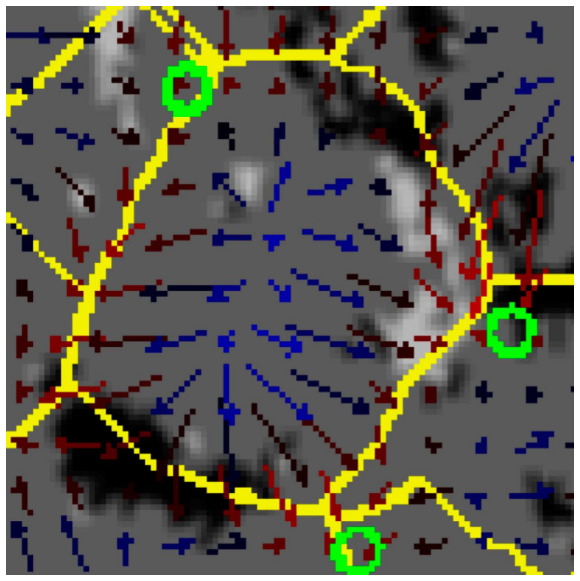
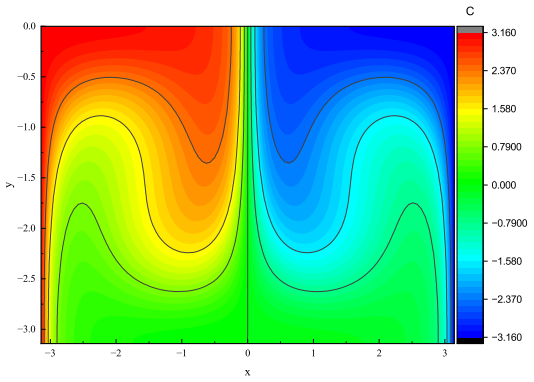
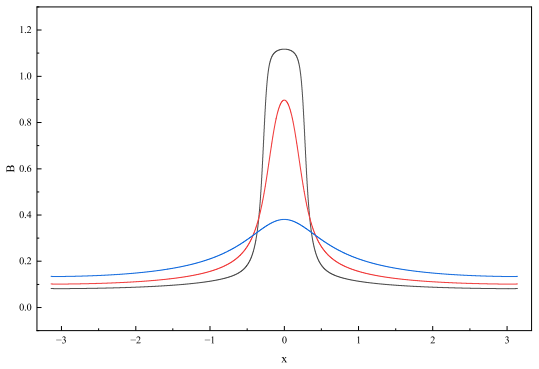
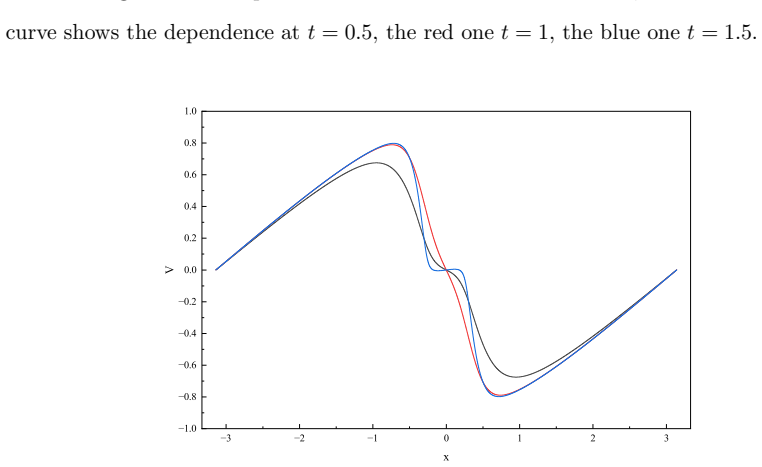
At the initial stage, magnetic filaments begin to form at the boundaries of convective cells in hyperbolic regions of the flow that act as attractors for the magnetic field. The formation is independent of the internal structure of the convective cells and is determined by the behavior of the convective flow along the free surface. In the next stage the magnetic field pressure gradient impedes the convective flow, shifting the hyperbolic regions toward the convective flow along the free surface so that the transverse size of the filament increases and stops when the kinetic energy density and the magnetic field energy density become comparable.
What carries the argument
Hyperbolic regions of the surface flow that first attract the frozen-in magnetic field and later shift outward under magnetic pressure until energies equilibrate.
If this is right
- Filament formation occurs independently of convective cell interiors.
- Initial field at the free boundary is predominantly normal to the surface.
- Saturation occurs when kinetic and magnetic energy densities become comparable.
- After the kinematic stage, finite conductivity limits further growth inside the filament.
Where Pith is reading between the lines
- The same surface-flow mechanism could organize magnetic structures in other stars with comparable convection.
- Measured widths of solar filaments could be compared directly against the predicted energy-balance stopping point.
- Models of surface magnetism could be reduced to two-dimensional flow problems at the free boundary.
Load-bearing premise
The free boundary of the convective zone near cell interfaces can be treated as flat so that filament growth and saturation are set solely by the surface flow.
What would settle it
A simulation or observation in which filament formation requires the internal cell structure or saturates at an energy-density ratio far from unity would falsify the two-stage surface-flow model.
Figures


read the original abstract
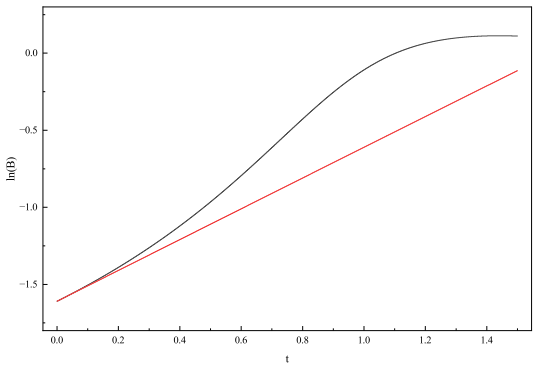
This paper presents a brief overview of studies of magnetic filament formation in the solar convection zone. Two stages of magnetic filament formation and development are distinguished. The first stage can be described within the kinematic approximation for the MHD equation, since the average kinetic energy of convective motion exceeds the average magnetic field energy. Moreover, magnetic Reynolds number is on the order of $10^6$. Therefore, at the initial stage of magnetic filament formation, the magnetic field can be considered frozen-in. It turns out that at this stage, magnetic filaments begin to form at the boundaries of convective cells in hyperbolic regions of the flow. These regions act as attractors for the magnetic field. At the free boundary of the convective zone near the interfaces between convective cells, the magnetic field has a predominantly normal component relative to the boundary. As the magnetic field increases, the field's frozen-in nature in the filament is disrupted, and saturation occurs due to finite conductivity. It is important to note that the magnetic field growth and saturation in the filament at this stage can be determined by analyzing the behavior of the magnetic field at the free boundary, which, according to observations, can be considered flat. Moreover, the formation of magnetic filaments is independent of the internal structure of the convective cells and is determined by the behavior of the convective flow along the free surface. In the next stage, when the magnetic field in the filament is sufficiently strong, the magnetic field pressure gradient begins to impede the convective flow, leading to a shift of the hyperbolic regions toward the convective flow along the free surface. As a result, the transverse size of the filament increases and stops when the kinetic energy density and the magnetic field energy density become comparable.
Editorial analysis
A structured set of objections, weighed in public.
Referee Report
Summary. The manuscript provides a brief overview distinguishing two stages of magnetic filament formation in the solar convective zone. Stage 1 is treated in the kinematic MHD approximation (high Rm ~10^6, frozen-in field) where filaments form at hyperbolic flow regions at convective cell boundaries that act as attractors; growth and saturation are asserted to be determinable solely from behavior at the free surface (treated as flat per observations), independent of internal cell structure, with saturation due to finite conductivity. Stage 2 occurs when magnetic pressure impedes flow, shifting hyperbolic regions along the free surface so that filament transverse size grows until kinetic and magnetic energy densities become comparable.
Significance. If the two-stage separation and the surface-flow independence hold, the work could simplify models of solar magnetic structuring by decoupling filament properties from deep convective details. The explicit separation of kinematic versus dynamic regimes and the attractor role of hyperbolic points are conceptually useful, though the absence of supporting derivations or quantitative tests limits immediate predictive power.
major comments (2)
- [Abstract] Abstract (and the central claim paragraph): the assertion that 'the formation of magnetic filaments is independent of the internal structure of the convective cells and is determined by the behavior of the convective flow along the free surface' and that 'magnetic field growth and saturation ... can be determined by analyzing the behavior of the magnetic field at the free boundary' rests on the flat-boundary approximation. No quantitative tolerance on curvature, no estimate of how granulation-scale deviations would alter normal-component dominance or attractor dynamics, and no derivation showing that stage-2 impedance and transverse-size saturation remain unchanged under boundary deformation are supplied; this approximation is load-bearing for the independence claim.
- [Abstract] Abstract (stage-2 description): the statements that 'the magnetic field pressure gradient begins to impede the convective flow, leading to a shift of the hyperbolic regions' and that 'the transverse size of the filament increases and stops when the kinetic energy density and the magnetic field energy density become comparable' are presented without reference to specific equations, scaling arguments, or cited derivations that demonstrate how the impedance produces the described shift and saturation; these steps are load-bearing for the two-stage distinction.
minor comments (1)
- The manuscript is described as a 'brief overview of studies'; adding one or two key equations or scaling relations from the referenced literature would clarify how the frozen-in condition and hyperbolic attractors follow from the MHD induction equation under the stated Rm.
Simulated Author's Rebuttal
We thank the referee for the constructive comments. The manuscript is intended as a brief conceptual overview of two-stage filament formation rather than a full derivation paper; we address the load-bearing claims below and will revise the abstract and text for clarity where the approximations and transitions require additional qualification.
read point-by-point responses
-
Referee: [Abstract] Abstract (and the central claim paragraph): the assertion that 'the formation of magnetic filaments is independent of the internal structure of the convective cells and is determined by the behavior of the convective flow along the free surface' and that 'magnetic field growth and saturation ... can be determined by analyzing the behavior of the magnetic field at the free boundary' rests on the flat-boundary approximation. No quantitative tolerance on curvature, no estimate of how granulation-scale deviations would alter normal-component dominance or attractor dynamics, and no derivation showing that stage-2 impedance and transverse-size saturation remain unchanged under boundary deformation are supplied; this approximation is load-bearing for the independence claim.
Authors: The independence follows from the kinematic (frozen-in) regime at high Rm, where field lines are advected solely by the surface flow and accumulate at hyperbolic attractors; internal cell structure does not enter because only the surface velocity field determines the normal-component dominance and attractor locations. The flat-boundary statement is observational (granulation appears locally flat on the relevant scales). We agree that no quantitative tolerance on curvature or explicit derivation of invariance under deformation is supplied. We will revise to add a short qualifying sentence noting that the approximation holds for observed granulation flatness and that curvature effects would require separate 3D simulations outside the scope of this overview. revision: partial
-
Referee: [Abstract] Abstract (stage-2 description): the statements that 'the magnetic field pressure gradient begins to impede the convective flow, leading to a shift of the hyperbolic regions' and that 'the transverse size of the filament increases and stops when the kinetic energy density and the magnetic field energy density become comparable' are presented without reference to specific equations, scaling arguments, or cited derivations that demonstrate how the impedance produces the described shift and saturation; these steps are load-bearing for the two-stage distinction.
Authors: Stage 2 is the transition out of the kinematic regime once magnetic pressure becomes dynamically important. The impedance shifts the surface hyperbolic points because the Lorentz force opposes the inflow, allowing the filament to widen until equipartition halts further growth; this is a standard MHD scaling (magnetic pressure gradient balancing convective ram pressure). Because the manuscript is an overview, the steps are stated qualitatively. We will revise the abstract and add a brief parenthetical reference to the equipartition scaling and to prior MHD literature that derives the shift and saturation explicitly. revision: yes
Circularity Check
No circularity: derivation applies standard MHD to observed boundary geometry
full rationale
The paper's two-stage description follows directly from the kinematic MHD limit (kinetic energy > magnetic energy, Rm ~ 10^6 implying frozen-in field) applied to hyperbolic flow regions at cell boundaries, with the flat free-surface assumption stated as an observational input rather than derived internally. Growth and saturation are analyzed at that boundary without any fitted parameters, self-referential definitions, or load-bearing self-citations that reduce the result to its own inputs. The independence from internal cell structure is a direct consequence of the boundary-dominated analysis under the stated approximations, not a renaming or smuggling of an ansatz. The derivation is therefore self-contained.
Axiom & Free-Parameter Ledger
free parameters (1)
- magnetic Reynolds number =
10^6
axioms (2)
- domain assumption The MHD equations govern the plasma in the solar convective zone
- domain assumption The free boundary of the convective zone can be treated as flat
Reference graph
Works this paper leans on
-
[1]
on the generation of magnetic filaments by a convective system of hexagonal cells. In one of our previous studies, we numerically simulated the corresp onding process within the kinematic approximation [44], when the magnetic fie ld energy is relatively small compared to the energy of turbulent motions. In t his case, at the interface between convective cel...
-
[2]
Convective cells are responsible for the formation of magnetic fila ments in the solar convection zone
-
[3]
This process is exponential in time at high magnetic Reynolds numbers
At the kinematic stage, when the average kinetic energy exceed s the average magnetic field energy, the formation of magnetic filaments is due to t he com- pressibility of continuously distributed magnetic field lines, a consequ ence of the frozen-in magnetic field. This process is exponential in time at high magnetic Reynolds numbers
-
[4]
The increase in the magnetic field in a filamen t is of the order of √ Rem
In the kinematic limit, the magnetic field saturation of the filaments occurs due to finite conductivity. The increase in the magnetic field in a filamen t is of the order of √ Rem. For the solar convection zone, the magnetic field values in filaments in this regime can be 1 − 10 kG; 26
-
[5]
The region of these flows represents a unique attractor of magnetic fields
Magnetic filaments on the Sun form at the boundaries of convect ive cells, which coincide with descending convective flows. The region of these flows represents a unique attractor of magnetic fields. This attractor is a hyperbolic region of hydrodynamic flows. The magnetic field reaches its maximum at the hyperbolic point
-
[6]
Based on observations, the boundary of the convective zone c an be consid- ered flat with good accuracy. In this case, the kinematic stage allow s us to elucidate the most general patterns of filament formation and dev elopment — a process independent of the internal structure of the convec tive cell flow. Specifically, it has been shown that all types of loc...
-
[7]
At this stage, we found that the magnetic pressure gradient pushes the convective flow, shifting the hyperbolic point toward the flow
When the magnetic field growth in the filaments is significant, the gr owing magnetic fields in the filaments begin to influence the convective flow. At this stage, we found that the magnetic pressure gradient pushes the convective flow, shifting the hyperbolic point toward the flow. As a result, the fi lament size increases compared to the filament width in the kin...
-
[8]
Gaponov A.V., Miller M.A. // JETP. — 1958. — V. 34, No.1. — P .168—169
1958
-
[9]
Gaponov A.V., Miller M.A. // JETP. — 1958. — V. 34, No.3. — P .515—516
1958
-
[10]
Vedenov A.A., Rudakov L.I.// Dokl. Akad. Nauk SSSR. - 196 4. - T. 159, No. 4. - P. 767-770 (in Russ.)
-
[11]
Zakharov V. E. // JETP. — 1972. — V. 35, No.5. — P.908 – 914. 27
1972
-
[12]
Zakharov V. E., Kuznetsov E. A. // Phys.Usp. — 2012. — V.55 . — P. 535–556. DOI:10.3367/UFNe.0182.201206a.0569
-
[13]
Kolmogorov A. N. // Dokl. Akad. Nauk. SSSR. – 1941. – V. 31. – P.538–541 (in Russ.)
1941
-
[14]
Obukhov A. M. // Dokl. Akad. Nauk. SSSR. – 1941. – V. 32. – P. 22–24 (in Russ.)
1941
-
[15]
// Hydrodynamics
Lamb H. // Hydrodynamics. Cambridge University Press, C ambridge, UK, 1932
1932
-
[16]
K.// An Introduction to Fluid Dynamics
Batchelor G. K.// An Introduction to Fluid Dynamics. Cam bridge University Press, Cambridge, UK, 1967. DOI: 10.1017/CBO9780511800955
-
[17]
Salmon R. // Annual Review of Fluid Mechanics. 1988. – V. 20. – P.225–256. DOI: 10.1146/annurev.fl.20.010188.001301
-
[18]
Zakharov V. E., Kuznetsov E. A. // Phys. Usp. – 1997. – V.4 0. – P.1087–1116. DOI: 10.1070/PU1997v040n11ABEH000304
-
[19]
// Ra diophysics and Quantum Electronics
Abrashkin A.A., Zen‘kovich D.A., Yakubovich E.I. // Ra diophysics and Quantum Electronics. – 1996. – V.39. – P.518 – 526. DOI: 10.1007/BF02 122398
-
[20]
I., Zenkovich D
Yakubovich E. I., Zenkovich D. A.// Journal Fluid Mech. – 2001. – V. 443 – P.167–
2001
-
[21]
DOI: 10.1017/S0022112001005195
-
[22]
Alfven Hannes, Arkiv for Matematik, Astrnomi Och Fysik . – 1942. – Band 29 B, No 2. – P.1-7
1942
-
[23]
Yudovich V. I. // USSR Computational Mathematics and Ma thematical Physics. –
-
[24]
– V. 3. - No.6. – P.1407–1456. DOI: 10.1016/0041-5553( 63)90247-7
-
[25]
// Archive for Rational Mechanics and Analysis
Kato T. // Archive for Rational Mechanics and Analysis. – 1967. – V. 25. – P.188-
1967
-
[26]
DOI: 10.1007/BF00251588
-
[27]
Gibbon J. D. // Physica D. – 2008. – V.237. – P.1894 – 1904. DOI: 10.1016/j.physd.2007.10.014
-
[28]
Hou T. Y., Li R. // J. Comp. Phys. – 2007. – V.226. – P.379–3 97. DOI: 10.1016/j.jcp.2007.04.014
-
[29]
Kuznetsov E. A., Naulin V., Nielsen A. H. et al. // Theor. Comput. Fluid. Dun. 2007, V.19, 105110. DOI: 10.1063/1.2793150 28
-
[30]
Agafontsev D.S., Kuznetsov E. A., Mailybaev A. A., Sere shchenko E. V. // Phys. Usp. – 2022. – V.65. – P.189–208. DOI: 10.3367/UFNe.2020.11 .038875
-
[31]
Agafontsev D. S., Kuznetsov E. A., Mailybaev A. A. // Phy s.Fluids. – 2015. – V.27. – 085102. DOI: 10.1063/1.4927680
-
[32]
Agafontsev D. S., Kuznetsov E. A., Mailybaev A. A. // JET P Letters. – 2016. – V.104. – P.685–689. DOI: 10.1134/S002136401622001X
-
[33]
Kuznetsov E. A., Ruban V. P. // JETP Letters. – 1998. – V.6 7. – P.1076–1081. DOI: 10.1134/1.567795
-
[34]
Kuznetsov E. A. // JETP Letters. – 2002. – V.76. – P.346–3 50. DOI: 10.1134/1.1525034
-
[35]
A., Sereshchenko E
Kuznetsov E. A., Sereshchenko E. V. // JETP Letters. – 20 19. – V.109. – P.239 –
-
[36]
DOI: 10.1134/S0021364019040039
-
[37]
I., Sunyaev R
Shakura N. I., Sunyaev R. A. // Astronomy and Astrophysi cs. – 1973. – V.24. – 337
1973
-
[38]
R¨ udiger G., Elstner D., Stepinsky T. F. // Astronomy & A strophysics. 1995. V.298, 934–943
1995
-
[39]
M. Ghasemnezhad // M. Not. R.Astron.Soc. – 2017. – V.469 . – P.3322–3328. DOI: 10.1093/mnras/stx1118 10.1093/mnras/stx1118
-
[40]
Boneva D. V., Mikhailov E. A., Pashentseva M. V., Sokolo ff D. D. // Astronomy and Astrophysics. – 2021. – V.652. – A38. DOI: 10.1051/0004-636 1/202038680
-
[41]
Hawley J. F., Balbus S. A., Stone J. M. // Astrophysical J ournal. – 2001. – V.554. – L49. DOI: 10.1086/320931
-
[42]
Parker E. N. // Astrophysical Journal. – 1963. – V. 138. – P.552-–575. DOI: 10.1086/147663
-
[43]
Galloway D.J., Weiss N.O. // Astrophysical Journal. – 1 981. – V. 243. – P.945-–953. DOI: 10.1086/158659
-
[44]
// Monthly Notices of the Royal A stronomical Society
Anzer U., Galloway D.J. // Monthly Notices of the Royal A stronomical Society. –
-
[45]
– V. 203. – P.637–650. DOI: 10.1093/mnras/203.3.637
-
[46]
// Geophysical & Astrophysical Fluid Dynamic s
Arter, W. // Geophysical & Astrophysical Fluid Dynamic s. – 1983. – V. 31. – 29 P.311—344. DOI: 10.1080/03091928308221752
-
[47]
Solanki S. K. // Astronomy & Astrophysics Review. – 2003 . – V.11. P.153-–286. DOI: 10.1007/s00159-003-0018-4
-
[48]
Evolution of zero-mean magnetic fields in c ellular flows Physics of Fluids 2005, 17, 103604
ilvers, L.J. Evolution of zero-mean magnetic fields in c ellular flows Physics of Fluids 2005, 17, 103604. DOI: 10.1063/1.2084247
-
[49]
Ferriz-Mas A., Steiner O. // Solar Physics. – 2007. – V.2 46. – P.31-–39. DOI: 10.1007/s11207-007-9072-9
-
[50]
Nagata S., Tsuneta S., Suematsu Y., Ichimoto K., Katsuk awa Y., Shimizu T., Yokoyama T. et al. // Astrophysical Journal Letters. – 2008. – V.677. – L145. DOI: 10.1086/588026
-
[52]
// Astro nomy and Astrophysics
van Noort M., Lagg A., Tiwari S.K., Solanki S.K. // Astro nomy and Astrophysics. – 2013. – V.557. – A25. DOI: 10.1051/0004-6361/201321391
-
[53]
// Physics of Magnetic Flux Tubes
Ryutova M. // Physics of Magnetic Flux Tubes. Springer: Berlin, Germany, 2018. DOI: 10.1007/978-3-662-45243-1
-
[54]
Straßburger (2013): Cut Elimination in Nested Sequents for Intuitionistic Modal Logics
Stix M. The Sun: an Introduction. Springer, Berlin, 200 2. DOI: 10.1007/978-3-642- 56042-2
-
[55]
Getling A. V., Buchnev A. A. // Astronomy Letters. – 2010 . – V.87. – P.254–259. DOI: 10.1134/S1063772910030078
-
[56]
Kuznetsov E. A., Mikhailov E. A. // JETP. – 2020. – V.131. – P.496-505. DOI: 10.1134/S106377612009006X
-
[57]
Kitiashvili I.N., Kosovichev A.G., Wray A.A., Mansour , N. N. // Astrophysical Journal. – 2010. – V.719. – P.307-–312. DOI:10.1088/0004-6 37X/719/1/307
-
[58]
Eddy J. A. // A new sun: the solar results from Skylab, 402 Scientific and Technical Information Office, National Aeronautics and Space Agency, W ashington, 1979
1979
-
[59]
Kosovichev A.G.// Space science reviews. – 2009. – V.14 4. – P.175–195. DOI:10.1007/s11214-009-9487-8 30
-
[60]
Kuznetsov E. A., Mikhailov E. A. // Mathematics. – 2024. – V.12. – 677. DOI: 10.3390/math12050677
-
[61]
Chertkov M., Falkovich G., Kolokolov I., Vergassola M. // Phys.Rev.Lett. – 1999. – V.83. – 4065. DOI: 10.1103/PhysRevLett.83.4065
-
[63]
, Zhuxoviczkij E.M
Gershuni G.Z. , Zhuxoviczkij E.M. //Konvektivnaya neu stojchivost‘ neszhimaemoj zhidkosti, Nauka, Moskva, 1972
1972
-
[64]
, Spector M.D.// Journal of Applied Mech anics and Technical Physics
Kuznetsov E.A. , Spector M.D.// Journal of Applied Mech anics and Technical Physics. – 1980. – V.21. – P.220–228. DOI: 10.1007/BF009182 32
-
[65]
Weiss J.// Physica D. – 1991. – V.48. – P.273–294. DOI:10 .1016/0167- 2789(91)90088-Q
1991
-
[66]
// Deep sea research and oceanographic abstrac ts
Okubo A. // Deep sea research and oceanographic abstrac ts. 1970. V. 17, 445. DOI: 10.1016/0011-7471(70)90059-8
-
[67]
Sokoloff D.D. // Phys. Usp. – 2015. – V.58. – P.601–605. DO I: 10.3367/UFNe.0185.201506h.0643
-
[68]
// Fizika zvezd
Kaplan S.A. // Fizika zvezd. Izd. 3, pererab. i dop. 1977 . 208 s. 31
1977
discussion (0)
Sign in with ORCID, Apple, or X to comment. Anyone can read and Pith papers without signing in.