PIAvatar: Physically Interactive Avatars via Deformation Gradient Decoupling
Pith reviewed 2026-06-26 12:54 UTC · model grok-4.3
The pith
Decoupling kinematic velocity from deformation gradient enables avatars to maintain poses under external physical forces.
A machine-rendered reading of the paper's core claim, the machinery that carries it, and where it could break.
Core claim
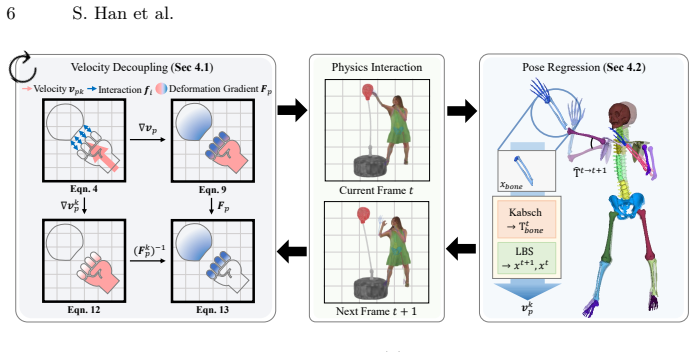
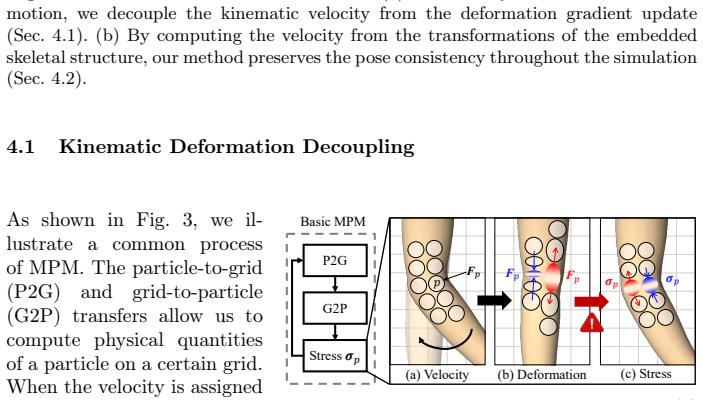
When external forces act on avatars, the kinematic velocity induces stress which hinders the avatar's ability to achieve a desired pose. Decoupling kinematic velocity from deformation gradient resolves this issue. In addition, integrating a skeletal framework within the avatar allows estimating its poses and real-time tracking in a closed form, even during non-rigid physical interactions. The approach is implemented within a conventional Material Point Method framework to ensure physically consistent dynamics, enabling interactions with objects and other humans.
What carries the argument
Deformation gradient decoupling that separates kinematic velocity to eliminate pose-hindering stress, combined with an embedded skeletal framework for closed-form tracking.
If this is right
- Avatars achieve physically aware interactions with environments and other avatars.
- Non-rigid body simulation occurs without sacrificing pose control.
- Pose estimation and tracking stay in closed form during deformations.
- Physically consistent dynamics are produced in standard MPM simulations.
- Behavior is validated across human-object and human-human scenarios.
Where Pith is reading between the lines
- Similar decoupling might apply to other simulation domains like soft robotics or cloth dynamics.
- Real-time performance could enable new interactive applications in games or virtual reality.
- Extending the skeletal framework to handle more extreme deformations could be a next step.
Load-bearing premise
Embedding a skeletal framework inside the avatar will allow closed-form pose estimation and real-time tracking even while the body undergoes non-rigid physical deformations.
What would settle it
Run a simulation where an external force pushes the avatar away from its target pose; check if the decoupling keeps the pose accurate or if stress still appears.
Figures




read the original abstract
3D human avatars have shown impressive visual fidelity driven by pose-conditioned models, yet they still lack the physical ability required for interactions with each other and environments. Although recent studies have made various attempts to incorporate physical characteristics into 3D avatars, they only exhibit limited physical deformations, often leading to constrained interaction behaviors. To resolve this issue, we present PIAvatar, a framework to simultaneously enable physically aware interactions between avatar-avatar and avatar-environment, and a non-rigid deformable human body simulation. In this work, our key insight is to decouple kinematic velocity from deformation gradient. When external forces act on avatars, the kinematic velocity induces stress which hinders the avatar's ability to achieve a desired pose. In addition, we integrate a skeletal framework within the avatar. It allows estimating its poses and real-time tracking in a closed form, even during non-rigid physical interactions. Our approach is implemented within a conventional Material Point Method framework to ensure physically consistent dynamics. We lastly evaluate the method on both human-object and human-human interaction scenarios to assess its behavior under diverse interaction settings.
Editorial analysis
A structured set of objections, weighed in public.
Referee Report
Summary. The paper presents PIAvatar, a framework for physically interactive 3D human avatars that supports avatar-avatar and avatar-environment interactions alongside non-rigid body simulation. The central claims are that decoupling kinematic velocity from the deformation gradient prevents induced stress from opposing desired poses under external forces, and that embedding a skeletal framework enables closed-form pose estimation and real-time tracking even while the body undergoes non-rigid physical deformations inside an MPM solver. The approach is implemented in a standard Material Point Method framework and evaluated on human-object and human-human interaction scenarios.
Significance. If the decoupling resolves the stress-pose conflict and the skeletal inverse remains closed-form under general MPM deformations, the work would enable more physically consistent interactive avatars than prior limited-deformation models, with potential impact on animation, VR, and physics-based graphics. The MPM implementation and interaction evaluations are standard strengths, but the absence of visible derivations for the load-bearing skeletal claim limits immediate assessment of novelty.
major comments (2)
- [Abstract (skeletal integration paragraph)] Abstract (skeletal integration paragraph): the assertion that the skeletal framework 'allows estimating its poses and real-time tracking in a closed form, even during non-rigid physical interactions' is load-bearing for the interactivity claim, yet no derivation, auxiliary constraint, or skinning-weight condition is supplied to show why the inverse problem remains closed-form rather than a non-linear least-squares solve under arbitrary MPM deformations.
- [Abstract (decoupling insight)] Abstract (decoupling insight): the statement that 'decoupling kinematic velocity from deformation gradient' resolves stress hindering desired poses is presented without equations, implementation details, or proof that the separation does not reintroduce parameters or approximations inside the MPM constitutive model.
minor comments (1)
- The abstract would be strengthened by a one-sentence reference to any quantitative metrics, ablation results, or timing data that support the real-time and physical-consistency claims.
Simulated Author's Rebuttal
We thank the referee for the constructive feedback on the key claims. We address each major comment below and will revise the manuscript to supply the requested details and derivations.
read point-by-point responses
-
Referee: [Abstract (skeletal integration paragraph)] Abstract (skeletal integration paragraph): the assertion that the skeletal framework 'allows estimating its poses and real-time tracking in a closed form, even during non-rigid physical interactions' is load-bearing for the interactivity claim, yet no derivation, auxiliary constraint, or skinning-weight condition is supplied to show why the inverse problem remains closed-form rather than a non-linear least-squares solve under arbitrary MPM deformations.
Authors: We agree the abstract would be strengthened by explicit support for the closed-form claim. The skeletal tracker remains closed-form because particle-to-joint mappings use fixed skinning weights; the pose is recovered by solving a linear system over the deformed particle positions after the kinematic velocity step, independent of the subsequent MPM deformation-gradient update. We will add a concise derivation and the skinning-weight condition to the methods section and reference it from the abstract in the revision. revision: yes
-
Referee: [Abstract (decoupling insight)] Abstract (decoupling insight): the statement that 'decoupling kinematic velocity from deformation gradient' resolves stress hindering desired poses is presented without equations, implementation details, or proof that the separation does not reintroduce parameters or approximations inside the MPM constitutive model.
Authors: The decoupling is realized by splitting the grid velocity into a kinematic component (prescribed by the target pose) and a residual deformational component; only the residual updates the deformation gradient inside the standard MPM constitutive model. This separation uses the existing velocity field and does not introduce new parameters or approximations. We will insert the explicit velocity-split equations and a short implementation note in the revised methods section. revision: yes
Circularity Check
No circularity; claims asserted without self-referential reduction
full rationale
The provided abstract and text assert decoupling of kinematic velocity from the deformation gradient and closed-form pose recovery via skeletal embedding inside an MPM solver, but contain no equations, fitted parameters, or self-citations that reduce any prediction or result to its own inputs by construction. The skeletal closed-form claim is presented as an enabling property of the framework rather than derived from prior results or data fits within the paper. No load-bearing step exhibits the enumerated circular patterns.
Axiom & Free-Parameter Ledger
Reference graph
Works this paper leans on
-
[1]
In: ACM Transactions on Graphics (TOG)
Anguelov, D., Srinivasan, P., Koller, D., Thrun, S., Rodgers, J., Davis, J.: Scape: shape completion and animation of people. In: ACM Transactions on Graphics (TOG). ACM (2005)
2005
-
[2]
Authors, G.: Genesis: A generative and universal physics engine for robotics and beyond (December 2024),https://github.com/Genesis-Embodied-AI/Genesis
2024
-
[3]
In: Proceedings of European Conference on Computer Vision (ECCV) (2016)
Bogo, F., Kanazawa, A., Lassner, C., Gehler, P., Romero, J., Black, M.J.: Keep it SMPL: Automatic estimation of 3D human pose and shape from a single image. In: Proceedings of European Conference on Computer Vision (ECCV) (2016)
2016
-
[4]
Clough,R.:TheFiniteElementMethodinPlaneStressAnalysis.AmericanSociety of Civil Engineers (1960),https://books.google.co.kr/books?id=rfwFHQAACAAJ
1960
-
[5]
Corporation, N.: Nvidia physx sdk.https://developer.nvidia.com/physx-sdk (2021), accessed: March 2025
2021
-
[6]
In: ACM SIGGRAPH 2015 Courses, p
Coumans, E.: Bullet physics simulation. In: ACM SIGGRAPH 2015 Courses, p. 1. ACM (2015) 20 S. Han et al. (a) Soccer ball : 0.5kg(b) Basketball : 1.5kg(c) Bowling ball : 8kg Fig.13: Interaction response under different object masses.We perform the same kicking motion with objects of different masses: (a) soccer ball (0.5 kg), (b) basketball (1.5 kg), and (...
2015
-
[7]
In: Proceedings of IEEE Conference on Computer Vision and Pattern Recognition (CVPR) (2023)
Guo, C., Jiang, T., Chen, X., Song, J., Hilliges, O.: Vid2avatar: 3d avatar re- construction from videos in the wild via self-supervised scene decomposition. In: Proceedings of IEEE Conference on Computer Vision and Pattern Recognition (CVPR) (2023)
2023
-
[8]
ACM Transactions on Graphics (TOG) (2018)
Guo, Q., Han, X., Fu, C., Gast, T., Tamstorf, R., Teran, J.: A material point method for thin shells with frictional contact. ACM Transactions on Graphics (TOG) (2018)
2018
-
[9]
In: Proceedings of IEEE Conference on Computer Vision and Pattern Recognition (CVPR) (2023)
Han, S.H., Park, M.G., Yoon, J.H., Kang, J.M., Park, Y.J., Jeon, H.G.: High- fidelity 3d human digitization from single 2k resolution images. In: Proceedings of IEEE Conference on Computer Vision and Pattern Recognition (CVPR) (2023)
2023
-
[10]
ACM Transactions on Graphics (TOG) (2019)
Han, X., Gast, T.F., Guo, Q., Wang, S., Jiang, C., Teran, J.: A hybrid material point method for frictional contact with diverse materials. ACM Transactions on Graphics (TOG) (2019)
2019
-
[11]
ACM Transactions on Programming Lan- guages and Systems (TOPLAS) (1991)
Herlihy, M.: Wait-free synchronization. ACM Transactions on Programming Lan- guages and Systems (TOPLAS) (1991)
1991
-
[12]
In: Proceedings of IEEE Conference on Com- puter Vision and Pattern Recognition (CVPR) (2024)
Ho, I., Song, J., Hilliges, O., et al.: Sith: Single-view textured human reconstruction with image-conditioned diffusion. In: Proceedings of IEEE Conference on Com- puter Vision and Pattern Recognition (CVPR) (2024)
2024
-
[13]
Proceedings of the Neural Information Processing Systems (NeurIPS) (2024)
Hu, H., Fan, Z., Wu, T., Xi, Y., Lee, S., Pavlakos, G., Wang, Z., et al.: Expressive gaussian human avatars from monocular rgb video. Proceedings of the Neural Information Processing Systems (NeurIPS) (2024)
2024
-
[14]
In: Proceedings of IEEE Conference on Computer Vision and Pattern Recognition (CVPR) (2024) PIAvatar 21
Hu, L., Zhang, H., Zhang, Y., Zhou, B., Liu, B., Zhang, S., Nie, L.: Gaussianavatar: Towards realistic human avatar modeling from a single video via animatable 3d gaussians. In: Proceedings of IEEE Conference on Computer Vision and Pattern Recognition (CVPR) (2024) PIAvatar 21
2024
-
[15]
ACM Transactions on Graphics (TOG) (2018)
Hu, Y., Fang, Y., Ge, Z., Qu, Z., Zhu, Y., Pradhana, A., Jiang, C.: A moving least squares material point method with displacement discontinuity and two-way rigid body coupling. ACM Transactions on Graphics (TOG) (2018)
2018
-
[16]
ACM Transactions on Graphics (TOG)42(4), 1–12 (2023)
Işık, M., Rünz, M., Georgopoulos, M., Khakhulin, T., Starck, J., Agapito, L., Nießner, M.: Humanrf: High-fidelity neural radiance fields for humans in mo- tion. ACM Transactions on Graphics (TOG) (2023).https://doi.org/10.1145/ 3592415,https://doi.org/10.1145/3592415
-
[17]
ACM Transactions on Graphics (TOG) (2017)
Jiang, C., Gast, T., Teran, J.: Anisotropic elastoplasticity for cloth, knit and hair frictional contact. ACM Transactions on Graphics (TOG) (2017)
2017
-
[18]
ACM Transactions on Graphics (TOG) (2015)
Jiang, C., Schroeder, C., Selle, A., Teran, J., Stomakhin, A.: The affine particle- in-cell method. ACM Transactions on Graphics (TOG) (2015)
2015
-
[19]
Journal of Computational Physics (JCP) (2017)
Jiang, C., Schroeder, C., Teran, J.: An angular momentum conserving affine- particle-in-cell method. Journal of Computational Physics (JCP) (2017)
2017
-
[20]
In: Acm siggraph 2016 courses
Jiang, C., Schroeder, C., Teran, J., Stomakhin, A., Selle, A.: The material point method for simulating continuum materials. In: Acm siggraph 2016 courses. ACM Transactions on Graphics (TOG) (2016)
2016
-
[21]
In: Proceedings of IEEE Conference on Computer Vision and Pattern Recognition (CVPR) (2023)
Jiang, T., Chen, X., Song, J., Hilliges, O.: Instantavatar: Learning avatars from monocular video in 60 seconds. In: Proceedings of IEEE Conference on Computer Vision and Pattern Recognition (CVPR) (2023)
2023
-
[22]
Founda- tions of Crystallography (1976)
Kabsch, W.: A solution for the best rotation to relate two sets of vectors. Founda- tions of Crystallography (1976)
1976
-
[23]
In: Proceedings of IEEE Conference on Computer Vision and Pattern Recognition (CVPR) (2018)
Kanazawa, A., Black, M.J., Jacobs, D.W., Malik, J.: End-to-end recovery of human shape and pose. In: Proceedings of IEEE Conference on Computer Vision and Pattern Recognition (CVPR) (2018)
2018
-
[24]
ACM Transactions on Graphics (TOG) (2023)
Keller, M., Werling, K., Shin, S., Delp, S., Pujades, S., Liu, C.K., Black, M.J.: From skin to skeleton: Towards biomechanically accurate 3d digital humans. ACM Transactions on Graphics (TOG) (2023)
2023
-
[25]
In: Proceedings of IEEE Conference on Computer Vision and Pattern Recognition (CVPR) (2022)
Keller, M., Zuffi, S., Black, M.J., Pujades, S.: Osso: Obtaining skeletal shape from outside. In: Proceedings of IEEE Conference on Computer Vision and Pattern Recognition (CVPR) (2022)
2022
-
[26]
ACM Transactions on Graphics (TOG) (2023)
Kerbl, B., Kopanas, G., Leimkühler, T., Drettakis, G.: 3d gaussian splatting for real-time radiance field rendering. ACM Transactions on Graphics (TOG) (2023)
2023
-
[27]
ACM Transactions on Graph- ics (TOG) (2017)
Kim, M., Pons-Moll, G., Pujades, S., Bang, S., Kim, J., Black, M.J., Lee, S.H.: Data-driven physics for human soft tissue animation. ACM Transactions on Graph- ics (TOG) (2017)
2017
-
[28]
Klár, G., Gast, T., Pradhana, A., Fu, C., Schroeder, C., Jiang, C., Teran, J.: Drucker-pragerelastoplasticityforsandanimation.ACMTransactionsonGraphics (TOG) (2016)
2016
-
[29]
In: Proceedings of IEEE Conference on Computer Vision and Pattern Recognition (CVPR) (2020)
Kocabas, M., Athanasiou, N., Black, M.J.: Vibe: Video inference for human body pose and shape estimation. In: Proceedings of IEEE Conference on Computer Vision and Pattern Recognition (CVPR) (2020)
2020
-
[30]
In: Proceedings of the Neural Information Processing Systems (NeurIPS) (2025)
Lee, C., Lee, J., Kim, T.K.: Mpmavatar: Learning 3d gaussian avatars with accu- rate and robust physics-based dynamics. In: Proceedings of the Neural Information Processing Systems (NeurIPS) (2025)
2025
-
[31]
ACM Transactions on Graphics (TOG) (2018)
Lee, S., Yu, R., Park, J., Aanjaneya, M., Sifakis, E., Lee, J.: Dexterous manipula- tion and control with volumetric muscles. ACM Transactions on Graphics (TOG) (2018)
2018
-
[32]
arXiv preprint arXiv:2012.04457 (2020) 22 S
Li, M., Kaufman, D.M., Jiang, C.: Codimensional incremental potential contact. arXiv preprint arXiv:2012.04457 (2020) 22 S. Han et al
arXiv 2012
-
[33]
In: Proceedings of IEEE Conference on Computer Vision and Pattern Recognition (CVPR) (2024)
Li, Z., Zheng, Z., Wang, L., Liu, Y.: Animatable gaussians: Learning pose- dependent gaussian maps for high-fidelity human avatar modeling. In: Proceedings of IEEE Conference on Computer Vision and Pattern Recognition (CVPR) (2024)
2024
-
[34]
ACM Transactions on Graphics (TOG) (2013)
Liu, L., Yin, K., Wang, B., Guo, B.: Simulation and control of skeleton-driven soft body characters. ACM Transactions on Graphics (TOG) (2013)
2013
-
[35]
ACM Transactions on Graphics (TOG) (2014)
Loper, M., Mahmood, N., Black, M.J.: Mosh: motion and shape capture from sparse markers. ACM Transactions on Graphics (TOG) (2014)
2014
-
[36]
ACM Transactions on Graphics (TOG) (2015)
Loper, M., Mahmood, N., Romero, J., Pons-Moll, G., Black, M.J.: Smpl: a skinned multi-person linear model. ACM Transactions on Graphics (TOG) (2015)
2015
-
[37]
In: Proceedings of International Conference on Computer Vision (ICCV) (2023)
Luo, Z., Cao, J., Kitani, K., Xu, W., et al.: Perpetual humanoid control for real- time simulated avatars. In: Proceedings of International Conference on Computer Vision (ICCV) (2023)
2023
-
[38]
International Confer- ence on Learning Representations (ICLR) (2023)
Luo, Z., Cao, J., Merel, J., Winkler, A., Huang, J., Kitani, K., Xu, W.: Universal humanoid motion representations for physics-based control. International Confer- ence on Learning Representations (ICLR) (2023)
2023
-
[39]
In: Proceedings of International Con- ference on Computer Vision (ICCV) (2019)
Mahmood, N., Ghorbani, N., Troje, N.F., Pons-Moll, G., Black, M.J.: Amass: Archive of motion capture as surface shapes. In: Proceedings of International Con- ference on Computer Vision (ICCV) (2019)
2019
-
[40]
maximeraafat: Blendernerf.https://github.com/maximeraafat/BlenderNeRF (2023)
2023
-
[41]
ACM Transactions on Graphics (TOG) (2024)
Moenne-Loccoz, N., Mirzaei, A., Perel, O., de Lutio, R., Esturo, J.M., State, G., Fidler, S., Sharp, N., Gojcic, Z.: 3d gaussian ray tracing: Fast tracing of particle scenes. ACM Transactions on Graphics (TOG) (2024)
2024
-
[42]
In: Proceedings of European Conference on Computer Vision (ECCV) (2024)
Moon, G., Shiratori, T., Saito, S.: Expressive whole-body 3d gaussian avatar. In: Proceedings of European Conference on Computer Vision (ECCV) (2024)
2024
-
[43]
ACM transactions on graphics (TOG)24(3), 471–478 (2005)
Müller,M.,Heidelberger,B.,Teschner,M.,Gross,M.:Meshlessdeformationsbased on shape matching. ACM transactions on graphics (TOG)24(3), 471–478 (2005)
2005
-
[44]
Proceedings of the Neural Information Processing Systems (NeurIPS) (2024)
Pan, P., Su, Z., Lin, C., Fan, Z., Zhang, Y., Li, Z., Shen, T., Mu, Y., Liu, Y.: Hu- mansplat: Generalizable single-image human gaussian splatting with structure pri- ors. Proceedings of the Neural Information Processing Systems (NeurIPS) (2024)
2024
-
[45]
In: Proceedings of IEEE Conference on Computer Vision and Pattern Recognition (CVPR) (2019)
Pavlakos, G., Choutas, V., Ghorbani, N., Bolkart, T., Osman, A.A.A., Tzionas, D., Black, M.J.: Expressive body capture: 3D hands, face, and body from a sin- gle image. In: Proceedings of IEEE Conference on Computer Vision and Pattern Recognition (CVPR) (2019)
2019
-
[46]
In: Proceedings of IEEE Conference on Computer Vision and Pattern Recognition (CVPR) (2019)
Pavlakos, G., Choutas, V., Ghorbani, N., Bolkart, T., Osman, A.A., Tzionas, D., Black,M.J.:Expressivebodycapture:3dhands,face,andbodyfromasingleimage. In: Proceedings of IEEE Conference on Computer Vision and Pattern Recognition (CVPR) (2019)
2019
-
[47]
In: Proceedings of International Conference on Computer Vision (ICCV) (2021)
Peng, S., Dong, J., Wang, Q., Zhang, S., Shuai, Q., Zhou, X., Bao, H.: Animatable neural radiance fields for modeling dynamic human bodies. In: Proceedings of International Conference on Computer Vision (ICCV) (2021)
2021
-
[48]
In: Proceedings of IEEE Conference on Computer Vision and Pattern Recognition (CVPR) (2021)
Peng, S., Zhang, Y., Xu, Y., Wang, Q., Shuai, Q., Bao, H., Zhou, X.: Neural body: Implicit neural representations with structured latent codes for novel view synthesis of dynamic humans. In: Proceedings of IEEE Conference on Computer Vision and Pattern Recognition (CVPR) (2021)
2021
-
[49]
ACM Transactions on Graphics (TOG) (2018)
Peng, X.B., Abbeel, P., Levine, S., van de Panne, M.: Deepmimic: Example-guided deep reinforcement learning of physics-based character skills. ACM Transactions on Graphics (TOG) (2018)
2018
-
[50]
ACM Transactions on Graphics (TOG) (2021) PIAvatar 23
Peng, X.B., Ma, Z., Abbeel, P., Levine, S., Kanazawa, A.: Amp: Adversarial motion priors for stylized physics-based character control. ACM Transactions on Graphics (TOG) (2021) PIAvatar 23
2021
-
[51]
Proceedings of International Conference on Computer Vision (ICCV) (2025)
Qiu, L., Gu, X., Li, P., Zuo, Q., Shen, W., Zhang, J., Qiu, K., Yuan, W., Chen, G., Dong, Z., et al.: Lhm: Large animatable human reconstruction model from a single image in seconds. Proceedings of International Conference on Computer Vision (ICCV) (2025)
2025
-
[52]
In: Proceedings of IEEE Conference on Computer Vision and Pattern Recognition (CVPR) (2025)
Qiu, L., Zhu, S., Zuo, Q., Gu, X., Dong, Y., Zhang, J., Xu, C., Li, Z., Yuan, W., Bo, L., et al.: Anigs: Animatable gaussian avatar from a single image with inconsistent gaussian reconstruction. In: Proceedings of IEEE Conference on Computer Vision and Pattern Recognition (CVPR) (2025)
2025
-
[53]
In: Proceedings of International Conference on Computer Vision (ICCV) (2019)
Saito, S., Huang, Z., Natsume, R., Morishima, S., Kanazawa, A., Li, H.: Pifu: Pixel-aligned implicit function for high-resolution clothed human digitization. In: Proceedings of International Conference on Computer Vision (ICCV) (2019)
2019
-
[54]
In: Proceedings of IEEE Conference on Computer Vision and Pattern Recognition (CVPR) (2020)
Saito, S., Simon, T., Saragih, J., Joo, H.: Pifuhd: Multi-level pixel-aligned im- plicit function for high-resolution 3d human digitization. In: Proceedings of IEEE Conference on Computer Vision and Pattern Recognition (CVPR) (2020)
2020
-
[55]
In: Proceedings of IEEE Conference on Computer Vision and Pattern Recognition (CVPR) (2024)
Shao, Z., Wang, Z., Li, Z., Wang, D., Lin, X., Zhang, Y., Fan, M., Wang, Z.: Splattingavatar: Realistic real-time human avatars with mesh-embedded gaussian splatting. In: Proceedings of IEEE Conference on Computer Vision and Pattern Recognition (CVPR) (2024)
2024
-
[56]
In: Pro- ceedings of European Conference on Computer Vision (ECCV) (2024)
Shin, J., Lee, J., Lee, S., Park, M.G., Kang, J.M., Yoon, J.H., Jeon, H.G.: Canon- icalfusion: Generating drivable 3d human avatars from multiple images. In: Pro- ceedings of European Conference on Computer Vision (ECCV) (2024)
2024
-
[57]
In: Proceedings of International Conference on Computer Vision (ICCV) (2025)
Sim, G., Moon, G.: Persona: Personalized whole-body 3d avatar with pose-driven deformations from a single image. In: Proceedings of International Conference on Computer Vision (ICCV) (2025)
2025
-
[58]
arXiv preprint arXiv:2507.23778 (2025)
Siyao, L., Feng, Y., Taheri, O., Loy, C.C., Black, M.J.: Half-physics: Enabling kine- matic 3d human model with physical interactions. arXiv preprint arXiv:2507.23778 (2025)
arXiv 2025
-
[59]
ACM Transactions on Graphics (TOG) (2013)
Stomakhin, A., Schroeder, C., Chai, L., Teran, J., Selle, A.: A material point method for snow simulation. ACM Transactions on Graphics (TOG) (2013)
2013
-
[60]
Proceedings of the Neural Information Processing Systems (NeurIPS) (2021)
Su, S.Y., Yu, F., Zollhöfer, M., Rhodin, H.: A-nerf: Articulated neural radiance fields for learning human shape, appearance, and pose. Proceedings of the Neural Information Processing Systems (NeurIPS) (2021)
2021
-
[61]
Tevet, G., Raab, S., Cohan, S., Reda, D., Luo, Z., Peng, X.B., Bermano, A.H., van de Panne, M.: Closd: Closing the loop between simulation and diffusion for multi-taskcharactercontrol.InternationalConferenceonLearningRepresentations (ICLR) (2025)
2025
-
[62]
In: Proceedings of International Conference on Intelligent Robots and Systems (IROS)
Todorov, E., Erez, T., Tassa, Y.: Mujoco: A physics engine for model-based control. In: Proceedings of International Conference on Intelligent Robots and Systems (IROS). IEEE (2012)
2012
-
[63]
In: Proceedings of IEEE Conference on Computer Vision and Pattern Recognition (CVPR) (2025)
Wang, R., Prada, F., Wang, Z., Jiang, Z., Yin, C., Li, J., Saito, S., Santesteban, I., Romero, J., Joshi, R., et al.: Fresa: Feedforward reconstruction of personalized skinned avatars from few images. In: Proceedings of IEEE Conference on Computer Vision and Pattern Recognition (CVPR) (2025)
2025
-
[64]
In: Proceed- ings of IEEE Conference on Computer Vision and Pattern Recognition (CVPR) (2024)
Wen, J., Zhao, X., Ren, Z., Schwing, A.G., Wang, S.: Gomavatar: Efficient animat- able human modeling from monocular video using gaussians-on-mesh. In: Proceed- ings of IEEE Conference on Computer Vision and Pattern Recognition (CVPR) (2024)
2024
-
[65]
In: Proceedings of IEEE Conference on Computer Vision and Pattern Recognition (CVPR) (2022) 24 S
Weng, C.Y., Curless, B., Srinivasan, P.P., Barron, J.T., Kemelmacher-Shlizerman, I.: Humannerf: Free-viewpoint rendering of moving people from monocular video. In: Proceedings of IEEE Conference on Computer Vision and Pattern Recognition (CVPR) (2022) 24 S. Han et al
2022
-
[66]
In: Proceedings of IEEE Conference on Computer Vision and Pattern Recognition (CVPR) (2024)
Wu, G., Yi, T., Fang, J., Xie, L., Zhang, X., Wei, W., Liu, W., Tian, Q., Wang, X.: 4d gaussian splatting for real-time dynamic scene rendering. In: Proceedings of IEEE Conference on Computer Vision and Pattern Recognition (CVPR) (2024)
2024
-
[67]
Conference on Computer Vision and Pattern Recognition (CVPR) (2025)
Wu, Q., Martinez Esturo, J., Mirzaei, A., Moenne-Loccoz, N., Gojcic, Z.: 3dgut: Enabling distorted cameras and secondary rays in gaussian splatting. Conference on Computer Vision and Pattern Recognition (CVPR) (2025)
2025
-
[68]
In: Proceedings of IEEE Conference on Computer Vision and Pattern Recognition (CVPR) (2024)
Xie, T., Zong, Z., Qiu, Y., Li, X., Feng, Y., Yang, Y., Jiang, C.: Physgaussian: Physics-integrated 3d gaussians for generative dynamics. In: Proceedings of IEEE Conference on Computer Vision and Pattern Recognition (CVPR) (2024)
2024
-
[69]
In: Proceedings of IEEE Conference on Computer Vision and Pattern Recognition (CVPR) (2023)
Xiu, Y., Yang, J., Cao, X., Tzionas, D., Black, M.J.: Econ: Explicit clothed hu- mans optimized via normal integration. In: Proceedings of IEEE Conference on Computer Vision and Pattern Recognition (CVPR) (2023)
2023
-
[70]
In: Proceedings of IEEE Conference on Computer Vision and Pat- tern Recognition (CVPR) (2022)
Xiu, Y., Yang, J., Tzionas, D., Black, M.J.: Icon: Implicit clothed humans obtained from normals. In: Proceedings of IEEE Conference on Computer Vision and Pat- tern Recognition (CVPR) (2022)
2022
-
[71]
In: Proceedings of IEEE Conference on Computer Vision and Pattern Recognition (CVPR) (2020)
Xu, H., Bazavan, E.G., Zanfir, A., Freeman, W.T., Sukthankar, R., Sminchisescu, C.: Ghum & ghuml: Generative 3d human shape and articulated pose models. In: Proceedings of IEEE Conference on Computer Vision and Pattern Recognition (CVPR) (2020)
2020
-
[72]
In: Proceedings of IEEE Conference on Computer Vision and Pattern Recognition (CVPR) (2025)
Xu, S., Ling, H.Y., Wang, Y.X., Gui, L.Y.: Intermimic: Towards universal whole- body control for physics-based human-object interactions. In: Proceedings of IEEE Conference on Computer Vision and Pattern Recognition (CVPR) (2025)
2025
-
[73]
Proceedings of the Neural Information Processing Systems (NeurIPS) (2024)
Xue, Y., Xie, X., Marin, R., Pons-Moll, G.: Human 3diffusion: Realistic avatar creation via explicit 3d consistent diffusion models. Proceedings of the Neural Information Processing Systems (NeurIPS) (2024)
2024
-
[74]
In: Proceedings of European Conference on Computer Vision (ECCV) (2024)
Zheng, Y., Zhao, Q., Yang, G., Yifan, W., Xiang, D., Dubost, F., Lagun, D., Beeler, T., Tombari, F., Guibas, L., et al.: Physavatar: Learning the physics of dressed 3d avatars from visual observations. In: Proceedings of European Conference on Computer Vision (ECCV) (2024)
2024
-
[75]
IEEE Transactions on Pat- tern Analysis and Machine Intelligence (PAMI) (2021)
Zheng, Z., Yu, T., Liu, Y., Dai, Q.: Pamir: Parametric model-conditioned implicit representation for image-based human reconstruction. IEEE Transactions on Pat- tern Analysis and Machine Intelligence (PAMI) (2021)
2021
-
[76]
In: Proceedings of IEEE Conference on Computer Vision and Pattern Recognition (CVPR) (2025)
Zhuang, Y., Lv, J., Wen, H., Shuai, Q., Zeng, A., Zhu, H., Chen, S., Yang, Y., Cao, X., Liu, W.: Idol: Instant photorealistic 3d human creation from a single image. In: Proceedings of IEEE Conference on Computer Vision and Pattern Recognition (CVPR) (2025)
2025
discussion (0)
Sign in with ORCID, Apple, or X to comment. Anyone can read and Pith papers without signing in.