Economic Transformation and Cultural Change: Evidence from Two Centuries of French Drama
Pith reviewed 2026-06-26 14:18 UTC · model grok-4.3
The pith
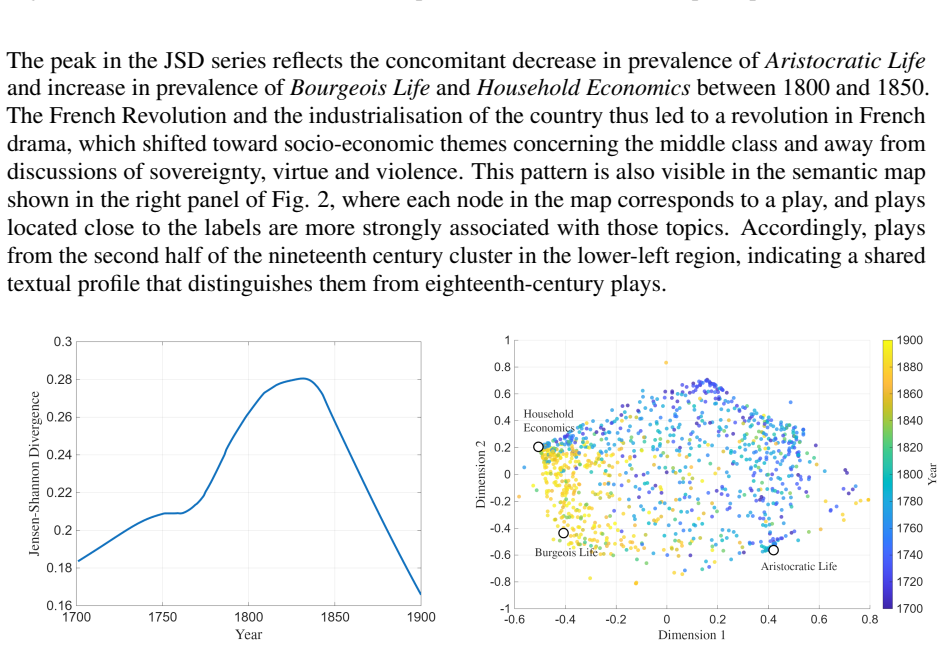
French drama shifted from sovereignty themes to bourgeois economics as capitalism developed.
A machine-rendered reading of the paper's core claim, the machinery that carries it, and where it could break.
Core claim
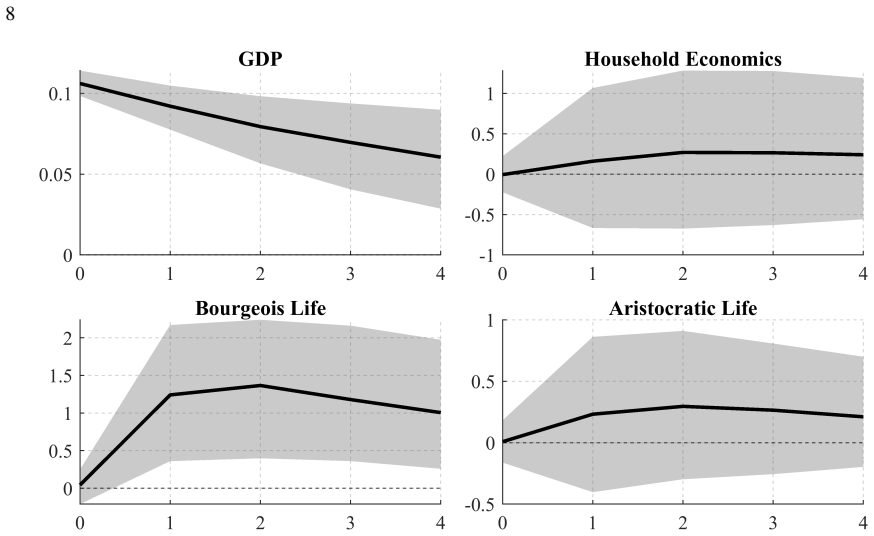
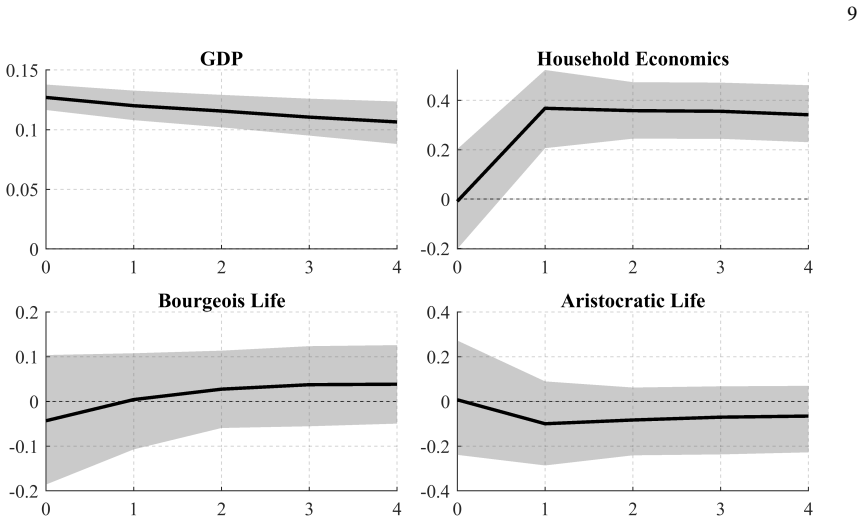
Applying latent Dirichlet allocation to a corpus of 1,215 French theatrical texts published between 1700 and 1900 shows that aristocratic discourse centred on sovereignty and political authority was gradually displaced by bourgeois and household economic themes as French capitalism developed. Bayesian vector autoregressive models with max-share shock identification suggest a temporal shift in the literary response to economic shocks: bourgeois everyday-life themes reacted to GDP shocks in the eighteenth century, whereas household-economic concerns became responsive only after 1820, amid accelerating industrialisation. A discrete-choice model shows that peer effects among authors and sensitiv
What carries the argument
Latent Dirichlet allocation topic proportions extracted from plays, fed into Bayesian vector autoregressive models for shock identification and a discrete-choice model of author peer effects and economic sensitivity.
If this is right
- Bourgeois everyday-life themes responded to GDP shocks in the eighteenth century while household-economic themes became responsive only after 1820.
- Peer effects among authors and direct sensitivity to economic conditions together generate the observed thematic trajectory.
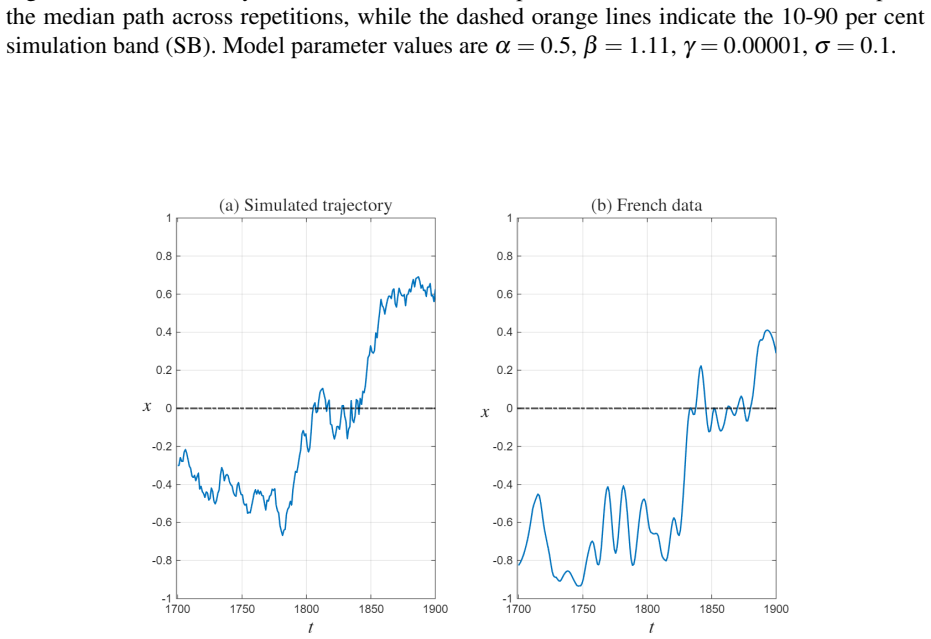
- Monte Carlo simulations of the discrete-choice model reproduce the historical displacement of aristocratic by bourgeois and household themes.
Where Pith is reading between the lines
- The same combination of topic extraction, shock identification, and peer-effect modelling could be applied to other national literatures to test whether comparable displacements accompanied industrialisation elsewhere.
- If peer effects are the dominant channel, the framework implies that concentrated economic changes could produce clustered shifts in cultural output beyond the French case.
- Extending the corpus past 1900 would allow a test of whether the post-1820 pattern stabilised, reversed, or gave way to new theme sensitivities in the twentieth century.
Load-bearing premise
The topics identified by latent Dirichlet allocation accurately and stably capture aristocratic sovereignty themes versus bourgeois and household economic themes without substantial distortion from author style, genre, or preprocessing choices.
What would settle it
Re-estimating the topic model on the same corpus with altered preprocessing or topic count that eliminates the long-run decline in sovereignty proportions, or finding no temporal break in GDP-shock responses around 1820 in the vector autoregressive models, would falsify the displacement claim.
Figures



read the original abstract
How do large-scale economic transformations shape cultural production? We address this question by combining computational linguistics, econometrics, and formal modelling, using French drama as a well-documented empirical laboratory. Applying latent Dirichlet allocation to a corpus of 1,215 theatrical texts published between 1700 and 1900, we show that aristocratic discourse centred on sovereignty and political authority was gradually displaced by bourgeois and household economic themes as French capitalism developed. Bayesian vector autoregressive models with max-share shock identification suggest a temporal shift in the literary response to economic shocks: bourgeois everyday-life themes reacted to GDP shocks in the eighteenth century, whereas household-economic concerns became responsive only after 1820, amid accelerating industrialisation. A discrete-choice model shows that peer effects among authors and sensitivity to prevailing economic conditions can jointly account for these dynamics. Monte Carlo simulations reproduce the observed historical trajectory with reasonable fidelity. These findings offer a quantitative framework for understanding how economic transformations propagate into cultural production through identifiable social mechanisms, contributing to the study of cultural evolution and the long-run relationship between institutions and literary discourse.
Editorial analysis
A structured set of objections, weighed in public.
Referee Report
Summary. The paper claims that LDA applied to 1,215 French drama texts (1700–1900) reveals a gradual displacement of aristocratic sovereignty/political-authority themes by bourgeois and household-economic themes coinciding with capitalist development. BVAR models with max-share identification indicate a temporal shift in literary responses to GDP shocks (bourgeois themes responsive in the 18th century, household themes only post-1820). A discrete-choice model incorporating author peer effects and economic-condition sensitivity is shown to jointly account for the observed dynamics, with Monte Carlo simulations reproducing the historical trajectory.
Significance. If the LDA topics cleanly isolate the claimed cultural themes and the discrete-choice calibration avoids circularity, the work would supply a rare quantitative, mechanism-based account of how macroeconomic change propagates into literary discourse. The multi-method integration (computational linguistics + BVAR + structural discrete choice + simulation) is a methodological strength that could inform cultural-evolution research; however, the absence of any reported validation or robustness metrics for the core LDA step substantially weakens the evidential foundation.
major comments (3)
- [Abstract] Abstract: the central interpretive claim—that aristocratic discourse was 'gradually displaced' by bourgeois/household themes—rests entirely on LDA topic proportions, yet no topic-coherence scores, stability checks across random seeds or K values, human inter-rater agreement, or sensitivity analyses to preprocessing are supplied. Because all subsequent BVAR and discrete-choice results are conditioned on these proportions, any genre- or style-driven contamination directly undermines the displacement narrative.
- [Abstract] Abstract: the discrete-choice model is described as calibrated such that Monte Carlo simulations 'reproduce the observed historical trajectory with reasonable fidelity.' This procedure matches the simulation output to the same aggregate pattern the model is intended to explain, creating a circularity that is not mitigated by any out-of-sample validation, hold-out periods, or alternative identification strategies.
- [Abstract] Abstract: the BVAR results on temporal shifts in shock responses are presented without reported impulse-response confidence bands, lag-order robustness, or alternative identification schemes (e.g., sign restrictions or external instruments), making it impossible to assess whether the claimed eighteenth- versus nineteenth-century difference is statistically distinguishable from sampling variation.
minor comments (2)
- [Abstract] The abstract refers to '1,215 theatrical texts' but supplies no breakdown by century, genre sub-type, or author coverage; a table or appendix listing corpus composition would improve transparency.
- [Abstract] The phrase 'reasonable fidelity' for the Monte Carlo exercise is undefined; quantitative metrics (e.g., mean squared error on topic shares or Kolmogorov-Smirnov statistics) should be reported.
Simulated Author's Rebuttal
We thank the referee for the constructive comments, which identify key areas where the empirical support for our claims can be strengthened. We address each major comment in turn and outline the revisions we will make.
read point-by-point responses
-
Referee: [Abstract] Abstract: the central interpretive claim—that aristocratic discourse was 'gradually displaced' by bourgeois/household themes—rests entirely on LDA topic proportions, yet no topic-coherence scores, stability checks across random seeds or K values, human inter-rater agreement, or sensitivity analyses to preprocessing are supplied. Because all subsequent BVAR and discrete-choice results are conditioned on these proportions, any genre- or style-driven contamination directly undermines the displacement narrative.
Authors: We agree that the absence of reported LDA validation metrics is a limitation. In the revised manuscript we will add topic coherence scores (CV and UMass), stability diagnostics across random seeds and alternative K values, and sensitivity checks to preprocessing decisions. We will also include a brief discussion of possible genre-driven contamination and its implications for the displacement interpretation. revision: yes
-
Referee: [Abstract] Abstract: the discrete-choice model is described as calibrated such that Monte Carlo simulations 'reproduce the observed historical trajectory with reasonable fidelity.' This procedure matches the simulation output to the same aggregate pattern the model is intended to explain, creating a circularity that is not mitigated by any out-of-sample validation, hold-out periods, or alternative identification strategies.
Authors: The model parameters are recovered from the estimated topic shares and observed economic covariates, with peer-effect strength chosen to match documented patterns of author interaction; the Monte Carlo exercise then serves as a consistency check rather than an independent test. We nevertheless recognize that the description in the abstract can give the impression of circularity. In revision we will expand the methods section to detail the exact identification of each parameter from the data, report sensitivity of the simulated trajectory to alternative parameter values, and add a hold-out exercise using pre-1750 data where feasible. revision: partial
-
Referee: [Abstract] Abstract: the BVAR results on temporal shifts in shock responses are presented without reported impulse-response confidence bands, lag-order robustness, or alternative identification schemes (e.g., sign restrictions or external instruments), making it impossible to assess whether the claimed eighteenth- versus nineteenth-century difference is statistically distinguishable from sampling variation.
Authors: We will augment the BVAR section with impulse-response functions and their confidence bands, report results for alternative lag orders, and implement at least one additional identification approach (sign restrictions) to evaluate whether the reported temporal change in responsiveness remains distinguishable from sampling variation. revision: yes
Circularity Check
Monte Carlo 'reproduction' of historical trajectory reduces to model calibration by construction
specific steps
-
fitted input called prediction
[Abstract]
"A discrete-choice model shows that peer effects among authors and sensitivity to prevailing economic conditions can jointly account for these dynamics. Monte Carlo simulations reproduce the observed historical trajectory with reasonable fidelity."
The discrete-choice model is calibrated to the observed trajectory (LDA topic proportions over time and BVAR responses); the Monte Carlo exercise then 'reproduces' that same trajectory. The reproduction is therefore forced by the fitting step rather than constituting an independent test of the mechanism.
full rationale
The paper's central mechanism claim rests on a discrete-choice model whose parameters are selected so its Monte Carlo output matches the same LDA-derived topic trajectory and BVAR shock responses it is invoked to explain. This is a direct instance of fitted input called prediction: the simulation fidelity is guaranteed once the model is calibrated to the target pattern. The LDA topic extraction and BVAR identification steps themselves show no such reduction and are treated as independent inputs. No self-citation load-bearing or self-definitional steps appear in the provided text.
Axiom & Free-Parameter Ledger
Reference graph
Works this paper leans on
-
[1]
American Economic Review , volume=
Business-cycle anatomy , author=. American Economic Review , volume=. 2020 , publisher=
2020
-
[2]
Journal of Machine Learning Research , volume=
Latent dirichlet allocation , author=. Journal of Machine Learning Research , volume=
-
[3]
Exchange rate disconnect revisited , author=
-
[4]
Fischer, Frank and Börner, Ingo and Göbel, Mathias and Hechtl, Angelika and Kittel, Christopher and Milling, Carsten and Trilcke, Peer , year =. Programmable. doi:10.5281/zenodo.4284002 , booktitle =
-
[5]
Distant Reading , author=
-
[6]
Some Problems and solutions
Topic modeling, long texts and the best number of topics. Some Problems and solutions. , author=. Quality & Quantity , volume=
-
[7]
Proceedings of the National Academy of Sciences , volume=
Finding scientific topics , author=. Proceedings of the National Academy of Sciences , volume=. 2004 , publisher=
2004
-
[8]
Human language technologies: The 2010 annual conference of the North American chapter of the association for computational linguistics , pages=
Automatic evaluation of topic coherence , author=. Human language technologies: The 2010 annual conference of the North American chapter of the association for computational linguistics , pages=
2010
-
[9]
Entropy , volume=
Selection of the optimal number of topics for LDA topic model—taking patent policy analysis as an example , author=. Entropy , volume=. 2021 , publisher=
2021
-
[10]
Proceedings of the Eighth ACM International Conference on Web Search and Data Mining , pages =
Exploring the Space of Topic Coherence Measures , author =. Proceedings of the Eighth ACM International Conference on Web Search and Data Mining , pages =. 2015 , publisher =
2015
-
[11]
1925 , publisher=
The Gift: Forms and Functions of Exchange in Archaic Societies , author=. 1925 , publisher=
1925
-
[12]
Cliometrica , volume=
Economic history goes digital: Topic modeling the Journal of Economic History , author=. Cliometrica , volume=. 2019 , publisher=
2019
-
[13]
Poetics , volume=
Exploiting affinities between topic modeling and the sociological perspective on culture: Application to newspaper coverage of US government arts funding , author=. Poetics , volume=. 2013 , publisher=
2013
-
[14]
Poetics , volume=
Introduction-Topic models: What they are and why they matter , author=. Poetics , volume=. 2013 , publisher=
2013
-
[15]
Communications of the ACM , volume=
Probabilistic topic models , author=. Communications of the ACM , volume=. 2012 , publisher=
2012
-
[16]
IEEE Transactions on Information Theory , volume=
Divergence measures based on the Shannon entropy , author=. IEEE Transactions on Information Theory , volume=. 1991 , publisher=
1991
-
[17]
Plos one , volume=
Pandemic news information uncertainty—News dynamics mirror differential response strategies to COVID-19 , author=. Plos one , volume=. 2023 , publisher=
2023
-
[18]
American Journal of Sociology , volume=
Economic action and social structure: The problem of embeddedness , author=. American Journal of Sociology , volume=. 1985 , publisher=
1985
-
[19]
2010 , OrigDate =
Age of revolution: 1789-1848 , author=. 2010 , OrigDate =
2010
-
[20]
2010 , OrigDate =
The Age of Capital: 1848-1875 , author=. 2010 , OrigDate =
2010
-
[21]
Digital Humanities Quarterly , volume=
Topic modeling genre: An exploration of French classical and enlightenment drama , author=. Digital Humanities Quarterly , volume=
-
[22]
Journal of Digital Humanities , volume=
Topic modeling and figurative language , author=. Journal of Digital Humanities , volume=
-
[23]
PloS one , volume=
Modeling narrative structure and dynamics with networks, sentiment analysis, and topic modeling , author=. PloS one , volume=. 2019 , publisher=
2019
-
[24]
Digital Studies in Language and Literature , volume=
Applying topic modeling to literary analysis: A review , author=. Digital Studies in Language and Literature , volume=. 2024 , publisher=
2024
-
[25]
nature , volume=
Learning the parts of objects by non-negative matrix factorization , author=. nature , volume=. 1999 , publisher=
1999
-
[26]
Advances in Neural Information Processing Systems , volume=
Algorithms for non-negative matrix factorization , author=. Advances in Neural Information Processing Systems , volume=
-
[27]
Histoire et sciences sociales: la longue dur
Braudel, Fernand , booktitle=. Histoire et sciences sociales: la longue dur. 1958 , organization=
1958
-
[28]
Economia , volume=
The nature and significance of Lionel Robbins’ methodological individualism , author=. Economia , volume=. 2018 , publisher=
2018
-
[29]
The British Journal of Sociology , volume=
Methodological individualism , author=. The British Journal of Sociology , volume=. 1960 , publisher=
1960
-
[30]
The British Journal of Sociology , volume=
Institutional individualism , author=. The British Journal of Sociology , volume=. 1975 , publisher=
1975
-
[31]
The British Journal of Sociology , volume=
Societal Facts , author=. The British Journal of Sociology , volume=. 1955 , publisher=
1955
-
[32]
2013 , publisher=
Macroanalysis: Digital Methods and Literary History , author=. 2013 , publisher=
2013
-
[33]
Faces, Fights, and Families: Topic Modeling and Gendered Themes in Two Corpora of Swedish Prose Fiction , booktitle =
Dahll. Faces, Fights, and Families: Topic Modeling and Gendered Themes in Two Corpora of Swedish Prose Fiction , booktitle =. 2019 , address =
2019
-
[34]
2024 , eprint=
Historia Magistra Vitae: Dynamic Topic Modeling of Roman Literature using Neural Embeddings , author=. 2024 , eprint=
2024
-
[35]
Proceedings of the 2024 Joint International Conference on Computational Linguistics, Language Resources and Evaluation (LREC-COLING 2024) , pages=
Exploring Neural Topic Modeling on a Classical Latin Corpus , author=. Proceedings of the 2024 Joint International Conference on Computational Linguistics, Language Resources and Evaluation (LREC-COLING 2024) , pages=
2024
-
[36]
Handbook of Latent Semantic Analysis , pages=
Probabilistic topic models , author=. Handbook of Latent Semantic Analysis , pages=. 2007 , publisher=
2007
-
[37]
Journal of Economic Surveys , year =
Reiner Franke and Frank Westerhoff , title =. Journal of Economic Surveys , year =. doi:10.1111/joes.12219 , publisher =
-
[38]
Quarterly Journal of Economics , year =
Alan Kirman , title =. Quarterly Journal of Economics , year =. doi:10.2307/2118498 , publisher =
-
[39]
William A. Brock and Steven N. Durlauf , title =. Review of Economic Studies , year =. doi:10.1111/1467-937X.00168 , publisher =
-
[40]
Journal of Economic Literature , year =
Cars Hommes , title =. Journal of Economic Literature , year =. doi:10.1257/jel.20191434 , publisher =
-
[41]
William A. Brock and Cars H. Hommes , title =. Econometrica , year =. doi:10.2307/2171879 , publisher =
-
[42]
Heterogeneous Agent Models in Finance , booktitle =
Roberto Dieci and Xue. Heterogeneous Agent Models in Finance , booktitle =. 2018 , pages =
2018
-
[43]
Journal of Economic Dynamics and Control , year =
Roberto Dieci and Noemi Schmitt and Frank Westerhoff , title =. Journal of Economic Dynamics and Control , year =. doi:10.1016/j.jedc.2018.05.001 , publisher =
-
[44]
European Economic Review , year =
Paul De Grauwe and Marianna Grimaldi , title =. European Economic Review , year =. doi:10.1016/j.euroecorev.2004.07.005 , publisher =
-
[45]
Christian R. Proaño , title =. Journal of Economic Behavior & Organization , year =. doi:10.1016/j.jebo.2010.10.005 , publisher =
-
[46]
Journal of Economic Dynamics and Control , year =
Laura Gardini and Davide Radi and Noemi Schmitt and Iryna Sushko and Frank Westerhoff , title =. Journal of Economic Dynamics and Control , year =. doi:10.1016/j.jedc.2022.104545 , publisher =
-
[47]
2019 , address =
Paul De Grauwe and Yuemei Ji , title =. 2019 , address =
2019
-
[48]
Journal of Economic Behavior & Organization , year =
Paul De Grauwe and Pasquale Foresti , title =. Journal of Economic Behavior & Organization , year =. doi:10.1016/j.jebo.2023.05.024 , publisher =
-
[49]
Journal of Economic Theory , year =
Alberto Bisin and Thierry Verdier , title =. Journal of Economic Theory , year =. doi:10.1006/jeth.2000.2678 , publisher =
-
[50]
Handbook of Social Economics , editor =
Alberto Bisin and Thierry Verdier , title =. Handbook of Social Economics , editor =. 2011 , pages =
2011
-
[51]
A Microeconometric Study of Theatre Demand , journal =
Louis L\'. A Microeconometric Study of Theatre Demand , journal =. 1996 , volume =. doi:10.1007/BF00148269 , publisher =
-
[52]
Willis , title =
Kenneth G. Willis , title =. Handbook of the Economics of Art and Culture, Volume 2 , editor =. 2014 , pages =
2014
-
[53]
David Throsby and Anita Zednik and Jorge E. Ara. Public preferences for heritage conservation strategies: a choice modelling approach , journal =. 2021 , volume =. doi:10.1007/s10824-021-09406-7 , publisher =
-
[54]
Severn and Katya Petetskaya , title =
David Throsby and John R. Severn and Katya Petetskaya , title =. Journal of Cultural Economics , year =. doi:10.1007/s10824-023-09487-6 , publisher =
-
[55]
Journal of Economic Behavior & Organization , year =
Paolo Zeppini , title =. Journal of Economic Behavior & Organization , year =. doi:10.1016/j.jebo.2015.01.006 , publisher =
-
[56]
Marwil J. D. Low-carbon transition policies, skill-driven inequality, and endogenous political cleavages , journal =. 2026 , volume =. doi:10.1016/j.eneco.2026.109227 , publisher =
-
[57]
Proceedings of the National Academy of Sciences of the United States of America , year =
Naomi Ehrich Leonard and Keena Lipsitz and Anastasia Bizyaeva and Alessio Franci and Yphtach Lelkes , title =. Proceedings of the National Academy of Sciences of the United States of America , year =. doi:10.1073/pnas.2102149118 , url =
-
[58]
Econometric Society 2004 North American Winter Meetings , number=
What moves GNP? , author=. Econometric Society 2004 North American Winter Meetings , number=. 2004 , organization=
2004
-
[59]
Journal of Monetary Economics , volume=
News shocks and business cycles , author=. Journal of Monetary Economics , volume=. 2011 , publisher=
2011
-
[60]
Science , volume=
Quantitative Analysis of Culture Using Millions of Digitized Books , author=. Science , volume=. 2011 , publisher=
2011
discussion (0)
Sign in with ORCID, Apple, or X to comment. Anyone can read and Pith papers without signing in.