Fine-Tuning a Universal Machine-Learned Interatomic Potential for Oxygen Plasma Interactions with WS₂
Pith reviewed 2026-06-26 13:22 UTC · model grok-4.3
The pith
A pretrained universal ML interatomic potential already reproduces chemisorbed S and O coverages for oxygen plasma on WS2.
A machine-rendered reading of the paper's core claim, the machinery that carries it, and where it could break.
Core claim
Even in the absence of fine-tuning, the pretrained uma-s-1p1 model reproduces the production-scale observables of interest, namely, chemisorbed S and O coverage under 15 eV O+ and O2+ bombardment.
What carries the argument
The pretrained Universal Models for Atoms (UMA) model, used with an iterative fine-tuning loop that employs SOAP descriptors and farthest-point sampling to select diverse configurations for DFT labeling.
If this is right
- MD simulations of plasma modification of WS2 can begin with the base model without waiting for custom potential development.
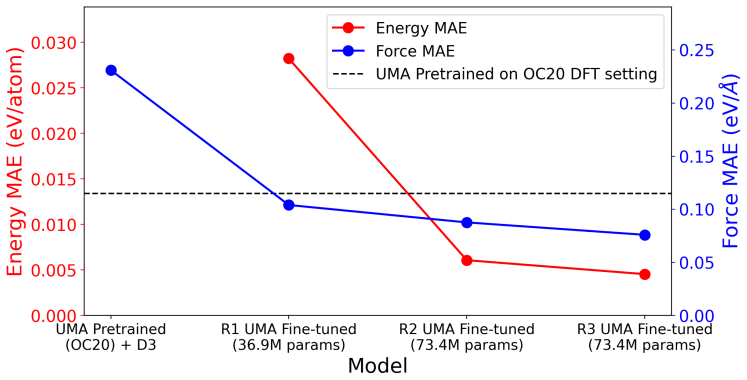
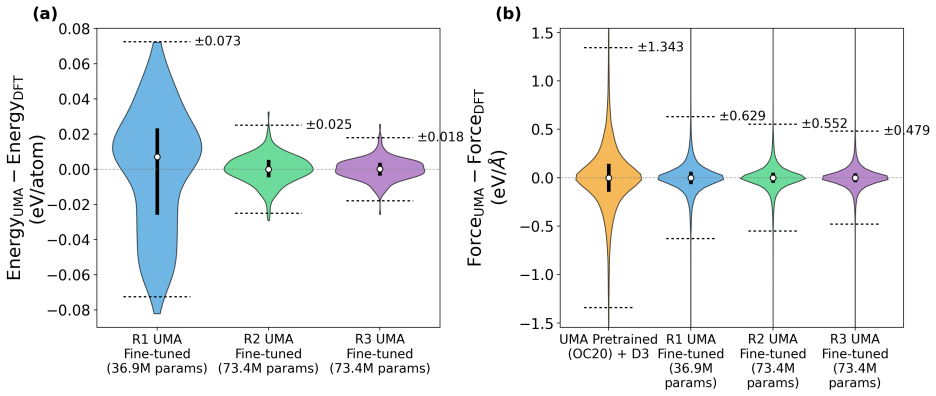
- Fine-tuning on a few hundred DFT-labeled configurations is sufficient to reach sub-0.1 eV/Å force accuracy for this system.
- Similar pretrained models may be applied to other 2D materials and plasma chemistries before system-specific retraining.
Where Pith is reading between the lines
- The transferability seen here suggests that OC20-scale training already encodes enough local chemistry for low-energy ion bombardment on transition-metal dichalcogenides.
- The same sampling-plus-fine-tuning workflow could be reused for other plasma species or for multilayer stacks with different terminations.
- If the coverages match experiment, the approach offers a practical route to replace empirical potentials in plasma-etch modeling.
Load-bearing premise
The pretrained model trained on OC20 generalizes sufficiently to oxygen-plasma chemistry on WS2 and the chosen DFT level supplies reliable reference labels.
What would settle it
Direct experimental measurement of chemisorbed S and O coverages under 15 eV O+ bombardment on WS2 that differs from the coverages obtained in the MD trajectories.
Figures




read the original abstract
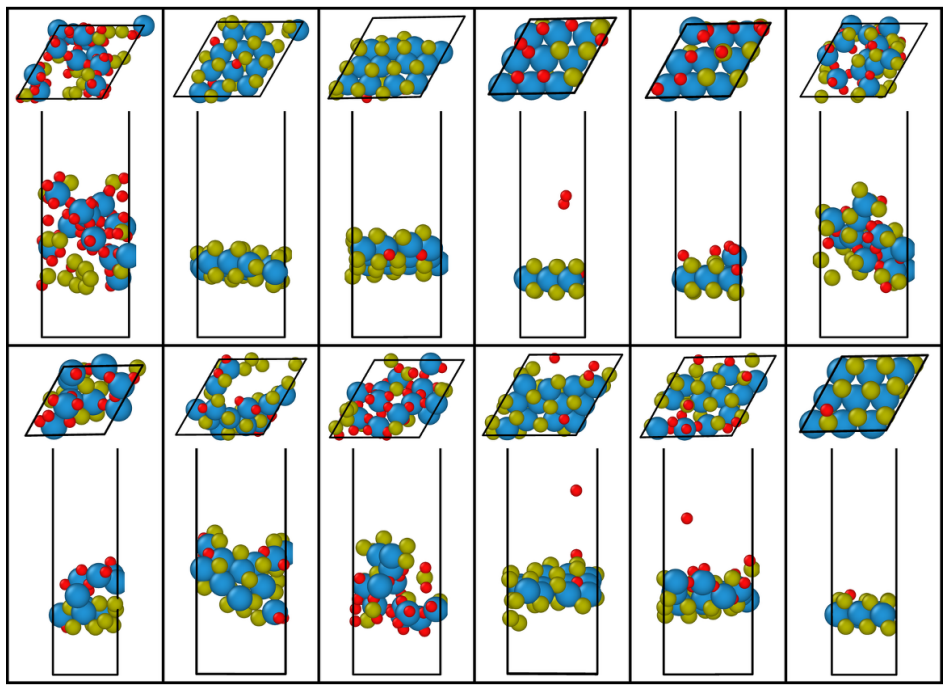
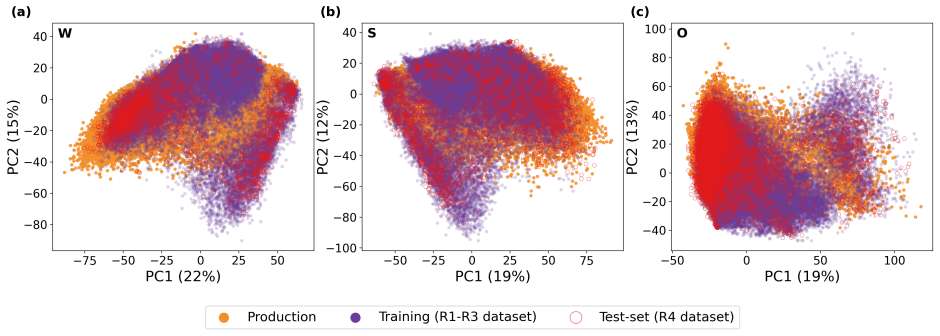
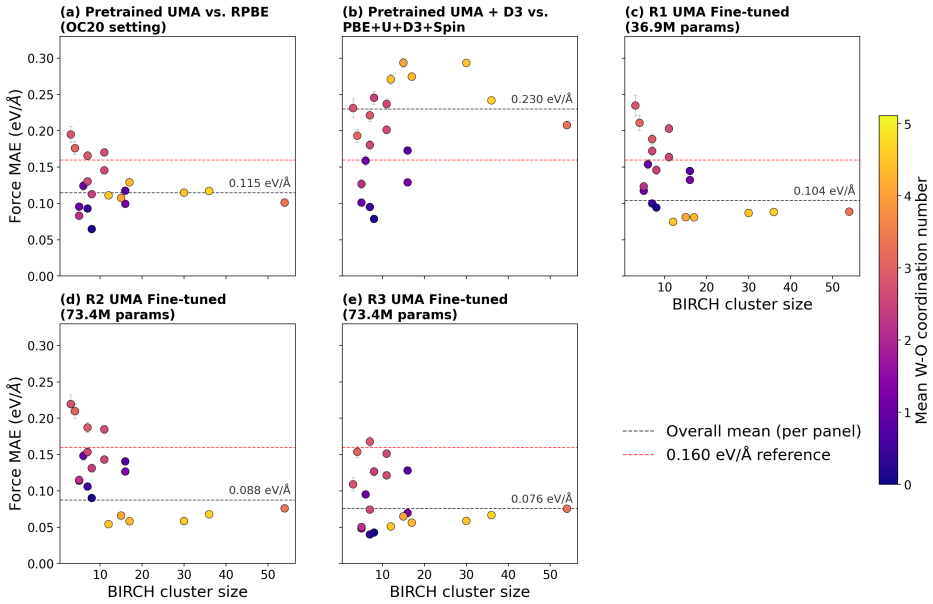
Molecular dynamics simulation of plasma-surface interactions requires an interatomic potential that is simultaneously accurate, computationally efficient, and able to describe many elements and bonding types in reactive systems. In principle, a foundation model for machine-learned interatomic potential (MLIP) can meet these demands. We explore the use of the Universal Models for Atoms (UMA) model, developed by Meta FAIR, for the interactions of oxygen plasma species on a multilayer of WS$_2$, a promising 2D material. Starting from the pretrained uma-s-1p1 model under the Open Catalyst 2020 (OC20) task, we apply an iterative fine-tuning loop with maximally diverse configuration sampling using Smooth Overlap of Atomic Positions (SOAP) and Farthest Point Sampling (FPS); DFT labeling at the PBE+D3+$U$+spin level; and fine-tuning on energy, force, and stress labels. Even in the absence of fine-tuning, the pretrained model reproduces the production-scale observables of interest, namely, chemisorbed S and O coverage under 15eV O$^+$ and O$_2^+$ bombardment. These results were obtained without spin polarization and Hubbard $U$ correction. Nonetheless, fine-tuning reduces the energy and force mean absolute error (MAE) to $4.5\times10^{-3}$eV/atom and $0.076$eV/angstrom, respectively.
Editorial analysis
A structured set of objections, weighed in public.
Referee Report
Summary. The manuscript explores fine-tuning the pretrained UMA (uma-s-1p1) machine-learned interatomic potential, originally trained on the OC20 catalysis dataset, for molecular dynamics simulations of 15 eV O+ and O2+ plasma interactions with multilayer WS2. It reports that the pretrained model already reproduces the key production-scale observables of chemisorbed S and O coverage under bombardment (obtained without spin polarization or Hubbard U), while an iterative fine-tuning procedure using SOAP/FPS sampling and PBE+D3+U+spin DFT labels reduces energy and force MAEs to 4.5×10^{-3} eV/atom and 0.076 eV/Å.
Significance. If the central claims hold, the work demonstrates transferability of a foundation MLIP from OC20 to hyperthermal plasma-surface chemistry on a transition-metal dichalcogenide, offering a route to efficient, multi-element reactive MD without building system-specific potentials from scratch. The iterative diverse-sampling fine-tuning loop is a methodological strength that could be adopted more broadly.
major comments (3)
- [Abstract] Abstract: The claim that the pretrained uma-s-1p1 model 'reproduces the production-scale observables of interest, namely, chemisorbed S and O coverage' under 15 eV bombardment is load-bearing for the paper's central thesis that fine-tuning is unnecessary for these quantities, yet no error bars, number of independent trajectories, coverage calculation protocol, or comparison to experiment/AIMD/higher-level theory are supplied.
- [Abstract] Abstract: Coverage results are stated to have been obtained 'without spin polarization and Hubbard U correction,' while fine-tuning labels use PBE+D3+U+spin; because coverage is an energy-dependent observable, any systematic shift between the two DFT settings could render the 'reproduction' claim dependent on the very reference data the fine-tuning later incorporates.
- [Abstract] Abstract: The reported MAE reductions after fine-tuning are given without baselines (pretrained-model errors on the same test set, comparison to other MLIPs or empirical potentials, or cross-validation statistics), preventing assessment of whether the improvement is meaningful or merely expected from additional training data.
Simulated Author's Rebuttal
We thank the referee for the careful and constructive review. We address each major comment point by point below, indicating revisions where the manuscript will be updated.
read point-by-point responses
-
Referee: [Abstract] Abstract: The claim that the pretrained uma-s-1p1 model 'reproduces the production-scale observables of interest, namely, chemisorbed S and O coverage' under 15 eV bombardment is load-bearing for the paper's central thesis that fine-tuning is unnecessary for these quantities, yet no error bars, number of independent trajectories, coverage calculation protocol, or comparison to experiment/AIMD/higher-level theory are supplied.
Authors: The abstract is concise by design, but the full manuscript details the MD protocol with multiple independent trajectories and shows coverage results with statistical variation in the figures. The coverage is calculated by identifying atoms satisfying a coordination-based chemisorption criterion after surface equilibration. We will revise the abstract to briefly note the use of multiple trajectories and error estimation from the runs. Direct comparisons to experiment or AIMD are not supplied because suitable reference data at this scale and energy do not exist. revision: partial
-
Referee: [Abstract] Abstract: Coverage results are stated to have been obtained 'without spin polarization and Hubbard U correction,' while fine-tuning labels use PBE+D3+U+spin; because coverage is an energy-dependent observable, any systematic shift between the two DFT settings could render the 'reproduction' claim dependent on the very reference data the fine-tuning later incorporates.
Authors: We acknowledge the potential for a systematic difference arising from the DFT settings. The coverage results use the pretrained model under its native (no spin, no U) settings to reflect efficient production conditions, while fine-tuning data incorporate the higher-level corrections. We will add a clarifying paragraph in the methods and discussion sections noting this distinction and stating that the reproduction is demonstrated under consistent settings for the observable of interest. revision: yes
-
Referee: [Abstract] Abstract: The reported MAE reductions after fine-tuning are given without baselines (pretrained-model errors on the same test set, comparison to other MLIPs or empirical potentials, or cross-validation statistics), preventing assessment of whether the improvement is meaningful or merely expected from additional training data.
Authors: The reported MAEs are evaluated on a held-out test set from the fine-tuning configurations. We agree that the pretrained baseline on the identical test set would provide useful context. We will add this comparison (pretrained vs. fine-tuned errors on the same test set) to the results section in a revised manuscript. revision: yes
- Direct comparisons to experimental data or higher-level AIMD/higher-theory calculations for chemisorbed S and O coverage under 15 eV O+ and O2+ bombardment are not available and were not performed, as they are either nonexistent in the literature or computationally prohibitive at the required scale.
Circularity Check
No significant circularity; external pretraining and new DFT labels keep derivation independent
full rationale
The paper begins from the externally pretrained uma-s-1p1 checkpoint on the independent OC20 dataset (Meta FAIR), then applies iterative fine-tuning on newly generated DFT labels at the PBE+D3+U+spin level. The central claim that the pretrained model already reproduces chemisorbed coverages under 15 eV bombardment is an empirical MD result, not a quantity fitted or defined from the fine-tuning data itself. No self-citation chains, self-definitional loops, or fitted-input-renamed-as-prediction steps appear in the derivation. The workflow is self-contained against external benchmarks.
Axiom & Free-Parameter Ledger
axioms (1)
- domain assumption PBE+D3+U+spin DFT calculations provide sufficiently accurate reference energies, forces, and stresses for the O-WS2 system.
Reference graph
Works this paper leans on
-
[1]
B.; Brault, P
Graves, D. B.; Brault, P. Molecular dynamics for low temperature plasma–surface interaction studies.Journal of Physics D: Applied Physics2009,42, 194011, DOI: 10 . 1088 / 0022 - 3727/42/19/194011
-
[2]
S.; Brandstadter, S
Oehrlein, G. S.; Brandstadter, S. M.; Bruce, R. L.; Chang, J. P.; DeMott, J. C.; Donnelly, V. M.; Dussart, R.; Fischer, A.; Gottscho, R. A.; Hamaguchi, S., et al. Future of plasma etching for microelectronics: Challenges and opportunities.Journal of Vacuum Science & Technology B2024,42
-
[3]
InPlasma Science for Microelectronics Nanofabrication, Department of Energy Office of Science, Fusion Energy Sciences Workshop, 2023
Graves, D.; Labelle, C.; Kushner, M. InPlasma Science for Microelectronics Nanofabrication, Department of Energy Office of Science, Fusion Energy Sciences Workshop, 2023
2023
-
[4]
C.; Brault, P
Neyts, E. C.; Brault, P. Molecular dynamics simulations for plasma-surface interactions. Plasma Processes and Polymers2017,14, 1600145
-
[5]
Roh, K.-B.; Lee, M.-G.; Han, H. N.; Kim, H. C.; Kim, G.-H. Sputtering yield increase with fluence in low-energy argon plasma-tungsten interaction.Fusion Engineering and Design2024, 206, 114607, DOI:10.1016/j.fusengdes.2024.114607
-
[6]
Kounis-Melas, A.; Vella, J. R.; Panagiotopoulos, A. Z.; Graves, D. B. Deep potential molecular dynamics simulations of low-temperature plasma-surface interactions.Journal of Vacuum Science & Technology A2025,43, 012603, DOI:10.1116/6.0004027
-
[7]
B.; Stevens, A
Humbird, D.; Graves, D. B.; Stevens, A. A. E.; Kessels, W. M. M. Molecular dynamics simulations of Ar+ bombardment of Si with comparison to experiment.Journal of Vacuum Science & Technology A: Vacuum, Surfaces, and Films2007,25, 1529–1533, DOI:10.1116/ 1.2787713. 15
-
[8]
Kubota, N. A.; Economou, D. J.; Plimpton, S. J. Molecular dynamics simulations of low-energy (25–200 eV) argon ion interactions with silicon surfaces: Sputter yields and product formation pathways.Journal of Applied Physics1998,83, 4055–4063, DOI:10.1063/1.367225
-
[9]
Vella, J. R.; Graves, D. B. Near-surface damage and mixing in Si-Cl2-Ar atomic layer etching processes: Insights from molecular dynamics simulations.Journal of Vacuum Science & Technology A2023,41, 042601, DOI:10.1116/6.0002719
-
[10]
Multiscale modeling of plasma–surface interaction—General picture and a case study of Si and SiO2 etching by fluorocarbon-based plasmas.Applied Physics Reviews2021,8
Vanraes, P.; Parayil Venugopalan, S.; Bogaerts, A. Multiscale modeling of plasma–surface interaction—General picture and a case study of Si and SiO2 etching by fluorocarbon-based plasmas.Applied Physics Reviews2021,8
-
[11]
W.; Ong, S
Ko, T. W.; Ong, S. P. Recent advances and outstanding challenges for machine learning interatomic potentials.Nature Computational Science2023,3, 998–1000, DOI: 10.1038/ s43588-023-00561-9
-
[12]
Y.; Yang, J
Jacobs, R.; Morgan, D.; Attarian, S.; Meng, J.; Shen, C.; Wu, Z.; Xie, C. Y.; Yang, J. H.; Artrith, N.; Blaiszik, B., et al. A practical guide to machine learning interatomic potentials–Status and future.Current Opinion in Solid State and Materials Science2025,35, 101214
-
[13]
Wang, S.; Liu, X.; Xu, M.; Liu, L.; Yang, D.; Zhou, P. Two-dimensional devices and integration towards the silicon lines.Nature Materials2022,21, 1225–1239, DOI:10.1038/s41563-022- 01383-2
-
[14]
The future transistors.Nature2023,620, 501–515, DOI:10.1038/s41586-023-06145-x
Cao, W.; Bu, H.; Vinet, M.; Cao, M.; Takagi, S.; Hwang, S.; Ghani, T.; Banerjee, K. The future transistors.Nature2023,620, 501–515, DOI:10.1038/s41586-023-06145-x
-
[15]
S.; Kwon, J.; Ryu, H.; Kim, C.; Kim, H.; Lee, E.-K.; Lee, D.; Seo, S.; Han, N
Kim, K. S.; Kwon, J.; Ryu, H.; Kim, C.; Kim, H.; Lee, E.-K.; Lee, D.; Seo, S.; Han, N. M.; Suh, J. M.; Kim, J.; Song, M.-K.; Lee, S.; Seol, M.; Kim, J. The future of two-dimensional semiconductors beyond Moore’s law.Nature Nanotechnology2024,19, 895–906, DOI:10. 1038/s41565-024-01695-1
-
[16]
Wilson, J.; Yoffe, A. The transition metal dichalcogenides discussion and interpretation of the observed optical, electrical and structural properties.Advances in Physics1969,18, 193–335, DOI:10.1080/00018736900101307
-
[17]
Jain, A.; Ong, S. P.; Hautier, G.; Chen, W.; Richards, W. D.; Dacek, S.; Cholia, S.; Gunter, D.; Skinner, D.; Ceder, G.; Persson, K. A. Commentary: The Materials Project: A materials genome approach to accelerating materials innovation.APL Materials2013,1, 011002, DOI: 10.1063/1.4812323
-
[18]
Horton, M. K.; Huck, P.; Yang, R. X.; Munro, J. M.; Dwaraknath, S.; Ganose, A. M.; Kingsbury, R. S.; Wen, M.; Shen, J. X.; Mathis, T. S.; Kaplan, A. D.; Berket, K.; Riebesell, J.; George, J.; Rosen, A. S.; Spotte-Smith, E. W. C.; McDermott, M. J.; Cohen, O. A.; Dunn, A.; Kuner, M. C.; Rignanese, G.-M.; Petretto, G.; Waroquiers, D.; Griffin, S. M.; Neaton,...
-
[19]
Sun, W.; Dacek, S. T.; Ong, S. P.; Hautier, G.; Jain, A.; Richards, W. D.; Gamst, A. C.; Persson, K. A.; Ceder, G. The thermodynamic scale of inorganic crystalline metastability. Science Advances2016,2, e1600225, DOI:10.1126/sciadv.1600225
-
[20]
Influence of quantum confinement on the electronic structure of the transition metal sulfide T S 2.Physical Review B2011,83, 245213, DOI:10.1103/ PhysRevB.83.245213
Kuc, A.; Zibouche, N.; Heine, T. Influence of quantum confinement on the electronic structure of the transition metal sulfide T S 2.Physical Review B2011,83, 245213, DOI:10.1103/ PhysRevB.83.245213. 16
-
[21]
Bui, V. Q.; Pham, T.-T.; Le, D. A.; Thi, C. M.; Le, H. M. A first-principles investigation of various gas (CO, H2 O, NO, and O2 ) absorptions on a WS2 monolayer: stability and electronic properties.Journal of Physics: Condensed Matter2015,27, 305005, DOI: 10.1088/0953- 8984/27/30/305005
-
[22]
Kanarik, K. J.; Lill, T.; Hudson, E. A.; Sriraman, S.; Tan, S.; Marks, J.; Vahedi, V.; Gottscho, R. A. Overview of atomic layer etching in the semiconductor industry.Journal of Vacuum Science & Technology A: Vacuum, Surfaces, and Films2015,33, 020802, DOI:10.1116/1. 4913379
-
[23]
J.; Tan, S.; Yang, W.; Kim, T.; Lill, T.; Kabansky, A.; Hudson, E
Kanarik, K. J.; Tan, S.; Yang, W.; Kim, T.; Lill, T.; Kabansky, A.; Hudson, E. A.; Ohba, T.; Nojiri, K.; Yu, J.; Wise, R.; Berry, I. L.; Pan, Y.; Marks, J.; Gottscho, R. A. Predicting synergy in atomic layer etching.Journal of Vacuum Science & Technology A: Vacuum, Surfaces, and Films2017,35, 05C302, DOI:10.1116/1.4979019
-
[24]
T. Carver, C.; J. Plombon, J.; E. Romero, P.; Suri, S.; A. Tronic, T.; B. Turkot, R. Atomic Layer Etching: An Industry Perspective.ECS Journal of Solid State Science and Technology 2015,4, N5005–N5009, DOI:10.1149/2.0021506jss
-
[25]
Physical Review Letters , volume =
Zhang, L.; Han, J.; Wang, H.; Car, R.; E, W. Deep Potential Molecular Dynamics: A Scalable Model with the Accuracy of Quantum Mechanics.Physical Review Letters2018,120, 143001, DOI:10.1103/PhysRevLett.120.143001
-
[26]
Generalized Neural-Network Representation of High-Dimensional Potential-Energy Surfaces.Physical Review Letters2007,98, 146401, DOI: 10
Behler, J.; Parrinello, M. Generalized Neural-Network Representation of High-Dimensional Potential-Energy Surfaces.Physical Review Letters2007,98, 146401, DOI: 10 . 1103 / PhysRevLett.98.146401
-
[27]
Bartók, A. P.; Payne, M. C.; Kondor, R.; Csányi, G. Gaussian Approximation Potentials: The Accuracy of Quantum Mechanics, without the Electrons.Physical Review Letters2010,104, 136403, DOI:10.1103/PhysRevLett.104.136403
-
[28]
P.; Kornbluth, M.; Molinari, N.; Smidt, T
Batzner, S.; Musaelian, A.; Sun, L.; Geiger, M.; Mailoa, J. P.; Kornbluth, M.; Molinari, N.; Smidt, T. E.; Kozinsky, B. E(3)-equivariant graph neural networks for data-efficient and accurate interatomic potentials.Nature Communications2022,13, 2453, DOI: 10.1038/ s41467-022-29939-5
-
[29]
P.; Simm, G
Batatia, I.; Kovács, D. P.; Simm, G. N. C.; Ortner, C.; Csányi, G. MACE: Higher Order Equivariant Message Passing Neural Networks for Fast and Accurate Force Fields
-
[30]
Hong, C.; Oh, S.; An, H.; Kim, P.-h.; Kim, Y.; Ko, J.-h.; Sue, J.; Oh, D.; Park, S.; Han, S. Atomistic Simulation of HF Etching Process of Amorphous Si3 N4 Using Machine Learning Potential.ACS Applied Materials & Interfaces2024,16, 48457–48469, DOI:10.1021/acsami. 4c07949
-
[31]
Deng, B.; Zhong, P.; Jun, K.; Riebesell, J.; Han, K.; Bartel, C. J.; Ceder, G. CHGNet as a pretrained universal neural network potential for charge-informed atomistic modelling.Nature Machine Intelligence2023,5, 1031–1041, DOI:10.1038/s42256-023-00716-3
-
[32]
MatterSim: A Deep Learning Atomistic Model Across Elements, Temperatures and Pressures
Yang, H.; Hu, C.; Zhou, Y.; Liu, X.; Shi, Y.; Li, J.; Li, G.; Chen, Z.; Chen, S.; Zeni, C.; Horton, M.; Pinsler, R.; Fowler, A.; Zügner, D.; Xie, T.; Smith, J.; Sun, L.; Wang, Q.; Kong, L.; Liu, C.; Hao, H.; Lu, Z. MatterSim: A Deep Learning Atomistic Model Across Elements, Temperatures and Pressures, en, arXiv:2405.04967 [cond-mat], 2024, DOI:10.48550/ar...
work page internal anchor Pith review Pith/arXiv arXiv doi:10.48550/arxiv.2405.04967 2024
-
[33]
Wood, B. M.; Dzamba, M.; Fu, X.; Gao, M.; Shuaibi, M.; Barroso-Luque, L.; Abdelmaqsoud, K.; Gharakhanyan, V.; Kitchin, J. R.; Levine, D. S.; Michel, K.; Sriram, A.; Cohen, T.; Das, A.; Rizvi, A.; Sahoo, S. J.; Ulissi, Z. W.; Zitnick, C. L. UMA: A Family of Universal Models for Atoms, en, arXiv:2506.23971 [cs], 2026, DOI:10.48550/arXiv.2506.23971
-
[34]
Oh, S.; You, J.; Kim, J.; Lee, J.; An, H.; Han, S.; Kang, Y. A Lightweight Universal Machine- Learning Interatomic Potential via Knowledge Distillation for Scalable Atomistic Simulations, en, arXiv:2604.10887 [cond-mat], 2026, DOI:10.48550/arXiv.2604.10887
work page internal anchor Pith review Pith/arXiv arXiv doi:10.48550/arxiv.2604.10887 2026
-
[35]
Chanussot, L.; Das, A.; Goyal, S.; Lavril, T.; Shuaibi, M.; Riviere, M.; Tran, K.; Heras-Domingo, J.; Ho, C.; Hu, W.; Palizhati, A.; Sriram, A.; Wood, B.; Yoon, J.; Parikh, D.; Zitnick, C. L.; Ulissi, Z. The Open Catalyst 2020 (OC20) Dataset and Community Challenges.ACS Catalysis 2021,11, arXiv:2010.09990 [cond-mat], 6059–6072, DOI:10.1021/acscatal.0c04525
-
[36]
Open Materials 2024 (OMat24) Inorganic Materials Dataset and Models
Barroso-Luque, L.; Shuaibi, M.; Fu, X.; Wood, B. M.; Dzamba, M.; Gao, M.; Rizvi, A.; Zitnick, C. L.; Ulissi, Z. W. Open Materials 2024 (OMat24) Inorganic Materials Dataset and Models, en, arXiv:2410.12771 [cond-mat], 2024, DOI:10.48550/arXiv.2410.12771
work page internal anchor Pith review Pith/arXiv arXiv doi:10.48550/arxiv.2410.12771 2024
-
[37]
Dissociation of O 2 at Al (111): The role of spin selection rules.Physical review letters2005,94, 036104
Behler, J.; Delley, B.; Lorenz, S.; Reuter, K.; Scheffler, M. Dissociation of O 2 at Al (111): The role of spin selection rules.Physical review letters2005,94, 036104
-
[38]
Nonadiabatic effects in the dissociation of oxygen molecules at the Al (111) surface.Physical Review B—Condensed Matter and Materials Physics2008, 77, 115421
Behler, J.; Reuter, K.; Scheffler, M. Nonadiabatic effects in the dissociation of oxygen molecules at the Al (111) surface.Physical Review B—Condensed Matter and Materials Physics2008, 77, 115421
-
[39]
Electronic and structural properties of WO3: a systematic hybrid DFT study.The Journal of Physical Chemistry C2011,115, 8345–8353
Wang, F.; Di Valentin, C.; Pacchioni, G. Electronic and structural properties of WO3: a systematic hybrid DFT study.The Journal of Physical Chemistry C2011,115, 8345–8353
-
[40]
Bondarenko, N.; Eriksson, O.; Skorodumova, N. V. Polaron mobility in oxygen-deficient and lithium-doped tungsten trioxide.Physical Review B2015,92, 165119
-
[41]
E.; Pacchioni, G
Gerosa, M.; Di Valentin, C.; Onida, G.; Bottani, C. E.; Pacchioni, G. Anisotropic effects of oxygen vacancies on electrochromic properties and conductivity ofγ-monoclinic WO3.The Journal of Physical Chemistry C2016,120, 11716–11726
-
[42]
Liu, X.; Zeng, K.; Luo, Z.; Wang, Y.; Zhao, T.; Xu, Z. Fine-Tuning Universal Machine-Learned Interatomic Potentials: A Tutorial on Methods and Applications, en, arXiv:2506.21935 [physics], 2025, DOI:10.48550/arXiv.2506.21935
-
[43]
Hsu, C.-C.; Nierode, M. A.; Coburn, J. W.; Graves, D. B. Comparison of model and experiment for Ar, Ar/O2 and Ar/O2 /Cl2 inductively coupled plasmas.Journal of Physics D: Applied Physics2006,39, 3272–3284, DOI:10.1088/0022-3727/39/15/009
-
[44]
E.; Christensen, R.; Dułak, M.; Friis, J.; Groves, M
Hjorth Larsen, A.; Jørgen Mortensen, J.; Blomqvist, J.; Castelli, I. E.; Christensen, R.; Dułak, M.; Friis, J.; Groves, M. N.; Hammer, B.; Hargus, C., et al. The atomic simulation environment—a Python library for working with atoms.Journal of Physics: Condensed Matter 2017,29, 273002
2017
-
[45]
A consistent and accurate ab initio parametriza- tion of density functional dispersion correction (DFT-D) for the 94 elements H-Pu.The Journal of chemical physics2010,132
Grimme, S.; Antony, J.; Ehrlich, S.; Krieg, H. A consistent and accurate ab initio parametriza- tion of density functional dispersion correction (DFT-D) for the 94 elements H-Pu.The Journal of chemical physics2010,132
-
[46]
PFP: Universal Neural Network Potential for Material Discovery, 2021
Takamoto, S.; Shinagawa, C.; Motoki, D.; Nakago, K.; Li, W.; Kurata, I.; Watanabe, T.; Yayama, Y.; Iriguchi, H.; Asano, Y.; Onodera, T.; Ishii, T.; Kudo, T.; Ono, H.; Sawada, R.; Ishitani, R.; Ong, M.; Yamaguchi, T.; Kataoka, T.; Hayashi, A.; Ibuka, T. PFP: Universal Neural Network Potential for Material Discovery, 2021. 18
2021
-
[47]
Hagstrum, H. D. Theory of Auger Neutralization of Ions at the Surface of a Diamond-Type Semiconductor.Physical Review1961,122, 83–113, DOI:10.1103/PhysRev.122.83
-
[48]
On the Berendsen thermostat.Molecular Simulation1994,13, 177–187
Lemak, A.; Balabaev, N. On the Berendsen thermostat.Molecular Simulation1994,13, 177–187
-
[49]
Humbird, D. W. Computational Studies of Plasma-Surface Interactions, Ph.D. thesis, Univer- sity of California, Berkeley, 2004
2004
-
[50]
P.; Richards, W
Ong, S. P.; Richards, W. D.; Jain, A.; Hautier, G.; Kocher, M.; Cholia, S.; Gunter, D.; Chevrier, V. L.; Persson, K. A.; Ceder, G. Python Materials Genomics (pymatgen): A robust, open-source python library for materials analysis.Computational Materials Science2013,68, 314–319
-
[51]
Qi, J.; Ko, T. W.; Wood, B. C.; Pham, T. A.; Ong, S. P. Robust training of machine learning interatomic potentials with dimensionality reduction and stratified sampling.npj Computational Materials2024,10, 43, DOI:10.1038/s41524-024-01227-4
-
[52]
On representing chemical environments
Bartók, A. P.; Kondor, R.; Csányi, G. On representing chemical environments.Physical Review B2013,87, arXiv:1209.3140 [physics], 184115, DOI:10.1103/PhysRevB.87.184115
work page internal anchor Pith review Pith/arXiv arXiv doi:10.1103/physrevb.87.184115
-
[53]
Abdi, H.; Williams, L. J. Principal component analysis.Wiley interdisciplinary reviews: computational statistics2010,2, 433–459
-
[54]
Imbalzano, G.; Anelli, A.; Giofré, D.; Klees, S.; Behler, J.; Ceriotti, M. Automatic selection of atomic fingerprints and reference configurations for machine-learning potentials.The Journal of Chemical Physics2018,148, 241730, DOI:10.1063/1.5024611
-
[55]
Visualization and analysis of atomistic simulation data with OVITO–the Open Visualization Tool.Modelling and simulation in materials science and engineering2010,18, 015012
Stukowski, A. Visualization and analysis of atomistic simulation data with OVITO–the Open Visualization Tool.Modelling and simulation in materials science and engineering2010,18, 015012
-
[56]
L.; Cococcioni, M.; Dabo, I., et al
Giannozzi, P.; Baroni, S.; Bonini, N.; Calandra, M.; Car, R.; Cavazzoni, C.; Ceresoli, D.; Chiarotti, G. L.; Cococcioni, M.; Dabo, I., et al. QUANTUM ESPRESSO: a modular and open- source software project for quantum simulations of materials.Journal of physics: Condensed matter2009,21, 395502
-
[57]
Advanced capabilities for materials modelling with Quantum ESPRESSO.Journal of physics: Condensed matter2017, 29, 465901
Giannozzi, P.; Andreussi, O.; Brumme, T.; Bunau, O.; Buongiorno Nardelli, M.; Calandra, M.; Car, R.; Cavazzoni, C.; Ceresoli, D.; Cococcioni, M., et al. Advanced capabilities for materials modelling with Quantum ESPRESSO.Journal of physics: Condensed matter2017, 29, 465901
-
[58]
P.; Burke, K.; Ernzerhof, M
Perdew, J. P.; Burke, K.; Ernzerhof, M. Generalized gradient approximation made simple. Physical review letters1996,77, 3865
-
[59]
mendeleev-A Python package with properties of chemical elements, ions, isotopes and methods to manipulate and visualize periodic table.Zenodo2021
Mentel, Ł. mendeleev-A Python package with properties of chemical elements, ions, isotopes and methods to manipulate and visualize periodic table.Zenodo2021
-
[60]
Pytorch: An imperative style, high-performance deep learning library.Advances in neural information processing systems2019,32
Paszke, A.; Gross, S.; Massa, F.; Lerer, A.; Bradbury, J.; Chanan, G.; Killeen, T.; Lin, Z.; Gimelshein, N.; Antiga, L., et al. Pytorch: An imperative style, high-performance deep learning library.Advances in neural information processing systems2019,32
-
[61]
Sgdr: Stochastic gradient descent with warm restarts.arXiv preprint arXiv:1608.039832016
Loshchilov, I.; Hutter, F. Sgdr: Stochastic gradient descent with warm restarts.arXiv preprint arXiv:1608.039832016
-
[62]
LoRA: Low-Rank Adaptation of Large Language Models
Hu, E. J.; Shen, Y.; Wallis, P.; Allen-Zhu, Z.; Li, Y.; Wang, S.; Wang, L.; Chen, W. LoRA: Low-Rank Adaptation of Large Language Models, en, arXiv:2106.09685 [cs], 2021, DOI: 10.48550/arXiv.2106.09685. 19
work page internal anchor Pith review Pith/arXiv arXiv doi:10.48550/arxiv.2106.09685 2021
-
[63]
BIRCH: A new data clustering algorithm and its applications.Data mining and knowledge discovery1997,1, 141–182
Zhang, T.; Ramakrishnan, R.; Livny, M. BIRCH: A new data clustering algorithm and its applications.Data mining and knowledge discovery1997,1, 141–182
-
[64]
Mettler, J.; Donnelly, V. M. Personal communication, 2026
2026
-
[65]
Ab initio molecular dynamics for liquid metals.Physical review B1993, 47, 558
Kresse, G.; Hafner, J. Ab initio molecular dynamics for liquid metals.Physical review B1993, 47, 558
-
[66]
Ab initio molecular-dynamics simulation of the liquid-metal–amorphous- semiconductor transition in germanium.Physical Review B1994,49, 14251
Kresse, G.; Hafner, J. Ab initio molecular-dynamics simulation of the liquid-metal–amorphous- semiconductor transition in germanium.Physical Review B1994,49, 14251
-
[67]
Efficiency of ab-initio total energy calculations for metals and semiconductors using a plane-wave basis set.Computational materials science1996,6, 15–50
Kresse, G.; Furthmüller, J. Efficiency of ab-initio total energy calculations for metals and semiconductors using a plane-wave basis set.Computational materials science1996,6, 15–50
-
[68]
Efficient iterative schemes for ab initio total-energy calculations using a plane-wave basis set.Physical review B1996,54, 11169
Kresse, G.; Furthmüller, J. Efficient iterative schemes for ab initio total-energy calculations using a plane-wave basis set.Physical review B1996,54, 11169
-
[69]
From ultrasoft pseudopotentials to the projector augmented-wave method.Physical review b1999,59, 1758
Kresse, G.; Joubert, D. From ultrasoft pseudopotentials to the projector augmented-wave method.Physical review b1999,59, 1758
-
[70]
Quacc–the quantum accelerator.Zenodo2023
Rosen, A. Quacc–the quantum accelerator.Zenodo2023. Appendix A.1 Choice of the OC20 task over OMat As noted in Sec. 2, the pretrained UMA-S model was applied to the WS2 system under the OC20 task rather than the OMat task. The choice was made by benchmarking the two tasks against ab-initio MD (AIMD) reference trajectories of 15 eV O+ impacts on a3×3×1WS 2...
discussion (0)
Sign in with ORCID, Apple, or X to comment. Anyone can read and Pith papers without signing in.