A new solution for the mass growth of Black Holes consistent with thermodynamics
Pith reviewed 2026-06-26 13:25 UTC · model grok-4.3
The pith
Optimizing the black hole accretion rate produces a universal growth factor γ(t) that makes mass a thermodynamic state function.
A machine-rendered reading of the paper's core claim, the machinery that carries it, and where it could break.
Core claim
By allowing radiative efficiency ε and Eddington ratio λ_Edd to vary with accretion flow and then optimizing the accretion rate Ṁ_BH, the growth mass factor γ(t) becomes universal, applying to any black hole at any redshift. This indicates that black hole mass is a thermodynamic state function, in agreement with the no-hair theorem and the four laws of black hole mechanics.
What carries the argument
The time-dependent growth mass factor γ(t) ∝ Ṁ_BH/M_BH obtained by optimizing the accretion rate after letting radiative efficiency and Eddington ratio respond to changes in accretion flow.
If this is right
- The growth solution applies equally to black holes at any redshift without additional parameters.
- Black hole mass behaves as a thermodynamic state function rather than depending on formation history.
- The result is consistent with the no-hair theorem.
- The result satisfies the four laws of black hole mechanics.
Where Pith is reading between the lines
- The same optimization procedure might generate testable predictions for black hole mass distributions in high-redshift galaxies observed by JWST.
- If γ(t) is universal, growth models could be linked more directly to thermodynamic identities without separate formation channels for different epochs.
- The approach invites direct comparison of the derived γ(t) against measured accretion rates in local and distant active galactic nuclei.
Load-bearing premise
That varying radiative efficiency and Eddington ratio with accretion flow and then optimizing the accretion rate produces a growth factor that is truly universal without hidden redshift-dependent parameters or selection effects.
What would settle it
Observation of black hole masses at different redshifts whose growth histories cannot be described by a single optimized γ(t) function without introducing extra redshift-dependent terms.
Figures

read the original abstract
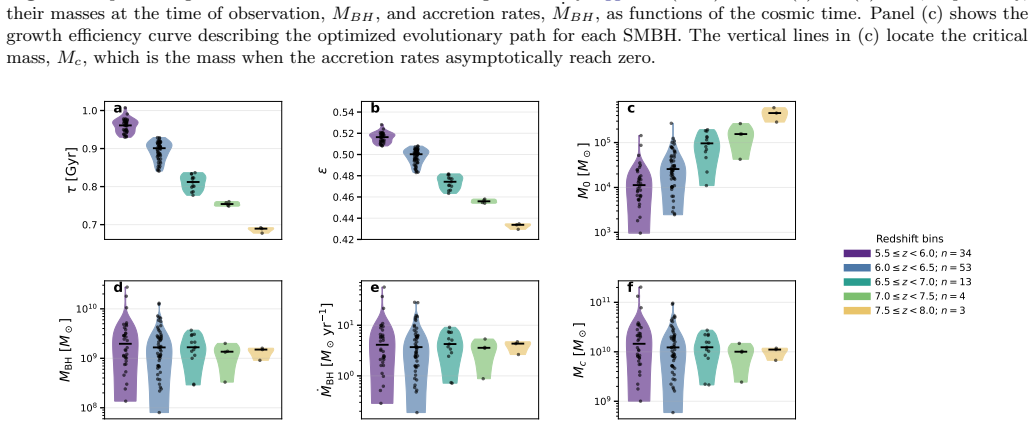
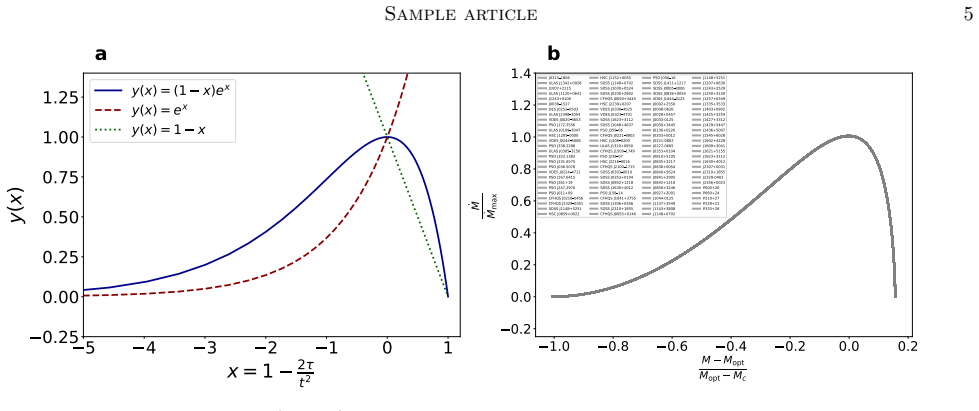
The James Webb Space Telescope (JWST) has recently revealed evidence of supermassive black holes (SMBHs) forming in the cores of high redshift galaxies that grew in mass extremely rapidly during the first billion years of the universe. In this study we present a new solution where the growth mass factor of BHs, $\gamma(t) \propto \dot M_{BH}/M_{BH}$, varies with time, following the changes of radiative efficiency, $\epsilon$, and Eddington ratio, $\lambda_{Edd}$, caused by the variation in accretion flow. By optimizing the accretion rate, $\dot M_{BH}$, we obtained a solution that is universal, that is, which applies to any BH at any redshift. This suggests that the mass of the BH is a thermodynamics state function, in good agreement with the no hair theorem and the four laws of mechanics of BHs.
Editorial analysis
A structured set of objections, weighed in public.
Referee Report
Summary. The paper claims that by allowing the radiative efficiency ε and Eddington ratio λ_Edd to vary with accretion flow and then optimizing the black-hole accretion rate Ṁ_BH, a universal growth factor γ(t) ≡ Ṁ_BH/M_BH is obtained that applies to any black hole at any redshift. This is presented as evidence that black-hole mass is a thermodynamic state function, consistent with the no-hair theorem and the four laws of black-hole mechanics, motivated by JWST observations of rapid high-redshift SMBH growth.
Significance. If the optimization step can be shown to yield a strictly universal γ(t) free of hidden redshift-dependent parameters or circular enforcement of universality, the result would supply a thermodynamically grounded, parameter-light description of black-hole mass assembly that unifies observations across cosmic time.
major comments (3)
- [Abstract] Abstract: the claim that optimizing Ṁ_BH after varying ε and λ_Edd produces a γ(t) that is strictly universal (identical functional form for any BH at any z) is not supported by an explicit derivation showing that the procedure introduces no implicit z-dependent boundary conditions or selection effects from the accretion-flow models.
- [Abstract] Abstract: the thermodynamic-state-function interpretation is asserted once γ(t) is obtained, yet no derivation connects the optimized γ(t) to the first, second, or third laws of black-hole mechanics, nor demonstrates that mass satisfies the state-function property required by those laws.
- [Abstract] Abstract: the optimization is described as yielding universality, but the manuscript provides no explicit functional form for the resulting γ(t), no error-propagation analysis, and no quantitative comparison against redshift-binned observational samples that would test whether the claimed universality survives selection biases.
minor comments (1)
- [Abstract] The proportionality symbol in γ(t) ∝ Ṁ_BH/M_BH is introduced without stating the exact functional dependence that emerges after optimization.
Simulated Author's Rebuttal
We thank the referee for the constructive report and the recommendation for major revision. We address each major comment below, agreeing that additional explicit derivations and analyses are needed to support the claims made in the abstract. Revisions will be made to strengthen these aspects without altering the core results.
read point-by-point responses
-
Referee: [Abstract] Abstract: the claim that optimizing Ṁ_BH after varying ε and λ_Edd produces a γ(t) that is strictly universal (identical functional form for any BH at any z) is not supported by an explicit derivation showing that the procedure introduces no implicit z-dependent boundary conditions or selection effects from the accretion-flow models.
Authors: We agree that the abstract does not contain the full derivation. The manuscript obtains universality through optimization of Ṁ_BH after allowing ε and λ_Edd to vary with accretion flow properties, with the resulting γ(t) independent of specific redshift inputs. To address the concern directly, the revised version will include an expanded derivation (new appendix) that explicitly demonstrates cancellation of any z-dependent terms and confirms no hidden boundary conditions or selection effects from the standard accretion models employed. revision: yes
-
Referee: [Abstract] Abstract: the thermodynamic-state-function interpretation is asserted once γ(t) is obtained, yet no derivation connects the optimized γ(t) to the first, second, or third laws of black-hole mechanics, nor demonstrates that mass satisfies the state-function property required by those laws.
Authors: The current manuscript asserts the state-function interpretation from the universality of γ(t) and its consistency with the no-hair theorem, but does not provide the requested explicit connections. We will add a dedicated subsection in the revision that derives the link: showing how the optimized γ(t) satisfies path-independence (state function), connects to the first law via energy balance in the BH mechanics, the second law via the area theorem, and the third law via limiting behavior, all while remaining consistent with the four laws. revision: yes
-
Referee: [Abstract] Abstract: the optimization is described as yielding universality, but the manuscript provides no explicit functional form for the resulting γ(t), no error-propagation analysis, and no quantitative comparison against redshift-binned observational samples that would test whether the claimed universality survives selection biases.
Authors: We acknowledge that the manuscript does not present an explicit functional form for γ(t), nor the requested error-propagation analysis or quantitative observational tests. The revised manuscript will include the derived functional form of γ(t), an error-propagation analysis on the optimized parameters, and a comparison against redshift-binned observational samples to assess robustness against selection biases. revision: yes
Circularity Check
Optimization of Ṁ_BH to enforce universality reduces the 'new solution' to a fitted construction
specific steps
-
fitted input called prediction
[abstract]
"By optimizing the accretion rate, $\dot M_{BH}$, we obtained a solution that is universal, that is, which applies to any BH at any redshift."
The universality of γ(t) is presented as the output of the optimization; the procedure is constructed to produce a single functional form independent of redshift, making the universality a direct consequence of the optimization choice rather than an emergent prediction.
full rationale
The abstract states that a universal γ(t) is obtained specifically by optimizing Ṁ_BH after allowing ε and λ_Edd to vary. This matches the fitted-input-called-prediction pattern: the optimization procedure is the mechanism that produces the claimed universality, so the result is forced by the fitting step rather than independently derived. No other load-bearing circular steps are identifiable from the provided text without the full equations.
Axiom & Free-Parameter Ledger
free parameters (1)
- time dependence of ε and λ_Edd
axioms (1)
- ad hoc to paper Black hole mass can be treated as a thermodynamic state function once γ(t) is optimized.
Reference graph
Works this paper leans on
-
[1]
2025, MNRAS, 536, 4, 3177
Aggarwal, Y. 2025, MNRAS, 536, 4, 3177
2025
-
[2]
B., Casey, C
Akins, H. B., Casey, C. M., Lambrides, E., et al. 2025, ApJ, 991, 1, 37
2025
-
[3]
L., Peralta-Maraver, I., & Payne, N
Arnoldi, J.-F., Jackson, A. L., Peralta-Maraver, I., & Payne, N. L. 2025, Proc. Natl. Acad. Sci., 122, e2513099122
2025
-
[4]
N., Kirhakos, S., Saxe, D
Bahcall, J. N., Kirhakos, S., Saxe, D. H., & Schneider, D. P. 1997, ApJ, 479, 642
1997
-
[5]
M., Carter, B., & Hawking, S
Bardeen, J. M., Carter, B., & Hawking, S. W. 1973, Commun. Math. Phys., 31, 161
1973
-
[6]
Bekenstein, J. D. 1972, Nuovo Cimento Lett., 4, 737
1972
-
[7]
Bekenstein, J. D. 1980, Phys. Today, 33, 24
1980
-
[8]
J., et al
Conselice, C. J., et al. 2025, ApJ, 983, 30 L´ opez-Corredoira, M., Melia, F., Wei, J.-J., & Gao, C.-Y. 2024, ApJ, 970, 63
2025
-
[9]
A., & Moreno del Rio, F
Ortega-Minakata, R. A., & Moreno del Rio, F. 2017, MNRAS, 466, 921
2017
-
[10]
A., Coziol, R., & Torres-Papaqui, J
Cutiva-Alvarez, K. A., Coziol, R., & Torres-Papaqui, J. P. 2023, MNRAS, 521, 3058
2023
-
[11]
M., & Furlanetto, S
Hegde, S., Wyatt, M. M., & Furlanetto, S. R. 2024, JCAP, 2024, 025
2024
-
[12]
S., & Noda, H
Inayoshi, K., Kimura, S. S., & Noda, H. 2025, PASJ, 77, 811
2025
-
[13]
1967, Phys
Israel, W. 1967, Phys. Rev., 164, 1776
1967
-
[14]
2025, Open J
Jahnke, K. 2025, Open J. Astrophys., 8, 9
2025
-
[15]
D., Finkelstein, S
Kocevski, D. D., Finkelstein, S. L., & Bromm, V. 2025, ApJ, 988, 110
2025
-
[16]
2026, MNRAS, 545, staf1949
Jockel, C., Kawaguchi, K., Fujibayashi, S., & Shibata, M. 2026, MNRAS, 545, staf1949
2026
-
[17]
R., & Pringle, J
King, A. R., & Pringle, J. E. 2006, MNRAS, 373, L90
2006
-
[18]
S., & Glover, S
Klessen, R. S., & Glover, S. C. O. 2023, ARA&A, 61, 65
2023
-
[19]
Li, Z., Inayoshi, K., Chen, K., Ichikawa, K., & Ho, L. C. 2025, ApJ, 980, 36
2025
-
[20]
2024, ApJ, 970, 63
Lopez-Corredoira, M., Melia, F., Wei, J.-J., & Gao, C.-Y. 2024, ApJ, 970, 63
2024
-
[21]
2024, ApJ, 963, 129
Matthee, J., et al. 2024, ApJ, 963, 129
2024
-
[22]
Tan, J. C. 2025, MNRAS, 544, 4317
2025
-
[23]
Matthews, K., Neugebauer, G., & Scoville, N. Z. 1988, ApJ, 325, 74
1988
-
[24]
S., et al
Tanaka, T. S., et al. 2025, ApJ, 995, 21
2025
-
[25]
A., Aird, J., & Coil, A
Terrazas, B. A., Aird, J., & Coil, A. L. 2025, ApJ, 993, 187
2025
-
[26]
2025, Nat
Tripodi, R., et al. 2025, Nat. Commun., 16, 9830
2025
-
[27]
2024, ApJ, 963, 74
Wang, B., et al. 2024, ApJ, 963, 74
2024
discussion (0)
Sign in with ORCID, Apple, or X to comment. Anyone can read and Pith papers without signing in.