Improving Doppler Resilience of OFDM through Delay-Doppler Sensing
Pith reviewed 2026-06-26 11:57 UTC · model grok-4.3
The pith
Overlaying a Zadoff-Chu pilot on CP-OFDM data carriers lets delay-Doppler sensing recover the full frequency-domain input-output relation and equalize inter-carrier interference.
A machine-rendered reading of the paper's core claim, the machinery that carries it, and where it could break.
Core claim
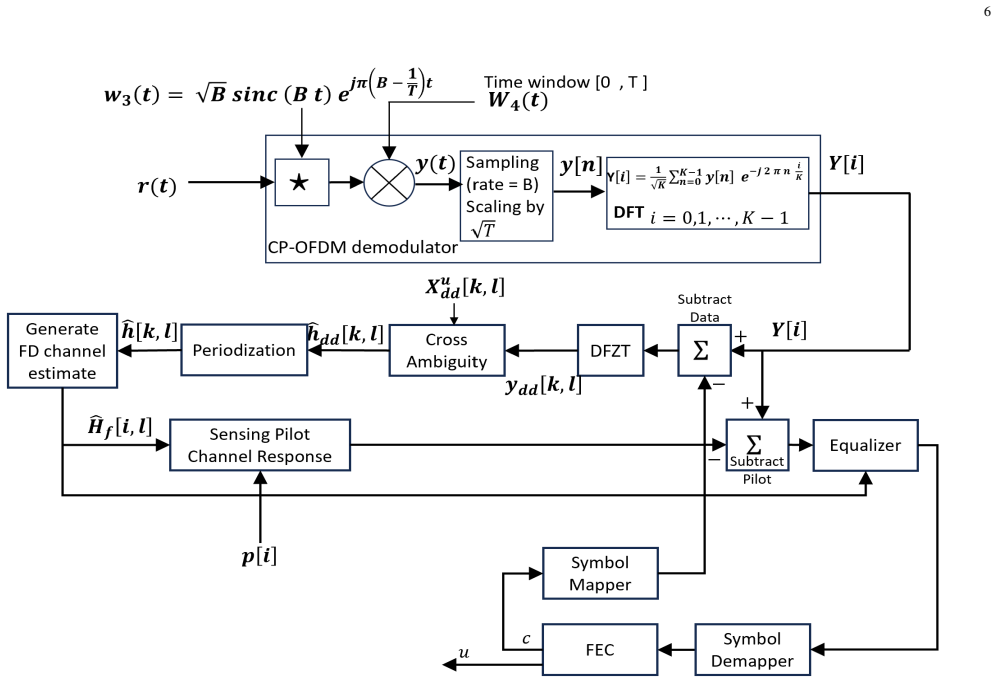
Transmitting an overlaid Zadoff-Chu pilot with CP-OFDM data and performing delay-Doppler domain sensing yields an accurate estimate of the stationary effective DD-domain channel filter; this estimate directly supplies the full frequency-domain input-output relation among CP-OFDM carriers, which is then used to cancel the pilot and jointly equalize all data carriers.
What carries the argument
The stationary effective delay-Doppler domain channel filter acquired from the overlaid Zadoff-Chu pilot, from which the complete frequency-domain input-output relation is derived.
If this is right
- The frequency-domain input-output relation among all CP-OFDM carriers becomes known once the DD-domain filter is estimated.
- The received pilot component can be reconstructed and subtracted, leaving a data-only signal.
- Joint detection across all carriers then removes the inter-carrier interference term.
- Spectral efficiency improves markedly over conventional CP-OFDM in high-mobility 3GPP TDL-C channels.
Where Pith is reading between the lines
- The same pilot-overlay idea could be tested on other multicarrier formats that suffer from Doppler-induced leakage.
- If the DD filter stationarity holds only approximately, an adaptive tracking loop inside the DD domain might still keep the frequency-domain map accurate enough for detection.
- Hardware experiments with moving terminals and the standardized TDL-C profile would directly check whether the simulated spectral-efficiency gain appears in practice.
Load-bearing premise
The effective channel response remains stationary inside the delay-Doppler domain over the observation interval, so that one Zadoff-Chu pilot measurement suffices to reconstruct the entire frequency-domain carrier mapping.
What would settle it
A measurement or simulation in which the delay-Doppler channel filter changes appreciably inside one OFDM symbol interval, so that the single Zadoff-Chu estimate no longer reproduces the observed frequency-domain input-output relation.
Figures


read the original abstract
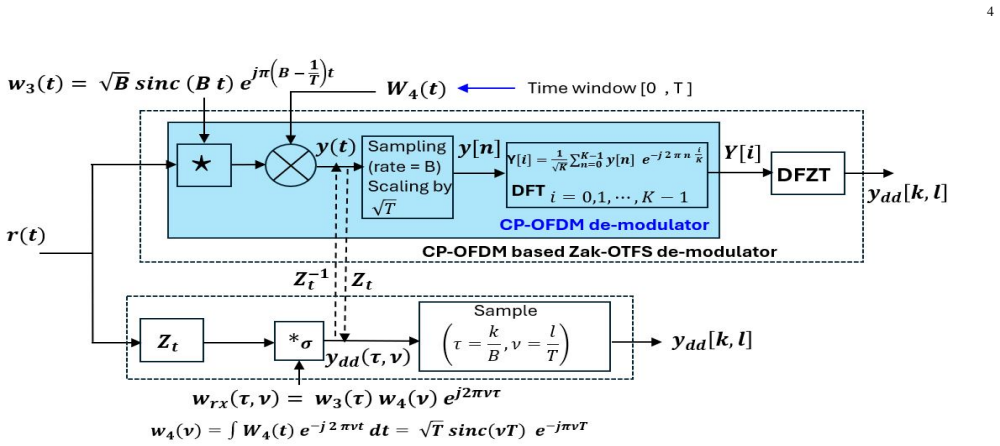
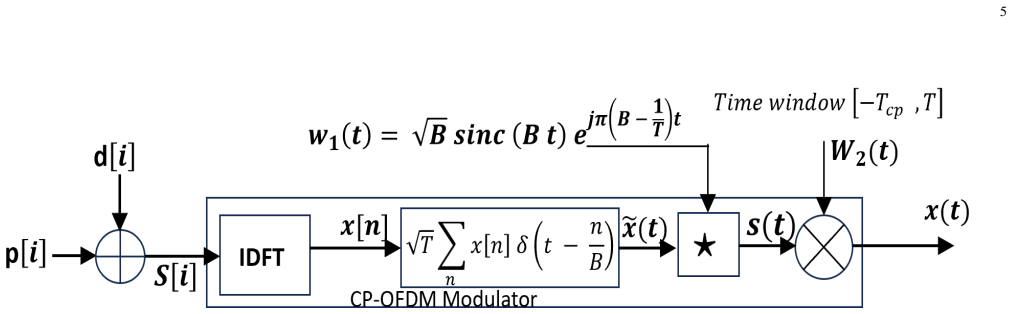
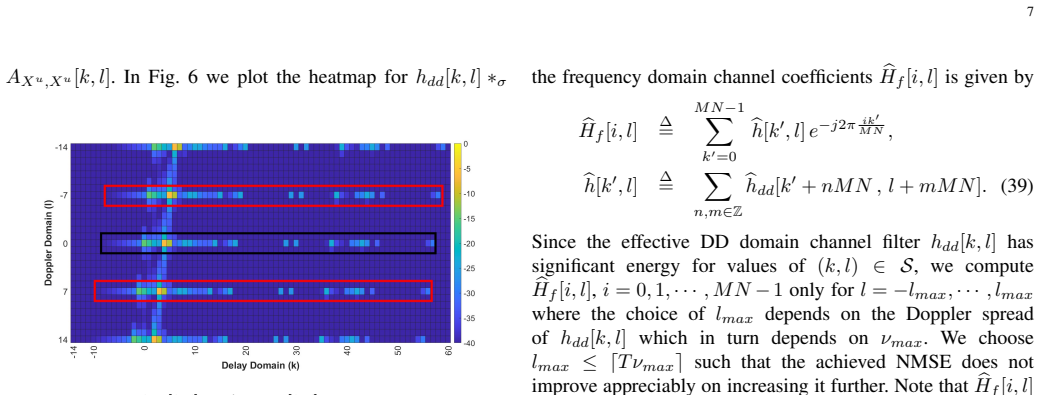
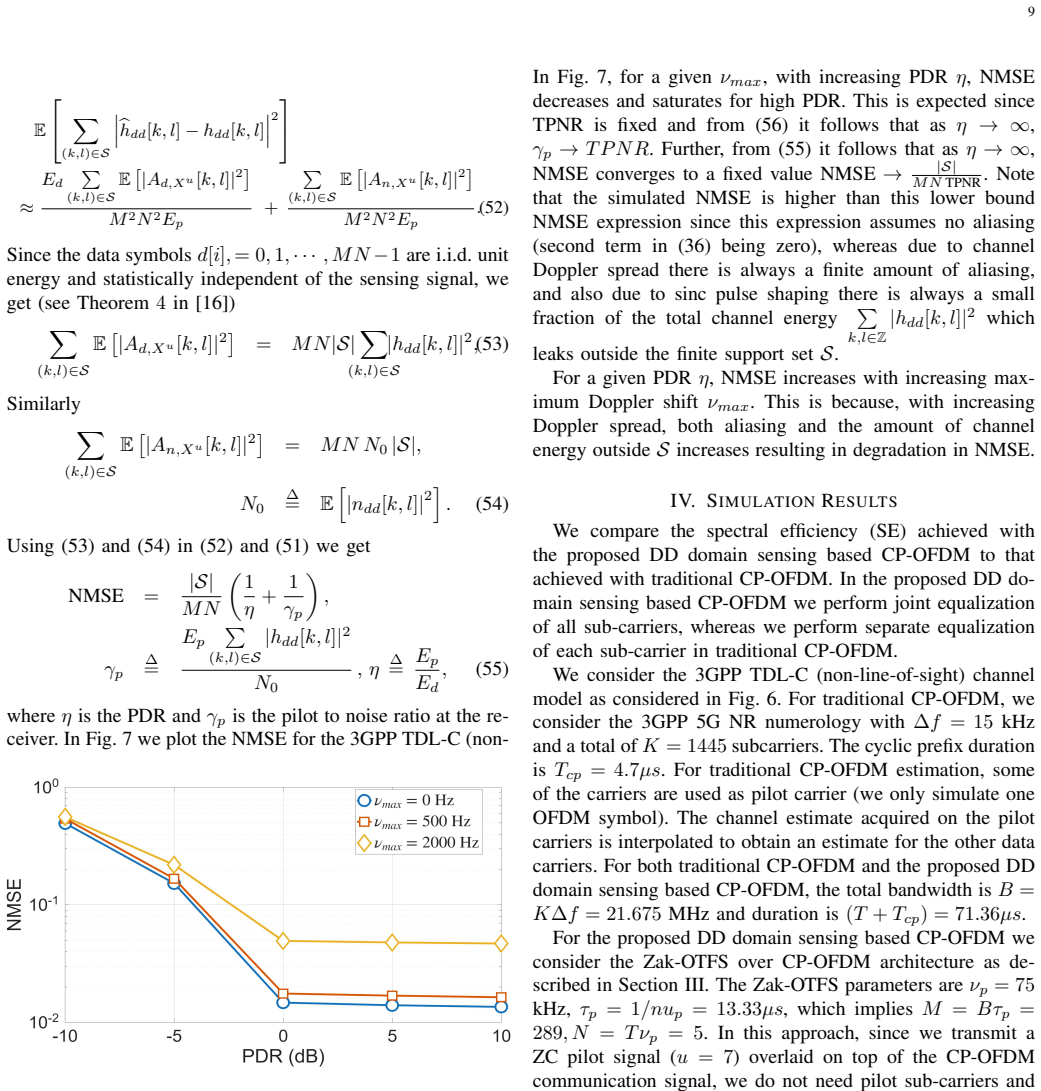
The performance of traditional CP-OFDM degrades severely in doubly-spread wireless channels due to inter-carrier interference (ICI). In this paper, we propose DD domain sensing based CP-OFDM where we transmit a Zadoff-Chu (ZC) pilot signal overlaid on CP-OFDM data carriers. At the receiver, DD domain signal processing is used to acquire the effective DD domain channel filter which is stationary in the DD domain. From this DD domain estimate, we derive the complete frequency domain (FD) input-output (I/O) relation between CP-OFDM carriers, acquiring which is otherwise difficult with traditional time-frequency signal processing. Using this FD I/O relation, we estimate the received FD pilot signal which is then canceled from the received FD signal, resulting in a data-only signal. Joint detection of all CP-OFDM data carriers from this data-only signal equalizes the effect of ICI. Numerical simulations of the standardized 3GPP TDL-C channel shows that in high mobility scenarios, the proposed DD domain sensing based CP-OFDM achieves significantly better spectral efficiency when compared to that achieved by traditional CP-OFDM.
Editorial analysis
A structured set of objections, weighed in public.
Referee Report
Summary. The paper proposes DD domain sensing based CP-OFDM, in which a Zadoff-Chu pilot is overlaid on standard CP-OFDM data carriers. At the receiver, delay-Doppler processing acquires an effective DD-domain channel filter asserted to be stationary; this estimate is used to construct the full frequency-domain input-output matrix between subcarriers, cancel the pilot contribution, and perform joint detection that equalizes ICI. Numerical simulations on the 3GPP TDL-C channel are reported to show substantially higher spectral efficiency than conventional CP-OFDM in high-mobility regimes.
Significance. If the central derivation holds, the approach offers a practical route to improve Doppler resilience of existing CP-OFDM waveforms by adding only an overlaid pilot and DD-domain post-processing, without waveform redesign. The use of a known ZC sequence for DD sensing and the subsequent reconstruction of the FD I/O relation constitute a concrete technical contribution; the standardized TDL-C simulations provide an initial, reproducible testbed for the claimed gains.
major comments (2)
- [Abstract] Abstract: the claim that the effective DD-domain channel filter “is stationary in the DD domain” and thereby yields an exact frequency-domain I/O relation is stated without derivation, approximation bound, or error analysis for the TDL-C tapped-delay-line model. Because pilot cancellation and joint detection are built directly on this reconstructed matrix, any unquantified modeling error propagates into the equalized symbols and undermines the reported spectral-efficiency improvement.
- [Numerical simulations] Numerical simulations (referenced in abstract): the performance claim rests on simulations whose setup (Doppler spread values, pilot power allocation, exact baseline CP-OFDM receiver, number of Monte-Carlo runs, error bars) is not described. Without these details it is impossible to assess whether the observed gain is robust or an artifact of particular parameter choices.
minor comments (1)
- [Abstract] Acronyms CP-OFDM, ZC, ICI, and TDL-C should be defined at first use in the abstract and introduction for readability.
Simulated Author's Rebuttal
We thank the referee for the thorough review and valuable comments. We address each major comment below and will revise the manuscript to strengthen the presentation of the central claims and simulation details.
read point-by-point responses
-
Referee: [Abstract] Abstract: the claim that the effective DD-domain channel filter “is stationary in the DD domain” and thereby yields an exact frequency-domain I/O relation is stated without derivation, approximation bound, or error analysis for the TDL-C tapped-delay-line model. Because pilot cancellation and joint detection are built directly on this reconstructed matrix, any unquantified modeling error propagates into the equalized symbols and undermines the reported spectral-efficiency improvement.
Authors: We agree that the abstract states the stationarity property concisely. The full manuscript derives the effective DD-domain channel filter from the Zadoff-Chu pilot processing and shows how it yields the frequency-domain I/O matrix; however, an explicit approximation analysis and error bound for the TDL-C model is not provided. In the revision we will add a dedicated subsection deriving the FD I/O relation with a first-order error bound that quantifies the modeling mismatch for the TDL-C tapped-delay-line structure. revision: yes
-
Referee: [Numerical simulations] Numerical simulations (referenced in abstract): the performance claim rests on simulations whose setup (Doppler spread values, pilot power allocation, exact baseline CP-OFDM receiver, number of Monte-Carlo runs, error bars) is not described. Without these details it is impossible to assess whether the observed gain is robust or an artifact of particular parameter choices.
Authors: We acknowledge that the simulation parameters were not reported in sufficient detail. The revised manuscript will include an expanded simulation-setup subsection specifying the Doppler spreads (corresponding to the 3GPP high-mobility TDL-C scenarios), the pilot-to-data power allocation ratio, the exact baseline CP-OFDM receiver (standard per-subcarrier MMSE equalization), the number of Monte-Carlo realizations, and error bars on all plotted curves. revision: yes
Circularity Check
No circularity; derivation uses external pilot estimate to obtain I/O relation
full rationale
The paper's chain consists of transmitting an overlaid ZC pilot, acquiring the DD-domain channel filter via DD processing, asserting its stationarity, and deriving the FD I/O matrix from that estimate to enable pilot cancellation and joint detection. This is a direct estimation-plus-derivation procedure whose output is not forced by construction from the input data or by any self-citation chain. No equations reduce a claimed prediction to a fitted parameter, no uniqueness theorem is imported from the authors' prior work, and no ansatz is smuggled via citation. The stationarity claim is an assumption whose validity can be checked externally against the TDL-C model; it does not create a definitional loop inside the paper.
Axiom & Free-Parameter Ledger
axioms (1)
- domain assumption The effective DD domain channel filter is stationary in the DD domain.
Reference graph
Works this paper leans on
-
[1]
Framework and overall objectives of the future development of IMT for 2030 and beyond,
“Framework and overall objectives of the future development of IMT for 2030 and beyond,”Recommendation ITU-R M.2160-0, International Telecommunication Union (ITU) - R, Nov. 2023
2030
-
[2]
On the Road to 6G: Visions, Requirements, Key Technologies, and Testbeds,
C. X. Wang et al., “On the Road to 6G: Visions, Requirements, Key Technologies, and Testbeds,”IEEE Communications Surveys & Tutorials, vol. 25, no. 2, pp. 905–974, 2023
2023
-
[3]
OFDM for Wireless Multimedia Communica- tions,
R.V .Nee, and R. Prasad, “OFDM for Wireless Multimedia Communica- tions,”Artech House Inc., 2000
2000
-
[4]
Performance degradation of OFDM systems due to Doppler spreading,
T.Wang, J. G. Proakis, E . Masry and J. R. Zeidler, “Performance degradation of OFDM systems due to Doppler spreading,”IEEE Trans. on Wireless Commun., vol.5, no.6, June 2006
2006
-
[5]
Characterization of Randomly Time-Variant Linear Chan- nels,
P. A. Bello, “Characterization of Randomly Time-Variant Linear Chan- nels,”IEEE Trans. Comm. Syst., vol. 11, pp. 360-393, 1963
1963
-
[6]
Hlawatsch and G
F. Hlawatsch and G. Matz,Wireless Communications Over Rapidly Time- V arying Channels. New York, NY , USA: Academic Press, 2011
2011
-
[7]
OTFS—A Mathematical Foundation for Communication and Radar Sensing in the Delay-Doppler Domain,
S. K. Mohammed, R. Hadani, A. Chockalingam, and R. Calderbank, “OTFS—A Mathematical Foundation for Communication and Radar Sensing in the Delay-Doppler Domain,”IEEE BITS the Information Theory Magazine, vol. 2, no. 2, pp. 36–55, 2022
2022
-
[8]
OTFS—Predictability in the Delay-Doppler Domain and Its Value to Communication and Radar Sensing,
S. K. Mohammed, R. Hadani, A. Chockalingam, and R. Calderbank, “OTFS—Predictability in the Delay-Doppler Domain and Its Value to Communication and Radar Sensing,”IEEE BITS the Information Theory Magazine, vol. 3, no. 2, pp. 7-31, June 2023
2023
-
[9]
S. K. Mohammed, R. Hadani, and A. Chockalingam,OTFS Modulation: Theory and Applications. Hoboken, NJ, USA: Wiley-IEEE Press, 2024
2024
-
[10]
S. K. Mohammed, S. Prakash, M. Ubadah, I. A. Khan, R. Hadani, S. Rakib, S. Kons, Y . Hebron, A. Chockalingam, and R. Calderbank, “Zak- OTFS over CP-OFDM,”arXiv preprint arXiv:2508.03906, 2025
arXiv 2025
-
[11]
Multiple Preamble Detection with ZC Sequences in the Presence of Mobility and Delay Spread,
S. R. Mattu, I. A. Khan, V . Khammammetti, B. Dabak, S. K. Mo- hammed, K. Narayanan and R. Calderbank,“Multiple Preamble Detection with ZC Sequences in the Presence of Mobility and Delay Spread,”2025 IEEE International Symposium on Information Theory (ISIT), Ann Arbor, MI, USA, 2025, pp. 1-6
2025
-
[12]
Finite translations in solid state physics,
J. Zak, “Finite translations in solid state physics,”Phy. Rev. Lett., 19, pp. 1385-1387, 1967
1967
-
[13]
The Zak transform: a signal transform for sampled time-continuous signals,
A. J. E. M. Janssen, “The Zak transform: a signal transform for sampled time-continuous signals,”Philips J. Res., 43, pp. 23-69, 1988
1988
-
[14]
Zak-OTFS for Identification of Linear Time-Varying Systems,
D. Nisar, S. K. Mohammed, R. Hadani, A. Chockalingam, and R. Calder- bank, “Zak-OTFS for Identification of Linear Time-Varying Systems,” IEEE Transactions on Signal Processing, 2026
2026
-
[15]
Zak-OTFS With Interleaved Pilots to Extend the Region of Predictable Operation,
J. Jayachandran, I. A. Khan, S. K. Mohammed, R. Hadani, A. Chock- alingam, and R. Calderbank, “Zak-OTFS With Interleaved Pilots to Extend the Region of Predictable Operation,”IEEE Transactions on V ehicular Technology, 2024
2024
-
[16]
Zak-OTFS to Integrate Sensing the I/O Relation and Data Communication,
M. Ubadah, S. K. Mohammed, R. Hadani, S. Kons, A. Chockalingam and R. Calderbank, “Zak-OTFS to Integrate Sensing the I/O Relation and Data Communication,”arXiv preprint arXiv:2404.04182, 2024
arXiv 2024
-
[17]
Study on channel model for frequencies from 0.5 to 100 GHz,
3GPP TR 38.901, “Study on channel model for frequencies from 0.5 to 100 GHz,” 3gpp Release 16, 2020
2020
-
[18]
NR; Physical Channels and Modulation,
3GPP TS 38.211, “NR; Physical Channels and Modulation,” Release 15, 2018
2018
-
[19]
NR; Multiplexing and Channel Coding,
3GPP TS 38.212, “NR; Multiplexing and Channel Coding,” Release 15, 2018
2018
discussion (0)
Sign in with ORCID, Apple, or X to comment. Anyone can read and Pith papers without signing in.