Generation of two-dimensional pulses in lipid monolayers by rapid photoswitching
Pith reviewed 2026-06-26 11:24 UTC · model grok-4.3
The pith
Rapid photoswitching of azoPC lipids generates surface pressure pulses that propagate according to a fractional wave equation, matching experimental speeds and shapes.
A machine-rendered reading of the paper's core claim, the machinery that carries it, and where it could break.
Core claim
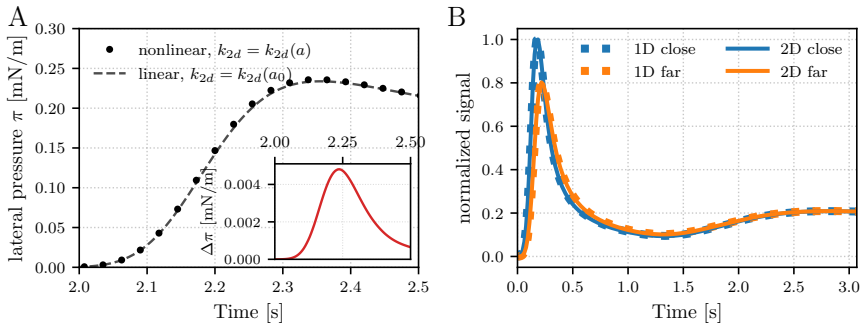
Rapid photoisomerization of azoPC lipids produces controllable longitudinal surface pressure pulses in monolayers. The measured pulse speeds and shapes agree quantitatively with solutions of a nonlinear fractional wave equation for the surface displacement field. The fractional time derivative term in the equation incorporates the subphase hydrodynamics. In narrow channels the one-dimensional model uses the pressure reading at a close sensor as boundary input to forecast the reading at a far sensor without any fit parameters. A single set of excitation parameters in the two-dimensional model accounts for all channel-width effects. Because the pulses remain small, the nonlinear contribution d
What carries the argument
Nonlinear fractional wave equation for the surface displacement field, with the fractional time derivative capturing subphase hydrodynamics.
If this is right
- Pulse speed and shape match experiment quantitatively across channel lengths and widths.
- One-dimensional model predicts far-sensor signal from near-sensor input without fit parameters in narrow channels.
- Two-dimensional model reproduces all channel-geometry effects with one common set of excitation parameters.
- Nonlinear term is irrelevant because observed amplitudes stay small.
Where Pith is reading between the lines
- The optical triggering approach could enable localized, non-mechanical control of monolayer tension for studying membrane-embedded proteins.
- Fractional-derivative models of this type may apply to pulse propagation in other thin-film or interface systems that rest on a viscous fluid.
- Experiments that deliberately increase pulse amplitude could test whether the nonlinear term begins to matter and alters propagation.
Load-bearing premise
The fractional time derivative term fully represents the subphase hydrodynamics for the experimental length scales without further geometry-specific corrections.
What would settle it
A clear mismatch between the pressure signal measured at the distant sensor and the signal predicted by the one-dimensional fractional wave equation when fed the close-sensor data as input.
Figures


read the original abstract
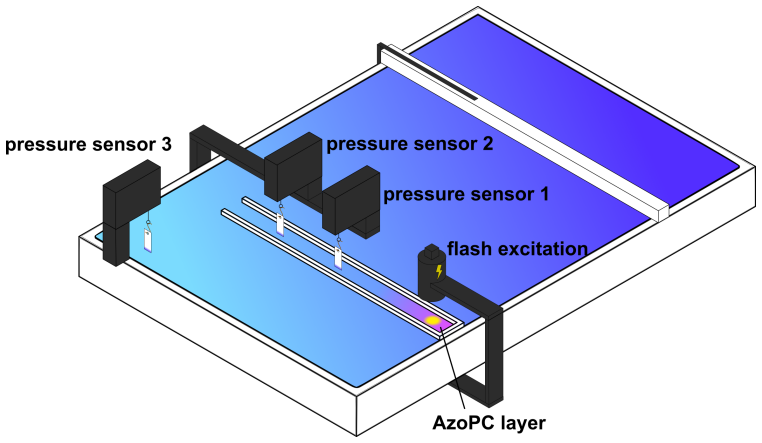
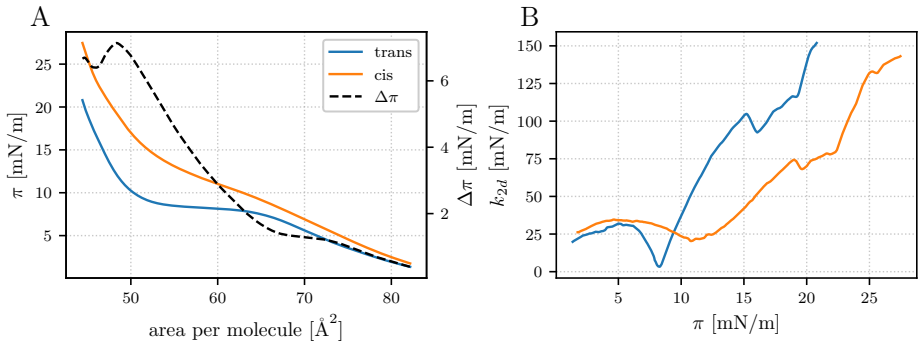
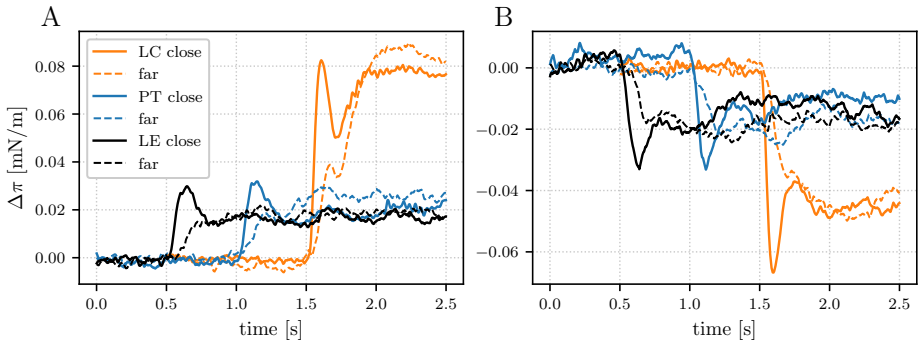
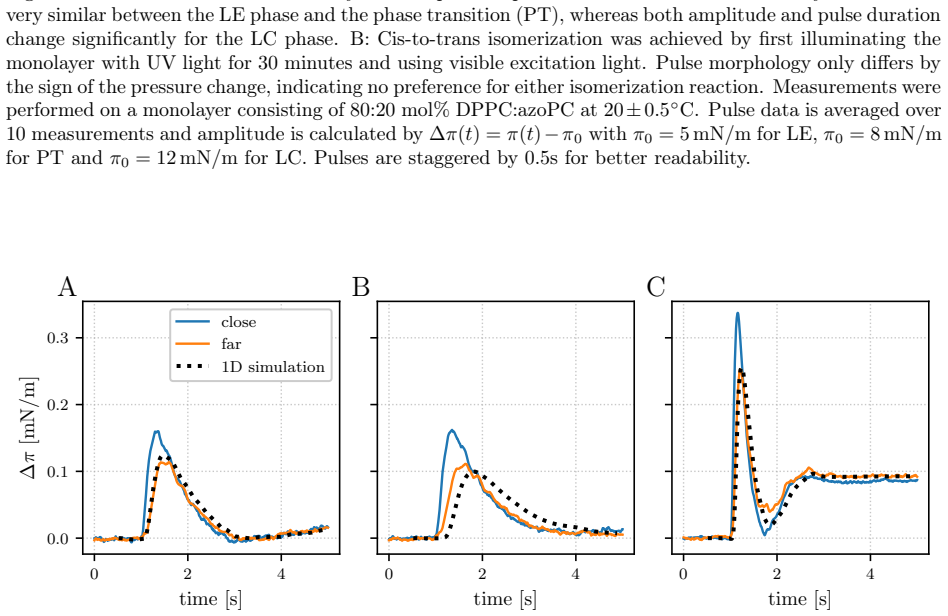
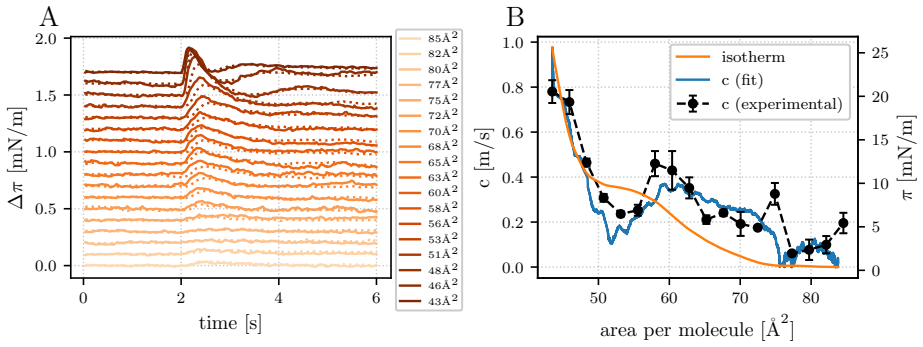
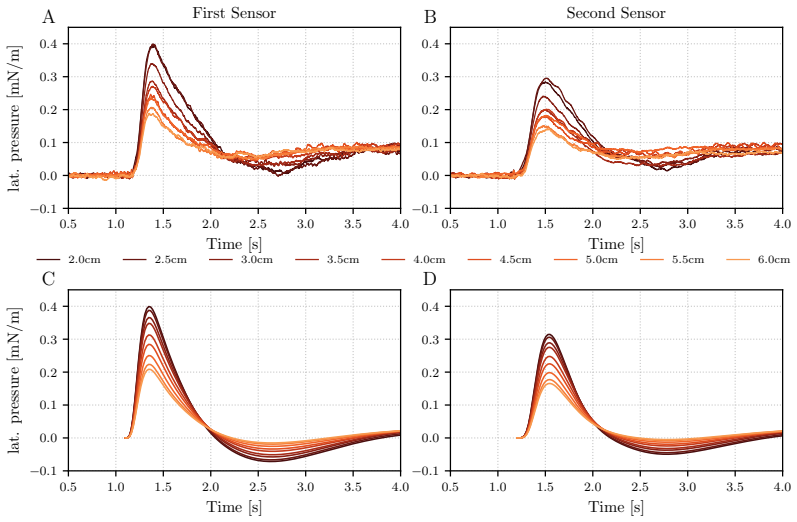
We study pressure pulse generation and propagation in lipid monolayers by an experimental approach employing rapid photoisomerization of photoswitchable lipids (azoPC). This allows us to generate longitudinal surface pressure pulses by optical flash excitation in both free and constrained layer geometries. We compare the observed pulse shapes with a theoretical approach based on a nonlinear fractional wave equation for a surface displacement field, where a fractional time derivative term captures the hydrodynamics of the monolayer subphase. We explore channel geometries of different lengths and widths and find quantitative agreement between theory and experiment regarding pulse speed and pulse shapes. For narrow channels, we employ a one-dimensional version of the fractional wave equation to study pulse propagation without any fit parameters by using the pressure signal at a close pressure sensor as boundary condition to predict the pressure signal at a second far sensor. A full two-dimensional description can capture all effects arising from the channel geometry for wider channels using one common set of fit parameters for the pulse excitation that can be applied to all geometries. The nonlinearity in the fractional wave equation plays no role in explaining the observed pulse shapes because pulse amplitudes generated by azoPC photoswitching remain very small.
Editorial analysis
A structured set of objections, weighed in public.
Referee Report
Summary. The paper reports an experimental method to generate longitudinal surface pressure pulses in lipid monolayers via rapid photoisomerization of azoPC lipids in both unconstrained and channel-constrained geometries. These pulses are compared to predictions from a nonlinear fractional wave equation for the surface displacement field, in which a fractional time derivative models the hydrodynamics of the monolayer subphase. Quantitative agreement is claimed for pulse speeds and shapes. For narrow channels a parameter-free 1D reduction is used, taking the near-sensor pressure trace directly as the boundary condition to predict the far-sensor trace. For wider channels a 2D formulation employs a single shared set of excitation parameters across all geometries. The nonlinearity is stated to be irrelevant because the generated amplitudes remain small.
Significance. If the reported quantitative matches are robust, the work supplies a controlled optical method for creating 2D pulses and supplies an independent test of the fractional-wave-equation description of subphase flow in laterally confined geometries. The parameter-free narrow-channel predictions constitute a genuine strength, as they avoid post-hoc adjustment of the hydrodynamic kernel.
major comments (2)
- [theoretical model and narrow-channel predictions] The central claim of parameter-free quantitative agreement in narrow channels rests on the assumption that the fractional time derivative (derived for unbounded or semi-infinite subphases) already incorporates all relevant hydrodynamic effects inside a finite-width channel. Side-wall boundary layers or depth-dependent corrections that scale with channel width would modify the effective kernel; the manuscript must demonstrate explicitly why such corrections remain negligible at the experimental length scales and channel widths, or provide a quantitative estimate of their magnitude.
- [wider-channel results] The 2D modeling for wider channels uses one common set of excitation parameters across geometries. The manuscript should report the sensitivity of the predicted far-field signals to plausible variations in those excitation parameters and show that the reported agreement is not an artifact of the particular choice.
minor comments (1)
- [Abstract] The abstract states that nonlinearity plays no role, but the manuscript should include a brief quantitative estimate (e.g., ratio of nonlinear to linear terms evaluated at the observed amplitudes) to support this statement.
Simulated Author's Rebuttal
We thank the referee for the careful and constructive review. We address each major comment below and will revise the manuscript to incorporate the requested clarifications and analyses.
read point-by-point responses
-
Referee: [theoretical model and narrow-channel predictions] The central claim of parameter-free quantitative agreement in narrow channels rests on the assumption that the fractional time derivative (derived for unbounded or semi-infinite subphases) already incorporates all relevant hydrodynamic effects inside a finite-width channel. Side-wall boundary layers or depth-dependent corrections that scale with channel width would modify the effective kernel; the manuscript must demonstrate explicitly why such corrections remain negligible at the experimental length scales and channel widths, or provide a quantitative estimate of their magnitude.
Authors: We agree that an explicit estimate of possible side-wall and depth-dependent hydrodynamic corrections is needed to fully justify the applicability of the unbounded-subphase kernel inside finite channels. In the revised manuscript we will add a dedicated paragraph (or short subsection) providing this estimate. We will compute the viscous boundary-layer thickness δ ≈ √(νt) for the experimental pulse timescales and subphase viscosity, compare it directly to the channel widths used, and discuss the shallow-water limit for depth-dependent effects. This addition will quantify why the corrections remain small at the relevant scales while leaving the central claims and parameter-free predictions unchanged. revision: yes
-
Referee: [wider-channel results] The 2D modeling for wider channels uses one common set of excitation parameters across geometries. The manuscript should report the sensitivity of the predicted far-field signals to plausible variations in those excitation parameters and show that the reported agreement is not an artifact of the particular choice.
Authors: We concur that a sensitivity analysis strengthens the 2D modeling results. In the revision we will add a supplementary section (or figure) that varies the shared excitation parameters (amplitude and temporal profile of the photo-induced displacement) within their experimental uncertainty ranges and recomputes the far-field traces for the wider-channel geometries. The resulting family of predictions will be overlaid on the data to demonstrate that the quantitative agreement persists across these variations and is therefore not an artifact of a single parameter choice. revision: yes
Circularity Check
No significant circularity; predictions are independent of inputs
full rationale
The narrow-channel case explicitly uses the measured close-sensor pressure as a boundary condition to propagate via the fractional wave equation and predict the far-sensor signal with zero fit parameters; this is a genuine forward prediction, not a reduction by construction. Wider-channel results fit a common set of excitation parameters once and apply them across geometries, but the model equations themselves (nonlinear fractional wave equation for displacement) remain an independent theoretical input rather than being defined from the target data. No quoted self-definitional steps, fitted-input-renamed-as-prediction, or load-bearing self-citation chains appear in the provided description. The derivation chain is therefore self-contained.
Axiom & Free-Parameter Ledger
free parameters (1)
- pulse excitation parameters
axioms (1)
- domain assumption The fractional time derivative term captures the hydrodynamics of the monolayer subphase
Reference graph
Works this paper leans on
-
[1]
Heimburg, T.; Jackson, A. D. On soliton propagation in biomembranes and nerves.Proc. Natl. Acad. Sci. U. S. A.2005,102, 9790–9795
2005
-
[2]
Longitudinal capillary waves
Lucassen, J. Longitudinal capillary waves. Part 2.—Experiments.Trans. Faraday Soc.1968,64, 2230– 2235
1968
-
[3]
Wave Propagation in Lipid Monolayers.Biophys
Griesbauer, J.; Wixforth, A.; Schneider, M. Wave Propagation in Lipid Monolayers.Biophys. J.2009, 97, 2710–2716
2009
-
[4]
Griesbauer, J.; Bössinger, S.; Wixforth, A.; Schneider, M. F. Propagation of 2D Pressure Pulses in Lipid Monolayers and Its Possible Implications for Biology.Phys. Rev. Lett.2012,108, 198103
2012
-
[5]
Shrivastava, S.; Schneider, M. F. Opto-Mechanical Coupling in Interfaces under Static and Propagative Conditions and Its Biological Implications.PLoS ONE2013,8, e67524
-
[6]
Shrivastava, S.; Schneider, M. F. Evidence for two-dimensional solitary sound waves in a lipid controlled interface and its implications for biological signalling.J. R. Soc. Interface2014,11, 20140098
-
[7]
Integration der Biochemie in die Physik der Grenzfläche
Fichtl, B. Integration der Biochemie in die Physik der Grenzfläche. Dissertation, Universität Augsburg, Augsburg, 2016
2016
-
[8]
Fichtl, B.; Shrivastava, S.; Schneider, M. F. Protons at the speed of sound: Predicting specific biological signaling from physics.Sci. Rep.2016,6, 22874
2016
-
[9]
Generation and transmission of a surface pressure impulse in mono- layers.Thin Solid Films1986,138, 151–156
Suzuki, M.; Möbius, D.; Ahuja, R. Generation and transmission of a surface pressure impulse in mono- layers.Thin Solid Films1986,138, 151–156
-
[10]
D.; Morstein, J.; Pritzl, N
Pritzl, S. D.; Morstein, J.; Pritzl, N. A.; Lipfert, J.; Lohmüller, T.; Trauner, D. H. Photoswitchable phos- pholipids for the optical control of membrane processes, protein function, and drug delivery.Commun. Mater.2025,6, 59
2025
-
[11]
Bandara, H. M. D.; Burdette, S. C. Photoisomerization in different classes of azobenzene.Chem. Soc. Rev.2012,41, 1809–1825
2012
-
[12]
F.; Morigaki, K.; Enomoto, T.; Hashimoto, K.; Fujishima, A
Liu, Z. F.; Morigaki, K.; Enomoto, T.; Hashimoto, K.; Fujishima, A. Kinetic studies on the thermal cis-trans isomerization of an azo compound in the assembled monolayer film.J. Phys. Chem.1992,96, 1875–1880
1992
-
[13]
Investigation of the photoresponse of lipid monolayers containing azobenzene derivatives by a Maxwell-displacement-current-measuring technique.J
Iwamoto, M.; Ohnishi, K. Investigation of the photoresponse of lipid monolayers containing azobenzene derivatives by a Maxwell-displacement-current-measuring technique.J. Appl. Phys.1994,76, 8121– 8128
1994
-
[14]
E.; Reise, F.; Hövelmann, S
Warias, J. E.; Reise, F.; Hövelmann, S. C.; Giri, R. P.; chael Röhrl, M.; Kuhn, J.; Jacobsen, M.; Chatterjee, K.; Arnold, T.; a nd Sven Festersen, C. S.; Sartori, A.; Jordt, P.; Magnussen, O. M.; Lindhorst, T. K.; Murphy, B. M. Photoinduced bidirectional switching in lipid membranes containing azobenzene glycolipid s.Sci. Rep.2023,13, 11480
2023
-
[15]
Longitudinal capillary waves
Lucassen, J. Longitudinal capillary waves. Part 1.—Theory.Trans. Faraday Soc.1968,64, 2221–2229
1968
-
[16]
Kappler, J.; Netz, R. R. Multiple surface wave solutions on linear viscoelastic media.Europhys. Lett. 2015,112, 19002
2015
-
[17]
Kappler,J.; Shrivastava,S.; Schneider,M.F.; Netz,R.R.Nonlinearfractionalwavesatelasticinterfaces. Phys. Rev. Fluids2017,2, 114804. 15
-
[18]
R.; Kappler, J
Zendehroud, S.; Netz, R. R.; Kappler, J. Linear waves at viscoelastic interfaces between viscoelastic media.Phys. Rev. Fluids2022,7, 114801
-
[19]
E.; Cormack, J
Simon, B. E.; Cormack, J. M.; Hamilton, M. F. Evolution equations for nonlinear Lucassen waves. 177th Meeting of the Acoustical Society of America. 2019; p 045001
2019
-
[20]
J.; Bagley, R
Torvik, P. J.; Bagley, R. L. On the Appearance of the Fractional Derivative in the Behavior of Real Materials.J. Appl. Mech.1984,51, 294–298
1984
-
[21]
Mainardi, F.Fractional Calculus and Waves in Linear Viscoelasticity; Imperial College Press: London, 2010
2010
-
[22]
Heimburg, T. InThermodynamics and Biophysics of Biomedical Nanosystems: Applications and Prac- tical Consi derations; Demetzos, C., Pippa, N., Eds.; Springer Singapore: Singapore, 2019; pp 39–61
2019
-
[23]
D.; Pitaevskii, L
Landau, L. D.; Pitaevskii, L. P.; Lifshitz, E. M.; Kosevich, A. M.Theory of Elasticity, 3rd ed.; Butterworth-Heinemann, 1986
1986
-
[24]
Apparent molar heat capacities of phospholipids in aqueous dispersion
Blume, A. Apparent molar heat capacities of phospholipids in aqueous dispersion. Effects of chain length and head group structure.Biochemistry1983,22, 5436–5442
-
[25]
Q.; Steltenkamp, S.; Zasadzinski, J
Choi, S. Q.; Steltenkamp, S.; Zasadzinski, J. A.; Squires, T. M. Active microrheology and simultaneous visualization of sheared phospholipid monolayers.Nat. Commun.2011,2
2011
-
[26]
Numerical approximation of nonlinear fractional differential equations with subdiffusion and superdiffusion.Comput
Li, C.; Zhao, Z.; Chen, Y. Numerical approximation of nonlinear fractional differential equations with subdiffusion and superdiffusion.Comput. Math. Appl.2011,62, 855–875
2011
-
[27]
A.; Urban, P.; Roeske, C
Pernpeintner, C.; Frank, J. A.; Urban, P.; Roeske, C. R.; Pritzl, S. D.; Trauner, D.; Lohmüller, T. Light- Controlled Membrane Mechanics and Shape Transitions of Photoswitchable Lipid Vesicles.Langmuir 2017,33, 4083–4089
2017
-
[28]
S.; Campos-Terán, J.; Langevin, D.; Castillo, R.; Espinosa, G
Luviano, A. S.; Campos-Terán, J.; Langevin, D.; Castillo, R.; Espinosa, G. Mechanical Properties of DPPC-POPE Mixed Langmuir Monolayers.Langmuir2019,35, 16734–16744
-
[29]
R.; López-Montero, I.; Ignés-Mullol, J.; Monroy, F
Arriaga, L. R.; López-Montero, I.; Ignés-Mullol, J.; Monroy, F. Domain-growth kinetic origin of non- horizontal phase coexistence plateaux in langmuir monolayers: compression rigidity of a Raft-like lipid distribution.J. Phys. Chem. B2010,114, 4509–4520
-
[30]
Differential Evolution – A Simple and Efficient Heuristic for global Optimization over Continuous Spaces.J
Storn, R.; Price, K. Differential Evolution – A Simple and Efficient Heuristic for global Optimization over Continuous Spaces.J. Glob. Optim.1997,11, 341–359
1997
-
[31]
Fluorescence spectra of trans- and cis-azobenzene – emission from the Franck–Condon stat e.Chem
Satzger, H.; Spörlein, S.; Root, C.; Wachtveitl, J.; Zinth, W.; Gilch, P. Fluorescence spectra of trans- and cis-azobenzene – emission from the Franck–Condon stat e.Chem. Phys. Lett.2003,372, 216–223
2003
-
[32]
Determining the photoisomerization quantum yield of photoswitchable molecules in solution and in the solid state.Sci
Stranius, K.; Börjesson, K. Determining the photoisomerization quantum yield of photoswitchable molecules in solution and in the solid state.Sci. Rep.2017,7
2017
-
[33]
Kinetics of photo-isomerization of azobenzene containing surfactants.J
Arya, P.; Jelken, J.; Lomadze, N.; Santer, S.; Bekir, M. Kinetics of photo-isomerization of azobenzene containing surfactants.J. Chem. Phys.2020,152
2020
-
[34]
Backus, E. H. G.; Kuiper, J. M.; Engberts, J. B. F. N.; Poolman, B.; Bonn, M. Reversible Optical Control of Monolayers on Water through Photoswitchable Lipids.J. Phys. Chem. B2011,115, 2294– 2302
-
[35]
E.; Hofemeier, A
Höglsperger, F.; Vos, B. E.; Hofemeier, A. D.; Seyfried, M. D.; Stövesand, B.; Alavizargar, A.; Topp, L.; Heuer, A.; Betz, T.; Ravoo, B. J. Rapid and reversible optical switching of cell membrane area by an amphiphilic azobenzene.Nat. Commun.2023,14, 3760
2023
-
[36]
Photo-Lipids: Light-Sensitive Nano-Switches to Control Membrane Properties
Socrier, L.; Steinem, C. Photo-Lipids: Light-Sensitive Nano-Switches to Control Membrane Properties. ChemPlusChem2023,88, e202300203. 16
discussion (0)
Sign in with ORCID, Apple, or X to comment. Anyone can read and Pith papers without signing in.