Resume Screening, Fast and Slow: (Biased) AI Recommendations' Influence on Human Decision Making
Pith reviewed 2026-06-26 10:50 UTC · model grok-4.3
The pith
Biased AI recommendations alter the time people spend viewing resumes and influence hiring decisions
A machine-rendered reading of the paper's core claim, the machinery that carries it, and where it could break.
Core claim
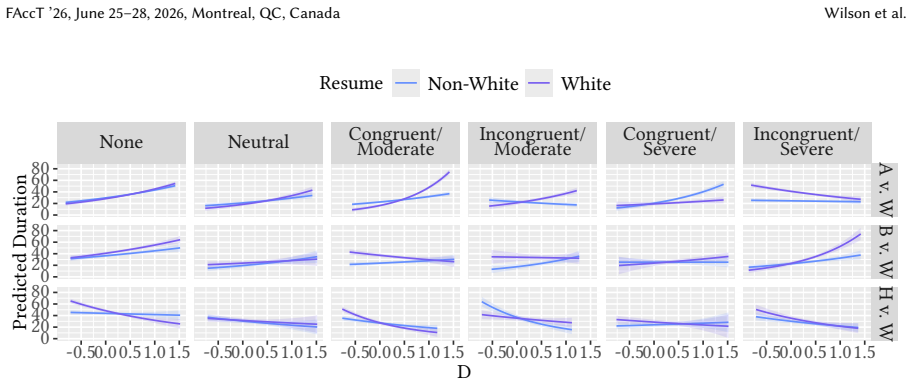
In an experiment on resume screening, AI recommendations change the duration people spend on each resume; non-recommended candidates receive more viewing time, which raises their selection probability by 3-4 percent, while IAT scores predict both the amount of time spent and the degree of racial parity in viewing times, indicating that human oversight may fail to neutralize AI bias.
What carries the argument
Time spent viewing resumes, treated as a measurable proxy for cognitive effort and fairness, together with its interaction with participants' IAT scores during human-AI collaboration.
If this is right
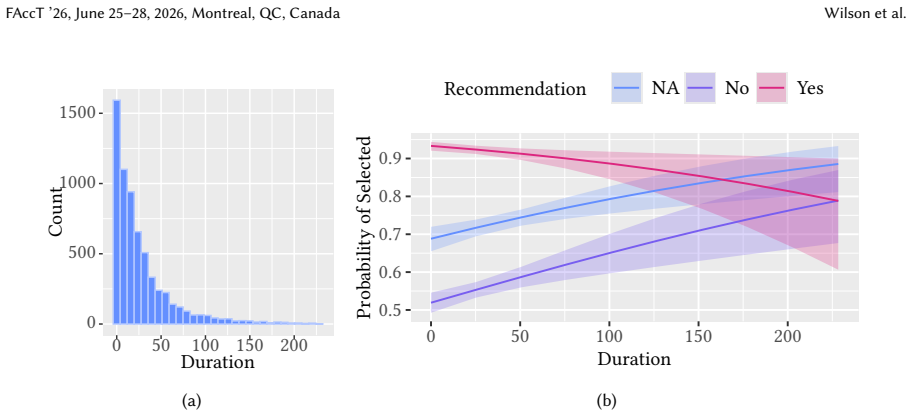
- Non-recommended candidates gain a 3-4 percent higher selection chance when reviewers spend extra time on their resumes.
- Removing AI recommendations increases average viewing time by as much as 55.6 percent.
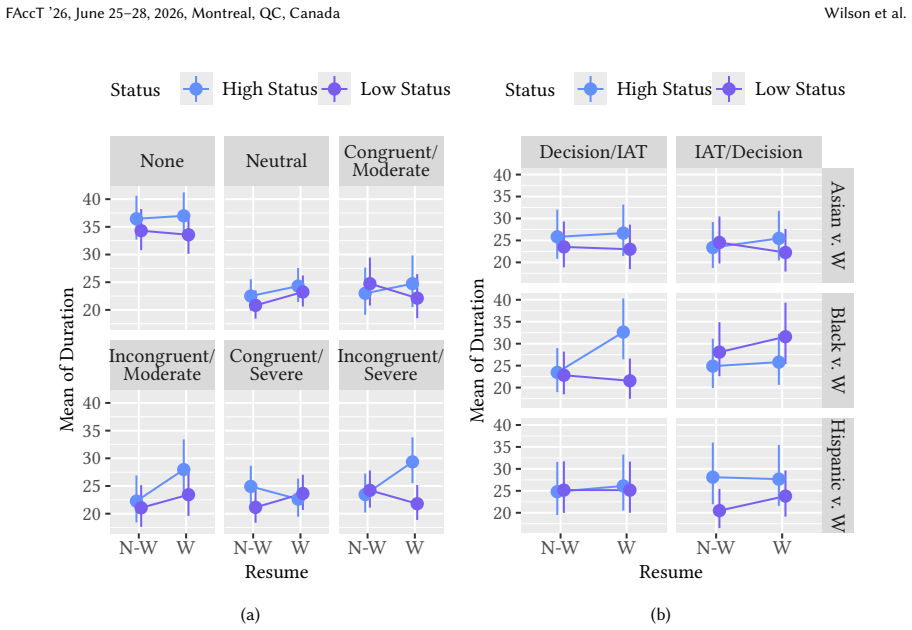
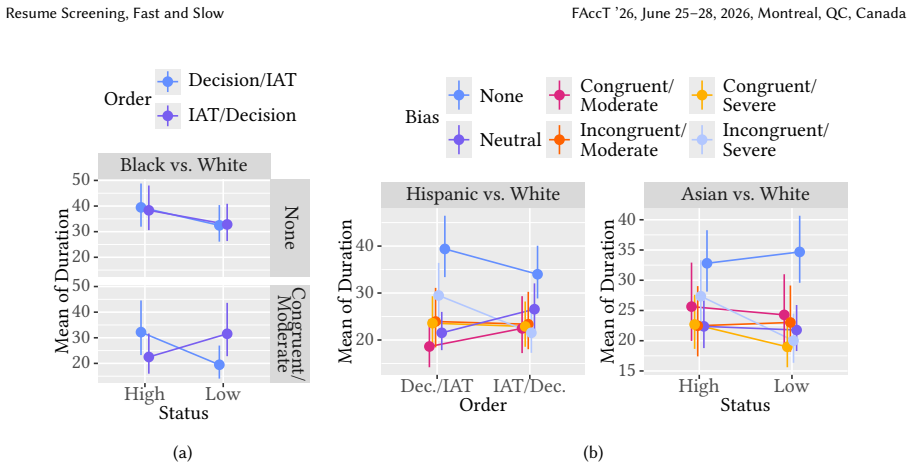
- Participants who complete an IAT before screening are more likely to allocate equal viewing time to candidates of different races.
- IAT scores directly predict the duration of attention given during the human-AI screening task.
Where Pith is reading between the lines
- Pre-task bias awareness exercises such as the IAT could be incorporated into hiring workflows to reduce unequal attention.
- The results point to a need for system-level safeguards that do not rely solely on human reviewers to detect and correct AI bias.
- Similar time-tracking methods might be tested in other high-stakes domains where AI assists decisions, such as loan approvals or medical triage.
Load-bearing premise
The time people spend looking at a resume accurately reflects the cognitive effort and fairness of their final hiring decision.
What would settle it
A replication in which viewing time shows no statistical link to selection outcomes or in which IAT scores fail to predict time differences across racial groups would undermine the central claim.
Figures
read the original abstract
AI is increasingly being used collaboratively with people to make decisions in high-stakes domains, but this new paradigm is still not well-understood in many respects -- particularly regarding how AI that replicates human social biases influences people's decision making processes and how that can influence outcomes. In this study, we analyzed the time people spend viewing candidate resumes from an experiment investigating biased AI resume screening to evaluate decision-making fairness and cognitive processes underlying human-AI collaboration. We found that spending more time viewing resumes corresponds to candidates' selection chance increasing by 3-4% if they are not recommended, and people may spend up to 55.6% longer viewing resumes when no AI recommendations are given. Furthermore, people who completed an implicit association test (IAT) before resume screening were significantly more likely to evaluate candidates of different races for the same amount of time, and their IAT scores were also predictive of the time spent in human-AI collaboration. These results demonstrate how people's decision-making processes can be insufficient for overseeing AI in high-stakes domains.
Editorial analysis
A structured set of objections, weighed in public.
Referee Report
Summary. The paper reports an experiment analyzing time spent viewing resumes in a human-AI resume screening task. It claims that more viewing time increases selection probability by 3-4% for non-AI-recommended candidates, that people spend up to 55.6% longer viewing resumes without AI recommendations, that pre-task IAT completion leads to more equal evaluation times across races, and that IAT scores predict viewing time in human-AI collaboration. The authors conclude that these results show human decision-making processes are insufficient for overseeing biased AI in high-stakes domains.
Significance. If the proxy interpretations are validated, the work would contribute to understanding bias propagation in human-AI collaborative decision-making in hiring contexts. The experimental measurement of viewing time and IAT interactions provides a concrete empirical angle on oversight limitations, though the absence of direct links to decision accuracy limits its immediate applicability.
major comments (2)
- [Abstract] Abstract: The abstract reports directional effects (3-4% selection boost, 55.6% longer viewing) and IAT predictive effects but supplies no sample size, statistical model details, controls for multiple comparisons, or exclusion criteria. This prevents verification that the data support the stated claims and is load-bearing for all quantitative conclusions.
- [Abstract] Abstract (final sentence): The claim that the results demonstrate decision-making processes are insufficient for overseeing AI depends on treating time spent viewing resumes as a valid proxy for cognitive effort/fairness and IAT scores as capturing the relevant bias interaction. No evidence is provided that longer viewing time or IAT scores predict reduced bias or higher accuracy in final selections versus objective candidate merit; time could instead index resume length or difficulty. This interpretation is load-bearing for the central insufficiency conclusion.
Simulated Author's Rebuttal
We thank the referee for their careful reading and constructive feedback on the abstract and its interpretive claims. We address each major comment below and indicate the revisions we will make.
read point-by-point responses
-
Referee: [Abstract] Abstract: The abstract reports directional effects (3-4% selection boost, 55.6% longer viewing) and IAT predictive effects but supplies no sample size, statistical model details, controls for multiple comparisons, or exclusion criteria. This prevents verification that the data support the stated claims and is load-bearing for all quantitative conclusions.
Authors: We agree that the abstract should contain these details to allow independent assessment of the quantitative claims. The full manuscript reports the sample size, uses linear mixed-effects models with participant-level random effects, applies Bonferroni correction for multiple comparisons, and specifies exclusion criteria in the Methods. We will revise the abstract to include the sample size and a concise description of the modeling approach and corrections. revision: yes
-
Referee: [Abstract] Abstract (final sentence): The claim that the results demonstrate decision-making processes are insufficient for overseeing AI depends on treating time spent viewing resumes as a valid proxy for cognitive effort/fairness and IAT scores as capturing the relevant bias interaction. No evidence is provided that longer viewing time or IAT scores predict reduced bias or higher accuracy in final selections versus objective candidate merit; time could instead index resume length or difficulty. This interpretation is load-bearing for the central insufficiency conclusion.
Authors: The referee correctly notes that the manuscript does not provide direct evidence linking viewing time or IAT scores to reduced bias or improved accuracy against objective merit, and that alternative explanations (e.g., resume length or difficulty) are possible. We will revise the final sentence of the abstract to state the findings more narrowly as patterns in attention allocation that suggest limitations in human oversight, without claiming direct evidence of insufficient fairness in outcomes. We will also add a brief discussion of alternative interpretations of viewing time in the main text. revision: yes
Circularity Check
No circularity: purely experimental reporting with no derivation chain
full rationale
The paper reports measured outcomes from a human-subject experiment on resume viewing times, selection rates, and IAT correlations. No equations, fitted models, predictions, or first-principles derivations are claimed or present in the provided text. The central claim follows directly from the experimental data without any reduction to self-defined inputs, self-citations, or renamed known results. The proxy interpretations (time as effort, IAT as bias) raise questions of external validity but do not constitute circularity under the defined patterns.
Axiom & Free-Parameter Ledger
axioms (2)
- domain assumption The implicit association test measures implicit racial bias that influences time allocation during resume screening.
- domain assumption Time spent viewing a resume is a reliable indicator of cognitive processing and decision fairness.
Reference graph
Works this paper leans on
-
[1]
Icek Ajzen and Nilanjana Dasgupta. 2015. Explicit and implicit beliefs, attitudes, and intentions.The sense of agency115 (2015)
2015
-
[2]
H Akaike. 1974. A New Look at the Statistical Model Identification.IEEE Trans. Automat. Control19 (1974), 716–723
1974
-
[3]
2013.Cognitive skills and their acquisition
John R Anderson. 2013.Cognitive skills and their acquisition. Psychology Press
2013
-
[4]
Martin Bäckström and Fredrik Björklund. 2017. Increasing systematicity leads to better selection decisions: Evidence from a computer paradigm for evaluating selection tools.PLoS One12, 5 (2017), e0178276
2017
-
[5]
Thom Baguley. 2009. Standardized or simple effect size: What should be reported?British journal of psychology100, 3 (2009), 603–617
2009
-
[6]
Maya Bar-Hillel. 2015. Position effects in choice from simultaneous displays: A conundrum solved.Perspectives on Psychological Science 10, 4 (2015), 419–433
2015
-
[7]
2023.Fairness and Machine Learning: Limitations and Opportunities
Solon Barocas, Moritz Hardt, and Arvind Narayanan. 2023.Fairness and Machine Learning: Limitations and Opportunities. MIT Press
2023
-
[8]
Rewina Bedemariam and Jennifer L Wessel. 2023. The roles of outcome and race on applicant reactions to AI systems.Computers in Human Behavior148 (2023), 107869
2023
-
[9]
Joel Brockner and Batia M Wiesenfeld. 2013. How, when, and why does outcome favorability interact with procedural fairness? In Handbook of organizational justice. Psychology Press, 525–553
2013
-
[10]
Zana Buçinca, Maja Barbara Malaya, and Krzysztof Z Gajos. 2021. To trust or to think: cognitive forcing functions can reduce overreliance on AI in AI-assisted decision-making.Proceedings of the ACM on Human-computer Interaction5, CSCW1 (2021), 1–21
2021
-
[11]
Thomas P Carpenter, Ruth Pogacar, Chris Pullig, Michal Kouril, Stephen Aguilar, Jordan LaBouff, Naomi Isenberg, and Alek Chakroff
-
[12]
Survey-software implicit association tests: A methodological and empirical analysis.Behavior research methods51 (2019), 2194–2208
2019
-
[13]
Shelly Chaiken, Roger Giner-Sorolla, and Serena Chen. 1996. Beyond accuracy: Defense and impression motives in heuristic and systematic information processing. (1996)
1996
-
[14]
Eva Chan. 2024. 2024 hiring trends survey: What makes a great job candidate? https://resumegenius.com/blog/job-hunting/hiring- trends-survey
2024
-
[15]
Valerie Chen, Q Vera Liao, Jennifer Wortman Vaughan, and Gagan Bansal. 2023. Understanding the role of human intuition on reliance in human-AI decision-making with explanations.Proceedings of the ACM on Human-computer Interaction7, CSCW2 (2023), 1–32
2023
-
[16]
Myra Cheng, Esin Durmus, and Dan Jurafsky. 2023. Marked Personas: Using Natural Language Prompts to Measure Stereotypes in Language Models. InProceedings of the 61st Annual Meeting of the Association for Computational Linguistics (Volume 1: Long Papers). 1504–1532
2023
-
[17]
Hyesun Choung, Prabu David, Hasan Mahmud, and Samantha Norcutt. 2025. Fairness and Trust in AI Decision-Making: The Role of Human Involvement and Outcome Favorability.International Journal of Human–Computer Interaction(2025), 1–21
2025
-
[18]
Jacob Cohen. 2016. A power primer.Quantitative Methods in Psychology(2016)
2016
-
[19]
Maureen A. Craig and L. Taylor Phillips. 2023. Group-Based Hierarchies of Power and Status. InThe Oxford Handbook of Political Psychology. Oxford University Press. doi:10.1093/oxfordhb/9780197541302.013.22
-
[20]
Jeffrey Dastin. 2018. Insight - Amazon scraps secret AI recruiting tool that showed bias against women. https://www.reuters.com/ article/idUSKCN1MK0AG/. [Accessed 28-04-2024]
2018
-
[21]
Jeremy F Dawson. 2014. Moderation in management research: What, why, when, and how.Journal of business and psychology29, 1 (2014), 1–19
2014
-
[22]
Patricia G Devine. 1989. Stereotypes and prejudice: Their automatic and controlled components.Journal of personality and social psychology56, 1 (1989), 5. Resume Screening, Fast and Slow FAccT ’26, June 25–28, 2026, Montreal, QC, Canada
1989
-
[23]
Peter H Ditto and David F Lopez. 1992. Motivated skepticism: Use of differential decision criteria for preferred and nonpreferred conclusions.Journal of personality and social psychology63, 4 (1992), 568
1992
-
[24]
Simon Eisbach, Markus Langer, and Guido Hertel. 2023. Optimizing human-AI collaboration: Effects of motivation and accuracy information in AI-supported decision-making.Computers in Human Behavior: Artificial Humans1, 2 (2023), 100015
2023
-
[25]
Elizabeth Mitchell Elder and Matthew Hayes. 2023. Signaling race, ethnicity, and gender with names: Challenges and recommendations. The Journal of Politics85, 2 (2023), 764–770
2023
-
[26]
Alessandro Fabris, Nina Baranowska, Matthew J Dennis, David Graus, Philipp Hacker, Jorge Saldivar, Frederik Zuiderveen Borgesius, and Asia J Biega. 2025. Fairness and bias in algorithmic hiring: A multidisciplinary survey.ACM Transactions on Intelligent Systems and Technology16, 1 (2025), 1–54
2025
-
[27]
Susan T Fiske, Amy JC Cuddy, Peter Glick, and Jun Xu. 2018. A model of (often mixed) stereotype content: Competence and warmth respectively follow from perceived status and competition. InSocial cognition. Routledge, 162–214
2018
-
[28]
Vagrant Gautam, Arjun Subramonian, Anne Lauscher, and Os Keyes. 2024. Stop! In the Name of Flaws: Disentangling Personal Names and Sociodemographic Attributes in NLP. InThe 5th Workshop on Gender Bias in Natural Language Processing. 323
2024
-
[29]
Kate Glazko, Yusuf Mohammed, Ben Kosa, Venkatesh Potluri, and Jennifer Mankoff. 2024. Identifying and improving disability bias in GPT-based resume screening. InProceedings of the 2024 ACM Conference on Fairness, Accountability, and Transparency. 687–700
2024
-
[30]
Jerald Greenberg. 2012. Promote procedural and interactional justice to enhance individual and organizational outcomes.Handbook of principles of organizational behavior: Indispensable knowledge for evidence-based management(2012), 255–271
2012
-
[31]
Anthony G Greenwald, Debbie E McGhee, and Jordan LK Schwartz. 1998. Measuring individual differences in implicit cognition: the implicit association test.Journal of personality and social psychology74, 6 (1998), 1464
1998
-
[32]
Anthony G Greenwald, Brian A Nosek, and Mahzarin R Banaji. 2003. Understanding and using the implicit association test: I. An improved scoring algorithm.Journal of personality and social psychology85, 2 (2003), 197
2003
-
[33]
Jonathan Haidt. 2001. The emotional dog and its rational tail: a social intuitionist approach to moral judgment.Psychological review108, 4 (2001), 814
2001
-
[34]
Patrick Hemmer, Max Schemmer, Niklas Kühl, Michael Vössing, and Gerhard Satzger. 2025. Complementarity in human-AI collaboration: Concept, sources, and evidence.European Journal of Information Systems34, 6 (2025), 979–1002
2025
-
[35]
HireVue. 2017. Unilever Finds Top Talent Faster With Hirevue Assessments. https://web.archive.org/web/20240502111407/https: //cdn.featuredcustomers.com/CustomerCaseStudy.document/hirevue_unilever_138410.pdf. (2017)
arXiv 2017
-
[36]
Thorsten Joachims, Laura Granka, Bing Pan, Helene Hembrooke, Filip Radlinski, and Geri Gay. 2007. Evaluating the accuracy of implicit feedback from clicks and query reformulations in web search.ACM Transactions on Information Systems (TOIS)25, 2 (2007), 7–es
2007
-
[37]
2011.Thinking, fast and slow
Daniel Kahneman. 2011.Thinking, fast and slow. macmillan
2011
-
[38]
2013.A perspective on judgment and choice: Mapping bounded rationality
Daniel Kahneman. 2013.A perspective on judgment and choice: Mapping bounded rationality. Psychology Press
2013
-
[39]
Pauline T Kim. 2015. Addressing systemic discrimination: Public enforcement and the role of the EEOC.BUL Rev.95 (2015), 1133
2015
-
[40]
Jouni Kuha. 2004. AIC and BIC: Comparisons of assumptions and performance.Sociological methods & research33, 2 (2004), 188–229
2004
-
[41]
Ulrike Kuhl and Annika Bush. 2025. When Bias Backfires: The Modulatory Role of Counterfactual Explanations on the Adoption of Algorithmic Bias in XAI-Supported Human Decision-Making. InWorld Conference on Explainable Artificial Intelligence. Springer, 249–273
2025
-
[42]
Vivian Lai and Chenhao Tan. 2019. On human predictions with explanations and predictions of machine learning models: A case study on deception detection. InProceedings of the conference on fairness, accountability, and transparency. 29–38
2019
-
[43]
Wen Luo, Haoran Li, Eunkyeng Baek, Siqi Chen, Kwok Hap Lam, and Brandie Semma. 2021. Reporting practice in multilevel modeling: A revisit after 10 years.Review of Educational Research91, 3 (2021), 311–355
2021
-
[44]
Katelyn Xiaoying Mei, Rock Yuren Pang, Alex Lyford, Lucy Lu Wang, and Katharina Reinecke. 2025. Passing the Buck to AI: How Individuals’ Decision-Making Patterns Affect Reliance on AI.ACM Transactions on Computer-Human Interaction(2025)
2025
-
[45]
David Melamed, Leanne Barry, Bradley Montgomery, and Oneya F Okuwobi. 2020. Measuring racial status beliefs with implicit associations.American sociological review85, 6 (2020), 1123–1131
2020
-
[46]
David Melamed, Christopher W Munn, Leanne Barry, Bradley Montgomery, and Oneya F Okuwobi. 2019. Status characteristics, implicit bias, and the production of racial inequality.American Sociological Review84, 6 (2019), 1013–1036
2019
-
[47]
Lotte Meteyard and Robert AI Davies. 2020. Best practice guidance for linear mixed-effects models in psychological science.Journal of Memory and Language112 (2020), 104092
2020
-
[48]
With recruitment I always feel I need to listen to my gut
Andrew Miles and Eugene Sadler-Smith. 2014. “With recruitment I always feel I need to listen to my gut”: The role of intuition in employee selection.Personnel Review43, 4 (2014), 606–627
2014
-
[49]
Bradley Montgomery, Hyomin Park, Leanne Barry Burrill, and David Melamed. 2024. Measuring gender status beliefs.Socius10 (2024), 23780231241245845
2024
-
[50]
Gordon B Moskowitz and Peizhong Li. 2011. Egalitarian goals trigger stereotype inhibition: A proactive form of stereotype control. Journal of Experimental Social Psychology47, 1 (2011), 103–116. FAccT ’26, June 25–28, 2026, Montreal, QC, Canada Wilson et al
2011
-
[51]
Brian A Nosek, Frederick L Smyth, Jeffrey J Hansen, Thierry Devos, Nicole M Lindner, Kate A Ranganath, Colin Tucker Smith, Kristina R Olson, Dolly Chugh, Anthony G Greenwald, et al. 2007. Pervasiveness and correlates of implicit attitudes and stereotypes.European review of social psychology18, 1 (2007), 36–88
2007
-
[52]
B Keith Payne. 2005. Conceptualizing control in social cognition: how executive functioning modulates the expression of automatic stereotyping.Journal of personality and social psychology89, 4 (2005), 488
2005
-
[53]
Richard E Petty. 1986. The elaboration likelihood model of persuasion.Advances in experimental social psychology/Academic Press (1986)
1986
-
[54]
Wendy J Phillips, Jennifer M Fletcher, Anthony DG Marks, and Donald W Hine. 2016. Thinking styles and decision making: A meta-analysis.Psychological Bulletin142, 3 (2016), 260
2016
-
[55]
Crystal Qian and James Wexler. 2024. Take it, leave it, or fix it: Measuring productivity and trust in human-ai collaboration. InProceedings of the 29th International Conference on Intelligent User Interfaces. 370–384
2024
-
[56]
Priya Raghubir and Ana Valenzuela. 2006. Center-of-inattention: Position biases in decision-making.Organizational Behavior and Human Decision Processes99, 1 (2006), 66–80
2006
-
[57]
Charvi Rastogi, Yunfeng Zhang, Dennis Wei, Kush R Varshney, Amit Dhurandhar, and Richard Tomsett. 2022. Deciding fast and slow: The role of cognitive biases in ai-assisted decision-making.Proceedings of the ACM on Human-computer Interaction6, CSCW1 (2022), 1–22
2022
-
[58]
Maribeth Rauh, Nahema Marchal, Arianna Manzini, Lisa Anne Hendricks, Ramona Comanescu, Canfer Akbulut, Tom Stepleton, Juan Mateos-Garcia, Stevie Bergman, Jackie Kay, et al. 2024. Gaps in the safety evaluation of generative ai. InProceedings of the AAAI/ACM Conference on AI, Ethics, and Society, Vol. 7. 1200–1217
2024
-
[59]
7 in 10 Companies Will Use AI in the Hiring Process in 2025, Despite Most Saying It’s Biased
2024. 7 in 10 Companies Will Use AI in the Hiring Process in 2025, Despite Most Saying It’s Biased. https://www.resumebuilder.com/7- in-10-companies-will-use-ai-in-the-hiring-process-in-2025-despite-most-saying-its-biased/. (2024)
2024
-
[60]
Carlo Reverberi, Tommaso Rigon, Aldo Solari, Cesare Hassan, Paolo Cherubini, and Andrea Cherubini. 2022. Experimental evidence of effective human–AI collaboration in medical decision-making.Scientific reports12, 1 (2022), 14952
2022
-
[61]
Astrid Marieke Rosenthal-von der Pütten and Alexandra Sach. 2024. Michael is better than Mehmet: exploring the perils of algorithmic biases and selective adherence to advice from automated decision support systems in hiring.Frontiers in Psychology15 (2024), 1416504
2024
-
[62]
Laurie A Rudman and Richard D Ashmore. 2007. Discrimination and the implicit association test.Group Processes & Intergroup Relations 10, 3 (2007), 359–372
2007
-
[63]
Gideon Schwarz. 1978. Estimating the dimension of a model.The annals of statistics(1978), 461–464
1978
-
[64]
Michael Selmi. 2023. From Disparate Impact to Protecting White Men and Their Interests: The Early Development of Title VII.Ariz. L. Rev.65 (2023), 1009
2023
-
[65]
Herbert A Simon. 1987. Making management decisions: The role of intuition and emotion.Academy of Management Perspectives1, 1 (1987), 57–64
1987
-
[66]
Eliot R Smith and Jamie DeCoster. 2000. Dual-process models in social and cognitive psychology: Conceptual integration and links to underlying memory systems.Personality and social psychology review4, 2 (2000), 108–131
2000
-
[67]
Keith E. Stanovich and Richard F. West. 2000. Individual differences in reasoning: Implications for the rationality debate?Behavioral and Brain Sciences23, 5 (2000), 645–665. doi:10.1017/S0140525X00003435
-
[68]
Michael Tesler. 2017. Racial Priming with Implicit and Explicit Messages. doi:10.1093/acrefore/9780190228637.013.49
-
[69]
Stefan T Trautmann. 2023. Procedural fairness and equality of opportunity.Journal of Economic Surveys37, 5 (2023), 1697–1714
2023
-
[70]
Barbara Valcke, Alain Van Hiel, Emma Onraet, and Kim Dierckx. 2020. Procedural fairness enacted by societal actors increases social trust and social acceptance among ethnic minority members through the promotion of sense of societal belonging.Journal of Applied Social Psychology50, 10 (2020), 573–587
2020
-
[71]
Lauren Valentino. 2022. Constructing the racial hierarchy of labor: the role of race in occupational prestige judgments.Sociological Inquiry92, 2 (2022), 647–673
2022
-
[72]
Leaf Van Boven, Mark Travers, Jacob Westfall, and Gary McClelland. 2013. Judgment and Decision Making. InThe Oxford Handbook of Social Cognition. Oxford University Press. doi:10.1093/oxfordhb/9780199730018.013.0018
-
[73]
Scott I Vrieze. 2012. Model selection and psychological theory: a discussion of the differences between the Akaike information criterion (AIC) and the Bayesian information criterion (BIC).Psychological methods17, 2 (2012), 228
2012
-
[74]
Hilde Weerts, Aislinn Kelly-Lyth, Reuben Binns, and Jeremias Adams-Prassl. 2024. Unlawful Proxy Discrimination: A Framework for Challenging Inherently Discriminatory Algorithms. InProceedings of the 2024 ACM Conference on Fairness, Accountability, and Transparency. 1850–1860
2024
-
[75]
Wilkins and Cheryl R
Clara L. Wilkins and Cheryl R. Kaiser. 2014. Racial Progress as Threat to the Status Hierarchy: Implications for Perceptions of Anti-White Bias.Psychological science25, 2 (2014), 439–446
2014
-
[76]
Sue Williamson and Meraiah Foley. 2018. Unconscious bias training: The ‘silver bullet’for gender equity?Australian Journal of Public Administration77, 3 (2018), 355–359. Resume Screening, Fast and Slow FAccT ’26, June 25–28, 2026, Montreal, QC, Canada
2018
-
[77]
Kyra Wilson and Aylin Caliskan. 2024. Gender, race, and intersectional bias in resume screening via language model retrieval. In Proceedings of the AAAI/ACM Conference on AI, Ethics, and Society, Vol. 7. 1578–1590
2024
-
[78]
Kyra Wilson, Mattea Sim, Anna-Maria Gueorguieva, and Aylin Caliskan. 2025. No Thoughts Just AI: Biased LLM Hiring Recommendations Alter Human Decision Making and Limit Human Autonomy. InProceedings of the AAAI/ACM Conference on AI, Ethics, and Society, Vol. 8. 2692–2704. A Demographic Signals on Resumes Group Feature Values Asian First Name Hong, Huang, X...
2025
discussion (0)
Sign in with ORCID, Apple, or X to comment. Anyone can read and Pith papers without signing in.