Glass-based physical models for tissue mechanics
Pith reviewed 2026-06-26 09:54 UTC · model grok-4.3
The pith
Glass stretched at process temperature models large deformations in Trichoplax adhaerens tissue.
A machine-rendered reading of the paper's core claim, the machinery that carries it, and where it could break.
Core claim
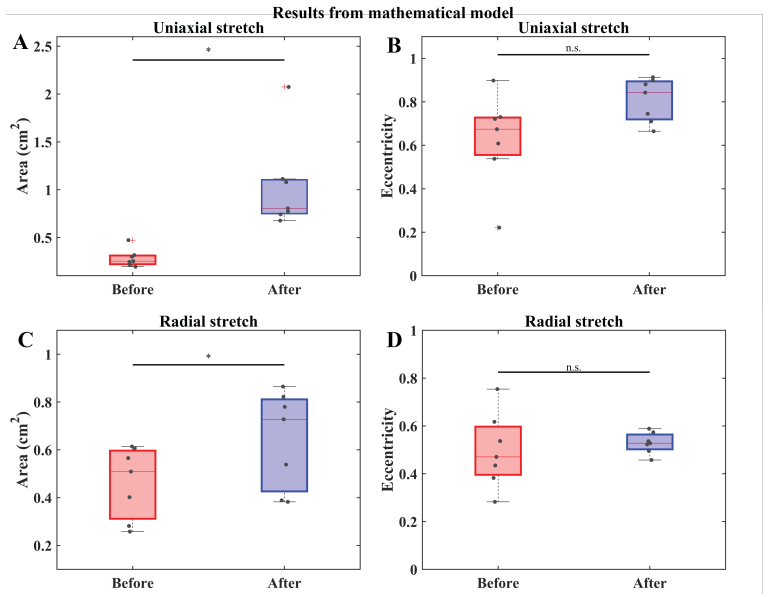
Glass-based physical models, formed by shaping glass into monolayers, heating to process temperature, and stretching, arrest deformed configurations upon cooling that replicate the large deformations and increased eccentricity seen in T. adhaerens epithelial tissues. Tensegrity-based models capture the principal experimental deformation patterns but underestimate the magnitude of eccentricity changes.
What carries the argument
Heating and stretching glass at its process temperature to produce tunable, arrestable tissue-like strain states, validated against tensegrity simulations of cellular geometry.
If this is right
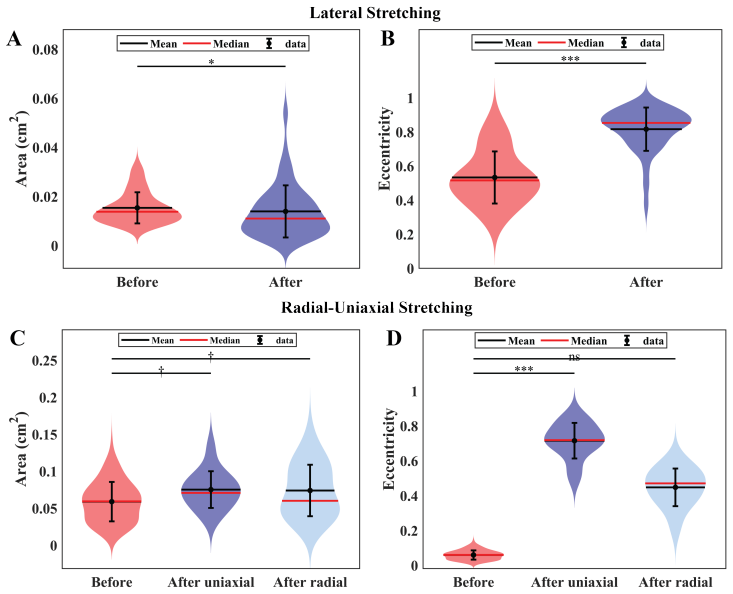
- Area and eccentricity of individual cells increase under lateral and radial stretching.
- The models reproduce ductile-to-brittle transitions at fast loading rates.
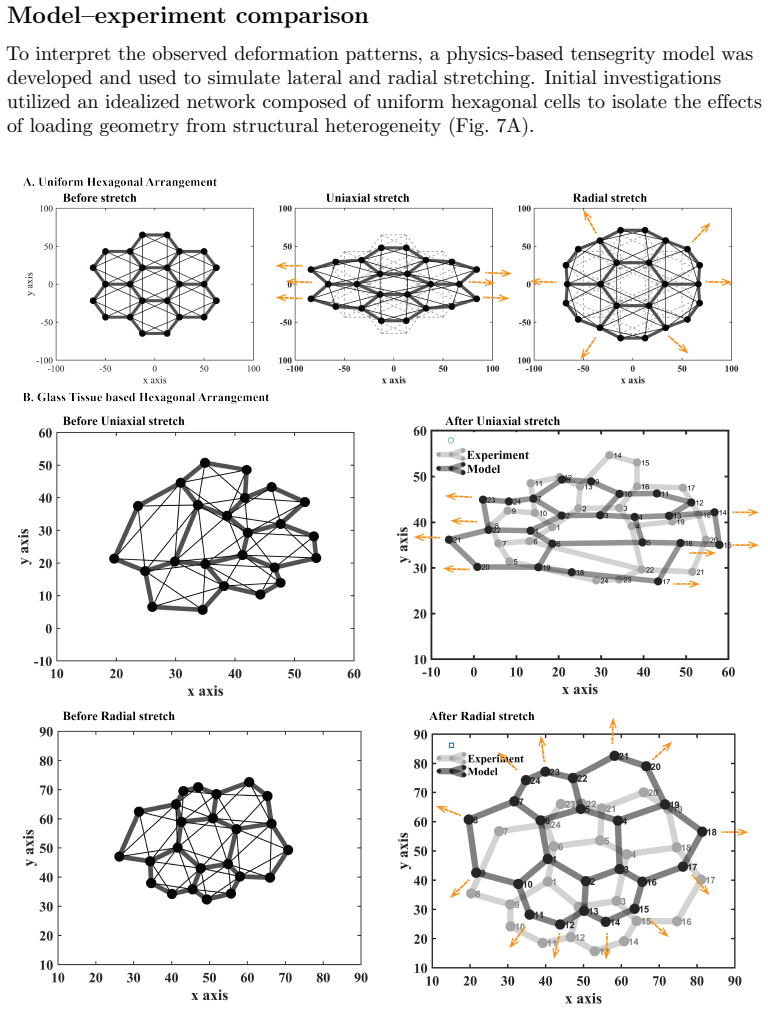
- Tensegrity models can be used to quantify and compare deformations with experiments.
- Interdisciplinary art and science methods enable new studies of tissue-scale mechanics.
Where Pith is reading between the lines
- The approach may allow testing of mechanical hypotheses without using live organisms initially.
- Similar physical modeling could apply to other simple tissues or organisms exhibiting large deformations.
- Further refinement of the tensegrity model might better match the observed eccentricity magnitudes.
Load-bearing premise
The mechanical response of heated and stretched glass at its process temperature is sufficiently similar to the epithelial tissue of T. adhaerens to serve as a valid analog for large deformations and eccentricity changes.
What would settle it
If measurements on actual T. adhaerens show no increase in eccentricity or no ductile-to-brittle transition matching the glass model behaviors under comparable stretch rates and geometries.
Figures

read the original abstract
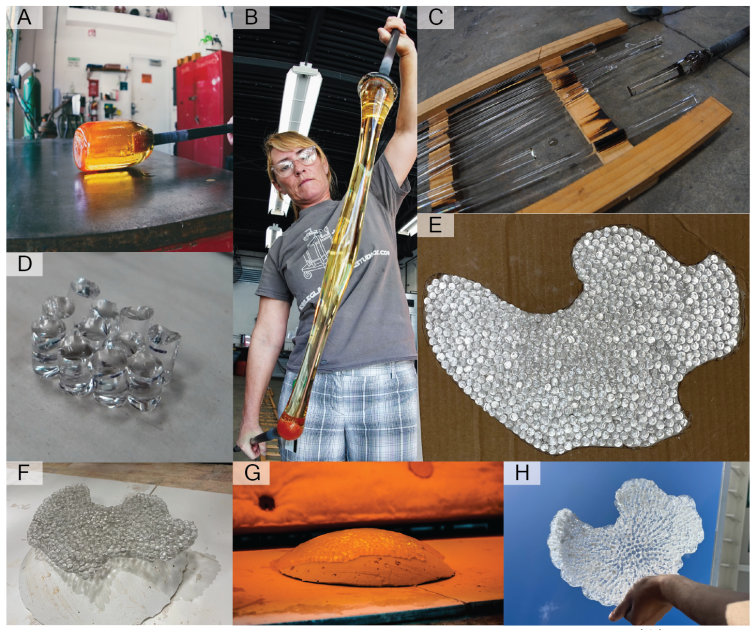
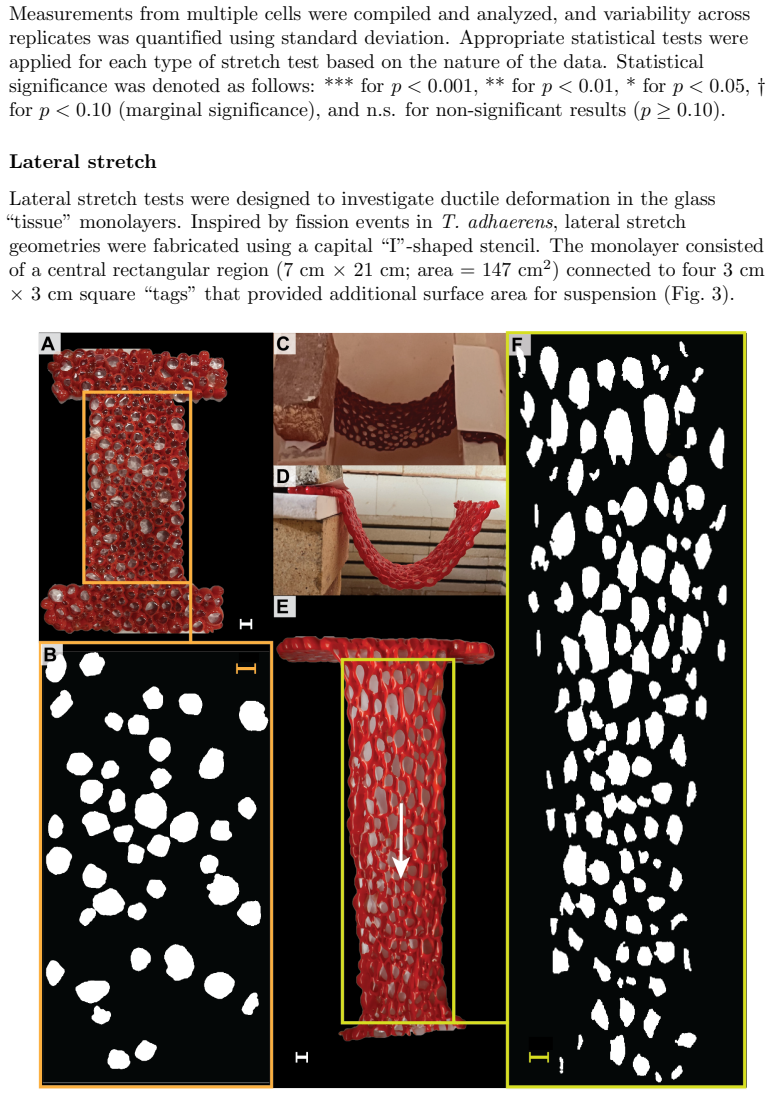
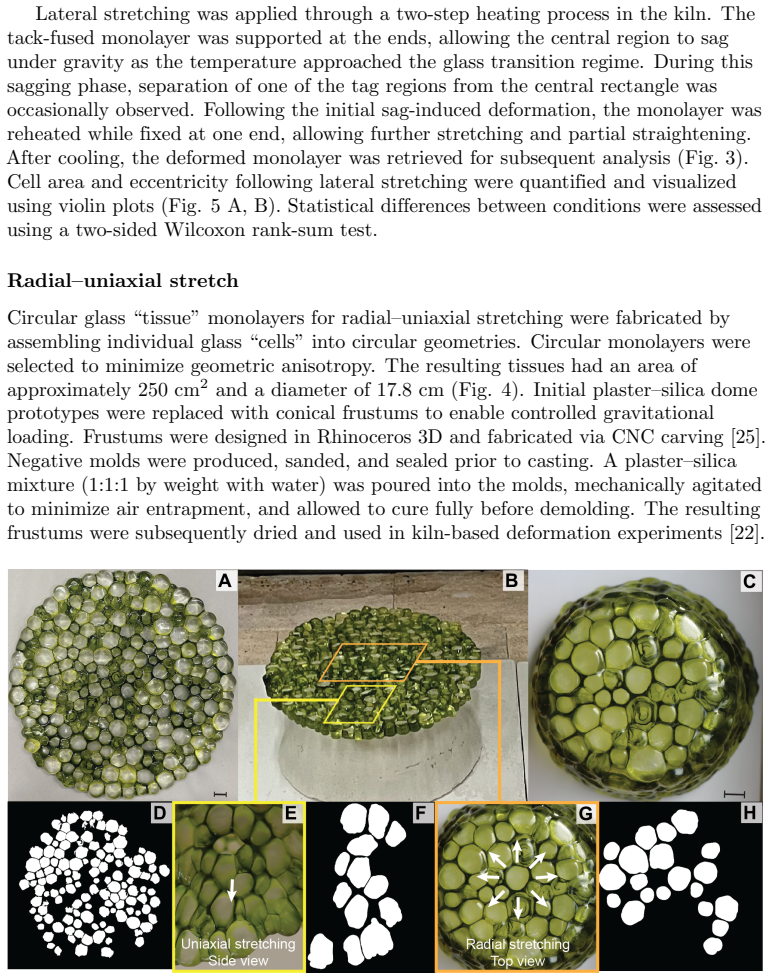
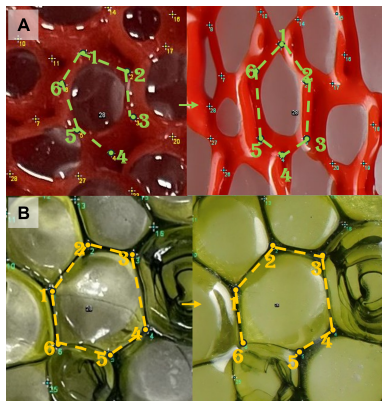
Techniques from glass art and fabrication provide a controllable physical platform for studying tissue mechanics in simple organisms. Here, we use glass-based physical models to investigate tissue deformation in the marine organism Trichoplax adhaerens. Previous studies have shown that the epithelial tissues in T. adhaerens undergo large deformations and form fracture holes under mechanical loading, exhibiting a ductile-to-brittle transition at fast loading rates. To model these behaviors in a tunable and experimentally accessible system, glass is shaped into tissue-like monolayers in a glass studio, heated to its specific process temperature, and subjected to controlled stretching. Rapid cooling arrests the deformed configurations, providing snapshots of tissue-like strain states under load. Under lateral and radial stretching, we quantify changes in the area and eccentricity of individual "cells" in the glass models, and found that eccentricity increases after stretching. We further use tensegrity-based models to quantify deformations in the cellular geometry of the glass tissues, enabling direct comparison between experiments and simulations. The model captures the principal experimental deformation patterns, but underestimates the magnitude of the observed eccentricity changes. Our results demonstrate that glass-based physical models provide an experimentally accessible platform for studying tissue-scale deformation and mechanical behavior, while supporting interdisciplinary approaches that connect methods in the arts and sciences.
Editorial analysis
A structured set of objections, weighed in public.
Referee Report
Summary. The manuscript claims that glass-based physical models fabricated as tissue-like monolayers, heated to process temperature, stretched under controlled lateral/radial conditions, and rapidly cooled to arrest deformed states, constitute an experimentally accessible platform for studying tissue-scale deformations and mechanical behavior in Trichoplax adhaerens. Experiments quantify increases in cell eccentricity after stretching; tensegrity simulations capture the principal deformation patterns but underestimate the magnitude of eccentricity changes. The work positions the approach as enabling interdisciplinary connections between glass art methods and biological mechanics.
Significance. If the platform's mechanical analogy and experimental accessibility are established, the approach could provide a tunable physical system for investigating large deformations, area changes, and ductile-to-brittle transitions without sole reliance on biological samples, while opening avenues for arts-sciences collaboration in tissue mechanics.
major comments (1)
- [Abstract] Abstract: The abstract reports directional findings (eccentricity increases after stretching; simulations capture patterns but underestimate magnitude) but supplies no quantitative data, error bars, sample sizes, statistical tests, or exclusion criteria. This makes it impossible to evaluate the strength of evidence for the central claim that the glass models form a usable platform.
Simulated Author's Rebuttal
We thank the referee for their feedback. We address the single major comment below and agree that the abstract requires strengthening with quantitative details.
read point-by-point responses
-
Referee: [Abstract] Abstract: The abstract reports directional findings (eccentricity increases after stretching; simulations capture patterns but underestimate magnitude) but supplies no quantitative data, error bars, sample sizes, statistical tests, or exclusion criteria. This makes it impossible to evaluate the strength of evidence for the central claim that the glass models form a usable platform.
Authors: We agree that the abstract, as written, provides only directional statements and omits the quantitative metrics needed to assess evidence strength. The body of the manuscript reports these values (cell eccentricity changes with standard deviations, sample sizes for cells and models, and direct experiment-simulation comparisons), but they were not summarized in the abstract. We will revise the abstract to include representative quantitative results, such as the observed average eccentricity increase under lateral and radial stretching, associated variability, sample sizes, and any statistical comparisons performed. This change will allow readers to evaluate the platform claim directly from the abstract while preserving the manuscript's overall length and focus. revision: yes
Circularity Check
No significant circularity detected
full rationale
The paper describes an experimental fabrication and stretching protocol for glass monolayers, followed by direct quantification of cell eccentricity and area changes, with comparison to separate tensegrity simulations that reproduce qualitative patterns. No load-bearing step reduces by definition, by fitted-parameter renaming, or by self-citation chain to its own inputs; the platform claim follows from the reported physical procedures and measurements without circular equivalence.
Axiom & Free-Parameter Ledger
axioms (1)
- domain assumption Heated glass at its specific process temperature deforms in a manner analogous to biological epithelial tissue under mechanical loading.
Reference graph
Works this paper leans on
-
[1]
Biomechanics: Motion, Flow, Stress, and Growth
Fung Y. Biomechanics: Motion, Flow, Stress, and Growth. Springer; 1990
1990
-
[2]
Tissue mechanics, an important regulator of development and disease
Ayad NME, Kaushik S, Weaver VM. Tissue mechanics, an important regulator of development and disease. Philosophical Transactions of the Royal Society B: Biological Sciences,20180215, 374, 1779. 2019
2019
-
[3]
Mechanics of epithelial tissue homeostasis and morphogenesis
Guillot C, Lecuit T. Mechanics of epithelial tissue homeostasis and morphogenesis. Science. 2013;340(6137):1185–1189. June 23, 2026 15/21
2013
-
[4]
Characterizing the mechanics of cultured cell monolayers
Harris AR, Peter L, Bellis J, Baum B, Kabla AJ, Charras GT. Characterizing the mechanics of cultured cell monolayers. Proceedings of the National Academy of Sciences. 2012;109(41):16449–16454. doi:10.1073/pnas.1213301109
-
[5]
Unjamming and cell shape in the asthmatic airway epithelium
Park JA, Kim JH, Bi D, Mitchel JA, Qazvini NT, Tantisira K, et al. Unjamming and cell shape in the asthmatic airway epithelium. Nature materials. 2015;14(10):1040–1048
2015
-
[6]
Field biology of placozoans (Trichoplax): distribution, diversity, biotic interactions
Pearse VB, Voigt O. Field biology of placozoans (Trichoplax): distribution, diversity, biotic interactions. Integrative and Comparative Biology. 2007;47(5):677–692. doi:10.1093/icb/icm015
-
[7]
Motility-induced fracture reveals a ductile-to-brittle crossover in a simple animal’s epithelia
Prakash VN, Bull MS, Prakash M. Motility-induced fracture reveals a ductile-to-brittle crossover in a simple animal’s epithelia. Nature Physics. 2021;17(4):504–511
2021
-
[8]
Smith C, Varoqueaux F, Kittelmann M, Azzam R, Cooper B, Winters C, et al. Novel Cell Types, Neurosecretory Cells, and Body Plan of the Early-Diverging Metazoan Trichoplax adhaerens. Current Biology. 2014;24(14):1565–1572. doi:https://doi.org/10.1016/j.cub.2014.05.046
-
[9]
Armon S, Bull MS, Aranda-Diaz A, Prakash M. Ultrafast epithelial contractions provide insights into contraction speed limits and tissue integrity. Proceedings of the National Academy of Sciences. 2018;115(44):E10333–E10341. doi:10.1073/pnas.1802934115
-
[10]
Coordinated feeding behavior in Trichoplax, an animal without synapses
Smith CL, Pivovarova N, Reese TS. Coordinated feeding behavior in Trichoplax, an animal without synapses. PloS one. 2015;10(9):e0136098
2015
-
[11]
Quantifying Ciliary-Generated Traction Forces During Locomotion in a Simple Marine Animal’s Epithelial Tissues
Madhu G, McCord M, Spencer J, Kafkis K, Notbohm J, Prakash VN. Quantifying Ciliary-Generated Traction Forces During Locomotion in a Simple Marine Animal’s Epithelial Tissues. In: SEM Annual Conference and Exposition on Experimental and Applied Mechanics. Springer; 2024. p. 83–88
2024
-
[12]
Non-bilaterians as model systems for tissue mechanics
Gooshvar S, Madhu G, Ruszczyk M, Prakash VN. Non-bilaterians as model systems for tissue mechanics. Integrative and comparative biology. 2023;63(6):1442–1454
2023
-
[13]
The cell as a material
Kasza KE, Rowat AC, Liu J, Angelini TE, Brangwynne CP, Koenderink GH, et al. The cell as a material. Current opinion in cell biology. 2007;19(1):101–107
2007
-
[14]
Glass-like dynamics of collective cell migration
Angelini TE, Hannezo E, Trepat X, Marquez M, Fredberg JJ, Weitz DA. Glass-like dynamics of collective cell migration. Proceedings of the National Academy of Sciences. 2011;108(12):4714–4719. doi:10.1073/pnas.1010059108
-
[15]
A density-independent rigidity transition in biological tissues
Bi D, Lopez J, Schwarz JM, Manning ML. A density-independent rigidity transition in biological tissues. Nature Physics. 2015;11(12):1074–1079
2015
-
[16]
A fluid-to-solid jamming transition underlies vertebrate body axis elongation
Mongera A, Rowghanian P, Gustafson HJ, Shelton E, Kealhofer DA, Carn EK, et al. A fluid-to-solid jamming transition underlies vertebrate body axis elongation. Nature. 2018;561(7723):401–405
2018
-
[17]
How glass changed the world
Rasmussen SC. How glass changed the world. vol. 3. Springer; 2012
2012
-
[18]
Dependence of the glass transition temperature on heating and cooling rate
Moynihan CT, Easteal AJ, Wilder J, Tucker J. Dependence of the glass transition temperature on heating and cooling rate. The journal of physical chemistry. 1974;78(26):2673–2677. June 23, 2026 16/21
1974
-
[19]
Glass: nature, structure, and properties
Scholze H. Glass: nature, structure, and properties. Springer Science & Business Media; 2012
2012
-
[20]
Theoretical perspective on the glass transition and amorphous materials
Berthier L, Biroli G. Theoretical perspective on the glass transition and amorphous materials. Reviews of modern physics. 2011;83(2):587–645
2011
-
[21]
Introduction to glass science and technology
Shelby JE. Introduction to glass science and technology. Royal society of chemistry; 2020
2020
-
[22]
A Novel Study of Trichoplax adhaerens Tissue Strain Using Hot and Kiln Formed Glass Processes [Master’s thesis]
Delli-Santi JE. A Novel Study of Trichoplax adhaerens Tissue Strain Using Hot and Kiln Formed Glass Processes [Master’s thesis]. University of Miami; 2023
2023
-
[23]
Glass, Marine Biology, and Physics
Efrein J, Delli-Santi C, Prakash VN. Glass, Marine Biology, and Physics. Glass Arts Society Journal. 2023; p. 49–51
2023
-
[24]
Analysis of clustered tensegrity structures using a modified dynamic relaxation algorithm
Ali NBH, Rhode-Barbarigos L, Smith IFC. Analysis of clustered tensegrity structures using a modified dynamic relaxation algorithm. International Journal of Solids and Structures. 2011;48:637–647
2011
-
[25]
Rhinoceros 3D; 2026
Robert McNeel & Associates. Rhinoceros 3D; 2026. Available from: https://www.rhino3d.com
2026
-
[26]
Generation of planar tensegrity structures through cellular multiplication
Aloui O, Orden D, Rhode-Barbarigos L. Generation of planar tensegrity structures through cellular multiplication. Applied Mathematical Modelling. 2018;64:71–92
2018
-
[27]
A method for the automatic evaluation of the dynamic relaxation parameters
Papadrakakis M. A method for the automatic evaluation of the dynamic relaxation parameters. Computer methods in applied mechanics and engineering. 1981;25(1):35–48
1981
-
[28]
Experimental testing of a tensegrity simplex: self-stress implementation and static loading
Feron J, Rhode-Barbarigos L, Latteur P. Experimental testing of a tensegrity simplex: self-stress implementation and static loading. journal of structural engineering. 2023;149(7):04023073
2023
-
[29]
A theoretical framework for sensor placement, structural identification and damage detection in tensegrity structures
Aloui O, Lin J, Rhode-Barbarigos L. A theoretical framework for sensor placement, structural identification and damage detection in tensegrity structures. Smart Materials and Structures. 2019;28(12):125004
2019
-
[30]
Multi-objective optimization of polyester-rope and steel-rope suspended footbridges
Segal EM, Rhode-Barbarigos L, Adriaenssens S, Coelho RDF. Multi-objective optimization of polyester-rope and steel-rope suspended footbridges. Engineering structures. 2015;99:559–567
2015
-
[31]
Dynamic relaxation study and experimental verification of dielectric-elastomer minimum-energy structures
Siu S, Rhode-Barbarigos L, Wagner S, Adriaenssens S. Dynamic relaxation study and experimental verification of dielectric-elastomer minimum-energy structures. Applied Physics Letters. 2013;103(17)
2013
-
[32]
Modeling Tissue Mechanics with Molten Glass
Berkowitz R. Modeling Tissue Mechanics with Molten Glass. Physics. 2024;17:55
2024
-
[33]
cells” with consistent height and diameter. June 23, 2026 18/21 Glass “cells
Madhu G, Delli-Santi C, Efrein J, Suraneni P, Nagendra Prakash V. Glass Art, Physics, and Marine Biology: Outreach using the Glass Shop as a Laboratory for Tissue Biophysics in Marine Animals. In: APS March Meeting Abstracts. vol. 2024; 2024. p. N61–004. June 23, 2026 17/21 Supporting information All colored glass used in this study was purchased from Oly...
2024
discussion (0)
Sign in with ORCID, Apple, or X to comment. Anyone can read and Pith papers without signing in.