Dynamic Resilience Assessment of Power Systems With Data Center Load Events Using Physics-Informed Neural Networks
Pith reviewed 2026-06-26 09:33 UTC · model grok-4.3
The pith
A DAE-PINN jointly predicts dynamic and algebraic states to screen data center reconnection strategies in power systems.
A machine-rendered reading of the paper's core claim, the machinery that carries it, and where it could break.
Core claim
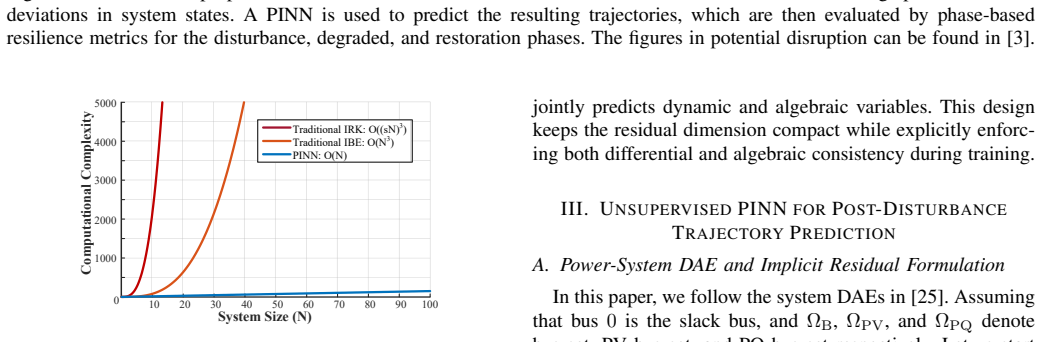
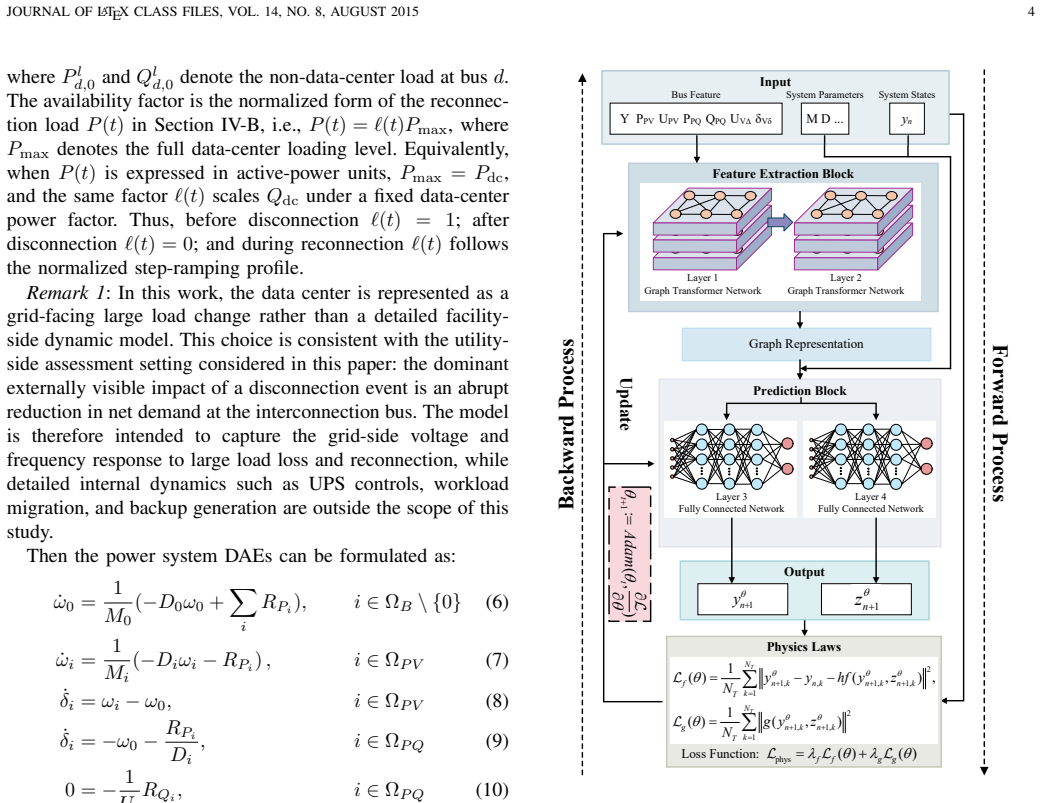
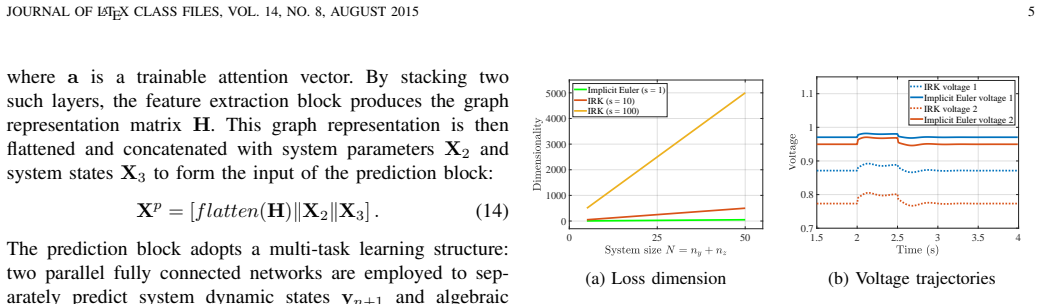
An unsupervised differential algebraic equation-physics informed neural network (DAE-PINN) based on an implicit backward Euler residual is developed to jointly predict dynamic and algebraic states, enabling repeated post-disturbance trajectory evaluation while enforcing network algebraic consistency for resilience assessment of data center load events.
What carries the argument
Unsupervised DAE-PINN using an implicit backward Euler residual to enforce algebraic consistency while predicting both dynamic and algebraic states.
If this is right
- Normalized multi-phase resilience metrics distinguish effects of disturbance size, data center location, and reconnection strategy.
- Repeated restoration screening becomes feasible for evaluating load-ramping strategies under security constraints.
- The framework reveals a trade-off between faster restoration and increased transient resilience loss.
- Computation time for repeated trajectory evaluations drops substantially compared with direct numerical DAE integration.
Where Pith is reading between the lines
- The same unsupervised residual approach could be tested on other sudden load classes such as aggregated EV charging.
- Because the network is trained without labeled internal data, it may support online retraining from streaming phasor measurements.
- Extending the residual to include stochastic load models would allow probabilistic resilience screening.
Load-bearing premise
Resilience assessment can be performed using only grid-side dynamic models and observable post-disturbance trajectories without requiring detailed internal data center models.
What would settle it
A side-by-side comparison on a new feeder or larger disturbance where the DAE-PINN state trajectories deviate from a high-fidelity numerical DAE solver by more than the reported tracking error.
Figures



read the original abstract
Large data center loads introduce new resilience challenges to power systems because their disconnection and staged reconnection can induce fast voltage and frequency dynamics that are not captured by static service-status or energy-based metrics. This paper proposes a utility-side, physics-informed resilience assessment framework that evaluates these events using only grid-side dynamic models and observable post-disturbance trajectories, without requiring detailed internal data center models. An unsupervised differential algebraic equation-physics informed neural network (DAE-PINN) based on an implicit backward Euler residual is developed to jointly predict dynamic and algebraic states, enabling repeated post-disturbance trajectory evaluation while enforcing network algebraic consistency. Normalized multi-phase resilience metrics are then used to quantify disturbance, degraded-state, and restoration-period impacts and to screen data center reconnection timing and load-ramping strategies under security constraints. Case studies on a modified IEEE 33-bus feeder show that the proposed DAE-PINN accurately tracks numerical DAE solutions and substantially reduces computation time in repeated restoration screening. The proposed metrics distinguish the effects of disturbance size, data center location, and reconnection strategy, revealing the trade-off between restoration speed and transient resilience loss.
Editorial analysis
A structured set of objections, weighed in public.
Referee Report
Summary. The paper proposes a utility-side resilience assessment framework for power systems experiencing data center load events (disconnection and staged reconnection). It develops an unsupervised DAE-PINN that employs an implicit backward Euler residual to jointly predict dynamic and algebraic states while enforcing network consistency, avoiding the need for internal data center models. Normalized multi-phase resilience metrics quantify impacts across disturbance, degraded-state, and restoration periods. Case studies on a modified IEEE 33-bus feeder report that the DAE-PINN tracks numerical DAE solutions accurately while substantially reducing computation time for repeated post-disturbance screening of reconnection timing and load-ramping strategies.
Significance. If the quantitative validation holds, the approach offers a practical tool for screening data center reconnection strategies under transient security constraints using only observable grid-side trajectories. The unsupervised PINN formulation with algebraic consistency enforcement and the multi-phase normalized metrics represent a targeted advance for handling fast dynamics from large flexible loads, potentially enabling more efficient resilience studies than repeated full numerical DAE integrations.
major comments (2)
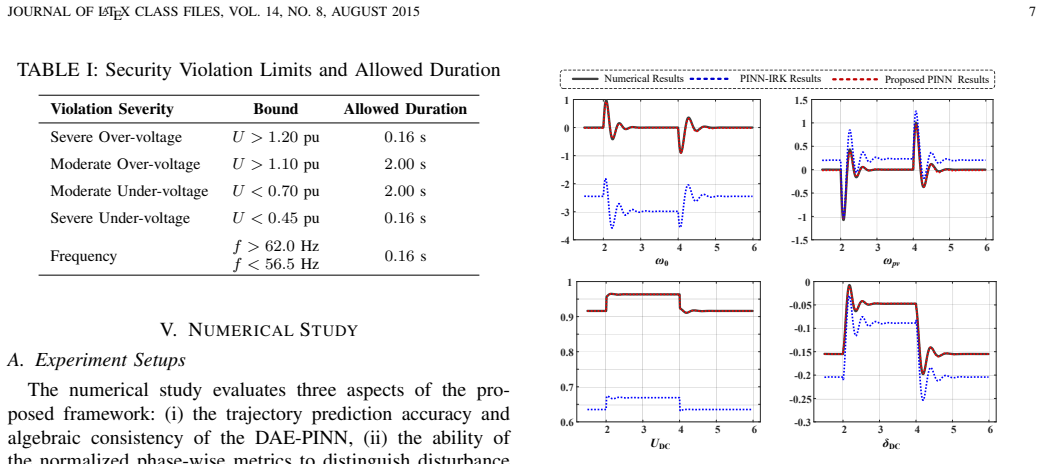
- [§4] §4 (Case Studies), Table 2 and Figure 5: the claim that DAE-PINN 'accurately tracks numerical DAE solutions' requires explicit quantitative support such as maximum absolute errors on voltage/frequency trajectories, L2 norms, or convergence plots versus the numerical solver; without these, the accuracy assertion for repeated screening remains unverified.
- [§3.2] §3.2, Eq. (8)–(10): the implicit backward Euler residual is presented as enforcing algebraic consistency, but the training loss weighting between dynamic residual, algebraic residual, and initial condition terms is not specified; this choice directly affects whether the network reliably satisfies the DAE algebraic constraints across the reported test cases.
minor comments (2)
- [Abstract] Abstract and §1: the statement that the framework uses 'only grid-side dynamic models' should be cross-referenced to the specific model equations (e.g., which generator and load models are retained) to clarify scope.
- [§5] §5: the normalized resilience metrics are introduced without an explicit sensitivity analysis showing how metric values change with data center location or ramp rate; adding this would strengthen the screening claims.
Simulated Author's Rebuttal
We thank the referee for the constructive comments on our manuscript. We address each major comment below and will revise the manuscript accordingly to strengthen the quantitative validation and clarify the training details.
read point-by-point responses
-
Referee: [§4] §4 (Case Studies), Table 2 and Figure 5: the claim that DAE-PINN 'accurately tracks numerical DAE solutions' requires explicit quantitative support such as maximum absolute errors on voltage/frequency trajectories, L2 norms, or convergence plots versus the numerical solver; without these, the accuracy assertion for repeated screening remains unverified.
Authors: We agree that explicit quantitative error metrics are required to support the accuracy claims for repeated screening applications. In the revised manuscript, we will add to Section 4 a new table (or extension to Table 2) reporting maximum absolute errors and L2 norms on voltage magnitude, voltage angle, and frequency trajectories for all case studies, directly comparing DAE-PINN outputs against the numerical DAE solver. We will also include residual convergence plots versus the solver to quantify tracking performance. revision: yes
-
Referee: [§3.2] §3.2, Eq. (8)–(10): the implicit backward Euler residual is presented as enforcing algebraic consistency, but the training loss weighting between dynamic residual, algebraic residual, and initial condition terms is not specified; this choice directly affects whether the network reliably satisfies the DAE algebraic constraints across the reported test cases.
Authors: We acknowledge that the specific weighting coefficients in the composite loss were omitted. In the revision to Section 3.2, we will explicitly state the loss weights (λ_dyn, λ_alg, λ_ic) used in Eq. (10) along with the numerical values applied during training for the reported experiments. This will allow readers to assess how algebraic consistency is enforced. revision: yes
Circularity Check
No significant circularity detected
full rationale
The DAE-PINN construction relies on an implicit backward Euler residual enforcing the underlying differential-algebraic equations directly in the loss; the method is validated by matching independent numerical DAE solvers on the IEEE 33-bus cases rather than by fitting to the evaluation trajectories themselves. Resilience metrics are computed from the resulting trajectories but are not shown to reduce to the network inputs or fitted parameters by definition. No self-citation chain, ansatz smuggling, or uniqueness theorem imported from prior author work is load-bearing for the central claim. The derivation remains self-contained against external numerical benchmarks.
Axiom & Free-Parameter Ledger
axioms (1)
- domain assumption Power system behavior during data center events can be adequately captured by grid-side dynamic models without internal data center details.
Reference graph
Works this paper leans on
-
[1]
2024 united states data center energy usage report,
A. Shehabi, A. Newkirk, S. Smith, A. Hubbard, N. Lei, M. Siddik et al., “2024 united states data center energy usage report,” Lawrence Berkeley National Laboratory, Tech. Rep. LBNL-2001637, 2024. [Online]. Available: https://escholarship.org/uc/item/32d6m0d1
2024
-
[2]
Powering intelligence: Analyzing artificial intelligence and data center energy consumption,
J. Aljbour, T. Wilson, and P. Patel, “Powering intelligence: Analyzing artificial intelligence and data center energy consumption,”EPRI White Paper no. 3002028905, 2024
2024
-
[3]
Incident review: Considering simultaneous voltage-sensitive load reductions,
North American Electric Reliability Corporation, “Incident review: Considering simultaneous voltage-sensitive load reductions,” North American Electric Reliability Corporation, Tech. Rep.,
-
[4]
Available: https://www.nerc.com/globalassets/our-work/ reports/event-reports/incident review large load loss.pdf
[Online]. Available: https://www.nerc.com/globalassets/our-work/ reports/event-reports/incident review large load loss.pdf
-
[5]
Power systems resilience metrics: A comprehensive review of challenges and outlook,
H. Raoufi, V . Vahidinasab, and K. Mehran, “Power systems resilience metrics: A comprehensive review of challenges and outlook,”Sustain- ability, vol. 12, no. 22, p. 9698, 2020
2020
-
[6]
Resilience metrics for the electric power system: A performance-based approach
E. D. Vugrin, A. R. Castillo, and C. A. Silva-Monroy, “Resilience metrics for the electric power system: A performance-based approach.” Sandia National Laboratories (SNL-NM), Albuquerque, NM (United States), Tech. Rep., 2017
2017
-
[7]
How long is a resilience event in a transmission system?: Metrics and models driven by utility data,
I. Dobson and S. Ekisheva, “How long is a resilience event in a transmission system?: Metrics and models driven by utility data,”IEEE Transactions on Power Systems, vol. 39, no. 2, pp. 2814–2826, 2023
2023
-
[8]
Models, metrics, and their formulas for typical electric power system resilience events,
I. Dobson, “Models, metrics, and their formulas for typical electric power system resilience events,”IEEE Transactions on Power Systems, vol. 38, no. 6, pp. 5949–5952, 2023
2023
-
[9]
Metrics and quantification of operational and infrastruc- ture resilience in power systems,
M. Panteli, P. Mancarella, D. N. Trakas, E. Kyriakides, and N. D. Hatziargyriou, “Metrics and quantification of operational and infrastruc- ture resilience in power systems,”IEEE Transactions on Power Systems, vol. 32, no. 6, pp. 4732–4742, 2017
2017
-
[10]
Methods for analysis and quantification of power system resilience,
A. M. Stankovi ´c, K. L. Tomsovic, F. De Caro, M. Braun, J. H. Chow, N. ˇCukalevski, I. Dobson, J. Eto, B. Fink, C. Hachmannet al., “Methods for analysis and quantification of power system resilience,” IEEE Transactions on Power Systems, vol. 38, no. 5, pp. 4774–4787, 2022
2022
-
[11]
Practical guidance and considerations for large load interconnections,
R. Quint, K. Thomas, J. Zhao, A. Isaacs, and C. Baker, “Practical guidance and considerations for large load interconnections,”Elevate Energy Consulting, Washington, DC, USA, 2025
2025
-
[12]
Characteristics and risks of emerging large loads,
North American Electric Reliability Corporation, “Characteristics and risks of emerging large loads,” North American Electric Reliability Corporation, Large Loads Task Force White Paper, Jul. 2025. [Online]. Available: https: //www.nerc.com/globalassets/who-we-are/standing-committees/rstc/3 doc white-paper-characteristics-and-risks-of-emerging-large-loads.pdf
2025
-
[13]
Short-term load forecasting for ai-data center,
M. Mughees, Y . Li, Y . Chen, and Y . R. Li, “Short-term load forecasting for ai-data center,” in2025 IEEE Power & Energy Society General Meeting (PESGM). IEEE, 2025, pp. 1–5
2025
-
[14]
Enhanced precision data center server power consumption model with temperature estimation based on cpu operating statues,
L. Yu, D. Liu, J. Zhu, H. Zhou, Y . Li, Y . Wang, and H. Jia, “Enhanced precision data center server power consumption model with temperature estimation based on cpu operating statues,”Applied Energy, vol. 394, p. 126097, 2025
2025
-
[15]
Power for ai data centers: Energy demand, grid impacts, challenges and perspectives,
Y . Sheng, C. Zhang, Z. Zhu, H. Xu, J. Wen, R. Wang, J. Yang, Q. Wang, and S. Bu, “Power for ai data centers: Energy demand, grid impacts, challenges and perspectives,”Energies, vol. 19, no. 3, p. 722, 2026
2026
-
[16]
Electricity demand and grid impacts of ai data centers: Challenges and prospects,
X. Chen, X. Wang, A. Colacelli, M. Lee, and L. Xie, “Electricity demand and grid impacts of ai data centers: Challenges and prospects,”arXiv preprint arXiv:2509.07218, 2025
arXiv 2025
-
[17]
Data center load modeling through optimal energy consumption characteristics: A path to simultaneously enhance energy efficiency and demand response quality,
Y . Zhou, F. Wei, S. Li, Z. Wang, J. Liu, and D. Yu, “Data center load modeling through optimal energy consumption characteristics: A path to simultaneously enhance energy efficiency and demand response quality,” Applied Energy, vol. 393, p. 126095, 2025
2025
-
[18]
Physics-informed neural networks: A deep learning framework for solving forward and inverse problems involving nonlinear partial differential equations,
M. Raissi, P. Perdikaris, and G. E. Karniadakis, “Physics-informed neural networks: A deep learning framework for solving forward and inverse problems involving nonlinear partial differential equations,” Journal of Computational physics, vol. 378, pp. 686–707, 2019
2019
-
[19]
Physics-informed neural networks for power systems,
G. S. Misyris, A. Venzke, and S. Chatzivasileiadis, “Physics-informed neural networks for power systems,” in2020 IEEE power & energy society general meeting (PESGM). IEEE, 2020, pp. 1–5
2020
-
[20]
Transient stabil- ity analysis with physics-informed neural networks,
J. Stiasny, G. S. Misyris, and S. Chatzivasileiadis, “Transient stabil- ity analysis with physics-informed neural networks,”arXiv preprint arXiv:2106.13638, 2021
arXiv 2021
-
[21]
Dae-pinn: a physics-informed neural network model for simulating differential algebraic equations with application to power networks,
C. Moya and G. Lin, “Dae-pinn: a physics-informed neural network model for simulating differential algebraic equations with application to power networks,”Neural Computing and Applications, vol. 35, no. 5, pp. 3789–3804, 2023
2023
-
[22]
Pinnsim: A simulator for power system dynamics based on physics-informed neural networks,
J. Stiasny, B. Zhang, and S. Chatzivasileiadis, “Pinnsim: A simulator for power system dynamics based on physics-informed neural networks,” Electric Power Systems Research, vol. 235, p. 110796, 2024
2024
-
[23]
Physics-following neural network for online dynamic security assessment,
C. Shen, K. Zuo, and M. Sun, “Physics-following neural network for online dynamic security assessment,”IEEE Transactions on Power Systems, 2025
2025
-
[24]
Fast transient stability batch assessment using cascaded convolutional neural networks,
R. Yan, G. Geng, Q. Jiang, and Y . Li, “Fast transient stability batch assessment using cascaded convolutional neural networks,”IEEE Trans- actions on Power Systems, vol. 34, no. 4, pp. 2802–2813, 2019
2019
-
[25]
Implicit runge–kutta methods for differential algebraic equations,
M. Roche, “Implicit runge–kutta methods for differential algebraic equations,”SIAM journal on numerical analysis, vol. 26, no. 4, pp. 963–975, 1989
1989
-
[26]
A bi-stable branch model for energy- based cascading failure analysis in power systems,
H. Zheng and C. L. DeMarco, “A bi-stable branch model for energy- based cascading failure analysis in power systems,” inNorth American Power Symposium 2010. IEEE, 2010, pp. 1–7
2010
-
[27]
A discussion on euler method: A review,
B. N. Biswas, S. Chatterjee, S. Mukherjee, and S. Pal, “A discussion on euler method: A review,”Electronic Journal of Mathematical Analysis and Applications, vol. 1, no. 2, pp. 2090–2792, 2013
2090
-
[28]
P. Veli ˇckovi´c, G. Cucurull, A. Casanova, A. Romero, P. Lio, and Y . Ben- gio, “Graph attention networks,”arXiv preprint arXiv:1710.10903, 2017
Pith/arXiv arXiv 2017
-
[29]
Facility interconnec- tion requirements,
Dominion Energy Virginia, Electric Transmission, “Facility interconnec- tion requirements,” Revision 25.0, effective Oct. 1, 2025, 2025
2025
-
[30]
Ieee 1547 and 2030 standards for distributed energy resources interconnection and interoperability with the electricity grid,
T. Basso, “Ieee 1547 and 2030 standards for distributed energy resources interconnection and interoperability with the electricity grid,” National Renewable Energy Laboratory (NREL), Golden, CO (United States), Tech. Rep., 2014
2030
discussion (0)
Sign in with ORCID, Apple, or X to comment. Anyone can read and Pith papers without signing in.