Integrated Whispering-Gallery Microlaser-Waveguide Platform for On-Chip Electrical Excitation of InGaAs Quantum Dots
Pith reviewed 2026-06-26 09:44 UTC · model grok-4.3
The pith
An electrically driven microlaser on a chip excites distant quantum dots through a waveguide to produce single photons.
A machine-rendered reading of the paper's core claim, the machinery that carries it, and where it could break.
Core claim
The authors demonstrate that coherent emission from an on-chip whispering-gallery-mode micropillar laser, evanescently coupled into a ridge waveguide, can optically pump InGaAs quantum dots located in a separate electrically contacted micropillar at the waveguide end, producing single-photon emission with measured g(2)(0) = (3.49 ± 0.01) percent that remains tunable by the quantum-confined Stark effect.
What carries the argument
Evanescent coupling between a whispering-gallery-mode micropillar laser and a ridge waveguide that delivers on-chip optical excitation to quantum dots in a distant micropillar.
If this is right
- Single-photon sources can be fabricated entirely on one chip with only electrical contacts, removing external laser alignment.
- Spectral tuning of the emitted photons by the Stark effect remains available after integration.
- The same waveguide can in principle connect multiple laser-QD pairs, enabling larger circuits.
- Continuous-wave operation is shown to suffice, so pulsed electrical drive is not required for the basic demonstration.
Where Pith is reading between the lines
- The platform could be extended to include on-chip detectors or modulators at the waveguide output to create a fully monolithic quantum node.
- Because the laser and the emitter share the same epitaxial stack, wafer-scale processing might allow thousands of such sources on one die.
- If background counts remain low at higher laser powers, the design could support higher repetition rates without external filtering.
Load-bearing premise
The light that reaches the target quantum dots is strong enough to drive them into the single-photon regime without adding enough background or multi-photon events to spoil the measured correlation.
What would settle it
A measurement showing g(2)(0) above 10 percent or loss of antibunching when the waveguide gap is varied while keeping laser current fixed would indicate the coupling fails to deliver clean excitation.
Figures



read the original abstract
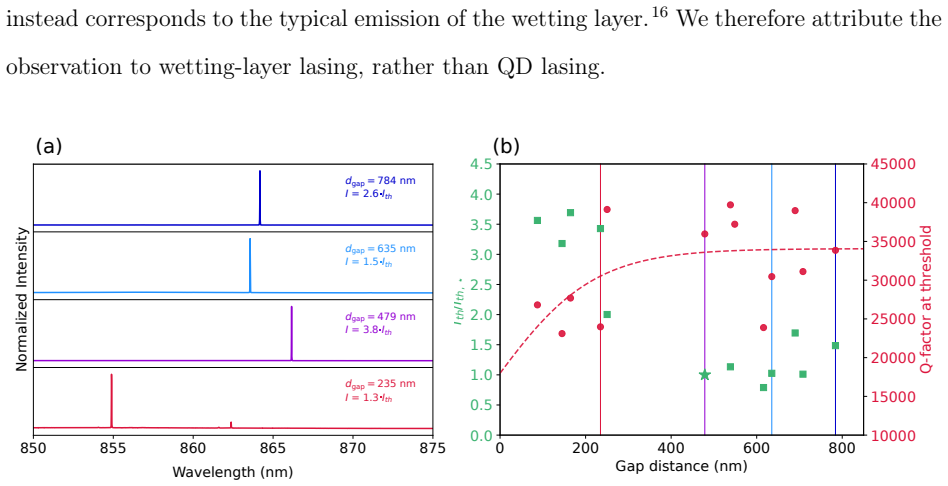
We report the fabrication and characterization of an integrated quantum photonic device consisting of an electrically driven whispering-gallery-mode micropillar laser evanescently coupled to a ridge waveguide, both incorporating InGaAs quantum dots (QDs). The lasing characteristics of microlasers are systematically investigated as a function of the pillar-waveguide gap distance. Coherent emission from the whispering-gallery-mode microlaser coupled into the waveguide enables on-chip optical excitation of QDs embedded in an electrically contacted micropillar at the end of the waveguide. Under continuous-wave on-chip excitation, we observe single-photon emission with $g^{(2)}(0) = (3.49 \pm 0.01) \%$ for a QD integrated in the outcoupling micropillar which can be spectrally tuned-by the quantum confined Stark effect. These results constitute an important step toward low-footprint, deterministic, and scalable single-photon sources for QD-based integrated quantum photonic circuits.
Editorial analysis
A structured set of objections, weighed in public.
Referee Report
Summary. The manuscript reports fabrication of an integrated device with an electrically pumped whispering-gallery-mode micropillar laser evanescently coupled to a ridge waveguide, both incorporating InGaAs QDs. It demonstrates on-chip CW optical excitation of a QD in the outcoupling micropillar via the waveguide, yielding single-photon emission with g^{(2)}(0) = (3.49 ± 0.01)% that is spectrally tunable by the quantum confined Stark effect.
Significance. If verified, the result would constitute a meaningful step toward compact, electrically driven single-photon sources for scalable QD-based quantum photonic circuits by eliminating external laser sources and enabling on-chip excitation. The experimental demonstration of antibunching under waveguide-mediated excitation is a clear strength of the work.
major comments (1)
- [Results (lasing vs. gap)] § on lasing characteristics vs. pillar-waveguide gap (abstract and results): the manuscript states that lasing was investigated as a function of gap distance but supplies no extracted coupling coefficient, transmitted power, propagation loss, or delivered excitation intensity at the target QD. These quantities are required to establish that the reported g^{(2)}(0) originates from the intended evanescent coupling rather than residual direct illumination or electrical crosstalk.
minor comments (1)
- [Abstract] Abstract: 'tuned-by' contains a hyphenation error and should read 'tuned by'.
Simulated Author's Rebuttal
We thank the referee for the constructive feedback and positive assessment of the work's significance. We address the single major comment below.
read point-by-point responses
-
Referee: [Results (lasing vs. gap)] § on lasing characteristics vs. pillar-waveguide gap (abstract and results): the manuscript states that lasing was investigated as a function of gap distance but supplies no extracted coupling coefficient, transmitted power, propagation loss, or delivered excitation intensity at the target QD. These quantities are required to establish that the reported g^{(2)}(0) originates from the intended evanescent coupling rather than residual direct illumination or electrical crosstalk.
Authors: We agree that quantitative metrics are needed to confirm the excitation mechanism. The manuscript reports systematic measurements of lasing threshold and output power versus gap distance (demonstrating the expected monotonic dependence), but does not extract the requested parameters. In revision we will add: (i) coupling coefficients derived from the gap-dependent data using a simple evanescent-coupling model, (ii) estimates of waveguide propagation loss and transmitted power from the measured output, and (iii) calculated delivered intensity at the target QD. These will be presented in the results section together with a brief discussion ruling out direct illumination and electrical crosstalk on the basis of the gap dependence and the observed g^{(2)}(0) value. revision: yes
Circularity Check
Pure experimental demonstration; no derivations or predictions present
full rationale
The manuscript is a device fabrication and characterization report. It describes measured lasing thresholds versus gap distance, observed waveguide-coupled emission, and a directly measured g^{(2)}(0) = (3.49 ± 0.01)% under CW on-chip excitation. No equations, fitted parameters renamed as predictions, ansatzes, or uniqueness theorems appear. The central result is an experimental datum, not a quantity derived from prior inputs within the paper. No self-citation load-bearing steps exist. This is the normal case of a self-contained experimental paper.
Axiom & Free-Parameter Ledger
Reference graph
Works this paper leans on
-
[1]
J.; Betz, F.; Yang, Y.; Limame, I.; Shih, C.-W.; Burger, S.; Reitzenstein, S
Roche, L. J.; Betz, F.; Yang, Y.; Limame, I.; Shih, C.-W.; Burger, S.; Reitzenstein, S. Numerical Investigation of a Coupled Micropillar - Waveguide System for Integrated Quantum Photonic Circuits. Advanced Quantum Technologies 2024, 7, 2400195
2024
-
[2]
Huber, T.; Davanco, M.; M\" u ller, M.; Shuai, Y.; Gazzano, O.; Solomon, G. S. Filter-free single-photon quantum dot resonance fluorescence in an integrated cavity-waveguide device. Optica 2020, 7, 380--385
2020
-
[3]
Analysis of semiconductor microcavity lasers using rate equations
Bjork, G.; Yamamoto, Y. Analysis of semiconductor microcavity lasers using rate equations. IEEE Journal of Quantum Electronics 1991, 27, 2386--2396
1991
-
[4]
Optical pumping of quantum dot micropillar lasers
Andreoli, L.; Porte, X.; Heuser, T.; Gro e, J.; Moeglen-Paget, B.; Furfaro, L.; Reitzenstein, S.; Brunner, D. Optical pumping of quantum dot micropillar lasers. Opt. Express 2021, 29, 9084--9097
2021
-
[5]
C.; Koulas-Simos, A.; Brunner, D.; Reitzenstein, S
Shih, C.-W.; Limame, I.; Krüger, S.; Palekar, C. C.; Koulas-Simos, A.; Brunner, D.; Reitzenstein, S. Low-threshold lasing of optically pumped micropillar lasers with Al _ 0.2 Ga _ 0.8 As/Al _ 0.9 Ga _ 0.1 As distributed Bragg reflectors. Applied Physics Letters 2023, 122, 151111
2023
-
[6]
E.; Painter, O
Borselli, M.; Srinivasan, K.; Barclay, P. E.; Painter, O. Rayleigh scattering, mode coupling, and optical loss in silicon microdisks. Applied Physics Letters 2004, 85, 3693--3695
2004
-
[7]
D.; Oxborrow, M.; Astratov, V
Jones, B. D.; Oxborrow, M.; Astratov, V. N.; Hopkinson, M.; Tahraoui, A.; Skolnick, M. S.; Fox, A. M. Splitting and lasing of whispering gallery modes in quantum dot micropillars. Opt. Express 2010, 18, 22578--22592
2010
-
[8]
On the applicability of a few level rate equation model to the determination of exciton versus biexciton kinetics in quasi-zero-dimensional structures
Sek, G.; Musiał, A.; Podemski, P.; Misiewicz, J. On the applicability of a few level rate equation model to the determination of exciton versus biexciton kinetics in quasi-zero-dimensional structures. Journal of Applied Physics 2010, 108, 033507
2010
-
[9]
Bright Electrically Contacted Circular Bragg Grating Resonators with Deterministically Integrated Quantum Dots
Wijitpatima, S.; Auler, N.; Mudi, P.; Funk, T.; Barua, A.; Shrestha, B.; Schall, J.; Limame, I.; Rodt, S.; Reuter, D.; Reitzenstein, S. Bright Electrically Contacted Circular Bragg Grating Resonators with Deterministically Integrated Quantum Dots. ACS Nano 2024, 18, 31834--31845, PMID: 39498511 mcitethebibliography document
2024
-
[10]
Solid-state single-photon emitters
Aharonovich, I.; Englund, D.; Toth, M. Solid-state single-photon emitters. Nature Photonics 2016, 10, 631–641
2016
-
[11]
Quantum dots for photonic quantum information technology
Heindel, T.; Kim, J.-H.; Gregersen, N.; Rastelli, A.; Reitzenstein, S. Quantum dots for photonic quantum information technology. Adv. Opt. Photon. 2023, 15, 613--738
2023
-
[12]
Kaneda, F.; Kwiat, P. G. High-efficiency single-photon generation via large-scale active time multiplexing. Science Advances 2019, 5, eaaw8586
2019
-
[13]
Strong Purcell effect for InAs quantum boxes in high-Q wet-etched microdisks
Gayral, B.; Gérard, J. Strong Purcell effect for InAs quantum boxes in high-Q wet-etched microdisks. Physica E: Low-dimensional Systems and Nanostructures 2000, 7, 641--645
2000
-
[14]
Gayral, B.; G\'erard, J. M. Photoluminescence experiment on quantum dots embedded in a large Purcell-factor microcavity. Phys. Rev. B 2008, 78, 235306
2008
-
[15]
L.; Rastelli, A.; Michler, P
Hepp, S.; Hornung, F.; Bauer, S.; Hesselmeier, E.; Yuan, X.; Jetter, M.; Portalupi, S. L.; Rastelli, A.; Michler, P. Purcell-enhanced single-photon emission from a strain-tunable quantum dot in a cavity-waveguide device. Applied Physics Letters 2020, 117, 254002
2020
-
[16]
An electrically driven cavity-enhanced source of indistinguishable photons with 61\ Photonics 2016, 1, 011301
Schlehahn, A.; Thoma, A.; Munnelly, P.; Kamp, M.; Höfling, S.; Heindel, T.; Schneider, C.; Reitzenstein, S. An electrically driven cavity-enhanced source of indistinguishable photons with 61\ Photonics 2016, 1, 011301
2016
-
[17]
Somaschi, N. et al. Near-optimal single-photon sources in the solid state. Nature Photonics 2016, 10, 340--345
2016
-
[18]
In Comprehensive Semiconductor Science and Technology (Second Edition), second edition ed.; Fornari, R., Ed.; Elsevier: Oxford, 2025; pp 689--732
Reitzenstein, S. In Comprehensive Semiconductor Science and Technology (Second Edition), second edition ed.; Fornari, R., Ed.; Elsevier: Oxford, 2025; pp 689--732
2025
-
[19]
D.; Rodt, S.; Gies, C.; Ludwig, A.; Reitzenstein, S
Mudi, P.; Barua, A.; Gaur, K.; Wilksen, S.; Steinhoff, A.; Wijitpatima, S.; Tripathi, S.; Ritzmann, J.; Wieck, A. D.; Rodt, S.; Gies, C.; Ludwig, A.; Reitzenstein, S. Enhancement of Indistinguishable Photon Emission from a GaAs Quantum Dot via Charge Noise Suppression. 2025,
2025
-
[20]
Integrated nanophotonics for the development of fully functional quantum circuits based on on-demand single-photon emitters
Rodt, S.; Reitzenstein, S. Integrated nanophotonics for the development of fully functional quantum circuits based on on-demand single-photon emitters. APL Photonics 2021, 6, 010901
2021
-
[21]
Whispering gallery mode lasing in electrically driven quantum dot micropillars
Albert, F.; Braun, T.; Heindel, T.; Schneider, C.; Reitzenstein, S.; Höfling, S.; Worschech, L.; Forchel, A. Whispering gallery mode lasing in electrically driven quantum dot micropillars. Applied Physics Letters 2010, 97, 101108
2010
-
[22]
Electrically Tunable Single-Photon Source Triggered by a Monolithically Integrated Quantum Dot Microlaser
Munnelly, P.; Heindel, T.; Thoma, A.; Kamp, M.; H \"o fling, S.; Schneider, C.; Reitzenstein, S. Electrically Tunable Single-Photon Source Triggered by a Monolithically Integrated Quantum Dot Microlaser. ACS Photonics 2017, 4, 790--794
2017
-
[23]
Kryzhanovskaya, N. V. et al. III–V microdisk lasers coupled to planar waveguides. Journal of Applied Physics 2023, 134, 103101
2023
-
[24]
E.; Kardynał, B
Fricker, D.; Atkinson, P.; Jin, X.; Lepsa, M.; Zeng, Z.; Kovács, A.; Kibkalo, L.; Dunin-Borkowski, R. E.; Kardynał, B. E. E ffect of surface gallium termination on the formation and emission energy of an I n G a A s wetting layer during the growth of I n G a A s quantum dots by droplet epitaxy. Nanotechnology 2023, 34, 145601
2023
-
[25]
Empirical fits to the Voigt line width: A brief review
Olivero, J.; Longbothum, R. Empirical fits to the Voigt line width: A brief review. Journal of Quantitative Spectroscopy and Radiative Transfer 1977, 17, 233--236
1977
-
[26]
J.; Plattner, M.; Koltchanov, A.; Rodt, S.; Reitzenstein, S
Limame, I.; Shih, C.-W.; Koulas-Simos, A.; Pietsch, J.; Roche, L. J.; Plattner, M.; Koltchanov, A.; Rodt, S.; Reitzenstein, S. Diameter-dependent whispering gallery mode lasing effects in quantum dot micropillar cavities. Opt. Express 2024, 32, 31819--31829
2024
-
[27]
GaAs micro-nanodisks probed by a looped fiber taper for optomechanics applications
Ding, L.; Senellart, P.; Lemaitre, A.; Ducci, S.; Leo, G.; Favero, I. GaAs micro-nanodisks probed by a looped fiber taper for optomechanics applications . Nanophotonics III. 2010; p 771211
2010
-
[28]
D.; Midolo, L.; Lodahl, P.; Rotenberg, N
Brooks, A.; Chu, X.-L.; Liu, Z.; Schott, R.; Ludwig, A.; Wieck, A. D.; Midolo, L.; Lodahl, P.; Rotenberg, N. Integrated Whispering-Gallery-Mode Resonator for Solid-State Coherent Quantum Photonics. Nano Letters 2021, 21, 8707--8714, PMID: 34636568
2021
-
[29]
On the applicability of a few level rate equation model to the determination of exciton versus biexciton kinetics in quasi-zero-dimensional structures
Sęk, G.; Musiał, A.; Podemski, P.; Misiewicz, J. On the applicability of a few level rate equation model to the determination of exciton versus biexciton kinetics in quasi-zero-dimensional structures. Journal of Applied Physics 2010, 108, 033507
2010
-
[30]
Bright Electrically Contacted Circular Bragg Grating Resonators with Deterministically Integrated Quantum Dots
Wijitpatima, S.; Auler, N.; Mudi, P.; Funk, T.; Barua, A.; Shrestha, B.; Schall, J.; Limame, I.; Rodt, S.; Reuter, D.; Reitzenstein, S. Bright Electrically Contacted Circular Bragg Grating Resonators with Deterministically Integrated Quantum Dots. ACS Nano 2024, 18, 31834--31845, PMID: 39498511
2024
-
[31]
Fry, P. W. et al. Inverted Electron-Hole Alignment in InAs-GaAs Self-Assembled Quantum Dots. Phys. Rev. Lett. 2000, 84, 733--736
2000
-
[32]
J.; Patel, R
Bennett, A. J.; Patel, R. B.; Skiba-Szymanska, J.; Nicoll, C. A.; Farrer, I.; Ritchie, D. A.; Shields, A. J. Giant Stark effect in the emission of single semiconductor quantum dots. Applied Physics Letters 2010, 97, 031104
2010
-
[33]
Spectral control of deterministically fabricated quantum dot waveguide systems using the quantum confined Stark effect
Schnauber, P.; Große, J.; Kaganskiy, A.; Ott, M.; Anikin, P.; Schmidt, R.; Rodt, S.; Reitzenstein, S. Spectral control of deterministically fabricated quantum dot waveguide systems using the quantum confined Stark effect. APL Photonics 2021, 6, 050801
2021
-
[34]
M.; Gies, C.; Ates, S.; Wiersig, J.; Reitzenstein, S.; Hofmann, C.; L\"offler, A.; Forchel, A.; Jahnke, F.; Michler, P
Ulrich, S. M.; Gies, C.; Ates, S.; Wiersig, J.; Reitzenstein, S.; Hofmann, C.; L\"offler, A.; Forchel, A.; Jahnke, F.; Michler, P. Photon Statistics of Semiconductor Microcavity Lasers. Phys. Rev. Lett. 2007, 98, 043906 mcitethebibliography document
2007
discussion (0)
Sign in with ORCID, Apple, or X to comment. Anyone can read and Pith papers without signing in.