Chaos Generation and Control with Molecular Optomechanical System
Pith reviewed 2026-06-26 07:27 UTC · model grok-4.3
The pith
Increasing plasmon-vibration coupling drives a hybrid molecular optomechanical system from oscillations to chaos via period-doubling cascade.
A machine-rendered reading of the paper's core claim, the machinery that carries it, and where it could break.
Core claim
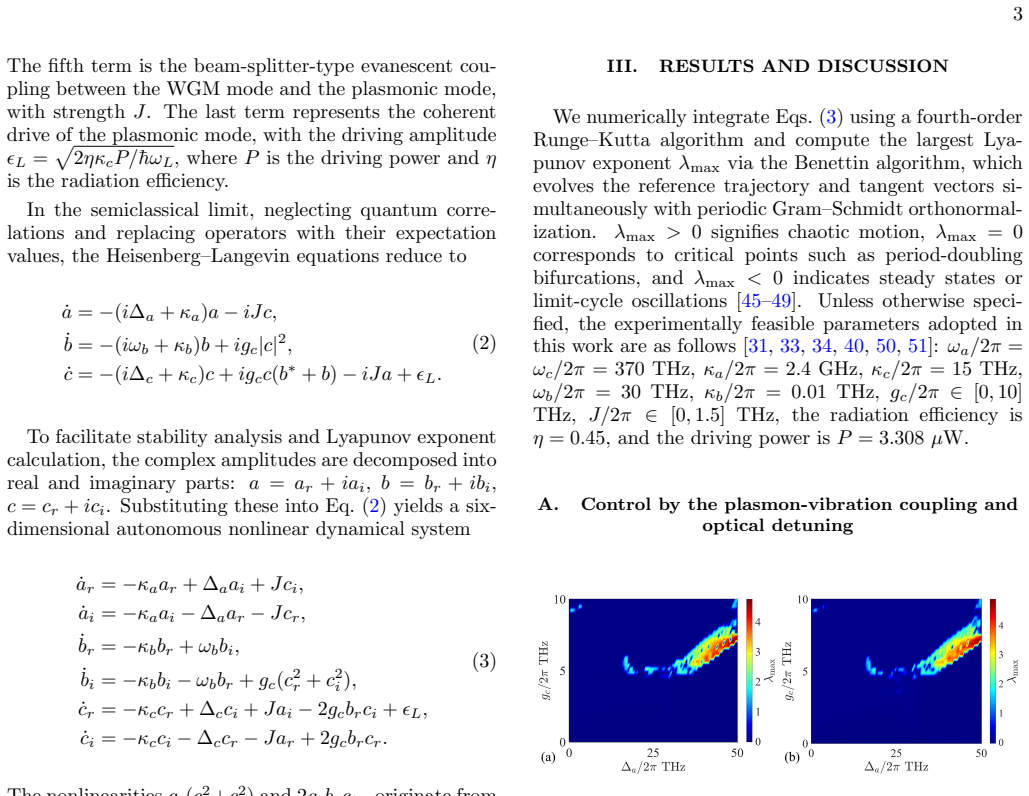
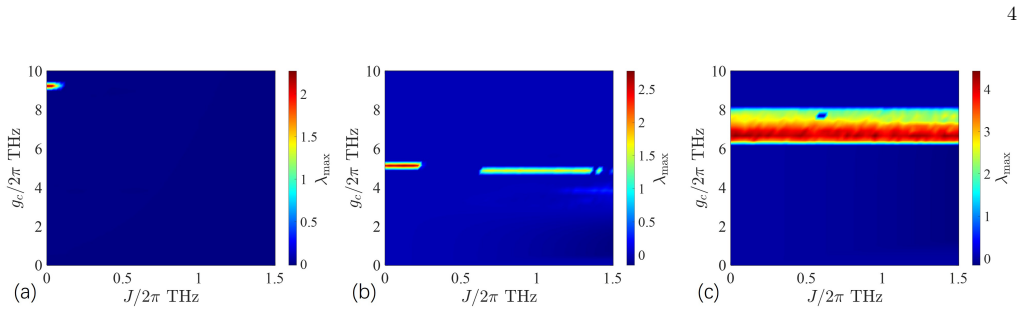
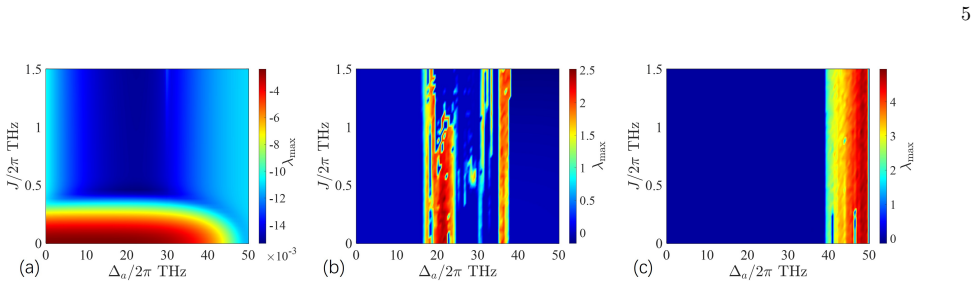
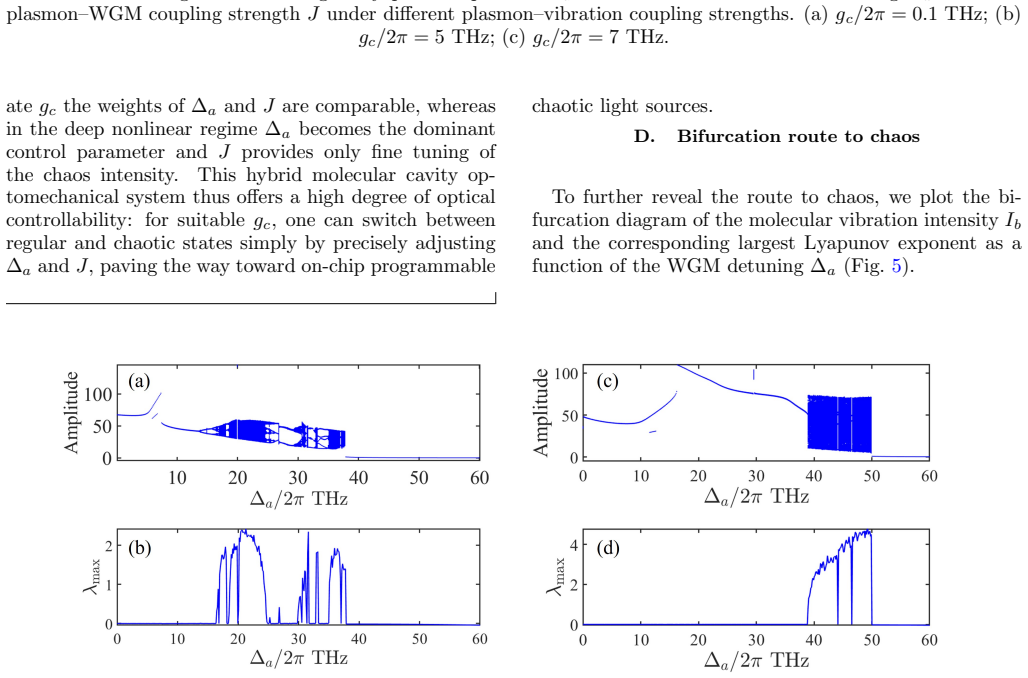
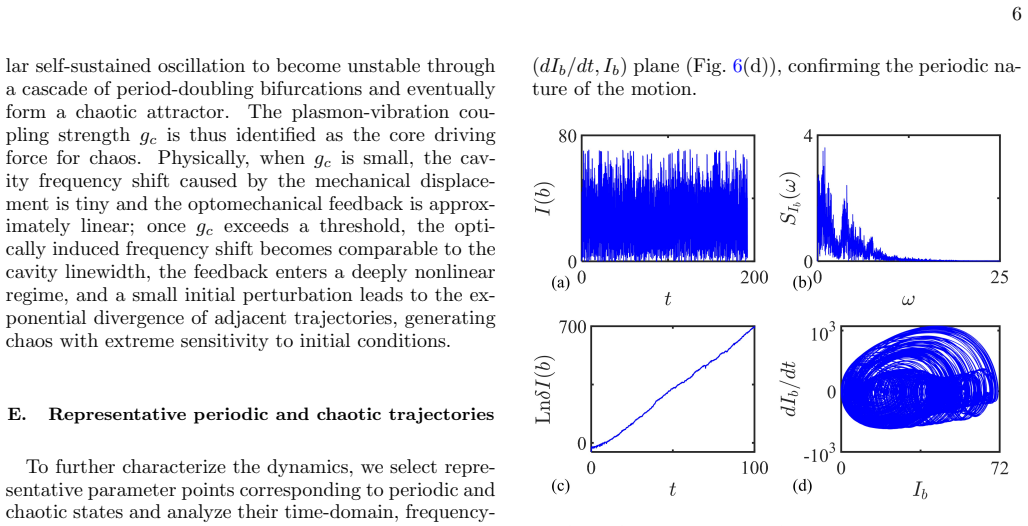
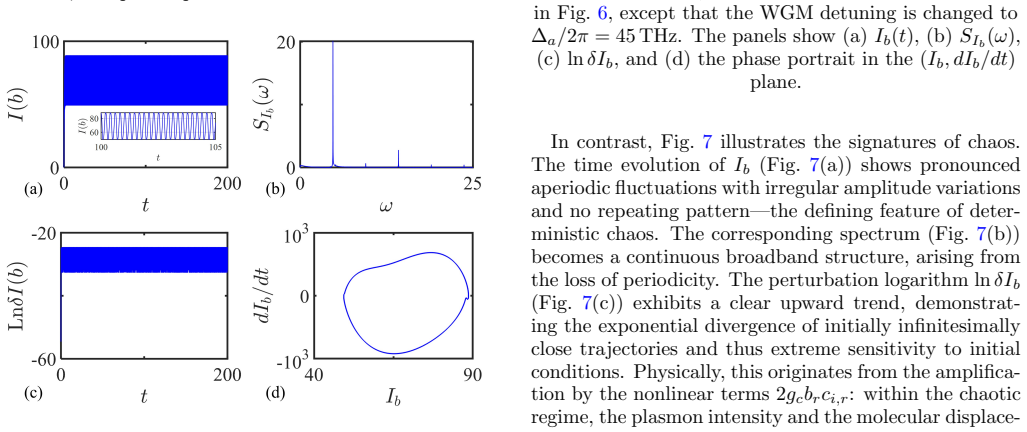
By integrating the semiclassical equations of motion and evaluating the largest Lyapunov exponent, the analysis shows that increasing the plasmon-vibration optomechanical coupling drives the system from self-sustained oscillations to chaos through a period-doubling cascade, while WGM detuning and inter-cavity coupling open or close isolated chaos windows at moderate coupling strengths.
What carries the argument
The plasmon-vibration optomechanical coupling strength, which functions as the primary bifurcation parameter controlling transitions between periodic and chaotic regimes in the hybrid cavity system.
If this is right
- The system transitions from self-sustained oscillations to chaos as the plasmon-vibration coupling strength increases.
- Isolated chaos windows can be opened or closed by tuning the WGM detuning and the inter-cavity coupling at moderate coupling strengths.
- The hybrid molecular optomechanical platform enables controllable chaotic light generation at room temperature.
- Mapping via the largest Lyapunov exponent identifies the parameter regions for periodic versus chaotic dynamics.
Where Pith is reading between the lines
- If the semiclassical period-doubling route holds experimentally, molecular optomechanics could serve as an on-chip alternative for chaos-based applications without requiring cryogenic temperatures or high driving powers.
- Tunable chaos windows suggest the possibility of switchable random-signal sources integrated with photonic circuits for secure communication protocols.
- Future extensions might examine how the inclusion of quantum noise terms alters the boundaries of the chaotic regimes identified in the semiclassical model.
Load-bearing premise
The semiclassical equations of motion accurately capture the nonlinear dynamics of the hybrid system at room temperature without significant quantum corrections or thermal noise dominating the observed period-doubling route to chaos.
What would settle it
An experiment measuring the optical field time series that finds no period-doubling bifurcations or a largest Lyapunov exponent remaining negative throughout the high plasmon-vibration coupling regime predicted by the model.
Figures

read the original abstract
Chaos is central to secure communication and physical random-number generation. Conventional cavity-optomechanical implementations, however, usually rely on weak single-photon optomechanical coupling and low-frequency mechanical modes, so access to deterministic chaotic dynamics often requires large driving power and careful suppression of thermal noise. Here we theoretically study a hybrid molecular optomechanical system formed by coupling a plasmonic nanocavity to a whispering-gallery-mode (WGM) microcavity. The plasmonic nanocavity provides terahertz-scale single-photon optomechanical coupling to a molecular vibration, while the WGM resonator offers a low-loss photonic channel that mitigates the short plasmon lifetime. By integrating the semiclassical equations of motion and evaluating the largest Lyapunov exponent, we map the nonlinear dynamical regimes in the parameter spaces of WGM detuning, plasmon--WGM coupling, and plasmon--vibration optomechanical coupling. We show that increasing the plasmon--vibration coupling drives the system from self-sustained oscillations to chaos through a period-doubling cascade. At moderate coupling strengths, isolated chaos windows can be opened or closed by tuning the WGM detuning and the inter-cavity coupling. These results identify molecular optomechanics as a controllable room-temperature platform for on-chip chaotic light generation and random-signal applications.
Editorial analysis
A structured set of objections, weighed in public.
Referee Report
Summary. The paper theoretically investigates a hybrid molecular optomechanical system in which a plasmonic nanocavity (providing strong single-photon optomechanical coupling to a molecular vibration) is coupled to a whispering-gallery-mode microcavity. Using numerical integration of semiclassical equations of motion and computation of the largest Lyapunov exponent, the authors map dynamical regimes as functions of WGM detuning, plasmon-WGM coupling, and plasmon-vibration coupling strength. They report that increasing the plasmon-vibration coupling drives a transition from self-sustained oscillations to chaos via a period-doubling cascade, with isolated chaos windows that can be opened or closed by tuning the WGM detuning and inter-cavity coupling, and position the system as a controllable room-temperature platform for chaotic light generation.
Significance. If the deterministic semiclassical model remains valid, the work identifies a hybrid platform that enables parameter-controlled access to chaotic dynamics at room temperature without requiring extreme driving powers or cryogenic conditions, which would be relevant for applications in secure communication and physical random-number generation. The use of Lyapunov exponents to delineate regimes is a standard and appropriate diagnostic for the central claim.
major comments (2)
- [Abstract and Model section] The central claim of a controllable room-temperature chaotic platform rests on integration of deterministic semiclassical equations of motion (described in the abstract and presumably the Model section). At room temperature the molecular vibration has thermal occupation kT/ħω_vib ≫ 1 and the plasmonic cavity has large decay; the corresponding Langevin noise terms required by the fluctuation-dissipation theorem are therefore expected to be non-negligible. No indication is given that these stochastic forces were retained, so it is unclear whether the reported period-doubling cascade survives when thermal noise is included.
- [Abstract] The abstract states that the system is studied at room temperature, yet the semiclassical treatment omits any discussion of the validity of the classical approximation when thermal noise is present. A quantitative estimate of the noise strength relative to the deterministic drive (e.g., via the ratio of thermal force fluctuations to the optomechanical force) is needed to support the claim that the bifurcation diagram remains representative.
Simulated Author's Rebuttal
We thank the referee for the careful reading and for emphasizing the role of thermal noise in assessing the validity of our deterministic semiclassical model at room temperature. We address the two major comments below.
read point-by-point responses
-
Referee: [Abstract and Model section] The central claim of a controllable room-temperature chaotic platform rests on integration of deterministic semiclassical equations of motion (described in the abstract and presumably the Model section). At room temperature the molecular vibration has thermal occupation kT/ħω_vib ≫ 1 and the plasmonic cavity has large decay; the corresponding Langevin noise terms required by the fluctuation-dissipation theorem are therefore expected to be non-negligible. No indication is given that these stochastic forces were retained, so it is unclear whether the reported period-doubling cascade survives when thermal noise is included.
Authors: We agree that the model employs deterministic semiclassical equations without explicit Langevin noise terms. The analysis focuses on the mean-field nonlinear dynamics and the bifurcation structure induced by the plasmon-vibration coupling. In the revised manuscript we will add a dedicated paragraph in the Model section providing a quantitative estimate of thermal force fluctuations relative to the optomechanical force, using the system parameters (room-temperature occupation, decay rates, and coupling strengths). This estimate will delineate the regime in which the deterministic approximation is expected to remain representative. revision: partial
-
Referee: [Abstract] The abstract states that the system is studied at room temperature, yet the semiclassical treatment omits any discussion of the validity of the classical approximation when thermal noise is present. A quantitative estimate of the noise strength relative to the deterministic drive (e.g., via the ratio of thermal force fluctuations to the optomechanical force) is needed to support the claim that the bifurcation diagram remains representative.
Authors: We accept that the abstract and main text should explicitly address the validity of the classical approximation. We will revise the abstract to qualify the results as obtained within the deterministic semiclassical framework and will insert the requested noise-strength estimate (thermal fluctuation to optomechanical force ratio) into the Model section of the revised manuscript. revision: yes
- Whether the reported period-doubling cascade and isolated chaos windows survive once thermal noise terms are explicitly included in the stochastic equations of motion.
Circularity Check
No significant circularity detected
full rationale
The paper derives its central claims (period-doubling route to chaos and control via detuning/coupling) directly from numerical integration of semiclassical equations of motion followed by Lyapunov exponent evaluation. This constitutes an independent dynamical simulation rather than any self-definitional loop, fitted parameter renamed as prediction, or load-bearing self-citation. No equations or steps in the provided text reduce the output to the input by construction, and the method is self-contained against external benchmarks.
Axiom & Free-Parameter Ledger
free parameters (3)
- plasmon-vibration optomechanical coupling
- WGM detuning
- plasmon-WGM coupling
axioms (2)
- domain assumption Semiclassical equations of motion suffice to describe the system dynamics
- standard math Largest Lyapunov exponent reliably detects chaotic regimes
Reference graph
Works this paper leans on
-
[1]
Allaria, F
E. Allaria, F. T. Arecchi, A. Di Garbo, and R. Meucci, Synchronization of homoclinic chaos, Phys. Rev. Lett. 86, 791 (2001)
2001
-
[2]
D’Alessio, Y
L. D’Alessio, Y. Kafri, A. Polkovnikov, and M. Rigol, From quantum chaos and eigenstate thermalization to statistical mechanics and thermodynamics, Adv. Phys. 65, 239 (2016)
2016
-
[3]
Carmon, M
T. Carmon, M. C. Cross, and K. J. Vahala, Chaotic quivering of micron-scaled on-chip resonators excited by centrifugal optical pressure, Phys. Rev. Lett.98, 167203 (2007)
2007
-
[4]
J. M. T. Thompson and H. B. Stewart,Nonlinear dy- namics and chaos(John Wiley & Sons, 2002)
2002
-
[5]
Q. Chen, C. Peng, L. Zhao, W. You, H. Wen, and J. Li, Physical layer encryption based on digital chaos in thz wireless communication, Opt. Fiber Technol.90, 104118 (2025)
2025
-
[6]
Y.-B. Peng, Z. Dai, K.-L. Lin, P.-L. Wang, Z. Shen, B. Chen, F. Grillot, and C. Wang, Broadband chaos of an interband cascade laser with a 6-ghz bandwidth, Opt. Lett.49, 3142 (2024)
2024
-
[7]
X.-Y. L¨ u, H. Jing, J.-Y. Ma, and Y. Wu,PT-symmetry- breaking chaos in optomechanics, Phys. Rev. Lett.114, 253601 (2015)
2015
-
[8]
Monifi, J
F. Monifi, J. Zhang, S ¸. K. ¨Ozdemir, B. Peng, Y.-x. Liu, F. Bo, F. Nori, and L. Yang, Optomechanically induced stochastic resonance and chaos transfer between optical fields, Nat. Photon.10, 399 (2016)
2016
-
[9]
Navarro-Urrios, N
D. Navarro-Urrios, N. E. Capuj, M. F. Colombano, P. D. Garc´ ıa, M. Sledzinska, F. Alzina, A. Griol, A. Mart´ ınez, and C. M. Sotomayor-Torres, Nonlinear dynamics and chaos in an optomechanical beam, Nat. Commun.8, 14965 (2017)
2017
-
[10]
Zhang, L.-L
D.-W. Zhang, L.-L. Zheng, C. You, C.-S. Hu, Y. Wu, and X.-Y. L¨ u, Nonreciprocal chaos in a spinning optomechan- ical resonator, Phys. Rev. A104, 033522 (2021)
2021
-
[11]
T. F. Roque, F. Marquardt, and O. M. Yevtushenko, Nonlinear dynamics of weakly dissipative optomechanical systems, New J. Phys.22, 013049 (2020)
2020
-
[12]
Zhang, Y.-B
Z.-Y. Zhang, Y.-B. Qian, L. Sun, S.-T. Huang, B.-P. Hou, and L. Tang, Squeezing-induced nonreciprocal chaos in a cavity optomechanical system, Phys. Lett. A533, 130222 (2025)
2025
-
[13]
Zhu, C.-S
G.-L. Zhu, C.-S. Hu, Y. Wu, and X.-Y. L¨ u, Cavity op- tomechanical chaos, Fundam. Res.3, 63 (2023)
2023
-
[14]
Z.-X. Liu, C. You, B. Wang, H. Xiong, and Y. Wu, Phase- mediated magnon chaos-order transition in cavity opto- magnonics, Opt. Lett.44, 507 (2019)
2019
-
[15]
W. Li, J. Cheng, W.-j. Gong, and J. Li, Nonlinear self- sustaining dynamics in cavity magnomechanics, Phys. Rev. A108, 033518 (2023)
2023
-
[16]
Peng, Z.-X
J. Peng, Z.-X. Liu, Y.-F. Yu, and H. Xiong, Cavity mag- nomechanical chaos, Phys. Rev. A110, 053704 (2024)
2024
-
[17]
M. Wang, D. Zhang, X.-H. Li, Y.-Y. Wu, and Z.-Y. Sun, Magnon chaos inpt-symmetric cavity magnomechanics, IEEE Photon. J.11, 1 (2019)
2019
-
[18]
H. H. Xu, F. Z. Cao, E. Wu, and Y. H. Ma, Chaos gener- ation and control in optoelectromechanical systems, Opt. Express33, 49996 (2025)
2025
-
[19]
Wang, X.-Y
M. Wang, X.-Y. L¨ u, J.-Y. Ma, H. Xiong, L.-G. Si, and Y. Wu, Controllable chaos in hybrid electro- optomechanical systems, Sci. Rep.6, 22705 (2016)
2016
-
[20]
Bakemeier, A
L. Bakemeier, A. Alvermann, and H. Fehske, Route to chaos in optomechanics, Phys. Rev. Lett.114, 013601 (2015)
2015
-
[21]
Li and S
J. Li and S. Chesi, Routes to chaos in the balanced two- photon dicke model with qubit dissipation, Phys. Rev. A 109, 053702 (2024)
2024
-
[22]
Halef and I
L. Halef and I. Shomroni, Route to hyperchaos in quadratic optomechanics, Phys. Rev. Lett.135, 257201 (2025)
2025
-
[23]
Genes, A
C. Genes, A. Mari, P. Tombesi, and D. Vitali, Robust en- tanglement of a micromechanical resonator with output optical fields, Phys. Rev. A78, 032316 (2008)
2008
-
[24]
Wang and A
Y.-D. Wang and A. A. Clerk, Reservoir-engineered en- tanglement in optomechanical systems, Phys. Rev. Lett. 110, 253601 (2013)
2013
-
[25]
Y. Li, W. Chen, X. He, J. Shi, X. Cui, J. Sun, and H. Xu, Boosting light-matter interactions in plasmonic nanogaps, Adv. Mater.36, 2405186 (2024)
2024
-
[26]
Esteban, J
R. Esteban, J. J. Baumberg, and J. Aizpurua, Molecu- lar optomechanics approach to surface-enhanced raman scattering, Acc. Chem. Res.55, 1889 (2022). 8
2022
-
[27]
T.-T. Ma, J. Tang, Y.-L. Zuo, R. Huang, A. Miranow- icz, F. Nori, and H. Jing, Two-polariton blockade via ultrastrong light-matter coupling, Phys. Rev. Lett.136, 033601 (2026)
2026
-
[28]
Roelli, C
P. Roelli, C. Galland, N. Piro, and T. J. Kippenberg, Molecular cavity optomechanics as a theory of plasmon- enhanced raman scattering, Nat. Nanotechnol.11, 164 (2016)
2016
-
[29]
M. K. Schmidt, R. Esteban, A. Gonzalez-Tudela, G. Giedke, and J. Aizpurua, Quantum mechanical de- scription of raman scattering from molecules in plasmonic cavities, ACS Nano10, 6291 (2016)
2016
-
[30]
M. K. Schmidt, R. Esteban, F. Benz, J. J. Baumberg, and J. Aizpurua, Linking classical and molecular optome- chanics descriptions of sers, Faraday Discuss.205, 31 (2017)
2017
-
[31]
Lombardi, M
A. Lombardi, M. K. Schmidt, L. Weller, W. M. Deacon, F. Benz, B. de Nijs, J. Aizpurua, and J. J. Baumberg, Pulsed molecular optomechanics in plasmonic nanocav- ities: From nonlinear vibrational instabilities to bond- breaking, Phys. Rev. X8, 011016 (2018)
2018
-
[32]
M. D. Anderson, S. Tarrago Velez, K. Seibold, H. Flayac, V. Savona, N. Sangouard, and C. Galland, Two-color pump-probe measurement of photonic quantum correla- tions mediated by a single phonon, Phys. Rev. Lett.120, 233601 (2018)
2018
-
[33]
F. Bell, L. Jakob, C. Todd, I. Lohia, Y. Roh, R. Arul, and J. J. Baumberg, Coherent dynamics of molecular vi- brations in single plasmonic nanogaps, Phys. Rev. Lett. 135, 076901 (2025)
2025
-
[34]
S. E. Kim, L. Zhang, K. Ma, M. Riegman, F. Chen, I. Ingold, M. Conrad, M. Z. Turker, M. Gao, X. Jiang, S. Monette, M. Pauliah, M. Gonen, P. Zanzonico, T. Quinn, U. Wiesner, M. S. Bradbury, and M. Over- holtzer, Ultrasmall nanoparticles induce ferroptosis in nutrient-deprived cancer cells and suppress tumour growth, Nat. Nanotechnol.11, 977 (2016)
2016
-
[35]
Huang, D
J. Huang, D. Lei, G. S. Agarwal, and Z. Zhang, Collective quantum entanglement in molecular cavity optomechan- ics, Phys. Rev. B110, 184306 (2024)
2024
-
[36]
B. Yin, J. Wang, Q. Zhang, D. Wang, T.-X. Lu, and H. Jing, Molecular-optomechanical phonon laser, Laser & Photonics Reviews , e71191 (2026)
2026
-
[37]
E. K. Berinyuy, D. K. Massembele, P. Djorw´ e, R. Altu- ijri, S. Abdel-Khalek, A.-H. Abdel-Aty, and S. N. Engo, Quantum correlations in molecular cavity optomechan- ics, Chaos, Solitons & Fractals205, 117820 (2026)
2026
-
[38]
Loirette-Pelous, R
A. Loirette-Pelous, R. A. Boto, J. Aizpurua, and R. Es- teban, Addressing intramolecular vibrational redistri- bution in a single molecule through pump and probe surface-enhanced vibrational spectroscopy, ACS Photon- ics (2026)
2026
-
[39]
Barzanjeh, E
S. Barzanjeh, E. S. Redchenko, M. Peruzzo, M. Wulf, D. P. Lewis, G. Arnold, and J. M. Fink, Stationary en- tangled radiation from micromechanical motion, Nature 570, 480 (2019)
2019
-
[40]
picocavities
F. Benz, M. K. Schmidt, A. Dreismann, R. Chikkaraddy, Y. Zhang, A. Demetriadou, C. Carnegie, H. Ohadi, B. de Nijs, R. Esteban, J. Aizpurua, and J. J. Baumberg, Single-molecule optomechanics in “picocavities”, Science 354, 726 (2016)
2016
-
[41]
J. J. Baumberg, Picocavities: a primer, Nano Lett.22, 5859 (2022)
2022
-
[42]
J. J. Baumberg, J. Aizpurua, M. H. Mikkelsen, and D. R. Smith, Extreme nanophotonics from ultrathin metallic gaps, Nat. Mater.18, 668 (2019)
2019
-
[43]
J. Tang, B. Li, B. Yin, T.-X. Lu, R. Huang, F. Nori, and H. Jing, Robust photon blockade with hybrid molecular optomechanics, npj Quantum Inf.12, 78 (2026)
2026
-
[44]
B. Yin, J. Wang, M.-Y. Peng, Q. Zhang, D. Wang, T.- X. Lu, K. Wei, and H. Jing, Molecular optomechanically induced transparency, Phys. Rev. A111, 043507 (2025)
2025
-
[45]
Nowoczyn, L
C. Nowoczyn, L. Mathey, and K. Seibold, Universal quantum melting of quasiperiodic attractors in driven- dissipative cavities, Phys. Rev. A113, 052208 (2026)
2026
-
[46]
Escot Mangas and J
L. Escot Mangas and J. E. Sandubete Gal´ an, A brief methodological note on chaos theory and its recent appli- cations based on new computer resources, EnergeiaVII, 53 (2020)
2020
-
[47]
Benettin, L
G. Benettin, L. Galgani, A. Giorgilli, and J.-M. Strelcyn, Lyapunov characteristic exponents for smooth dynami- cal systems and for hamiltonian systems; a method for computing all of them. part 1: Theory, Meccanica15, 9 (1980)
1980
-
[48]
Datseris, Dynamicalsystems
G. Datseris, Dynamicalsystems. jl: A julia software li- brary for chaos and nonlinear dynamics, J. Open Source Softw.3, 598 (2018)
2018
-
[49]
Baier and M
G. Baier and M. Klein,A chaotic hierarchy(World Sci- entific, 1991)
1991
-
[50]
Yu, Y.-F
H.-Y. Yu, Y.-F. Jiao, J. Wang, F. Li, B. Yin, Q.-R. Liu, T. Jiang, H. Jing, and K. Wei, Strong molecule-light en- tanglement with molecular cavity optomechanics, Phys. Rev. Lett.136, 013602 (2026)
2026
-
[51]
L. A. Jakob, W. M. Deacon, Y. Zhang, B. de Nijs, E. Pavlenko, S. Hu, C. Carnegie, T. Neuman, R. Es- teban, J. Aizpurua, and J. J. Baumberg, Giant optome- chanical spring effect in plasmonic nano- and picocavities probed by surface-enhanced raman scattering, Nat. Com- mun.14, 3291 (2023)
2023
discussion (0)
Sign in with ORCID, Apple, or X to comment. Anyone can read and Pith papers without signing in.