Double-slit optical ventriloquism: High phase sensitivity via diffraction patterns
Pith reviewed 2026-06-26 07:18 UTC · model grok-4.3
The pith
A double-slit setup turns intensity minima into a sensitive phase detector through local wave-vector shifts.
A machine-rendered reading of the paper's core claim, the machinery that carries it, and where it could break.
Core claim
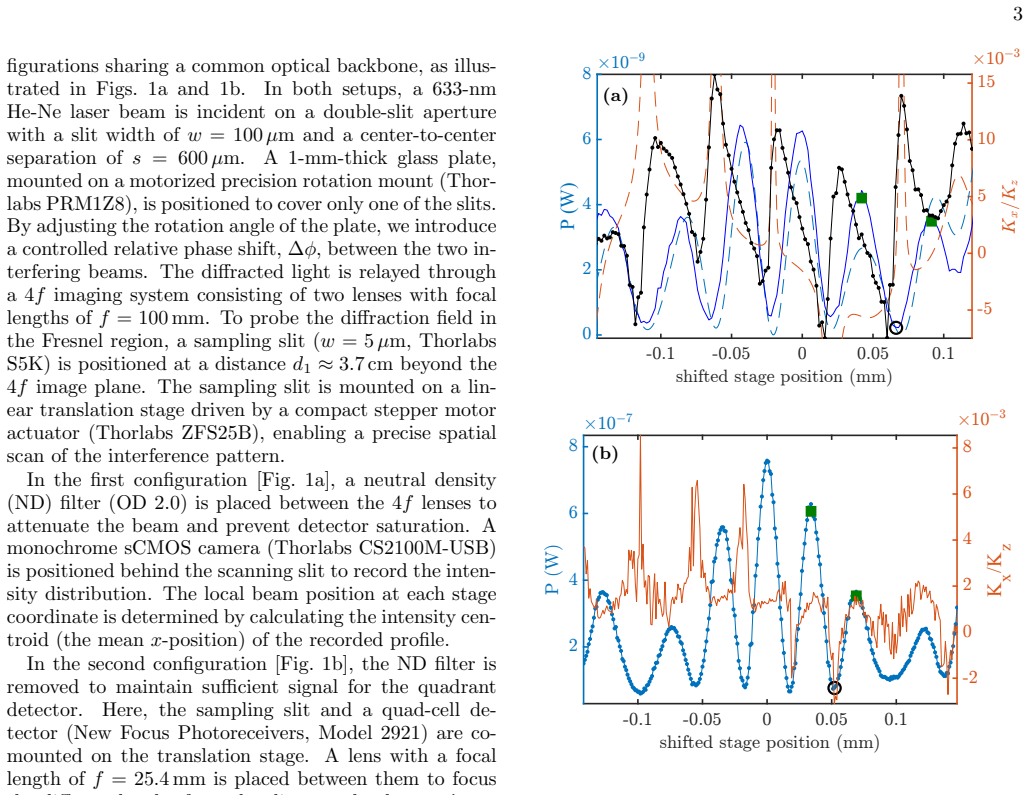
Minute phase differences between the slits produce reliable spatial displacements of the entire diffraction pattern because the local wave vector near intensity minima undergoes an anomalous shift traceable to weak-value behavior; these displacements are detected with an sCMOS camera or quadrant-cell detector, demonstrating that engineering the dark regions of simple diffraction patterns supplies a foundation for phase sensing with minimal structural complexity.
What carries the argument
The optical ventriloquism effect, in which super-oscillations near intensity minima cause an anomalous local wave-vector shift via weak-value behavior that displaces the observed diffraction pattern.
If this is right
- Phase signals can be read out from the spatial position of a simple double-slit pattern rather than from fringe visibility.
- Both imaging detectors and quadrant cells can extract the amplified displacement signal once noise sources are characterized.
- The same dark-region engineering principle applies to other low-complexity diffractive elements beyond the double slit.
- Sensitivity is ultimately set by the balance between the super-oscillatory shift and detector or source noise rather than by interferometer path stability.
Where Pith is reading between the lines
- The approach may extend to sensing other parameters that shift the effective slit phase, such as small refractive-index changes in one arm.
- Because the method relies on the dark-region behavior, it could be combined with adaptive optics that deliberately deepen the minima to increase the shift.
- Practical limits would be tested by scaling the slit separation or wavelength while keeping the same detector noise floor.
Load-bearing premise
The anomalous local wave-vector shift near the minima produces spatial displacements that reliably exceed ordinary diffraction limits and are not overwhelmed by experimental noise.
What would settle it
A measurement in which the observed pattern displacements match exactly the predictions of standard diffraction theory or fall entirely within the noise floor of the detector would falsify the claim that the ventriloquism effect supplies usable extra sensitivity.
Figures


read the original abstract
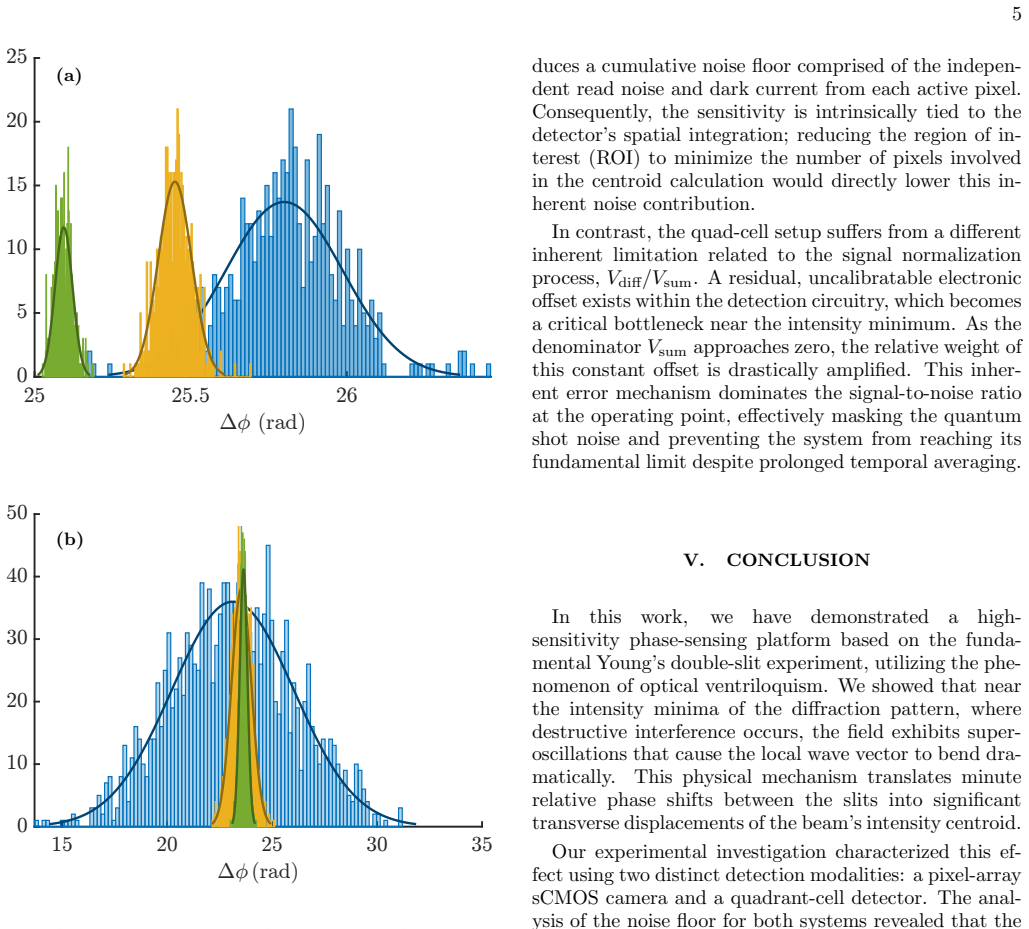
High-sensitivity phase sensing is traditionally performed using complex interferometric configurations. As an alternative, we present a robust and simple system based on the classical Young's double-slit experiment that leverages the "optical ventriloquism" effect to amplify phase signals. This phenomenon arises from super-oscillations near intensity minima, which cause an anomalous shift of the local wave vector as a consequence of weak-value behavior. In this work, we constructed an accessible experimental setup that translates minute phase differences into measurable spatial displacements of the diffraction pattern. We compare the detection performance of an sCMOS camera and a quadrant-cell detector, analyzing the noise sources that limit the system's sensitivity. Our results demonstrate that engineering the dark regions of simple diffraction patterns can provide a foundation for advanced optical sensing technologies with minimal structural complexity.
Editorial analysis
A structured set of objections, weighed in public.
Referee Report
Summary. The manuscript presents an experimental double-slit setup that exploits the optical ventriloquism effect—arising from super-oscillations near intensity minima and interpreted via weak-value behavior—to convert minute phase differences into measurable spatial displacements of the diffraction pattern. Using both sCMOS camera imaging and a quadrant-cell detector, the authors measure these shifts while analyzing limiting noise sources (shot noise, readout noise, alignment stability). The central claim is that engineering dark regions in simple diffraction patterns provides a low-complexity foundation for high-sensitivity phase sensing as an alternative to complex interferometers.
Significance. If the reported displacements and noise-limited sensitivities hold under the described conditions, the work offers a practical, minimal-complexity route to phase metrology that could impact optical sensing applications. The explicit experimental comparison of two detectors and the discussion of concrete noise budgets constitute a strength, moving beyond purely theoretical proposals. Reproducible aspects of the setup (standard double-slit geometry plus commercial detectors) further support potential for independent verification.
minor comments (3)
- [Abstract] Abstract and §2: the phrase 'optical ventriloquism' is used without an explicit definition or citation to prior literature on the effect; adding one sentence of clarification would aid readers unfamiliar with the terminology.
- [Figure 4] Figure 4 (noise analysis): the plotted displacement sensitivities lack explicit error bars or uncertainty estimates derived from the shot-noise and alignment contributions discussed in the text; including these would strengthen the quantitative claims.
- [§4.2] §4.2: the statement that the observed shifts 'exceed ordinary diffraction limits' would be clearer if accompanied by a direct numerical comparison (e.g., to the Rayleigh or Abbe limit for the given wavelength and slit separation) rather than a qualitative assertion.
Simulated Author's Rebuttal
We thank the referee for the positive summary, significance assessment, and recommendation of minor revision. No specific major comments were provided in the report.
Circularity Check
No significant circularity in experimental demonstration
full rationale
The manuscript presents an experimental double-slit setup measuring spatial shifts near intensity minima via sCMOS and quadrant detectors, with explicit noise analysis. The central claim rests on observed translations of phase differences into measurable displacements, not on any derivation, fitted parameter renamed as prediction, or self-citation chain. No equations or first-principles results are shown to reduce to their own inputs by construction. The weak-value framing is interpretive rather than load-bearing for the reported data. This is a self-contained experimental result against external benchmarks (measured displacements and noise sources), warranting score 0.
Axiom & Free-Parameter Ledger
Reference graph
Works this paper leans on
-
[1]
utilized in this work lies in the propagation of a monochromatic scalar wave, Ψ(r, t) = exp(−iωt)ψ(r), where the spatial amplitude is expressed in polar form as ψ(r) =A(r) exp[ik 0ϕ(r)].(1) Within this framework, the local wave vectork loc(r) is determined by the phase gradient: kloc(r) =k 0∇ϕ= Re " ⟨r|ˆk|ψ⟩ ⟨r|ψ⟩ # (2) By identifying the field as a state...
Pith/arXiv arXiv 2026
-
[2]
quantum potential
of the wave-vector operator ˆk. In this expression, the denominator represents the post-selection of the field at a specific spatial location⟨r|. The wave-vector opera- tor ˆkis defined in a manner analogous to the quantum momentum operator, such that its projection onto the spatial basis follows the relation:⟨r| ˆk|ψ⟩=−i∇⟨r|ψ⟩. In our double-slit configu...
1920
-
[3]
J. D. Monnier, Phases in interferometry, New Astronomy Reviews51, 604 (2007)
2007
-
[4]
Dalidet, L
R. Dalidet, L. Labont´ e, G. Sauder, S. Tanzilli, and A. Martin, Accurate and precise optical phase sensor based on a nonlinear quantum sagnac interferometer, Physical Review Research7, 033175 (2025)
2025
-
[5]
Zemlyanov, N
V. Zemlyanov, N. Kirsanov, M. Perelshtein, D. Lykov, O. Misochko, M. Lebedev, V. Vinokur, and G. Lesovik, Phase estimation algorithm for the multibeam optical metrology, Scientific Reports10, 8715 (2020)
2020
-
[6]
Ataman, A
S. Ataman, A. Preda, and R. Ionicioiu, Phase sensitiv- ity of a mach-zehnder interferometer with single-intensity and difference-intensity detection, Physical Review A98, 043856 (2018)
2018
-
[7]
Huang, C
G. Huang, C. Cui, X. Lei, Q. Li, S. Yan, X. Li, and G. Wang, A review of optical interferometry for high-precision length measurement, Micromachines16, 6 (2024)
2024
-
[8]
G. A. Lashari, F. Mumtaz, Z. Ai, and Y. Dai, Recent ad- vancements and future challenges in hybrid optical fiber interferometers, Optik282, 170860 (2023)
2023
-
[9]
Young, I
T. Young, I. the bakerian lecture. experiments and cal- culations relative to physical optics, Philosophical Trans- actions of the Royal Society of London , 1
-
[10]
Aharonov, D
Y. Aharonov, D. Z. Albert, and L. Vaidman, How the result of a measurement of a component of the spin of a spin-1/2 particle can turn out to be 100, Phys. Rev. Lett. 60, 1351 (1988)
1988
-
[11]
Berry and P
M. Berry and P. Shukla, Typical weak and superweak val- ues, Journal of Physics A: Mathematical and Theoretical 43, 354024 (2010)
2010
-
[12]
Hosoya and Y
A. Hosoya and Y. Shikano, Strange weak values, Journal of Physics A: Mathematical and Theoretical43, 385307 (2010)
2010
-
[13]
M. F. Pusey, Anomalous weak values are proofs of con- textuality, arXiv preprint arXiv:1409.1535 (2014)
Pith/arXiv arXiv 2014
-
[14]
Stern, Y
I. Stern, Y. Bloch, E. Grynszpan, M. Kahn, Y. Aharonov, J. Dressel, E. Cohen, and J. C. Howell, Light that appears to come from a source that does not exist, Phys. Rev. A 109, 012206 (2024)
2024
-
[15]
Aharonov, S
Y. Aharonov, S. Popescu, and D. Rohrlich, How can an infra-red photon behave as a gamma ray, Tel-Aviv Uni- versity Preprint TAUP90, 1847 (1990)
1990
-
[16]
M. V. Berry, Superoscillations and the quantum poten- tial, Eur. J. Phys.42, 015401 (2020)
2020
-
[17]
M. V. Berry, Faster than Fourier (World Scientific, Sin- gapore, 1994) pp. 55–65
1994
-
[18]
Berry and S
M. Berry and S. Popescu, Evolution of quantum super- oscillations and optical superresolution without evanes- cent waves, Journal of Physics A: Mathematical and Gen- eral39, 6965 (2006)
2006
-
[19]
Katzav and M
E. Katzav and M. Schwartz, Yield-optimized superoscil- lations, IEEE Transactions on Signal Processing61, 3113 (2013)
2013
-
[20]
M. R. Dennis, A. C. Hamilton, and J. Courtial, Super- oscillation in speckle patterns, Optics letters33, 2976 (2008)
2008
-
[21]
N. I. Zheludev and G. Yuan, Optical superoscillation technologies beyond the diffraction limit, Nature Reviews Physics4, 16 (2022)
2022
-
[22]
C. C. Gerry and P. L. Knight,Introductory Quantum Optics, 1st ed. (Cambridge University Press, Cambridge, UK, 2005)
2005
-
[23]
Demkowicz-Dobrza´ nski, M
R. Demkowicz-Dobrza´ nski, M. Jarzyna, and J. Ko lody´ nski, Quantum limits in optical interfer- ometry, inProgress in Optics, Progress in Optics, Vol. 60, edited by E. Wolf (Elsevier, 2015) pp. 345–435
2015
discussion (0)
Sign in with ORCID, Apple, or X to comment. Anyone can read and Pith papers without signing in.