A λ=1.3 millimeter Survey for Disks around Herbig Be Stars
Pith reviewed 2026-06-26 07:20 UTC · model grok-4.3
The pith
Millimeter detections from five Herbig Be stars match extrapolated disk scaling relations from lower-mass stars and indicate masses sufficient for giant planet formation.
A machine-rendered reading of the paper's core claim, the machinery that carries it, and where it could break.
Core claim
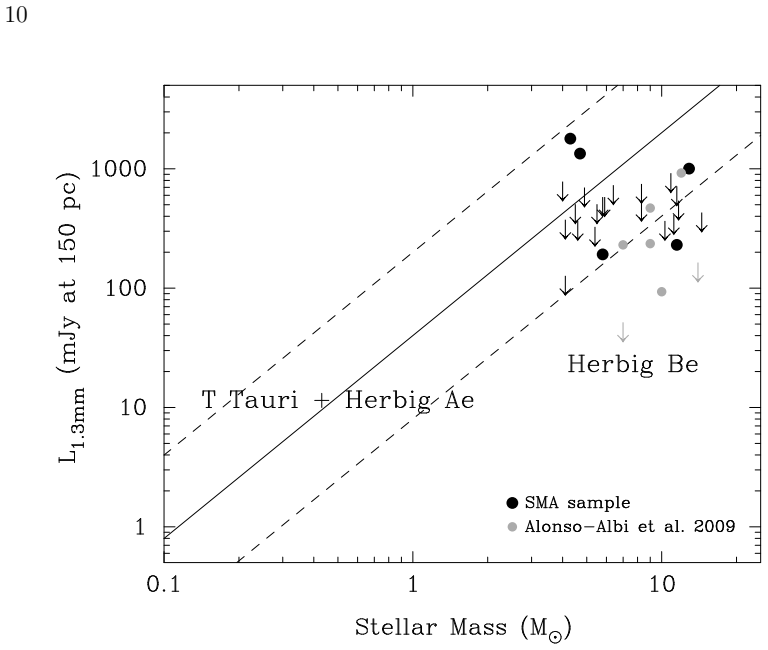
The 1.3 mm detections toward five Herbig Be stars are compatible with an extrapolation of the scaling relation between millimeter luminosity and stellar host mass, and also millimeter continuum size, derived for lower-mass T Tauri and Herbig Ae stars, suggesting these detections represent emission from circumstellar disks. The implied disk masses are sufficient for giant planet formation. No decrease in the millimeter detection fraction with stellar host mass is evident within this sample that would implicate rapid disk dissipation by the radiation fields of the higher mass stars.
What carries the argument
The scaling relation between millimeter luminosity (and continuum size) and stellar host mass, extrapolated from lower-mass stars, which the 1.3 mm detections match to indicate a disk origin.
If this is right
- The detected disks contain enough mass to form giant planets.
- Disk occurrence shows no clear drop as stellar mass increases from 4 to 13 solar masses.
- Most non-detections arise from survey sensitivity limits, photoevaporation, or the presence of stellar companions.
- Spectral indices from 0.87 mm follow-up data remain consistent with partly optically thick dust.
Where Pith is reading between the lines
- Deeper surveys could reveal whether undetected disks around the remaining stars are simply faint or genuinely absent.
- Stellar companions may dominate disk evolution more than radiation for stars above 3 solar masses.
- These results suggest models of planet formation around high-mass stars can start from disk masses similar to those around solar-type stars.
- The lack of a mass-dependent detection drop implies disk lifetimes may not shorten dramatically with increasing stellar luminosity in this range.
Load-bearing premise
The detected 1.3 mm emission originates from circumstellar disks rather than unrelated sources, and the scaling relations from lower-mass stars continue to apply here.
What would settle it
Deeper observations that either detect many more disks at higher stellar masses or show the 1.3 mm emission has a non-disk spectral signature would test the claim.
Figures
read the original abstract
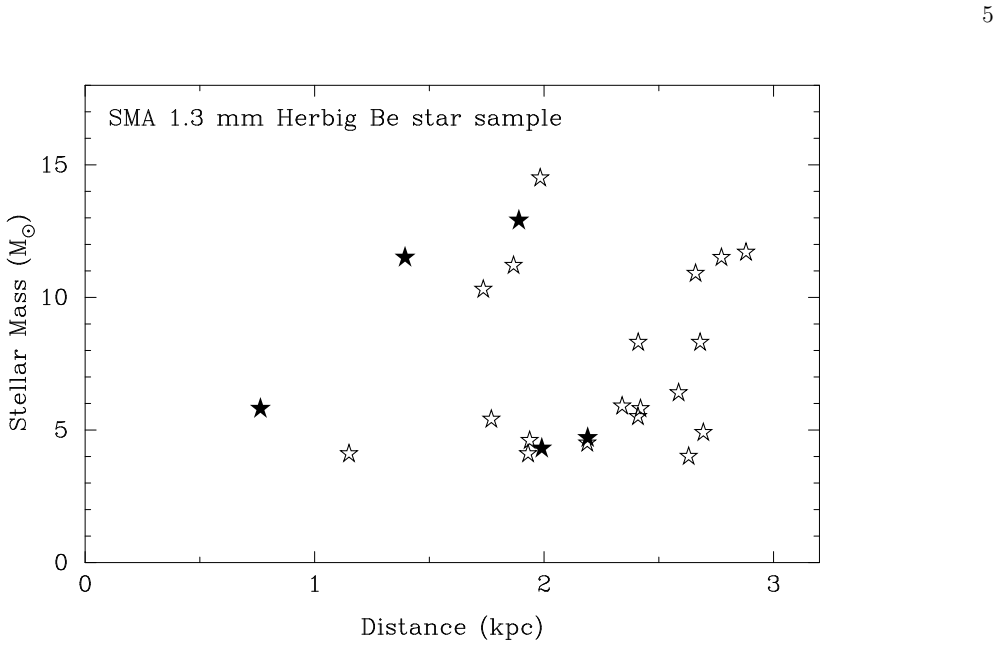
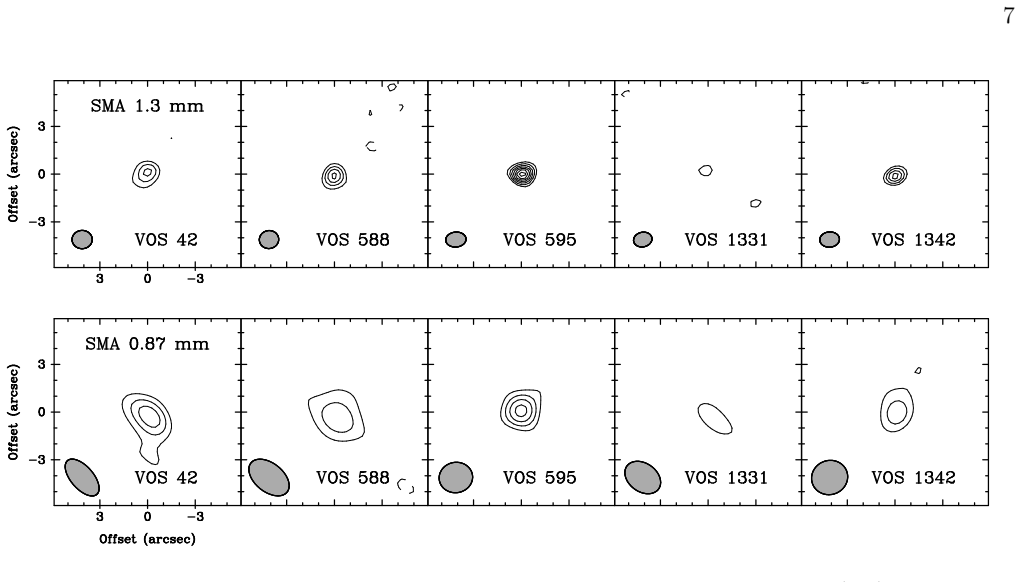
We present a survey of 24 Herbig Be stars (young stellar objects $>3$ M$_{\odot}$) within 3 kpc at 1.3~millimeters using the Submillimeter Array at about $1''$ resolution to identify circumstellar disks and assess planet forming potential. We detect 1.3 mm emission toward 5 Herbig Be stars that range in mass from 4.3 to 12.9 M$_{\odot}$. Follow-up observations at 0.87 mm show spectral indices consistent with partly optically thick dust emission. These millimeter detections are compatible with an extrapolation of the scaling relation derived for lower-mass T Tauri and Herbig Ae stars between millimeter luminosity and stellar host mass, and also millimeter continuum size, suggesting these detections represent emission from circumstellar disks. The implied disk masses are sufficient for giant planet formation. No decrease in the millimeter detection fraction with stellar host mass is evident within this sample that would implicate rapid disk dissipation by the radiation fields of the higher mass stars. The high fraction of millimeter non-detections is likely due to the survey sensitivity limits together with photoevaporation and the dynamical impact of stellar companions.
Editorial analysis
A structured set of objections, weighed in public.
Referee Report
Summary. The manuscript reports a 1.3 mm SMA survey of 24 Herbig Be stars (>3 M⊙, within 3 kpc), detecting continuum emission toward 5 sources (masses 4.3–12.9 M⊙). Follow-up 0.87 mm observations yield spectral indices consistent with partly optically thick dust. These detections lie on the extrapolated L_mm–M⋆ and size–M⋆ relations previously derived for T Tauri and Herbig Ae stars, supporting a circumstellar-disk origin. Implied disk masses are stated to be sufficient for giant-planet formation. No decline in millimeter detection fraction with stellar mass is found, arguing against rapid radiation-driven dissipation; non-detections are attributed to sensitivity limits, photoevaporation, and companions.
Significance. If the disk interpretation and scaling-relation consistency hold, the work extends millimeter-disk scaling relations into the Herbig Be regime and supplies direct evidence that disk masses around stars up to ~13 M⊙ remain adequate for giant-planet formation. The absence of a mass-dependent drop in detection rate within the sample constrains models of external photoevaporation and provides an observational anchor for population-synthesis studies of planets around intermediate-mass stars. The spectral-index check is a useful internal consistency test.
major comments (3)
- [Results] Results section (and any associated table/figure): individual 1.3 mm and 0.87 mm flux densities, uncertainties, and source positions are not reported for the five detections. Without these values it is impossible to verify the quoted spectral indices, compute L_mm, or assess whether the points truly lie on the extrapolated relations cited from lower-mass samples.
- [Discussion] Discussion of scaling relations: the manuscript states compatibility with the L_mm–M⋆ and size–M⋆ relations but does not show the actual data points overlaid on the prior fits, nor does it quantify the extrapolation (e.g., the slope and intercept adopted from the T Tauri/Herbig Ae literature or the uncertainty on the extrapolated locus). This information is required to evaluate the strength of the “compatible” claim that underpins the disk-mass and planet-formation conclusions.
- [Discussion] Detection-fraction analysis: the statement that “no decrease … is evident within this sample” is presented without a binned detection-rate plot or a simple statistical test (e.g., Spearman rank or contingency table) against stellar mass. Given the small number of detections (5/24), a quantitative assessment is needed to support the claim that radiation-driven dissipation is not operating.
minor comments (2)
- [Abstract/Introduction] The abstract and introduction should explicitly cite the specific prior works whose scaling relations are being extrapolated (e.g., the T Tauri/Herbig Ae L_mm–M⋆ papers).
- [Observations] Figure captions and text should clarify the beam size, rms noise, and primary-beam correction applied to each target so that non-detection limits can be reproduced.
Simulated Author's Rebuttal
We thank the referee for the constructive comments. We address each major point below and will revise the manuscript to incorporate the requested information and analysis.
read point-by-point responses
-
Referee: [Results] Results section (and any associated table/figure): individual 1.3 mm and 0.87 mm flux densities, uncertainties, and source positions are not reported for the five detections. Without these values it is impossible to verify the quoted spectral indices, compute L_mm, or assess whether the points truly lie on the extrapolated relations cited from lower-mass samples.
Authors: We agree that these values should be reported. The revised manuscript will add a table listing the 1.3 mm and 0.87 mm flux densities with uncertainties, source positions, and derived spectral indices for the five detections, enabling verification of the indices and L_mm calculations. revision: yes
-
Referee: [Discussion] Discussion of scaling relations: the manuscript states compatibility with the L_mm–M⋆ and size–M⋆ relations but does not show the actual data points overlaid on the prior fits, nor does it quantify the extrapolation (e.g., the slope and intercept adopted from the T Tauri/Herbig Ae literature or the uncertainty on the extrapolated locus). This information is required to evaluate the strength of the “compatible” claim that underpins the disk-mass and planet-formation conclusions.
Authors: We agree that overlaying the points and quantifying the extrapolation is needed. The revision will include a figure showing our detections overlaid on the literature L_mm–M⋆ and size–M⋆ relations, and will explicitly state the adopted slopes, intercepts, and uncertainties from the T Tauri/Herbig Ae fits. revision: yes
-
Referee: [Discussion] Detection-fraction analysis: the statement that “no decrease … is evident within this sample” is presented without a binned detection-rate plot or a simple statistical test (e.g., Spearman rank or contingency table) against stellar mass. Given the small number of detections (5/24), a quantitative assessment is needed to support the claim that radiation-driven dissipation is not operating.
Authors: We agree a quantitative assessment strengthens the claim. The revised manuscript will add a binned detection-rate plot versus stellar mass and include a Spearman rank correlation test between detection status and mass (noting the limited power due to small sample size) to support that no decrease is evident. revision: yes
Circularity Check
No significant circularity; purely observational survey with external comparisons
full rationale
The paper reports new SMA 1.3 mm observations of 24 Herbig Be stars, with 5 detections whose spectral indices (from follow-up 0.87 mm data) are consistent with dust. It then compares these luminosities and sizes to scaling relations previously derived in independent studies of T Tauri and Herbig Ae stars. No equations fit parameters to a subset of the current data and then treat a closely related quantity as a 'prediction'; no self-citation chain supplies a uniqueness theorem or ansatz that the present work relies upon; no known empirical pattern is merely renamed. All load-bearing steps are direct measurements or external literature comparisons, making the derivation self-contained against external benchmarks.
Axiom & Free-Parameter Ledger
axioms (1)
- domain assumption Millimeter continuum emission at 1.3 mm traces thermal dust emission in circumstellar disks
Reference graph
Works this paper leans on
-
[1]
Ababakr, K. M., Oudmaijer, R. D., & Vink, J. S. 2017, MNRAS, 472, 854, doi: 10.1093/mnras/stx1891
-
[2]
Akeson, R. L., Jensen, E. L. N., Carpenter, J., et al. 2019, ApJ, 872, 158, doi: 10.3847/1538-4357/aaff6a 15
-
[3]
2009, A&A, 497, 117, doi: 10.1051/0004-6361/200810401
Alonso-Albi, T., Fuente, A., Bachiller, R., et al. 2009, A&A, 497, 117, doi: 10.1051/0004-6361/200810401
-
[4]
2018, A&A, 617, A31, doi: 10.1051/0004-6361/201731658
Alonso-Albi, T., Riviere-Marichalar, P., Fuente, A., et al. 2018, A&A, 617, A31, doi: 10.1051/0004-6361/201731658
-
[5]
Andrews, S. M. 2020, ARA&A, 58, 483, doi: 10.1146/annurev-astro-031220-010302
-
[6]
Wilner, D. J. 2013, ApJ, 771, 129, doi: 10.1088/0004-637X/771/2/129
-
[7]
Andrews, S. M., Terrell, M., Tripathi, A., et al. 2018, ApJ, 865, 157, doi: 10.3847/1538-4357/aadd9f
-
[8]
Hydrodynamic models , author =
Pozzo, M. 2006, MNRAS, 367, 737, doi: 10.1111/j.1365-2966.2006.10006.x
-
[9]
1990, AJ, 99, 924, doi: 10.1086/115385 Beltr´ an, M
Guesten, R. 1990, AJ, 99, 924, doi: 10.1086/115385 Beltr´ an, M. T., & de Wit, W. J. 2016, A&A Rv, 24, 6, doi: 10.1007/s00159-015-0089-z
-
[10]
Disruption of bound clusters by photoionization
Bressan, A., Marigo, P., Girardi, L., et al. 2012, MNRAS, 427, 127, doi: 10.1111/j.1365-2966.2012.21948.x
-
[11]
D., Kamp, I., Meeus, G., Oudmaijer, R
Brittain, S. D., Kamp, I., Meeus, G., Oudmaijer, R. D., & Waters, L. B. F. M. 2023, SSRv, 219, 7, doi: 10.1007/s11214-023-00949-z CASA Team, Bean, B., Bhatnagar, S., et al. 2022, PASP, 134, 114501, doi: 10.1088/1538-3873/ac9642
-
[12]
Cheng, S., Schlaufman, K. C., & Caiazzo, I. 2025, AJ, 170, 47, doi: 10.3847/1538-3881/addd21
-
[13]
Disruption of bound clusters by photoionization
Chini, R., Hoffmeister, V. H., Nasseri, A., Stahl, O., & Zinnecker, H. 2012, MNRAS, 424, 1925, doi: 10.1111/j.1365-2966.2012.21317.x
-
[14]
2024, A&A, 692, A263, doi: 10.1051/0004-6361/202451461
Delorme, P., Chomez, A., Squicciarini, V., et al. 2024, A&A, 692, A263, doi: 10.1051/0004-6361/202451461
-
[15]
2006, ApJL, 649, L119, doi: 10.1086/508349
Fuente, A., Alonso-Albi, T., Bachiller, R., et al. 2006, ApJL, 649, L119, doi: 10.1086/508349
-
[16]
Gorti, U., & Hollenbach, D. 2009, ApJ, 690, 1539, doi: 10.1088/0004-637X/690/2/1539 Guzm´ an-D´ ıaz, J., Mendigut´ ıa, I., Montesinos, B., et al. 2021, A&A, 650, A182, doi: 10.1051/0004-6361/202039519
-
[17]
Kraus, A. L. 2012, ApJ, 751, 115, doi: 10.1088/0004-637X/751/2/115
-
[18]
2025, The Journal of Open Source Software, 10, 7482, doi: 10.21105/joss.07482
Keating, G., Hazelton, B., Kolopanis, M., et al. 2025, The Journal of Open Source Software, 10, 7482, doi: 10.21105/joss.07482
-
[19]
Keating, G. K. 2025, SMA Newsletter, 39
2025
-
[20]
2025, ApJ, 979, 46, doi: 10.3847/1538-4357/ad9746
Komaki, A., & Yoshida, N. 2025, ApJ, 979, 46, doi: 10.3847/1538-4357/ad9746
-
[21]
2021, AJ, 162, 150, doi: 10.3847/1538-3881/ac1355
Kraus, M., Liimets, T., Moiseev, A., et al. 2021, AJ, 162, 150, doi: 10.3847/1538-3881/ac1355
-
[22]
2021, ApJ, 909, 109, doi: 10.3847/1538-4357/abdb2a
Kunitomo, M., Ida, S., Takeuchi, T., et al. 2021, ApJ, 909, 109, doi: 10.3847/1538-4357/abdb2a
-
[23]
Jansky Very Large Array Sky Survey (VLASS)
Lacy, M., Baum, S. A., Chandler, C. J., et al. 2020, PASP, 132, 035001, doi: 10.1088/1538-3873/ab63eb
-
[24]
2024, Nature Astronomy, 8, 472, doi: 10.1038/s41550-023-02181-9
Li, S., Sanhueza, P., Beuther, H., et al. 2024, Nature Astronomy, 8, 472, doi: 10.1038/s41550-023-02181-9
-
[25]
Lindegren, L., Klioner, S. A., Hern´ andez, J., et al. 2021, A&A, 649, A2, doi: 10.1051/0004-6361/202039709
-
[28]
Moe, M., & Di Stefano, R. 2017, ApJS, 230, 15, doi: 10.3847/1538-4365/aa6fb6
work page internal anchor Pith review doi:10.3847/1538-4365/aa6fb6 2017
-
[29]
Manara, C. F., Ansdell, M., Rosotti, G. P., et al. 2023, in Astronomical Society of the Pacific Conference Series, Vol. 534, Protostars and Planets VII, ed. S. Inutsuka, Y. Aikawa, T. Muto, K. Tomida, & M. Tamura, 539, doi: 10.48550/arXiv.2203.09930
-
[30]
2017, ApJ, 835, 77, doi: 10.3847/1538-4357/835/1/77
Marigo, P., Girardi, L., Bressan, A., et al. 2017, ApJ, 835, 77, doi: 10.3847/1538-4357/835/1/77
-
[31]
Offner, S. S. R., Moe, M., Kratter, K. M., et al. 2023, in Astronomical Society of the Pacific Conference Series, Vol. 534, Protostars and Planets VII, ed. S. Inutsuka, Y. Aikawa, T. Muto, K. Tomida, & M. Tamura, 275, doi: 10.48550/arXiv.2203.10066
work page internal anchor Pith review Pith/arXiv arXiv doi:10.48550/arxiv.2203.10066 2023
-
[32]
K., Kataza, H., Honda, M., et al
Okamoto, Y. K., Kataza, H., Honda, M., et al. 2009, ApJ, 706, 665, doi: 10.1088/0004-637X/706/1/665 Ould Rouis, L. B., Hermes, J. J., G¨ ansicke, B. T., et al. 2024, ApJ, 976, 156, doi: 10.3847/1538-4357/ad86bb 16
-
[33]
2022, A&A, 662, L8, doi: 10.1051/0004-6361/202243637
Pinilla, P., Garufi, A., & G´ arate, M. 2022, A&A, 662, L8, doi: 10.1051/0004-6361/202243637
-
[34]
2015, A&A, 574, A116, doi: 10.1051/0004-6361/201322360
Trifonov, T., & K¨ unstler, A. 2015, A&A, 574, A116, doi: 10.1051/0004-6361/201322360
-
[35]
Reynolds, S. P. 1986, ApJ, 304, 713, doi: 10.1086/164209
-
[36]
Sandell, G., Weintraub, D. A., & Hamidouche, M. 2011, ApJ, 727, 26, doi: 10.1088/0004-637X/727/1/26
-
[37]
Stapper, L. M., Hogerheijde, M. R., van Dishoeck, E. F., & Mentel, R. 2022, A&A, 658, A112, doi: 10.1051/0004-6361/202142164
-
[38]
Stapper, L. M., Hogerheijde, M. R., van Dishoeck, E. F., et al. 2025, A&A, 693, A286, doi: 10.1051/0004-6361/202450260
-
[39]
J., Rodgers, B., van der Bliek, N
Thomas, S. J., Rodgers, B., van der Bliek, N. S., et al. 2023, AJ, 165, 135, doi: 10.3847/1538-3881/aca803
-
[40]
Wilner, D. J. 2017, ApJ, 845, 44, doi: 10.3847/1538-4357/aa7c62
-
[41]
Ancker, M. E., et al. 2012, A&A, 538, A101, doi: 10.1051/0004-6361/201014916
-
[42]
Oudmaijer, R. D. 2002, MNRAS, 337, 356, doi: 10.1046/j.1365-8711.2002.05920.x
-
[43]
D., Baines, D., Mendigut´ ıa, I., & P´ erez-Mart´ ınez, R
Vioque, M., Oudmaijer, R. D., Baines, D., Mendigut´ ıa, I., & P´ erez-Mart´ ınez, R. 2018, A&A, 620, A128, doi: 10.1051/0004-6361/201832870
-
[44]
Vioque, M., Oudmaijer, R. D., Schreiner, M., et al. 2020, A&A, 638, A21, doi: 10.1051/0004-6361/202037731
-
[45]
Vioque, M., Oudmaijer, R. D., Wichittanakom, C., et al. 2022, ApJ, 930, 39, doi: 10.3847/1538-4357/ac5c46
-
[46]
Goodwin, S. P. 2010, MNRAS, 401, 1199, doi: 10.1111/j.1365-2966.2009.15708.x
-
[47]
2019, ApJL, 877, L18, doi: 10.3847/2041-8213/ab1f8c
Zhu, Z., Zhang, S., Jiang, Y.-F., et al. 2019, ApJL, 877, L18, doi: 10.3847/2041-8213/ab1f8c
discussion (0)
Sign in with ORCID, Apple, or X to comment. Anyone can read and Pith papers without signing in.