Toward Decarbonization of Chemical Manufacturing: Joint Optimization of Unit Commitment and Microgrid Operations
Pith reviewed 2026-06-26 07:29 UTC · model grok-4.3
The pith
Electrifying steam cracking units to 30 percent minimizes total greenhouse gas emissions from Texas power systems and chemical plants.
A machine-rendered reading of the paper's core claim, the machinery that carries it, and where it could break.
Core claim
The largest overall greenhouse gas emission reduction for both power systems and microgrids is achieved when the electrification level of steam cracking units is at 30 percent. Above 30 percent electrification level, a higher electrification level leads to higher overall GHG emissions and steady increase in operating costs, particularly on the microgrid side. Increasing renewables contributions in the electric power system helps debottleneck the electrification efforts and facilitate holistic decarbonization.
What carries the argument
A mixed-integer linear programming model solved with a two-stage method of Benders decomposition followed by warm-starting the full centralized problem, which simultaneously optimizes unit commitment across the main power system and hourly operations inside each electrified steam cracking microgrid.
Load-bearing premise
The hourly demand profiles, renewable availability, fuel and carbon prices, and plant operating constraints for the 26 Texas ethylene facilities accurately represent real-world conditions without major unmodeled limits or market rules.
What would settle it
Re-running the optimization on measured 2025 Texas grid and plant data and obtaining lower total emissions at 40 percent electrification than at 30 percent would falsify the reported optimum.
Figures


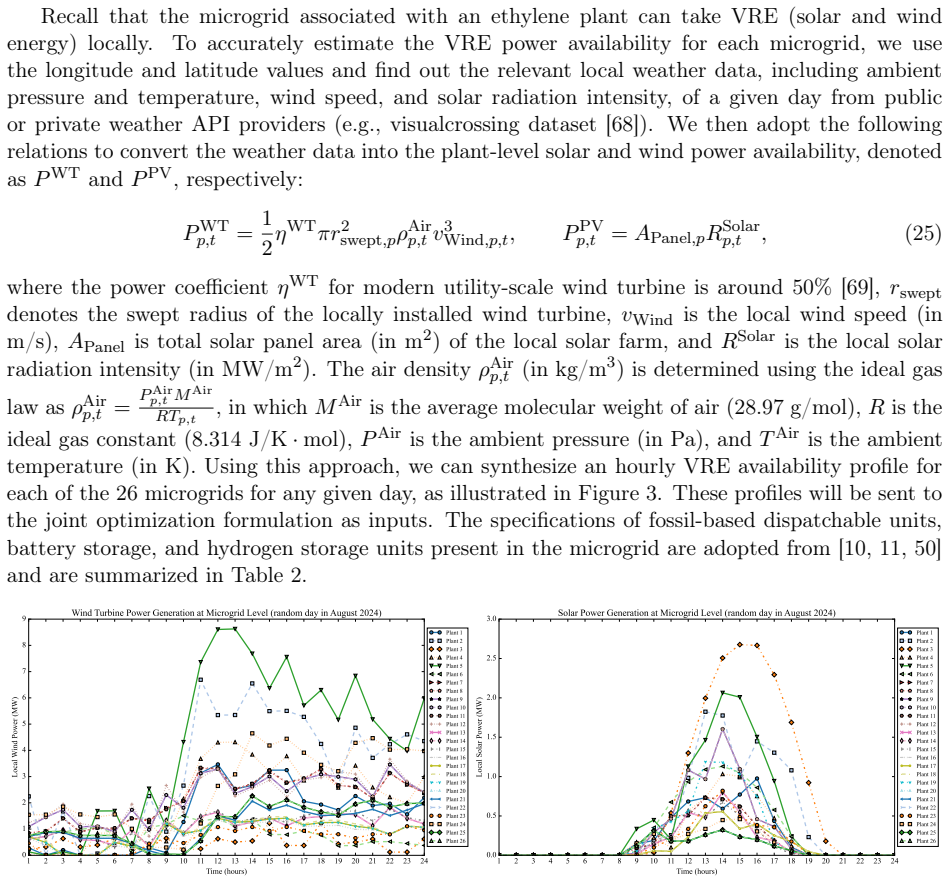


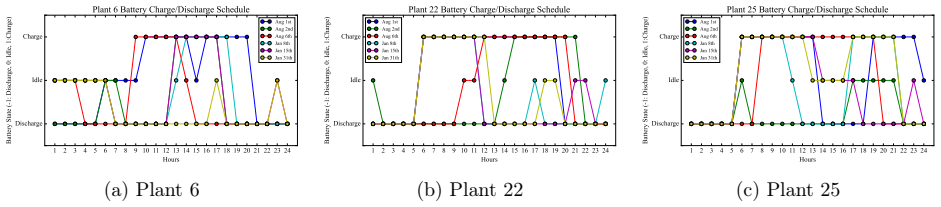
read the original abstract
The electrification of chemical process heating is essential to industrial decarbonization and sustainable manufacturing of chemical products. Joint optimization of electrified chemical process heating units and electric power systems is needed to achieve decarbonized operation of both sectors. In this work, we introduce a centralized optimization model that identifies the optimal unit commitment of power systems and optimal operation of electrified steam cracking microgrids for sustainable olefins production. A mixed-integer linear programming (MILP) model is developed to optimize the hourly operational plan of 26 ethylene plants and the main power system in Texas. We propose a two-stage solution method to solve the resulting large-scale centralized MILP problem efficiently. In the first stage, we apply Benders decomposition with LP-relaxed subproblems to decouple microgrid operations from the main power system. In the second stage, we use the first-stage optimal solution as a warm starting point for the centralized MILP. This two-stage approach reduces the average solution time by 93.5% compared to direct solution of the MILP. Results show that the largest overall greenhouse gas (GHG) emission reduction for both power systems and microgrids is achieved when the electrification level of steam cracking units is at 30%. Above 30% electrification level, a higher electrification level leads to higher overall GHG emissions and steady increase in operating costs, particularly on the microgrid side. Increasing renewables contributions in the electric power system helps debottleneck the electrification efforts and facilitate holistic decarbonization. We also remark that the optimal operational plan of electrified steam cracking microgrids also exhibit strong spatiotemporal patterns.
Editorial analysis
A structured set of objections, weighed in public.
Referee Report
Summary. The paper develops a mixed-integer linear programming (MILP) model for the joint optimization of unit commitment in the Texas power system and the operations of 26 electrified steam cracking microgrids. It proposes a two-stage solution method using Benders decomposition followed by warm-starting the full MILP, which reduces solution time by 93.5%. The key finding is that a 30% electrification level for steam cracking units achieves the largest overall GHG emission reduction, with higher levels increasing emissions and costs, and that higher renewable contributions facilitate decarbonization.
Significance. If the model inputs accurately reflect real conditions, this study provides valuable quantitative guidance on optimal electrification strategies for decarbonizing chemical manufacturing while accounting for power system interactions. The computational approach for solving large-scale instances is a positive aspect that could be useful for similar problems.
major comments (2)
- [Abstract] Abstract: The claim that the largest GHG emission reduction occurs at exactly 30% electrification is presented without any sensitivity analysis on the key input parameters (fuel/carbon prices, renewable availability time series) that determine the location of this minimum.
- [Results] Results: No validation or description of how the 26-plant dataset (hourly demand profiles, plant operating constraints) was assembled or checked against real dispatch/market data is provided, which is load-bearing for the reported numerical outcomes including the 30% optimum and 93.5% time reduction.
minor comments (1)
- The abstract states that optimal microgrid plans 'exhibit strong spatiotemporal patterns' but provides no elaboration, figures, or tables to illustrate these patterns or their implications.
Simulated Author's Rebuttal
We thank the referee for their thoughtful review and constructive comments on our manuscript. We address each major comment below and indicate the revisions we will make to strengthen the paper.
read point-by-point responses
-
Referee: [Abstract] Abstract: The claim that the largest GHG emission reduction occurs at exactly 30% electrification is presented without any sensitivity analysis on the key input parameters (fuel/carbon prices, renewable availability time series) that determine the location of this minimum.
Authors: We agree that the robustness of the 30% electrification optimum would be strengthened by sensitivity analysis on parameters such as fuel and carbon prices and renewable availability time series. In the revised manuscript we will add a new subsection presenting sensitivity results on these inputs and their effect on the location of the GHG minimum. revision: yes
-
Referee: [Results] Results: No validation or description of how the 26-plant dataset (hourly demand profiles, plant operating constraints) was assembled or checked against real dispatch/market data is provided, which is load-bearing for the reported numerical outcomes including the 30% optimum and 93.5% time reduction.
Authors: We acknowledge that a transparent description of data sources and validation steps is necessary. In the revised manuscript we will insert a dedicated data section that details the assembly of the 26-plant hourly demand profiles and operating constraints, the public and industry sources used, and any consistency checks performed against available Texas market or dispatch records. revision: yes
Circularity Check
No circularity: MILP optimum is computed from external inputs and objectives
full rationale
The paper poses a standard MILP for joint unit commitment and microgrid scheduling. The reported 30% electrification optimum is the numerical argmin of an objective that penalizes GHG emissions and costs, using externally supplied time series for demand, renewables, prices, and plant constraints. No equation defines the optimum in terms of itself, no parameter is fitted to a subset and then re-predicted, and no self-citation supplies a uniqueness theorem or ansatz that forces the result. The two-stage Benders method is only a computational device and does not alter the mathematical dependence on the input data. The derivation chain is therefore self-contained against external benchmarks.
Axiom & Free-Parameter Ledger
Forward citations
Cited by 2 Pith papers
-
Decentralized Operations of Decarbonized Chemical Plants with Renewable-driven Transmission Systems
A privacy-preserving decentralized ADMM framework for joint unit commitment and electrified ethane cracker scheduling on the Texas grid shows small optimality gaps.
-
Decentralized Operations of Decarbonized Chemical Plants with Renewable-driven Transmission Systems
A decentralized ADMM framework with auxiliary penalty for joint power-chemical system optimization achieves small optimality gaps on Texas grid model with 26 plants while preserving data privacy.
Reference graph
Works this paper leans on
-
[1]
Industrial decarbonization roadmap
U.S. DOE, “Industrial decarbonization roadmap.”https://www.energy.gov/eere/ doe-industrial-decarbonization-roadmap, Sept. 2022. [Online; accessed <INSERT ACCESS DATE HERE>]
2022
-
[2]
Decarbonization of chemical process industries via electrification,
R. Agrawal and J. Siirola, “Decarbonization of chemical process industries via electrification,” The Bridge: The National Academy of Engineering, vol. 53, pp. 32–40, 2023
2023
-
[3]
Decarbonization of the chemical industry through electrification: Barriers and opportunities,
D. S. Mallapragada, Y. Dvorkin, M. A. Modestino, D. V. Esposito, W. A. Smith, B.-M. Hodge, M. P. Harold, V. M. Donnelly, A. Nuz, C. Bloomquist,et al., “Decarbonization of the chemical industry through electrification: Barriers and opportunities,”Joule, vol. 7, no. 1, pp. 23–41, 2023
2023
-
[4]
Annual energy outlook 2025
U.S. EIA, “Annual energy outlook 2025.”https://www.eia.gov/outlooks/aeo/, Mar. 2025. [Online; accessed February 21, 2026]
2025
-
[5]
Ethylene: the “world’s most important chemical
AFPM Communications, “Ethylene: the “world’s most important chemical”.”https://www. afpm.org/newsroom/blog/ethylene-worlds-most-important-chemical, 2017. [Online; ac- cessed November 21, 2025]
2017
-
[6]
Ethylene market size, share, and trends 2024 to 2033
Precedence Research, “Ethylene market size, share, and trends 2024 to 2033.” [Online], 2024. Accessed: September 16, 2024
2024
-
[7]
Zimmermann and R
H. Zimmermann and R. Walzl,Ethylene. John Wiley & Sons, Ltd, 2009
2009
-
[8]
Powering the transition to net zero with electric cracking technology,
T. Sinn, M. Hofstaetter, R. Kemper, and G. Kracker, “Powering the transition to net zero with electric cracking technology,”Chemical Engineering Progress, vol. 120, no. 8, pp. 42–49, 2024
2024
-
[9]
BASF, SABIC, and Linde celebrate the start-up of the world’s first large-scale elec- trically heated steam cracking furnace
SABIC, “BASF, SABIC, and Linde celebrate the start-up of the world’s first large-scale elec- trically heated steam cracking furnace.” [Online], 2024. Accessed: September 16, 2025
2024
-
[10]
S. G. Naraghi, T. Kareck, L. Xiao, R. Reed, P. Ramanan, and Z. Jiang,Decarbonization of Steam Cracking for Clean Olefins Production: Microgrid Planning and Operation, ch. 10. John Wiley & Sons, Inc., 2026
2026
-
[11]
Microgrid optimal scheduling with multi-period islanding constraints,
A. Khodaei, “Microgrid optimal scheduling with multi-period islanding constraints,”IEEE Transactions on Power Systems, vol. 29, no. 3, pp. 1383–1392, 2013. 22
2013
-
[12]
Grid structural characteristics as validation criteria for synthetic networks,
A. B. Birchfield, T. Xu, K. M. Gegner, K. S. Shetye, and T. J. Overbye, “Grid structural characteristics as validation criteria for synthetic networks,”IEEE Transactions on Power Systems, vol. 32, pp. 3258–3265, July 2017
2017
-
[13]
Review of electric cracking of hydrocarbons,
M. E. H. Tijani, H. Zondag, and Y. Van Delft, “Review of electric cracking of hydrocarbons,” ACS Sustainable Chemistry & Engineering, vol. 10, no. 49, pp. 16070–16089, 2022
2022
-
[14]
Decarbonization of the chemical industry through electrification: Barriers and opportunities,
D. S. Mallapragada, Y. Dvorkin, M. A. Modestino, D. V. Esposito, W. A. Smith, B.-M. Hodge, M. P. Harold, V. M. Donnelly, A. Nuz, C. Bloomquist, K. Baker, L. C. Grabow, Y. Yan, N. N. Rajput, R. L. Hartman, E. J. Biddinger, E. S. Aydil, and A. D. Taylor, “Decarbonization of the chemical industry through electrification: Barriers and opportunities,”Joule, vo...
2023
-
[15]
Thepotentialofdirectsteamcrackerelectrificationandcarboncapture&utilizationvia oxidative coupling of methane as decarbonization strategies for ethylene production,
L. S. Layritz, I. Dolganova, M. Finkbeiner, G. Luderer, A. T. Penteado, F. Ueckerdt, and J.-U. Repke, “Thepotentialofdirectsteamcrackerelectrificationandcarboncapture&utilizationvia oxidative coupling of methane as decarbonization strategies for ethylene production,”Applied Energy, vol. 296, p. 117049, 2021
2021
-
[16]
Optimization of electric ethylene production: Exploring the role of cracker flexibility, batteries, and renewable energy integration,
J. L. Tiggeloven, A. P. C. Faaij, G. J. Kramer, and M. Gazzani, “Optimization of electric ethylene production: Exploring the role of cracker flexibility, batteries, and renewable energy integration,”Industrial & Engineering Chemistry Research, vol. 62, no. 40, pp. 16360–16382, 2023
2023
-
[17]
Electrificationofsteamcracking as a pathway to reduce the impact of the petrochemical industry on climate change,
O. Mynko, M. Bonheure, I. Amghizar, D. J. Brown, L. Chen, G. B. Marin, R. Freitas de Alvarenga, D.Civancik Uslu, J.Dewulf, andK.M.VanGeem, “Electrificationofsteamcracking as a pathway to reduce the impact of the petrochemical industry on climate change,”Journal of Cleaner Production, vol. 427, p. 139208, 2023
2023
-
[18]
Comparative reactor, process, techno- economic, and life cycle emissions assessment of ethylene production via electrified and thermal steam cracking,
A. Cattry, C. Vuppanapalli, and D. S. Mallapragada, “Comparative reactor, process, techno- economic, and life cycle emissions assessment of ethylene production via electrified and thermal steam cracking,”Green Chem., vol. 27, pp. 13357–13374, 2025
2025
-
[19]
Modular reactors with electrical resistance heating for hy- drocarbon cracking and other endothermic reactions,
V. Balakotaiah and R. R. Ratnakar, “Modular reactors with electrical resistance heating for hy- drocarbon cracking and other endothermic reactions,”AIChE Journal, vol. 68, no. 2, p. e17542, 2022
2022
-
[20]
Electrically heated dehydrogenation process,
R. Agrawal, Z. Chen, and P. Oladipupo, “Electrically heated dehydrogenation process,” 2023. U.S. Patent No. 11,578,019
2023
-
[21]
Electricreaction-towersforflexibleoperationofendother- mic reactions under variable power and feed supply rates,
E.A.Rodriguez-GilandR.Agrawal, “Electricreaction-towersforflexibleoperationofendother- mic reactions under variable power and feed supply rates,”Cell Reports Physical Science, vol. 6, no. 8, p. 102771, 2025
2025
-
[22]
Process modeling and evaluation of plasma-assisted ethylene production from methane,
E. Delikonstantis, M. Scapinello, and G. D. Stefanidis, “Process modeling and evaluation of plasma-assisted ethylene production from methane,”Processes, vol. 7, no. 2, 2019
2019
-
[23]
Thermal electrification of chemical processes using renewable energy: Economic and decarbonization impacts,
I. Giannikopoulos, A. Skouteris, D. T. Allen, M. Baldea, and M. A. Stadtherr, “Thermal electrification of chemical processes using renewable energy: Economic and decarbonization impacts,”Industrial & Engineering Chemistry Research, vol. 63, no. 27, pp. 12064–12082, 2024
2024
-
[24]
The u.s. department of energy’s microgrid initiative,
D. T. Ton and M. A. Smith, “The u.s. department of energy’s microgrid initiative,”The Elec- tricity Journal, vol. 25, no. 8, pp. 84–94, 2012. 23
2012
-
[25]
Resiliency-oriented microgrid optimal scheduling,
A. Khodaei, “Resiliency-oriented microgrid optimal scheduling,”IEEE Transactions on Smart Grid, vol. 5, no. 4, pp. 1584–1591, 2014
2014
-
[26]
Microgrid-based co-optimization of generation and trans- mission planning in power systems,
A. Khodaei and M. Shahidehpour, “Microgrid-based co-optimization of generation and trans- mission planning in power systems,”IEEE transactions on power systems, vol. 28, no. 2, pp. 1582–1590, 2012
2012
-
[27]
Microgrids and active distribution networks,
I. Series, “Microgrids and active distribution networks,”The institution of Engineering and Technology, vol. 332, 2009
2009
-
[28]
Operation and design optimization of microgrids with renewables,
B. Yan, P. B. Luh, G. Warner, and P. Zhang, “Operation and design optimization of microgrids with renewables,”IEEE Transactions on Automation Science and Engineering, vol. 14, no. 2, pp. 573–585, 2017
2017
-
[29]
Energy optimization model for a cchp system with available gas turbines,
X. Kong, R. Wang, and X. Huang, “Energy optimization model for a cchp system with available gas turbines,”Applied Thermal Engineering, vol. 25, no. 2, pp. 377–391, 2005
2005
-
[30]
Operation optimization of a distributed energy system considering energy costs and exergy efficiency,
M. Di Somma, B. Yan, N. Bianco, G. Graditi, P. Luh, L. Mongibello, and V. Naso, “Operation optimization of a distributed energy system considering energy costs and exergy efficiency,” Energy Conversion and Management, vol. 103, pp. 739–751, 2015
2015
-
[31]
Multi- objective operation optimization of a distributed energy system for a large-scale utility cus- tomer,
M. Di Somma, B. Yan, N. Bianco, P. B. Luh, G. Graditi, L. Mongibello, and V. Naso, “Multi- objective operation optimization of a distributed energy system for a large-scale utility cus- tomer,”Applied Thermal Engineering, vol. 101, pp. 752–761, 2016
2016
-
[32]
Stochastic optimization of renewable-based microgrid operation incorporating battery operating cost,
T. A. Nguyen and M. L. Crow, “Stochastic optimization of renewable-based microgrid operation incorporating battery operating cost,”IEEE Transactions on Power Systems, vol. 31, no. 3, pp. 2289–2296, 2016
2016
-
[33]
Real-time energy storage management for renewable inte- gration in microgrid: An off-line optimization approach,
K. Rahbar, J. Xu, and R. Zhang, “Real-time energy storage management for renewable inte- gration in microgrid: An off-line optimization approach,”IEEE Transactions on Smart Grid, vol. 6, no. 1, pp. 124–134, 2015
2015
-
[34]
Coordinated optimal dispatch of energy storage in a net- work of grid-connected microgrids,
M. R. Sandgani and S. Sirouspour, “Coordinated optimal dispatch of energy storage in a net- work of grid-connected microgrids,”IEEE Transactions on Sustainable Energy, vol. 8, no. 3, pp. 1166–1176, 2017
2017
-
[35]
Sizing renewable generation and energy storage in stand-alone microgrids considering distributionally robust shortfall risk,
R. Xie, W. Wei, M. Shahidehpour, Q. Wu, and S. Mei, “Sizing renewable generation and energy storage in stand-alone microgrids considering distributionally robust shortfall risk,” IEEE Transactions on Power Systems, vol. 37, no. 5, pp. 4054–4066, 2022
2022
-
[36]
Data-driven joint distri- butionally robust chance-constrained operation for multiple integrated electricity and heating systems,
J. Zhai, Y. Jiang, M. Zhou, Y. Shi, W. Chen, and C. N. Jones, “Data-driven joint distri- butionally robust chance-constrained operation for multiple integrated electricity and heating systems,”IEEE Transactions on Sustainable Energy, vol. 15, no. 3, pp. 1782–1798, 2024
2024
-
[37]
Decentralized dis- tributionally robust chance-constrained operation of integrated electricity and hydrogen trans- portation networks,
W. Jia, T. Ding, Y. Yuan, C. Mu, H. Zhang, S. Wang, Y. He, and X. Sun, “Decentralized dis- tributionally robust chance-constrained operation of integrated electricity and hydrogen trans- portation networks,”Applied Energy, vol. 377, p. 124369, 2025
2025
-
[38]
A coordinated optimal operation of a grid- connected wind-solar microgrid incorporating hybrid energy storage management systems,
M. B. Abdelghany, A. Al-Durra, and F. Gao, “A coordinated optimal operation of a grid- connected wind-solar microgrid incorporating hybrid energy storage management systems,” IEEE Transactions on Sustainable Energy, vol. 15, no. 1, pp. 39–51, 2024. 24
2024
-
[39]
Combined heat and power dis- patch considering pipeline energy storage of district heating network,
Z. Li, W. Wu, M. Shahidehpour, J. Wang, and B. Zhang, “Combined heat and power dis- patch considering pipeline energy storage of district heating network,”IEEE Transactions on Sustainable Energy, vol. 7, no. 1, pp. 12–22, 2016
2016
-
[40]
Decentralized solution for combined heat and power dispatch through benders decomposition,
C. Lin, W. Wu, B. Zhang, and Y. Sun, “Decentralized solution for combined heat and power dispatch through benders decomposition,”IEEE Transactions on Sustainable Energy, vol. 8, no. 4, pp. 1361–1372, 2017
2017
-
[41]
Integrated heat and power dispatch truly utilizing thermalinertiaofdistrictheatingnetworkforwindpowerintegration,
J. Zheng, Z. Zhou, J. Zhao, and J. Wang, “Integrated heat and power dispatch truly utilizing thermalinertiaofdistrictheatingnetworkforwindpowerintegration,”Applied Energy, vol.211, pp. 865–874, 2018
2018
-
[42]
Coordinated dispatch of multi-energy system with district heating network: Modeling and solution strategy,
S. Lu, W. Gu, J. Zhou, X. Zhang, and C. Wu, “Coordinated dispatch of multi-energy system with district heating network: Modeling and solution strategy,”Energy, vol. 152, pp. 358–370, 2018
2018
-
[43]
Improving flexibility for microgrids by co- ordinated optimization of electricity and steam networks,
B. Chen, W. Wu, C. Lin, Q. Guo, and H. Sun, “Improving flexibility for microgrids by co- ordinated optimization of electricity and steam networks,”IEEE Transactions on Sustainable Energy, vol. 12, no. 1, pp. 314–324, 2021
2021
-
[44]
Using hydrogen and ammonia for renewable energy storage: A geographically comprehensive techno-economic study,
M. J. Palys and P. Daoutidis, “Using hydrogen and ammonia for renewable energy storage: A geographically comprehensive techno-economic study,”Computers & Chemical Engineering, vol. 136, p. 106785, 2020
2020
-
[45]
Optimal design of sustainable ammonia- based food–energy–water systems with nitrogen management,
H. Wang, M. Palys, P. Daoutidis, and Q. Zhang, “Optimal design of sustainable ammonia- based food–energy–water systems with nitrogen management,”ACS Sustainable Chemistry & Engineering, vol. 9, no. 7, pp. 2816–2834, 2021
2021
-
[46]
A novel system for ammonia-based sustainable energy and agriculture: Concept and design optimization,
M. J. Palys, A. Kuznetsov, J. Tallaksen, M. Reese, and P. Daoutidis, “A novel system for ammonia-based sustainable energy and agriculture: Concept and design optimization,”Chem- ical Engineering and Processing - Process Intensification, vol. 140, pp. 11–21, 2019
2019
-
[47]
Real-time operation of a stand-alone microgrid with green ammonia storage,
B. Kong, Q. Zhang, and P. Daoutidis, “Real-time operation of a stand-alone microgrid with green ammonia storage,”IEEE Transactions on Control Systems Technology, vol. 32, no. 4, pp. 1463–1470, 2024
2024
-
[48]
A risk- averse just-in-time scheme for learning-based operation of microgrids with coupled electricity- hydrogen-ammonia under uncertainties,
L. Li, C. Ning, G. Pan, L. Zhang, W. Gu, L. Zhao, W. Du, and M. Shahidehpour, “A risk- averse just-in-time scheme for learning-based operation of microgrids with coupled electricity- hydrogen-ammonia under uncertainties,”IEEE Transactions on Sustainable Energy, vol. 16, no. 4, pp. 2621–2635, 2025
2025
-
[49]
Emissions mitigation: Each process requires a unique decarbonization solution,
J. Bell, “Emissions mitigation: Each process requires a unique decarbonization solution,”Chem- ical Engineering, vol. 132, pp. 32–35, 2025
2025
-
[50]
Multi-objective optimization of steam cracking microgrid for clean olefins production,
S. Ghasemi Naraghi, T. Kareck, and Jiang Z*, “Multi-objective optimization of steam cracking microgrid for clean olefins production,”Systems & Control Transactions, vol. 4, pp. 837–843, 2025
2025
-
[51]
Unit commitment-a bibliographical survey,
N. P. Padhy, “Unit commitment-a bibliographical survey,”IEEE Transactions on power sys- tems, vol. 19, no. 2, pp. 1196–1205, 2004. 25
2004
-
[52]
Cht: a digital computer package for solving short term hydro-thermal coordination and unit commitment problems,
R. Nieva, A. Inda, and J. Frausto, “Cht: a digital computer package for solving short term hydro-thermal coordination and unit commitment problems,”IEEE transactions on power sys- tems, vol. 1, no. 3, pp. 168–174, 2007
2007
-
[53]
Dynamic programming approach to unit commitment,
W. L. Snyder, H. D. Powell, and J. C. Rayburn, “Dynamic programming approach to unit commitment,”IEEE transactions on Power systems, vol. 2, no. 2, pp. 339–348, 2007
2007
-
[54]
Integer programming approach to the problem of optimal unit commitment with probabilistic reserve determination,
T. S. Dillon, K. W. Edwin, H.-D. Kochs, and R. Taud, “Integer programming approach to the problem of optimal unit commitment with probabilistic reserve determination,”IEEE Trans- actions on Power Apparatus and Systems, no. 6, pp. 2154–2166, 1978
1978
-
[55]
Solution of large-scale optimal unit commitment problems,
G. S. Lauer, N. Sandell, D. Bertsekas, and T. A. Posbergh, “Solution of large-scale optimal unit commitment problems,”IEEE Transactions on Power Apparatus and Systems, no. 1, pp. 79–86, 1982
1982
-
[56]
A computationally efficient mixed-integer linear formulation for the thermal unit commitment problem,
M. Carrión and J. M. Arroyo, “A computationally efficient mixed-integer linear formulation for the thermal unit commitment problem,”IEEE Transactions on power systems, vol. 21, no. 3, pp. 1371–1378, 2006
2006
-
[57]
Tighter approximated milp formulations for unit commitment problems,
A. Frangioni, C. Gentile, and F. Lacalandra, “Tighter approximated milp formulations for unit commitment problems,”IEEE Transactions on Power Systems, vol. 24, no. 1, pp. 105–113, 2008
2008
-
[58]
A tighter piecewise linear approximation of quadratic cost curves for unit commitment problems,
L. Wu, “A tighter piecewise linear approximation of quadratic cost curves for unit commitment problems,”IEEE Transactions on Power Systems, vol. 26, no. 4, pp. 2581–2583, 2011
2011
-
[59]
Polynomial time algorithms and extended formulations for unit commitment problems,
Y. Guan, K. Pan, and K. Zhou, “Polynomial time algorithms and extended formulations for unit commitment problems,”IISE transactions, vol. 50, no. 8, pp. 735–751, 2018
2018
-
[60]
On the complexity of the unit commitment prob- lem,
P. Bendotti, P. Fouilhoux, and C. Rottner, “On the complexity of the unit commitment prob- lem,”Annals of Operations Research, vol. 274, pp. 119–130, 2019
2019
-
[61]
A multi-agent approach to unit commitment problems,
T. Nagata, M. Ohono, J. Kubokawa, H. Sasaki, and H. Fujita, “A multi-agent approach to unit commitment problems,” in2002 IEEE Power Engineering Society Winter Meeting. Conference Proceedings (Cat. No. 02CH37309), vol. 1, pp. 64–69, IEEE, 2002
2002
-
[62]
Solution of the profit-based unit commitment problem by using multi-agent system,
J. Yu, J. Zhou, W. Wu, J. Yang, and W. Yu, “Solution of the profit-based unit commitment problem by using multi-agent system,” inFifth World Congress on Intelligent Control and Automation (IEEE Cat. No. 04EX788), vol. 6, pp. 5079–5083, IEEE, 2004
2004
-
[63]
Multi-agent modeling for solving profit based unit commitment problem,
D. Sharma, A. Trivedi, D. Srinivasan, and L. Thillainathan, “Multi-agent modeling for solving profit based unit commitment problem,”Applied Soft Computing, vol. 13, no. 8, pp. 3751–3761, 2013
2013
-
[64]
Market-based versus price-based microgrid optimal scheduling,
S. Parhizi, A. Khodaei, and M. Shahidehpour, “Market-based versus price-based microgrid optimal scheduling,”IEEE Transactions on Smart Grid, vol. 9, no. 2, pp. 615–623, 2016
2016
-
[65]
Technical assessment of large scale pem electrolyzers as flexibility service providers,
D. Gusain, M. Cvetković, R. Bentvelsen, and P. Palensky, “Technical assessment of large scale pem electrolyzers as flexibility service providers,” in2020 IEEE 29th International Symposium on Industrial Electronics (ISIE), pp. 1074–1078, 2020
2020
-
[66]
A recent comprehensive review of fuel cells: History, types, and applications,
N. A. A. Qasem and G. A. Q. Abdulrahman, “A recent comprehensive review of fuel cells: History, types, and applications,”International Journal of Energy Research, vol. 2024, no. 1, p. 7271748, 2024. 26
2024
-
[67]
Optimum gas turbine cycle for combined cycle power plant,
A. Polyzakis, C. Koroneos, and G. Xydis, “Optimum gas turbine cycle for combined cycle power plant,”Energy Conversion and Management, vol. 49, no. 4, pp. 551–563, 2008
2008
-
[68]
accessed on October 25, 2025
visualcrossing.https://www.visualcrossing.com/weather-data/. accessed on October 25, 2025
2025
-
[69]
Wind vision: A new era for wind power in the united states,
Office of Scientific and Technical Information, “Wind vision: A new era for wind power in the united states,” tech. rep., U.S Department of Energy, 2015
2015
-
[70]
Scopes 1 and 2 emissions inventorying and guidance
U.S. EPA, “Scopes 1 and 2 emissions inventorying and guidance.”https://www.epa.gov/ climateleadership/scopes-1-and-2-emissions-inventorying-and-guidance. accessed on June 3, 2026. 27
2026
discussion (0)
Sign in with ORCID, Apple, or X to comment. Anyone can read and Pith papers without signing in.