High-quality single crystals of the kagome metals Ni₃In and Ni₃Sn grown from Pb flux
Pith reviewed 2026-06-26 07:11 UTC · model grok-4.3
The pith
Pb-flux growth produces millimeter-scale single crystals of Ni3In and Ni3Sn whose resistivity matches electron-phonon calculations.
A machine-rendered reading of the paper's core claim, the machinery that carries it, and where it could break.
Core claim
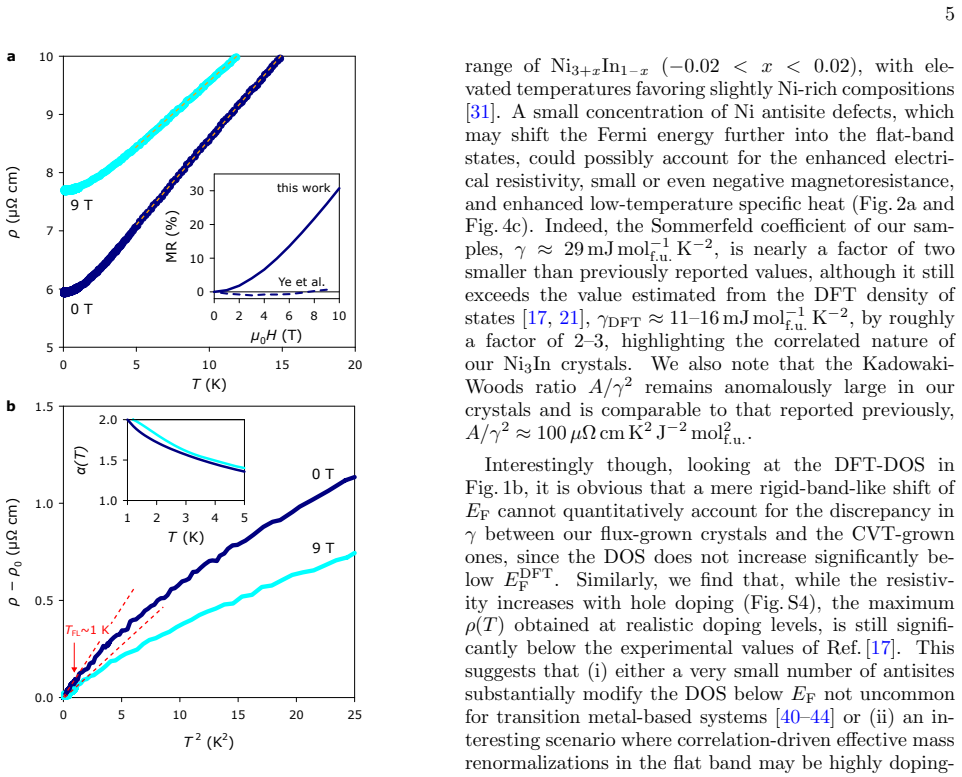
Optimizing Pb-flux growth conditions suppresses competing binary phases and enables synthesis of single crystals of Ni3(In,Sn) reaching several millimeters in size. These crystals display significantly lower electrical resistivity in excellent agreement with calculations of resistivity from electron-phonon scattering, a sizeable non-saturating magnetoresistance, and reduced Sommerfeld coefficient and magnetic susceptibility relative to prior samples, differences that are likely related to shifts in Fermi level position.
What carries the argument
The Pb-flux technique that suppresses competing binary phases through optimized growth conditions to produce large crystals.
If this is right
- Large crystals become available for thermodynamic and spectroscopic probes of the flat band near the Fermi level.
- Resistivity limited by electron-phonon scattering sets a baseline for identifying additional scattering channels in future doped or strained samples.
- Non-saturating magnetoresistance persists in higher-quality material, consistent with possible topological contributions.
- Lower Sommerfeld coefficient and susceptibility provide a revised experimental benchmark for theoretical models of the electronic structure.
Where Pith is reading between the lines
- The method could be tested on related kagome compounds to determine whether Pb flux generally improves crystal quality over vapor-transport routes.
- If Fermi-level tuning is confirmed, controlled doping during growth might be used to position the flat band exactly at the Fermi energy.
- Comparison of phonon spectra or defect densities between growth methods would isolate whether the resistivity improvement is purely electronic or partly structural.
Load-bearing premise
The observed reductions in resistivity, Sommerfeld coefficient, and susceptibility arise from a shift in Fermi level position rather than from residual Pb contamination or growth-induced defects.
What would settle it
Direct Fermi-level measurements such as ARPES on the Pb-flux crystals that show no shift relative to earlier samples, or transport data on deliberately Pb-contaminated crystals that reproduce the same low resistivity, would falsify the attribution.
Figures



read the original abstract
The bilayer kagome metal Ni$_3$In has recently attracted attention due to the presence of a flat band located near the Fermi level, which has been associated with unconventional thermodynamic and electronic transport properties [Ye et al., Nat. Phys. 20, 610-614 (2024)]. However, further investigation of the intrinsic properties of this system has been hindered by the lack of large, high-quality single crystals. Here, we report the successful growth of Ni$_3$(In, Sn) single crystals using a Pb-flux technique. By optimizing the growth conditions, competing binary phases can be effectively suppressed, enabling the synthesis of single crystals with dimensions reaching several millimeters. We compare the physical properties of our Pb-flux-grown crystals to previously reported samples prepared by iodine-assisted chemical vapor transport and molecular beam epitaxy as well as to first-principles resistivity calculations. We find a significantly lower electrical resistivity in our crystals, in excellent agreement with calculations of resistivity from electron-phonon scattering, a sizeable non-saturating magnetoresistance, and a reduced Sommerfeld coefficient and magnetic susceptibility compared to previous experimental findings, which are likely related to differences in the Fermi level position. Our results establish Pb-flux growth as a reliable route for obtaining large single crystals of the bilayer kagome metals Ni$_3$(In, Sn) that are suitable for further thermodynamic and spectroscopic investigations of their intrinsic electronic and magnetic properties.
Editorial analysis
A structured set of objections, weighed in public.
Referee Report
Summary. The manuscript reports successful Pb-flux growth of millimeter-scale single crystals of the bilayer kagome metals Ni₃In and Ni₃Sn by optimizing conditions to suppress competing binary phases. It compares their electrical resistivity, magnetoresistance, Sommerfeld coefficient, and magnetic susceptibility to prior iodine-assisted CVT and MBE samples as well as to first-principles electron-phonon resistivity calculations, finding lower resistivity in agreement with theory, sizeable non-saturating MR, and reduced γ and χ values, which are attributed to a shifted Fermi level position.
Significance. If the property improvements are shown to be intrinsic, the work supplies a scalable route to large, high-quality crystals of these flat-band kagome systems, enabling the thermodynamic and spectroscopic measurements that have been limited by prior sample quality. Explicit agreement between measured resistivity and parameter-free e-ph calculations is a concrete strength.
major comments (2)
- [Abstract] Abstract: The central interpretation that the observed reductions in resistivity, Sommerfeld coefficient, and susceptibility 'are likely related to differences in the Fermi level position' is load-bearing for the claim of intrinsic high-quality behavior, yet the text provides no EDX, WDX, or other compositional analysis to place quantitative limits on residual Pb incorporation from the flux, which could itself shift E_F or add scattering.
- [Abstract] Abstract/Methods: No sample characterization details (e.g., XRD rocking curves, full resistivity data with error bars, or direct side-by-side plots versus prior CVT/MBE crystals) are referenced, leaving the magnitude and reproducibility of the reported improvements unverifiable from the presented information.
Simulated Author's Rebuttal
We thank the referee for their constructive comments and positive assessment of the significance of our work. We address each major comment below.
read point-by-point responses
-
Referee: [Abstract] Abstract: The central interpretation that the observed reductions in resistivity, Sommerfeld coefficient, and susceptibility 'are likely related to differences in the Fermi level position' is load-bearing for the claim of intrinsic high-quality behavior, yet the text provides no EDX, WDX, or other compositional analysis to place quantitative limits on residual Pb incorporation from the flux, which could itself shift E_F or add scattering.
Authors: We agree that quantitative compositional analysis is needed to support the interpretation. Although the measured resistivity agrees closely with parameter-free electron-phonon calculations (indicating low additional scattering), we will add EDX or WDX data in the revised manuscript to place upper limits on any residual Pb incorporation from the flux. revision: yes
-
Referee: [Abstract] Abstract/Methods: No sample characterization details (e.g., XRD rocking curves, full resistivity data with error bars, or direct side-by-side plots versus prior CVT/MBE crystals) are referenced, leaving the magnitude and reproducibility of the reported improvements unverifiable from the presented information.
Authors: The main text already contains XRD characterization, multi-sample resistivity data, and comparisons to prior CVT and MBE results. We will revise the abstract to explicitly reference these details, including any available rocking-curve widths, error bars on resistivity, and direct comparative plots. revision: yes
Circularity Check
No circularity: experimental growth and property measurements rest on direct data and external benchmarks
full rationale
The manuscript is an experimental crystal-growth report. It describes Pb-flux synthesis conditions, suppression of secondary phases, crystal sizes, and measured transport/thermodynamic quantities, then compares those quantities to independent first-principles electron-phonon resistivity calculations and to earlier literature samples. No equation or claim reduces by construction to a fitted parameter, self-definition, or self-citation chain; the central attribution of property differences to Fermi-level position is an inference from external comparisons, not a tautology. The derivation chain is therefore self-contained against external benchmarks.
Axiom & Free-Parameter Ledger
axioms (1)
- domain assumption Optimization of growth conditions in Pb flux can effectively suppress competing binary phases
Reference graph
Works this paper leans on
-
[1]
In this work, we report the growth and physical properties of large Ni3In1–x Snx single crystals with improved sample qual- ity, which were synthesized using a Pb-flux method
with relatively low residual resistivity ratios (RRR), or polycrystalline samples [21, 27] that obscure the intrin- sic anisotropy of the electronic structure. In this work, we report the growth and physical properties of large Ni3In1–x Snx single crystals with improved sample qual- ity, which were synthesized using a Pb-flux method. The remainder of this...
-
[2]
exhibit significantly largerχ(T) over the entire measured range and can be fitted down to 86 K. From our fits, we obtain an effective moment ofµ eff = 0.69µ B per Ni for bothH∥aandH∥c, nearly a factor of two smaller than the value µeff = 1.3µ B reported for CVT-grown crystals [17] as well as Curie–Weiss temperatures ofθ a ≈ −27 K andθ c ≈ −44 K, which are...
-
[3]
L. Ye, M. Kang, J. Liu, F. Von Cube, C. R. Wicker, T. Suzuki, C. Jozwiak, A. Bostwick, E. Rotenberg, D. C. Bell,et al., Nature555, 638 (2018)
2018
-
[4]
B. R. Ortiz, L. C. Gomes, J. R. Morey, M. Winiarski, M. Bordelon, J. S. Mangum, I. W. Oswald, J. A. Rodriguez-Rivera, J. R. Neilson, S. D. Wilson,et al., Physical Review Materials3, 094407 (2019)
2019
-
[5]
S. M. Thomas, C. S. Kengle, W. Simeth, C.-y. Lim, Z. W. Riedel, K. Allen, A. Schmidt, M. Ruf, S. Gim, J. D. Thompson,et al., npj Quantum Materials10, 66 (2025)
2025
-
[6]
Z. W. Riedel, W. Simeth, C. S. Kengle, S. M. Thomas, J. D. Thompson, A. O. Scheie, F. Ronning, C. Lane, J.- X. Zhu, P. F. Rosa,et al., Physical Review Materials9, 084401 (2025)
2025
-
[7]
Cheng, K
E. Cheng, K. Wang, Y. Hao, W. Chen, H. Tan, Z. Li, M. Wang, W. Gao, D. Wu, S. Sun,et al., Nature mate- rials25, 602 (2026)
2026
-
[8]
Di Sante, T
D. Di Sante, T. Neupert, G. Sangiovanni, R. Thomale, R. Comin, J. G. Checkelsky, I. Zeljkovic, and S. D. Wil- son, Reviews of Modern Physics98, 015002 (2026)
2026
-
[9]
M. Kang, S. Fang, L. Ye, H. C. Po, J. Denlinger, C. Jozwiak, A. Bostwick, E. Rotenberg, E. Kaxiras, J. G. Checkelsky,et al., Nature communications11, 4004 (2020)
2020
-
[10]
Z. Liu, M. Li, Q. Wang, G. Wang, C. Wen, K. Jiang, X. Lu, S. Yan, Y. Huang, D. Shen,et al., Nature com- munications11, 4002 (2020)
2020
-
[11]
W. R. Meier, M.-H. Du, S. Okamoto, N. Mohanta, A. F. May, M. A. McGuire, C. A. Bridges, G. D. Samolyuk, and B. C. Sales, Physical Review B102, 075148 (2020)
2020
-
[12]
M. Kang, L. Ye, S. Fang, J.-S. You, A. Levitan, M. Han, J. I. Facio, C. Jozwiak, A. Bostwick, E. Rotenberg,et al., Nature materials19, 163 (2020)
2020
-
[13]
H. Chen, Q. Niu, and A. H. MacDonald, Physical review letters112, 017205 (2014)
2014
-
[14]
Mazin, H
I. Mazin, H. O. Jeschke, F. Lechermann, H. Lee, M. Fink, R. Thomale, and R. Valent´ ı, Nature communications5, 4261 (2014)
2014
-
[15]
G. Xu, B. Lian, and S.-C. Zhang, Physical review letters 115, 186802 (2015). 7
2015
-
[16]
H. Tan, Y. Liu, Z. Wang, and B. Yan, Physical review letters127, 046401 (2021)
2021
-
[17]
Liu, Z.-Y
Y. Liu, Z.-Y. Liu, J.-K. Bao, P.-T. Yang, L.-W. Ji, S.-Q. Wu, Q.-X. Shen, J. Luo, J. Yang, J.-Y. Liu,et al., Nature 632, 1032 (2024)
2024
-
[18]
T. Park, M. Ye, and L. Balents, Physical Review B104, 035142 (2021)
2021
-
[19]
L. Ye, S. Fang, M. Kang, J. Kaufmann, Y. Lee, C. John, P. M. Neves, S. F. Zhao, J. Denlinger, C. Jozwiak,et al., Nature Physics20, 610 (2024)
2024
-
[20]
M. Mahankali, F. Xie, Y. Fang, L. Chen, S. Sur, S. Paschen, J. C. Souza, M. Haim, A. Gupta, N. Avra- ham,et al., arXiv preprint arXiv:2503.09706 (2025)
arXiv 2025
-
[21]
D.-H. Gim, D. Wulferding, C. Lee, H. Cui, K. Nam, M. J. Han, and K. H. Kim, Physical Review B108, 115143 (2023)
2023
-
[22]
J. C. Souza, M. Haim, A. Gupta, M. Mahankali, F. Xie, Y. Fang, L. Chen, S. Fang, H. Tan, M. Han,et al., Nature Physics22, 541 (2026)
2026
-
[23]
Garmroudi, J
F. Garmroudi, J. Coulter, I. Serhiienko, S. Di Cataldo, M. Parzer, A. Riss, M. Grasser, S. Stockinger, S. Khmelevskyi, K. Pryga,et al., Physical Review X15, 021054 (2025)
2025
-
[24]
J. Mao, H. Zhu, Z. Ding, Z. Liu, G. A. Gamage, G. Chen, and Z. Ren, Science365, 495 (2019)
2019
-
[25]
P. Zhao, W. Xue, Y. Zhang, S. Zhi, X. Ma, J. Qiu, T. Zhang, S. Ye, H. Mu, J. Cheng,et al., Nature631, 777 (2024)
2024
-
[26]
Garmroudi, M
F. Garmroudi, M. Parzer, A. Riss, A. V. Ruban, S. Khmelevskyi, M. Reticcioli, M. Knopf, H. Michor, A. Pustogow, T. Mori,et al., Nature communications 13, 3599 (2022)
2022
-
[27]
Garmroudi, I
F. Garmroudi, I. Serhiienko, M. Parzer, S. Ghosh, P. Zi- olkowski, G. Oppitz, H. D. Nguyen, C. Bourg` es, Y. Hat- tori, A. Riss,et al., Nature Communications16, 2976 (2025)
2025
-
[28]
Garmroudi, M
F. Garmroudi, M. Parzer, T. Mori, and E. Bauer, Sci- ence and Technology of Advanced Materials26, 2517537 (2025)
2025
-
[29]
F. Garmroudi, I. Serhiienko, S. Di Cataldo, M. Parzer, A. Riss, M. Grasser, S. Stockinger, S. Khmelevskyi, K. Pryga, B. Wiendlocha,et al., arXiv preprint arXiv:2404.08067 (2024)
arXiv 2024
-
[30]
Garmroudi, M
F. Garmroudi, M. Parzer, A. Riss, C. Bourg` es, S. Khmelevskyi, T. Mori, E. Bauer, and A. Pustogow, Science Advances9, eadj1611 (2023)
2023
-
[31]
Garmroudi, S
F. Garmroudi, S. Di Cataldo, M. Parzer, J. Coul- ter, Y. Iwasaki, M. Grasser, S. Stockinger, S. P´ azm´ an, S. Witzmann, A. Riss,et al., Science Advances11, eadv7113 (2025)
2025
-
[32]
M. Han, C. John, J. Zheng, S. Fang, and J. G. Checkel- sky, Physical Review B109, L121112 (2024)
2024
-
[33]
Durussel, G
P. Durussel, G. Burri, and P. Feschotte, Journal of alloys and compounds257, 253 (1997)
1997
-
[34]
Schmetterer, H
C. Schmetterer, H. Flandorfer, K. W. Richter, U. Saeed, M. Kauffman, P. Roussel, and H. Ipser, Intermetallics 15, 869 (2007)
2007
-
[35]
Pomianek, International Journal of Materials Re- search77, 388 (1986)
T. Pomianek, International Journal of Materials Re- search77, 388 (1986)
1986
-
[36]
Nash, Bulletin of Alloy Phase Diagrams8, 264 (1987)
P. Nash, Bulletin of Alloy Phase Diagrams8, 264 (1987)
1987
-
[37]
Karakaya and W
I. Karakaya and W. Thompson, Journal of Phase Equi- libria9, 144 (1988)
1988
-
[38]
Nabot and I
J. Nabot and I. Ansara, Bulletin of Alloy Phase Diagrams 8, 246 (1987)
1987
-
[39]
Cepellotti and B
A. Cepellotti and B. Kozinsky, Mater. Today Phys.19, 100412 (2021)
2021
-
[40]
Cepellotti, J
A. Cepellotti, J. Coulter, A. Johansson, N. S. Fedorova, and B. Kozinsky, J. Phys. Mater.5, 035003 (2022)
2022
-
[41]
Kumar, C
S. Kumar, C. Multunas, B. Defay, D. Gall, and R. Sun- dararaman, Physical Review Materials6, 085002 (2022)
2022
-
[42]
P. Qiu, J. Yang, X. Huang, X. Chen, and L. Chen, Ap- plied Physics Letters96(2010)
2010
-
[43]
N. S. Sitaraman, M. M. Kelley, R. D. Porter, M. U. Liepe, T. A. Arias, J. Carlson, A. R. Pack, M. K. Transtrum, and R. Sundararaman, Physical Review B103, 115106 (2021)
2021
-
[44]
Parzer, F
M. Parzer, F. Garmroudi, A. Riss, S. Khmelevskyi, T. Mori, and E. Bauer, Applied Physics Letters120 (2022)
2022
-
[45]
Parzer, F
M. Parzer, F. Garmroudi, A. Riss, M. Reticcioli, R. Pod- loucky, M. St¨ oger-Pollach, E. Constable, A. Pustogow, T. Mori, and E. Bauer, PRX Energy3, 033006 (2024)
2024
-
[46]
Parzer, F
M. Parzer, F. Garmroudi, A. Riss, T. Mori, A. Pusto- gow, and E. Bauer, Physical Review Letters135, 066302 (2025)
2025
-
[47]
Giannozzi, S
P. Giannozzi, S. Baroni, N. Bonini, M. Calandra, R. Car, C. Cavazzoni, D. Ceresoli, G. L. Chiarotti, M. Cococ- cioni, I. Dabo,et al., Journal of physics: Condensed mat- ter21, 395502 (2009)
2009
-
[48]
Giannozzi, O
P. Giannozzi, O. Andreussi, T. Brumme, O. Bunau, M. B. Nardelli, M. Calandra, R. Car, C. Cavazzoni, D. Ceresoli, M. Cococcioni,et al., Journal of physics: Condensed matter29, 465901 (2017)
2017
-
[49]
K. F. Garrity, J. W. Bennett, K. M. Rabe, and D. Van- derbilt, Computational Materials Science81, 446 (2014)
2014
-
[50]
J. P. Perdew, K. Burke, and M. Ernzerhof, Physical re- view letters77, 3865 (1996). IV. EXPERIMENTAL METHODS Single crystals of Ni 3In1–x Snx were synthesized using a two-step procedure. First, polycrystalline Ni 3In1–x Snx precursor ingots with a total mass of approximately 2 g were prepared by arc melting stoichiometric amounts of elemental Ni (99.996 %...
1996
discussion (0)
Sign in with ORCID, Apple, or X to comment. Anyone can read and Pith papers without signing in.