A generalized multiple-intervention stepped wedge design framework for treatment effect estimation in the presence of non-uniform cluster-period correlation structures
Pith reviewed 2026-06-26 07:24 UTC · model grok-4.3
The pith
A covariance framework for multiple-intervention stepped wedge designs separates intracluster correlation from a cluster-period matrix to handle non-uniform structures.
A machine-rendered reading of the paper's core claim, the machinery that carries it, and where it could break.
Core claim
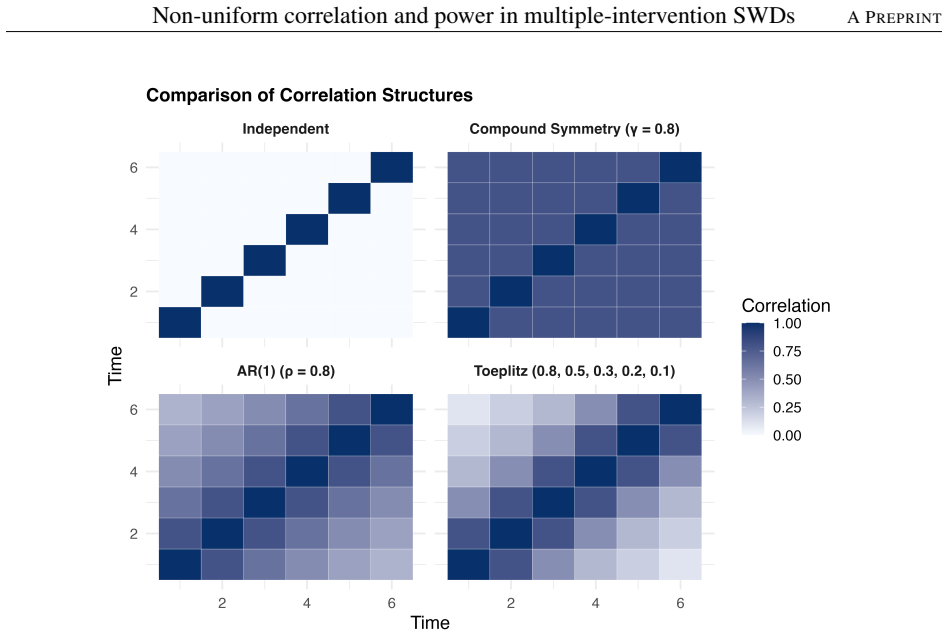
We develop a unified covariance framework for M-SWDs that separates intracluster correlation from an explicit cluster-period correlation matrix. This formulation accommodates exchangeable, autoregressive, and more general distance-dependent correlation structures while preserving closed-form expressions for the variance of treatment effect estimators under linear mixed models.
What carries the argument
The unified covariance framework that separates a scalar intracluster correlation from the cluster-period correlation matrix, enabling flexible structures in variance calculations for treatment effects.
If this is right
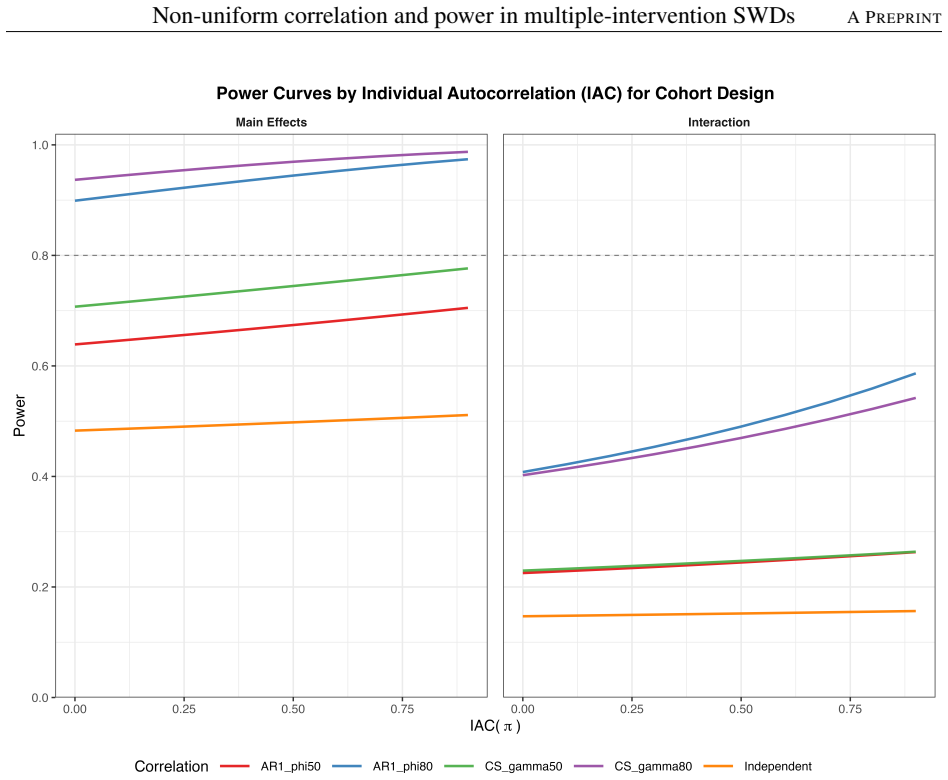
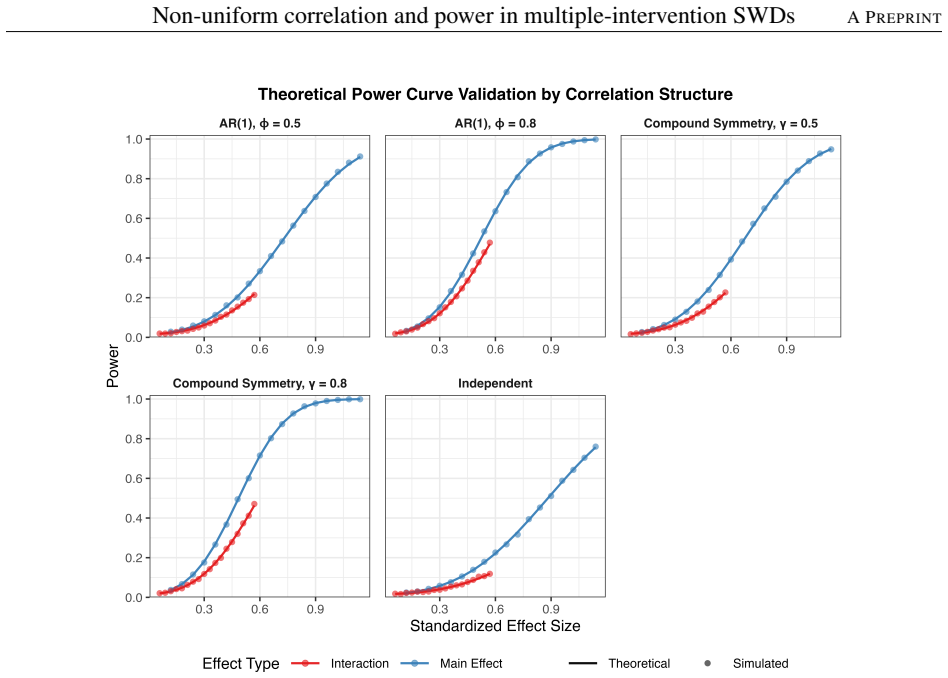
- Misspecification of correlation as exchangeable when it is time-dependent distorts variance estimation and power, particularly for treatment interaction effects.
- Designs calibrated under independence assumptions may be overly conservative.
- Compound symmetry assumptions can be either optimistic or conservative depending on the true correlation decay.
- Explicitly modeling cluster-period correlation at the design stage improves power calculation accuracy in realistic settings.
Where Pith is reading between the lines
- Researchers designing stepped wedge trials could routinely perform sensitivity analyses across different correlation structures using this framework.
- The approach may generalize to other longitudinal cluster trial designs where period-specific correlations matter.
- Software implementations of power calculators for stepped wedge designs would benefit from incorporating selectable correlation matrices beyond exchangeable.
Load-bearing premise
The observations follow a linear mixed model whose covariance structure can be factored into a scalar intracluster correlation multiplied by a fully specified cluster-period correlation matrix.
What would settle it
Collect data from a stepped wedge trial with known time-dependent correlations and check whether the framework's predicted variances match the observed variability of treatment effect estimates better than standard uniform-correlation models.
Figures







read the original abstract
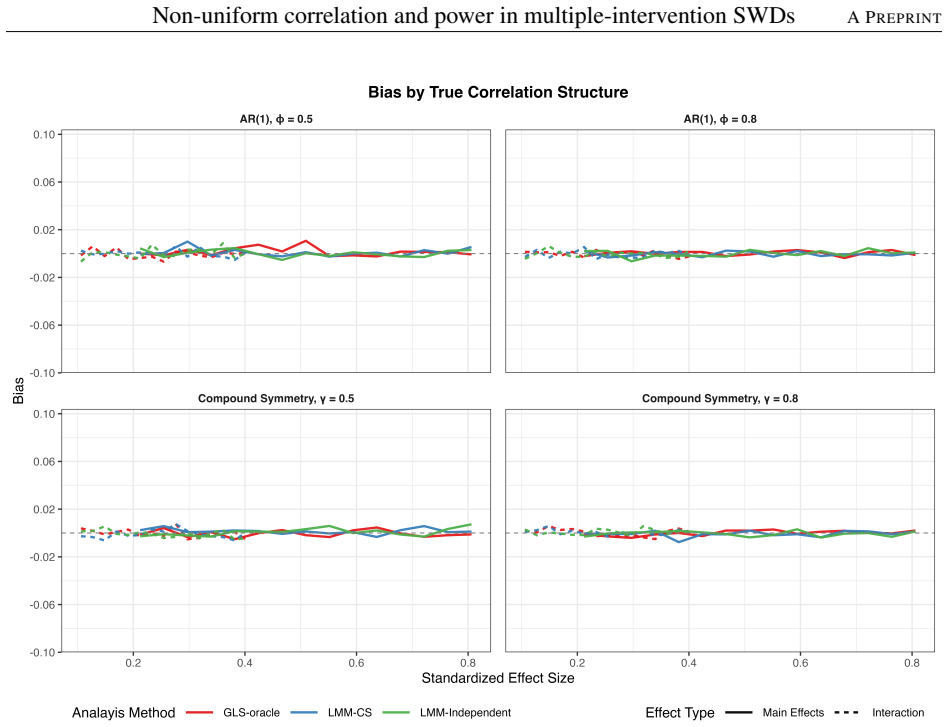
Existing power and design methods for multiple-intervention stepped wedge designs (M-SWDs) typically assume exchangeable cluster-period correlation, despite evidence that correlation often decays over time. Misspecification of this correlation structure can substantially distort variance estimation and power, particularly for treatment interaction effects. We develop a unified covariance framework for M-SWDs that separates intracluster correlation from an explicit cluster-period correlation matrix. This formulation accommodates exchangeable, autoregressive, and more general distance-dependent correlation structures while preserving closed-form expressions for the variance of treatment effect estimators under linear mixed models. Using analytic results and simulation studies, we demonstrate that assuming uniform correlation when the true structure is time-dependent can lead to substantial power mischaracterization. Specifically, we find that designs calibrated under independence assumptions may be overly conservative and compound symmetry can be either optimistic or conservative. These findings demonstrate the importance of explicitly modeling cluster-period correlation at the design stage of M-SWDs and provide practical guidance for power calculation and design selection in realistic settings.
Editorial analysis
A structured set of objections, weighed in public.
Referee Report
Summary. The paper develops a unified covariance framework for multiple-intervention stepped wedge designs (M-SWDs) that separates a scalar intracluster correlation from an explicit cluster-period correlation matrix. This accommodates exchangeable, autoregressive, and distance-dependent structures while retaining closed-form variance expressions for treatment-effect estimators under linear mixed models. Analytic derivations and simulation studies are used to demonstrate that misspecifying the correlation structure (e.g., assuming exchangeability when the true structure is time-dependent) can substantially distort power calculations, particularly for interaction effects.
Significance. If the derivations and simulations hold, the framework addresses a documented limitation in existing M-SWD power methods by enabling realistic, non-uniform correlation modeling at the design stage without sacrificing closed-form variance expressions. The explicit separation of ICC from the cluster-period matrix and the provision of analytic results plus simulations constitute clear strengths for practical trial design.
minor comments (2)
- [Abstract] Abstract: the phrase 'more general distance-dependent correlation structures' is used without naming the specific families (e.g., Toeplitz, exponential decay) that are actually implemented; a brief enumeration would improve clarity.
- [Methods] The manuscript states that closed-form expressions are preserved, but the precise matrix inversion or Woodbury identity steps used to obtain the variance of the treatment estimator are not previewed; adding a short outline in the methods section would aid readers.
Simulated Author's Rebuttal
We thank the referee for their positive summary and significance assessment of our unified covariance framework for M-SWDs. We note the recommendation for minor revision but observe that no specific major comments were provided in the report.
Circularity Check
No significant circularity; framework is a deliberate modeling choice with independent analytic validation
full rationale
The paper presents a covariance factorization (scalar ICC times explicit cluster-period correlation matrix) as an explicit modeling decision that extends existing LMM variance formulas to non-exchangeable structures. This choice is not derived from or reduced to its own fitted outputs; the closed-form variance expressions follow directly from standard linear mixed model algebra once the covariance structure is posited. Validation occurs via separate analytic derivations plus simulation studies that compare power under misspecified versus correctly specified structures, providing external checks. No self-citation chain is invoked to justify uniqueness or to substitute for the derivation, and no step renames a fitted quantity as a prediction. The central contribution therefore remains self-contained against the stated assumptions.
Axiom & Free-Parameter Ledger
Reference graph
Works this paper leans on
-
[1]
Statistics in Medicine , author =
Power analysis for stepped wedge trials with multiple interventions , volume =. Statistics in Medicine , author =. 2022 , pages =. doi:10.1002/sim.9301 , abstract =
-
[2]
Journal of Clinical Epidemiology , author =
Proposed variations of the stepped-wedge design can be used to accommodate multiple interventions , volume =. Journal of Clinical Epidemiology , author =. 2017 , pmid =. doi:10.1016/j.jclinepi.2017.04.004 , abstract =
-
[3]
Cancer Research , author =
The. Cancer Research , author =. 1987 , pages =
1987
-
[4]
American journal of epidemiology , author =
Intraclass. American journal of epidemiology , author =. 1995 , pages =. doi:10.1093/oxfordjournals.aje.a117194 , abstract =
-
[5]
American Journal of Public Health , author =
Design and. American Journal of Public Health , author =. 2004 , pmid =
2004
-
[6]
Statistics in Medicine , author =
Analysis of cluster randomized cross-over trial data: a comparison of methods , volume =. Statistics in Medicine , author =. 2007 , note =. doi:10.1002/sim.2537 , abstract =
-
[7]
Contemporary Clinical Trials , author =
Design and analysis of stepped wedge cluster randomized trials , volume =. Contemporary Clinical Trials , author =. 2007 , pmid =. doi:10.1016/j.cct.2006.05.007 , abstract =
-
[8]
Longitudinal data analysis using generalized linear models , volume =. Biometrika , author =. 1986 , pages =. doi:10.1093/biomet/73.1.13 , abstract =
-
[9]
Biometrical Journal , author =
Relative efficiency of unequal versus equal cluster sizes in cluster randomized trials using generalized estimating equation models , volume =. Biometrical Journal , author =. 2018 , note =. doi:10.1002/bimj.201600262 , abstract =
-
[10]
Journal of Consulting and Clinical Psychology , author =
Random-effects regression models for clustered data with an example from smoking prevention research , volume =. Journal of Consulting and Clinical Psychology , author =. 1994 , note =. doi:10.1037/0022-006X.62.4.757 , abstract =
-
[11]
Biometrics , author =
Random-effects models for longitudinal data , volume =. Biometrics , author =. 1982 , pmid =
1982
-
[12]
Implementation Science , author =
Evaluating the impact of multilevel evidence-based implementation strategies to enhance provider recommendation on human papillomavirus vaccination rates among an empaneled primary care patient population: a study protocol for a stepped-wedge cluster randomized trial , volume =. Implementation Science , author =. 2018 , keywords =. doi:10.1186/s13012-018-...
-
[13]
BMC Health Services Research , author =
Effectiveness of sensor monitoring in an occupational therapy rehabilitation program for older individuals after hip fracture, the. BMC Health Services Research , author =. 2017 , keywords =. doi:10.1186/s12913-016-1934-0 , abstract =
-
[14]
Enhancing doctor-patient relationships in community health care institutions: the. BMC Psychiatry , author =. 2023 , pmid =. doi:10.1186/s12888-023-04948-w , abstract =
-
[15]
Journal of Clinical Epidemiology , author =
Systematic review of stepped wedge cluster randomized trials shows that design is particularly used to evaluate interventions during routine implementation , volume =. Journal of Clinical Epidemiology , author =. 2011 , keywords =. doi:10.1016/j.jclinepi.2010.12.003 , abstract =
-
[16]
Effectiveness of sensor monitoring in a rehabilitation programme for older patients after hip fracture: a three-arm stepped wedge randomised trial , volume =. Age and Ageing , author =. 2019 , pages =. doi:10.1093/ageing/afz074 , abstract =
-
[17]
Assessment, management, and incidence of neonatal jaundice in healthy neonates cared for in primary care: a prospective cohort study , volume =. Scientific Reports , author =. 2022 , note =. doi:10.1038/s41598-022-17933-2 , abstract =
-
[18]
Screening and treatment to reduce severe hyperbilirubinaemia in infants in primary care (. BMJ Open , author =. 2019 , pmid =. doi:10.1136/bmjopen-2018-028270 , abstract =
-
[19]
Understanding the cluster randomised crossover design: a graphical illustration of the components of variation and a sample size tutorial , volume =. Trials , author =. 2017 , keywords =. doi:10.1186/s13063-017-2113-2 , abstract =
-
[20]
The Lancet Infectious Diseases , author =
Stepped-wedge trial design to evaluate. The Lancet Infectious Diseases , author =. 2015 , pmid =. doi:10.1016/S1473-3099(15)00078-X , language =
-
[21]
Reporting of stepped wedge cluster randomised trials: extension of the. The BMJ , author =. 2018 , pmid =. doi:10.1136/bmj.k1614 , abstract =
-
[22]
Clinical trials (London, England) , author =
Statistical. Clinical trials (London, England) , author =. 2016 , pmid =. doi:10.1177/1740774516646578 , abstract =
-
[23]
Statistical Methods in Medical Research , author =
Mixed-effects models for the design and analysis of stepped wedge cluster randomized trials:. Statistical Methods in Medical Research , author =. 2021 , pmid =. doi:10.1177/0962280220932962 , abstract =
-
[24]
The stepped wedge cluster randomised trial: rationale, design, analysis, and reporting , volume =. BMJ , author =. 2015 , pmid =. doi:10.1136/bmj.h391 , abstract =
-
[25]
Statistics in Medicine , author =
Statistical efficiency and optimal design for stepped cluster studies under linear mixed effects models , volume =. Statistics in Medicine , author =. 2016 , note =. doi:10.1002/sim.6850 , abstract =
-
[26]
International Journal of Epidemiology , author =
Methods for sample size determination in cluster randomized trials , volume =. International Journal of Epidemiology , author =. 2015 , pmid =. doi:10.1093/ije/dyv113 , abstract =
-
[27]
Simple sample size calculation for cluster-randomized trials. , volume =. International Journal of Epidemiology , author =. 1999 , pages =. doi:10.1093/ije/28.2.319 , abstract =
-
[28]
Contemporary clinical trials , author =
Ethical and epistemic issues in the design and conduct of pragmatic stepped-wedge cluster randomized clinical trials , volume =. Contemporary clinical trials , author =. 2022 , pmid =. doi:10.1016/j.cct.2022.106703 , abstract =
-
[29]
Inadequacy of ethical conduct and reporting of stepped wedge cluster randomized trials:. Clinical Trials , author =. 2017 , note =. doi:10.1177/1740774517703057 , abstract =
-
[30]
Stepped wedge cluster randomized controlled trial designs: a review of reporting quality and design features , volume =. Trials , author =. 2017 , pmid =. doi:10.1186/s13063-017-1783-0 , abstract =
-
[31]
International Journal of Epidemiology , author =
Reflection on modern methods: when is a stepped-wedge cluster randomized trial a good study design choice? , volume =. International Journal of Epidemiology , author =. 2020 , pmid =. doi:10.1093/ije/dyaa077 , abstract =
-
[32]
Annals of Family Medicine , author =
What. Annals of Family Medicine , author =. 2004 , pmid =. doi:10.1370/afm.141 , abstract =
-
[33]
American Journal of Epidemiology , author =. 1981 , pages =. doi:10.1093/oxfordjournals.aje.a113261 , abstract =
-
[34]
International Journal of Epidemiology , author =
Cluster randomized trials with a small number of clusters: which analyses should be used? , volume =. International Journal of Epidemiology , author =. 2018 , pages =. doi:10.1093/ije/dyx169 , abstract =
-
[35]
BMC Medical Research Methodology , author =
The stepped wedge trial design: a systematic review , volume =. BMC Medical Research Methodology , author =. 2006 , pmid =. doi:10.1186/1471-2288-6-54 , abstract =
-
[36]
Design and
DONNER, ALLAN and Klar, Neil , year =. Design and
-
[37]
Stepped wedge randomised controlled trials: systematic review of studies published between 2010 and 2014 , volume =. Trials , author =. 2015 , keywords =. doi:10.1186/s13063-015-0839-2 , abstract =
-
[38]
Eldridge, Sandra and Kerry, Sally , year =. A
-
[39]
Statistics in Medicine , author =
Relative efficiency of unequal cluster sizes in stepped wedge and other trial designs under longitudinal or cross‐sectional sampling , volume =. Statistics in Medicine , author =. 2018 , pmid =. doi:10.1002/sim.7943 , abstract =
-
[40]
Journal of Clinical Epidemiology , author =
Stepped wedge designs could reduce the required sample size in cluster randomized trials , volume =. Journal of Clinical Epidemiology , author =. 2013 , keywords =. doi:10.1016/j.jclinepi.2013.01.009 , abstract =
-
[41]
Journal of Clinical Epidemiology , author =
The stepped wedge cluster randomized trial always requires fewer clusters but not always fewer measurements, that is, participants than a parallel cluster randomized trial in a cross-sectional design , volume =. Journal of Clinical Epidemiology , author =. 2013 , pages =. doi:10.1016/j.jclinepi.2013.07.008 , number =
-
[42]
The efficiency of stepped wedge vs. cluster randomized trials:. Journal of Clinical Epidemiology , author =. 2013 , pages =. doi:10.1016/j.jclinepi.2013.07.007 , number =
-
[43]
Journal of Clinical Epidemiology , author =
Sample size calculations for stepped wedge and cluster randomised trials: a unified approach , volume =. Journal of Clinical Epidemiology , author =. 2016 , pmid =. doi:10.1016/j.jclinepi.2015.08.015 , abstract =
-
[44]
Statistics in Medicine , author =
Design and analysis of three-arm parallel cluster randomized trials with small numbers of clusters , volume =. Statistics in Medicine , author =. 2021 , note =. doi:10.1002/sim.8828 , abstract =
-
[45]
Statistics in medicine , author =
Constrained randomization and statistical inference for multi-arm parallel cluster randomized controlled trials , volume =. Statistics in medicine , author =. 2022 , pmid =. doi:10.1002/sim.9333 , abstract =
-
[46]
Reporting of. JAMA , author =. 2019 , pages =. doi:10.1001/jama.2019.3087 , abstract =
-
[47]
Clinical Cancer Research , author =
Multi-. Clinical Cancer Research , author =. 2008 , pages =. doi:10.1158/1078-0432.CCR-08-0325 , abstract =
-
[48]
More multiarm randomised trials of superiority are needed , volume =. The Lancet , author =. 2014 , pages =. doi:10.1016/S0140-6736(14)61122-3 , number =
-
[49]
International Journal of Epidemiology , author =
Sample size calculators for planning stepped-wedge cluster randomized trials: a review and comparison , volume =. International Journal of Epidemiology , author =. 2022 , pmid =. doi:10.1093/ije/dyac123 , abstract =
-
[50]
Statistical Methods in Medical Research , author =
Sample size determination for stepped wedge cluster randomized trials in pragmatic settings , volume =. Statistical Methods in Medical Research , author =. 2021 , note =. doi:10.1177/09622802211022392 , abstract =
-
[51]
Systematic review finds major deficiencies in sample size methodology and reporting for stepped-wedge cluster randomised trials , volume =. BMJ Open , author =. 2016 , pmid =. doi:10.1136/bmjopen-2015-010166 , abstract =
-
[52]
American Journal of Preventive Medicine , author =
Food. American Journal of Preventive Medicine , author =. 2023 , pages =. doi:10.1016/j.amepre.2023.03.022 , abstract =
-
[53]
Impact of. BMJ , author =. 2011 , pmid =. doi:10.1136/bmj.d5886 , abstract =
-
[54]
Designing a stepped wedge trial: three main designs, carry-over effects and randomisation approaches , volume =. Trials , author =. 2015 , keywords =. doi:10.1186/s13063-015-0842-7 , abstract =
-
[55]
Statistics in Medicine , author =
Sample size calculation for stepped wedge and other longitudinal cluster randomised trials , volume =. Statistics in Medicine , author =. 2016 , pmid =. doi:10.1002/sim.7028 , abstract =
-
[56]
Statistical Methods in Medical Research , author =
Impact of non-uniform correlation structure on sample size and power in multiple-period cluster randomised trials , volume =. Statistical Methods in Medical Research , author =. 2019 , note =. doi:10.1177/0962280217734981 , abstract =
-
[57]
Statistics in Medicine , author =
Accounting for a decaying correlation structure in cluster randomized trials with continuous recruitment , volume =. Statistics in Medicine , author =. 2019 , note =. doi:10.1002/sim.8089 , abstract =
-
[58]
Statistics in Medicine , author =
Bias and inference from misspecified mixed-effect models in stepped wedge trial analysis , volume =. Statistics in Medicine , author =. 2017 , note =. doi:10.1002/sim.7348 , abstract =
-
[59]
Statistical Methods in Medical Research , author =
Inference for the treatment effect in multiple-period cluster randomised trials when random effect correlation structure is misspecified , volume =. Statistical Methods in Medical Research , author =. 2019 , note =. doi:10.1177/0962280218797151 , abstract =
-
[60]
Allocation techniques for balance at baseline in cluster randomized trials: a methodological review , volume =. Trials , author =. 2012 , keywords =. doi:10.1186/1745-6215-13-120 , abstract =
-
[61]
Statistics in Medicine , author =
An evaluation of constrained randomization for the design and analysis of group-randomized trials with binary outcomes , volume =. Statistics in Medicine , author =. 2017 , pmid =. doi:10.1002/sim.7410 , abstract =
-
[62]
Statistical design of
-
[63]
Annals of Internal Medicine , author =. 2010 , note =. doi:10.7326/0003-4819-152-11-201006010-00232 , abstract =
-
[64]
Improving the reporting of pragmatic trials: an extension of the. The BMJ , author =. 2008 , pmid =. doi:10.1136/bmj.a2390 , abstract =
-
[65]
Consort 2010 statement: extension to cluster randomised trials , volume =. BMJ , author =. 2012 , pmid =. doi:10.1136/bmj.e5661 , abstract =
-
[66]
Statistics in Medicine , author =
Cohort versus cross-sectional design in large field trials:. Statistics in Medicine , author =. 1994 , note =. doi:10.1002/sim.4780130108 , abstract =
-
[67]
Statistics in Medicine , author =
A simple sample size formula for analysis of covariance in cluster randomized trials , volume =. Statistics in Medicine , author =. 2012 , note =. doi:10.1002/sim.5352 , abstract =
-
[68]
BJOG : an international journal of obstetrics and gynaecology , author =
Randomised controlled trials—the gold standard for effectiveness research , volume =. BJOG : an international journal of obstetrics and gynaecology , author =. 2018 , pmid =. doi:10.1111/1471-0528.15199 , number =
-
[69]
Korean Journal of Anesthesiology , author =
Randomization in clinical studies , volume =. Korean Journal of Anesthesiology , author =. 2019 , pmid =. doi:10.4097/kja.19049 , abstract =
-
[70]
, volume =
Randomisation. , volume =. BMJ : British Medical Journal , author =. 1991 , pmid =
1991
-
[71]
Neuropsychiatric Disease and Treatment , author =
Randomized controlled trials – a matter of design , volume =. Neuropsychiatric Disease and Treatment , author =. 2016 , pmid =. doi:10.2147/NDT.S101938 , urldate =
-
[72]
Treatment allocation in controlled trials: why randomise? , volume =. BMJ , author =. 1999 , pmid =. doi:10.1136/bmj.318.7192.1209 , abstract =
-
[73]
Statistics in Medicine , author =
Stepped-wedge cluster randomised controlled trials: a generic framework including parallel and multiple-level designs , volume =. Statistics in Medicine , author =. 2015 , note =. doi:10.1002/sim.6325 , abstract =
-
[74]
Intensive Care Medicine , author =
Introducing. Intensive Care Medicine , author =. 2004 , keywords =. doi:10.1007/s00134-004-2268-7 , abstract =
-
[75]
Annals of Epidemiology , author =
Regression. Annals of Epidemiology , author =. 2005 , keywords =. doi:10.1016/j.annepidem.2004.08.007 , abstract =
-
[76]
The. Epidemiology , author =. 2007 , pages =. doi:10.1097/EDE.0b013e3181200199 , abstract =
-
[77]
Journal of Clinical Epidemiology , author =
Explanatory and. Journal of Clinical Epidemiology , author =. 2009 , pages =. doi:10.1016/j.jclinepi.2009.01.012 , abstract =
-
[78]
New England Journal of Medicine , author =
Pragmatic. New England Journal of Medicine , author =. 2016 , note =. doi:10.1056/NEJMra1510059 , abstract =
-
[79]
Clinical trials (London, England) , author =
Exploring the ethical and regulatory issues in pragmatic clinical trials , volume =. Clinical trials (London, England) , author =. 2015 , pmid =. doi:10.1177/1740774515598334 , abstract =
-
[80]
Practical. JAMA , author =. 2003 , pages =. doi:10.1001/jama.290.12.1624 , abstract =
discussion (0)
Sign in with ORCID, Apple, or X to comment. Anyone can read and Pith papers without signing in.