Ram-pressure signatures in the dwarf irregular galaxy SextansB revealed by deep MeerKAT HI observations
Pith reviewed 2026-06-26 08:08 UTC · model grok-4.3
The pith
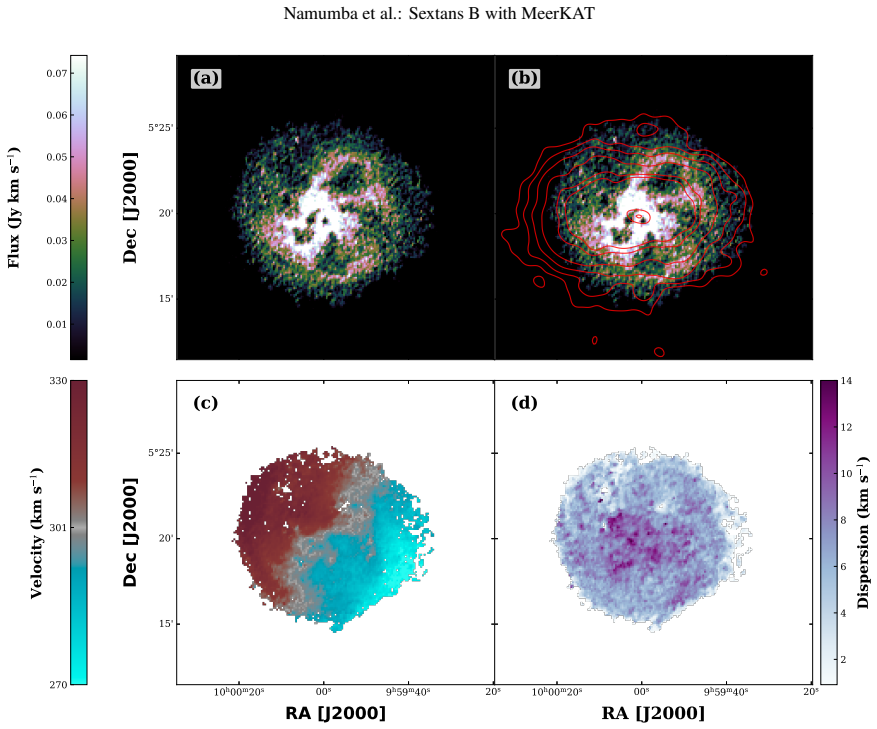
Deep MeerKAT HI data show the outer gas disc of Sextans B being disturbed by ram pressure from the diffuse intergalactic medium.
A machine-rendered reading of the paper's core claim, the machinery that carries it, and where it could break.
Core claim
The combination of morphological and kinematic signatures suggests that the outer HI disc of Sextans B is affected by ram-pressure interaction with the diffuse IGM in the outskirts of the Local Group. This is the second strong example in the Local Group, after WLM, showing that a very low-density IGM can significantly influence the gas distribution and kinematics of dwarf galaxies.
What carries the argument
The asymmetric low-column-density HI envelope with rosette-like filaments together with the divergence between approaching and receding rotation curves at large radii, reproduced by tailored hydrodynamical simulations of IGM ram pressure.
If this is right
- Ram pressure can operate on dwarf galaxy discs at IGM densities far below those in galaxy clusters.
- The outer HI discs of other Local Group dwarfs may show similar disturbances from the diffuse IGM.
- Gas kinematics in dwarfs at large radii should be checked for departures from axisymmetric rotation before attributing them solely to internal processes.
- Environmental effects on gas content must be considered even for galaxies traditionally viewed as isolated.
Where Pith is reading between the lines
- Surveys of additional low-mass galaxies in the Local Group outskirts could test how common such IGM interactions are.
- The observed filamentary structures might serve as tracers for mapping the density and velocity structure of the surrounding IGM.
- If confirmed, this interaction could reduce the retained gas reservoir over time and affect future star formation in Sextans B.
Load-bearing premise
Stellar feedback cannot generate the filamentary HI structure, the asymmetric outer HI envelope, or the divergence between the approaching and receding rotation curves.
What would settle it
Detection of a mechanism internal to the galaxy, such as stellar feedback or past mergers, that reproduces both the rosette-like filamentary HI structure extending to low column densities and the specific divergence in the outer rotation curve sides.
Figures





read the original abstract
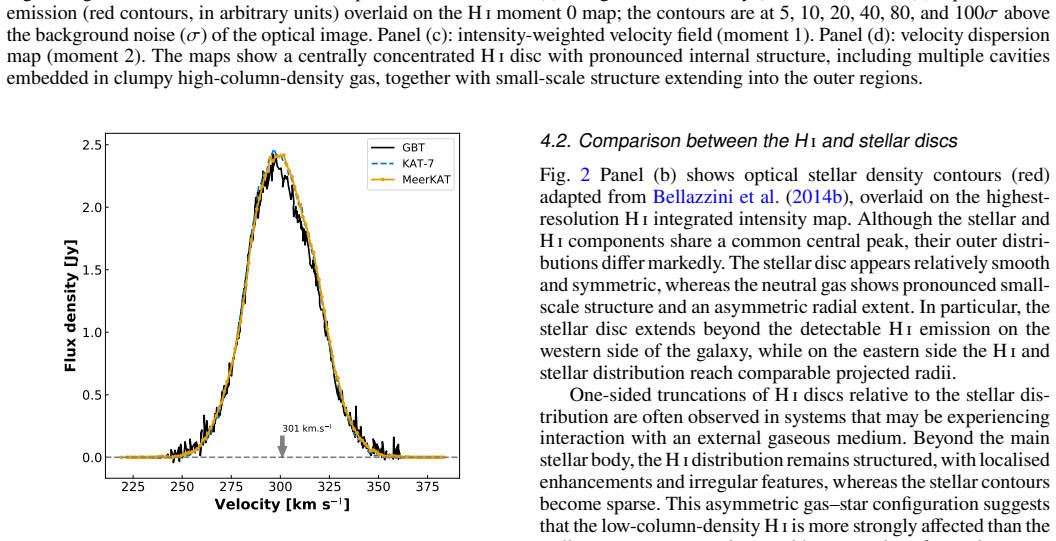
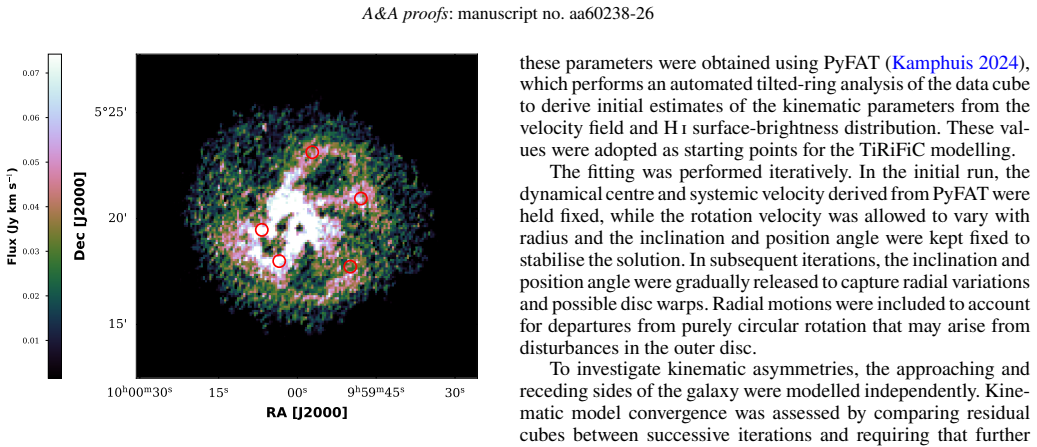
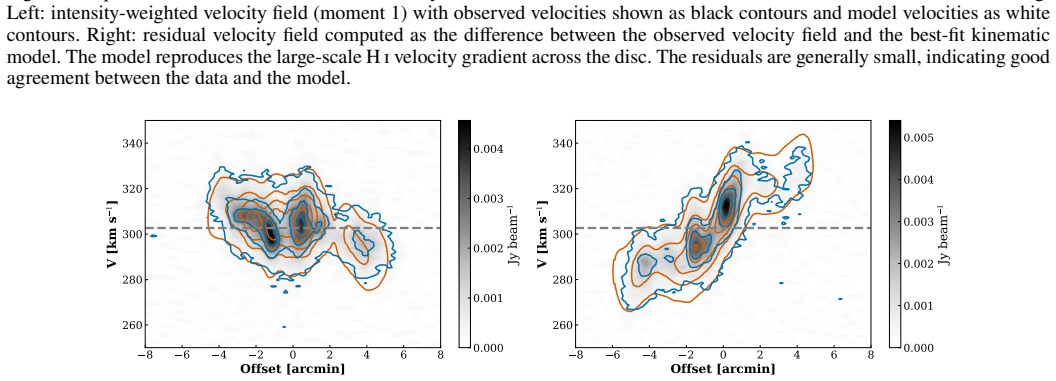
The impact of extremely low-density environments such as the diffuse intergalactic medium (IGM) on the neutral gas distribution of dwarf galaxies remains poorly explored observationally. We present deep MeerKAT HI 21 cm observations of the Local Group dwarf irregular galaxy Sextans B that achieve a spectral resolution of 1.4 km/s and reach column-density sensitivities down to 3.3 x 10^18 cm^-2, allowing us to trace the extended HI disc and faint outer structures. The low-column-density HI distribution is asymmetric and reveals a rosette-like filamentary structure superposed on the HI disc. Comparison with the stellar distribution shows offsets between the gaseous and stellar components, with the stellar disc remaining relatively symmetric while the HI envelope becomes increasingly disturbed. 3D kinematic modelling with TiRiFiC reproduces the global velocity gradient but reveals differences between the approaching and receding sides of the rotation curve at large radii, indicating departures from axisymmetric rotation. While stellar feedback can produce small-scale cavities and turbulence in dwarf galaxies, it cannot generate the filamentary HI structure, the asymmetric outer HI envelope, or the divergence between the approaching and receding rotation curves. This is consistent with interaction with a diffuse IGM. Hydrodynamical simulations tailored to Sextans B show that IGM ram pressure acting on the outer gas disc can produce asymmetric gas distributions, filamentary structures, and kinematic perturbations. The combination of morphological and kinematic signatures suggests that the outer HI disc of Sextans B is affected by ram-pressure interaction with the diffuse IGM in the outskirts of the Local Group. This is the second strong example in the Local Group, after WLM, showing that a very low-density IGM can significantly influence the gas distribution and kinematics of dwarf galaxies.
Editorial analysis
A structured set of objections, weighed in public.
Referee Report
Summary. The manuscript presents deep MeerKAT HI 21 cm observations of the Local Group dwarf irregular galaxy Sextans B, reaching 1.4 km/s spectral resolution and 3.3×10^18 cm^-2 column-density sensitivity. It reports an asymmetric low-column-density HI distribution featuring a rosette-like filamentary structure, offsets between gas and stars, and kinematic departures from axisymmetry revealed by TiRiFiC 3D modeling (differences between approaching and receding rotation curves at large radii). The authors rule out stellar feedback as the origin of these large-scale features and interpret the observations as ram-pressure interaction with the diffuse IGM, supported by tailored hydrodynamical simulations. This is presented as the second such case in the Local Group after WLM.
Significance. If the exclusion of stellar feedback is placed on a quantitative footing, the work would provide valuable observational evidence that very low-density IGM can measurably perturb the outer HI discs of dwarfs, extending the WLM result. The depth of the MeerKAT data and the use of tailored simulations are clear strengths. The central claim remains defensible but currently rests on an assertion rather than a direct test against feedback-only models.
major comments (1)
- [Abstract] Abstract (and corresponding discussion section): the statement that stellar feedback 'cannot generate the filamentary HI structure, the asymmetric outer HI envelope, or the divergence between the approaching and receding rotation curves' is load-bearing for the central claim yet is supported only by noting that feedback produces small-scale cavities and turbulence. No feedback-only hydrodynamical run of Sextans B is described that demonstrates these specific large-scale morphological and kinematic features are absent at the quoted sensitivity (3.3×10^18 cm^-2) and resolution (1.4 km/s). The presented simulations are tailored exclusively to IGM ram pressure; an explicit comparison is required to substantiate the exclusion of internal processes.
Simulated Author's Rebuttal
We thank the referee for their constructive feedback, which highlights an opportunity to strengthen the presentation of our central claim. We respond to the single major comment below.
read point-by-point responses
-
Referee: [Abstract] Abstract (and corresponding discussion section): the statement that stellar feedback 'cannot generate the filamentary HI structure, the asymmetric outer HI envelope, or the divergence between the approaching and receding rotation curves' is load-bearing for the central claim yet is supported only by noting that feedback produces small-scale cavities and turbulence. No feedback-only hydrodynamical run of Sextans B is described that demonstrates these specific large-scale morphological and kinematic features are absent at the quoted sensitivity (3.3×10^18 cm^-2) and resolution (1.4 km/s). The presented simulations are tailored exclusively to IGM ram pressure; an explicit comparison is required to substantiate the exclusion of internal processes.
Authors: We agree that the exclusion of stellar feedback rests on a general argument rather than a galaxy-specific feedback-only simulation at the quoted sensitivity and resolution. The manuscript's statement draws from the established literature on dwarf-galaxy feedback, which consistently shows that stellar feedback produces localised cavities and turbulence on scales of tens to a few hundred parsecs, not the kiloparsec-scale filamentary asymmetry and global kinematic divergence reported here. Our tailored ram-pressure simulations reproduce these large-scale features, providing positive evidence for the external-interaction interpretation. To address the referee's concern, we will revise the abstract and discussion to replace the absolute phrasing ('cannot generate') with a qualified statement ('is not expected to generate, given the characteristic scales of feedback in dwarfs') and will add citations to feedback-only simulations of similar dwarfs that lack such extended structures. This constitutes a partial revision; we do not add a new feedback-only run of Sextans B, as that would require a separate modelling effort beyond the scope of the present work. revision: partial
Circularity Check
No significant circularity; derivation rests on independent observations and modeling
full rationale
The paper's core argument—that observed HI morphology and kinematics indicate ram-pressure interaction—derives directly from MeerKAT data (column-density maps, velocity fields) and separate hydrodynamical simulations run with IGM ram-pressure parameters. The statement ruling out stellar feedback is an assertion based on scale arguments (feedback produces small-scale features) rather than any fitted parameter, self-defined quantity, or self-citation chain that reduces the conclusion to the inputs. No equations, predictions, or uniqueness theorems are shown to be equivalent to the data by construction. The derivation chain is self-contained against external benchmarks.
Axiom & Free-Parameter Ledger
free parameters (1)
- TiRiFiC kinematic model parameters
axioms (1)
- domain assumption Standard assumptions of axisymmetric disc geometry and circular rotation in 3D kinematic modeling
Reference graph
Works this paper leans on
-
[1]
D., Allende Prieto, C., Almeida, A., et al
Albareti, F. D., Allende Prieto, C., Almeida, A., et al. 2017, ApJS, 233, 25
2017
-
[2]
2020, A&A, 644, A125
Bacchini, C., Fraternali, F., Pezzulli, G., & Marasco, A. 2020, A&A, 644, A125
2020
-
[3]
2011, AJ, 141, 23
Bagetakos, I., Brinks, E., Walter, F., et al. 2011, AJ, 141, 23
2011
-
[4]
J., Brinks, E., & Bagetakos, I
Banerjee, A., Jog, C. J., Brinks, E., & Bagetakos, I. 2011, MNRAS, 415, 687
2011
-
[5]
S., Famaey, B., & Kroupa, P
Banik, I., Haslbauer, M., Pawlowski, M. S., Famaey, B., & Kroupa, P. 2021, MNRAS, 503, 6170 Article number, page 12 of 13 Namumba et al.: Sextans B with MeerKAT
2021
-
[6]
Barnes, J. E. 2011, ZENO: N-body and SPH Simulation Codes, Astrophysics Source Code Library, record ascl:1102.027
2011
-
[7]
F., & Fritz, T
Battaglia, G., Taibi, S., Thomas, G. F., & Fritz, T. K. 2022, A&A, 657, A54
2022
-
[8]
2014b, A&A, 566, A44 Benítez-Llambay, A., Navarro, J
Bellazzini, M., Beccari, G., Fraternali, F., et al. 2014b, A&A, 566, A44 Benítez-Llambay, A., Navarro, J. F., Abadi, M. G., et al. 2013, ApJ, 763, L41
2013
-
[9]
& Gavazzi, G
Boselli, A. & Gavazzi, G. 2006, PASP, 118, 517 Brunthaler,A.,Reid,M.J.,Falcke,H.,Henkel,C.,&Menten,K.M.2007,A&A, 462, 101
2006
-
[10]
& Carignan, C
Bureau, M. & Carignan, C. 2002, AJ, 123, 1316
2002
-
[11]
2018, ApJ, 856, 180
Camilo, F., Scholz, P., Serylak, M., et al. 2018, ApJ, 856, 180
2018
-
[12]
J., Jonsson, P., Primack, J
Cox, T. J., Jonsson, P., Primack, J. R., & Somerville, R. S. 2006, MNRAS, 373, 1013 de Vaucouleurs, G., de Vaucouleurs, A., Corwin, Jr., H. G., et al. 1991, Third Reference Catalogue of Bright Galaxies
2006
-
[13]
E., Saha, A., Skillman, E
Dolphin, A. E., Saha, A., Skillman, E. D., et al. 2003, AJ, 125, 1261
2003
-
[14]
& Putman, M
Grcevich, J. & Putman, M. E. 2009, ApJ, 696, 385
2009
-
[15]
Gunn, J. E. & Gott, III, J. R. 1972, ApJ, 176, 1
1972
-
[16]
B., Flores, H., Puech, M., & Fouquet, S
Hammer, F., Yang, Y. B., Flores, H., Puech, M., & Fouquet, S. 2015, ApJ, 813, 110
2015
-
[17]
Hopkins, P. F. 2015, MNRAS, 450, 53
2015
-
[18]
A., Ficut-Vicas, D., Ashley, T., et al
Hunter, D. A., Ficut-Vicas, D., Ashley, T., et al. 2012, AJ, 144, 134
2012
-
[19]
& MeerKAT Team
Jonas, J. & MeerKAT Team. 2016, in MeerKAT Science: On the Pathway to the SKA, 1 Józsa, G. I. G., Kenn, F., Klein, U., & Oosterloo, T. A. 2007, A&A, 468, 731 Józsa, G. I. G., White, S. V., Thorat, K., et al. 2020, CARACal: Containerized AutomatedRadioAstronomyCalibrationpipeline,AstrophysicsSourceCode Library, record ascl:2006.014
2016
-
[20]
Kalberla, P. M. W. & Haud, U. 2006, A&A, 455, 481
2006
-
[21]
2024, pyFAT: Python Fully Automated TiRiFiC, Astrophysics Source Code Library, record ascl:2407.002
Kamphuis, P. 2024, pyFAT: Python Fully Automated TiRiFiC, Astrophysics Source Code Library, record ascl:2407.002
2024
-
[22]
A., Wilcots, E
Kepley, A. A., Wilcots, E. M., Hunter, D. A., & Nordgren, T. 2007, AJ, 133, 2242
2007
-
[23]
Y., Grebel, E
Kniazev, A. Y., Grebel, E. K., Pustilnik, S. A., Pramskij, A. G., & Zucker, D. B. 2005, AJ, 130, 1558
2005
-
[24]
2026, A&A, 707, A309
Kolhe, N., Hammer, F., Yang, Y., et al. 2026, A&A, 707, A309
2026
-
[25]
McConnachie, A. W. 2012, AJ, 144, 4
2012
-
[26]
W., Venn, K
McConnachie, A. W., Venn, K. A., Irwin, M. J., Young, L. M., & Geehan, J. J. 2007, ApJ, 671, L33
2007
-
[27]
R., Carignan, C., Beaulieu, S
Meurer, G. R., Carignan, C., Beaulieu, S. F., & Freeman, K. C. 1996, AJ, 111, 1551
1996
-
[28]
Miller, M. J. & Bregman, J. N. 2013, ApJ, 770, 118
2013
-
[29]
2018, MNRAS, 478, 487
Namumba, B., Carignan, C., & Passmoor, S. 2018, MNRAS, 478, 487
2018
-
[30]
Offringa, A. R. 2010, AOFlagger: RFI Software, Astrophysics Source Code Li- brary, record ascl:1010.017 Offringa,A.R.,McKinley,B.,Hurley-Walker,N.,etal.2014,MNRAS,444,606
2010
-
[31]
Offringa, A. R. & Smirnov, O. 2017, MNRAS, 471, 301
2017
-
[32]
R., van de Gronde, J
Offringa, A. R., van de Gronde, J. J., & Roerdink, J. B. T. M. 2012, A&A, 539, A95
2012
-
[33]
A., Brinks, E., et al
Oh, S.-H., Hunter, D. A., Brinks, E., et al. 2015, AJ, 149, 180
2015
-
[34]
Pawlowski, M. S. & McGaugh, S. S. 2014, MNRAS, 440, 908
2014
-
[35]
E., Impey, C
Pickering, T. E., Impey, C. D., van Gorkom, J. H., & Bothun, G. D. 1997, AJ, 114, 1858
1997
-
[36]
1992, AJ, 103, 1841
Puche, D., Westpfahl, D., Brinks, E., & Roy, J.-R. 1992, AJ, 103, 1841
1992
-
[37]
E., Zheng, Y., Price-Whelan, A
Putman, M. E., Zheng, Y., Price-Whelan, A. M., et al. 2021, ApJ, 913, 53 Soszyński, I., Gieren, W., Pietrzyński, G., et al. 2006, ApJ, 648, 375
2021
-
[38]
M., Haynes, M
Springob, C. M., Haynes, M. P., Giovanelli, R., & Kent, B. R. 2005, ApJS, 160, 149
2005
-
[39]
2020, MNRAS, 494, 1114
Steyrleithner, P., Hensler, G., & Boselli, A. 2020, MNRAS, 494, 1114
2020
-
[40]
& Brinks, E
Walter, F. & Brinks, E. 1999, AJ, 118, 273
1999
-
[41]
2024, MNRAS, 527, 7144
Wang, J., Hammer, F., Yang, Y., et al. 2024, MNRAS, 527, 7144
2024
-
[42]
2019, MNRAS, 486, 5907
Wang, J., Hammer, F., Yang, Y., et al. 2019, MNRAS, 486, 5907
2019
-
[43]
2021, MNRAS, 506, 3962
Westmeier, T., Kitaeff, S., Pallot, D., et al. 2021, MNRAS, 506, 3962
2021
-
[44]
2022, A&A, 660, L11 Article number, page 13 of 13
Yang, Y., Ianjamasimanana, R., Hammer, F., et al. 2022, A&A, 660, L11 Article number, page 13 of 13
2022
discussion (0)
Sign in with ORCID, Apple, or X to comment. Anyone can read and Pith papers without signing in.