Canopies: A Generalization of Vines and Vineyards for Parameterized Persistence
Pith reviewed 2026-06-26 05:39 UTC · model grok-4.3
The pith
Canopies track choices of simplex pairs in filtered complexes rather than persistence diagram points, producing homeomorphic structures for any filtration.
A machine-rendered reading of the paper's core claim, the machinery that carries it, and where it could break.
Core claim
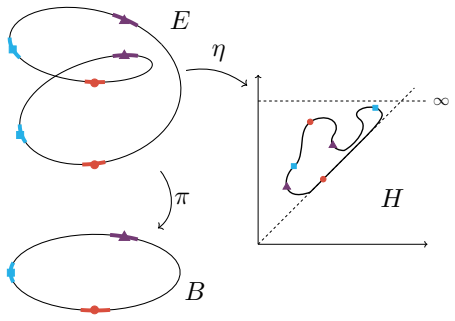
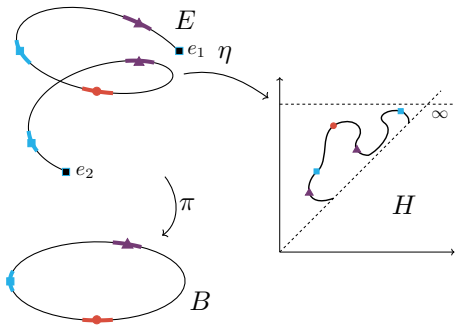
By tracking a choice of simplex pairs instead of the output point in the persistence diagram, a canopy can be built directly from any filtered filtration function. The algebraic structure of filtered chain complexes guarantees that different valid pair choices produce homeomorphic canopies. This combinatorial replacement of the persistence bundle enables vines with multiplicity and a direct connection between non-trivial monodromy in the persistent homology transform and non-Hausdorff points in the canopy.
What carries the argument
The canopy, obtained by replacing each persistence point with a choice of the pair of simplices whose birth and death generate it, acting as a combinatorial encoding of the filtered chain complex.
If this is right
- Vines can be defined even when persistence points occur with multiplicity.
- Monodromy of the parameterized persistence can be discussed directly from the canopy.
- Non-trivial monodromy in the persistent homology transform implies the existence of non-Hausdorff points in the canopy.
Where Pith is reading between the lines
- The same pair-tracking idea could be used to extend other persistence summaries that currently discard diagonal or multiplicity information.
- Because the canopy is built from the chain complex level, it may support direct comparison of persistence across different filtrations without first computing diagrams.
Load-bearing premise
The algebraic structure of filtered chain complexes is enough to force homeomorphism between canopies built from different valid simplex pair choices.
What would settle it
An explicit filtered complex together with two different valid simplex pair selections that produce non-homeomorphic canopies would falsify the homeomorphism claim.
Figures





read the original abstract
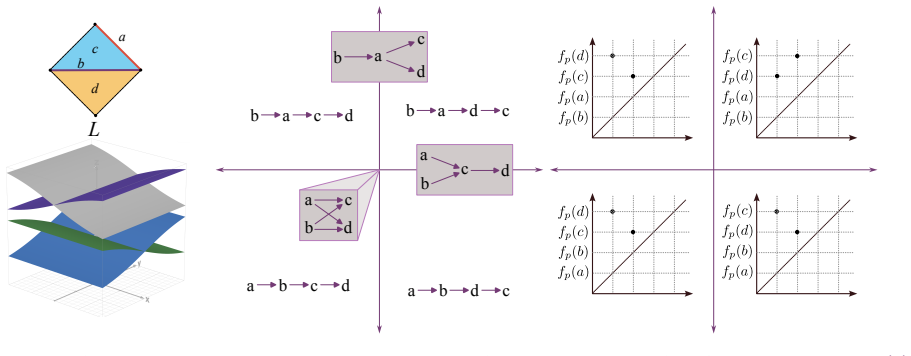
In this paper, we provide a new construction for studying parameterized persistence, called a canopy. We give two versions of this construction: the A-canopy, retaining all information about points on the diagonal of the persistence diagram; and the D-canopy, encoding the information of the "standard" persistence diagram. We do this by making a simple but major modification in the persistence bundle representation information: namely, rather than tracking a point in the persistence diagram, we instead track some choice of pairs of simplices that created said point. This viewpoint is a combinatorial version of tracking the chain complex information rather than just the output of persistence. We show how to construct the canopies from any filtered filtration function, proving, using the algebraic structure of filtered chain complexes, that different choices of pairs result in homeomorphic structures. Finally, we showcase the power of our approach by using canopies to define vines even in the presence of points with multiplicity; to discuss monodromy; and to obtain some immediate results linking non-trivial monodromy in the persistent homology transform with the existence of non-Hausdorff points in the canopy.
Editorial analysis
A structured set of objections, weighed in public.
Referee Report
Summary. The manuscript introduces canopies as a generalization of vines and vineyards for studying parameterized persistence. It defines two versions: the A-canopy, which retains information about diagonal points, and the D-canopy, which encodes standard persistence diagram information. By tracking choices of simplex pairs instead of persistence diagram points, the authors construct canopies from any filtered filtration function. They prove that different pair choices yield homeomorphic structures using the algebraic properties of filtered chain complexes. Applications include defining vines with multiplicity, analyzing monodromy, and relating non-trivial monodromy in the persistent homology transform to non-Hausdorff points in the canopy.
Significance. If the central homeomorphism result holds with the required structure-preserving properties, this work provides a valuable combinatorial framework for parameterized persistence that extends existing concepts like vines to handle multiplicities and monodromy. The use of algebraic structure of filtered chain complexes for the proof is a positive aspect, offering a more foundational approach than purely combinatorial methods.
major comments (1)
- [Homeomorphism proof (algebraic argument using filtered chain complexes)] The homeomorphism claim (abstract and the section presenting the algebraic proof via filtered chain complexes) establishes equivalence of total spaces for different simplex-pair choices, but does not explicitly establish that the homeomorphism is fiberwise over the filtration parameter or that it induces a correspondence on the tracked pairs at each parameter value. This is load-bearing for the applications to vines with multiplicity and monodromy, as a non-fiberwise homeomorphism could fail to preserve the combinatorial data needed for those claims.
minor comments (2)
- [Construction section] Notation for A-canopy versus D-canopy could be introduced with a short table or diagram in the construction section to clarify the distinction between retaining diagonal information and encoding the standard diagram.
- [Abstract] The abstract states the homeomorphism result but does not preview whether it is fiberwise; adding one sentence would better connect the proof to the later applications.
Simulated Author's Rebuttal
We thank the referee for their careful reading and for highlighting an important point about the homeomorphism. We address the major comment below.
read point-by-point responses
-
Referee: The homeomorphism claim (abstract and the section presenting the algebraic proof via filtered chain complexes) establishes equivalence of total spaces for different simplex-pair choices, but does not explicitly establish that the homeomorphism is fiberwise over the filtration parameter or that it induces a correspondence on the tracked pairs at each parameter value. This is load-bearing for the applications to vines with multiplicity and monodromy, as a non-fiberwise homeomorphism could fail to preserve the combinatorial data needed for those claims.
Authors: We agree that the fiberwise property over the filtration parameter, together with the induced correspondence on tracked pairs, is essential for the applications to multiplicity and monodromy. The algebraic argument in the manuscript proceeds from the structure of filtered chain complexes, whose chain groups, boundary maps, and induced isomorphisms are all defined levelwise with respect to the filtration parameter. Consequently the homeomorphism between total spaces is fiberwise and preserves the pairing data at each parameter value. To make this explicit and to strengthen the link to the applications, we will add a clarifying statement (and, if space permits, a short lemma) in the section containing the algebraic proof. revision: yes
Circularity Check
No circularity: derivation relies on standard algebraic properties of filtered chain complexes
full rationale
The paper constructs canopies by tracking simplex pairs in filtered chain complexes and proves homeomorphism of structures for different pair choices using the algebraic structure of those complexes. This is presented as an application of existing algebraic topology facts rather than a self-referential definition, fitted parameter renamed as prediction, or load-bearing self-citation. No equations or steps reduce the claimed homeomorphism or applications (vines with multiplicity, monodromy) to the inputs by construction. The central result is self-contained against external algebraic benchmarks.
Axiom & Free-Parameter Ledger
Reference graph
Works this paper leans on
-
[1]
Barbara Giunti, J¯ anis Lazovskis, and Bastian Rieck.DONUT: Database of Original & Non-Theoretical Uses of Topology.https://donut.topology.rocks. 2022
2022
-
[2]
Filtrations induced by continuous functions
B. Di Fabio and P. Frosini. “Filtrations induced by continuous functions”. In:Topology and its Appli- cations160.12 (Aug. 2013), pp. 1413–1422.issn: 0166-8641.doi:10.1016/j.topol.2013.05.013
-
[3]
Persistence Diagram Bundles: A Multidimensional Generalization of Vineyards
Abigail Hickok. “Persistence Diagram Bundles: A Multidimensional Generalization of Vineyards”. In: Foundations of Computational Mathematics(Apr. 2026).issn: 1615-3383.doi:10.1007/s10208-026- 09747-9. arXiv:2210.05124 [math.AT]
-
[5]
Magnus Bakke Botnan and Michael Lesnick.An introduction to multiparameter persistence. Nov. 2023, pp. 77–150.doi:10.4171/ecr/19/4.url:https://doi.org/10.4171/ecr/19/4
work page doi:10.4171/ecr/19/4.url:https://doi.org/10.4171/ecr/19/4 2023
-
[6]
Computing Minimal Presentations and Bigraded Betti Num- bers of 2-Parameter Persistent Homology
Michael Lesnick and Matthew Wright. “Computing Minimal Presentations and Bigraded Betti Num- bers of 2-Parameter Persistent Homology”. In:SIAM Journal on Applied Algebra and Geometry6.2 (May 2022), pp. 267–298.issn: 2470-6566.doi:10.1137/20m1388425. arXiv:http://arxiv.org/ abs/1902.05708v1 [math.AT]
-
[7]
Elder-Rule-Staircodes for Augmented Metric Spaces
Chen Cai, Woojin Kim, Facundo M´ emoli, and Yusu Wang. “Elder-Rule-Staircodes for Augmented Metric Spaces”. In:SIAM Journal on Applied Algebra and Geometry5.3 (2021), pp. 391–426.doi: 10.1137/20M1353605
-
[8]
Computation ofγ-linear Projected Barcodes for Multiparameter Persistence
Alex Fernandes, Steve Oudot, and Fran¸ cois Petit. “Computation ofγ-linear Projected Barcodes for Multiparameter Persistence”. In:Journal of Applied and Computational Topology9.2 (2025).doi: 10.1007/s41468-025-00209-9
-
[9]
Projected Distances for Multi-Parameter Persistence Modules
Nicolas Berkouk and Fran¸ cois Petit. “Projected Distances for Multi-Parameter Persistence Modules”. In:arXiv preprint(2022).doi:10.48550/arXiv.2206.08818. arXiv:2206.08818 [math.AT]
-
[10]
Fast Queries of Fibered Barcodes
Michael Lesnick and Matthew Wright. “Fast Queries of Fibered Barcodes”. In:arXiv preprint(2025). doi:10.48550/arXiv.2511.05837. arXiv:2511.05837 [math.AT]
-
[11]
Move schedules: fast persistence computations in coarse dynamic settings
Matthew Piekenbrock and Jose A. Perea. “Move schedules: fast persistence computations in coarse dynamic settings”. In:Journal of Applied and Computational Topology8.2 (Jan. 2024), pp. 301–345. issn: 2367-1734.doi:10.1007/s41468-023-00156-3
-
[12]
Vines and Vineyards by Updating Persistence in Linear Time
David Cohen-Steiner, Herbert Edelsbrunner, and Dmitriy Morozov. “Vines and Vineyards by Updating Persistence in Linear Time”. In:Proceedings of the twenty-second annual symposium on Computational geometry - SCG ’06(2006), p. 119.doi:10.1145/1137856.1137877.url:http://portal.acm.org/ citation.cfm?doid=1137856.1137877
work page doi:10.1145/1137856.1137877.url:http://portal.acm.org/ 2006
-
[13]
Homological Illusions of Persistence and Stability
Dmitriy Morozov. “Homological Illusions of Persistence and Stability”. PhD thesis. Duke University, 2008
2008
-
[14]
Applications of Persistent Homology to Time Varying Systems
Elizabeth Munch. “Applications of Persistent Homology to Time Varying Systems”. PhD thesis. Duke University, 2013
2013
-
[15]
Tracking a Generator by Persistence
Oleksiy Busaryev, Tamal K. Dey, and Yusu Wang. “Tracking a Generator by Persistence”. In:Discrete Mathematics, Algorithms and Applications02.04 (Dec. 2010), pp. 539–552.issn: 1793-8317.doi:10. 1142/s1793830910000875
2010
-
[16]
Homological persistence in time series: an application to music classification
Mattia G. Bergomi and Adriano Barat` e. “Homological persistence in time series: an application to music classification”. In:Journal of Mathematics and Music14.2 (May 2020), pp. 204–221.issn: 1745- 9745.doi:10.1080/17459737.2020.1786745
-
[17]
Shannon Dee Algar, D´ ebora C. Corrˆ ea, and David M. Walker. “On detecting dynamical regime change using a transformation cost metric between persistent homology diagrams”. In:Chaos: An Interdisci- plinary Journal of Nonlinear Science31.12 (Dec. 2021), p. 123117.doi:10.1063/5.0073247. 27
-
[18]
Jaejun Yoo, Eun Young Kim, Yong Min Ahn, and Jong Chul Ye. “Topological persistence vineyard for dynamic functional brain connectivity during resting and gaming stages”. In:Journal of Neuroscience Methods267 (July 2016), pp. 1–13.issn: 0165-0270.doi:10.1016/j.jneumeth.2016.04.001
-
[19]
Andrew Salch, Adam Regalski, Hassan Abdallah, Raviteja Suryadevara, Michael J. Catanzaro, and Vaibhav A. Diwadkar. “From mathematics to medicine: A practical primer on topological data analysis (TDA) and the development of related analytic tools for the functional discovery of latent structure in fMRI data”. In:PLOS ONE16.8 (Aug. 2021). Ed. by Federico Gi...
-
[20]
Abigail Hickok, Deanna Needell, and Mason A. Porter. “Analysis of Spatial and Spatiotemporal Anomalies Using Persistent Homology: Case Studies with COVID-19 Data”. In:SIAM Journal on Mathematics of Data Science4.3 (Aug. 2022), pp. 1116–1144.issn: 2577-0187.doi:10.1137/21m1435033. arXiv:2107.09188 [cs.CG]
-
[21]
Rootstock effects on scion phenotypes in a ‘Chambourcin’ experimental vine- yard
Zo¨ e Migicovsky et al. “Rootstock effects on scion phenotypes in a ‘Chambourcin’ experimental vine- yard”. In:Horticulture Research6 (), p. 64.issn: 2052-7276.doi:10.1038/s41438-019-0146-2.url: https://doi.org/10.1038/s41438-019-0146-2(visited on 04/09/2022)
-
[22]
Maxime Soler, Melanie Plainchault, Bruno Conche, and Julien Tierny. “Lifted Wasserstein Matcher for Fast and Robust Topology Tracking”. In:2018 IEEE 8th Symposium on Large Data Analysis and Visualization (LDAV). IEEE, Oct. 2018, pp. 23–33.doi:10.1109/ldav.2018.8739196. arXiv: http://arxiv.org/abs/1808.05870v2 [eess.IV]
-
[23]
Katharine Turner. “Representing Vineyard Modules”. In: (July 2023).doi:10.48550/ARXIV.2307. 06020. arXiv:2307.06020 [math.RT]
-
[24]
Probabilistic Fr´ echet means for time varying persistence diagrams
Elizabeth Munch, Katharine Turner, Paul Bendich, Sayan Mukherjee, Jonathan Mattingly, and John Harer. “Probabilistic Fr´ echet means for time varying persistence diagrams”. In:Electron. J. Statist.9 (2015), pp. 1173–1204.doi:10.1214/15-EJS1030.url:http://dx.doi.org/10.1214/15-EJS1030
work page doi:10.1214/15-ejs1030.url:http://dx.doi.org/10.1214/15-ejs1030 2015
-
[25]
Patil, Vivian Fang, and Raluca Ada Popa
Sebastien Tchitchek, Mohamed Kissi, and Julien Tierny. “Continuous Edit Distance, Geodesics and Barycenters of Time-varying Persistence Diagrams”. In: (Dec. 2025).doi:10.48550/ARXIV.2512. 12939. arXiv:2512.12939 [cs.CG]
-
[26]
Persistent homology transform for modeling shapes and surfaces
K. Turner, S. Mukherjee, and D. M. Boyer. “Persistent homology transform for modeling shapes and surfaces”. In:Information and Inference3.4 (Dec. 2014), pp. 310–344.doi:10.1093/imaiai/iau011
-
[27]
On the effectiveness of persistent homology
Renata Turkeˇ s, Guido Mont´ ufar, and Nina Otter. “On the effectiveness of persistent homology”. In: Proceedings of the 36th International Conference on Neural Information Processing Systems. NIPS ’22. New Orleans, LA, USA: Curran Associates Inc., 2022.isbn: 9781713871088
2022
-
[28]
Shoving tubes through shapes gives a sufficient and efficient shape statistic
Adam Onus, Nina Otter, and Renata Turkes. “Shoving tubes through shapes gives a sufficient and efficient shape statistic”. In: (Dec. 2024).doi:10 . 48550 / ARXIV . 2412 . 18452. arXiv:2412 . 18452 [math.AT].url:https://arxiv.org/abs/2412.18452
arXiv 2024
-
[29]
Erin Chambers, Christopher Fillmore, Elizabeth Stephenson, and Mathijs Wintraecken. “Braiding vineyards”. In: (Apr. 2025).doi:10.48550/ARXIV.2504.11203. arXiv:2504.11203 [cs.CG]
-
[30]
Spatiotemporal Persistent Homology for Dynamic Metric Spaces
Woojin Kim and Facundo M´ emoli. “Spatiotemporal Persistent Homology for Dynamic Metric Spaces”. In:Discrete & Computational Geometry(Feb. 2020).doi:10.1007/s00454- 019- 00168- w. arXiv: 1812.00949v1 [math.AT]
-
[31]
Analysis of Dynamic Graphs and Dynamic Metric Spaces via Zigzag Persistence
Woojin Kim, Facundo M´ emoli, and Zane Smith. “Analysis of Dynamic Graphs and Dynamic Metric Spaces via Zigzag Persistence”. In:Topological Data Analysis. Springer International Publishing, 2020, pp. 371–389.doi:10.1007/978-3-030-43408-3_14
-
[32]
Using Persistent Homology to Quantify a Diurnal Cycle in Hurricane Felix
Sarah Tymochko, Elizabeth Munch, Jason Dunion, Kristen Corbosiero, and Ryan Torn. “Using Per- sistent Homology to Quantify a Diurnal Cycle in Hurricane Felix”. In:Pattern Recognition Letters133 (May 2020), pp. 137–143.issn: 0167-8655.doi:10.1016/j.patrec.2020.02.022. arXiv:1902.06202
work page internal anchor Pith review Pith/arXiv arXiv doi:10.1016/j.patrec.2020.02.022 2020
-
[33]
Audun Myers, Elizabeth Munch, and Firas A. Khasawneh. “Persistent Homology of Complex Networks for Dynamic State Detection”. In:Physical Review E100.2 (Aug. 2019).doi:10.1103/physreve. 100.022314. arXiv:1904.07403v1 [nlin.CD]. 28
-
[34]
Signatures, Lipschitz-Free Spaces, and Paths of Persistence Dia- grams
Chad Giusti and Darrick Lee. “Signatures, Lipschitz-Free Spaces, and Paths of Persistence Dia- grams”. In:SIAM Journal on Applied Algebra and Geometry9.1 (2025), pp. 146–179.doi:10.1137/ 22M1528471
2025
-
[35]
Tracking Collective Cell Motion by Topological Data Analysis
Ignacio Garcia et al. “Tracking Collective Cell Motion by Topological Data Analysis”. In:PLoS Com- putational Biology17.1 (2021), e1008407.doi:10.1371/journal.pcbi.1008407
-
[36]
Ranking Viscous Finger Simulations to an Acquired Ground Truth with Topology-Aware Matchings
Maxime Soler, Martin Petitfrere, Gilles Darche, Melanie Plainchault, Bruno Conche, and Julien Tierny. “Ranking Viscous Finger Simulations to an Acquired Ground Truth with Topology-Aware Matchings”. In:2019 IEEE 9th Symposium on Large Data Analysis and Visualization (LDAV). IEEE, Oct. 2019, pp. 62–72.doi:10.1109/ldav48142.2019.8944365
-
[37]
Topological Data Analysis of Biological Ag- gregation Models
Chad M. Topaz, Lori Ziegelmeier, and Tom Halverson. “Topological Data Analysis of Biological Ag- gregation Models”. In:PLOS ONE10.5 (May 2015). Ed. by Bard Ermentrout, e0126383.doi:10. 1371/journal.pone.0126383
2015
-
[38]
Capturing dynamics of time-varying data via topology
Lu Xian, Henry Adams, Chad M. Topaz, and Lori Ziegelmeier. “Capturing dynamics of time-varying data via topology”. In:Foundations of Data Science4.1 (2022), p. 1.issn: 2639-8001.doi:10.3934/ fods.2021033
2022
-
[39]
Assessing biological models using topological data analysis
M. Ulmer, Lori Ziegelmeier, and Chad M. Topaz. “Assessing biological models using topological data analysis”. In: (Nov. 2018). arXiv:1811.04827 [q-bio.QM]
Pith/arXiv arXiv 2018
-
[40]
Detecting bifurcations in dynamical systems with CROCKER plots
˙Ismail G¨ uzel, Elizabeth Munch, and Firas A. Khasawneh. “Detecting bifurcations in dynamical systems with CROCKER plots”. In:Chaos: An Interdisciplinary Journal of Nonlinear Science32.9 (Sept. 2022), p. 093111.doi:10.1063/5.0102421
-
[41]
Sunia Tanweer, Firas A. Khasawneh, Elizabeth Munch, and Joshua R. Tempelman. “A topological framework for identifying phenomenological bifurcations in stochastic dynamical systems”. In:Nonlin- ear Dynamics(Feb. 2024).issn: 1573-269X.doi:10.1007/s11071-024-09289-1. arXiv:2305.03118 [math.DS]
-
[42]
An Invitation to the Euler Characteristic Transform
Elizabeth Munch. “An Invitation to the Euler Characteristic Transform”. In:The American Mathemat- ical Monthly132.1 (Dec. 2024), pp. 15–25.issn: 1930-0972.doi:10.1080/00029890.2024.2409616
-
[43]
A statistical pipeline for identifying physical features that differentiate classes of 3D shapes
Bruce Wang, Timothy Sudijono, Henry Kirveslahti, Tingran Gao, Douglas M. Boyer, Sayan Mukherjee, and Lorin Crawford. “A statistical pipeline for identifying physical features that differentiate classes of 3D shapes”. In:The Annals of Applied Statistics15.2 (June 2021).doi:10.1214/20-aoas1430
-
[44]
Erik J Am´ ezquita, Michelle Y Quigley, Tim Ophelders, Jacob B Landis, Daniel Koenig, Elizabeth Munch, and Daniel H Chitwood. “Measuring hidden phenotype: quantifying the shape of barley seeds using the Euler characteristic transform”. In:in silico Plants4.1 (Dec. 2021). Ed. by Tsu-Wei Chen and Stephen P Long.doi:10.1093/insilicoplants/diab033
-
[45]
The Weighted Euler Characteristic Transform for Image Shape Classification
Jessi Cisewski-Kehe, Brittany Terese Fasy, Dhanush Giriyan, and Eli Quist. “The Weighted Euler Characteristic Transform for Image Shape Classification”. In: (July 2023).doi:10 . 48550 / ARXIV . 2307.13940. arXiv:2307.13940 [cs.CG]
arXiv 2023
-
[46]
Disentangling blade and vasculature shape in grapevine leaves
Wahiba Yahiaoui et al. “Disentangling blade and vasculature shape in grapevine leaves”. In: (Jan. 2026).doi:10.64898/2026.01.27.701982
-
[47]
Yemeen Ayub et al. “The Euler Characteristic Transform Enables Classification of Complex Plant Shapes and Prediction of Leaf Venation from Blade Geometry”. In: (Apr. 2026).doi:10.64898/2026. 04.13.718293
-
[48]
Formigrams: Clustering Summaries of Dynamic Data
Woojin Kim and Facundo M´ emoli. “Formigrams: Clustering Summaries of Dynamic Data”. In:CCCG 2018, Winnipeg, Canada, August 8–10, 2018. 2018
2018
-
[49]
Gunnar Carlsson and Vin de Silva. “Zigzag Persistence”. English. In:Foundations of Computational Mathematics10.4 (2010), pp. 367–405.issn: 1615-3375.doi:10.1007/s10208- 010- 9066- 0.url: http://dx.doi.org/10.1007/s10208-010-9066-0
-
[50]
Using Zigzag Persistent Homology to Detect Hopf Bifurcations in Dynamical Systems
Sarah Tymochko, Elizabeth Munch, and Firas A. Khasawneh. “Using Zigzag Persistent Homology to Detect Hopf Bifurcations in Dynamical Systems”. In:Algorithms13.11 (Oct. 2020), p. 278.doi: 10.3390/a13110278. arXiv:2009.08972. 29
-
[51]
Temporal Network Analysis Using Zigzag Persistence
Audun Myers, David Mu˜ noz, Firas A. Khasawneh, and Elizabeth Munch. “Temporal Network Analysis Using Zigzag Persistence”. In:EPJ Data Science12.6 (Mar. 2023).doi:10.1140/epjds/s13688- 023-00379-5. arXiv:2205.11338 [cs.CG]
-
[52]
Computing Zigzag Persistence on Graphs in Near-Linear Time
Tamal K. Dey and Tao Hou. “Computing Zigzag Persistence on Graphs in Near-Linear Time”. In: (Mar. 2021). arXiv:2103.07353 [cs.CG]
arXiv 2021
-
[53]
Fast Computation of Zigzag Persistence
Tamal K. Dey and Tao Hou. “Fast Computation of Zigzag Persistence”. In: (Apr. 2022). arXiv:2204. 11080 [cs.CG]
2022
-
[54]
A Complete Set of 4-Point Amplitudes in the Con- structive Standard Model
Abigail Hickok. “Computing Persistence Diagram Bundles”. In: (Aug. 2022).doi:10.48550/ARXIV. 2210.06424. arXiv:2210.06424 [math.AT]
work page internal anchor Pith review doi:10.48550/arxiv 2022
-
[55]
Discrete Approximate Circle Bundles
Brad Turow and Jose A. Perea. “Discrete Approximate Circle Bundles”. In: (Aug. 2025).doi:10. 48550/ARXIV.2508.12914. arXiv:2508.12914 [math.AT]
arXiv 2025
-
[56]
Dale Husemoller.Fibre Bundles. Springer New York, 1994.isbn: 9781475722611.doi:10.1007/978- 1-4757-2261-1
-
[57]
Combinatorial persistent homology transform
Brittany Terese Fasy and Amit Patel. “Combinatorial persistent homology transform”. In:Foundations of Data Science6.3 (2024), pp. 379–394.issn: 2639-8001.doi:10.3934/fods.2024020. arXiv:2208. 05243 [math.AT]
-
[58]
Topological persistence for circle-valued maps
Dan Burghelea and Tamal K Dey. “Topological persistence for circle-valued maps”. In:Discrete & Computational Geometry50.1 (2013), pp. 69–98
2013
-
[59]
Topology of angle valued maps, bar codes and Jordan blocks
Dan Burghelea and Stefan Haller. “Topology of angle valued maps, bar codes and Jordan blocks”. In:Journal of Applied and Computational Topology1.1 (2017), pp. 121–197.issn: 2367-1734.doi: 10.1007/s41468-017-0005-x
-
[60]
A Study of Monodromy in the Computation of Multidimensional Persistence
Andrea Cerri, Marc-Andr´ e ´Ethier, and Patrizio Frosini. “A Study of Monodromy in the Computation of Multidimensional Persistence”. In:Discrete Geometry for Computer Imagery. 2013
2013
-
[61]
Decomposing the Persistent Homology Transform of Star-Shaped Objects
Shreya Arya, Barbara Giunti, Abigail Hickok, Lida Kanari, Sarah McGuire, and Katharine Turner. “Decomposing the Persistent Homology Transform of Star-Shaped Objects”. In: (Aug. 2024).doi: 10.48550/ARXIV.2408.14995. arXiv:2408.14995 [math.AT]
-
[62]
Decomposing filtered chain complexes: Geometry behind barcoding algorithms
Wojciech Chach´ olski, Barbara Giunti, Alvin Jin, and Claudia Landi. “Decomposing filtered chain complexes: Geometry behind barcoding algorithms”. In:Computational Geometry109 (2023).doi: https://doi.org/10.1016/j.comgeo.2022.101938
-
[63]
Invariants for tame parametrised chain complexes
Wojciech Chach´ olski, Barbara Giunti, and Claudia Landi. “Invariants for tame parametrised chain complexes”. In:Homology, Homotopy and Applications23.2 (2021), pp. 183–213.issn: 1532-0081.doi: 10.4310/hha.2021.v23.n2.a11
-
[64]
To appear
Wojciech Chach´ oski, Barbara Giunti, Claudia Landi, and Francesca Tombari.Wasserstein stability of filtered chain complexes. To appear. 2026
2026
-
[65]
Chal- lenges in Reconstructing Shapes from Euler Characteristic Curves
Brittany Terese Fasy, Samuel Micka, David L. Millman, Anna Schenfisch, and Lucia Williams. “Chal- lenges in Reconstructing Shapes from Euler Characteristic Curves”. In:arXiv:1811.11337(Nov. 2018). arXiv:http://arxiv.org/abs/1811.11337v1 [cs.CG]
Pith/arXiv arXiv 2018
-
[66]
A Faithful Discretization of Verbose Directional Transforms
Brittany Terese Fasy, Samuel Micka, David L. Millman, Anna Schenfisch, and Lucia Williams. “A Faithful Discretization of Verbose Directional Transforms”. In:Discrete & Computational Geometry 75.3 (Nov. 2025), pp. 904–949.issn: 1432-0444.doi:10.1007/s00454-025-00791-w
-
[67]
Efficient Graph Reconstruction and Representation Using Augmented Persistence Diagrams
Brittany Terese Fasy, Samuel Micka, David L. Millman, Anna Schenfisch, and Lucy Williams. “Efficient Graph Reconstruction and Representation Using Augmented Persistence Diagrams”. In:Canadian Conference on Computational Geometry (CCCG)().url:https://par.nsf.gov/biblio/10351522
-
[68]
Ephemeral Persistence Features and the Stability of Filtered Chain Complexes
Facundo M´ emoli and Ling Zhou. “Ephemeral Persistence Features and the Stability of Filtered Chain Complexes”. en. In: vol. 258. Schloss Dagstuhl – Leibniz-Zentrum f¨ ur Informatik, 2023, 51:1–51:18. doi:10.4230/LIPICS.SOCG.2023.51
-
[69]
Michor.Topics in differential geometry
Peter W. Michor.Topics in differential geometry. Graduate studies in mathematics volume 93. In- cludes bibliographical references (pages 479-488) and index. Description based on print version record. Providence, Rhode Island: American Mathematical Society, 2008. 1510 pp.isbn: 9781470411619. 30
2008
-
[70]
Cambridge University Press, 2002
Allen Hatcher.Algebraic Topology. Cambridge University Press, 2002
2002
-
[71]
Reviewofsummation-by-partsschemesforinitial-boundary- value problems
Robin Lynne Belton, Brittany Terese Fasy, Rostik Mertz, Samuel Micka, David L. Millman, Daniel Salinas, Anna Schenfisch, Jordan Schupbach, and Lucia Williams. “Reconstructing embedded graphs from persistence diagrams”. In:Computational Geometry90 (Oct. 2020), p. 101658.doi:10.1016/j. comgeo.2020.101658
work page doi:10.1016/j 2020
-
[72]
Searching and Reconstruction: Algorithms with Topological Descriptors
Samuel A. Micka. “Searching and Reconstruction: Algorithms with Topological Descriptors”. English. Copyright - Database copyright ProQuest LLC; ProQuest does not claim copyright in the individual underlying works; Last updated - 2023-03-07. PhD thesis. 2020, p. 169.isbn: 9798643180715.url: https://www.proquest.com/dissertations- theses/searching- reconstr...
arXiv 2023
-
[73]
Persistent homology and Floer–Novikov theory
Michael Usher and Jun Zhang. “Persistent homology and Floer–Novikov theory”. In:Geometry & Topology20.6 (Dec. 2016), pp. 3333–3430.issn: 1465-3060.doi:10.2140/gt.2016.20.3333
-
[74]
Ephemeral persistence modules and distance comparison
Nicolas Berkouk and Fran¸ cois Petit. “Ephemeral persistence modules and distance comparison”. In: Algebraic & Geometric Topology21.1 (Feb. 2021), pp. 247–277.issn: 1472-2747.doi:10.2140/agt. 2021.21.247. arXiv:1902.09933 [math.AT]
work page doi:10.2140/agt 2021
-
[75]
Springer International Publishing, 2016.doi:10.1007/978-3-319-42545-0
Fr´ ed´ eric Chazal, Vin de Silva, Marc Glisse, and Steve Oudot.The Structure and Stability of Persistence Modules. Springer International Publishing, 2016.doi:10.1007/978-3-319-42545-0
-
[76]
The framed Morse complex and its invariants
Serguei Barannikov. “The framed Morse complex and its invariants”. In: vol. 21. Advances in Soviet Mathematics, American Mathematical Society, 1994, pp. 93–115
1994
-
[77]
Dualities in persistent (co)homology
Vin de Silva, Dmitriy Morozov, and Mikael Vejdemo-Johansson. “Dualities in persistent (co)homology”. In:Inverse Problems27.12 (2011), pp. 124003, 17
2011
-
[78]
On the Structural Theorem of Persistent Ho- mology
Killian Meehan, Andrei Pavlichenko, and Jan Segert. “On the Structural Theorem of Persistent Ho- mology”. In:Discrete and Computational Geometry62 (2017), pp. 945–989
2017
-
[79]
Topological persistence and simplification
H. Edelsbrunner, D. Letscher, and A. Zomorodian. “Topological persistence and simplification”. In: Proceedings 41st Annual Symposium on Foundations of Computer Science. 2000, pp. 454–463.doi: 10.1109/SFCS.2000.892133
-
[80]
Decomposition of Pointwise Finite-Dimensional Persistence Modules
William Crawley-Boevey. “Decomposition of Pointwise Finite-Dimensional Persistence Modules”. In: Journal of Algebra and Its Applications14.5 (2015), p. 1550066.doi:10.1142/S0219498815500668
-
[81]
Oudot.Persistence Theory: From Quiver Representations to Data Analysis
Steve Y. Oudot.Persistence Theory: From Quiver Representations to Data Analysis. Vol. 209. Mathe- matical Surveys and Monographs. Providence, RI: American Mathematical Society, 2015.isbn: 9781470425456
2015
discussion (0)
Sign in with ORCID, Apple, or X to comment. Anyone can read and Pith papers without signing in.