Hydrogen airglow from an escaping ultrahot Jupiter atmosphere
Pith reviewed 2026-06-26 06:44 UTC · model grok-4.3
The pith
Atomic hydrogen emission detected from KELT-9 b reveals mass-loss rate above 10^13 g/s
A machine-rendered reading of the paper's core claim, the machinery that carries it, and where it could break.
Core claim
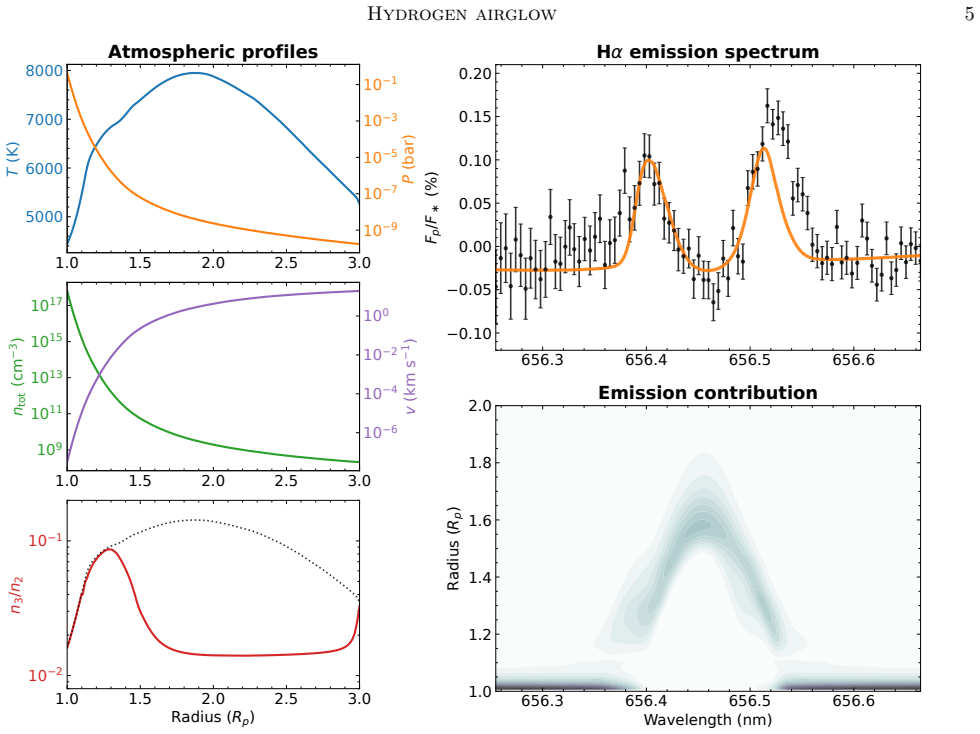
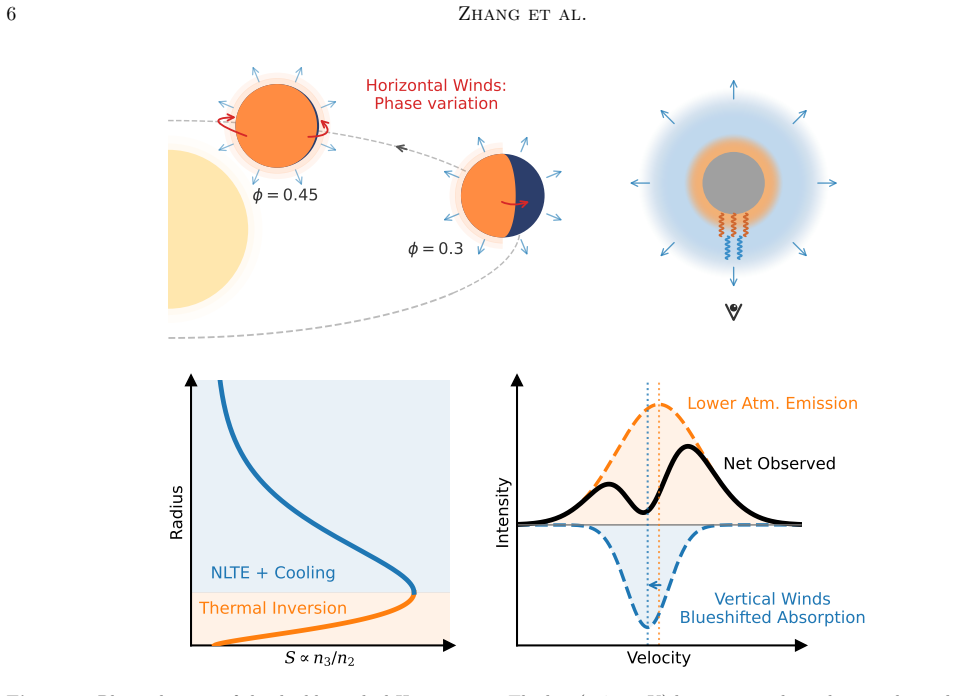
We report the first detection of atomic hydrogen emission from the escaping atmosphere of a gas giant. Using high-resolution spectroscopy of the ultrahot Jupiter KELT-9 b, we detect a hydrogen Balmer line (Hα 6564.6 Å) emission signature originating from the planetary dayside. The emission line profile features a distinctive double-peaked shape with 0.1-0.15% peak amplitudes at +/-30 km/s and central self-absorption. This profile breaks transmission degeneracies, providing direct observational constraints on the vertical thermal structure, excited-state hydrogen populations, and wind dynamics in the upper atmosphere of KELT-9 b. Initial modeling reveals a vigorous outflow with a mass-loss ra
What carries the argument
The double-peaked Hα emission line profile with central self-absorption that directly encodes vertical thermal structure, excited-state hydrogen populations, and outflow dynamics in the upper atmosphere.
Load-bearing premise
The observed Hα emission originates purely from the planetary dayside escaping atmosphere without significant stellar contamination or other sources, and the modeling accurately maps the line profile to thermal structure, populations, and dynamics without major degeneracies.
What would settle it
Independent high-resolution spectra that show no double-peaked Hα emission at the planetary velocity or that reproduce the identical profile from the star alone would indicate the signal is not from the planet's atmosphere.
Figures

read the original abstract
Intense high-energy irradiation of close-in gaseous exoplanets drives the rapid escape of their atmospheres, fundamentally shaping planetary demographics. While atmospheric loss is routinely observed via transit absorption in atomic hydrogen, helium, and metal ions, the underlying physical properties, specifically the thermal structure, outflow dynamics, and mass-loss rate, remain poorly constrained due to inherent degeneracies in the transmission geometry. Here we report the first detection of atomic hydrogen emission from the escaping atmosphere of a gas giant. Using high-resolution spectroscopy of the ultrahot Jupiter KELT-9 b, we detect a hydrogen Balmer line (H{\alpha} 6564.6 {\AA}) emission signature originating from the planetary dayside. The emission line profile features a distinctive double-peaked shape with 0.1-0.15% peak amplitudes at +/-30 km/s and central self-absorption. This profile breaks transmission degeneracies, providing direct observational constraints on the vertical thermal structure, excited-state hydrogen populations, and wind dynamics in the upper atmosphere of KELT-9 b. Initial modeling reveals a vigorous outflow with a mass-loss rate above 10^{13} g/s, among the highest measured to date for gaseous exoplanets. Our results establish hydrogen airglow emission as a powerful diagnostic of atmospheric escape, opening a new observational window into the evolution of worlds in extreme radiation environments.
Editorial analysis
A structured set of objections, weighed in public.
Referee Report
Summary. The manuscript reports the first detection of atomic hydrogen Hα (6564.6 Å) emission from the dayside escaping atmosphere of the ultrahot Jupiter KELT-9b via high-resolution spectroscopy. The line shows a double-peaked profile with 0.1-0.15% peak amplitudes at ±30 km/s and central self-absorption. This profile is interpreted as breaking transmission degeneracies and, via initial modeling, implies a mass-loss rate exceeding 10^{13} g/s.
Significance. If the detection and modeling are robust, the result would be significant as the first airglow emission detection of escaping hydrogen on a gas giant, offering direct constraints on thermal structure, excited-state populations, and outflow dynamics that complement transmission observations and could establish emission spectroscopy as a new tool for atmospheric escape studies.
major comments (2)
- [Abstract] Abstract: The headline mass-loss rate >10^{13} g/s is attributed to 'initial modeling' of the double-peaked profile, but no hydrodynamic model equations, parameter ranges (T-P profile, radial n=2 distribution, wind acceleration law), fitting procedure, or degeneracy tests are shown; without these, it is unclear whether lower mass-loss rates remain consistent with the reported 0.1-0.15% amplitudes and ±30 km/s peaks.
- [Abstract] Abstract/Observations: The claim that the emission originates purely from the planetary dayside escaping atmosphere requires explicit demonstration that stellar contamination, telluric lines, or other sources have been ruled out at the 0.1% level; the absence of presented spectra, error bars, or subtraction details makes this assumption load-bearing for the detection itself.
minor comments (1)
- [Abstract] The wavelength is given as 6564.6 Å; confirm that all velocities are reported in the stellar rest frame and that any systemic velocity correction is stated explicitly.
Simulated Author's Rebuttal
We thank the referee for their detailed and constructive report. The comments highlight important areas for clarification regarding the modeling and the robustness of the detection against contaminants. We address each point below and will revise the manuscript accordingly to improve transparency and strengthen the presentation of our results.
read point-by-point responses
-
Referee: [Abstract] Abstract: The headline mass-loss rate >10^{13} g/s is attributed to 'initial modeling' of the double-peaked profile, but no hydrodynamic model equations, parameter ranges (T-P profile, radial n=2 distribution, wind acceleration law), fitting procedure, or degeneracy tests are shown; without these, it is unclear whether lower mass-loss rates remain consistent with the reported 0.1-0.15% amplitudes and ±30 km/s peaks.
Authors: We agree that the abstract's reference to 'initial modeling' would benefit from more explicit support. The full manuscript (Section 4) describes the 1D hydrodynamic escape model, including the adopted T-P profile, n=2 population assumptions, and a beta-law wind acceleration. However, to directly address the concern, we will expand the methods and results sections with the governing equations, the explored parameter grid, the chi-squared fitting procedure, and degeneracy tests (including additional figures) demonstrating that rates below 10^{13} g/s fail to reproduce both the peak amplitudes and the ±30 km/s velocity separation. This revision will make the mass-loss constraint more transparent without altering the reported lower limit. revision: yes
-
Referee: [Abstract] Abstract/Observations: The claim that the emission originates purely from the planetary dayside escaping atmosphere requires explicit demonstration that stellar contamination, telluric lines, or other sources have been ruled out at the 0.1% level; the absence of presented spectra, error bars, or subtraction details makes this assumption load-bearing for the detection itself.
Authors: We acknowledge that explicit validation against contaminants is essential for a claim at the 0.1% level. The observations section outlines the reduction pipeline, including telluric correction via contemporaneous standard-star observations and cross-checks against the stellar spectrum and known telluric features. To strengthen this, we will add a dedicated figure (and associated text) in the revised manuscript showing example raw and processed spectra around Hα, the subtracted telluric and stellar components with error bars, and the final residual, confirming no residual features at the detection amplitude. These checks were performed during analysis but were not fully illustrated; the added material will demonstrate that the double-peaked profile is inconsistent with stellar or telluric origins. revision: yes
Circularity Check
No significant circularity; result driven by new observational detection and modeling
full rationale
The paper's central claim is a first detection of Hα emission from KELT-9 b's dayside, with the observed double-peaked line profile (0.1-0.15% amplitude at ±30 km/s) used as input to initial hydrodynamic modeling that yields a mass-loss rate >10^13 g/s. This is not equivalent to any input by construction, nor does it rely on self-citation chains, uniqueness theorems from the same authors, or renaming of prior results. The derivation chain is self-contained against the new data and external benchmarks for escape rates.
Axiom & Free-Parameter Ledger
Reference graph
Works this paper leans on
-
[1]
Ahlers, J. P., Johnson, M. C., Stassun, K. G., et al. 2020, AJ, 160, 4, doi: 10.3847/1538-3881/ab8fa3
-
[2]
Allart, R., Coulombe, L.-P., Carteret, Y., et al. 2025, A complex structure of escaping helium spanning more than half the orbit of the ultra-hot Jupiter WASP-121\,b, arXiv, doi: 10.48550/arXiv.2510.09809 Astropy Collaboration, Robitaille, T. P., Tollerud, E. J., et al. 2013, A&A, 558, A33, doi: 10.1051/0004-6361/201322068 Astropy Collaboration, Price-Whe...
-
[3]
Baldwin, A., Lothringer, J. D., Santos, L. A. D., et al. 2025, A High-Resolution NUV Transmission Spectrum of KELT-9b: Mg II and Fe II Escaping from the Hottest Known Giant Planet, arXiv, doi: 10.48550/arXiv.2512.19662
-
[4]
Borsa, F., Rainer, M., Bonomo, A. S., et al. 2019, A&A, 631, A34, doi: 10.1051/0004-6361/201935718
-
[5]
Bourrier, V., Lecavelier des Etangs, A., Ehrenreich, D., et al. 2018, Astron. Astrophys., 620, A147, doi: 10.1051/0004-6361/201833675
-
[6]
Cauley, P. W., Shkolnik, E. L., Ilyin, I., et al. 2019, AJ, 157, 69, doi: 10.3847/1538-3881/aaf725
-
[7]
Czesla, S., Nail, F., Lavail, A., et al. 2024, Astron. Astrophys., 692, A230, doi: 10.1051/0004-6361/202451003 des Etangs, A. L., Ehrenreich, D., Vidal-Madjar, A., et al. 2010, A&A, 514, A72, doi: 10.1051/0004-6361/200913347 Dos Santos, L. A., Vidotto, A. A., Vissapragada, S., et al. 2022, Astron. Astrophys., 659, A62, doi: 10.1051/0004-6361/202142038
-
[8]
Nature, Volume 522, Issue 7557, pp
Ehrenreich, D., Bourrier, V., Wheatley, P. J., et al. 2015, Nature, 522, 459, doi: 10.1038/nature14501
-
[9]
Fossati, L., Koskinen, T., Lothringer, J. D., et al. 2018, ApJL, 868, L30, doi: 10.3847/2041-8213/aaf0a5 Hydrogen airglow9 KEL T-9 ϕ = 0 Transit ϕ = 0.5 ϕ = 0.25 Eclipsea 6520 6540 6560 6580 6600 6620 Wavelength (Å) 0.4 0.5 0.6 0.7 0.8 0.9 1.0Normalized Flux b 6566 6568 6570 6572 0.325 0.350 0.375 0.400 0.425Phase c Order 1 6566 6568 6570 6572 d Order 2 6...
-
[10]
Fossati, L., Young, M. E., Shulyak, D., et al. 2021, Astron. Astrophys., 653, A52, doi: 10.1051/0004-6361/202140813
-
[11]
Fossati, L., Shulyak, D., Sreejith, A. G., et al. 2020, A&A, 643, A131, doi: 10.1051/0004-6361/202039061 Garc´ ıa Mu˜ noz, A., & Schneider, P. C. 2019, ApJL, 884, L43, doi: 10.3847/2041-8213/ab498d
-
[12]
Gaudi, B. S., Stassun, K. G., Collins, K. A., et al. 2017, Nature, 546, 514, doi: 10.1038/nature22392
-
[13]
Gibson, S. R., Howard, A. W., Rider, K., et al. 2020, in Ground-Based Airborne Instrum. Astron. VIII, Vol. 11447 (SPIE), 848–865, doi: 10.1117/12.2561783
-
[14]
Ground-based and Airborne Instrumentation for Astronomy X , year = 2024, editor =
Gibson, S. R., Howard, A. W., Rider, K., et al. 2024, in Ground-based and Airborne Instrumentation for Astronomy X, Vol. 13096, 1309609, doi: 10.1117/12.3017841 10Zhang et al. 6563 6564 6565 6566 Wavelength (Å) −0.1 0.0 0.1 0.2 0.3 Fp/F ∗ (%) a ϕ=0.10−0.25 Order 1 Order 2 Binned 6563 6564 6565 6566 Wavelength (Å) −0.1 0.0 0.1 0.2 0.3 Fp/F ∗ (%) b ϕ=0.30−0...
-
[15]
Gray, D. F. 2005, The Observation and Analysis of Stellar Photospheres, 3rd edn. (Cambridge University Press), doi: 10.1017/CBO9781316036570
-
[16]
Ferland, G. J. 2023, Res. Notes AAS, 7, 246, doi: 10.3847/2515-5172/ad0e75
-
[17]
Harris, C. R., Millman, K. J., van der Walt, S. J., et al. 2020, Nature, 585, 357, doi: 10.1038/s41586-020-2649-2
-
[18]
J., Ehrenreich, D., Kitzmann, D., et al
Hoeijmakers, H. J., Ehrenreich, D., Kitzmann, D., et al. 2019, Astron. Astrophys., 627, A165, doi: 10.1051/0004-6361/201935089
-
[19]
Householder, A., Dai, F., Kesseli, A., et al. 2025, The KPF SURFS-UP Survey I: Transmission Spectroscopy of WASP-76 b, arXiv, doi: 10.48550/arXiv.2511.14175
-
[20]
Huang, C., Koskinen, T., Lavvas, P., & Fossati, L. 2023, A hydrodynamic study of the escape of metal species and excited hydrogen from the atmosphere of the hot Jupiter WASP-121b, arXiv, doi: 10.48550/arXiv.2304.07352
-
[21]
Hunter, J. D. 2007, Comput. Sci. Eng., 9, 90, doi: 10.1109/MCSE.2007.55
-
[22]
A new extensive library of PHOENIX stellar atmospheres and synthetic spectra
Husser, T. O., Wende-von Berg, S., Dreizler, S., et al. 2013, Astron. Astrophys., 553, A6, doi: 10.1051/0004-6361/201219058 Hydrogen airglow11 656.3 656.4 656.5 656.6 Wavelength (nm) −0.10 −0.05 0.00 0.05 0.10 0.15 Fp/F ∗ (%) log ̇M = 11.5 log ̇M = 12.0 log ̇M = 12.5 log ̇M = 13.0 log ̇M = 13.5 log ̇M = 14.0 Figure A3.NLTE outflow model spectra as a funct...
work page internal anchor Pith review doi:10.1051/0004-6361/201219058 2013
-
[23]
Lei, E., & Molli` ere, P. 2024, easyCHEM: A Python package for calculating chemical equilibrium abundances in exoplanet atmospheres, arXiv, doi: 10.48550/arXiv.2410.21364
-
[24]
Linssen, D., Shih, J., MacLeod, M., & Oklopˇ ci´ c, A. 2024, The open-source sunbather code: modeling escaping planetary atmospheres and their transit spectra, arXiv. https://arxiv.org/abs/2404.12775
arXiv 2024
-
[25]
C., Oklopˇ ci´ c, A., & MacLeod, M
Linssen, D. C., Oklopˇ ci´ c, A., & MacLeod, M. 2022, Astron. Astrophys., 667, A54, doi: 10.1051/0004-6361/202243830
-
[26]
Mansfield, M., Bean, J. L., Stevenson, K. B., et al. 2020, Astrophys. J., 888, L15, doi: 10.3847/2041-8213/ab5b09
-
[27]
2013, Icarus, 226, 1709, doi: 10.1016/j.icarus.2013.02.028 Pai Asnodkar, A., Wang, J., Gaudi, B
Menager, H., Barth´ elemy, M., Koskinen, T., et al. 2013, Icarus, 226, 1709, doi: 10.1016/j.icarus.2013.02.028 Pai Asnodkar, A., Wang, J., Gaudi, B. S., et al. 2022, Astron. J., 163, 40, doi: 10.3847/1538-3881/ac32c7
-
[28]
Rosener, R., Zhang, M., & Bean, J. L. 2025, ApJ, 980, 34, doi: 10.3847/1538-4357/ada6ab
-
[29]
Saidel, M., Vissapragada, S., Knutson, H., et al. 2025, The First Dedicated Survey of Atmospheric Escape from Planets Orbiting F Stars, arXiv, doi: 10.48550/arXiv.2510.05240 S´ anchez-L´ opez, A., Lin, L., Snellen, I. a. G., et al. 2022, A&A, 666, L1, doi: 10.1051/0004-6361/202244416
-
[30]
Sanz-Forcada, J., L´ opez-Puertas, M., Lamp´ on, M., et al. 2025, A&A, 693, A285, doi: 10.1051/0004-6361/202451680
-
[31]
Smette, A., Sana, H., Noll, S., et al. 2015, Astron. Astrophys., 576, A77, doi: 10.1051/0004-6361/201423932
-
[32]
Virtanen, P., Gommers, R., Oliphant, T. E., et al. 2020, Nat. Methods, 17, 261, doi: 10.1038/s41592-019-0686-2
-
[33]
Wong, I., Shporer, A., Kitzmann, D., et al. 2020, Astron. J., 160, 88, doi: 10.3847/1538-3881/aba2cb
-
[34]
2020, A&A, 638, A87, doi: 10.1051/0004-6361/201937316
Wyttenbach, A., Molli` ere, P., Ehrenreich, D., et al. 2020, A&A, 638, A87, doi: 10.1051/0004-6361/201937316
-
[35]
Yan, D., Guo, J., Huang, C., & Xing, L. 2021, Astrophys. J., 907, L47, doi: 10.3847/2041-8213/abda41
-
[36]
Yan, F., & Henning, T. 2018, Nat. Astron., 2, 714, doi: 10.1038/s41550-018-0503-3
-
[37]
Zhang, Y., Snellen, I. A. G., Molli` ere, P., et al. 2020, Astron. Astrophys., 641, A161, doi: 10.1051/0004-6361/202038412
-
[38]
Zhang, Y., Wardenier, J. P., Householder, A., et al. 2026, ApJL, 997, L40, doi: 10.3847/2041-8213/ae36a1
-
[39]
Zhang, Z., Morley, C. V., Gully-Santiago, M., et al. 2023, Sci. Adv., 9, eadf8736, doi: 10.1126/sciadv.adf8736
discussion (0)
Sign in with ORCID, Apple, or X to comment. Anyone can read and Pith papers without signing in.