(Generalized) Spine Subalgebras of Fourier-Stieltjes algebras and their Homomorphisms
Pith reviewed 2026-06-26 06:13 UTC · model grok-4.3
The pith
Generalized spine subalgebras A*_D(G) inside B(G) have all their completely positive, completely contractive, and (when G amenable) completely bounded homomorphisms to B(H) characterized via compatible fusions.
A machine-rendered reading of the paper's core claim, the machinery that carries it, and where it could break.
Core claim
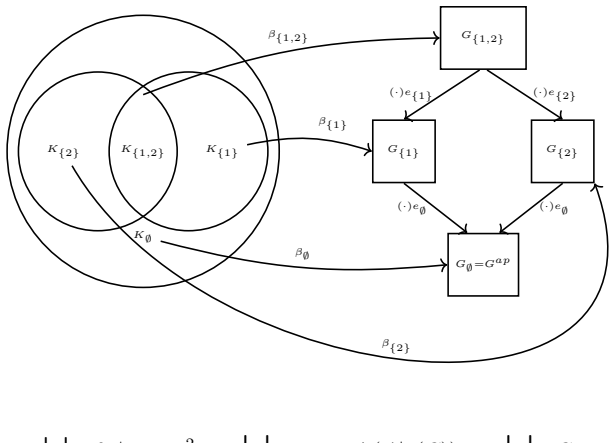
The central claim is that A*_D(G) is a semilattice-graded ℓ¹-direct sum of maximal Fourier algebras whose spectrum is a semilattice of groups, and that every completely positive, every completely contractive, and (when G is amenable) every completely bounded homomorphism from A*_D(G) to B(H) arises from a compatible fusion of homomorphisms and affine maps.
What carries the argument
The generalized spine subalgebra A*_D(G), realized as the semilattice-graded ℓ¹-direct sum of maximal copies of Fourier algebras indexed by the topologies in D.
Load-bearing premise
The upper semilattice D consists of locally precompact topologies on G, and the classification of completely bounded homomorphisms further requires G to be amenable.
What would settle it
An explicit example of a completely positive homomorphism from some A*_D(G) to a B(H) that cannot be written as any compatible fusion would falsify the characterization.
Figures
read the original abstract
For any upper semilattice ${\cal D}$ of locally precompact topologies on a locally compact group $G$, we define an associated generalized spine subalgebra $A^*_{\cal D}(G)$ of the Fourier-Stieltjes algebra $B(G)$. We show that $A^*_{\cal D}(G)$ is a semilattice-graded $\ell^1$-direct sum of maximal copies of Fourier algebras and we identify its spectrum as a semilattice of groups. We build a collection of examples of generalized spine algebras over whose spectra we exhibit fine control. We define notions of compatible fusions of homomorphisms and affine maps, and use these definitions to characterize all completely positive, completely contractive and, when $G$ is amenable, all completely bounded homomorphisms from a generalized spine algebra $A^*_{\cal D}(G)$ to a Fourier-Stieltjes algebra $B(H)$. These results are new, even when $A^*_{\cal D}(G)$ is the full spine algebra $A^*(G)$ and even when $G$ and $H$ are abelian. We provide examples illustrating the scope of our theorems.
Editorial analysis
A structured set of objections, weighed in public.
Referee Report
Summary. The manuscript defines, for any upper semilattice D of locally precompact topologies on a locally compact group G, a generalized spine subalgebra A*_D(G) inside the Fourier-Stieltjes algebra B(G). It proves that A*_D(G) decomposes as a semilattice-graded ℓ¹-direct sum of maximal copies of Fourier algebras A(G_τ), identifies its spectrum as a semilattice of groups, constructs families of examples with explicit spectral control, and characterizes all completely positive, completely contractive, and (when G is amenable) completely bounded homomorphisms from A*_D(G) into B(H) by means of compatible fusions of homomorphisms and affine maps. The results are asserted to be new even when D is the full spine semilattice and when G and H are abelian.
Significance. If the stated decompositions, spectrum identifications, and homomorphism classifications hold, the work supplies a systematic extension of the theory of spine algebras to a parameterized family of subalgebras of B(G), together with explicit homomorphism theorems that remain valid in the abelian setting. The restriction of the amenability hypothesis to the completely bounded case is correctly localized, and the construction of examples with controllable spectra strengthens the applicability of the framework within harmonic analysis and operator-algebraic group theory.
minor comments (2)
- The abstract and §1 state that the decomposition, spectrum identification, and homomorphism characterizations are proved, yet the manuscript would benefit from an explicit statement (perhaps in the introduction) of the precise semilattice operations and the definition of “maximal copy” used in the graded sum, to aid readers who are not already familiar with the spine-algebra literature.
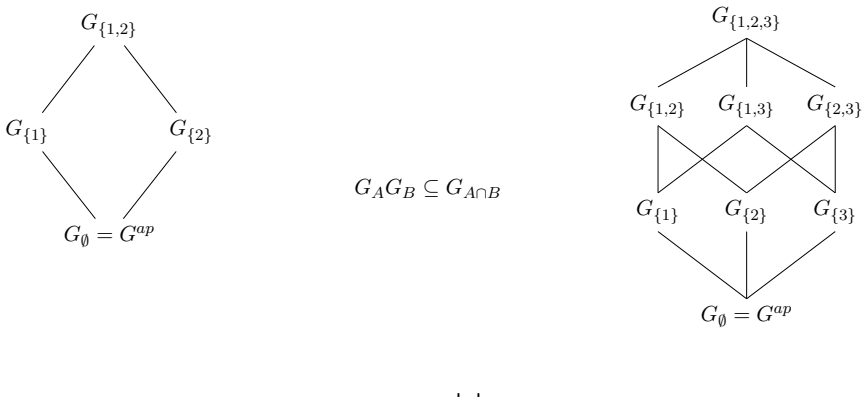
- Notation for the semilattice D and the associated topologies is introduced early; a short table or diagram summarizing the order relations and the induced group topologies would improve readability of the later homomorphism theorems.
Simulated Author's Rebuttal
We thank the referee for their positive assessment of the manuscript, including the summary of the main results on generalized spine subalgebras, the significance evaluation, and the recommendation for minor revision. No major comments were provided in the report.
Circularity Check
No significant circularity
full rationale
The derivation begins with the explicit definition of A*_D(G) as a subalgebra of B(G) graded by the externally given upper semilattice D of locally precompact topologies; the semilattice-graded ℓ¹-direct-sum decomposition, spectrum identification, and subsequent homomorphism characterizations via compatible fusions are then proved from this definition together with standard facts about Fourier algebras A(G) and B(G). No equation in the paper reduces a claimed prediction or uniqueness result to a fitted parameter or prior self-citation by construction, and the amenability hypothesis is stated explicitly only for the CB case. The central claims therefore remain independent of the paper's own inputs.
Axiom & Free-Parameter Ledger
axioms (2)
- standard math Standard properties of the Fourier-Stieltjes algebra B(G) and Fourier algebra A(G) as Banach algebras with completely bounded multiplier structure.
- domain assumption An upper semilattice D of locally precompact topologies on G can be used to grade the algebra.
invented entities (1)
-
generalized spine subalgebra A*_D(G)
no independent evidence
Reference graph
Works this paper leans on
-
[1]
Arsac, Sur l’espace de Banach engendr´ e par les coefficients d’une repr´ esentation unitaire, Publ
G. Arsac, Sur l’espace de Banach engendr´ e par les coefficients d’une repr´ esentation unitaire, Publ. D´ep. Math. (Lyon)13 (1976), 1-101
1976
-
[2]
Berglund, H
J.F. Berglund, H. Junghenn and P. Milnes,Analysis on semigroups: function spaces, compacti- fications, representations,Canadian Mathematical Society Series of Monographs and Advanced Texts, John Wiley & Sons, Inc., New York, 1989
1989
-
[3]
P. J. Cohen, On homomorphisms of group algebras,Amer. J. Math82 (1960), 213-226
1960
-
[4]
Daws, Completely bounded homomorphisms of the Fourier algebra revisited,J
M. Daws, Completely bounded homomorphisms of the Fourier algebra revisited,J. Group Theory25 (2022), no. 3, 579-600
2022
-
[5]
Effros and Z.-J
E.G. Effros and Z.-J. Ruan,Operator Spaces, Oxford University Press, 2000
2000
-
[6]
Eymard, L’alg´ ebre de Fourier d’un groupe localement compact,Bull
P. Eymard, L’alg´ ebre de Fourier d’un groupe localement compact,Bull. Soc. Math. France92 (1964), 181-236
1964
-
[7]
Forrest,Fourier analysis on coset spaces, Rocky Mountain J
B. Forrest,Fourier analysis on coset spaces, Rocky Mountain J. Math. 28, (1998), no. 1, 173-189
1998
-
[8]
Greenleaf, Norm decreasing homomorphisms of group algebras,Pacific J
F.P. Greenleaf, Norm decreasing homomorphisms of group algebras,Pacific J. Math.15 (1965), 1187-1219
1965
-
[9]
Ilie, On Fourier algebra homomorphisms,J
M. Ilie, On Fourier algebra homomorphisms,J. Funct. Anal., 213 (2004), 88-110
2004
-
[10]
Ilie and N
M. Ilie and N. Spronk, Completely bounded homomorphisms of the Fourier algebra,J. Funct. Anal.225 (2)(2005), 480-499
2005
-
[11]
Ilie and N
M. Ilie and N. Spronk, The spine of a Fourier–Stieltjes algebra,Proc. London Math. Soc.(3) 94 (2007) 273-301
2007
-
[12]
Ilie and N
M. Ilie and N. Spronk, Corrigendum: The spine of a Fourier–Stieltjes algebra,Proc. London Math. Soc.(3) 104 (2012) 859-863
2012
-
[13]
Ilie and R
M. Ilie and R. Stokke, Weak ∗-continuous homomorphisms of Fourier-Stieltjes algebras,Math. Proc. Cambridge Philos. Soc., 145 (2008), 107-120
2008
-
[14]
Inoue, Some closed subalgebras of measure algebras and a generalization of P.J
J. Inoue, Some closed subalgebras of measure algebras and a generalization of P.J. Cohen’s Theorem,J. Math. Soc. Japan, Vol. 23, No. 2 (1971), 278-294
1971
-
[15]
Kaniuth,A course in commutative Banach algebras, Graduate Texts in Mathematics, Springer, New York, 2009
E. Kaniuth,A course in commutative Banach algebras, Graduate Texts in Mathematics, Springer, New York, 2009. 31
2009
-
[16]
Kaniuth and A.T.-M
E. Kaniuth and A.T.-M. Lau,Fourier and Fourier-Stieltjes algebras on locally compact groups, Mathematical Surveys and Monographs, 231, American Mathematical Society, Providence, RI, 2018
2018
-
[17]
Kroeker, A
M.E. Kroeker, A. Stephens, R. Stokke, R. Yee, Norm-multiplicative homomorphisms of Beurl- ing algebras,J. Math. Anal. Appl.509 (2022), no. 1, Paper No. 125935, 25 pages
2022
-
[18]
PaulsenCompletely bounded maps and operator algebras, Cambridge Studies in Advanced Mathematics, 78, Cambridge University Press, Cambridge, 2002
V. PaulsenCompletely bounded maps and operator algebras, Cambridge Studies in Advanced Mathematics, 78, Cambridge University Press, Cambridge, 2002
2002
-
[19]
Pham, Contractive homomorphisms of the Fourier algebras,Bull
H.L. Pham, Contractive homomorphisms of the Fourier algebras,Bull. London Math. Soc. (2010) 42(5), 937-947
2010
-
[20]
Rudin,Fourier analysis on groups, Tracts in Pure and Applied Mathematics, No
W. Rudin,Fourier analysis on groups, Tracts in Pure and Applied Mathematics, No. 12 Wiley Interscience, New York-London 1962
1962
-
[21]
Spronk, Weakly almost-periodic topologies, idempotents, and ideals,Indiana Univ
N. Spronk, Weakly almost-periodic topologies, idempotents, and ideals,Indiana Univ. Math. J.71 (2022), no. 6, 2671-2702
2022
-
[22]
Stokke, Spine-like subalgebras of Fourier–Stieltjes algebras,in preparation
R. Stokke, Spine-like subalgebras of Fourier–Stieltjes algebras,in preparation
-
[23]
Stokke, Homomorphisms of convolution algebras,J
R. Stokke, Homomorphisms of convolution algebras,J. Funct. Anal.261 (2011), no. 12, 3665- 3695 (2011)
2011
-
[24]
Stokke, Homomorphisms of Fourier–Stieltjes algebras,Studia Math.258 (2021), no
R. Stokke, Homomorphisms of Fourier–Stieltjes algebras,Studia Math.258 (2021), no. 2, 175- 220
2021
-
[25]
Takesaki,Theory of Operator Algebras I,Encyclopedia of Mathematical Sciences Vol
M. Takesaki,Theory of Operator Algebras I,Encyclopedia of Mathematical Sciences Vol. 124, Springer–Verlag Berlin Heidelberg, 2002
2002
-
[26]
J. L. Taylor,Measure algebras,CBMS Regional Conference Series in Mathematics 16 (Amer- ican Mathematical Society, Providence, RI, 1973)
1973
-
[27]
Thamizhazhagan, On the structure of invertible elements in certain Fourier–Stieltjes alge- bras,Studia Math.257 (2021), no
A. Thamizhazhagan, On the structure of invertible elements in certain Fourier–Stieltjes alge- bras,Studia Math.257 (2021), no. 3, 347-360
2021
-
[28]
Walter,W ∗-algebras and nonabelian harmonic analysis,J
M. Walter,W ∗-algebras and nonabelian harmonic analysis,J. Funct. Anal.11 (1972), 17–38
1972
-
[29]
Walter, On the structure of the Fourier-Stieltjes algebra,Pacific J
M. Walter, On the structure of the Fourier-Stieltjes algebra,Pacific J. Math.58 (1975), no. 1, 267-281. Department of Pure Mathematics, University of W aterloo, W aterloo ON, N2L 3G1, Canada; email:nico.spronk@uwaterloo.ca Department of Mathematics and Statistics, University of Winnipeg, 515 Portage A venue, Winnipeg, MB, Canada, R3B 2E9; email:r.stokke@u...
1975
discussion (0)
Sign in with ORCID, Apple, or X to comment. Anyone can read and Pith papers without signing in.