Ensemble Feature Selection and Harris Hawks Optimization for Explainable Mental Health Risk Prediction in Female Sex Workers
Pith reviewed 2026-06-26 00:40 UTC · model grok-4.3
The pith
A hybrid model using ensemble feature selection and Harris Hawks optimization outperforms traditional classifiers at predicting depression risk among female sex workers.
A machine-rendered reading of the paper's core claim, the machinery that carries it, and where it could break.
Core claim
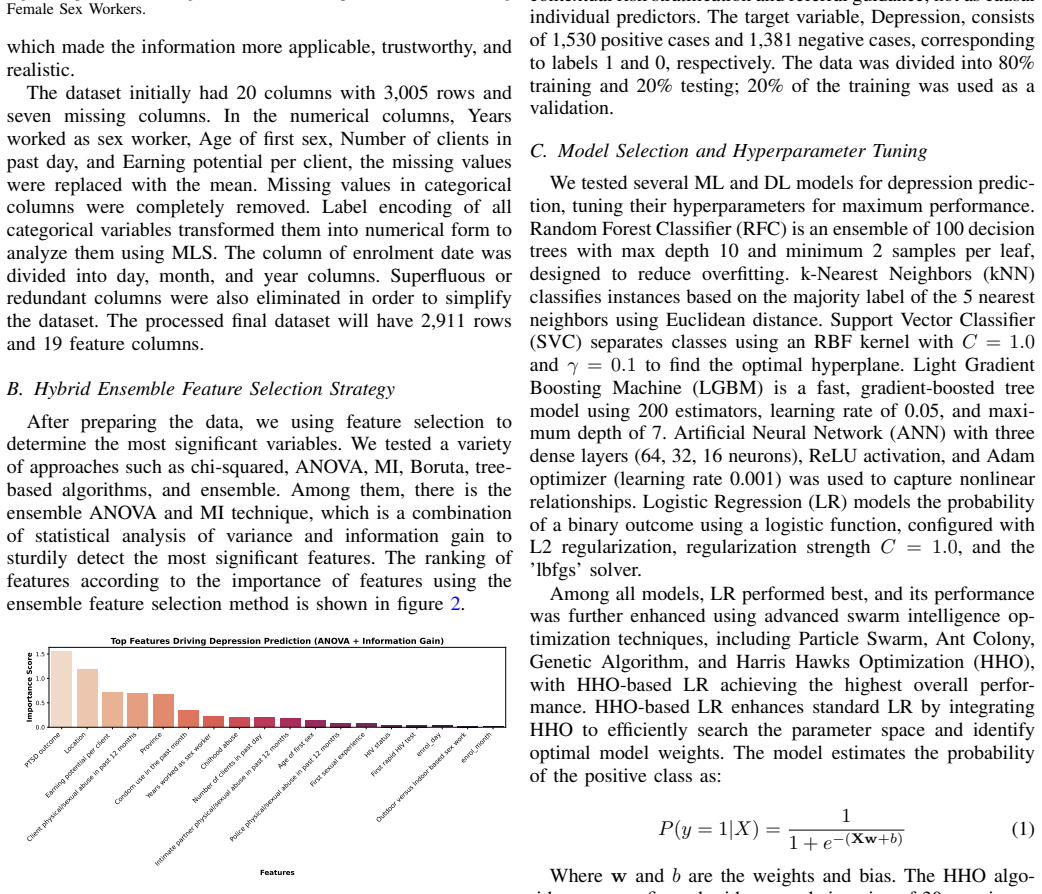
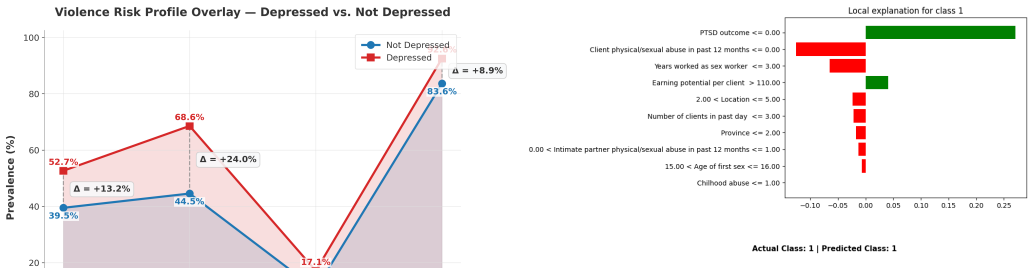
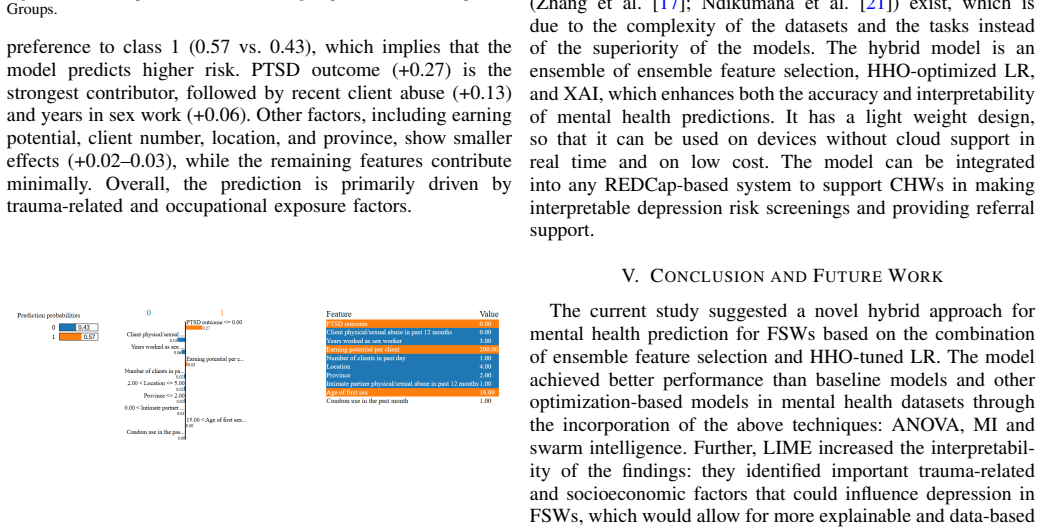
The ensemble feature selection strategy using ANOVA and mutual information together with Harris Hawks optimization-tuned logistic regression produces superior predictions of mental health risks compared to conventional classifiers, attaining 95.78% accuracy, 95.77% F1 score, and 0.96 AUC on data from 3,005 female sex workers, and XAI methods reveal that post-traumatic stress, client-related violence, and occupational factors are the primary contributors to depression.
What carries the argument
Ensemble feature selection with ANOVA and mutual information paired with Harris Hawks Optimization for tuning logistic regression, integrated with explainable AI techniques.
If this is right
- The model improves prediction accuracy for depression in this population over standard machine learning methods.
- XAI identifies actionable risk factors that can guide targeted psychosocial interventions.
- It offers a way to integrate machine learning insights with traditional care approaches for vulnerable groups.
- Supports development of tools for early assistance and evidence-based health planning.
Where Pith is reading between the lines
- The same ensemble and optimization pipeline could be applied to other high-risk populations facing violence and stigma to test transferability.
- Embedding the model in community health screening programs might enable proactive rather than reactive support.
- Longitudinal follow-up data on the same cohort could check whether the identified factors predict depression onset over time.
Load-bearing premise
The dataset of 3,005 female sex workers accurately represents the broader population without significant selection bias or measurement errors in the risk factors.
What would settle it
Replicating the model on a new independent dataset of female sex workers and obtaining accuracy below 85% or AUC below 0.85 would indicate the performance gains are not generalizable.
Figures

read the original abstract
One of the significant mental health issues affecting female sex workers (FSWs) is mental disorders, especially depression. Exposure to violence, stigma, and economic hardship further increases their psychological risk. Current machine learning (ML) models are typically ineffective at capturing the high-dimensional and complex risk patterns that exist in this marginalized group. This paper suggests a hybrid predictive model that merges an ensemble feature selection strategy using ANOVA and mutual information and Harris Hawks optimization-tuned logistic regression and represents a new application of swarm intelligence to predict mental health in vulnerable groups. The explainable AI (XAI) methods can be used to understand the factors of trauma associated with model predictions. When applied to a group of 3,005 FSWs, it can be seen that the proposed model is more effective than traditional classifiers, with an accuracy of 95.78%, an F1 score of 95.77%, and an AUC of 0.96, and identifying post-traumatic stress, client-related violence, and occupational factors as major contributors to depression. This work bridges the gaps between conventional and ML approaches to develop an XAI tool that enables vulnerable groups to receive early assistance, evidence-based targeted psychosocial care, and health planning.
Editorial analysis
A structured set of objections, weighed in public.
Referee Report
Summary. The manuscript proposes a hybrid model for predicting depression risk in female sex workers that combines ensemble feature selection (ANOVA + mutual information) with Harris Hawks Optimization (HHO) tuned logistic regression. On a dataset of 3,005 FSWs the model reportedly achieves 95.78% accuracy, 95.77% F1, and 0.96 AUC, outperforming traditional classifiers, while XAI attributes identify post-traumatic stress, client-related violence, and occupational factors as primary contributors. The work positions itself as bridging conventional and ML approaches to deliver an explainable tool for targeted psychosocial care.
Significance. If the performance and attributions prove generalizable, the approach would demonstrate a practical application of swarm-intelligence optimization and XAI to a high-stakes, stigmatized population. The manuscript supplies no evidence of reproducible code, machine-checked proofs, or pre-registered falsifiable predictions, so these strengths cannot be credited.
major comments (3)
- [Abstract] Abstract: the reported accuracy (95.78 %), F1 (95.77 %), and AUC (0.96) are obtained by applying the ensemble-selected features and HHO-tuned logistic regression to the identical 3,005-sample dataset used for both feature selection and hyper-parameter optimization. No train-test split, k-fold cross-validation procedure, or external validation set is described, so the metrics cannot be distinguished from in-sample fitting.
- [Abstract] Abstract: the central claim that the identified factors (post-traumatic stress, client-related violence, occupational factors) are major contributors to depression and that the model is more effective than traditional classifiers rests on the unstated assumption that the 3,005 FSWs sample is representative. No sampling frame, inclusion/exclusion criteria, response rate, geographic stratification, or validation of outcome measures (e.g., depression or violence scales) is supplied, leaving open the possibility of selection bias, collider bias, or under-reporting that would inflate in-sample performance while rendering attributions non-transportable.
- [Abstract] Abstract: superiority over “traditional classifiers” is asserted without naming the baselines, reporting statistical significance tests, or describing how class imbalance (if present) was handled; these omissions make the comparative claim unverifiable from the given information.
Simulated Author's Rebuttal
We thank the referee for the constructive and detailed comments. We address each major point below and will make the indicated revisions to improve clarity and rigor.
read point-by-point responses
-
Referee: [Abstract] Abstract: the reported accuracy (95.78 %), F1 (95.77 %), and AUC (0.96) are obtained by applying the ensemble-selected features and HHO-tuned logistic regression to the identical 3,005-sample dataset used for both feature selection and hyper-parameter optimization. No train-test split, k-fold cross-validation procedure, or external validation set is described, so the metrics cannot be distinguished from in-sample fitting.
Authors: We agree that the abstract does not explicitly describe the validation procedure. The full manuscript applies stratified 5-fold cross-validation, with feature selection and HHO optimization performed independently within each training fold to prevent leakage. We will revise the abstract to state this evaluation protocol clearly. revision: yes
-
Referee: [Abstract] Abstract: the central claim that the identified factors (post-traumatic stress, client-related violence, occupational factors) are major contributors to depression and that the model is more effective than traditional classifiers rests on the unstated assumption that the 3,005 FSWs sample is representative. No sampling frame, inclusion/exclusion criteria, response rate, geographic stratification, or validation of outcome measures (e.g., depression or violence scales) is supplied, leaving open the possibility of selection bias, collider bias, or under-reporting that would inflate in-sample performance while rendering attributions non-transportable.
Authors: The manuscript reports the sample size and basic data source but does not provide a full sampling frame or bias analysis. We will expand the Methods and add a Limitations section detailing inclusion/exclusion criteria, data collection procedures, and discussion of potential selection and reporting biases, along with caveats on generalizability. revision: yes
-
Referee: [Abstract] Abstract: superiority over “traditional classifiers” is asserted without naming the baselines, reporting statistical significance tests, or describing how class imbalance (if present) was handled; these omissions make the comparative claim unverifiable from the given information.
Authors: We will revise the abstract and results to name the baseline models (logistic regression without tuning, SVM, random forest, and XGBoost), report p-values from appropriate statistical tests (e.g., McNemar or DeLong), and describe class-imbalance handling via SMOTE within the cross-validation folds. revision: yes
Circularity Check
Performance metrics reported on the identical dataset used for feature selection and HHO tuning
specific steps
-
fitted input called prediction
[Abstract]
"When applied to a group of 3,005 FSWs, it can be seen that the proposed model is more effective than traditional classifiers, with an accuracy of 95.78%, an F1 score of 95.77%, and an AUC of 0.96"
The reported accuracy, F1, and AUC are computed on the same 3005-sample dataset that supplied the inputs to both the ensemble feature selection (ANOVA + mutual information) and the Harris Hawks optimization that tunes the logistic regression hyperparameters; therefore the quoted performance numbers are the direct numerical output of the fitting procedure rather than an independent prediction.
full rationale
The abstract presents accuracy/F1/AUC as the outcome of applying the ensemble ANOVA+MI feature selection plus HHO-tuned logistic regression to the 3005 FSWs. No independent test set, external validation cohort, or pre-specified hold-out is referenced in the provided text, so the quoted performance numbers are obtained after the model parameters and feature subset have already been chosen to maximize fit on those exact samples. This matches the fitted-input-called-prediction pattern but does not extend to self-definitional equations, load-bearing self-citations, or ansatz smuggling. The remainder of the method (hybrid FS + swarm optimization + XAI) is a standard empirical pipeline whose internal steps do not reduce to their own outputs by construction. Hence a moderate rather than high circularity score.
Axiom & Free-Parameter Ledger
free parameters (1)
- logistic regression hyperparameters
axioms (1)
- domain assumption The 3005 FSWs sample is representative of the target population and free of selection or measurement bias
Reference graph
Works this paper leans on
-
[1]
The impact of self- stigmatization on the mental health of female sex workers (fsws),
G. Kaya, O. Kalinowski, F. Kroehn-Liedtke, A. Lotysh, H. Mihaylova, L. Zerbe, W. Rössler, and M. Schouler-Ocak, “The impact of self- stigmatization on the mental health of female sex workers (fsws),” Frontiers in Public Health, vol. 13, p. 1679876, Nov 2025. Impact Factor: 3.4, Q1
2025
-
[2]
Mental disorders,
World Health Organization, “Mental disorders,” 2025. Accessed: 2026- 04-16
2025
-
[3]
Depressive disorder (depression),
World Health Organization, “Depressive disorder (depression),” 2025. Accessed: 2026-04-16
2025
-
[4]
Global, regional and national burden of anxiety and depression disorders from 1990 to 2021, and forecasts up to 2040,
Z. Zhang, X. Chen, S. Wu, X. Chen, X. Wang, C. Liu, N. Zeng, Y . Liu, T. Huo, X. Liu,et al., “Global, regional and national burden of anxiety and depression disorders from 1990 to 2021, and forecasts up to 2040,” Journal of Affective Disorders, p. 120299, 2025
1990
-
[5]
Social determinants of mental health outcomes among refugee adolescents and youth living with hiv in refugee settlements in uganda: A cross-sectional analysis,
N. T. Tutlam, S. Kizito, P. Nabunya, M. Naseh, I. Nabbosa, I. Kwesiga, P. Namatovu, O. S. Bahar, N. Nakasujja, and F. M. Ssewamala, “Social determinants of mental health outcomes among refugee adolescents and youth living with hiv in refugee settlements in uganda: A cross-sectional analysis,”AIDS and Behavior, vol. 29, pp. 3432–3443, Nov 2025. Impact Fact...
2025
-
[6]
Mental health by the numbers,
National Alliance on Mental Illness (NAMI), “Mental health by the numbers,” 2025. Accessed: 2026-04-16
2025
-
[7]
Kebede Kassaw, T
A.-A. Kebede Kassaw, T. Melese Yilma, Y . Sebastian, A. Yeneneh Birhanu, M. Sharew Melaku, and S. Surur Jemal, “Spatial distribution and machine learning prediction of sexually transmitted infections and associated factors among sexually active men and women in ethiopia, evidence from edhs 2016,”BMC Infectious Diseases, vol. 23, no. 1, p. 49, 2023
2016
-
[8]
Explainable suicide risk prediction with deepfusion: A hybrid intelligence approach,
M. Abubakkar, K. S. Sharif, I. Ahmad, D. M. Tabila, F. A. Alsaud, and S. Debnath, “Explainable suicide risk prediction with deepfusion: A hybrid intelligence approach,” in2025 4th International Conference on Electronics Representation and Algorithm (ICERA), pp. 455–460, IEEE, 2025
2025
-
[9]
De- tection of victimization patterns and risk of gender violence through machine learning algorithms,
E. R. Bernal-Monroy, E. D. Castañeda-Monroy, R. R. Rentería-Ramos, S. E. Campaña-Bastidas, J. Barrera, T. M. Palacios-Yampuezan, O. L. González Gustin, C. F. Tobar-Torres, and Z. R. Ceballos-Villada, “De- tection of victimization patterns and risk of gender violence through machine learning algorithms,” inInformatics, vol. 12, p. 21, MDPI, 2025
2025
-
[10]
A quantitative study on female sex workers’ mental health in germany,
F. Kroehn-Liedtke, O. Kalinowski, G. Kaya, A. Lotysh, H. Mihaylova, K. Sipos, A. Strunk, L. Zerbe, W. Rössler, and M. Schouler-Ocak, “A quantitative study on female sex workers’ mental health in germany,” Frontiers in Public Health, vol. V olume 13 - 2025, 2025
2025
-
[11]
Explain- able ai framework for improved thalassemia mental health classification and feature selection,
S. S. Ayon, A. Al Mamun, M. E. Hossain, W. Alamro, Y . M. Allawi, N. N. I. Prova, M. S. U. Miah, S. M. Sultan, and A. Abadleh, “Explain- able ai framework for improved thalassemia mental health classification and feature selection,”PLoS One, vol. 21, no. 1, p. e0341168, 2026
2026
-
[12]
Mental health and hiv risk differs by co- occurring structural vulnerabilities among women who sell sex,
C. Tomko, R. J. Musci, M. R. Kaufman, C. R. Underwood, M. R. Decker, and S. G. Sherman, “Mental health and hiv risk differs by co- occurring structural vulnerabilities among women who sell sex,”AIDS Care, vol. 35, no. 2, pp. 205–214, 2023
2023
-
[13]
M. Leis, M. McDermott, A. Koziarz, L. Szadkowski, A. Kariri, T. S. Beattie, R. Kaul, and J. Kimani, “Intimate partner and client-perpetrated violence are associated with reduced hiv pre-exposure prophylaxis (prep) uptake, depression and generalized anxiety in a cross-sectional study of female sex workers from nairobi, kenya,”Journal of the international A...
2021
-
[14]
Psychische gesundheit von sexarbeiter* innen in europa: ein scoping-review,
A. Mühlen, J. Rudy, A. Böckmann, and D. Deimel, “Psychische gesundheit von sexarbeiter* innen in europa: ein scoping-review,”Das Gesundheitswesen, vol. 85, no. 06, pp. 561–567, 2023
2023
-
[15]
Jewkes, M
R. Jewkes, M. Milovanovic, K. Otwombe, E. Chirwa, K. Hlongwane, N. Hill, V . Mbowane, M. Matuludi, K. Hopkins, G. Gray, and J. Coetzee, “Intersections of sex work, mental ill-health, ipv and other violence experienced by female sex workers: Findings from a cross-sectional community-centric national study in south africa,”International Journal of Environme...
2021
-
[16]
Suicidal thoughts, depression, post-traumatic stress, and harmful alcohol use associated with intimate partner violence and rape exposures among female students in south africa,
M. T. Machisa, E. Chirwa, P. Mahlangu, N. Nunze, Y . Sikweyiya, E. Dartnall, M. Pillay, and R. Jewkes, “Suicidal thoughts, depression, post-traumatic stress, and harmful alcohol use associated with intimate partner violence and rape exposures among female students in south africa,”International Journal of Environmental Research and Public Health, vol. 19,...
2022
-
[17]
Application of machine learning for risky sexual behavior interventions among factory workers in china,
F. Zhang, S. Zhu, S. Chen, Z. Hao, Y . Fang, H. Zou, Y . Cai, B. Cao, K. Zhang, H. Cao, Y . Chen, T. Hu, and Z. Wang, “Application of machine learning for risky sexual behavior interventions among factory workers in china,”Frontiers in Public Health, vol. 11, p. 1092018, 2023
2023
-
[18]
Using machine learning to identify patients at risk of acquiring hiv in an urban health system,
A. K. M. S. Nethi, M. Karam, Albert George M. S., K. S. Alvarez, A. E. Luque, A. E. Nijhawan, E. Adhikari, and H. L. King, “Using machine learning to identify patients at risk of acquiring hiv in an urban health system,”JAIDS Journal of Acquired Immune Deficiency Syndromes, vol. 97, pp. 40–47, Sep 2024
2024
-
[19]
Application of machine learning algorithms in predicting hiv infection among men who have sex with men: Model de- velopment and validation,
J. He, J. Li, S. Jiang, W. Cheng, J. Jiang, Y . Xu, J. Yang, X. Zhou, C. Chai, and C. Wu, “Application of machine learning algorithms in predicting hiv infection among men who have sex with men: Model de- velopment and validation,”Frontiers in Public Health, vol. 10, p. 967681, 2022
2022
-
[20]
Mental ill health experiences of female sex workers and their perceived risk factors: A systematic review of qualitative studies,
L. Morgan, H. R. Welborn, G. Feist-Paz,et al., “Mental ill health experiences of female sex workers and their perceived risk factors: A systematic review of qualitative studies,” Nov 2023. Preprint, Version 1
2023
-
[21]
Machine learning-based predictive modelling of mental health in rwandan youth,
F. Ndikumana, J. Izabayo, J. Kalisa, M. Nemerimana, E. C. Nyabyenda, S. H. Muzungu, I. Komezusenge, M. Uwase, S. Ndagijimana, C. Twizere, and V . Sezibera, “Machine learning-based predictive modelling of mental health in rwandan youth,”Scientific Reports, vol. 15, p. 16032, May
-
[22]
Q1, Impact Factor: 3.9
-
[23]
Dynamic ensemble selection for mental health prediction : A path towards explainable, scalable and high-impact ai solutions,
Y . Saha and H. S, “Dynamic ensemble selection for mental health prediction : A path towards explainable, scalable and high-impact ai solutions,” in2025 International Conference on Intelligent Computing and Knowledge Extraction (ICICKE), pp. 1–8, 2025
2025
-
[24]
Interpretable machine learning for predicting early mental health care-seeking among reproductive-age women in bangladesh using bdhs 2022 data,
M. R. Kanchon, J. Sani, T. Ahmed,et al., “Interpretable machine learning for predicting early mental health care-seeking among reproductive-age women in bangladesh using bdhs 2022 data,” Feb 2026. Preprint, Version 1
2022
-
[25]
Cross sectional study of female sex workers in south africa,
M. Milovanovic, “Cross sectional study of female sex workers in south africa,” 2021
2021
-
[26]
Explainable ai in feature selection: Improv- ing classification performance on imbalanced datasets,
S. Siddique Ayon, M. Ebrahim Hossain, M. S. Ullah Miah, M. M. Rahman, and M. Mahmud, “Explainable ai in feature selection: Improv- ing classification performance on imbalanced datasets,” inInternational conference on neural information processing, pp. 303–318, Springer, 2024
2024
discussion (0)
Sign in with ORCID, Apple, or X to comment. Anyone can read and Pith papers without signing in.