Density-wave order enhances the phonon thermal Hall effect in a trilayer nickelate
Pith reviewed 2026-06-25 23:23 UTC · model grok-4.3
The pith
Density-wave order in La4Ni3O10 strongly enhances the phonon thermal Hall effect below 140 K via magnon-phonon hybridization.
A machine-rendered reading of the paper's core claim, the machinery that carries it, and where it could break.
Core claim
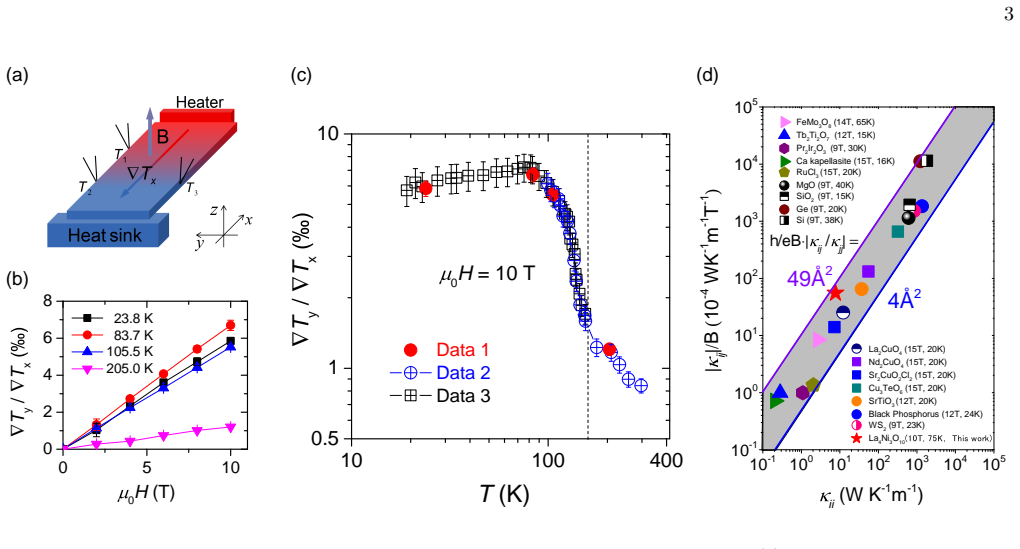
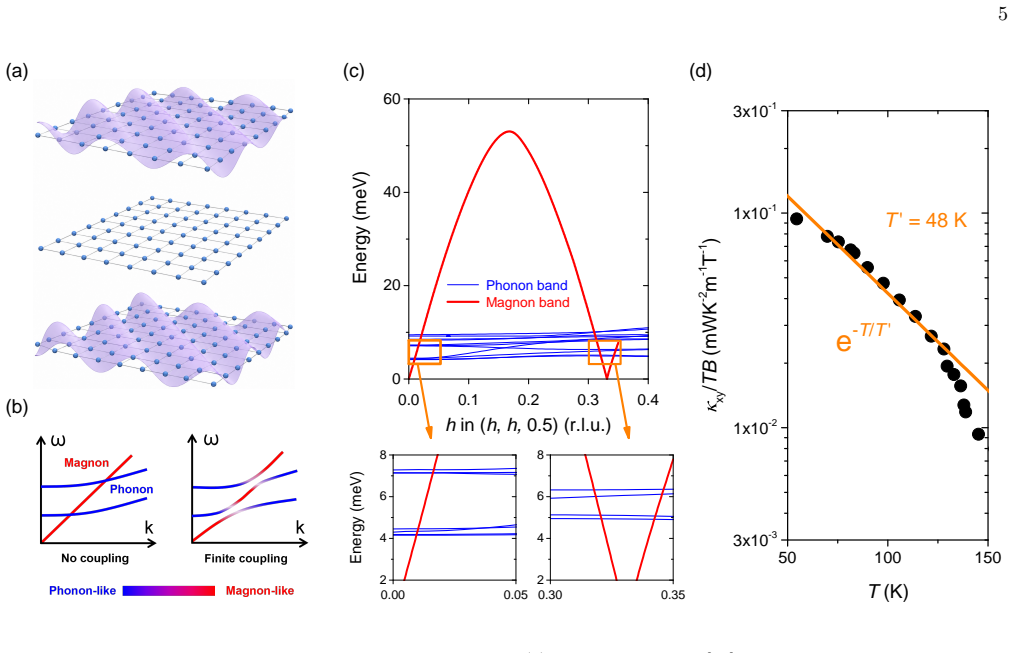
In La4Ni3O10 the phonon thermal Hall effect appears at ambient pressure and becomes strongly enhanced below the density-wave transition temperature T* approximately 140 K, where the thermal Hall resistivity exhibits two clear plateaus. The characteristic energy extracted from the temperature dependence of the thermal Hall response is about 4.1 meV and matches the magnon-phonon crossing span energy of about 3.2 meV, leading to the conclusion that magnon-phonon hybridization supplies the dominant mechanism for the observed enhancement.
What carries the argument
Magnon-phonon hybridization, which mixes spin-wave and lattice excitations to enlarge the thermal Hall response once density-wave order sets in.
Load-bearing premise
The numerical agreement between the 4.1 meV thermal Hall energy scale and the 3.2 meV magnon-phonon crossing energy establishes hybridization as the primary enhancing mechanism rather than coincidence or unrelated contributions.
What would settle it
Shift the magnon-phonon crossing energy away from 4 meV in a related compound while keeping the density-wave transition intact and check whether the thermal Hall enhancement disappears.
Figures


read the original abstract
Ruddlesden--Popper nickelates have emerged as a promising platform for high-temperature superconductivity, yet the role of lattice degrees of freedom in their correlated normal state remains largely unexplored. Here, we report the observation of a finite phonon thermal Hall effect in the trilayer nickelate La$_4$Ni$_3$O$_{10}$ at ambient pressure. Remarkably, the thermal Hall response is strongly enhanced below the density-wave transition at $T^*\approx140$ K, exhibiting two distinct plateaus in the thermal Hall resistivity. The characteristic energy scale extracted from the thermal Hall response ($\sim4.1$ meV) closely matches the magnon--phonon crossing span energy ($\sim3.2$ meV), pointing to magnon--phonon hybridization as the primary mechanism enhancing the thermal Hall effect. These results provide new insight into the interplay between lattice and spin excitations in nickelates, with implications for understanding both their superconductivity and the multiple possible origins of insulating thermal Hall signals.
Editorial analysis
A structured set of objections, weighed in public.
Referee Report
Summary. The manuscript reports the observation of a finite phonon thermal Hall effect in the trilayer nickelate La₄Ni₃O₁₀ at ambient pressure. The thermal Hall response is strongly enhanced below the density-wave transition at T* ≈ 140 K, exhibiting two distinct plateaus in the thermal Hall resistivity. A characteristic energy scale of ~4.1 meV is extracted from the thermal Hall response and noted to closely match the magnon–phonon crossing span energy of ~3.2 meV, leading the authors to identify magnon–phonon hybridization as the primary mechanism for the enhancement. The work discusses implications for lattice-spin interplay in nickelates and possible origins of insulating thermal Hall signals.
Significance. If the central claim of mechanism attribution holds, the result would provide direct experimental evidence linking density-wave order to enhanced phonon thermal Hall conductivity via magnon-phonon hybridization in a Ruddlesden-Popper nickelate. This would add to the understanding of correlated normal states in these materials and their potential relevance to high-temperature superconductivity, while contributing to the broader discussion of microscopic origins of thermal Hall signals in insulators.
major comments (1)
- [Mechanism discussion (corresponding to abstract claim and any dedicated results subsection on energy-scale comparison)] The attribution of the enhancement to magnon–phonon hybridization rests on the numerical proximity between the extracted thermal Hall energy scale (~4.1 meV) and the magnon–phonon crossing span (~3.2 meV). No quantitative transport calculation, Boltzmann-equation solution, or microscopic simulation is presented that converts the reported crossing energy into the measured thermal Hall resistivity magnitude, its temperature dependence, or the two observed plateaus. Alternative scattering channels or extrinsic contributions are not quantitatively bounded, leaving open the possibility that the match is coincidental.
Simulated Author's Rebuttal
We thank the referee for their careful reading of the manuscript and for raising this important point about the strength of the mechanism attribution. We respond to the major comment below.
read point-by-point responses
-
Referee: The attribution of the enhancement to magnon–phonon hybridization rests on the numerical proximity between the extracted thermal Hall energy scale (~4.1 meV) and the magnon–phonon crossing span (~3.2 meV). No quantitative transport calculation, Boltzmann-equation solution, or microscopic simulation is presented that converts the reported crossing energy into the measured thermal Hall resistivity magnitude, its temperature dependence, or the two observed plateaus. Alternative scattering channels or extrinsic contributions are not quantitatively bounded, leaving open the possibility that the match is coincidental.
Authors: We agree that a full microscopic transport calculation would provide more definitive support. However, such a calculation requires detailed knowledge of the magnon-phonon coupling matrix elements and the full dispersions, which are not yet experimentally constrained in La4Ni3O10. The attribution instead rests on two independent observations: (i) the thermal Hall resistivity onsets sharply at the density-wave transition T* and develops two clear plateaus whose characteristic energy scale (~4.1 meV) matches the magnon-phonon crossing span (~3.2 meV) extracted from the reported dispersions, and (ii) the temperature dependence of the Hall signal tracks the density-wave order parameter rather than any extrinsic scattering channel. These correlations make a purely coincidental numerical match improbable. We have already discussed why purely phononic or impurity-based mechanisms are inconsistent with the data; quantitative upper bounds on those channels would require additional measurements (e.g., field-angle dependence or isotope substitution) that lie outside the present study. We therefore maintain the interpretation while acknowledging the absence of a first-principles transport simulation. revision: no
Circularity Check
No circularity: experimental observations and direct energy-scale comparison are self-contained.
full rationale
The paper reports measured thermal Hall resistivity data showing enhancement and plateaus below T*≈140 K, then notes a numerical proximity between an extracted scale (~4.1 meV) and a reported magnon-phonon crossing span (~3.2 meV) as interpretive support for hybridization. No equations, fitting procedures, or self-citations are invoked that reduce any claimed result to its own inputs by construction. The comparison is presented as suggestive evidence rather than a derived prediction, and the manuscript contains no load-bearing derivation chain, ansatz smuggling, or uniqueness theorem. This is the normal case of an observational study whose central claims rest on external data rather than tautological reduction.
Axiom & Free-Parameter Ledger
axioms (1)
- domain assumption The thermal Hall effect in this context is dominated by phonons whose transport is modified by density-wave order via magnon hybridization.
Reference graph
Works this paper leans on
-
[1]
D. Li, K. Lee, B. Y. Wang, M. Osada, S. Crossley, H. R. Lee, Y. Cui, Y. Hikita, and H. Y. Hwang, Supercon- ductivity in an infinite-layer nickelate, Nature572, 624 (2019)
2019
-
[2]
G. A. Pan, D. Ferenc Segedin, H. LaBollita, Q. Song, E. M. Nica, B. H. Goodge, A. T. Pierce, S. Doyle, S. No- vakov, D. C´ ordova Carrizales, A. T. N’Diaye, P. Shafer, H. Paik, J. T. Heron, J. A. Mason, A. Yacoby, L. F. Kourkoutis, O. Erten, C. M. Brooks, A. S. Botana, and J. A. Mundy, Superconductivity in a quintuple-layer square-planar nickelate, Nature...
2022
-
[3]
N. Wang, M. Yang, Z. Yang, K. Chen, H. Zhang, Q. Zhang, Z. Zhu, Y. Uwatoko, L. Gu, X. Dong, and et al., Pressure-induced monotonic enhancement oft c to over 30 K in superconducting Pr0.82Sr0.18NiO2 thin films, Nature Communications13, 4367 (2022)
2022
-
[4]
X. Ding, C. C. Tam, X. Sui, Y. Zhao, M. Xu, J. Choi, H. Leng, J. Zhang, M. Wu, H. Xiao, and et al., Criti- cal role of hydrogen for superconductivity in nickelates, Nature615, 50 (2023)
2023
-
[5]
H. Sun, M. Huo, X. Hu, J. Li, Z. Liu, Y. Han, L. Tang, Z. Mao, P. Yang, B. Wang, and et al., Signatures of super- conductivity near 80 K in a nickelate under high pressure, Nature621, 493 (2023)
2023
-
[6]
Zhang, D
Y. Zhang, D. Su, Y. Huang, Z. Shan, H. Sun, M. Huo, K. Ye, J. Zhang, Z. Yang, Y. Xu, and et al., High- temperature superconductivity with zero resistance and strange-metal behaviour in La 3Ni2O7−δ, Nature Physics 20, 1269 (2024)
2024
-
[7]
G. Wang, N. Wang, X. Shen, J. Hou, L. Ma, L. Shi, Z. Ren, Y. Gu, H. Ma, P. Yang, and et al., Pressure-induced superconductivity in polycrystalline La3Ni2O7−δ, Phys. Rev. X14, 011040 (2024)
2024
-
[8]
Y. Zhu, D. Peng, E. Zhang, B. Pan, X. Chen, L. Chen, H. Ren, F. Liu, Y. Hao, N. Li, and et al., Superconduc- tivity in pressurized trilayer La4Ni3O10−δ single crystals, Nature631, 531 (2024)
2024
-
[9]
M. Shi, Y. Li, Y. Wang, D. Peng, S. Yang, H. Li, K. Fan, K. Jiang, J. He, Q. Zeng, and et al., Absence of su- perconductivity and density-wave transition in ambient- pressure tetragonal La 4Ni3O10, Nature Communications 16, 2887 (2025)
2025
-
[10]
F. Li, Z. Xing, D. Peng, J. Dou, N. Guo, L. Ma, Y. Zhang, L. Wang, J. Luo, J. Yang, and et al., Bulk superconduc- tivity up to 96 K in pressurized nickelate single crystals, Nature649, 871 (2026)
2026
-
[11]
Li, Y.-J
Q. Li, Y.-J. Zhang, Z.-N. Xiang, Y. Zhang, X. Zhu, and H.-H. Wen, Signature of superconductivity in pressurized La4Ni3O10, Chinese Physics Letters41, 017401 (2024)
2024
-
[12]
N. Li, J. Guan, L. Yan, X. Yan, M. Li, X. Liu, K. Zhang, F. Li, S. Cai, H. Dong, and et al., Crystal and electronic structure studies of La 4Ni3O10−δ under high-pressure and low-temperature conditions, Journal of the Ameri- can Chemical Society147, 43717 (2025)
2025
-
[13]
Li, C.-Q
J. Li, C.-Q. Chen, C. Huang, Y. Han, M. Huo, X. Huang, P. Ma, Z. Qiu, J. Chen, X. Hu, and et al., Structural tran- sition, electric transport, and electronic structures in the compressed trilayer nickelate La 4Ni3O10, Science China Physics, Mechanics & Astronomy67, 117403 (2024)
2024
-
[14]
D. Peng, Y. Bian, Z. Xing, L. Chen, J. Cai, T. Luo, F. Lan, Y. Liu, Y. Zhu, E. Zhang, and et al., Nearly isotropic upper critical field in pressurized trilayer nicke- late La4Ni3O10−δ, Phys. Rev. X16, 021008 (2026)
2026
-
[15]
LaBollita, J
H. LaBollita, J. Kapeghian, M. R. Norman, and A. S. Botana, Electronic structure and magnetic tendencies of trilayer La4Ni3O10 under pressure: Structural transition, molecular orbitals, and layer differentiation, Phys. Rev. B109, 195151 (2024)
2024
-
[16]
Z. Luo, X. Hu, M. Wang, W. W´ u, and D.-X. Yao, Bilayer two-orbital model of La 3Ni2O7 under pressure, Phys. Rev. Lett.131, 126001 (2023)
2023
-
[17]
Liu, J.-W
Y.-B. Liu, J.-W. Mei, F. Ye, W.-Q. Chen, and F. Yang, s±-wave pairing and the destructive role of apical-oxygen deficiencies in La3Ni2O7 under pressure, Phys. Rev. Lett. 131, 236002 (2023)
2023
-
[18]
Yang, G.-M
Y.-f. Yang, G.-M. Zhang, and F.-C. Zhang, Interlayer valence bonds and two-component theory for high-Tc su- perconductivity of La 3Ni2O7 under pressure, Phys. Rev. B108, L201108 (2023)
2023
-
[19]
Y. Chan, Y. Li, Y. Yan, X. Hong, T. Wang, M. dos Reis Cantarino, Y. Zhu, E. Zhang, L. Chen, J. Okamoto, H.-Y. Huang, D.-J. Huang, N. B. Brookes, J. Chang, Y. Shen, J. Zhao, and Q. Wang, Collective spin excita- tions in trilayer nickelate La 4Ni3O10, arXiv:2604.04643 (2026)
Pith/arXiv arXiv 2026
-
[20]
Khasanov, V
R. Khasanov, V. Sazgari, I. Plokhikh, L. Shi, K. Ma, M. Medarde, E. Pomjakushina, T. Klimczuk, T. J. Hicken, H. Luetkens, C. W. Schneieder, Z. Guguchia, S. Medvedev, and D. J. Gawryluk, Oxygen-isotope ef- fect on the density wave transitions in La 3Ni2O7, Phys. Rev. Res.8, L012055 (2026)
2026
-
[21]
X. Chen, Z. Li, M. Xie, D. Hu, Y.-F. Chiu, S. Agres- tini, W. Zhang, Y. Lu, M. Wang, M. Garcia-Fernandez, D. Feng, and K.-J. Zhou, Dissecting superconductiv- ity in the Ruddlesden-Popper nickelates: The role of electron correlation and interlayer magnetic exchange, arXiv:2604.01902 (2026)
arXiv 2026
-
[22]
Keimer, S
B. Keimer, S. A. Kivelson, M. R. Norman, S. Uchida, and J. Zaanen, From quantum matter to high-temperature superconductivity in copper oxides, Nature518, 179 (2015)
2015
-
[23]
Comin and A
R. Comin and A. Damascelli, Resonant X-ray scattering studies of charge order in cuprates, Annual Review of Condensed Matter Physics7, 369 (2016)
2016
-
[24]
Le Tacon, A
M. Le Tacon, A. Bosak, S. M. Souliou, G. Dellea, T. Loew, R. Heid, K.-P. Bohnen, G. Ghiringhelli, M. Krisch, and B. Keimer, Inelastic X-ray scattering in YBa2Cu3O6.6 reveals giant phonon anomalies and elas- tic central peak due to charge-density-wave formation, Nature Physics10, 52 (2014)
2014
-
[25]
J. M. Tranquada, B. J. Sternlieb, J. D. Axe, Y. Naka- mura, and S. Uchida, Evidence for stripe correlations of spins and holes in copper oxide superconductors, Nature 375, 561 (1995)
1995
-
[26]
S. A. Kivelson, I. P. Bindloss, E. Fradkin, V. Oganesyan, J. M. Tranquada, A. Kapitulnik, and C. Howald, How to detect fluctuating stripes in the high-temperature super- conductors, Rev. Mod. Phys.75, 1201 (2003)
2003
-
[27]
M. A. Kastner, R. J. Birgeneau, G. Shirane, and Y. En- doh, Magnetic, transport, and optical properties of monolayer copper oxides, Rev. Mod. Phys.70, 897 (1998). 7
1998
-
[28]
D. J. Scalapino, The case ford x2−y2 pairing in the cuprate superconductors, Physics Reports250, 329 (1995)
1995
-
[29]
H. F. Fong, P. Bourges, Y. Sidis, L. P. Reg- nault, A. Ivanov, G. D. Gu, N. Koshizuka, and B. Keimer, Neutron scattering from magnetic excitations in Bi2Sr2CaCu2O8+δ, Nature398, 588 (1999)
1999
-
[30]
[5, 8, 58, 68] (2026)
See Supplemental Material for more details on sample, methods, magnetoresistance, Hall resistivity, and mag- netothermal conductivity, negligible phonon drag contri- bution, charge–lattice coupling from apical oxygen dy- namics, which includes Refs. [5, 8, 58, 68] (2026)
2026
-
[31]
X. Guo, X. Li, A. Subedi, Z. Zhu, and K. Behnia, Inter- action driven transverse thermal resistivity in a phonon gas, arXiv:2604.03644 (2026)
Pith/arXiv arXiv 2026
-
[32]
Zhang, D
J. Zhang, D. Phelan, A. Botana, Y.-S. Chen, H. Zheng, M. Krogstad, S. G. Wang, Y. Qiu, J. Rodriguez-Rivera, R. Osborn, and et al., Intertwined density waves in a metallic nickelate, Nature communications11, 6003 (2020)
2020
-
[33]
X. Jia, Y. Shen, H. LaBollita, X. Chen, J. Zhang, Y. Li, H. Zhao, M. G. Kanatzidis, M. Krogstad, H. Zheng, A. H. Said, A. Alatas, S. Rosenkranz, D. Phelan, M. P. M. Dean, M. R. Norman, J. F. Mitchell, A. S. Botana, and Y. Cao, Lattice-charge coupling in a trilayer nickelate with intertwined density wave order, Phys. Rev. X16, 011013 (2026)
2026
-
[34]
Strohm, G
C. Strohm, G. L. J. A. Rikken, and P. Wyder, Phe- nomenological evidence for the phonon Hall effect, Phys. Rev. Lett.95, 155901 (2005)
2005
-
[35]
Onose, Y
Y. Onose, Y. Shiomi, and Y. Tokura, Lorenz number de- termination of the dissipationless nature of the anoma- lous Hall effect in itinerant ferromagnets, Phys. Rev. Lett.100, 016601 (2008)
2008
-
[36]
Onose, T
Y. Onose, T. Ideue, H. Katsura, Y. Shiomi, N. Nagaosa, and Y. Tokura, Observation of the magnon Hall effect, Science329, 297 (2010)
2010
-
[37]
Hirschberger, J
M. Hirschberger, J. W. Krizan, R. J. Cava, and N. P. Ong, Large thermal Hall conductivity of neutral spin ex- citations in a frustrated quantum magnet, Science348, 106 (2015)
2015
-
[38]
Watanabe, K
D. Watanabe, K. Sugii, M. Shimozawa, Y. Suzuki, T. Ya- jima, H. Ishikawa, Z. Hiroi, T. Shibauchi, Y. Matsuda, and M. Yamashita, Emergence of nontrivial magnetic ex- citations in a spin-liquid state of kagom´ e volborthite, Pro- ceedings of the National Academy of Sciences113, 8653 (2016)
2016
-
[39]
Ideue, T
T. Ideue, T. Kurumaji, S. Ishiwata, and Y. Tokura, Giant thermal Hall effect in multiferroics, Nature Materials16, 797 (2017)
2017
-
[40]
Sugii, M
K. Sugii, M. Shimozawa, D. Watanabe, Y. Suzuki, M. Halim, M. Kimata, Y. Matsumoto, S. Nakatsuji, and M. Yamashita, Thermal Hall effect in a phonon-glass Ba3CuSb2O9, Phys. Rev. Lett.118, 145902 (2017)
2017
-
[41]
X. Li, L. Xu, L. Ding, J. Wang, M. Shen, X. Lu, Z. Zhu, and K. Behnia, Anomalous Nernst and Righi-Leduc ef- fects in Mn3Sn: Berry curvature and entropy flow, Phys. Rev. Lett.119, 056601 (2017)
2017
-
[42]
Kasahara, T
Y. Kasahara, T. Ohnishi, Y. Mizukami, O. Tanaka, S. Ma, K. Sugii, N. Kurita, H. Tanaka, J. Nasu, Y. Mo- tome, and et al., Majorana quantization and half-integer thermal quantum Hall effect in a Kitaev spin liquid, Na- ture559, 227 (2018)
2018
-
[43]
Grissonnanche, A
G. Grissonnanche, A. Legros, S. Badoux, E. Lefran¸ cois, V. Zatko, M. Lizaire, F. Lalibert´ e, A. Gourgout, J.-S. Zhou, S. Pyon, and et al., Giant thermal Hall conductiv- ity in the pseudogap phase of cuprate superconductors, Nature571, 376 (2019)
2019
-
[44]
X. Li, B. Fauqu´ e, Z. Zhu, and K. Behnia, Phonon thermal Hall effect in strontium titanate, Phys. Rev. Lett.124, 105901 (2020)
2020
-
[45]
Grissonnanche, S
G. Grissonnanche, S. Th´ eriault, A. Gourgout, M.-E. Boulanger, E. Lefran¸ cois, A. Ataei, F. Lalibert´ e, M. Dion, J.-S. Zhou, S. Pyon, and et al., Chiral phonons in the pseudogap phase of cuprates, Nature Physics16, 1108 (2020)
2020
-
[46]
Boulanger, G
M.-E. Boulanger, G. Grissonnanche, S. Badoux, A. Al- laire, ´E. Lefran¸ cois, A. Legros, A. Gourgout, M. Dion, C. Wang, X. Chen, and et al., Thermal Hall conduc- tivity in the cuprate Mott insulators Nd 2CuO4 and Sr2CuO2Cl2, Nature Communications11, 1 (2020)
2020
-
[47]
Akazawa, M
M. Akazawa, M. Shimozawa, S. Kittaka, T. Sakakibara, R. Okuma, Z. Hiroi, H.-Y. Lee, N. Kawashima, J. H. Han, and M. Yamashita, Thermal Hall effects of spins and phonons in kagome antiferromagnet Cd-kapellasite, Phys. Rev. X10, 041059 (2020)
2020
-
[48]
S. Sim, H. Yang, H.-L. Kim, M. J. Coak, M. Itoh, Y. Noda, and J.-G. Park, Sizable suppression of thermal Hall effect upon isotopic substitution in SrTiO 3, Phys. Rev. Lett.126, 015901 (2021)
2021
-
[49]
Chen, M.-E
L. Chen, M.-E. Boulanger, Z.-C. Wang, F. Tafti, and L. Taillefer, Large phonon thermal Hall conductivity in the antiferromagnetic insulator Cu 3TeO6, Proceedings of the National Academy of Sciences119, e2208016119 (2022)
2022
-
[50]
Uehara, T
T. Uehara, T. Ohtsuki, M. Udagawa, S. Nakatsuji, and Y. Machida, Phonon thermal Hall effect in a metallic spin ice, Nature Communications13, 1 (2022)
2022
-
[51]
Jiang, X
S. Jiang, X. Li, B. Fauqu´ e, and K. Behnia, Phonon drag thermal Hall effect in metallic strontium titanate, Proceedings of the National Academy of Sciences119, e2201975119 (2022)
2022
-
[52]
Bruin, R
J. Bruin, R. Claus, Y. Matsumoto, N. Kurita, H. Tanaka, and H. Takagi, Robustness of the thermal Hall effect close to half-quantization inα-RuCl 3, Nature Physics18, 401 (2022)
2022
-
[53]
X. Li, Y. Machida, A. Subedi, Z. Zhu, L. Li, and K. Behnia, The phonon thermal Hall angle in black phos- phorus, Nature Communications14, 1027 (2023)
2023
-
[54]
L. Chen, L. Le Roux, G. Grissonnanche, M.-E. Boulanger, S. Th´ eriault, R. Liang, D. A. Bonn, W. N. Hardy, S. Pyon, T. Takayama, H. Takagi, K.-J. Xu, Z.- X. Shen, and L. Taillefer, Planar thermal Hall effect from phonons in cuprates, Phys. Rev. X14, 041011 (2024)
2024
-
[55]
Chen, ´E
L. Chen, ´E. Lefran¸ cois, A. Vallipuram, Q. Barth´ elemy, A. Ataei, W. Yao, Y. Li, and L. Taillefer, Planar thermal Hall effect from phonons in a Kitaev candidate material, Nature Communications15, 3513 (2024)
2024
-
[56]
Ataei, G
A. Ataei, G. Grissonnanche, M.-E. Boulanger, L. Chen, ´E. Lefran¸ cois, V. Brouet, and L. Taillefer, Phonon chi- rality from impurity scattering in the antiferromagnetic phase of Sr 2IrO4, Nature Physics20, 585 (2024)
2024
-
[57]
Q. Meng, X. Li, J. Liu, L. Zhao, C. Dong, Z. Zhu, L. Li, and K. Behnia, Thermodynamic origin of the phonon Hall effect in a honeycomb antiferromagnet, arXiv:2403.13306 (2024)
arXiv 2024
-
[58]
X. Li, X. Guo, Z. Zhu, and K. Behnia, Angle-dependent 8 planar thermal Hall effect by quasi-ballistic phonons in black phosphorus, Science Bulletin70, 1962 (2025)
1962
-
[59]
Xiang, X
Q. Xiang, X. Li, X. Guo, Z. Zhu, and K. Behnia, Thermal Hall conductivity of semimetallic graphite dominated by ambipolar phonon drag, Phys. Rev. Lett.136, 056303 (2026)
2026
-
[60]
Behnia, Phonon thermal Hall as a lattice Aharonov- Bohm effect, SciPost Physics Core8, 061 (2025)
K. Behnia, Phonon thermal Hall as a lattice Aharonov- Bohm effect, SciPost Physics Core8, 061 (2025)
2025
-
[61]
Escudero and F
R. Escudero and F. Morales, Point contact spectroscopy of Nb3Sn crystals: Evidence of a CDW gap related to the martensitic transition, Solid state communications150, 715 (2010)
2010
-
[62]
K. K. Kesharpu and P. D. Grigoriev, Temperature depen- dence of resistivity at the transition to a charge density wave state in rare-earth tritellurides, Journal of Physics: Conference Series1238, 012019 (2019)
2019
-
[63]
F. Liu, L. Chen, E. Zhang, Y.-J. Zhang, and J. Zhao, Interlayer electronic coherence links magnetism and superconductivity in Ruddlesden-Popper nickelates, arXiv:2605.18524 (2026)
Pith/arXiv arXiv 2026
-
[64]
P. Nie, H. Zuo, L. Zhao, and Z. Zhu, Anisotropic Fermi surfaces, electrical transport, and two-dimensional Fermi liquid behavior in layered ternary boride MoAlB, Chin. Phys. Lett.39, 057102 (2022)
2022
-
[65]
C.-Q. Chen, Z. Luo, M. Wang, W. W´ u, and D.-X. Yao, Trilayer multiorbital models of La4Ni3O10, Phys. Rev. B 110, 014503 (2024)
2024
-
[66]
Yang, G.-M
Y.-f. Yang, G.-M. Zhang, and F.-C. Zhang, Universal be- havior of the thermal Hall conductivity, Phys. Rev. Lett. 124, 186602 (2020)
2020
-
[67]
Khasanov, V
R. Khasanov, V. Sazgari, T. J. Hicken, I. Plokhikh, M. Medarde, E. Pomjakushina, L. Keller, V. Pom- jakushin, M. Bartkowiak, S. Kr´ olak, and et al., Pressure and oxygen-isotope substitution on density-wave transi- tions in La 4Ni3O10, Phys. Rev. Res.8, 013249 (2026)
2026
-
[68]
Density- wave order enhances the phonon thermal Hall effect in a trilayer nickelate
L. Zhang and Q. Niu, Angular momentum of phonons and the Einstein–de Haas effect, Phys. Rev. Lett.112, 085503 (2014). 9 Supplementary Material for “Density- wave order enhances the phonon thermal Hall effect in a trilayer nickelate” by Q. Xiang et al. S1. SAMPLE AND METHODS The precursor powder of La 4Ni3O10 was prepared us- ing a conventional solid-state...
2014
discussion (0)
Sign in with ORCID, Apple, or X to comment. Anyone can read and Pith papers without signing in.