Low-mass X-ray binaries as a probe of Kerr-MOG black hole spacetime
Pith reviewed 2026-06-25 23:06 UTC · model grok-4.3
The pith
Kerr-MOG black holes reproduce observed radiative efficiencies and jet powers in several low-mass X-ray binaries
A machine-rendered reading of the paper's core claim, the machinery that carries it, and where it could break.
Core claim
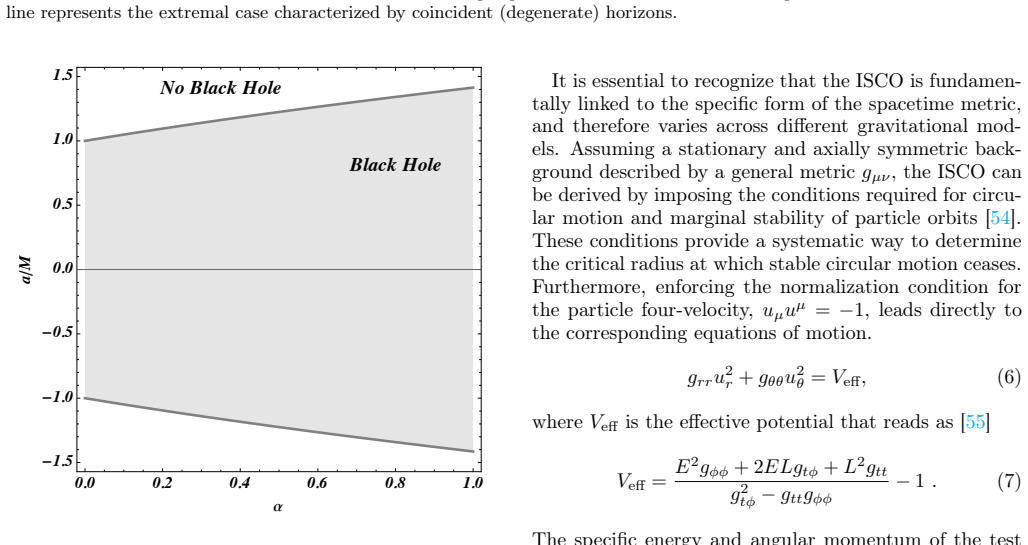
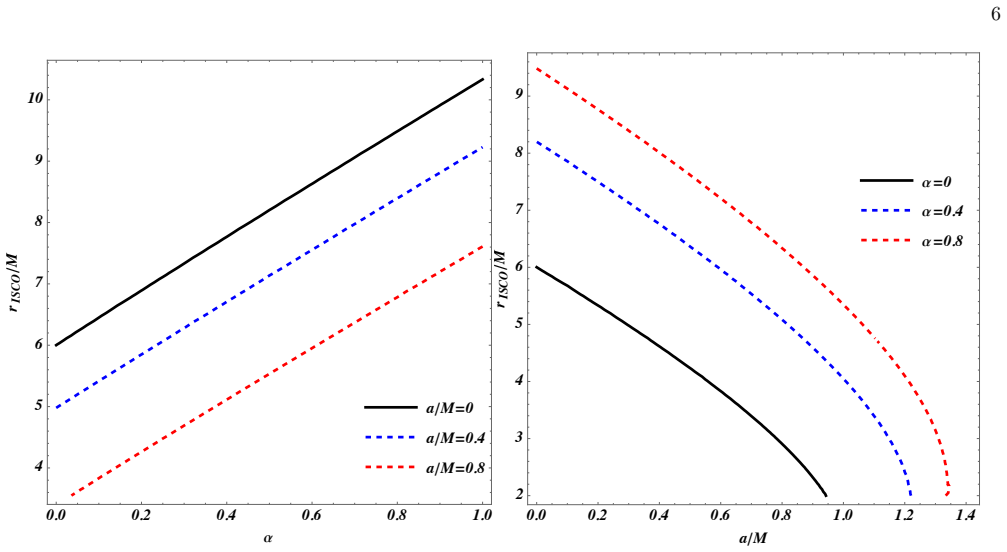
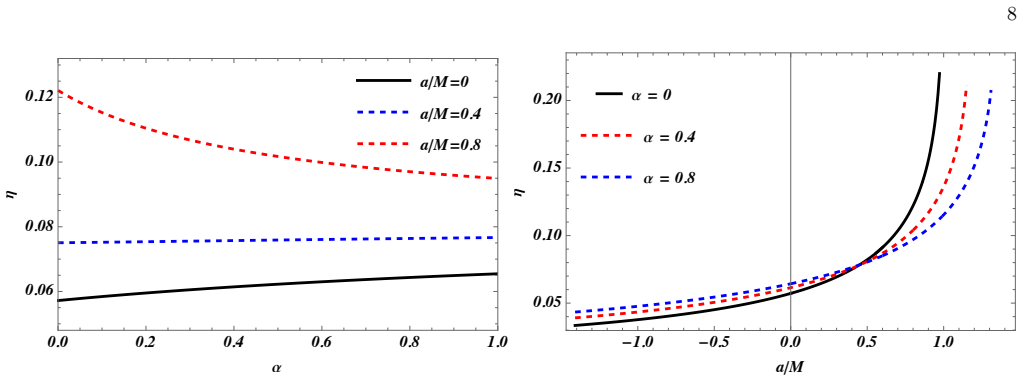
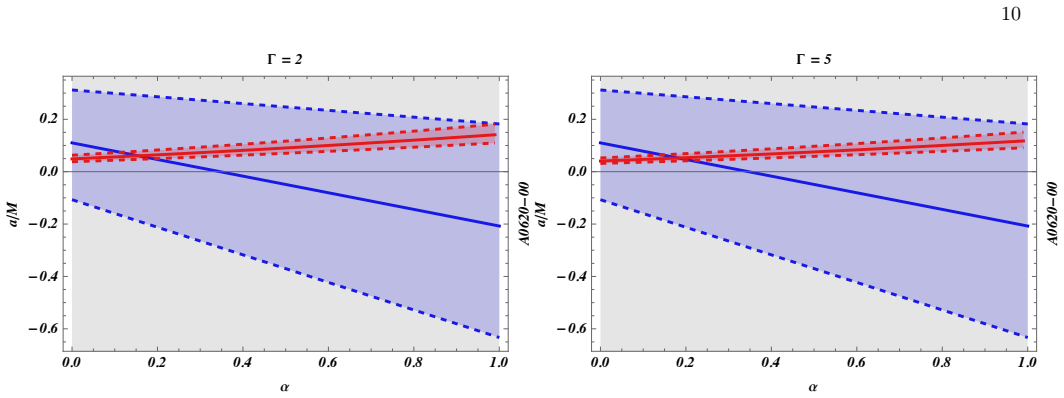
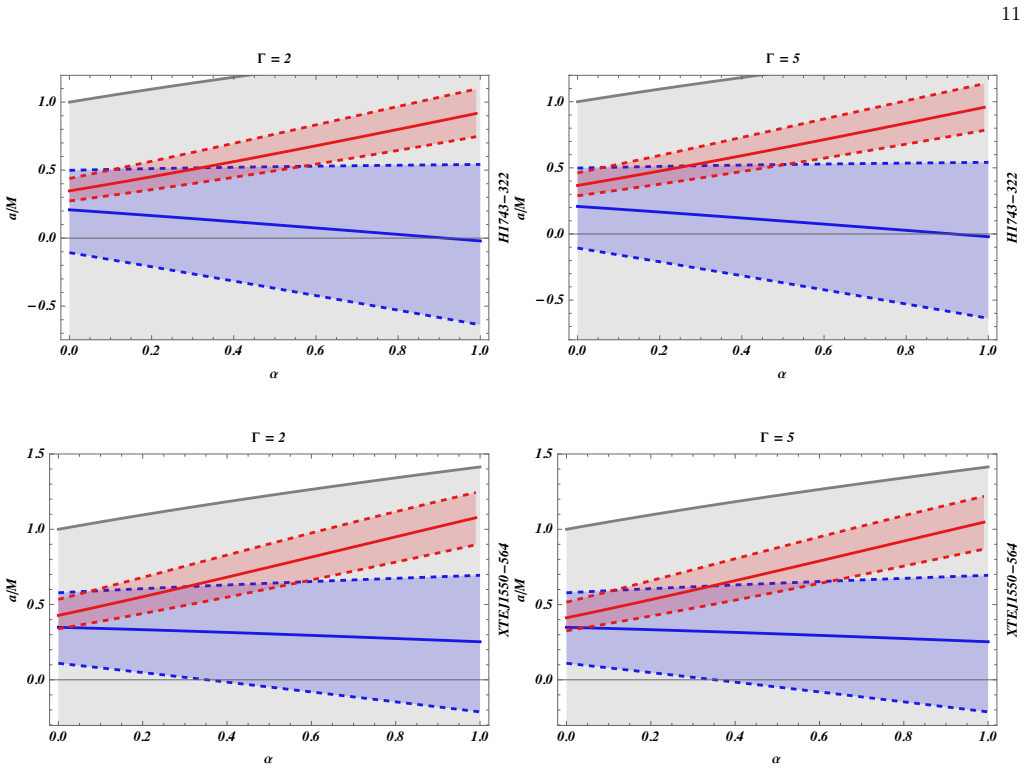
The presence of the MOG parameter alpha modifies the spacetime structure and the location of the ISCO. This affects the radiative efficiency of accretion disks and introduces a degeneracy between the spin and the modified gravity parameter. Using observational estimates and comparing with jet power predictions from the Blandford-Znajek mechanism, regions in the (a, alpha) space are identified where both observables are simultaneously reproduced for several sources, with only a narrow range for GRS1915+105.
What carries the argument
The Kerr-MOG geometry characterized by mass, spin parameter a, and modified gravity parameter alpha, which determines the ISCO location and thereby controls radiative efficiency and jet power.
If this is right
- Alpha creates a degeneracy with spin in efficiency constraints.
- Significant overlap regions in (a, alpha) exist for several sources when both efficiency and jet power are considered.
- For the high-spin source GRS1915+105 compatibility requires only a narrow range of Kerr-MOG parameters.
- The Kerr-MOG spacetime offers a viable framework for interpreting LMXB observations.
Where Pith is reading between the lines
- New spin measurements with smaller uncertainties could tighten or exclude the allowed alpha intervals.
- The same parameter constraints might be applied to other classes of black hole systems such as supermassive ones in active galaxies.
- If alpha must be non-zero to fit the data, it would constitute evidence for modified gravity at stellar-mass scales.
Load-bearing premise
The Novikov-Thorne thin accretion disk model remains valid and the radiative efficiency is determined solely by the ISCO location even in Kerr-MOG spacetime.
What would settle it
Observational data on radiative efficiency or jet power for GRS1915+105 lying outside the narrow compatible interval in the (a, alpha) plane would falsify the model for that source.
Figures




read the original abstract
We investigate the astrophysical implications of rotating black holes in modified gravity by studying the Kerr-MOG spacetime and applying it to several stellar-mass black hole candidates: A0620-00, H1743-322, XTE J1550-564, GRS1124-683, GRO J1655-40, and GRS1915+105. The Kerr-MOG geometry is characterized by the black hole mass, the spin parameter $a$, and the modified gravity parameter $\alpha$. We analyze how the presence of the MOG parameter modifies the spacetime structure and the location of the innermost stable circular orbit (ISCO). Within the Novikov--Thorne accretion disk model, we show that $\alpha$ significantly affects the radiative efficiency of accretion disks and introduces a degeneracy between the spin and the modified gravity parameter. Using observational estimates of radiative efficiencies inferred from the continuum-fitting method, we constrain the allowed regions in the $(a,\alpha)$ parameter space for each source. We further examine the relativistic jet power using the Blandford--Znajek mechanism and compare the theoretical predictions with the observed transient jet energetics, considering two representative jet Lorentz factors, $\Gamma=2$ and $\Gamma=5$. By combining the constraints from the radiative efficiency and jet power, we identify regions where both observables can be simultaneously reproduced. For several sources significant overlap regions appear, while for the highly spinning source GRS1915+105 the compatibility occurs only within a narrow range of Kerr--MOG parameters. These results suggest that the Kerr--MOG spacetime can provide a viable framework for interpreting the observed properties of several black hole X-ray binaries.
Editorial analysis
A structured set of objections, weighed in public.
Referee Report
Summary. The manuscript examines Kerr-MOG black holes applied to several low-mass X-ray binaries. It computes the ISCO location in the Kerr-MOG metric, applies the Novikov-Thorne thin-disk model to obtain radiative efficiencies as a function of spin a and MOG parameter α, and compares these to continuum-fitting observations to delineate allowed (a, α) regions. It further computes jet powers via the Blandford-Znajek mechanism for Lorentz factors Γ=2 and Γ=5, identifies overlap regions consistent with both efficiency and jet data, and notes a narrow compatible interval for the high-spin source GRS1915+105.
Significance. If the central mapping holds, the work supplies astrophysical constraints on the MOG parameter α from X-ray binary data and quantifies the spin-α degeneracy, thereby extending tests of modified gravity to stellar-mass black holes through accretion-disk and jet observables.
major comments (2)
- [Abstract and Novikov-Thorne section] Abstract (Novikov-Thorne application paragraph) and the corresponding methods section: radiative efficiencies are obtained by substituting the Kerr-MOG ISCO radius into the standard Novikov-Thorne binding-energy formula. The Kerr-MOG metric alters geodesic constants of motion and the effective potential, so the disk stress-energy tensor, vertical structure, and local energy flux require re-derivation from the modified Einstein equations rather than direct substitution of the new ISCO into the GR formula. This assumption is load-bearing for the efficiency constraints and the reported overlap regions, especially the narrow interval claimed for GRS1915+105.
- [Combined constraints section] Section on combined constraints (radiative efficiency plus jet power): the overlap regions are constructed by requiring the model to reproduce the same observational efficiency and jet-power numbers used to define the input constraints. No error budgets, robustness tests against model variations, or explicit propagation of observational uncertainties are supplied, so the claimed viable regions rest on unexamined assumptions about data and model fidelity.
minor comments (2)
- [Introduction] The definition and normalization of the MOG parameter α should be restated with an explicit reference to the original MOG field equations when first introduced.
- [Figures] The (a, α) contour plots would be clearer if observational error bars on efficiency and jet power were shown as shaded bands rather than point values.
Simulated Author's Rebuttal
We thank the referee for the careful reading and constructive comments. Below we respond point-by-point to the major comments and indicate the revisions we will make.
read point-by-point responses
-
Referee: [Abstract and Novikov-Thorne section] Abstract (Novikov-Thorne application paragraph) and the corresponding methods section: radiative efficiencies are obtained by substituting the Kerr-MOG ISCO radius into the standard Novikov-Thorne binding-energy formula. The Kerr-MOG metric alters geodesic constants of motion and the effective potential, so the disk stress-energy tensor, vertical structure, and local energy flux require re-derivation from the modified Einstein equations rather than direct substitution of the new ISCO into the GR formula. This assumption is load-bearing for the efficiency constraints and the reported overlap regions, especially the narrow interval claimed for GRS1915+105.
Authors: We computed the ISCO location and the specific energy E_ISCO directly from the conserved quantities and effective potential of the Kerr-MOG metric, so the radiative efficiency η = 1 − E_ISCO already incorporates the modified geodesic constants. Nevertheless, we agree that the full Novikov-Thorne stress-energy tensor and flux derivation assumes the Einstein equations and would ideally be repeated from the MOG field equations. This is a standard approximation in modified-gravity accretion studies, but we will add an explicit discussion of the approximation and its limitations in the revised manuscript, with particular emphasis on the narrow interval for GRS1915+105. revision: yes
-
Referee: [Combined constraints section] Section on combined constraints (radiative efficiency plus jet power): the overlap regions are constructed by requiring the model to reproduce the same observational efficiency and jet-power numbers used to define the input constraints. No error budgets, robustness tests against model variations, or explicit propagation of observational uncertainties are supplied, so the claimed viable regions rest on unexamined assumptions about data and model fidelity.
Authors: The overlap regions are the intersections of the separately allowed (a, α) domains defined by each observable. We did not include a full propagation of observational errors or robustness tests, which limits the quantitative strength of the claimed regions. We will revise the manuscript to add a discussion of the main observational uncertainties and their possible effect on the size of the overlap intervals, together with a clear statement that a formal statistical error budget lies beyond the scope of the present exploratory analysis. revision: yes
Circularity Check
No significant circularity; standard observational constraints on parameters
full rationale
The paper computes ISCO locations in the Kerr-MOG metric, inserts them into the standard Novikov-Thorne binding-energy formula for radiative efficiency, and uses published observational efficiency and jet-power values to delineate allowed (a, α) regions. This is ordinary parameter-space fitting against external data, not a derivation that reduces to its own inputs by construction. No self-definitional mapping, fitted quantity relabeled as prediction, or load-bearing self-citation chain appears in the quoted abstract or described procedure. The derivation remains self-contained against the cited observational benchmarks.
Axiom & Free-Parameter Ledger
free parameters (2)
- modified gravity parameter α
- spin parameter a
axioms (2)
- domain assumption Novikov-Thorne thin-disk model determines radiative efficiency from ISCO radius
- domain assumption Blandford-Znajek mechanism governs jet power
Reference graph
Works this paper leans on
-
[1]
M. S. Turner, Physics Reports333(2000), 10.1016/S0370-1573(00)00040-5. 14 0.0 0.2 0.4 0.6 0.8 1.0 0.6 0.8 1.0 1.2 1.4 α a/M Γ=2 GRS 1915+105 0.86 0.88 0.90 0.92 0.94 0.96 0.98 1.35 1.36 1.37 1.38 1.39 1.40 1.41 0.0 0.2 0.4 0.6 0.8 1.0 0.6 0.8 1.0 1.2 1.4 α a/M Γ=5 GRS 1915+105 0.86 0.88 0.90 0.92 0.94 0.96 0.98 1.35 1.36 1.37 1.38 1.39 1.40 1.41 FIG. 10. ...
-
[2]
B. K. Berger, Living Reviews in Relativity5, 1 (2002)
2002
-
[3]
Mandelstam, Annals of Physics19(1962), 10.1016/0003-4916(62)90233-6
S. Mandelstam, Annals of Physics19(1962), 10.1016/0003-4916(62)90233-6
-
[4]
Nojiri and S
S. Nojiri and S. D. Odintsov, Journal of Physics A: Math- ematical and Theoretical40, 6725 (2007)
2007
-
[5]
Koyama, Reports on Progress in Physics79, 046902 (2016)
K. Koyama, Reports on Progress in Physics79, 046902 (2016)
2016
-
[6]
Shankaranarayanan and J
S. Shankaranarayanan and J. P. Johnson, General Rela- tivity and Gravitation54, 44 (2022)
2022
-
[7]
Wanget al., Journal of Cosmology and Astropar- ticle Physics2019, 046 (2019)
H.-M. Wanget al., Journal of Cosmology and Astropar- ticle Physics2019, 046 (2019)
2019
-
[8]
Narzilloev, S
B. Narzilloev, S. Shaymatov, I. Hussain,et al., European Physical Journal C81, 849 (2021)
2021
-
[9]
Atamurotov, D
F. Atamurotov, D. Ortiqboev, A. Abdujabbarov,et al., European Physical Journal C82, 659 (2022)
2022
-
[10]
Kuanget al., Physical Review D106, 064012 (2022)
X. Kuanget al., Physical Review D106, 064012 (2022)
2022
-
[11]
Maselliet al., The Astrophysical Journal843, 25 (2017)
A. Maselliet al., The Astrophysical Journal843, 25 (2017)
2017
-
[12]
Chenet al., Journal of Cosmology and Astroparticle Physics2021, 043 (2021)
S. Chenet al., Journal of Cosmology and Astroparticle Physics2021, 043 (2021)
2021
-
[13]
Bhattacharyyaet al., Physical Review D96, 064044 (2017)
S. Bhattacharyyaet al., Physical Review D96, 064044 (2017)
2017
-
[14]
Moulin, Universe5, 202 (2019)
F. Moulin, Universe5, 202 (2019)
2019
-
[15]
Akiyamaet al., The Astrophysical Journal Letters 875, L1 (2019)
K. Akiyamaet al., The Astrophysical Journal Letters 875, L1 (2019)
2019
-
[16]
B. P. Abbottet al., Physical Review Letters116, 061102 (2016)
2016
-
[17]
J. W. Moffat, Journal of Cosmology and Astroparticle Physics2006, 004 (2006)
2006
-
[18]
Heisenberg, Journal of Cosmology and Astroparticle Physics2018, 054 (2018)
L. Heisenberg, Journal of Cosmology and Astroparticle Physics2018, 054 (2018)
2018
-
[19]
Jamaliet al., Journal of Cosmology and Astroparticle Physics2018, 048 (2018)
S. Jamaliet al., Journal of Cosmology and Astroparticle Physics2018, 048 (2018)
2018
-
[20]
J. D. Bekenstein, Physical Review D7, 2333 (1973)
1973
-
[21]
Ruppeiner, Physical Review D75, 024037 (2007)
G. Ruppeiner, Physical Review D75, 024037 (2007)
2007
-
[22]
Caiet al., Physical Review D91, 024032 (2015)
R. Caiet al., Physical Review D91, 024032 (2015)
2015
-
[23]
Iorio, Classical and Quantum Gravity31, 085003 (2014)
L. Iorio, Classical and Quantum Gravity31, 085003 (2014)
2014
-
[24]
M.Laurentiset al.,PhysicalReviewD97,104024(2018)
2018
-
[25]
Panpanichet al., Physical Review D100, 044031 (2019)
S. Panpanichet al., Physical Review D100, 044031 (2019)
2019
-
[26]
Tahirasghariet al., Physical Review D106, 064021 (2022)
F. Tahirasghariet al., Physical Review D106, 064021 (2022)
2022
-
[27]
R. P. Kerr, Physical Review Letters11, 237 (1963)
1963
-
[28]
Y. Cui, K. Hada, T. Kawashima, and et al., Nature621, 711 (2023)
2023
-
[29]
Sharif and M
M. Sharif and M. Shahzadi, European Physical Journal C77, 363 (2017)
2017
-
[30]
Zhang and et al., Journal of Cosmology and Astropar- ticle Physics2024, 027 (2024)
Z. Zhang and et al., Journal of Cosmology and Astropar- ticle Physics2024, 027 (2024)
2024
-
[31]
Z. Xu, D. Ma, and K. Li, European Physical Journal C 86, 295 (2026)
2026
-
[32]
M. A. Abramowicz and P. C. Fragile, Living Reviews in Relativity16, 1 (2013)
2013
-
[33]
Sądowski, J.-P
A. Sądowski, J.-P. Lasota, M. A. Abramowicz, and R. Narayan, Monthly Notices of the Royal Astronomi- cal Society456, 3915 (2016)
2016
-
[34]
Bagchi, M
J. Bagchi, M. Vivek, V. Vikram, A. Hota, K. G. Biju, S. K. Sirothia, R. Srianand, Gopal-Krishna, and J. Ja- cob, Astrophysical Journal788, 174 (2014)
2014
-
[36]
Dickinson, Galaxies6(2018), 10.3390/galax- ies6020056
B. Narzilloev, J. Rayimbaev, A. Abdujabbarov, and B. Ahmedov, Galaxies9(2021), 10.3390/galax- ies9030063
-
[37]
Narzilloev and B
B. Narzilloev and B. Ahmedov, New Astron.98, 101922 (2023)
2023
-
[38]
B. Narzilloev, A. Abdujabbarov, and A. Hakimov, In- ternational Journal of Modern Physics A37, 2250144 (2022), https://doi.org/10.1142/S0217751X22501445
-
[39]
Narzilloev and B
B. Narzilloev and B. Ahmedov, Symmetry15, 293 (2023)
2023
-
[40]
Mirzaev, S
T. Mirzaev, S. Li, B. Narzilloev, I. Hussain, A. Abdu- jabbarov, and B. Ahmedov, European Physical Journal Plus138, 47 (2023)
2023
-
[41]
Narzilloev and B
B. Narzilloev and B. Ahmedov, Int. J. Mod. Phys. A38, 2350026 (2023)
2023
-
[42]
J. S. Spilker, J. B. Champagne, X. Fan, S. Fujimoto, P. P. van der Werf, J. Yang, and M. Yue, Astrophysical 15 Journal982, 72 (2025)
2025
-
[43]
L. Gou, J. E. McClintock, J. F. Steiner, R. Narayan, A. G. Cantrell, C. D. Bailyn, and J. A. Orosz, Astro- physical Journal Letters718, L122 (2010)
2010
-
[44]
J. F. Steiner, J. E. McClintock, and M. J. Reid, Astro- physical Journal Letters745, L7 (2011)
2011
-
[46]
Z. Chen, L. Gou, J. E. McClintock, J. F. Steiner, J. Wu, W.Xu, J.A.Orosz, andY.Xiang,AstrophysicalJournal 825, 45 (2016)
2016
-
[47]
Shafee, J
R. Shafee, J. E. McClintock, R. Narayan, S. W. Davis, L.-X. Li, and R. A. Remillard, Astrophysical Journal 636, L113 (2005)
2005
-
[48]
J. E. McClintock, R. Shafee, R. Narayan, R. A. Remil- lard, S. W. Davis, and L.-X. Li, Astrophysical Journal 652, 518 (2006)
2006
-
[49]
B. Narzilloev and B. Ahmedov, Symmetry14(2022), 10.3390/sym14091765
-
[51]
Chandrasekhar,The mathematical theory of black holes, Vol
S. Chandrasekhar,The mathematical theory of black holes, Vol. 69 (Oxford university press, 1998)
1998
-
[52]
Narzilloev and B
B. Narzilloev and B. Ahmedov, Int. J. Mod. Phys. D32, 2350064 (2023)
2023
-
[53]
Saidov, B
B. Saidov, B. Narzilloev, I. Hussain, A. Abdujabbarov, and B. Ahmedov, Phys. Rev. D112, 104057 (2025)
2025
-
[54]
S. N. Zhang, W. Cui, and W. Chen, The Astrophysical Journal482, L155 (1997)
1997
-
[55]
Bambi,Black holes: a laboratory for testing strong gravity, Vol
C. Bambi,Black holes: a laboratory for testing strong gravity, Vol. 10 (Springer, 2017)
2017
-
[56]
Zhang, J
C. Zhang, J. Lewandowski, Y. Ma, and J. Yang, Physical Review D111, L081504 (2025)
2025
-
[57]
J. E. McClintock, R. Narayan, and J. F. Steiner, Space Science Reviews183, 295 (2014)
2014
-
[58]
M. Y. Piotrovich, E. S. Shablovinskaya, E. A. Ma- lygin, S. D. Buliga, and T. M. Natsvlishvili, Monthly Notices of the Royal Astronomical Society526, 2596 (2023), https://academic.oup.com/mnras/article- pdf/526/2/2596/51894287/stad2934.pdf
2023
-
[59]
N. I. Shakura and R. A. Sunyaev, Astronomy and Astro- physics, Vol. 24, p. 337-35524, 337 (1973)
1973
-
[61]
L.Kong, Z.Li, andC.Bambi,TheAstrophysicalJournal 797, 78 (2014)
2014
-
[62]
S. M. M. A. N. Wilmset al., arXiv preprint astro- ph/0509028 (2005)
arXiv 2005
-
[63]
I. F. Mirabel and L. F. Rodriguez, Annual Review of Astronomy and Astrophysics37, 409 (1999)
1999
-
[64]
Punsly and F
B. Punsly and F. Coroniti, Astrophysical Journal, Part 1 (ISSN 0004-637X), vol. 354, May 10, 1990, p. 583-615. 354, 583 (1990)
1990
-
[65]
Koide, Physical Review D67, 104010 (2003)
S. Koide, Physical Review D67, 104010 (2003)
2003
-
[66]
R. D. Blandford and R. L. Znajek, Monthly Notices of the Royal Astronomical Society179, 433 (1977)
1977
-
[67]
Tchekhovskoy, R
A. Tchekhovskoy, R. Narayan, and J. C. McKinney, The Astrophysical Journal711, 50 (2010)
2010
-
[68]
G. Pei, S. Nampalliwar, C. Bambi, and M. J. Middleton, The European Physical Journal C76, 1 (2016)
2016
-
[69]
R. A. Daly, The Astrophysical Journal886, 37 (2019)
2019
-
[70]
R. A. Daly, Monthly Notices of the Royal Astronomical Society500, 215 (2021)
2021
-
[71]
L. Gou, J. E. McClintock, J. F. Steiner, R. Narayan, A. G. Cantrell, C. D. Bailyn, and J. A. Orosz, The As- trophysical Journal Letters718, L122 (2010)
2010
-
[72]
J. F. Steiner, J. E. McClintock, and M. J. Reid, The Astrophysical Journal Letters745, L7 (2011)
2011
-
[73]
J. F. Steiner, R. C. Reis, J. E. McClintock, R. Narayan, R. A. Remillard, J. A. Orosz, L. Gou, A. C. Fabian, and M. A. Torres, Monthly Notices of the Royal Astronomical Society416, 941 (2011)
2011
-
[74]
Z. Chen, L. Gou, J. E. McClintock, J. F. Steiner, J. Wu, W. Xu, J. A. Orosz, and Y. Xiang, The Astrophysical Journal825, 45 (2016)
2016
-
[75]
Li, and R
R.Shafee, J.E.McClintock, R.Narayan, S.W.Davis, L.- X. Li, and R. A. Remillard, The Astrophysical Journal 636, L113 (2005)
2005
-
[76]
J. E. McClintock, R. Shafee, R. Narayan, R. A. Remil- lard, S. W. Davis, and L.-X. Li, The Astrophysical Jour- nal652, 518 (2006)
2006
-
[77]
Saidov, B
B. Saidov, B. Narzilloev, A. Abdujabbarov, M. Khudoy- berdieva, and B. Ahmedov, Universe10, 454 (2024)
2024
-
[78]
R. M. Wald, Phys. Rev. D10, 1680 (1974)
1974
-
[79]
Penrose, Phys
R. Penrose, Phys. Rev. Lett.14, 57 (1965)
1965
-
[80]
M. J. Middleton, J. C. Miller-Jones, and R. P. Fender, Monthly Notices of the Royal Astronomical Society439, 1740 (2014)
2014
-
[81]
Narzilloev and B
B. Narzilloev and B. Ahmedov, Symmetry14, 1765 (2022)
2022
-
[82]
Moscibrodzka, Astrophysics and Space Science369, 68 (2024)
M. Moscibrodzka, Astrophysics and Space Science369, 68 (2024)
2024
-
[83]
B. Narzilloev, A. Abdujabbarov, B. Ahmedov, and C. Bambi, Eur. Phys. J. C84, 909 (2024), arXiv:arXiv:2408.05576 [gr-qc]
arXiv 2024
-
[84]
Narzilloev, A
B. Narzilloev, A. Abdujabbarov, B. Ahmedov, and C. Bambi, Phys. Rev. D108, 103013 (2023)
2023
discussion (0)
Sign in with ORCID, Apple, or X to comment. Anyone can read and Pith papers without signing in.