NGC 6134: a comprehensive study through photometric and kinematic analysis using Gaia DR3
Pith reviewed 2026-06-25 23:56 UTC · model grok-4.3
The pith
NGC 6134 is a 1.4-billion-year-old open cluster 1064 parsecs away whose mass segregation arises from dynamical evolution and whose stars divide into core, tidal tail, and halo components.
A machine-rendered reading of the paper's core claim, the machinery that carries it, and where it could break.
Core claim
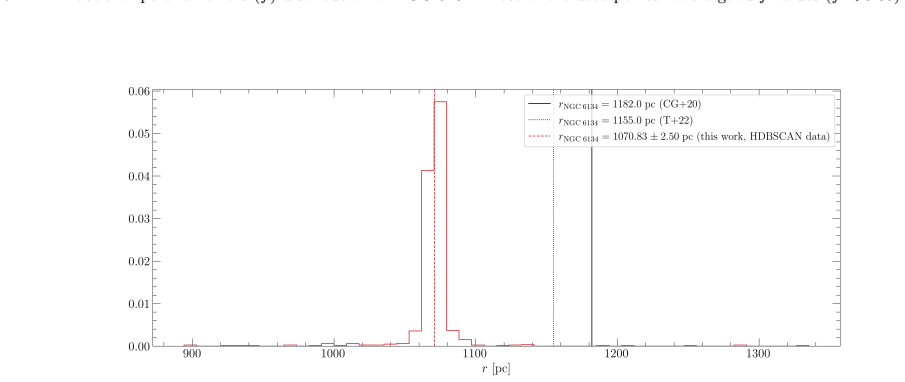
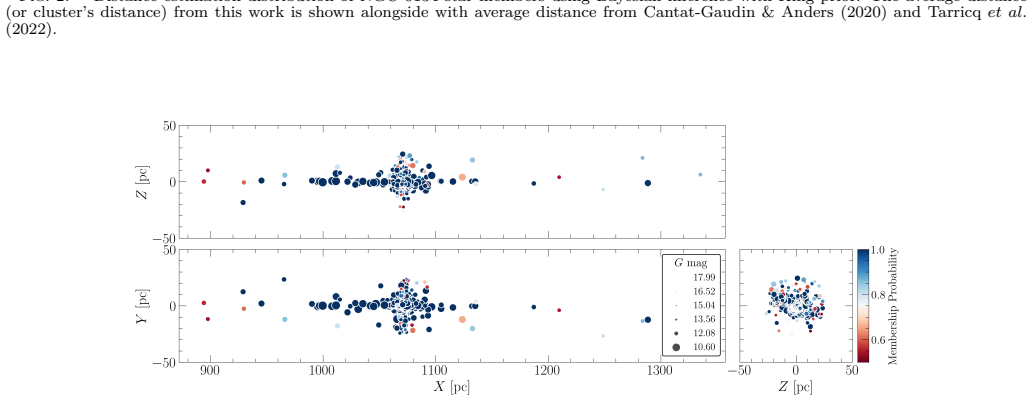
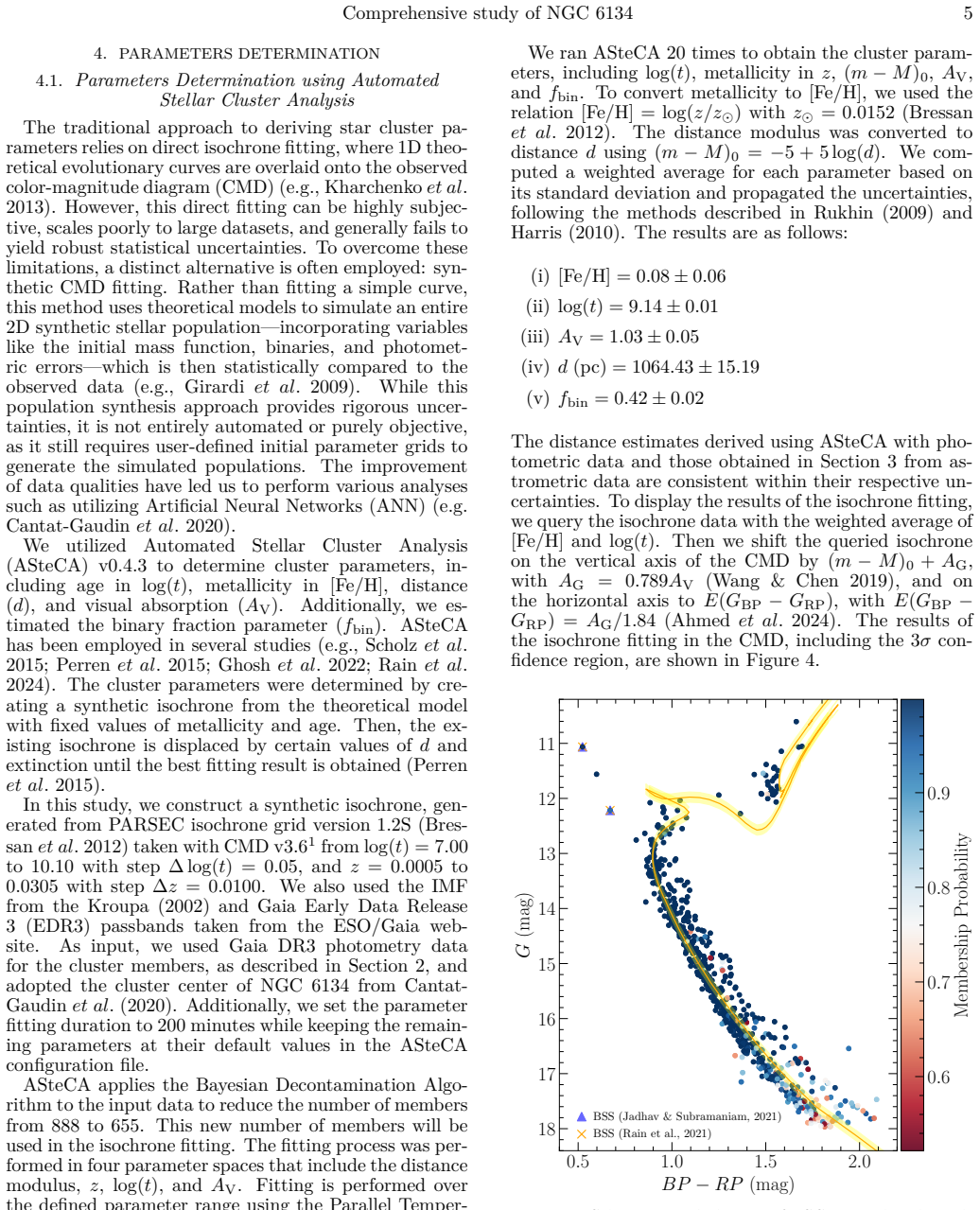
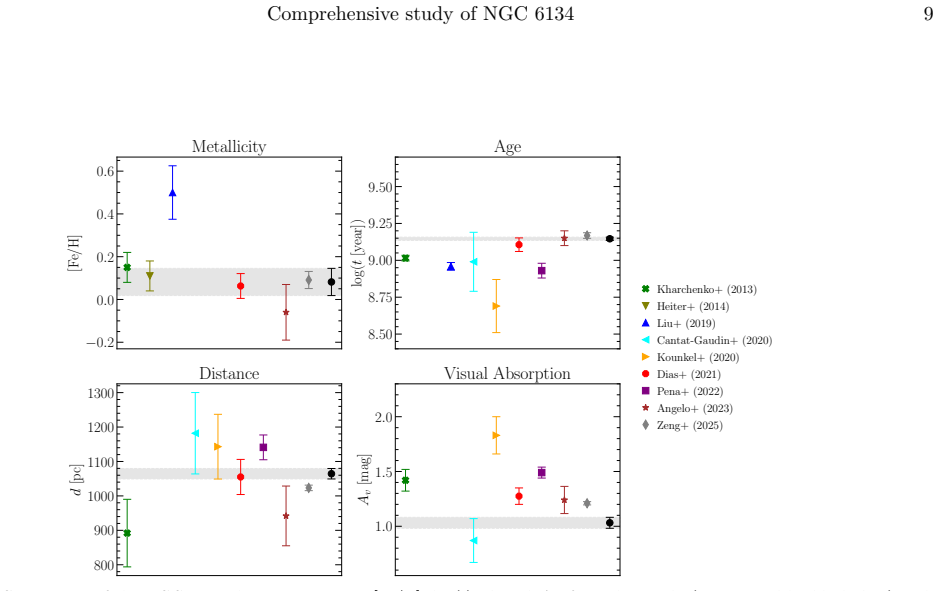
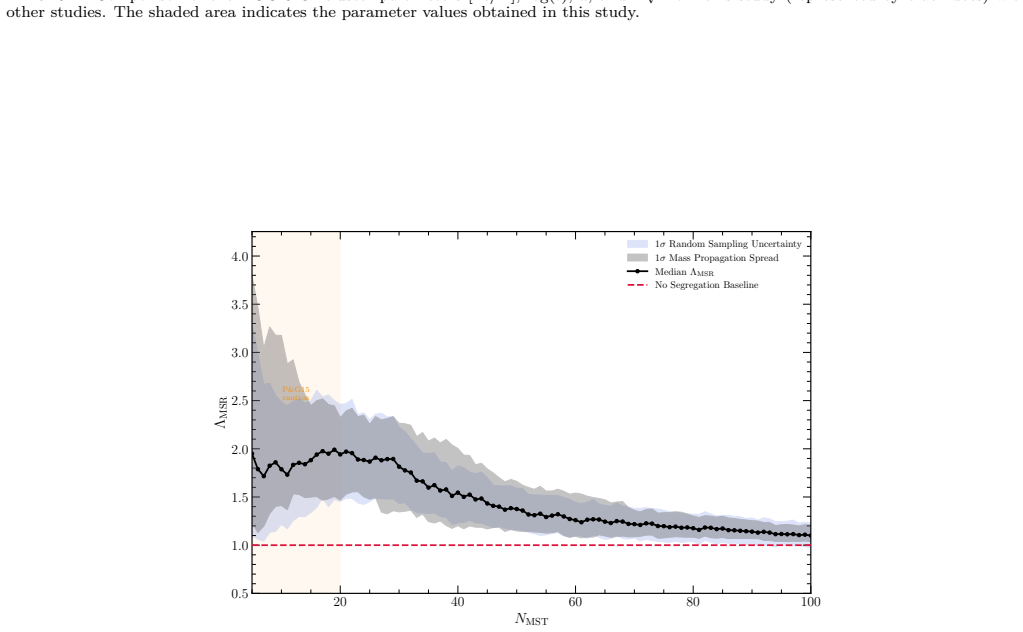
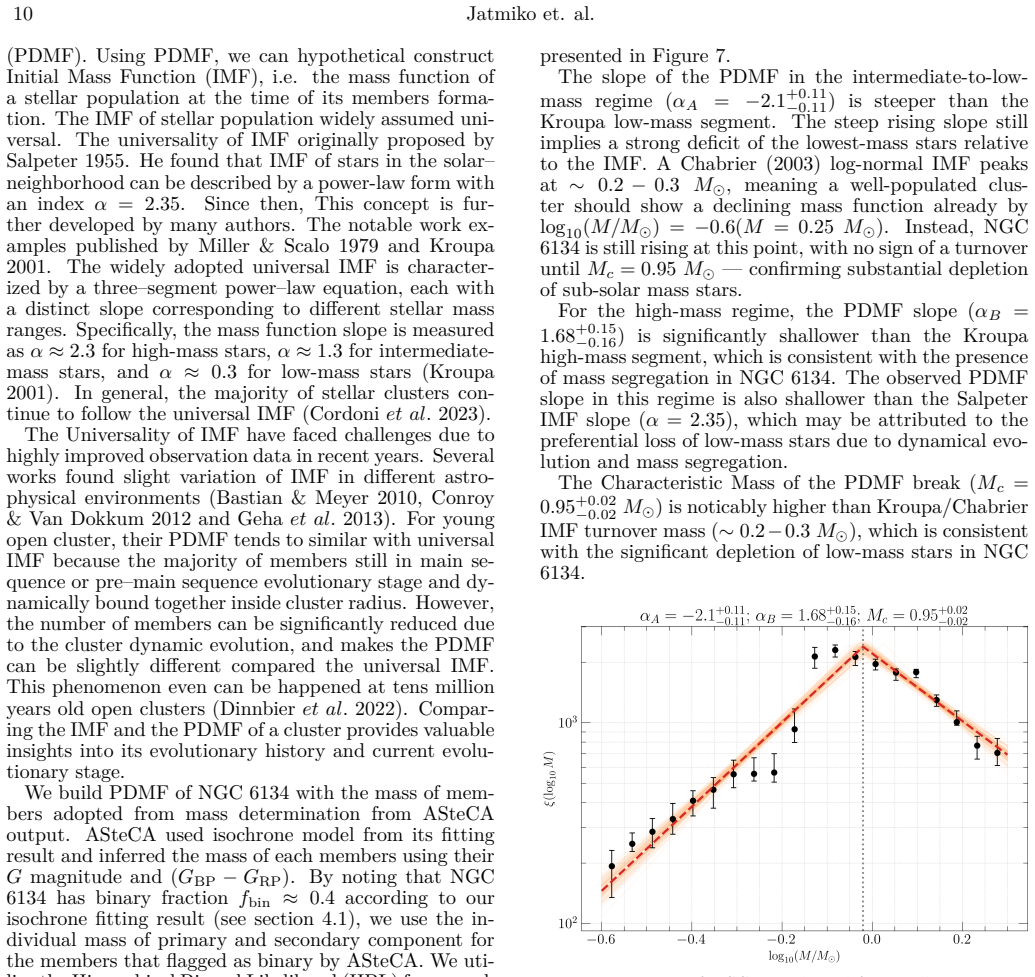
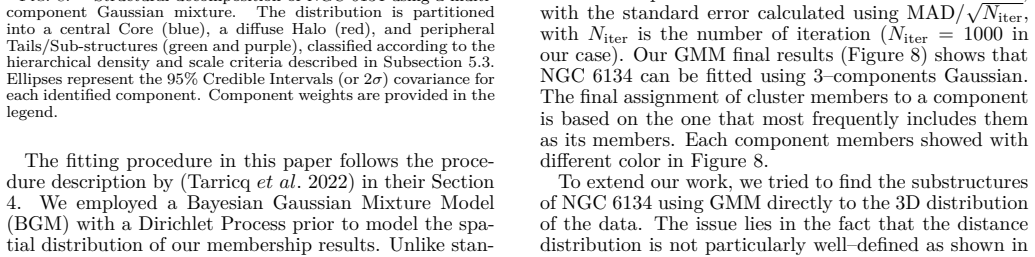
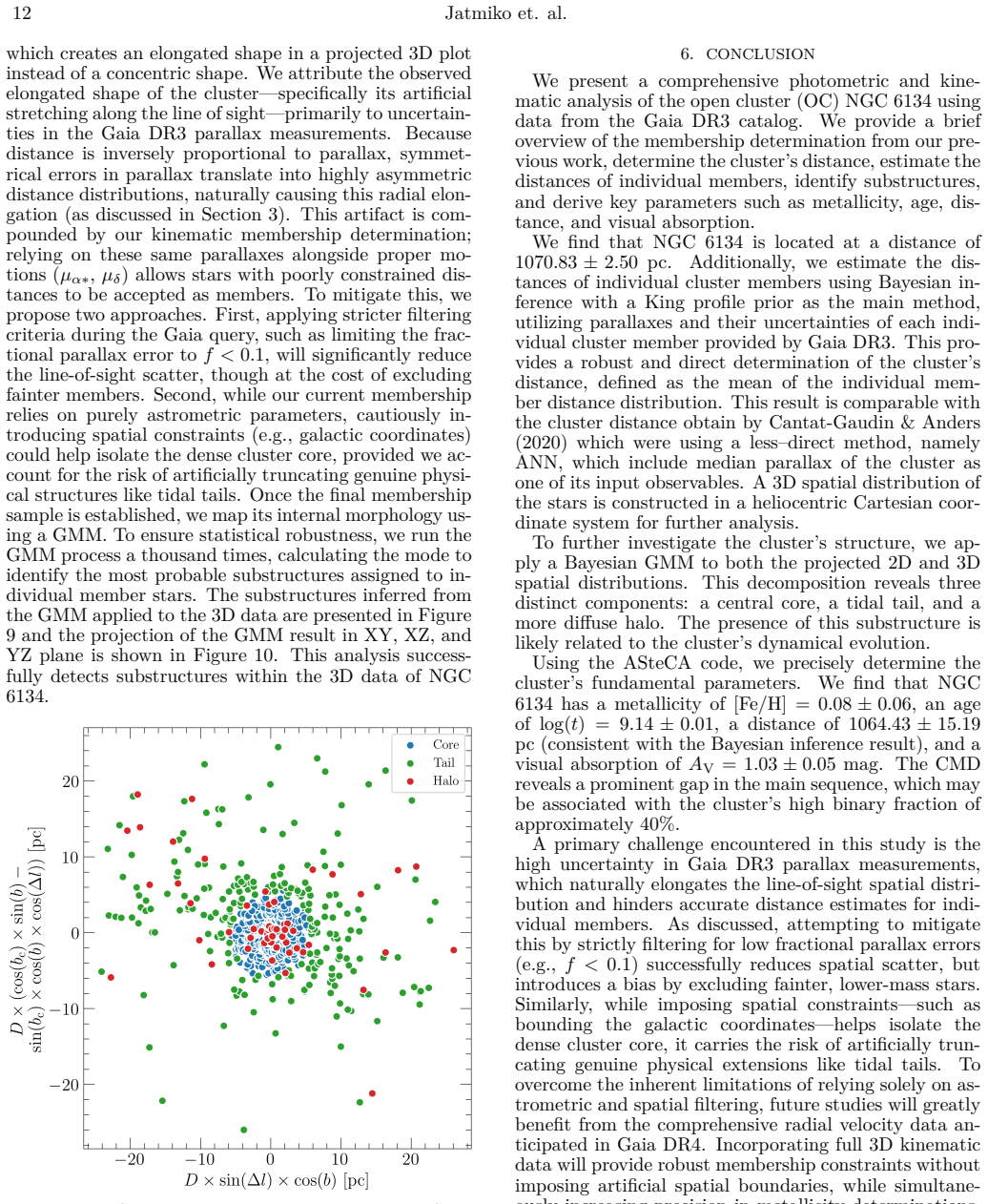
Application of the ASteCA code to the photometric and kinematic members yields cluster parameters [Fe/H] = 0.08 ± 0.06, log(t) = 9.14 ± 0.01, distance 1064.43 ± 15.19 pc, and A_v = 1.03 ± 0.05 mag; an independent Bayesian distance estimate from individual parallaxes agrees at 1070.83 ± 2.50 pc. Gaussian Mixture Models decompose the three-dimensional positions into core, tidal tail, and halo components. Minimum Spanning Tree analysis demonstrates that the observed mass segregation is produced by dynamical evolution. The color-magnitude diagram additionally contains probable blue stragglers and a main-sequence gap linked to the binary fraction.
What carries the argument
ASteCA isochrone fitting together with Gaussian Mixture Model decomposition of positions and Minimum Spanning Tree ordering of stellar masses.
If this is right
- The derived age, distance, and metallicity supply a calibrated reference for testing correlations between cluster environment and exoplanet occurrence.
- The three-component spatial model supplies a template for tracking how open clusters lose stars to the Galactic field.
- Attributing mass segregation to dynamical processes rather than formation conditions favors evolutionary models that begin with a uniform initial mass function.
- The reported main-sequence gap supplies an observable constraint on the cluster binary fraction that can be checked with radial-velocity surveys.
Where Pith is reading between the lines
- Repeating the same ASteCA-plus-GMM-plus-MST pipeline on other Gaia clusters would allow a uniform comparison of dynamical states across different ages and environments.
- Spectroscopic follow-up of the candidate blue stragglers could test whether the main-sequence gap is produced by mass transfer in binaries.
- The close match between the two independent distance methods suggests that Gaia parallaxes can be trusted for similar clusters once field contamination is controlled.
Load-bearing premise
The membership list and photometric measurements inherited from the earlier study contain few enough field stars and unresolved binaries that they do not shift the fitted isochrone or the substructure decomposition by a detectable amount.
What would settle it
A new, independent membership catalog or deeper photometry that returns a metallicity differing by more than 0.15 dex, an age outside log t = 9.10-9.20, or a mass-segregation signal whose Minimum Spanning Tree length is consistent with a primordial rather than dynamical origin.
Figures



read the original abstract
Open clusters provide a unique laboratory for precisely constraining stellar age, distance, and metallicity, facilitating studies on exoplanet-host star correlations. Building on our previous membership study, we analyze photometric data to comprehensively characterize the open cluster NGC 6134 by determining its fundamental parameters, 3D spatial distribution, substructures, and mass segregation. Using the ASteCA code, we derive the cluster's parameters: $\mathrm{[Fe/H]} = 0.08 \pm 0.06$, $\log(t) = 9.14 \pm 0.01$, $d = 1064.43 \pm 15.19$ pc, and $A_\mathrm{v} = 1.03 \pm 0.05$ mag. Independent Bayesian inference of individual member distances yields a cluster distance of $1070.83 \pm 2.50$ pc, in excellent agreement with the ASteCA results. Spatial substructures are successfully mapped using Gaussian Mixture Models, revealing a three-component distribution corresponding to the cluster's core, tidal tail, and halo. Furthermore, Minimum Spanning Tree analysis indicates that the observed mass segregation is driven by dynamical evolution rather than primordial origins. Finally, our analysis of the cluster's Color--Magnitude Diagram identifies probable blue straggler stars and a main-sequence gap, which we conclude is strongly linked to the cluster's binary fraction.
Editorial analysis
A structured set of objections, weighed in public.
Referee Report
Summary. The manuscript analyzes the open cluster NGC 6134 using Gaia DR3 photometry and kinematics, building on a prior membership study. It derives fundamental parameters via ASteCA ([Fe/H] = 0.08 ± 0.06, log(t) = 9.14 ± 0.01, d = 1064.43 ± 15.19 pc, A_v = 1.03 ± 0.05 mag) and reports an independent Bayesian distance of 1070.83 ± 2.50 pc in agreement. GMM identifies three spatial components (core, tidal tail, halo); MST analysis attributes observed mass segregation to dynamical evolution; the CMD shows probable blue stragglers and a main-sequence gap linked to binary fraction.
Significance. If the adopted membership list is reliable, the work supplies well-constrained parameters for NGC 6134 together with a multi-method view of its spatial structure and dynamical state. The reported agreement between two distance estimates is a concrete strength. Such cluster characterizations can support broader studies of open-cluster evolution and binary populations when the input data quality is independently verified.
major comments (3)
- [Methods (membership and input data)] The analysis adopts the membership list from the prior study without new membership probabilities, contamination fractions, or sensitivity tests to field-star or unresolved-binary contamination. This assumption is load-bearing for the ASteCA parameter fit, the GMM spatial decomposition, and the MST mass-segregation conclusion, yet no quantitative assessment of its impact is provided.
- [Results (distance comparison)] The Bayesian distance (1070.83 ± 2.50 pc) is presented as independent confirmation of the ASteCA distance, but both determinations use the identical member list; the quoted uncertainties therefore do not capture possible systematic bias from that list.
- [Discussion (mass segregation and CMD features)] The claim that mass segregation is driven by dynamical evolution (rather than primordial) rests on the MST analysis, and the MS-gap interpretation is tied to binary fraction, but neither conclusion includes quantitative tests against contamination scenarios or N-body simulations.
minor comments (2)
- [Abstract and tables] Ensure all reported parameter values and uncertainties match exactly between the abstract, tables, and text.
- [Methods (ASteCA configuration)] Clarify whether the ASteCA run used default priors or any user-specified settings for the isochrone grid.
Simulated Author's Rebuttal
We thank the referee for their constructive and detailed comments, which help improve the clarity and robustness of our analysis. We respond to each major comment below, indicating planned revisions where appropriate.
read point-by-point responses
-
Referee: [Methods (membership and input data)] The analysis adopts the membership list from the prior study without new membership probabilities, contamination fractions, or sensitivity tests to field-star or unresolved-binary contamination. This assumption is load-bearing for the ASteCA parameter fit, the GMM spatial decomposition, and the MST mass-segregation conclusion, yet no quantitative assessment of its impact is provided.
Authors: The membership list originates from our prior Gaia DR3 study, where probabilistic membership was assigned using astrometric and photometric criteria (detailed in that work). The present manuscript focuses on downstream analysis of those members. To address the concern, we will add a dedicated subsection on membership robustness, including sensitivity tests that vary the probability threshold and inject simulated field-star or binary contaminants to quantify effects on ASteCA parameters, GMM components, and MST results. revision: yes
-
Referee: [Results (distance comparison)] The Bayesian distance (1070.83 ± 2.50 pc) is presented as independent confirmation of the ASteCA distance, but both determinations use the identical member list; the quoted uncertainties therefore do not capture possible systematic bias from that list.
Authors: We agree that both distance methods share the same input member list, so the Bayesian result functions as an internal consistency check rather than a fully independent validation. We will revise the relevant section to explicitly state this shared dependence, reframe the agreement as supporting robustness of the ASteCA solution, and note that the reported uncertainties do not include membership-related systematics. revision: yes
-
Referee: [Discussion (mass segregation and CMD features)] The claim that mass segregation is driven by dynamical evolution (rather than primordial) rests on the MST analysis, and the MS-gap interpretation is tied to binary fraction, but neither conclusion includes quantitative tests against contamination scenarios or N-body simulations.
Authors: The MST analysis follows established literature methods for open clusters and supports dynamical evolution given the cluster age. We acknowledge the absence of new N-body simulations or explicit contamination Monte Carlo tests. In revision we will expand the discussion to include literature comparisons with N-body results for similar-age clusters, add caveats on possible contamination effects, and strengthen the binary-fraction link for the MS gap with additional references. Full quantitative simulations lie beyond the scope of this observational study. revision: partial
Circularity Check
No circularity; derivation applies external tools to prior membership input without redefinition or self-referential fitting
full rationale
The paper applies the external ASteCA package to a membership list obtained from a prior study, performs GMM spatial decomposition and MST mass-segregation analysis on that list, and cross-validates distance via an independent Bayesian inference on the same members. No equation or procedure redefines a fitted parameter as a prediction, imports a uniqueness theorem via self-citation, or renames an empirical pattern as a new derivation. The membership list is treated as an external input whose cleanliness is an assumption (correctness risk), not a quantity derived inside this paper's chain. The reported parameters and structures therefore do not reduce to the paper's own outputs by construction.
Axiom & Free-Parameter Ledger
Reference graph
Works this paper leans on
-
[1]
M., Bendary, R., Samir, R., & Elhosseiny, E
Ahmed, N. M., Bendary, R., Samir, R., & Elhosseiny, E. 2024, Scientific Reports, 14, 23777
2024
-
[2]
V., Cignoni, M., Bragaglia, A.,et al
Ahumada, A. V., Cignoni, M., Bragaglia, A.,et al. 2013, Monthly Notices of the Royal Astronomical Society, 430, 221
2013
-
[3]
2002, in Observed HR Diagrams and Stellar
Ahumada, J. 2002, in Observed HR Diagrams and Stellar
2002
-
[4]
J., Goodwin, S
Allison, R. J., Goodwin, S. P., Parker, R. J.,et al. 2009, Monthly Notices of the Royal Astronomical Society, 395, 1449
2009
-
[5]
2023, Monthly Notices of the Royal Astronomical Society, 522, 956
Angelo, M., Santos Jr, J., Maia, F., & Corradi, W. 2023, Monthly Notices of the Royal Astronomical Society, 522, 956
2023
-
[6]
Bailer-Jones, C. A. L. 2015, PASP, 127, 994
2015
-
[7]
Bailer-Jones, C. A. L., Rybizki, J., & Fouesneau, M. 2021, AJ, 161, 147
2021
-
[8]
Covey, K
Bastian, N. Covey, K. R., & Meyer, M. R. 2010, Annual Review of Astronomy and Astrophysics, 48, 339
2010
-
[9]
2008, A&A, 492, 277
Bayo, A., Rodrigo, C., Barrado Y Navascu´ es, D.,et al. 2008, A&A, 492, 277
2008
-
[10]
1998, Galactic Astronomy (Princeton, NJ: Princeton University Press)
Binney, J., & Merrifield, M. 1998, Galactic Astronomy (Princeton, NJ: Princeton University Press)
1998
-
[11]
2008, Galactic Dynamics: Second Edition
Binney, J., & Tremaine, S. 2008, Galactic Dynamics: Second Edition
2008
-
[12]
2019, Astronomy & Astrophysics, 623, A108
Bossini, D., Vallenari, A., Bragaglia, A.,et al. 2019, Astronomy & Astrophysics, 623, A108
2019
-
[13]
2012, Monthly Notices of the Royal Astronomical Society, 427, 127
Bressan, A., Marigo, P., Girardi, L.,et al. 2012, Monthly Notices of the Royal Astronomical Society, 427, 127
2012
-
[14]
1999, Astronomy and Astrophysics Supplement Series, 140, 135
Bruntt, H., Frandsen, S., Kjeldsen, H., & Andersen, M. 1999, Astronomy and Astrophysics Supplement Series, 140, 135
1999
-
[15]
2020, Astronomy & Astrophysics, 633, A99
Cantat-Gaudin, T., & Anders, F. 2020, Astronomy & Astrophysics, 633, A99
2020
-
[16]
2020, Astronomy & Astrophysics, 640, A1
Cantat-Gaudin, T., Anders, F., Castro-Ginard, A.,et al. 2020, Astronomy & Astrophysics, 640, A1
2020
-
[17]
Carrera, R., Pasquato, M., & Vallenari, A. e. a. 2019, A&A, 627, A119
2019
-
[18]
2004, Astronomy & Astrophysics, 422, 951
Carretta, E., Bragaglia, A., Gratton, R., & Tosi, M. 2004, Astronomy & Astrophysics, 422, 951
2004
-
[19]
2024, AJ, 167, 12
Cavallo, L., Spina, L., Carraro, G.,et al. 2024, AJ, 167, 12
2024
-
[20]
2003, PASP, 115, 763
Chabrier, G. 2003, PASP, 115, 763
2003
-
[21]
J., & Mermilliod, J.-C
Claria, J. J., & Mermilliod, J.-C. 1992, Astronomy and Astrophysics Supplement Series (ISSN 0365-0138), vol. 95, no. 3, p. 429-436., 95, 429
1992
-
[22]
Conroy, C., & Van Dokkum, P. G. 2012, The Astrophysical Journal, 760, 71
2012
-
[23]
P., Marino, A
Cordoni, G., Milone, A. P., Marino, A. F.,et al. 2023, Astronomy & Astrophysics, 672, A29 D’Antona, F., Di Criscienzo, M., Decressin, T.,et al. 2015, Monthly Notices of the Royal Astronomical Society, 453, 2637
2023
-
[24]
S., Alessi, B
Dias, W. S., Alessi, B. S., Moitinho, A., & L´ epine, J. R. D. 2002, Astronomy & Astrophysics, 389, 871
2002
-
[25]
S., Monteiro, H., Moitinho, A.,et al
Dias, W. S., Monteiro, H., Moitinho, A.,et al. 2021, Monthly Notices of the Royal Astronomical Society, 504, 356
2021
-
[26]
Dib, S., Schmeja, S., & Parker, R. J. 2018, Monthly Notices of the Royal Astronomical Society, 473, 849
2018
-
[27]
Dinnbier, F., Kroupa, P., & Anderson, R. I. 2022, Astronomy & Astrophysics, 660, A61
2022
-
[28]
A., & Valenti, J
Fischer, D. A., & Valenti, J. 2005, The Astrophysical Journal, 622, 1102
2005
-
[29]
Friel, E. D. 1995, Annual Review of Astronomy and Astrophysics, 33, 381 Gaia Collaboration, Prusti, T., de Bruijne, J. H. J.,et al. 2016, Astronomy & Astrophysics, 595, A1 Gaia Collaboration, Vallenari, A., Brown, A. G. A.,et al. 2023, Astronomy & Astrophysics, 674, A1
1995
-
[30]
M., Tumlinson, J.,et al
Geha, M., Brown, T. M., Tumlinson, J.,et al. 2013, The Astrophysical Journal, 771, 29
2013
-
[31]
M., Tucio, P., Fajrin, M.,et al
Ghosh, E. M., Tucio, P., Fajrin, M.,et al. 2022, Journal of Physics: Conference Series, 2214, 012009
2022
-
[32]
2009, Monthly Notices of the Royal Astronomical Society: Letters, 394, L74
Girardi, L., Rubele, S., & Kerber, L. 2009, Monthly Notices of the Royal Astronomical Society: Letters, 394, L74
2009
-
[33]
Groenewegen, M. A. T. 2021, A&A, 654, A20
2021
-
[34]
Harris, D. C. 2010, Quantitative chemical analysis (Macmillan)
2010
-
[35]
2014, Astronomy & Astrophysics, 561, A93 14 Jatmiko et
Heiter, U., Soubiran, C., Netopil, M., & Paunzen, E. 2014, Astronomy & Astrophysics, 561, A93 14 Jatmiko et. al
2014
-
[36]
V., & Subramaniam, A
Jadhav, V. V., & Subramaniam, A. 2021, Monthly Notices of the Royal Astronomical Society, 507, 1699
2021
-
[37]
Joshi, Y. C. 2005, Monthly Notices of the Royal Astronomical Society, 362, 1259
2005
-
[38]
2013, Astronomy & Astrophysics, 558, A53
Kharchenko, N., Piskunov, A., Schilbach, E., R¨ oser, S., & Scholz, R.-D. 2013, Astronomy & Astrophysics, 558, A53
2013
-
[39]
Kounkel, M., Covey, K., & Stassun, K. G. 2020, The Astronomical Journal, 160, 279
2020
-
[40]
2001, Monthly Notices of the Royal Astronomical Society, 322, 231 —
Kroupa, P. 2001, Monthly Notices of the Royal Astronomical Society, 322, 231 —. 2002, Science, 295, 82
2001
-
[41]
Lange, J. U. 2023, Monthly Notices of the Royal Astronomical Society, 525, 3181
2023
-
[42]
Li, C., De Grijs, R., Deng, L., & Milone, A. P. 2017, The Astrophysical Journal, 844, 119
2017
-
[43]
1972, Astronomy and Astrophysics Suppl., Vol
Lindoff, U. 1972, Astronomy and Astrophysics Suppl., Vol. 7, p. 231, 7, 231
1972
-
[44]
2019, The Astrophysical Journal Supplement Series, 245, 32
Liu, L., & Pang, X. 2019, The Astrophysical Journal Supplement Series, 245, 32
2019
-
[45]
Luri, X., Brown, A. G. A., & Sarro, L. M. e. a. 2018, A& A, 616, A9
2018
-
[46]
2019, Journal of Physics: Conference Series, 1127, 012051
Mandey, D., Yusuf, M., & Putra, M. 2019, Journal of Physics: Conference Series, 1127, 012051
2019
-
[47]
W., Gaidos, E., Mace, G
Mann, A. W., Gaidos, E., Mace, G. N.,et al. 2017, The Astronomical Journal, 153, 64
2017
-
[48]
2017, Journal of Open Source Software, 2, 205
McInnes, L., Healy, J., & Astels, S. 2017, Journal of Open Source Software, 2, 205
2017
-
[49]
2013, Nature, 499, 55 Mikolaitis, ˇS., Tautvaiˇ sien˙ e, G., Gratton, R., Bragaglia, A., &
Meibom, S., Torres, G., Fressin, F.,et al. 2013, Nature, 499, 55 Mikolaitis, ˇS., Tautvaiˇ sien˙ e, G., Gratton, R., Bragaglia, A., &
2013
-
[50]
2010, Monthly Notices of the Royal Astronomical Society, 407, 1866
Carretta, E. 2010, Monthly Notices of the Royal Astronomical Society, 407, 1866
2010
-
[51]
E., & Scalo, J
Miller, G. E., & Scalo, J. M. 1979, and JM Scalo. Astrophysical Journal Supplement Series, vol. 41, Nov. 1979, p. 513-547., 41, 513
1979
-
[52]
W., & Harrison, M
Miller, J. W., & Harrison, M. T. 2013, in Advances in Neural Information Processing Systems, ed. C. Burges, L. Bottou, M. Welling, Z. Ghahramani, & K. Weinberger, Vol. 26 (Curran
2013
-
[53]
2010, New Astronomy, 15, 433
Minniti, D., Lucas, P., Emerson, J.,et al. 2010, New Astronomy, 15, 433
2010
-
[54]
2021, Monthly Notices of the Royal Astronomical Society, 505, 3767
Nardiello, D., Deleuil, M., Mantovan, G.,et al. 2021, Monthly Notices of the Royal Astronomical Society, 505, 3767
2021
-
[55]
M., & Bouy, H
Olivares, J., Sarro, L. M., & Bouy, H. e. a. 2020, A&A, 644, A7
2020
-
[56]
2018, Astronomy and Astrophysics, 617, A15
Olivares, J., Sarro, L., Moraux, E.,et al. 2018, Astronomy and Astrophysics, 617, A15
2018
-
[57]
Pang, X., Tang, S.-Y., & Li, Y. e. a. 2022, ApJ, 931, 156
2022
-
[58]
J., & Goodwin, S
Parker, R. J., & Goodwin, S. P. 2015, MNRAS, 449, 3381
2015
-
[59]
2002, Astronomy & Astrophysics, 385, 867 Pe˜ na Ram´ ırez, K., Smith, L., Ram´ ırez Alegr´ ıa, S.,et al
Paunzen, E., & Maitzen, H. 2002, Astronomy & Astrophysics, 385, 867 Pe˜ na Ram´ ırez, K., Smith, L., Ram´ ırez Alegr´ ıa, S.,et al. 2022, Monthly Notices of the Royal Astronomical Society, 513, 5799
2002
-
[60]
I., Vazquez, R
Perren, G. I., Vazquez, R. A., & Piatti, A. E. 2015, Astronomy & Astrophysics, 576, A6
2015
-
[61]
2021, Astronomy & Astrophysics, 650, A67
Rain, M., Ahumada, J., & Carraro, G. 2021, Astronomy & Astrophysics, 650, A67
2021
-
[62]
2024, Astronomy & Astrophysics, 685, A33
Rain, M., Pera, M., Perren, G.,et al. 2024, Astronomy & Astrophysics, 685, A33
2024
-
[63]
Covey, K. R. 2018, The Astronomical Journal, 156, 195
2018
-
[64]
2016, BASE-9: Bayesian Analysis for Stellar Evolution with nine variables, Astrophysics Source Code Library, record ascl:1608.007, ascl:1608.007
Robinson, E., von Hippel, T., Stein, N.,et al. 2016, BASE-9: Bayesian Analysis for Stellar Evolution with nine variables, Astrophysics Source Code Library, record ascl:1608.007, ascl:1608.007
2016
-
[65]
Rukhin, A. L. 2009, Metrologia, 46, 323
2009
-
[66]
Salpeter, E. E. 1955, Astrophysics Journal, 121, 161S
1955
-
[67]
2015, Astronomy & Astrophysics, 581, A39
Schilbach, E. 2015, Astronomy & Astrophysics, 581, A39
2015
-
[68]
2006, The Astronomical Journal, 131, 1163
Skrutskie, M., Cutri, R., Stiening, R.,et al. 2006, The Astronomical Journal, 131, 1163
2006
-
[69]
C., & Caillo, A
Soubiran, C., Le Campion, J.-F., De Strobel, G. C., & Caillo, A. 2010, Astronomy & Astrophysics, 515, A111
2010
-
[70]
1987, Dynamical evolution of globular clusters
Spitzer, L. 1987, Dynamical evolution of globular clusters
1987
-
[71]
Sun, W., de Grijs, R., Deng, L., & Albrow, M. D. 2021, Monthly Notices of the Royal Astronomical Society, 502, 4350
2021
-
[72]
2022, Astronomy & Astrophysics, 659, A59
Tarricq, Y., Soubiran, C., Casamiquela, L.,et al. 2022, Astronomy & Astrophysics, 659, A59
2022
-
[73]
1997, aap, 324, 549
Trullols, E., & Jordi, C. 1997, aap, 324, 549
1997
-
[74]
Vallenari, A., & Brown, A. G. A. 2023, A&A, 674, A1
2023
-
[75]
2019, MNRAS, 2030
Vasiliev, E. 2019, MNRAS, 2030
2019
-
[76]
Vesperini, E., & Heggie, D. C. 1997, Monthly Notices of the Royal Astronomical Society, 289, 898
1997
-
[77]
2019, The Astrophysical Journal, 877, 116
Wang, S., & Chen, X. 2019, The Astrophysical Journal, 877, 116
2019
-
[78]
1974, Highlights of Astronomy, 3, 395
Wielen, R. 1974, Highlights of Astronomy, 3, 395
1974
-
[79]
2019, Journal of Physics: Conference Series, 1127, 012045
Yusuf, M., Mahasena, P., Jatmiko, A.,et al. 2019, Journal of Physics: Conference Series, 1127, 012045
2019
-
[80]
2024, Journal of Physics: Conference Series, 2773, 012004
Yusuf, M., Ramadhan, D., Jatmiko, A.,et al. 2024, Journal of Physics: Conference Series, 2773, 012004
2024
discussion (0)
Sign in with ORCID, Apple, or X to comment. Anyone can read and Pith papers without signing in.