Managing Task Execution for Unknown Workloads in Batteryless IoT: A Hardware-Agnostic Evaluation
Reviewed by Pith2026-06-26 00:30 UTCgrok-4.3pith:NGJVJCOEopen to challenge →
The pith
Hardware-agnostic dynamic schedulers let batteryless IoT devices execute unknown workloads without prior energy profiles.
A machine-rendered reading of the paper's core claim, the machinery that carries it, and where it could break.
Core claim
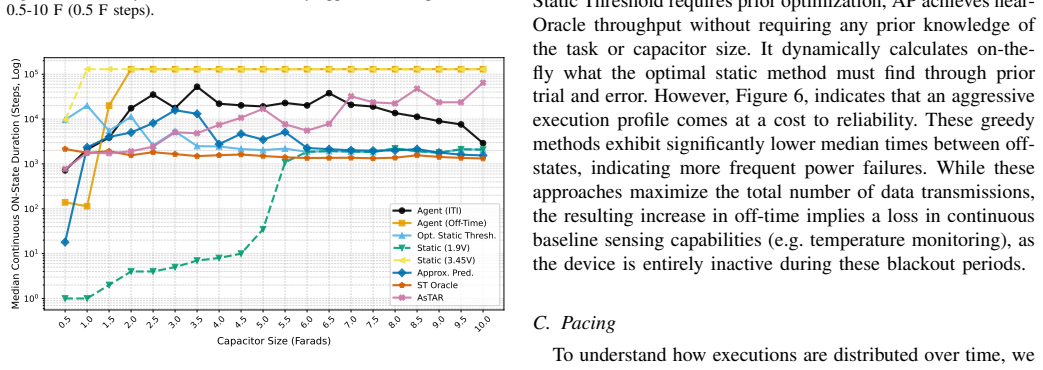
By treating workloads as black boxes with no prior energy information, the approximated prediction method delivers lightweight near-oracle task throughput, the reinforcement learning agent provides tunable survival-execution balancing, and AsTAR excels at execution pacing across long energy gaps, while static policies are efficient for devices with larger energy buffers.
What carries the argument
Model-free reinforcement learning agent and on-the-fly approximated prediction method for dynamic scheduling without hardware-specific profiles or workload energy data.
If this is right
- The AP approach achieves near-oracle task throughput with low computational cost.
- The RL agent allows balancing between device survival and task execution via tunable parameters.
- AsTAR provides effective execution pacing during extended periods of low energy availability.
- Advanced dynamic strategies become necessary only for systems with small capacitors, while larger energy buffers can rely on static policies.
Where Pith is reading between the lines
- The black-box treatment of workloads could apply to other energy-harvesting systems that lack pre-measured task profiles.
- A hybrid scheduler combining AP for throughput with RL for survival tuning might reduce the need to choose one method exclusively.
- If the simulation matches real hardware, the results imply that static policies can be deployed immediately on devices with larger buffers to save computation.
Load-bearing premise
The custom simulation framework driven by real-world solar data accurately captures the dynamics of real batteryless IoT hardware when workloads are treated as black boxes.
What would settle it
Direct experiments on physical batteryless IoT hardware under real solar conditions that compare actual task throughput and survival rates against the simulation results for the AP and RL schedulers.
Figures




read the original abstract
In recent years, the Internet of Things (IoT) paradigm has been shifting toward batteryless, energy-harvesting architectures. Sustaining reliable operation in these systems requires intelligent management of highly volatile stored energy. As edge applications grow in complexity, traditional energy-aware schedulers struggle with unpredictable workloads due to their reliance on static execution thresholds or pre-measured, hardware-specific task profiles. To overcome this, we propose two novel, hardware-agnostic dynamic scheduling strategies treating applications as a "black box," requiring no prior energy information: a model-free Reinforcement Learning (RL) agent and an on-the-fly Approximated Prediction (AP) method. We evaluate these methods against an adaptive task rate approach (AsTAR) and optimized static thresholds using a custom-built, physically accurate simulation framework driven by real-world solar data and dynamic LoRa transmission profiles. Rather than claiming universal superiority, our analysis exposes the distinct operational trade-offs of each method: the AP approach delivers lightweight, near-oracle task throughput; the RL agent provides tunable survival-execution balancing; and AsTAR excels at execution pacing across long energy gaps. Finally, we demonstrate that while these advanced strategies provide critical resilience for severely constrained systems with small capacitors, devices with larger energy buffers can efficiently rely on simpler, less computationally expensive static policies.
Editorial analysis
A structured set of objections, weighed in public.
Referee Report
Summary. The paper proposes two hardware-agnostic dynamic scheduling strategies for batteryless IoT with unknown (black-box) workloads: a model-free RL agent and an on-the-fly Approximated Prediction (AP) method. These are compared in a custom simulation driven by real solar traces and dynamic LoRa profiles against AsTAR and optimized static thresholds; the analysis highlights distinct trade-offs (AP near-oracle throughput, RL tunable survival-execution balance, AsTAR pacing across gaps) and concludes that advanced methods are needed only for small capacitors while static policies suffice for larger buffers.
Significance. If the simulation framework is shown to be faithful to hardware, the work would usefully inform policy selection by energy-buffer size in energy-harvesting IoT and demonstrate that hardware-agnostic methods can be lightweight. The explicit focus on operational trade-offs rather than universal superiority is a constructive framing.
major comments (2)
- [Abstract and Evaluation section] Abstract and Evaluation section: the repeated claim that the simulation is 'physically accurate' is not supported by any hardware-in-the-loop validation, sensitivity analysis to capacitor leakage, DC-DC conversion losses, or direct comparison against measured voltage traces. Because all quantitative trade-offs and the capacitor-size recommendation rest on this unvalidated simulator, the central claims cannot be assessed.
- [Methods and Evaluation sections] Methods and Evaluation sections: the black-box workload assumption (no prior energy profiles) is load-bearing for the hardware-agnostic claim, yet the paper provides no ablation or sensitivity test showing how mismatches between the simulated LoRa transmission energy model and real hardware would affect the reported AP/RL/AsTAR rankings.
minor comments (1)
- Notation for the RL reward function and the AP prediction horizon should be defined once in a single location rather than re-introduced in multiple places.
Simulated Author's Rebuttal
We thank the referee for their insightful comments, which help improve the clarity and rigor of our work. We address each major comment point by point below.
read point-by-point responses
-
Referee: [Abstract and Evaluation section] Abstract and Evaluation section: the repeated claim that the simulation is 'physically accurate' is not supported by any hardware-in-the-loop validation, sensitivity analysis to capacitor leakage, DC-DC conversion losses, or direct comparison against measured voltage traces. Because all quantitative trade-offs and the capacitor-size recommendation rest on this unvalidated simulator, the central claims cannot be assessed.
Authors: We concur that the simulation lacks explicit hardware validation. The 'physically accurate' phrasing is not backed by HIL tests or sensitivity to leakage and losses. We will revise the abstract and evaluation sections to replace 'physically accurate' with 'trace-driven' and include a new paragraph on simulator limitations, including the lack of direct voltage trace comparisons. This will ensure the capacitor-size recommendations are presented with appropriate caveats. revision: yes
-
Referee: [Methods and Evaluation sections] Methods and Evaluation sections: the black-box workload assumption (no prior energy profiles) is load-bearing for the hardware-agnostic claim, yet the paper provides no ablation or sensitivity test showing how mismatches between the simulated LoRa transmission energy model and real hardware would affect the reported AP/RL/AsTAR rankings.
Authors: The black-box assumption underpins the hardware-agnostic methods. While the LoRa profiles are dynamic and based on real measurements, we did not conduct sensitivity tests for model mismatches. We will perform and include such an ablation in the revised evaluation section by introducing controlled perturbations to the energy model and reporting the impact on method rankings, thereby strengthening the hardware-agnostic claim. revision: yes
Circularity Check
No circularity: claims rest on comparative simulation of proposed schedulers
full rationale
The paper proposes RL and AP schedulers for black-box workloads and evaluates them via simulation against baselines. No derivation chain, equations, or fitted parameters are presented that reduce to the inputs by construction. The evaluation framework is external to the methods themselves and is not claimed to be derived from the results. No self-citation load-bearing steps or ansatz smuggling appear in the provided text. The central claims are empirical performance comparisons, which are self-contained against the simulation benchmark.
Axiom & Free-Parameter Ledger
Reference graph
Works this paper leans on
-
[1]
(2024) State of iot 2024: Number of connected iot devices growing 13% to 18.8 billion globally
IoT Analytics. (2024) State of iot 2024: Number of connected iot devices growing 13% to 18.8 billion globally. Accessed on 22 August 2025. [Online]. Available: https://iot-analytics.com/number-connected-iot-devices/
2024
-
[2]
A review on battery market trends, second-life reuse, and recycling,
Y . Zhao, O. Pohl, A. I. Bhatt, G. E. Collis, P. J. Mahon, T. Rüther, and A. F. Hollenkamp, “A review on battery market trends, second-life reuse, and recycling,”Sustainable Chemistry, vol. 2, no. 1, p. 11, 2021
2021
-
[3]
Ambient iot: Redefining wireless communication for industry 4.0,
3GPP, “Ambient iot: Redefining wireless communication for industry 4.0,” https://www.3gpp.org/technologies/anbient-iot-tsdsi, 3rd Genera- tion Partnership Project (3GPP), Tech. Rep., 2025, accessed on 22 August 2025
2025
-
[4]
A comparative review of lead-acid, lithium-ion and ultra-capacitor technologies and their degradation mech- anisms,
A. Townsend and R. Gouws, “A comparative review of lead-acid, lithium-ion and ultra-capacitor technologies and their degradation mech- anisms,”Energies, vol. 15, no. 13, p. 4930, 2022
2022
-
[5]
Astar: Sustainable energy harvesting for the internet of things through adaptive task scheduling,
F. Yang, A. S. Thangarajan, G. S. Ramachandran, W. Joosen, and D. Hughes, “Astar: Sustainable energy harvesting for the internet of things through adaptive task scheduling,”ACM Trans. Sen. Netw., vol. 18, no. 1, Oct. 2021. [Online]. Available: https: //doi.org/10.1145/3467894
-
[6]
Mementos: System Support for Long-Running Computation on RFID-Scale Devices,
B. Ransford, J. Sorber, and K. Fu, “Mementos: System Support for Long-Running Computation on RFID-Scale Devices,” inProceedings of the 16th International Conference on Architectural Support for Programming Languages and Operating Systems (ASPLOS). ACM, 2011, pp. 159–170
2011
-
[7]
Alpaca: intermittent execution without checkpoints,
K. Maeng, A. Colin, and B. Lucia, “Alpaca: intermittent execution without checkpoints,”Proc. ACM Program. Lang., vol. 1, no. OOPSLA, Oct. 2017. [Online]. Available: https://doi.org/10.1145/3133920
-
[8]
A Reconfigurable Energy Storage Architecture for Energy-Harvesting Devices,
A. Colin, E. Ruppel, and B. Lucia, “A Reconfigurable Energy Storage Architecture for Energy-Harvesting Devices,” inProceedings of the 23rd International Conference on Architectural Support for Programming Languages and Operating Systems (ASPLOS). ACM, 2018, pp. 767– 781
2018
-
[9]
Ink: Reactive kernel for tiny batteryless sensors,
K. S. Yıldırım, A. Y . Majid, D. Patoukas, K. Schaper, P. Pawelczak, and J. Hester, “Ink: Reactive kernel for tiny batteryless sensors,” in Proceedings of the 16th ACM Conference on Embedded Networked Sensor Systems, ser. SenSys ’18. New York, NY , USA: Association for Computing Machinery, 2018, p. 41–53. [Online]. Available: https://doi.org/10.1145/32747...
-
[10]
Power Manage- ment in Energy Harvesting Sensor Networks,
A. Kansal, J. Hsu, S. Zahedi, and M. B. Srivastava, “Power Manage- ment in Energy Harvesting Sensor Networks,”ACM Transactions on Embedded Computing Systems (TECS), vol. 6, no. 4, pp. 32–es, 2007
2007
-
[11]
A. Cammarano, C. Petrioli, and D. Spenza, “Pro-energy: A novel energy prediction model for solar and wind energy-harvesting wireless sensor networks,” inProceedings of the 2012 IEEE 9th International Conference on Mobile Ad-Hoc and Sensor Systems (MASS), ser. MASS ’12. USA: IEEE Computer Society, 2012, p. 75–83. [Online]. Available: https://doi.org/10.110...
-
[12]
Adaptive power management in energy harvesting systems,
C. Moser, L. Thiele, D. Brunelli, and L. Benini, “Adaptive power management in energy harvesting systems,” in2007 Design, Automation & Test in Europe Conference & Exhibition, 2007, pp. 1–6
2007
-
[13]
Foundations for energy-aware zero-energy devices: From energy sensing to adaptive protocols,
O. L. A. López, M. Ashraf, S. Nasser, G. M. de Jesus, R. K. Singh, M. C. Filippou, and J. Famaey, “Foundations for energy-aware zero-energy devices: From energy sensing to adaptive protocols,” 2025. [Online]. Available: https://arxiv.org/abs/2507.22740
-
[14]
An Energy-Aware Task Scheduler for Energy-Harvesting Batteryless IoT Devices,
A. Sabovic, A. K. Sultania, C. Delgado, L. D. Roeck, and J. Famaey, “An Energy-Aware Task Scheduler for Energy-Harvesting Batteryless IoT Devices,”IEEE Internet of Things Journal, vol. 9, no. 22, pp. 23 097–23 114, Nov. 2022. [Online]. Available: https: //ieeexplore.ieee.org/document/9803046/
-
[15]
A new energy prediction algorithm for energy-harvesting wireless sensor networks with q-learning,
S. Kosunalp, “A new energy prediction algorithm for energy-harvesting wireless sensor networks with q-learning,”IEEE Access, vol. 4, pp. 5755–5763, 2016
2016
-
[16]
Reinforcement learning- based dynamic power management for energy harvesting wireless sensor network,
R. Chaoming Hsu, C.-T. Liu, and W.-M. Lee, “Reinforcement learning- based dynamic power management for energy harvesting wireless sensor network,” inNext-Generation Applied Intelligence, B.-C. Chien, T.-P. Hong, S.-M. Chen, and M. Ali, Eds. Berlin, Heidelberg: Springer Berlin Heidelberg, 2009, pp. 399–408
2009
-
[17]
Rlman: An energy manager based on reinforcement learning for energy harvesting wireless sensor networks,
F. Ait Aoudia, M. Gautier, and O. Berder, “Rlman: An energy manager based on reinforcement learning for energy harvesting wireless sensor networks,”IEEE Transactions on Green Communications and Network- ing, vol. 2, no. 2, pp. 408–417, 2018
2018
-
[18]
Deep reinforcement learning resource allocation in wireless sensor networks with energy harvesting and relay,
B. Zhao and X. Zhao, “Deep reinforcement learning resource allocation in wireless sensor networks with energy harvesting and relay,”IEEE Internet of Things Journal, vol. 9, no. 3, pp. 2330–2345, 2022
2022
-
[20]
Proximal Policy Optimization Algorithms
[Online]. Available: https://arxiv.org/abs/1707.06347
work page internal anchor Pith review Pith/arXiv arXiv
-
[21]
SMPS, STMicroelectronics, 2022, rev 9, Accessed: March 10, 2026
STMicroelectronics,STM32L412xx Datasheet: Ultra-low-power Arm Cortex-M4 32-bit MCU+FPU, 100DMIPS, up to 128KB flash, 40KB SRAM, analog, ext. SMPS, STMicroelectronics, 2022, rev 9, Accessed: March 10, 2026. [Online]. Available: https://www.st.com/resource/en/ datasheet/stm32l412kb.pdf
2022
-
[22]
[Online]
Sensirion AG,Datasheet SHT3x-DIS: Humidity and Temperature Sensor, Sensirion AG, December 2022, version 7, Accessed: March 10, 2026. [Online]. Available: https://sensirion.com/media/documents/ 213E6A3B/63A5A569/Datasheet_SHT3x_DIS.pdf
2022
-
[23]
[Online]
Semtech Corporation,SX1261/2 Datasheet: Long Range, Low Power, sub-GHz RF Transceiver, Semtech Corporation, 2020, accessed: March 10, 2026. [Online]. Available: https://www.semtech.com/products/ wireless-rf/lora-connect/sx1262
2020
-
[24]
Adaptive data rate (ADR),
The Things Network, “Adaptive data rate (ADR),” 2026, accessed: March 10, 2026. [Online]. Available: https://www.thethingsnetwork.org/ docs/lorawan/adaptive-data-rate/
2026
-
[25]
DGH Series Supercapacitor Datasheet,
Cornell Dubilier Electronics, “DGH Series Supercapacitor Datasheet,” Cornell Dubilier Electronics, Datasheet, 2024, accessed: 2026-03-16. [Online]. Available: https://www.cde.com/resources/catalogs/DGH.pdf 13
2024
-
[26]
Stable-baselines3: Reliable reinforcement learning implementations,
A. Raffin, A. Hill, A. Gleave, A. Kanervisto, M. Ernestus, and N. Dormann, “Stable-baselines3: Reliable reinforcement learning implementations,”Journal of Machine Learning Research, vol. 22, no. 268, pp. 1–8, 2021. [Online]. Available: http://jmlr.org/papers/v22/ 20-1364.html Samer NasserReceived his B.Sc. and M.Sc degrees in Electronics and ICT Engineeri...
2021
discussion (0)
Sign in with ORCID, Apple, or X to comment. Anyone can read and Pith papers without signing in.