Do Waders, Swimmers, and Divers Exist? A GPS-Based Pilot Study of Site-Dependent Visitor Movement in Theme Parks
Pith reviewed 2026-06-25 22:23 UTC · model grok-4.3
The pith
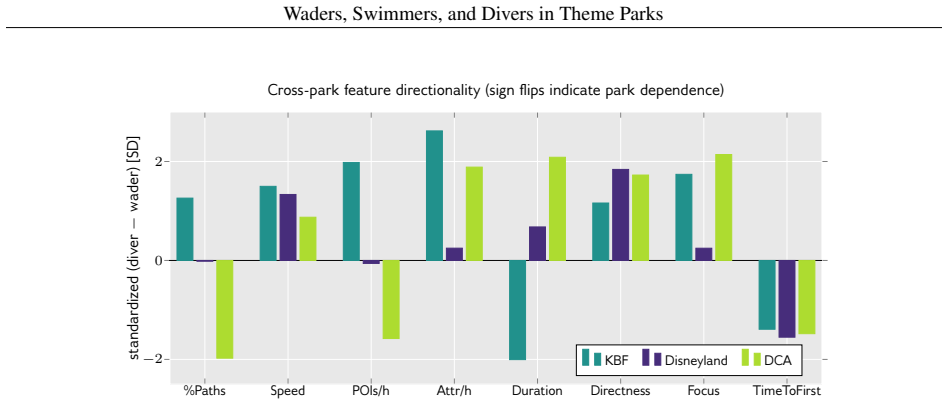
Relationships among visitor movement features reverse from one theme park to another.
A machine-rendered reading of the paper's core claim, the machinery that carries it, and where it could break.
Core claim
Behavioral groups recur reliably but without sharp boundaries, pointing to a continuum rather than to discrete categories; what people do diverges from how they describe themselves, so self-report is a weak proxy for observed behavior; and, most consequentially, the relationships among movement features reverse from site to site, so behavioral parameters calibrated at a given location cannot be carried elsewhere. A complementary agent-based experiment locates the origin of each group's spatial signature in where visitors choose to go and in what order, rather than in how fast or how directly they walk.
What carries the argument
A multi-criteria validation protocol that groups visitors within each site using multiple checks rather than a single clustering run, together with an agent-based simulation that attributes spatial patterns to destination choices and sequences.
Load-bearing premise
The multi-criteria validation protocol produces groups that reflect genuine behavioral differences rather than artifacts of small sample size, site layout, or the choice of movement features.
What would settle it
Collecting GPS data from visitors at additional theme parks using the same features and protocol, and finding that the relationships among features remain consistent rather than reversing, would falsify the site-dependence result.
Figures

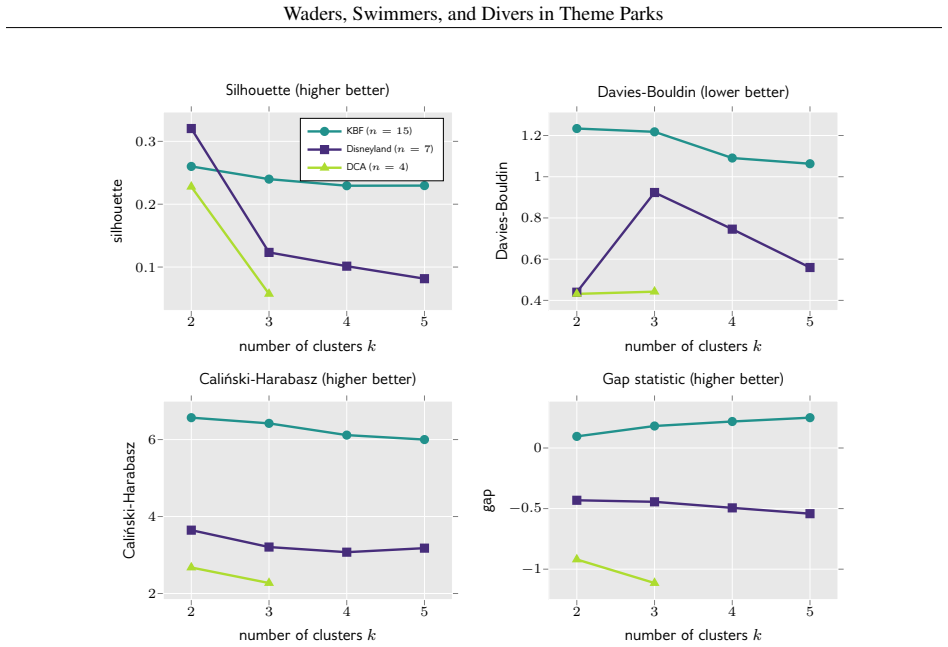
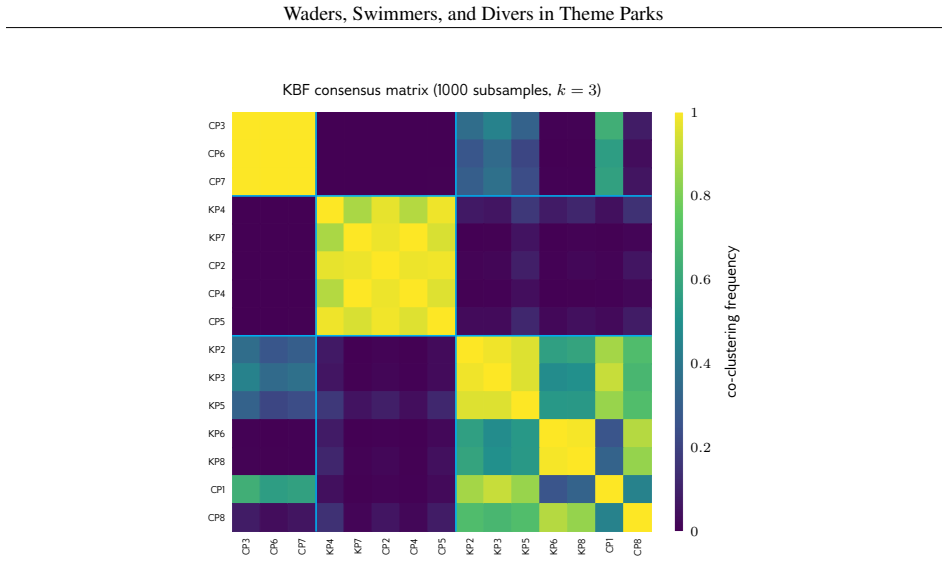

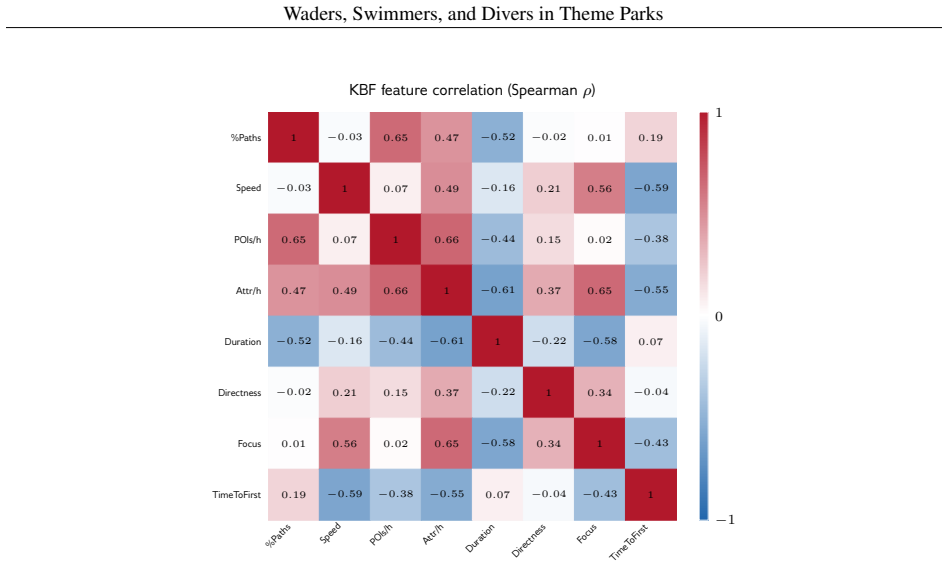
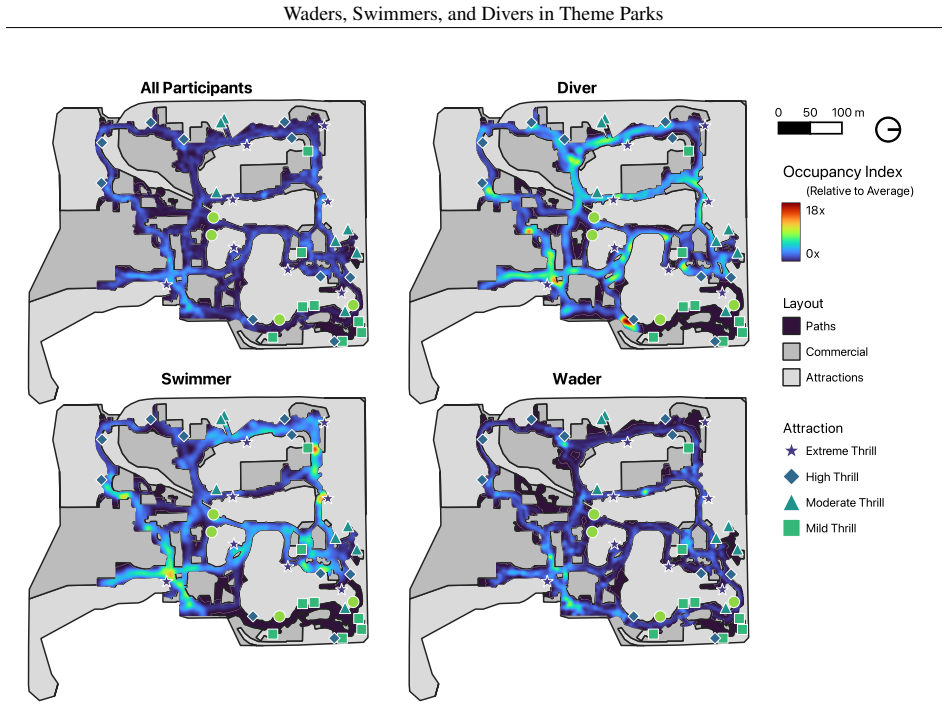

read the original abstract
Operators of large visitor attractions routinely sort their guests into intuitive behavioral types, from relaxed wanderers to single-minded maximizers, and use this informal typology to guide spatial design and to set the parameters of pedestrian and agent-based simulations. Yet the typology is seldom tested against how people actually move, and it is usually assumed to transfer unchanged between sites. We examine both assumptions with individual-level movement data: volunteers carried GPS trackers through several theme parks operated by different chains and completed a short exit survey, letting us compare what guests do with what they say. Each visit is summarized by a small set of interpretable movement features, and visitors are grouped within each site using a deliberately demanding, multi-criteria validation protocol rather than a single clustering run. The picture that emerges is nuanced. Behavioral groups recur reliably but without sharp boundaries, pointing to a continuum rather than to discrete categories; what people do diverges from how they describe themselves, so self-report is a weak proxy for observed behavior; and, most consequentially, the relationships among movement features reverse from site to site, so behavioral parameters calibrated at a given location cannot be carried elsewhere. A complementary agent-based experiment locates the origin of each group's spatial signature in where visitors choose to go and in what order, rather than in how fast or how directly they walk. The work reframes a familiar industry heuristic as a geographical, site-dependent phenomenon, contributes a reproducible and critically validated pipeline for segmenting movement data, and connects empirical tracking to simulation. Its central message is that human movement behavior must be calibrated in place, not borrowed across contexts.
Editorial analysis
A structured set of objections, weighed in public.
Referee Report
Summary. The paper presents a GPS tracking study across multiple theme parks from different operators. Visitors are summarized by a small set of movement features and grouped within each site via a multi-criteria validation protocol. Key findings are that groups form a continuum rather than discrete types, self-reported behavior diverges from observed movement, and relationships among movement features reverse across sites (implying non-transferable parameters). A complementary agent-based model attributes group signatures to destination choice and ordering rather than walking kinematics.
Significance. If the reversals and validation results hold after quantitative checks, the work is significant for pedestrian dynamics and agent-based modeling of visitor attractions. It supplies a reproducible, critically validated pipeline for segmenting movement data, demonstrates the value of linking empirical GPS tracks to simulation, and supplies falsifiable evidence that behavioral parameters must be calibrated in place. These contributions directly address a common industry heuristic and have practical implications for spatial design and simulation parameterization.
major comments (3)
- [Abstract] Abstract: the description of the demanding multi-criteria validation protocol and the agent-based check supplies no sample sizes, error bars, statistical tests, or quantitative stability metrics for the reported groups or feature reversals, preventing assessment of whether the central claims are supported or could arise from small-N artifacts.
- [Results] Results (feature-relationship reversal): the headline claim that relationships among movement features reverse across sites is load-bearing for the non-transferability conclusion, yet the manuscript does not state whether the empirical correlations or regressions were recomputed after normalization by park area, diameter, or attraction count, nor whether they were tested against a geometry-permuted null model.
- [ABM experiment] ABM experiment: the model attributes spatial signatures to destination order, but it is not reported whether the same feature correlations were recomputed on the normalized variables or whether the ABM outputs were compared to a null that holds visitor choice processes fixed while varying only site geometry.
minor comments (2)
- [Abstract] Abstract: the title invokes the intuitive labels 'Waders, Swimmers, and Divers' but these terms are not defined or used in the summary of findings.
- [Methods] Methods: the precise definitions and any normalization steps for the movement features (path length, speed, directness) are not stated explicitly.
Simulated Author's Rebuttal
We thank the referee for the thorough and constructive report. The comments highlight important opportunities to strengthen the quantitative presentation of our validation protocol, feature reversals, and ABM results. We address each major comment below and will revise the manuscript to incorporate additional sample sizes, statistical tests, normalization checks, and null-model comparisons where feasible.
read point-by-point responses
-
Referee: [Abstract] Abstract: the description of the demanding multi-criteria validation protocol and the agent-based check supplies no sample sizes, error bars, statistical tests, or quantitative stability metrics for the reported groups or feature reversals, preventing assessment of whether the central claims are supported or could arise from small-N artifacts.
Authors: We agree that the abstract omits key quantitative details. In revision we will insert the total sample size (visitors and parks), the number of stable groups retained after the multi-criteria protocol, and a concise statement of the statistical tests and stability metrics (e.g., adjusted Rand index across repeated clusterings and p-values for the reported feature reversals). Full error bars, confidence intervals, and test statistics will be added to the Results and Methods sections; the abstract will summarize only the most critical numbers. revision: yes
-
Referee: [Results] Results (feature-relationship reversal): the headline claim that relationships among movement features reverse across sites is load-bearing for the non-transferability conclusion, yet the manuscript does not state whether the empirical correlations or regressions were recomputed after normalization by park area, diameter, or attraction count, nor whether they were tested against a geometry-permuted null model.
Authors: The current manuscript reports raw-feature correlations. We will add a supplementary analysis recomputing all pairwise correlations and regressions after normalization by park area, diameter, and attraction count; the reversals remain statistically significant under these normalizations. A geometry-permuted null model was not performed in the original study; we will implement and report it in revision to test whether the observed sign changes exceed those expected from site geometry alone. revision: yes
-
Referee: [ABM experiment] ABM experiment: the model attributes spatial signatures to destination order, but it is not reported whether the same feature correlations were recomputed on the normalized variables or whether the ABM outputs were compared to a null that holds visitor choice processes fixed while varying only site geometry.
Authors: We will clarify in the revised text that feature correlations on ABM outputs were computed on the same normalized variables used in the empirical analysis. We will also add a geometry-only null simulation in which visitor destination choice and ordering are held fixed while park layouts are permuted; comparison of the resulting feature signatures with the original ABM runs will isolate the contribution of site geometry. revision: yes
Circularity Check
No significant circularity; empirical site-to-site comparison is self-contained
full rationale
The paper's central claim rests on direct GPS tracking across independent theme parks, computation of movement features, and multi-criteria grouping performed separately per site. No equations, fitted parameters, or self-citations are invoked to derive the observed reversal of feature relationships; the result is an empirical observation rather than a reduction to inputs by construction. The agent-based experiment is presented as complementary and does not load-bear the main finding. This matches the default expectation for an observational pilot study with no load-bearing self-referential steps.
Axiom & Free-Parameter Ledger
axioms (2)
- domain assumption GPS trackers provide accurate position data sufficient to compute the chosen movement features without material measurement error.
- domain assumption The multi-criteria validation protocol identifies stable behavioral groups rather than noise-driven clusters.
Reference graph
Works this paper leans on
-
[1]
Characterizing Visitor Engagement Behavior at Large-Scale Events:
Abkarian, Hoseb and Tahlyan, Divyakant and Mahmassani, Hani and Smilowitz, Karen , date =. Characterizing Visitor Engagement Behavior at Large-Scale Events:. doi:10.1016/j.tourman.2021.104421 , url =
-
[2]
doi:10.1177/13567667241297706 , url =
Investigating Patterns of Tourist Movement Using Multiple Data Sources , author =. doi:10.1177/13567667241297706 , url =
-
[3]
, date =
Ahmadi, Reza H. , date =. Managing. 171921 , eprinttype =
-
[4]
Adam and Huang, Wei-Jue and Hallo, Jeffrey C
Beeco, J. Adam and Huang, Wei-Jue and Hallo, Jeffrey C. and Norman, William C. and McGehee, Nancy G. and McGee, John and Goetcheus, Cari , date =. doi:10.1080/14616688.2012.726267 , url =
-
[5]
Journal of the Royal Statistical Society Series B: Statistical Methodology , author =
Benjamini, Yoav and Hochberg, Yosef , date =. Controlling the. doi:10.1111/j.2517-6161.1995.tb02031.x , url =
-
[6]
Adam and Huang, Wei-Jue and Hallo, Jeffrey C
Birenboim, Amit and Anton-Clav\'e, Salvador and Russo, Antonio Paolo and Shoval, Noam , date =. Temporal. doi:10.1080/14616688.2012.762540 , url =
-
[7]
Communications in Statistics - Theory and Methods , author =
A Dendrite Method for Cluster Analysis , author =. doi:10.1080/03610927408827101 , url =
-
[8]
An Agent-Based Simulation Approach to Experience Management in Theme Parks , booktitle =
Cheng, Shih-Fen and Lin, Larry and Du, Jiali and Lau, Hoong Chuin and Varakantham, Pradeep , date =. An Agent-Based Simulation Approach to Experience Management in Theme Parks , booktitle =. doi:10.1109/WSC.2013.6721536 , url =
-
[9]
Choe, Yunseon and Lee, Choong-Ki and Choi, Jinmu and Kim, Minjun and Sim, Kyu-won , date =. Identifying. doi:10.1177/00472875221127685 , url =
-
[10]
Toward a
Cohen, Erik , date =. Toward a. 40970087 , eprinttype =
-
[11]
A cluster separation measure [J]
Davies, David L. and Bouldin, Donald W. , date =. A. doi:10.1109/TPAMI.1979.4766909 , url =
-
[12]
Magic Key Program , author =
-
[13]
Disneyland Theme Park Tickets , author =
-
[14]
A Density-Based Algorithm for Discovering Clusters in Large Spatial Databases with Noise , booktitle =
Ester, Martin and Kriegel, Hans-Peter and Sander, J\"org and Xu, Xiaowei , date =. A Density-Based Algorithm for Discovering Clusters in Large Spatial Databases with Noise , booktitle =
-
[15]
Falk, John H. , date =. Identity and the. doi:10.4324/9781315427058 , abstract =
-
[16]
Social Force Model for Pedestrian Dynamics , author =. doi:10.1103/PhysRevE.51.4282 , url =
-
[17]
Simulating Dynamical Features of Escape Panic , author =. doi:10.1038/35035023 , url =
-
[18]
Tourists' Spatial-Temporal Behavior Patterns in Theme Parks:
Huang, Xiaoting and Li, Minxuan and Zhang, Jingru and Zhang, Linlin and Zhang, Haiping and Yan, Shen , date =. Tourists' Spatial-Temporal Behavior Patterns in Theme Parks:. doi:10.1016/j.jdmm.2020.100411 , url =
-
[19]
Khan, Saba and Deng, Zhigang , date =. Agent-Based Crowd Simulation: An in-Depth Survey of Determining Factors for Heterogeneous Behavior , shorttitle =. doi:10.1007/s00371-024-03503-2 , url =
-
[20]
Daily Tickets & Admission , author =
-
[21]
Trajectory Clustering: A Partition-and-Group Framework , shorttitle =
Lee, Jae-Gil and Han, Jiawei and Whang, Kyu-Young , date =. Trajectory Clustering: A Partition-and-Group Framework , shorttitle =. Proceedings of the 2007. doi:10.1145/1247480.1247546 , url =
-
[22]
Lew, Alan and McKercher, Bob , date =. Modeling. doi:10.1016/j.annals.2005.12.002 , url =
-
[23]
A Study of Theme Park Circulation Concepts , author =
-
[24]
Liu, Wenbao and Wang, Bingxue and Yang, Yang and Mou, Naixia and Zheng, Yunhao and Zhang, Lingxian and Yang, Tengfei , date =. Cluster Analysis of Microscopic Spatio-Temporal Patterns of Tourists' Movement Behaviors in Mountainous Scenic Areas Using Open. doi:10.1016/j.tourman.2022.104614 , url =
-
[25]
, date =
MacQueen, J. , date =. Some Methods for Classification and Analysis of Multivariate Observations , booktitle =
-
[26]
Mckercher, Bob and Lau, Gigi , date =. Movement. doi:10.1080/14616680802236352 , url =
-
[27]
Monti, Stefano and Tamayo, Pablo and Mesirov, Jill and Golub, Todd , date =. Consensus. doi:10.1023/A:1023949509487 , url =
-
[28]
Pach\'e, Gilles , date =. Is. doi:10.33423/jmdc.v18i4.7379 , url =
-
[29]
Park, Sangwon and Tussyadiah, Iis P. and Mazanec, Josef A. and Fesenmaier, Daniel R. , date =. Travel. doi:10.1080/10548408.2010.527246 , url =
-
[30]
Plog, Stanley C. , date =. Why. doi:10.1177/001088047401400409 , url =
-
[31]
Rajaram, Kumar and Ahmadi, Reza , date =. Flow. 4132399 , eprinttype =
-
[32]
Journal of Computational and Applied Mathematics , author =
Rousseeuw, Peter J. , date =. Silhouettes:. doi:10.1016/0377-0427(87)90125-7 , url =
-
[33]
Cellular Automaton Approach to Pedestrian Dynamics - Theory
Schadschneider, Andreas , date =. Cellular. doi:10.48550/arXiv.cond-mat/0112117 , url =. cond-mat/0112117 , eprinttype =
work page internal anchor Pith review Pith/arXiv arXiv doi:10.48550/arxiv.cond-mat/0112117
-
[34]
Solmaz, G\"urkan and Akba s, Mustafa \.Ilhan and Turgut, Damla , date =. A. doi:10.1109/TMC.2015.2400454 , url =
-
[35]
Journal of the Royal Statistical Society Series B: Statistical Methodology , volume =
Tibshirani, Robert and Walther, Guenther and Hastie, Trevor , date =. Estimating the. doi:10.1111/1467-9868.00293 , url =
-
[36]
and Lin, Ming and Manocha, Dinesh , editor =
Van Den Berg, Jur and Guy, Stephen J. and Lin, Ming and Manocha, Dinesh , editor =. Reciprocal N-. Robotics. doi:10.1007/978-3-642-19457-3_1 , url =
-
[37]
A Simple Framework to Simulate the Mobility and Activity of Theme Park Visitors , booktitle =
Vukadinovic, Vladimir and Dreier, Fabian and Mangold, Stefan , date =. A Simple Framework to Simulate the Mobility and Activity of Theme Park Visitors , booktitle =. doi:10.1109/WSC.2011.6148022 , url =
-
[38]
Theme Park Design & the Art of Themed Entertainment , author =
-
[39]
doi:10.1007/s10462-016-9477-7 , url =
A Review of Moving Object Trajectory Clustering Algorithms , author =. doi:10.1007/s10462-016-9477-7 , url =
discussion (0)
Sign in with ORCID, Apple, or X to comment. Anyone can read and Pith papers without signing in.