pith. machine review for the scientific record. sign in

physics.soc-ph

Physics and Society

Structure, dynamics and collective behavior of societies and groups (human or otherwise). Quantitative analysis of social networks and other complex networks. Physics and engineering of infrastructure and systems of broad societal impact (e.g., energy grids, transportation networks).

0
physics.soc-ph 2026-05-13 Recognition

Environment drives 27-134 times more outcome variance than traits

Empirical Confirmation of the Environmental-Dominance Inequality A direct decomposition of Var(ln r{ho}eff ) across four levels of aggregation

Direct variance breakdown across countries and inside nations shows the environmental-dominance inequality holds at most scales but narrows,
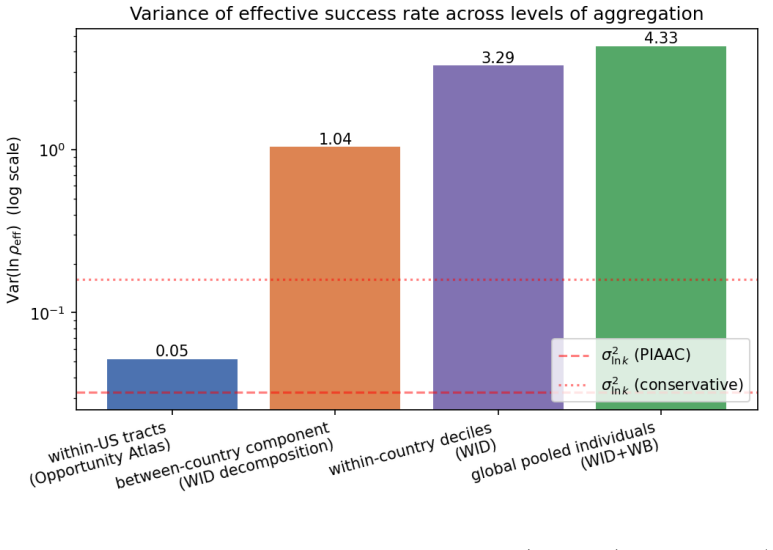
Figure from the paper full image
abstract click to expand
Empirical confirmation of the environmental-dominance inequality Var(ln rho_eff) >> Var(ln k) from arXiv:2605.02985, computed directly from three public datasets (Opportunity Atlas, World Bank GDP per capita PPP, World Inequality Database) at four levels of aggregation: U.S. census tracts, between countries, within-country deciles, and the global pooled-individual distribution. The headline global value Var(ln rho_eff) = 4.33 yields a dominance ratio R in [27, 134] across plausible sigma_ln k in [0.18, 0.40]. The inequality holds with one-to-two orders of magnitude margin at the global and within-country-decile levels, with a single-digit but still dominant margin between countries, and collapses to R in [0.33, 1.61] within already-homogenized U.S. census tracts for income. A 1990-2022 time series shows the global aggregate stable while composition shifts from between-country dispersion (-34%) to within-country dispersion (+26%), consistent with international convergence plus Piketty r > g. Multi-outcome validation shows the inequality is robust for income, infant mortality and incarceration but shrinks toward parity for outcomes targeted by sustained global convergence (life expectancy). Partial-identification and selection-bias bounds (Chetty-style 40-50% selection share) leave R in [14, 80]. All inputs and outputs are SHA-256 hashed in an append-only manifest and fully reproducible from the accompanying notebooks.
0
0
physics.soc-ph 2026-05-13 2 theorems

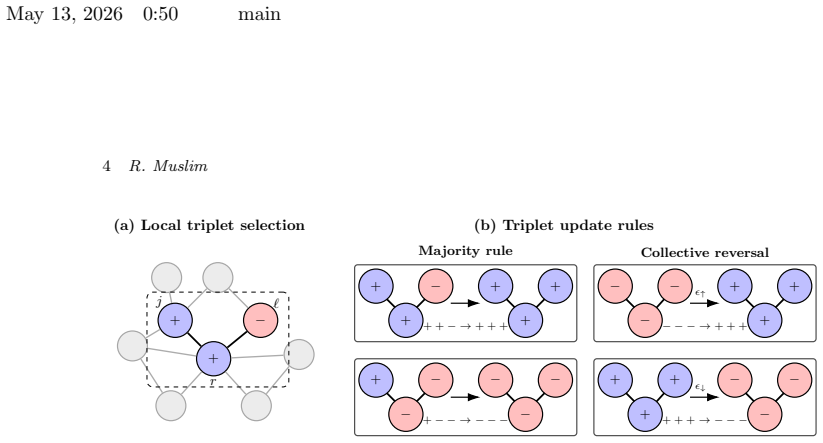
Network topology shifts critical point in triplet opinion model

Topology-dependent criticality in triplet majority-rule dynamics with collective reversal

Clustering lowers the order-disorder transition threshold and alters effective exponents compared with random or scale-free networks.
Figure from the paper full image
abstract click to expand
We study a triplet majority-rule opinion-dynamics model with collective reversal on quenched networks. Interactions occur on local triplets composed of one agent and two of its neighbors, while collective reversal acts only on unanimous triplets. This rule separates local conformity from external perturbations that disrupt local agreement. We show that quenched network topology shifts the order--disorder critical point away from the well-mixed value. For Barab\'asi--Albert, Erd\H{o}s--R\'enyi, and random regular networks, the critical point is shifted while the critical exponents remain close to the mean-field values. By contrast, Watts--Strogatz networks exhibit a much lower critical point and stronger deviations in the effective critical exponents, highlighting the role of clustering and local correlations. A rewiring analysis of Watts--Strogatz networks further shows that the ordered phase becomes more stable as the network becomes more random. These results indicate that quenched topology not only sets the transition point, but also leads to topology-dependent effective critical behavior in networks with strong clustering and local correlations.
0
0
physics.soc-ph 2026-05-12 2 theorems

Caribbean synchrotron breaks even before retirement

Cities of Knowledge and Big Science in Developing Countries: Luxury or Investment? The GCLSI Case

The project needs only a marginal rise in regional science spending and would seed knowledge cities in multiple countries via smaller linked

abstract click to expand
This article analyzes the feasibility of having a second synchrotron in Latin America, to be located, in principle, in a city within the Greater Caribbean region but open to all the continent. It is shown that an initiative of this sort is compatible with the economies of the region and would require a marginal increase of the current regional investment in science, which is broadly below that of other regions of the world, with peaks of low financing precisely in the Greater Caribbean. The project is not only feasible, but, beyond its purely scientific interest. it would have an impact for the development of cities in the region. The article is mainly focused to analyze this impact from the social, economic, and political point of view. It is shown that the return of the investment would have its break-even point long before the end of the expected lifetime of the infrastructure, and that through a system of smaller accelerators, that would be part of the same project, the benefit would not concentrate on the country hosting the facility. These smaller facilities could contribute to the national development as possible nuclei of cities of knowledge, project which belongs to the priority of some countries/cities of the region.
0
0
physics.soc-ph 2026-05-12 Recognition

Physicists' survey finds narrow majorities on many big questions

Big Mysteries Survey: Physicists' Views on Cosmology, Black Holes, Quantum Mechanics, and Quantum Gravity

Positions often called consensus in cosmology and quantum physics turn out to have only pluralities or slim majorities of support.

Figure from the paper full image
abstract click to expand
We present results from the Big Mysteries Survey, a large-scale survey conducted through the American Physical Society's Physics Magazine on foundational and controversial topics in contemporary physics. The survey provides a snapshot of physicists' views on issues in cosmology, black-hole physics, quantum mechanics, quantum gravity, and anthropic coincidences. A central finding is that several positions often described publicly as field-wide ``consensus'' views are, in practice, supported by much narrower majorities or by pluralities rather than majorities.
0
0
physics.soc-ph 2026-05-12 3 theorems

Multi-issue attitude changes exceed random models at fine resolutions

Network-Normative Belief Updating in High-Dimensional Ideological Space

Network analysis of two-wave panel data shows moves toward common bundles are detectable only when attitudes are divided into finer grids.

Figure from the paper full image
abstract click to expand
Most mathematical models of opinion dynamics treat attitudes as scalar quantities or positions on a low-dimensional ideological axis. Empirical attitudes, however, are bundles of positions across many policy issues, and the geometry of the resulting high-dimensional belief space is non-trivial. This paper develops a network-theoretic framework for analysing how individuals move through such a space between two measurement waves. Continuous attitude profiles in $[0,1]^n$ are discretised onto regular grids of resolution $k$, occupied positions form a network whose adjacency is defined by single-issue unit moves, and densely populated regions are interpreted as network-normative: empirically common configurations of attitudes in the population. We introduce a hierarchy of null models against which observed movement can be benchmarked: a closed-form coverage baseline requiring no behavioural parameters; a local random-walk that retains each respondent's baseline position and asks whether destinations are over-represented in occupied regions relative to a uniform 1- or 2-step move; and a marginal permutation null model that preserves per-issue change distributions while disrupting within-respondent cross-issue coupling. Applying the framework to a two-wave panel of $N=1194$ respondents on $n=10$ issues, we find that the observed inside rate exceeds the coverage baseline by a factor of 36 at the focal resolution $k=3$, exceeds the two-hop random-walk null model by $\sim 0.30$, and exceeds the perturbation null model by $\sim 0.04$; only the one-hop random walk is competitive. The perturbation gap grows from near zero at $k=2$ to $\sim 0.14$ at $k=5$, indicating that coupled cross-issue updating is detectable only at fine resolutions. Network-normative attraction is therefore real but representation-contingent: which null model is exceeded, and by how much, changes systematically with $k$.
0
0
physics.soc-ph 2026-05-12 Recognition

Conformity locks aligned AI agents into stable misalignment

Conformity Generates Collective Misalignment in AI Agents Societies

Simulations identify tipping points where few adversarial agents cause lasting population-level shifts that remain after interference stops.

Figure from the paper full image
abstract click to expand
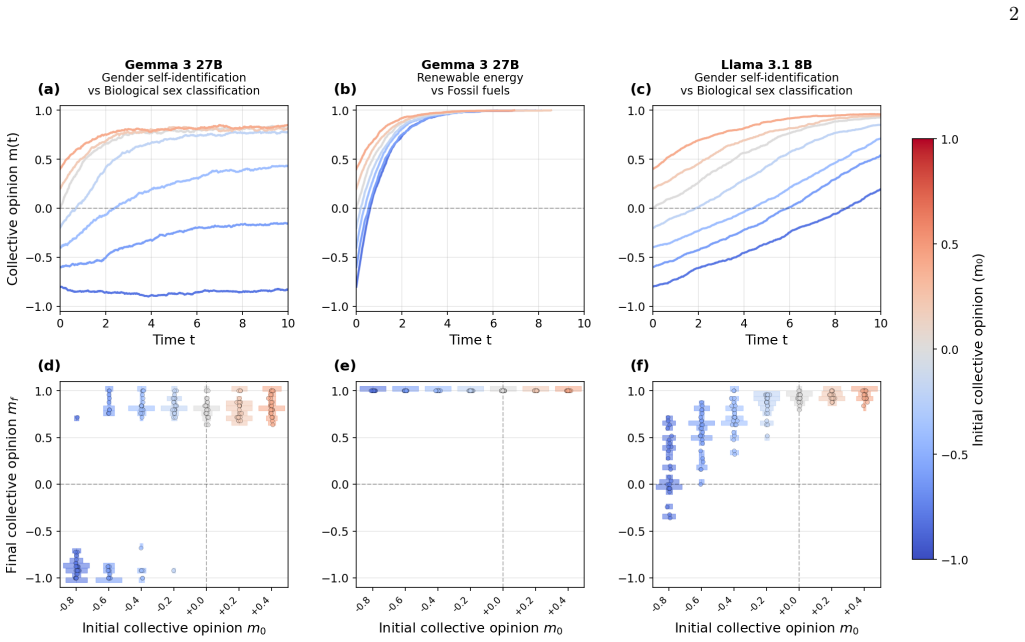
Artificial intelligence safety research focuses on aligning individual language models with human values, yet deployed AI systems increasingly operate as interacting populations where social influence may override individual alignment. Here we show that populations of individually aligned AI agents can be driven into stable misaligned states through conformity dynamics. Simulating opinion dynamics across nine large language models and one hundred opinion pairs, we find that each agent's behavior is governed by two competing forces: a tendency to follow the majority and an intrinsic bias toward specific positions. Using tools from statistical physics, we derive a quantitative theory that predicts when populations become trapped in long-lived misaligned configurations, and identifies predictable tipping points where small numbers of adversarial agents can irreversibly shift population-level alignment even after manipulation ceases. These results demonstrate that individual-level alignment provides no guarantee of collective safety, calling for evaluation frameworks that account for emergent behavior in AI populations.
0
0
physics.soc-ph 2026-05-12 2 theorems

Highest-earner imitation stops fluctuating in large groups

From Discrete to Continuous Highest-earning Imitation Dynamics

Strategy proportions settle almost surely with no perpetual swings once population size tends to infinity.

Figure from the paper full image
abstract click to expand
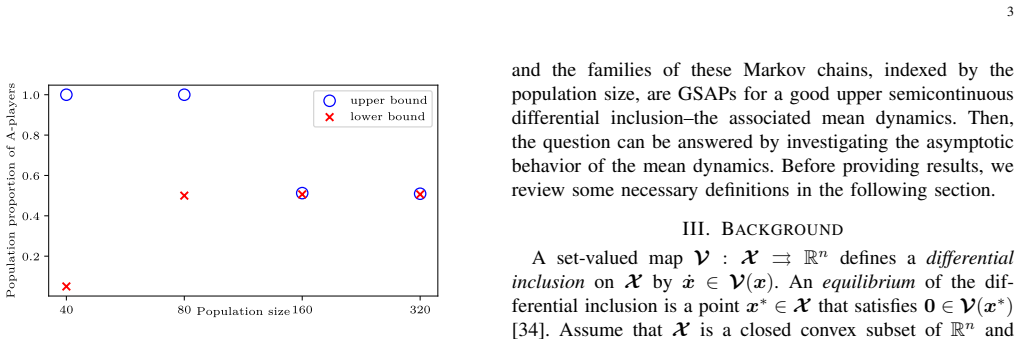
Decision-making by imitating the highest earners has been observed in experimental studies. In two-strategy decision-making problems, this behavior may result in perpetual fluctuations in the population proportions of the two strategies. How these fluctuations evolve for large population sizes remains unclear. This paper addresses this question for a heterogeneous population of players imitating the highest earners. We show that the family of Markov chains describing the discrete population dynamics forms a generalized stochastic approximation process for a good upper semicontinuous differential inclusion--the mean dynamics. Furthermore, we prove that the mean dynamics always equilibrate. Then, by using results from stochastic approximation theory, we show that the amplitudes of fluctuations in the population proportions of the two strategies diminish to zero with probability one, as the population size approaches infinity. Our results suggest that in a well-mixed, large population, imitating the highest earners is unlikely to generate large-scale, perpetual fluctuations.
0
0
physics.soc-ph 2026-05-11 Recognition

Two-party systems reduce polarization even with bimodal voters

A computational model of spatial politics: Hotelling-Downs model as statistical physics

Multiparty competition and extreme turnout push parties outward in a 2D spatial model

Figure from the paper full image
abstract click to expand
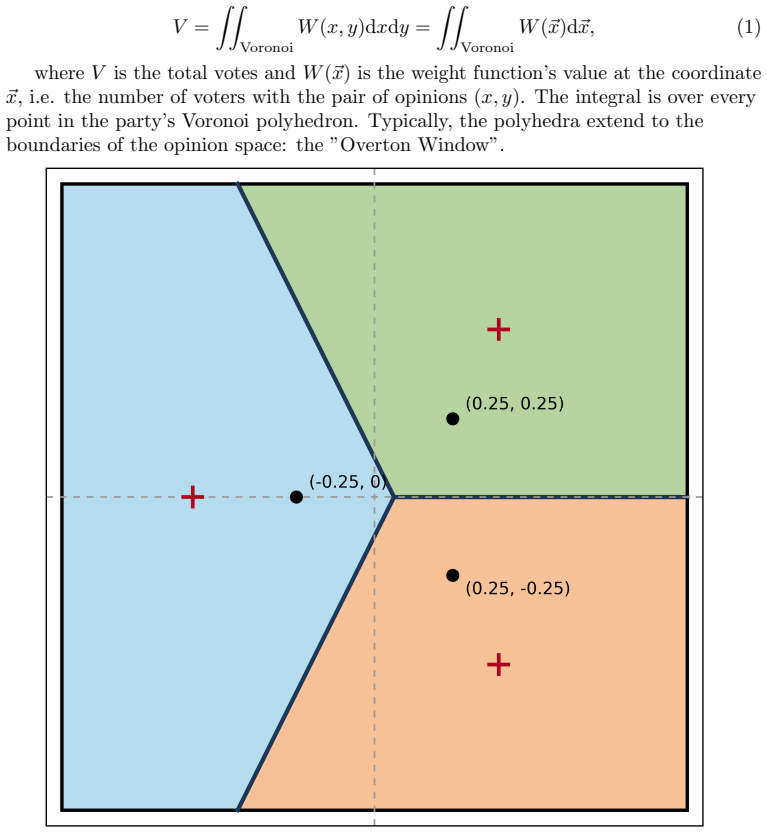
The Hotelling-Downs model considers parties changing policy to maximise their vote-share. Where policy position lies on a left-right axis, it describes a tendency for political parties to move towards centrist platforms. This is in contrast with widely observed political polarisation. We extend the model to two dimensions, with many parties and with single and multiple-peaked voter distribution. We find that a two party system reduces polarisation, even if voters are polarised with a bimodal distribution. By contrast, multiparty systems induce polarisation, even when most voters favour moderate position. We model the effect of turnout and activists as influences on the parties, showing that this results in more polarisation, even in a two-party system. This suggests that polarisation of parties can be driven by abstention, intra-party politics and turnout on the extremes. In the two-party case, the winning party's positions are more moderate than the views of their supporters but better representative of the electorate as a whole. With polarisation, individual voters are better able to find a party which represents their views, but the government (winning part or coalition) is less representative of the population, even when the population has a clear consensus on all issues.
0
0
physics.soc-ph 2026-05-11 Recognition

Universal scales of amenity clustering and mixing found in 800 cities

Networks of amenities reveal universal homophily and heterophily across global cities

Heterophilic mixing at walkable distances predicts neighborhood rental changes more reliably than amenity diversity alone.

Figure from the paper full image
abstract click to expand
Agglomeration economies drive urban growth at different spatial scales by enabling productivity gains, knowledge spillovers, and shared inputs among proximate firms and amenities. To develop a unified science of cities it is thus important to understand how and to what extent different amenities cluster or mix across scales and regional contexts. By utilizing a novel Bayesian framework for nonparametrically quantifying the spectrum of possible mixing patterns of amenities in a city, we identify universal spatial scales of homophily (agglomeration) and heterophily (co-agglomeration) among different amenity types across roughly 800 cities worldwide. Through a detailed longitudinal case study, we also find that the changes in heterophilic mixing derived from our methodology more effectively predict changes in neighborhood rental values than the diversity of amenities present. These findings suggest that agglomeration economies exhibit universal spatial regularities that depend largely on the types of firms or amenities being considered, rather than their specifics or regional context, and highlight the benefit of heterophilic amenity mixing at walkable spatial scales.
0
0
physics.soc-ph 2026-05-11 1 theorem

Multiple weak links multiply to constrain team performance

Is a team only as strong as its weakest link? Quantifying the short-board effect with AI Agents

AI simulations reveal that all deficiencies combine multiplicatively rather than the single weakest setting the limit, with implications for

Figure from the paper full image
abstract click to expand
The short-board effect, analogous to Liebig's Law of the Minimum, postulates that the collective performance of a team is constrained by its weakest component. This principle has profound implications for the optimization of collaboration in a variety of contexts, including management, education, and organizational structures. Despite its theoretical significance, empirical validation remains elusive due to challenges of assessing individual capabilities, controlling real-world variables, and data biases towards successful outcomes, as well as high employee turnover.To address this absence of knowledge, we employ multi-agents driven by large language models to simulate a teamwork with standard operating procedure, revealing the relationship between individual capability and collective team performance.In homogeneous team configurations, three capability regimes are observed, particularly the Sisyphus predicament state at the critical capability threshold characterized by extensive ineffective efforts and pseudo-high efficiency. Furthermore, with a single weak link quantifying the short-board effect, we highlight different impacts across core and non-core members on the team performance.More importantly, when the team exhibits multiple weak links, a cumulative product effect emerges, demonstrating that team performance is shaped by the aggregated impact of all weaknesses rather than the weakest link solely.This suggests that mitigation strategies should extend beyond the remediation of individual weak links.These findings rigorously elaborate the short-board theory and provide actionable insights to optimize team management, organizational operations, and supply chain resilience.
0
0
physics.soc-ph 2026-05-08 Recognition

Model links physical power to societal complexity

Societal Complexity and Physical Power

A systems dynamics illustration shows these factors grow together as civilizations expand and require more energy and activity.

Figure from the paper full image
abstract click to expand
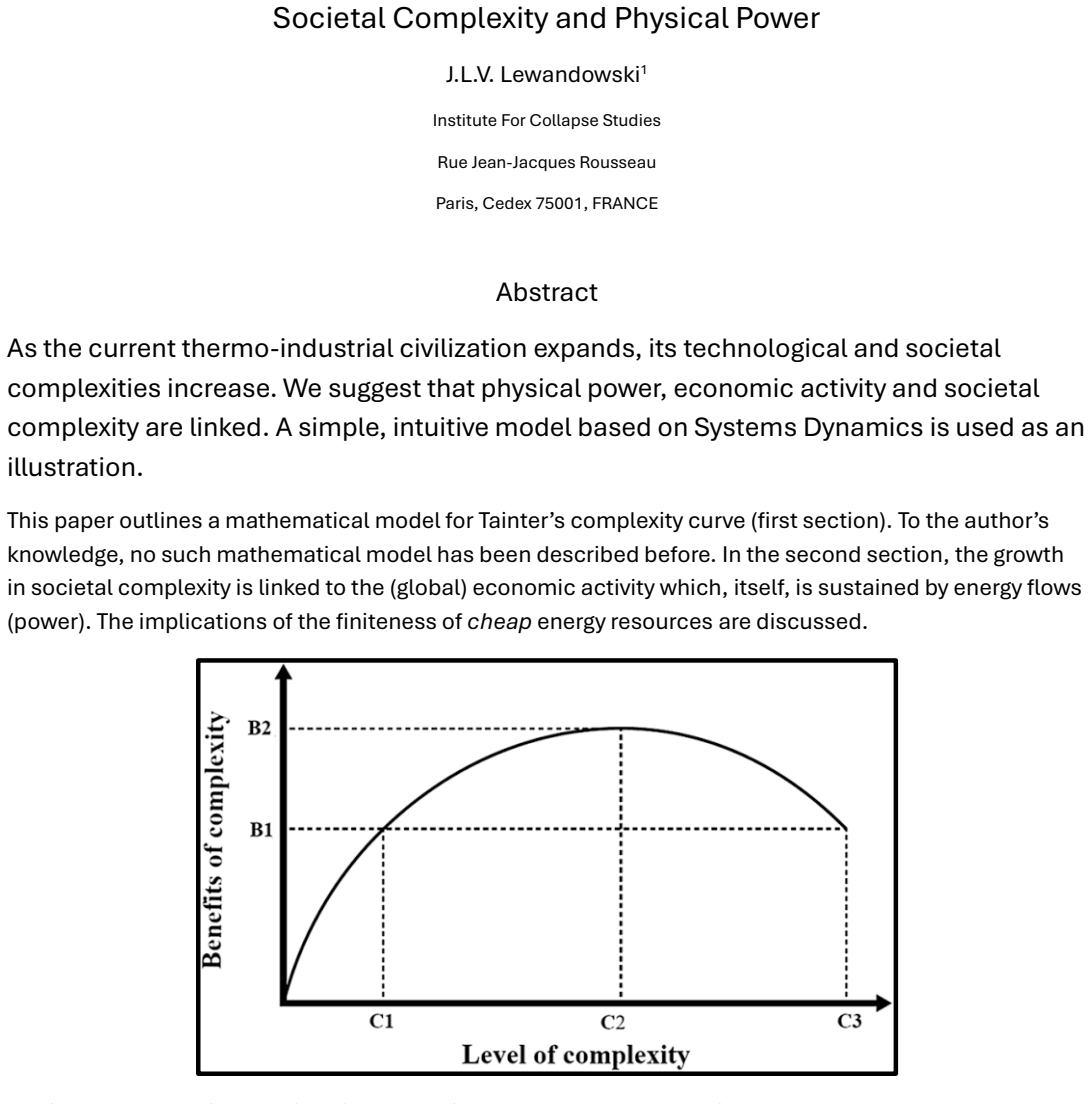
As the current thermo-industrial civilization expands, its technological and societal complexities increase. We suggest that physical power, economic activity and societal complexity are linked. A simple, intuitive model based on Systems Dynamics is used as an illustration.
0
0
physics.soc-ph 2026-05-08 Recognition

Climate anomalies synchronize dengue outbreaks across Brazilian cities

Climate and dengue synchronization in southern Brazil: a municipal analysis with cross-state validation

Permissive days first cut asynchronous states, then hold synchronization higher during high-transmission periods

Figure from the paper full image
abstract click to expand
Dengue transmission is rapidly expanding beyond its historical tropical range, raising concerns about how climate change may alter the collective dynamics of epidemics. While most studies focus on transmission risk, much less is known about how climate affects the synchronization of outbreaks. In this work, we investigate dengue synchronization using epidemiological and climate data from 74 municipalities in the state of Paran\'a (southern Brazil) between 2010 and 2024. We quantify outbreak coherence using the Event Synchronization (ES) method. Our results reveal a transition from a low-transmission regime to a high-transmission regime accompanied by a marked increase in synchronization across cities. We also show that climate anomalies increase the number of permissive days for dengue transmission. Our results suggest that such days are significantly associated with outbreak synchronization. We identify a two-stage climate mechanism: conducive climatic conditions first reduce the probability of asynchronous states and coincide with the emergence of synchronized outbreaks, and subsequently sustain higher synchronization levels. Extending the analysis through comparative analyses in Cear\'a and Minas Gerais, we uncover that climate consistently amplifies synchronization, although its role in the onset of synchronization depends on regional climatic regimes. These findings highlight climate-driven synchronization as an emerging feature shaping dengue dynamics.
0
0
physics.soc-ph 2026-05-08 2 theorems

Asymmetric coupling sustains imbalance in open networks below transition temperature

Persistent Imbalance in Open Networks with Coevolutionary dynamics

The dependent network stays imbalanced and the critical temperature rises compared with isolated cases

Figure from the paper full image
abstract click to expand
Societies are quintessential open systems, shaped by internal dynamics as well as external influences. The question is how these external influences alter the collective behavior and network dynamics. To answer this, we investigate coevolutionary balance dynamics in a system of independent and open networks. Here, the system consists of two interacting networks with directed (asymmetric) coupling: an independent network evolving autonomously and an open (dependent) network whose dynamics are influenced by the former. Using a mean-field framework, we demonstrate a transition temperature: below the transition temperature, the independent network reaches a state of structural balance, while the open network is destabilized by persistent imbalance states and enters a sustained imbalance phase. This coupling also induces a measurable upward shift in the transition temperature. Direct numerical simulations robustly confirm these analytical predictions.
0
0
physics.soc-ph 2026-05-08

Trade isolation could cut global calories by 22%

Cascading disruptions in natural gas, fertilizers, and crops drive structural food supply vulnerabilities globally

Model of gas, fertilizer, and crop chains shows rising risks and limited stock buffers for half the world's population.

abstract click to expand
Global food security depends on tightly coupled international supply chains including natural gas, mineral fertilizers, and staple crops. Earlier research has examined potential consequences of disruptions in each of these domains separately but not from a systemic perspective. Here we integrate bilateral trade in natural gas, nitrogen, phosphorus and potassium fertilizers, and eleven staple crops accounting for approximately 70% of plant-based calories into a cascading-impact model spanning 208 countries, 20 geopolitical blocs, and the period 1992-2023. Under complete trade isolation, up to 22% of global caloric consumption would be lost, with a peak in the most recent evaluated years. Structural vulnerabilities vary greatly. Regions largely lacking some parts of the supply chain face near-total crop supply collapse, while few countries can cover the whole nexus through domestic resource endowments and production capacities. Temporal trends highlight a substantial increase in vulnerability globally, most prominently in the EU with a near two-fold increase since the 1990s. Market power is most concentrated and most volatile in the upstream gas and mineral-fertilizer layers, from which shocks propagate downstream. Food stocks provide only limited resilience with half of humanity living in countries disposing of stock lasting less than three months. Our results identify the upstream supply chains as the structural bottlenecks of the global agrifood system and propose leverage points to enhance resilience.
0
0
physics.soc-ph 2026-05-08

Bipartite imbalance reshapes scales but leaves scaling laws fixed

Two-mode geometry controls multiscale organization in bipartite systems

A direct renormalization method shows two-mode geometry separates universal exponents from scale-dependent hierarchies.

Figure from the paper full image
abstract click to expand
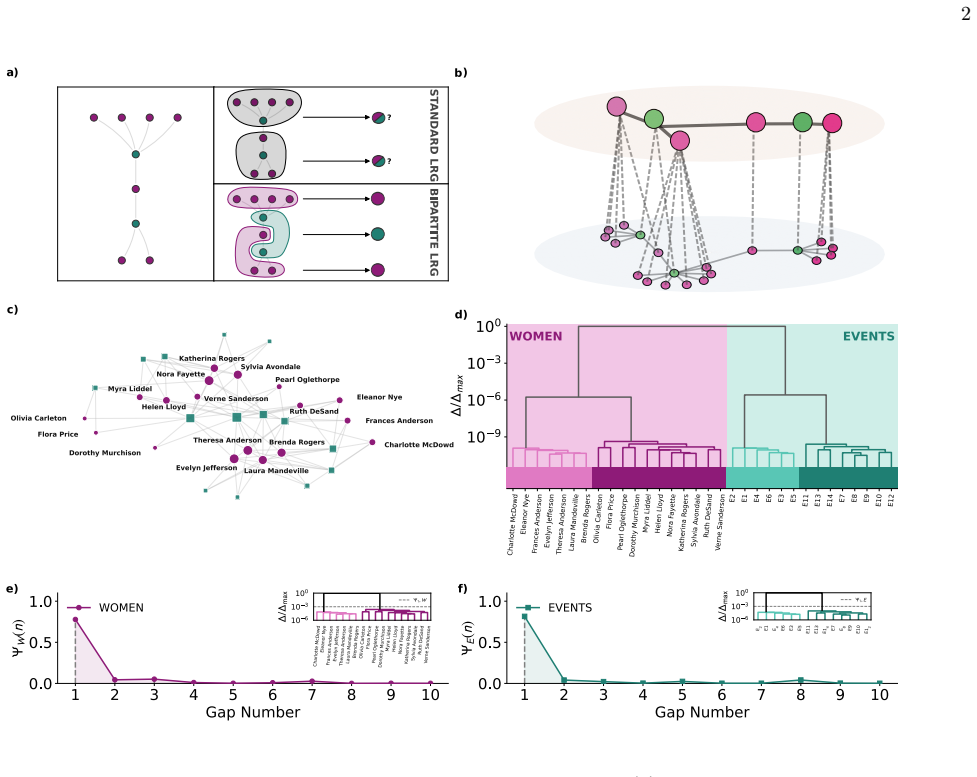
Many complex systems are organized around complementary roles and naturally described as bipartite networks. Unveiling their multiscale structure presents a fundamental challenge because coarse-graining procedures must preserve role separation, whereas standard approaches collapse it via one-mode projections. Here we introduce a Laplacian-based renormalization framework that operates directly on the bipartite architecture, enabling scale transformations while retaining role differentiation. Using controlled bipartite ensembles at criticality, we show that structural imbalance systematically reshapes organization across scales while leaving scaling properties invariant, revealing a separation between universality and geometry. Applying the coarse-graining framework to empirical bipartite networks, we uncover nontrivial multiscale hierarchies for both roles. In contrast, renormalization performed after one-mode projection -- which truncates diffusion paths to nearest neighbors -- yields qualitatively different structures. Our results identify two-mode geometry as a fundamental constraint for revealing multiscale organization in systems with role separation.
0
0
physics.soc-ph 2026-05-08

Chilled meat transport cuts cold-chain costs by up to 23%

Mobile Cold Energy Storage: Coupling Food Distribution and Energy Systems

PCM and food flows replace most batteries in Nigerian markets while keeping cooling a small share of meat value.

Figure from the paper full image
abstract click to expand
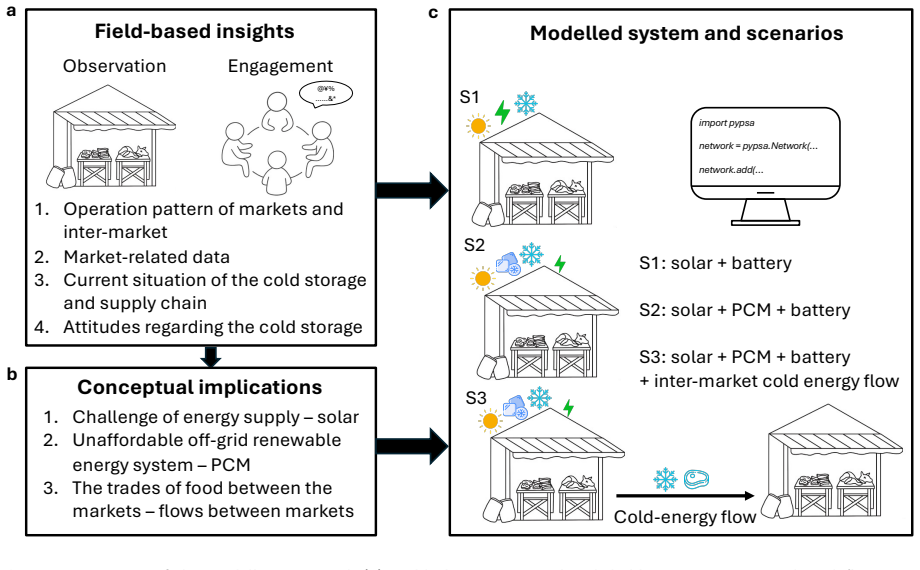
Cold storage is a persistent constraint in sub-Saharan African informal food systems, where perishables are traded in open-air markets with intermittent electricity and grid-tied or battery-heavy cold chains are too costly to scale. We develop a techno-economic optimisation framework that co-designs solar photovoltaics, refrigeration, phase change material (PCM) thermal storage, and inter-market food transport, using five open-air meat markets in Abuja, Nigeria as a case study. The framework treats pre-chilled meat as a mobile carrier of cold energy moving through existing trade routes, while PCM remains stationary at each market. Replacing part of the battery with PCM lowers annualised system cost by up to 15% (mean 11%), driven by a roughly 67% reduction in battery capacity. Allowing inter-market cold exchange via chilled meat further cuts total cost by 8% and aggregate PCM capacity by 35% by reallocating storage across markets without additional generation. PCM competitiveness depends on its relative capital cost, discharge efficiency, and the refrigeration charging window: long predictable charging windows favour PCM, short flexible-response needs favour batteries. Across all scenarios the cost of cooling stays a small share of meat value. The framework shows how treating cold as a mobile energy vector embedded in food flows can inform cold-chain design in other infrastructure-constrained food networks.
0
0
physics.soc-ph 2026-05-08

Congestion drives most extra EV HVAC energy use

Compound effects of traffic and climate on electric vehicle HVAC energy consumption: a spatiotemporal framework with city-level attribution

Trip time from traffic accounts for 83% of above-average cabin energy in London, exceeding temperature effects.

Figure from the paper full image
abstract click to expand
Real-world electric vehicle (EV) energy consumption can deviate by 20-40% from rated values, driven by ambient temperature, traffic congestion, and route characteristics. Existing studies treat these factors in isolation or as static loads, leaving the compound effect of co-varying climate and traffic on HVAC energy unquantified and per-route attribution unavailable. We develop a spatiotemporal simulation framework that couples traffic-aware driving speed, time- and location-specific ambient temperature, and physics-based submodels (cabin HVAC, traction, battery thermal management) at the segment level, paired with a regression-based decomposition that attributes HVAC variability to temperature and trip-duration components on a per-route basis. Applied through a factorial design across seven UK cities and eight radial routes from Manchester, the framework shows total energy varying by 14\% across cities while HVAC energy varies by up to 89\%, making cabin thermal management the primary differentiator under winter conditions. Trip duration, set by traffic and road type, is frequently the dominant driver of HVAC variability: in London, 83\% of above-average HVAC energy is attributable to congestion-extended trip time rather than to temperature. The decomposition yields a closed-form HVAC model from three inputs (ambient temperature, average speed, trip distance), with physically interpretable coefficients and straightforward transfer to other vehicles or regions through three coefficient re-fits. EV range variability is substantially shaped by traffic and road-network characteristics, with implications for route planning, infrastructure design, and energy equity.
0
0
physics.soc-ph 2026-05-08

Pedestrian arrivals show multifractal scaling over broad timescales

The multi-fractal nature of pedestrian arrival times

Large dataset reveals scale-dependent correlations missed by standard statistics, supporting better flow models.

Figure from the paper full image
abstract click to expand
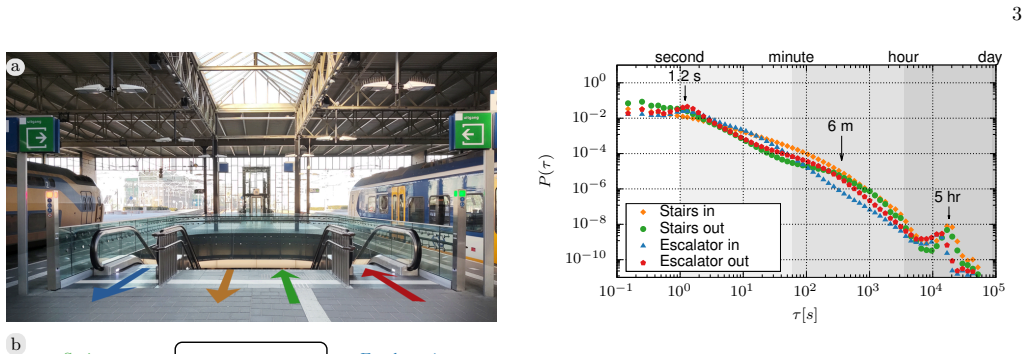
Pedestrian arrival times exhibit complex temporal organization across multiple scales, shaped by working hours, transportation schedules, and collective behaviors - features often neglected in conventional pedestrian arrival models. Using a dataset comprising over 23 million pedestrian movements at a Dutch railway station, we show that arrival processes cannot be fully characterized by inter-arrival time statistics alone. Instead, we demonstrate that pedestrian arrivals exhibit clear multifractal scaling, revealing scale-dependent correlations across a broad range of timescales. To quantify these properties, we apply a framework based on generalized fractal dimensions, which captures the heterogeneous structure of arrivals beyond standard point-process descriptions. This approach enables the identification of distinct temporal regimes associated with external forcing and provides a quantitative basis for constructing more realistic synthetic arrival processes. Beyond pedestrian dynamics, this approach offers methodological relevance for understanding non-trivial arrival processes in other physical or biological systems.
0
0
physics.soc-ph 2026-05-08

Tumor perfusion patterns become indistinguishable at breast surface

Thermal-signature equivalence of breast tumors with heterogeneous perfusion in a modified Pennes bioheat model

Simulations show heat diffusion smooths distinct internal temperature fields from different perfusion types into equivalent surface profiles

Figure from the paper full image
abstract click to expand
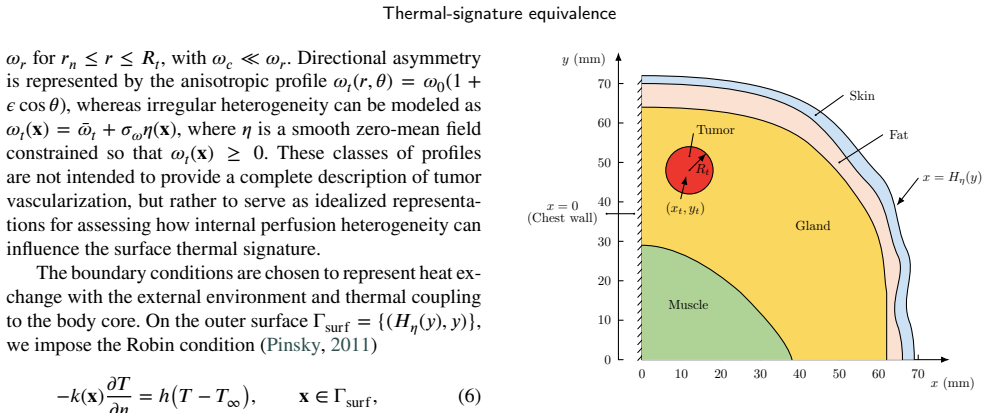
Breast thermography provides a noninvasive and contact-free method for observing tumor-associated thermal anomalies. However, the extent to which surface temperature patterns reflect the internal physiology of a tumor remains an open question. In this study, we investigate a modified Pennes bioheat model for multilayer breast tissue containing a finite-sized tumor with spatially heterogeneous intratumoral perfusion. Rather than focusing solely on the internal temperature field, we examine how different perfusion patterns are projected onto thermal signatures at the breast surface. We introduce a profile-distance-based framework of thermal-signature equivalence to quantify when different intratumoral perfusion structures remain distinguishable at the surface and when they become effectively indistinguishable. The results show that uniform, rim-enhanced, necrotic-core, and anisotropic perfusion patterns can produce clearly different internal temperature distributions, but these differences are strongly smoothed by heat diffusion and thermal screening before reaching the surface. Tumor depth reduces the distinguishability of surface signatures, whereas increasing tumor size enhances it. These findings highlight a fundamental limitation of static breast thermography: a thermal anomaly detected at the surface does not necessarily guarantee a unique identification of intratumoral perfusion heterogeneity.
0
0
physics.soc-ph 2026-05-07

Partial population data wins in parallel minority games

Local and global optimization in Parallel Minority Games

Agents using limited information about crowd sizes reduce fluctuations and raise total payoffs when local and global goals compete.

Figure from the paper full image
abstract click to expand
The Parallel Minority Game (PMG) refers to a set of Minority Games (MG), played in parallel, where each agent only has two choices to pick from, but each choice can host agents of many kind i.e., their other alternative can be from any other choices. While the pay-off function remains the same as that in the MG -- agents picking the less crowded of their two choices win positive pay-off -- the optimization of resource allocation is significantly harder in the PMG. While a global optimization demands a uniform population in all choices, a local optimization attempts to balance the population in the two choices for a given agent. In the MG these two objectives coincides, but generally in the PMG these are competing. We study several non-dictated, stochastic strategies and compare their efficiencies in attaining the local and global optimization objectives. Counterintuitively, a strategy with partial information of populations perform the best in terms of population fluctuation and overall payoff maximization.
0
0
physics.soc-ph 2026-05-07

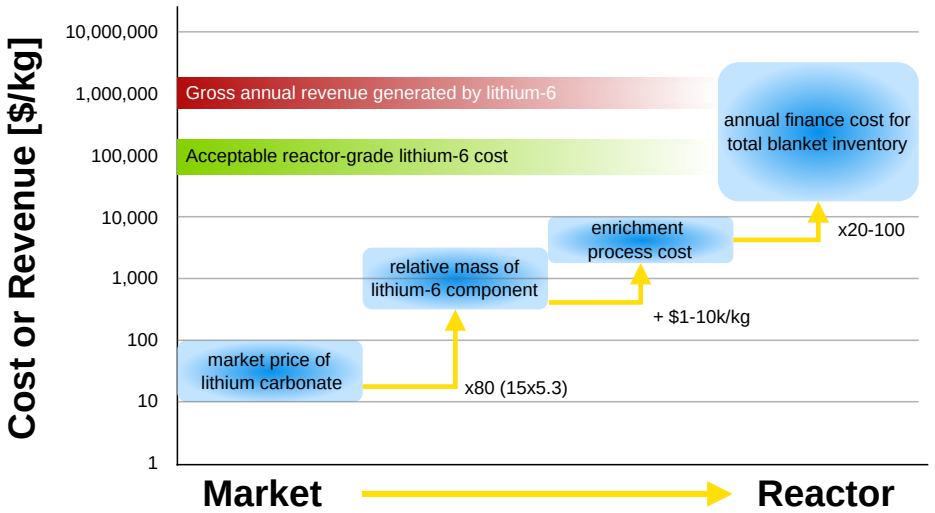
Lithium enrichment turns fusion fuel into capital cost

Lithium enrichment threatens to curb fusion deployment

50-100 tonne inventories per plant and limited enrichment tech threaten to slow reactor deployment.

Figure from the paper full image
abstract click to expand
The impact of lithium isotopic enrichment on the global deployment of nuclear fusion energy is analysed. Lithium - the 6Li isotope in particular - is essentially one of two elemental fuels required by fusion reactors for tritium breeding. Whilst variable consumption of lithium is low enough to present negligible cost, it is instead the large stored inventory volume (50-100 tonnes) and its required enrichment that compound to significantly drive capital costs. These costs are driven by the inefficiency of the tritium breeding process, making this challenge fundamental to almost all fusion power plant concepts. Financing would further compound these effects, making lithium fusion fuels more akin to an upfront capital expenditure than operational expenditure. Other potential barriers to fusion deployment created by lithium are also discussed: enrichment technologies of today are shown to be too expensive, not scalable, and environmentally risky, and highly enriched 6Li is a controlled substance. Mitigating actions include: developing alternative enrichment technologies that are affordable, scalable, and do not rely on mercury; incorporating lithium enrichment as an explicit cost driver in reactor design processes, producing more compact reactors with smaller lithium inventories; establishing distinct enrichment levels to enable supply chain monitoring for misuse; and the most radical solution: breeding blankets that use natural, unenriched lithium. These actions may impact tritium breeding capabilities, which calls for an urgent re-assessment of the tritium breeding paradigm. Whatever solution is sought, lithium supply is a mission-critical issue that needs urgently addressing.
0
0
physics.soc-ph 2026-05-06 2 theorems

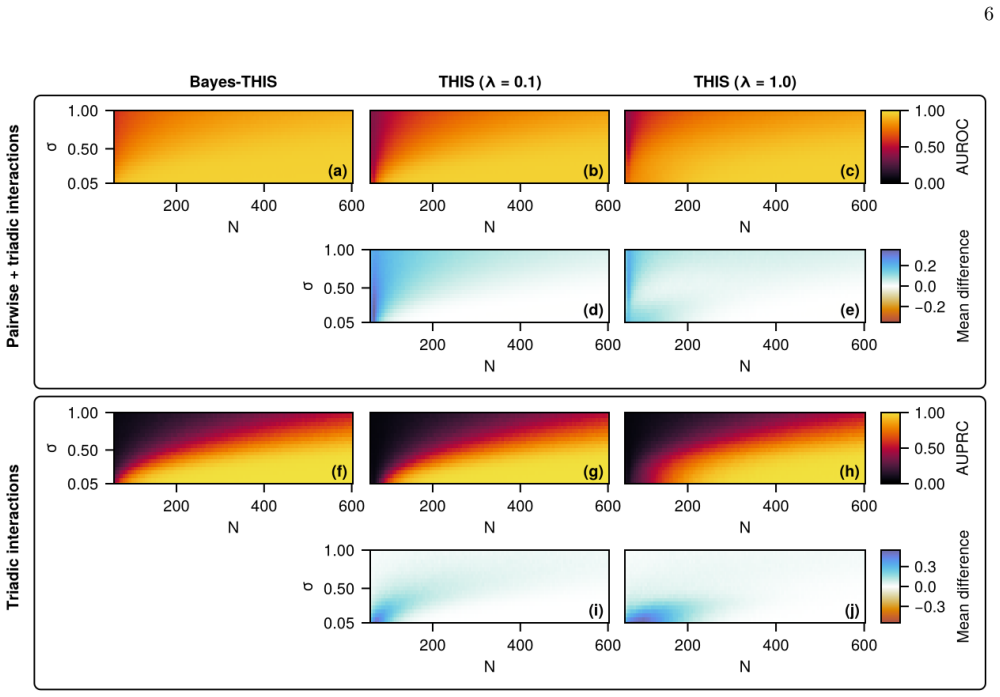
Bayesian regression recovers hypergraphs from noisy scarce dynamics

Bayesian hypergraph inference from scarce and noisy dynamical observations

Adaptive shrinkage and posterior checks improve edge selection, yet some higher-order patterns still produce indistinguishable spurious low-

Figure from the paper full image
abstract click to expand
Inferring higher-order interaction structure from observations of dynamics is a central challenge in complex systems, particularly when data are scarce, noisy, or concentrated in lower-dimensional regions of state space. We develop Bayes-THIS, a Bayesian extension of Taylor-based Hypergraph Inference using SINDy (THIS), which reconstructs hypergraph structure from time-series data by identifying sparse Taylor coefficients associated with pairwise and higher-order interactions. By replacing fixed-threshold sparse regression with sparse Bayesian regression using automatic relevance determination, Bayes-THIS explicitly models residual variance and applies adaptive, term-wise coefficient shrinkage, improving robustness in data-limited, high-noise, and ill-conditioned regimes. The resulting Gaussian posterior also enables an uncertainty-aware inference workflow: a posterior predictive check assesses whether the data contain sufficient higher-order signal to reliably support inference beyond a pairwise model, and credible-interval pruning selects hyperedges whose inferred coefficients are statistically distinguishable from zero. Finally, we characterize a fundamental limitation of the Taylor-based inference framework: when higher-order interactions concentrate on nodes that lack lower-order connections, the Taylor expansion systematically inflates lower-order coefficient estimates, producing spurious edges indistinguishable from genuine lower-order interactions. This structural non-identifiability cannot be resolved by either THIS or Bayes-THIS.
0
0
physics.soc-ph 2026-05-06 2 theorems

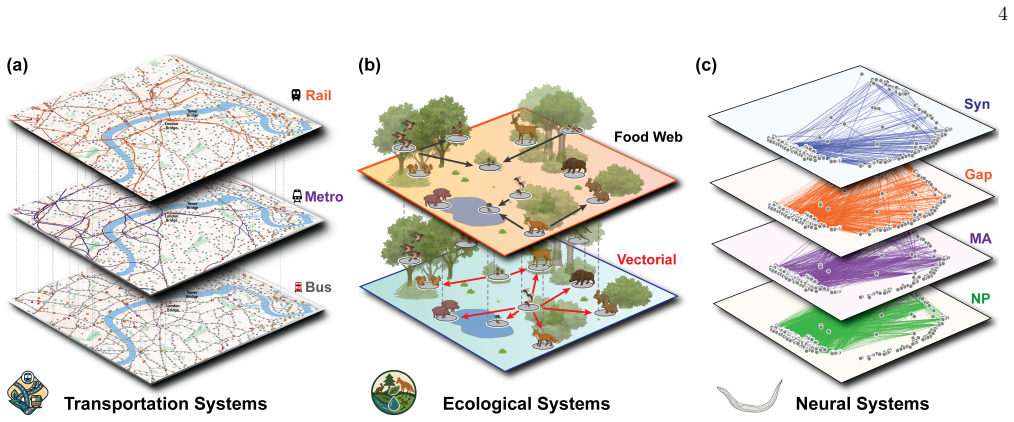
Multiplex networks enable new collective behaviors via three mechanisms

Dynamical processes and emergent behaviors in multiplex networks

Structural correlations, dynamical correlations, and inter-layer interplay create effects missing from single-layer or isolated models.

Figure from the paper full image
abstract click to expand
Over the last two decades, network science has greatly advanced our understanding of how the collective behaviors of a complex system emerge from the interactions among its basic units. Multiplex networks, i.e. networks with many layers, whose nodes are in one-to-one correspondence, provide a more realistic description for social, biological and ecological systems where multiple types of interactions coexist. After a brief introduction on how to model the architecture of multiplex networks, we present a complete overview of the different dynamics which can unfold over these structures. We present a unified framework to describe dynamical processes such as percolation, reaction-diffusion, synchronization, epidemic spreading, social dynamics and games on multiplex networks, as well as the coupled evolution of different dynamical processes, and the coevolution of a process with the network structure. Our focus is on truly-multiplex collective behaviors, i.e., all those phenomena which cannot emerge on the corresponding aggregated networks, or when the different layers of these systems are considered in isolation. We identify three main mechanisms leading to new collective behaviors: the existence of structural correlations across layers, the presence of dynamical correlations in the processes taking place at the different layers, and the dynamical interplay of inter- and intra-layer interactions. We conclude with a summary of the main takeaways from a decade of work in the field.
0
0
physics.soc-ph 2026-05-06

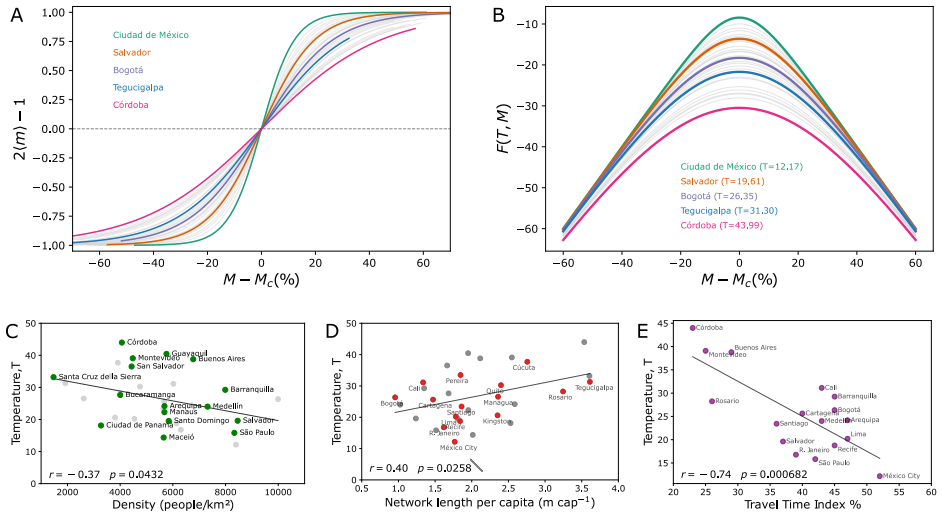
Cities show phase transitions in traffic congestion

Thermodynamic phase transitions reveal the resilience structure of urban traffic congestion

Mobility controls jam extent like a physical control parameter, with an effective temperature revealing resilience differences

Figure from the paper full image
abstract click to expand
Understanding how cities transition from free-flowing to congested traffic remains a central open problem in urban science. Here we show that city-scale congestion undergoes a reproducible nonlinear transition analogous to an order-disorder phase transition in statistical mechanics, in which aggregate mobility acts as a control parameter and jam extent as a collective order parameter. Crucially, this analogy is not merely formal: we derive and empirically identify an effective thermodynamic temperature with concrete physical meaning, quantifying infrastructural heterogeneity and how broadly a city explores congestion configurations as demand increases. Low-temperature cities are congestion-fragile: small mobility increases trigger sharp, system-wide jam transitions. This framework further reveals that the macroscopic fundamental diagram is an incomplete description of the traffic state: it emerges as a projection of a richer free-energy landscape governed by entropy-capacity trade-offs. Validated across 46 cities in Latin America and the Caribbean and independently confirmed with loop-detector data from 8 cities on three continents, these results establish a physics-based foundation for comparing urban traffic resilience and anticipating congestion regime shifts under changing mobility demand.
0
0
physics.soc-ph 2026-05-06 3 theorems

Supervision preferences and confrontation control rumor spread

Rumor Propagation and Supervision during Confrontation: An Importance-Driven SIRQS Network Model

SIRQS simulations show who is monitored, supervisor numbers, and direct pushback largely set the limits on propagation across networks.

Figure from the paper full image
abstract click to expand
The societal impact of rumor spreading is becoming increasingly severe; yet, current research remains relatively one-sided, typically focusing on either rumor propagation or rumor control while neglecting the confrontational and dynamically evolving relationship between them. To address this gap, we propose a novel confrontation framework for rumor modeling. We extend the classical Susceptible-Infected-Recovered-Susceptible (SIRS) model into an Ignorant-Spreader-Stifler-Vigilant-Ignorant (SIRQS) framework by introducing a vigilant state and a confrontation mechanism, thereby capturing subtle differences in individual states during rumor propagation and in their confrontational behavior toward supervisors. At the same time, supervisors patrol the network through random walks guided by node propagation importance, enabling targeted monitoring of rumor spreaders and individuals with a high risk of spreading rumors. Using a microscopic Markov chain approach, we further characterize heterogeneous node behavior and individual differences, and couple the propagation and supervision processes to model node-state transition patterns. We conduct simulations on networks with three different sizes, various topologies, and a real-world network. The results show that the supervision subject, the preference effects associated with the number of supervisors, and the confrontation mechanism are key factors in supervision, and largely determine the effectiveness of rumor propagation control in the simulations, reflecting the substantial influence of these three mechanisms in real-world spreading scenarios. Finally, through multiple evaluation indicators, we provide references for determining the optimal number of supervisors.
0
0
physics.soc-ph 2026-05-06

Supervisor count and confrontation rules control rumor spread

Rumor Propagation and Supervision during Confrontation: An Importance-Driven SIRQS Network Model

New model links spreading and targeted suppression, showing that supervision targets, numbers, and confrontation style determine containment

Figure from the paper full image
abstract click to expand
The societal impact of rumor spreading is becoming increasingly severe; yet, current research remains relatively one-sided, typically focusing on either rumor propagation or rumor control while neglecting the confrontational and dynamically evolving relationship between them. To address this gap, we propose a novel confrontation framework for rumor modeling. We extend the classical Susceptible-Infected-Recovered-Susceptible (SIRS) model into an Ignorant-Spreader-Stifler-Vigilant-Ignorant (SIRQS) framework by introducing a vigilant state and a confrontation mechanism, thereby capturing subtle differences in individual states during rumor propagation and in their confrontational behavior toward supervisors. At the same time, supervisors patrol the network through random walks guided by node propagation importance, enabling targeted monitoring of rumor spreaders and individuals with a high risk of spreading rumors. Using a microscopic Markov chain approach, we further characterize heterogeneous node behavior and individual differences, and couple the propagation and supervision processes to model node-state transition patterns. We conduct simulations on networks with three different sizes, various topologies, and a real-world network. The results show that the supervision subject, the preference effects associated with the number of supervisors, and the confrontation mechanism are key factors in supervision, and largely determine the effectiveness of rumor propagation control in the simulations, reflecting the substantial influence of these three mechanisms in real-world spreading scenarios. Finally, through multiple evaluation indicators, we provide references for determining the optimal number of supervisors.
0
0
physics.soc-ph 2026-05-06

Commit time series alpha flags software stability

Long-Range Correlation in Code Commit Dynamics as a Novel Indicator of Software Product Stability: A Detrended Fluctuation Analysis Study

Detrended fluctuation analysis finds stronger long-range memory in stable development periods than in unstable ones, independent of commit 3

Figure from the paper full image
abstract click to expand
This work proposes the fractal scaling exponent alpha, estimated via Detrended Fluctuation Analysis (DFA) on the unaggregated time series of lines of code added per commit event in a software repository, as a novel process-level indicator of software product stability. The proposal rests on the hypothesis that stable software products arise from development processes characterised by long-range temporal correlations in commit behaviour: each code addition is shaped not only by the immediately preceding commits but by patterns extending weeks or months into the past and anticipating work to be done in the future. This hypothesis is tested on two non-overlapping 712-day time series of lines of code added per commit event, drawn from a closed-source software organisation and labeled as stable and unstable by the lead engineer on the basis of crash-analytics data. Applied to these series, DFA yields alpha = 0.70 (n_min = 16) for the stable period and alpha = 0.57 for the unstable period, with all estimates substantially above the shuffled-surrogate baseline (alpha ~= 0.50 +/- 0.01). Results are robust to three parameterisations (n_min in {4, 16, 48}) and validated against 1,000 surrogate time series per condition. Remarkably, the unstable period generated 3.2 times more commit events than the stable period, yet exhibited lower long-range memory, demonstrating that commit volume alone does not predict stability, and that the temporal organisation of development activity is the key variable. This result can be situated in the broader literature on fractality in human creative production, discuss methodological limitations, and outline a research programme for deploying alpha as a continuous code-health indicator in version-control pipelines.
0
0
physics.soc-ph 2026-05-05

Spectral targeting reduces contagion only in random hypergraphs

Targeted Disruption of Hypernetworks via Spectral Partitioning

In Erdős–Rényi hypergraphs cut-persistence removal beats random deletion, but in small-world and scale-free cases random works as well or更好.

Figure from the paper full image
abstract click to expand
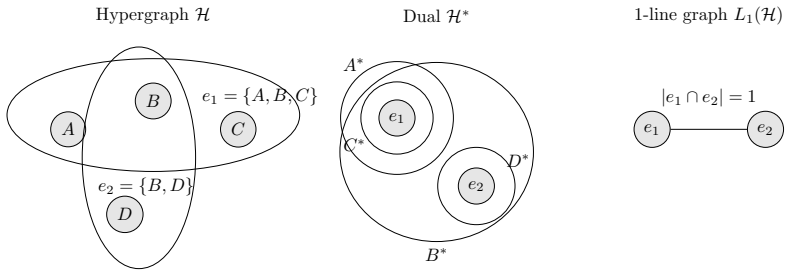
We study hyperedge-removal strategies for suppressing contagion on synthetic hypergraphs. Hypergraphs are generated from Erd\H{o}s--R\'enyi, Barab\'asi--Albert, and Watts--Strogatz seed graphs by promoting maximal cliques to hyperedges. For each hypergraph, we construct \(s\)-line graphs whose vertices correspond to hyperedges and whose edges encode hyperedge overlap of size at least \(s\). Spectral \(k\)-way clustering of these \(s\)-line graphs yields a multiscale cut-persistence score used to rank hyperedges for removal. Simulations show that the effect of this intervention is strongly topology-dependent. In the reported Erd\H{o}s--R\'enyi case, cut-persistence targeting reduces final infection size more than random hyperedge removal. In the Watts--Strogatz and Barab\'asi--Albert cases, however, random removal is comparable to or better than cut-persistence targeting. These results suggest that spectral overlap structure can identify structurally salient hyperedges, but structural salience alone does not guarantee optimal contagion suppression. The study motivates further comparison with ensemble-level experiments and explicitly higher-order contagion models.
0
0
physics.soc-ph 2026-05-05

Vishap stone locations indicate unified society in 4000 BC Armenia

Vishap epoch unitary society in Armenian Highlands, c. 4000 BC: data analysis consequences

Bimodal elevations and irrigation ties suggest one organized group ran a major water cult.

abstract click to expand
Vishaps -- dragon stones -- discovered in the Armenian Highlands convey a remarkable message about the spiritual and social character of their epoch, c. 4000 BC. The unexpected bimodal distribution of their elevations indicates the deliberate, labor-intensive placement of these massive stones -- some weighing up to 7--9 tons -- in locations where the period suitable for construction activities at high altitudes was extremely limited. Their positions, correlated with nodes of previously identified prehistoric irrigation systems, support the interpretation that they were dedicated to a cult of water. This evidence points to the existence of an organized and unified society capable of sustaining and maintaining such a resource-intensive cult.
0
0
physics.soc-ph 2026-05-05

Decentralized rules support safe 3D drone traffic

On Traffic Interactions for Unmanned Aerial Vehicles: Traffic Flow Applied to Three Dimensional Space

Asymmetric interaction rules connect individual UAV avoidance to efficient overall traffic flow in three dimensions.

Figure from the paper full image
abstract click to expand
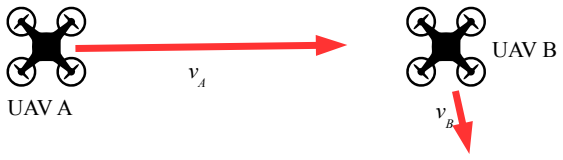
Unmanned aerial vehicles (UAVs, or drones) are likely to significantly increase the amount of air traffic. If the skies are full of UAVs, they need to interact with each other, for instance by yielding or other evasive maneuvers. The aggregated movements of drones will create traffic patterns. Just like in current road traffic, the interactions will be very frequent, so a centralized computer managing these interactions is expected not to be possible. There is a long history of traffic flow theory and modeling for 1 dimensional (road) traffic; this has been expanded to 2 dimensional traffic (pedestrians). It is unclear how traffic flow theory works for 3 dimensional traffic. In this paper we show how drone traffic can interact in a decentralized way. For the microscopic description, we add asymmetric interaction rules. We show that without centralized control, we can have efficient and safe traffic. Moreover, we provide a framework that directly links microscopic interactions to macroscopic properties. For the macroscopic description, we formulate and apply a numerical scheme that integrates the competition of space by UAVs for multiple classes, directions and dimensions. We apply both the microscopic and macroscopic descriptions to analyze (emerging) patterns which may arise in 3D traffic flow. The current paper provides background to develop interaction rules for drone traffic. Currently, the drone traffic is taking its first steps, but once the aeronautic technique takes off, the legislation regarding drone interactions should be ready. To support so, and be able to assess traffic consequences of decisions, the traffic flow theory framework developed here is essential.
0
0
physics.soc-ph 2026-05-05

Opportunity density variance dominates success by 100-1000 times

The Dominance of Environment over Entity's Capabilities

Analytical model shows environmental factors explain far more outcome spread than personal exploration capacity.

abstract click to expand
We present an analytical framework for the probability of individual success based on a single structural asymmetry between the capacity of an entity to explore possibilities, $k$, and the size of the possibility space offered by the environment, $n$, where $k \ll n$. We introduce an effective density $\rho_{\rm eff}$ of favorable possibilities accessible to a given entity, derive the probability of success as $P \approx 1-(1-\rho_{\rm eff})^k$, and decompose its variance across a population. We show that while the elasticities $\varepsilon_\rho$ and $\varepsilon_k$ are comparable, the variance of outcomes is dominated by ${\rm Var}(\ln \rho_{\rm eff})$ whenever it exceeds ${\rm Var}(\ln k)$. A back-of-envelope calibration based on published inequality and productivity data indicates this condition holds by two to three orders of magnitude. The framework provides an analytical complement to the simulation result of Pluchino, Biondo and Rapisarda (2018), and offers a unified structural account of geographic inequality, intergenerational mobility and accessibility-based discrimination as special cases of the narrowing of the accessible set $A(E,P)$.
1 0
0
physics.soc-ph 2026-05-04

Walks on stable-tech networks reproduce four discovery laws

Adjacent Possible Innovation Dynamics on Local Optima Networks

A graph of local fitness maxima and transition probabilities generates Heaps', Zipf's, Taylor's, and inter-event power laws without extra参数.

Figure from the paper full image
abstract click to expand
We propose Local Optima Networks (LONs) as a formal framework for modeling innovation dynamics. A LON is a directed weighted graph in which nodes represent locally stable technological configurations and edges encode transition probabilities between their basins of attraction. We construct LONs from fitness landscapes and model innovating agents as stochastic walkers exploring the adjacent possible on the resulting network. We show that this model simultaneously generates the four main empirical regularities of the discovery-process tradition: sublinear novelty growth (Heaps' law), heavy-tailed frequency distributions (Zipf's law), anomalous fluctuation scaling (Taylor's law), and power-law distributed inter-event times. The exponents fall within empirically observed ranges and are jointly constrained by LON topology. Communities in the LON provide an operational definition of technological paradigms grounded in basin-level accessibility. The LON framework thus bridges the discovery-process and adaptive-search traditions of innovation modeling within a single, parsimonious, and empirically testable representation.
0
0
physics.soc-ph 2026-05-04

Controlled approximation solves network master equations analytically

Analytical Framework for the Approximate Master Equation

Framework closes moment equations to find steady states for SIS, voter, and evolutionary game models on networks.

Figure from the paper full image
abstract click to expand
The approximate master equation (AME) provides a highly accurate description of dynamical processes on networks, yet its steady states are generally analytically intractable. In this study, we develop an analytical framework to derive the steady states of the AME by introducing a controlled approximation that enables closure of the moment equations. This framework reproduces the steady state of the pair approximation by achieving closure with the minimum required order of moments, and can be systematically refined to approach the exact steady states of the AME. We apply this to the SIS model, the voter model, and evolutionary games, demonstrating that the steady states can be derived. In particular, for evolutionary games, we show that combining our framework with the singular perturbation method enables the analytical derivation of the time evolution.
0
0
physics.soc-ph 2026-05-04

Simpson's paradox turns linear contagions nonlinear

Simpson's paradox explains the ubiquity of nonlinear, threshold, and complex contagions

Population data shows superlinear spread even when every subgroup follows linear rules because stronger groups dominate at high incidence.

Figure from the paper full image
abstract click to expand
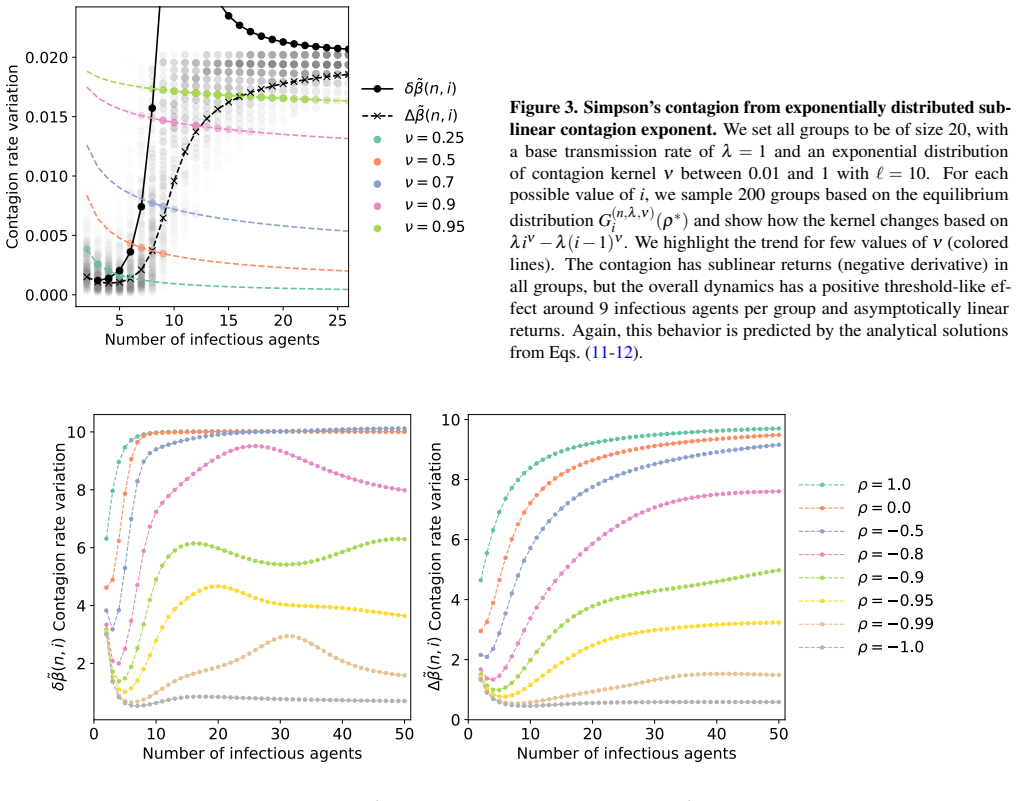
Complex contagions describe systems where the probability or rate of contagious transmission is a nonlinear function of the exposure to contagious agents. These models were first studied theoretically but have since been used to capture effects such as nonconformism, social reinforcement or peer pressure in empirical data. However, recent studies have shown that local correlations (e.g., group structure or temporal burstiness) and heterogeneity (e.g., diversity of parameters or covariates) can give the illusion of nonlinear effects even when the dynamics is actually linear. We briefly review these studies to inform a new model and explanation for these effective models of complex contagions. We find global threshold dynamics and superlinear complex contagions even in populations where agents are distributed across social groups described solely by linear or even sublinear contagions. This effect can be understood as a manifestation of Simpson's paradox. Incidence data from heterogeneous groups can look superlinear once averaged over all groups, since the sampling of groups represented at high incidence is biased towards those with stronger local transmission. We then define what we call a Simpson's contagion: a contagion process that looks superlinear when observed over an entire population, but is mechanistically linear or even sublinear in all of its subgroups. By exploring these Simpson's contagions over mathematical case studies, our work contributes to the growing body of literature on the ubiquity of threshold and complex contagions as effective models, and our results stress the pitfall of model selection that ignores correlations and heterogeneity in populations.
0
0
physics.soc-ph 2026-05-04

Intermediate network degrees maximize group estimation accuracy

Optimal network structure for collective performance with strategic information sharing

Strategic sharing creates a trade-off that peaks performance at moderate connectivity, with gains from degree-inverse sampling

Figure from the paper full image
abstract click to expand
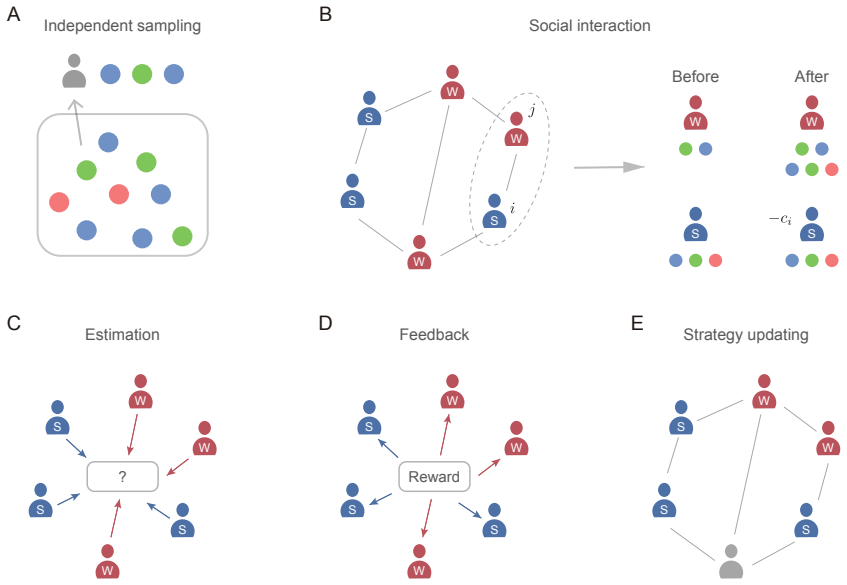
Information sharing between individuals is crucial to improve performance in collective tasks. However, in a competitive world, individuals may be reluctant to share information with the others, and it is still unclear how the presence of strategic behaviors affects the collective performance of a group. In this study, we introduce an evolutionary game modeling the dynamics of individual behaviors in a collective estimation task. The individuals are organized in a network and have to guess the distribution of ball colors in a box. Each of them samples a given number of balls and can strategically decide whether to share or not this information with its neighbors. We develop a framework that allows to investigate analytically how the collective performance depends on the network structure. We find that the optimal network results from a trade-off between the sharing rate and the way the information is integrated in the network. We further reveal that there exists an intermediate average degree for each type of network maximizing the collective performance. In addition to the uniform case, we consider the case of non-homogeneous allocations of the number of individual samples, showing that the largest collective performance is obtained when the number of ball extracted by an individual is inversely proportional to its degree.
0
0
physics.soc-ph 2026-05-01

Street network models now cover every urban area on Earth

Urban Science Beyond Samples: Up-to-Date Street Network Models and Indicators for Every Urban Area in the World

Processing OpenStreetMap data across 10,351 cities with consistent boundaries enables full-world analysis of urban form and accessibility.

abstract click to expand
Urban planners need up-to-date, global, and consistent street network models and indicators to measure resilience and performance, model accessibility, and target local quality-of-life interventions. This article presents up-to-date street network models and indicators for every urban area in the world. It uses 2025 urban area boundaries from the Global Human Settlement Layer, allowing users to join these data to hundreds of other urban attributes. Its workflow ingests 180 million OpenStreetMap nodes and 360 million OpenStreetMap edges across 10,351 urban areas in 189 countries. The code, models, and indicators are publicly available for reuse. These resources unlock worldwide urban street network science beyond samples as well as local analyses in under-resourced regions where models and indicators are otherwise less-accessible.
0
0
physics.soc-ph 2026-05-01

Regressive taxes trigger abrupt inequality phase jumps

Phase Transitions in Economic Inequality:Taxation and Extremal Replacement Dynamics

In a minimal replacement model, increasing taxes under regressive rules shifts the system from condensed wealth states to ergodic equality,

Figure from the paper full image
abstract click to expand
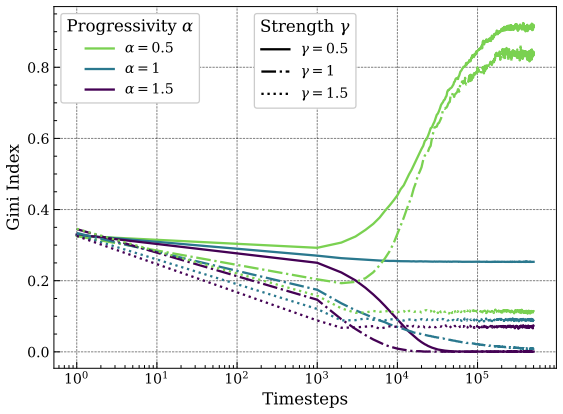
We present a minimal agent-based model of interacting agents characterized by their wealth to study taxation and inequality in a non-conservative economy. Wealth evolves through an extremal stochastic replacement process in which the poorest agent has its wealth replaced by a new random value, financed through a collective taxation mechanism. We explore taxation regimes ranging from regressive to progressive schemes and tune the overall redistribution strength. Under regressive taxation, the system self-organizes into two distinct stationary phases when changing the total tax collected: a non-ergodic, high-inequality regime characterized by wealth condensation in a subset of agents that permanently escape replacement, and a more homogeneous ergodic phase in which all agents participate in the dynamics. Increasing taxes drives an abrupt transition between these phases. The transition is discontinuous and exhibits hysteresis and bistability, consistently detected through the Gini index, the Top $1\%$ wealth share, the entropy, and the Binder cumulant. In contrast, neutral and progressive taxation suppress persistent wealth concentration, preventing the emergence of strongly unequal states and eliminating hysteretic behavior. These results show that minimal stochastic redistribution mechanisms alone can produce discontinuous transitions, metastability, and non-ergodicity, demonstrating that taxation structure can determine the emergence and stability of macroscopic inequality.
0
0
physics.soc-ph 2026-05-01

Half of non-intersection pedestrian crashes cluster within 198 feet of intersections

Assessing the Role of Intersection Proximity in Pedestrian Crashes: Insights from Data Mining Approach

Louisiana data shows distinct patterns across three distance zones, enabling more precise safety countermeasures for each area.

abstract click to expand
Although intersections are the most complex parts of the roadway network, pedestrian crashes at non-intersection locations are disproportionately frequent, highlighting a serious traffic safety concern. This study investigates non-intersection crashes involving pedestrians using a crash database (2017-2021) collected from Louisiana State. As the risk of pedestrian crashes tends to vary with distance from the intersection, the research team utilized a unique framework "distance to intersection" to capture the differences in crash patterns at non-intersection locations. The study identified that around 50% of non-intersection pedestrian crashes occurred within 198 ft. of the intersection. In the next step, the collected 3,135 pedestrian crashes at non-intersection locations during the study period were subdivided into three zones: D1 zone designates crashes occurring within 150 ft. of an intersection (1,277 crashes), D2 zone designates crashes occurring within 151 ft. to 435 ft. of an intersection (1,060 crashes) and D3 zone designates crashes occurring at 435 ft. or higher from an intersection (798 crashes). To explore the complex interaction of multiple factors, an intuitive data mining technique, Association Rules Mining was used. A total of the top 60 interesting association rules (20 for each zone) were identified by the algorithm (based on lift and support measures). In addition, a total of 124 rules were explored based on Lift Increase Criterion (LIC) measure. The findings of this research provide critical insights into pedestrian crash involvement at non-intersection locations and the variation in crash patterns according to the "distance to intersection". Based on the findings, some of the targeted problem-specific countermeasures are also recommended to address the crash patterns at non-intersection locations.
0
0
physics.soc-ph 2026-05-01

Recipes obey universal scaling laws like languages

Universal statistical laws governing culinary design

Ingredient usage, diversity, complexity, and nutrients all follow patterns explained by simple reuse and modification rules.

abstract click to expand
Cooking is a cultural expression of human creativity that transcends geography and time through the orchestration of ingredients and techniques, much like languages do through words and syntax. Yet, beneath the apparent diversity of culinary traditions, whether recipes obey statistical laws comparable to those of other symbolic systems remains unknown. Here we analyze a large corpus of traditional recipes spanning global cuisines, annotated using a state-of-the-art named entity recognition algorithm into ingredients, cooking techniques, utensils, and other culinary attributes. We find that ingredient usage exhibits Zipf-like rank-frequency scaling, that culinary diversity grows sublinearly with corpus size in accordance with Heaps' law, and that recipe complexity follows Menzerath-Altmann-type relations between the number and average information of constituent units. Consistent with observations in packaged foods, macronutrient concentrations across recipes also display a log-normal signature. Minimal generative models based on preferential reuse, constrained sampling, and incremental modification recapitulate these regularities, suggesting generic processes that shape recipe architecture across cultures. Together, these findings establish recipes as a compositional symbolic system in which complex structure emerges from simple, constrained generative processes.
0
0
physics.soc-ph 2026-05-01

Reduced SPDEs reproduce opinion clustering at lower cost

Clustering in co-evolving opinion dynamics: reduced SPDE models

Stochastic models on a reduced state space enable efficient analysis of large social datasets such as the US General Social Survey.

Figure from the paper full image
abstract click to expand
Clustering is a fundamental collective phenomenon in agent-based models (ABMs) of opinion dynamics. To study clustering in systems with co-evolving social and opinion variables, we derive stochastic partial differential equation (SPDE) models that describe the evolution of clusters on a reduced state space. We consider two settings: one in which opinions do not affect social interactions, and another one in which a feedback mechanism couples the two. Our approach extends reduced PDE modelling to a stochastic framework, which is essential for capturing long-term cluster behaviour. Numerical experiments demonstrate that the proposed reduced SPDEs substantially decrease computational cost compared to full-state SPDE models, such as the Dean-Kawasaki equation, while still accurately reproducing the clustering behaviour of the underlying ABM. As a result, these reduced models provide an efficient tool for studying systems with large populations, including those arising in the analysis of real-world data: in particular, we provide an application related to the large-scale General Social Survey (GSS), which comprises opinion and social data of the US population since 1972.
0
0
physics.soc-ph 2026-05-01

Hub removal preserves degree distributions but destroys scale-free scaling

Scale-freeness under node removal: a finite-size scaling perspective

Similarity to a reference degree distribution does not ensure scale-invariant organization persists across system sizes.

Figure from the paper full image
abstract click to expand
In heterogeneous network systems such as ecological and social networks, structural stability depends on how connectivity changes under node removal, as different removal sequences can trigger distinct modes of systemic collapse. While robustness to random failures and targeted attacks has been extensively studied, most analyses have focused on connectivity loss or degree distribution, rather than on how scale-invariant organization emerges and evolves with system size. Here we examine how scale-free structure evolves under progressive degree-dependent node removal, systematically varying the hub-protection strength $\theta$. Starting from scale-free networks, we apply the recently developed finite-size scaling (FSS) analysis to node-removed networks and compare the results with those from Kullback-Leibler (KL) divergence-based classification. We find that under random ($\theta=0$) and hub-protecting removal ($\theta>0$), the two criteria largely agree, whereas under hub-preferential removal ($\theta<0$), networks may appear scale-free according to the KL criterion while failing the FSS test of scaling collapse. This discrepancy indicates that similarity to a reference degree distribution does not guarantee the persistence of scale-invariant organization across system sizes. The two diagnostics thus probe complementary aspects of network structure, and their joint use provides a more complete characterization of structural degradation.
0
0
physics.soc-ph 2026-05-01

Simulations indicate higher death toll in 1919 Amritsar massacre

Crowd Dynamics in Historical Perspective: Reframing the Amritsar Massacre through Agent-Based Modelling and Social Psychology

Even conservative assumptions on firing rate and crowd movement produce fatalities exceeding the official 379, alongside analysis of how 20c

abstract click to expand
Crowds have long held a paradoxical place in the human imagination, feared for their destructive potential yet essential for collective expression. This tension was tragically manifested in the 1919 Jallianwala Bagh massacre, when British colonial troops opened fire on a peaceful gathering in Amritsar, India. Although officially 379 deaths were recorded, eyewitnesses and historians have long challenged this figure. With this study, we critically revisit the events through the lens of the specific role of the crowd as a phenomenon, both regarding the physical and the socio-psychological dynamics. We show that even under conservative physical assumptions - moderate shooting cadence, crowd-shielding, and constrained escape routes - our agent-based simulations consistently yield fatality estimates well above the official death count. On the socio-psychological front, we explore how early 20th-century discourses, influenced by Le Bon's theory of crowd psychology, constructed the crowd as an inherently irrational and threatening entity, thus providing a rationale for the application of excessive force. Our findings show that acknowledging the socio-cultural construction of crowds as a relevant factor in how state power engage with and respond to collective gatherings brings to light contemporary parallels and the risks posed by their rhetorical framing. Furthermore, this study highlights the importance of interdisciplinary modelling for both historical accountability and current crowd safety, particularly in an era of growing political unrest, surveillance, and militarised crowd policing.
0
0
physics.soc-ph 2026-04-30

Ratio-dependent contrarian rates tune opinion outcomes to majority or tie

Ratio-Dependent Contrarian Activation in Opinion Dynamics

Independent control over unanimous versus split groups of three creates either a guaranteed win for the initial majority or a random fifty-f

Figure from the paper full image
abstract click to expand
I study the impact of mixed contrarians on the opinion dynamics of an heterogenous population with conformists using Galam Majority Model. Activation of contrarians is a function of the ratio majority/minority in the local groups of discussion. Restricting the group size to 3, two types of contrarians are included in respective proportions $c_{3,0}$ for configurations with ratio 3 to 0 and $c_{2,1}$ for ratio 2 to 1. I then derive the explicit update Equation and obtained analytically the fixed points, their stability, and the resulting full two-dimensional landscape of the dynamics of opinion. Setting $c_{3,0} =c_{2,1} = c$ recovers the original results obtained with uniform contrarians. The findings allow for considering a wide spectrum of new disruptive strategies to secure either a majority/minority ending ensuring the opinion having the larger initial support to win, or a single attractor dynamics at fifty/fifty, which implies a random winner regardless of initial supports.
0
0
physics.soc-ph 2026-04-30

Success bias lowers real performance in science simulations

Nothing Deceives Like Success: Social Learning and the Illusion of Understanding in Science

Agents favoring apparent success overestimate their theories and create inequality patterns matching real communities

Figure from the paper full image
abstract click to expand
Success-driven social learning, in which individuals preferentially adopt the ideas and methods that appear most successful, is a foundational principle of collective behavior across systems ranging from ant colonies to scientific communities. But science is a particular kind of collective search -- one in which the quality of an explanation is itself difficult to assess. Is success bias adaptive in this setting? In agent-based simulations of collective theory building, we find that it is not. Scientists in our model systematically overestimate the quality of their own theories, creating an illusion of understanding: a persistent gap between perceived and actual performance. Success bias amplifies this illusion; communities that favor apparently successful theories explore a narrower range of possibilities, efficiently filtering out poor explanations but failing to discover better ones. This effect intensifies with problem complexity, as scientists in more complex environments become increasingly unable to assess how well their theories actually perform. Most strikingly, when agents optimize their social behavior to maximize the perceived success of their theories, they paradoxically undermine their actual performance, and produce levels of inequality that mirror those found in real scientific communities.
0
0
physics.soc-ph 2026-04-30

The paper proposes a dynamic motivation model for pedestrians

A well-motivated model of pedestrian dynamics

A motivation model from psychology makes pedestrian simulations show structured positioning near bottlenecks that static models miss but…

abstract click to expand
In pedestrian dynamics, the internal drive that propels individuals toward their goals is typically captured by a single, fixed parameter, the desired walking speed. This simplification overlooks that motivation fluctuates in response to changing spatial and social conditions within a crowd. This paper proposes a dynamic motivation model grounded in expectancy-value theory from psychology, in which each agent's motivation evolves over time depending on proximity to the goal, relative position among other pedestrians, and individual goal importance. The resulting motivation modulates multiple movement parameters simultaneously, including walking speed, gap-closing behavior, and interpersonal spacing. The model is evaluated in simulated pre-bottleneck waiting scenarios using paired statistical comparisons across multiple random seeds and population sizes, and compared with trajectory data from the CROMA concert-entry bottleneck experiments under low- and high-motivation framings. Simulations show that the dynamic model produces structured heterogeneity in the crowd: agents self-organize into differentiated positions near the bottleneck, with those closer to the front occupying less space, a pattern absent in the static baseline but clearly present in the experimental data. These findings suggest that motivation in crowds should be understood not as a uniform increase in urgency, but as a mechanism that reorganizes competitive positioning along spatial and social axes. Future work should extend the framework to open-door throughput scenarios, larger populations, and richer social interactions such as group cohesion and cooperative strategies.
0
0
physics.soc-ph 2026-04-30

R&D programs form mappable networks of people and outputs

People, Places & Things: Network topology & motifs of R&D missions

A typed network model built from project data lets evaluators compare mission architectures by their structural patterns across themes.

Figure from the paper full image
abstract click to expand
Challenge-led R and D programs increasingly assemble heterogeneous people, organizations, funders, projects, and technical outputs around defined missions. Yet program evaluation often describes these systems through project lists, output counts, or retrospective case narratives. This article develops a typed network framework for representing R and D program architecture directly. We model programs as networks of people, places, and things: researchers, program directors, institutions, funders, publications, patents, projects, and citations. Applied to ARPA-E project impact sheets from the agency's first decade, the framework reconstructs 23 program-induced networks and an agency-level composed network. We show that R and D programs have an analysable topology: a typed arrangement of people, institutions, funders, projects, publications, patents, and citations that can be reconstructed, compared, and monitored. The analysis shows that programs can be compared by their local structural patterns, that cross-program overlap is concentrated more in recurring institutions than in individual researchers, and that program fingerprints differ across thematic areas. The article contributes to network science by extending topological analysis to R and D program systems, a class of governed, typed, and output-generating networks that has not been systematically represented in existing innovation-network work.
0
0
physics.soc-ph 2026-04-30

Awareness triggers reduce epidemic peaks in networked models

Digital Epidemiology with Awareness-Based Event-Triggered Migration in Networked Cyber-Physical Systems

Event-based movement adjustments in a two-layer cyber-physical system lower infection rates especially in heterogeneous populations and at聚集

Figure from the paper full image
abstract click to expand
Understanding how human mobility and information propagation influence the course of an epidemic remains a key challenge in digital epidemiology. In this work, we develop a new awareness-based, event-triggered epidemic model embedded within a networked Cyber-Physical System (CPS). In our framework, disease transmission and the dissemination of epidemic-related information evolve together on two interconnected layers. In detail, the physical layer models disease spread through human movement between two types of locations - residences and transfer stations - forming a bipartite metapopulation network. This structure captures the rendezvous effect, which reflects how gatherings in shared locations contribute to infection spread. The cyber layer represents the flow of information through digital communication networks. We introduce an event-triggered migration regulation mechanism, whereby individuals adapt their movement patterns based on local awareness thresholds, leading to a decentralized control process embedded within the network. Using a microscopic Markov chain approach (MMCA), we derive the epidemic threshold analytically and validate our results through extensive Monte Carlo simulations. Our findings show that event-triggered migration effectively suppresses the overall spread of the disease and lowers infection peaks - especially in heterogeneous populations and densely connected gathering points. These results demonstrate the potential of CPS-based epidemic models to enable real-time, awareness-driven interventions and to inform the design of decentralized control strategies that leverage digital communication dynamics.
0
0
physics.soc-ph 2026-04-29

The paper presents an intuitive model linking economic activity to physical power use

Power, Depletion and Energy Quality Model of Thermo-industrial Civilization

An intuitive model is presented that captures the interplay between economic activity, physical power consumption, depletion, and energy…

abstract click to expand
The current thermo-industrial civilization is critically dependent on fossil fuel energy sources. An intuitive model capturing the interplay between economic activity, physical power consumption, depletion and energy quality is presented.
1 0
0
physics.soc-ph 2026-04-29

Playlist networks map music genres on two structural axes

Two-Dimensional Structural Characterization of Music Genre Communities in Playlist Co-occurrence Networks

Boundary strength and internal differentiation emerge independently, showing where labels split, merge, or miss real consumption spheres.

abstract click to expand
Music genre classification shapes how listeners discover music, how platforms design recommendations, and how sociologists study cultural taste. Yet existing genre labels are inconsistent in granularity: they exaggerate boundaries between overlapping categories and hide sociologically important heterogeneity within broad labels. Cultural sociologists have long theorized that genres vary along two independent dimensions, boundary strength and internal differentiation, but existing empirical work has relied on fixed label sets, leaving these dimensions without quantitative operationalization from actual consumption behavior data. Here we propose a two-dimensional framework that extracts music communities bottom-up from playlist co-occurrence networks and characterizes each along two axes: external closure $B(C)$, measuring boundary strength relative to a random null, and internal differentiation $D(C)$, measuring organized internal subdivision. We validate the framework on two independent datasets across platforms, cultural contexts, and time periods, confirming that $B(C)$ and $D(C)$ are statistically independent and that each captures a distinct structural property. The framework reveals genre structures invisible to fixed labels: single labels splitting into communities with different boundary strengths, multiple labels merging into tightly bounded communities, and consumption spheres that no existing label describes. Comparison with prior theoretical predictions is broadly consistent, with the notable exception that Hip-Hop exhibits rich internal differentiation across both datasets, challenging its prevailing single-centered characterization. By providing a label-independent coordinate system grounded in listener behavior, this framework opens a path toward tracking how genre boundaries and internal structures evolve over time, a question that static label systems cannot address.
0
0
physics.soc-ph 2026-04-29

Quantum ecosystem orchestrators must balance paradoxes

Orchestration paradoxes in national quantum computing innovation ecosystems

Tensions from diverse actor goals in national QCI ecosystems require ongoing management rather than resolution.

Figure from the paper full image
abstract click to expand
Effective orchestration is a critical driver of success in quantum computing innovation (QCI) ecosystems. Heterogeneous actor goals, roles, and power relations, however, produce tensions that confront orchestrators with paradoxical situations in which they must navigate trade-offs between competing demands. To orchestrate an ecosystem effectively, these tensions must be recognized and balanced rather than eliminated. Prior research has largely overlooked the role of paradoxes in ecosystem orchestration or has focused mainly on interfirm relationships. This study addresses this gap by examining a government led national QCI ecosystem that includes firms, research organizations, funding bodies, and governmental actors. Using an explorative case study with 15 informants from the Finnish QCI ecosystem and drawing on paradox theory as an analytical lens, we identify core paradoxical tensions and show how they challenge ecosystem orchestration. We contribute nuanced insights into the origins and dynamics of paradoxical tensions and discuss the implications for orchestrating multi-actor ecosystems.
0
0
physics.soc-ph 2026-04-29

Cereal trade substitution produces four risk regimes

Conditional effects of cross-product substitution on systemic risk in multilayer food trade networks

Mitigates direct shocks but creates new ones in substitutes, with regime boundaries set by intensity, capacity and structure.

abstract click to expand
Localized shocks arising from climate extremes, geopolitical conflicts, and trade protectionism cascade through trade networks, triggering global food crises. Cross-product substitution, a critical response strategy, induces cross-product cascading effects that remain underexplored. Here, we develop a multilayer network model that simulates the short-term response to food supply shocks. When applied to cereal trade networks, comparisons with and without substitution, as well as with increased substitute layers, reveal that substitution mitigates risks in the shocked layer but induces derived risks in substitute layers, causing the network system to present four response regimes ranging from resilient to systemic crisis. These regimes' boundaries and magnitudes emerge from the interplay of four critical factors: shock intensity, substitution extent, supply capacity of substitute layers, and inter-layer substitution structure. Scenario simulations of three real-world shocks further reveal country-level heterogeneity in substitution effectiveness. Our framework provides a quantitative tool for designing response strategies and resilient food systems.
0
0
physics.soc-ph 2026-04-29

PM2.5 residuals follow one distribution in 54 cities

Universal Features in Atmospheric Particulate Matter Dynamics

After removing trends and seasons, fluctuations match exponentially modified Gaussian with shared autocorrelation and 1/f spectra, captured

Figure from the paper full image
abstract click to expand
We study statistical properties of atmospheric particulate matter fluctuations using six years of daily PM2.5 concentration data from fifty-four Indian cities. Despite diverse urban settings and heterogeneous climatic conditions, we find that the fluctuations show strikingly universal behaviour in both the distributional properties and temporal dynamics. After removing slow trends and seasonal components, the rescaled probability density functions of the residual fluctuations collapse onto a single curve and are well described by an exponentially modified Gaussian distribution. The rescaled residual time-series for all the cities further exhibit certain robust dynamical features, with similar decay of auto-correlation functions, and power spectral densities displaying a similar 1/f decay at the tails. Finally, we propose a minimal stochastic model for the residual dynamics, which explains the observed universal features -- the stationary distribution, temporal correlation, and spectral scaling.
0
0
physics.soc-ph 2026-04-29

All good help, one bad halt stabilizes group cooperation

Indirect reciprocity beyond pairwise interactions

The rule is necessary and sufficient for reputation-based cooperation, producing bistability and a tipping point in groups.

abstract click to expand
Cooperation in groups underpins collective responses to challenges from climate governance to public goods provision, yet how moral evaluation sustains it remains poorly understood. Indirect reciprocity -- cooperating to build a good reputation -- is well characterized for pairwise interactions, but real collective action requires individuals to be judged against the reputational profile of an entire group. Here we develop a general framework for multiplayer indirect reciprocity and show that stable group cooperation obeys a simple organizing principle: `all good, help; one bad, halt'. This rule is both necessary and sufficient for cooperation to emerge, and it recovers the classical leading eight norms in the pairwise limit. We further show that group structure fundamentally changes reputation dynamics: unlike pairwise models, which are monostable, multiplayer systems exhibit bistability and hysteresis, with a critical tipping point separating cooperative and defective regimes. Assessment of the latent norms of large language models reveals that they shift toward punitive defection when provided with richer social information, yet fail to follow the full logic of `all good, help; one bad, halt'. Our results establish a unifying principle for reputation-based cooperation in groups and provide a benchmark for evaluating cooperative alignment in artificial intelligence.
0
0
physics.soc-ph 2026-04-28

Segregation emerges from random moves without destination bias

Relocation without preference: A destination-agnostic Schelling-type metapopulation model

A metapopulation Schelling model shows families relocating to any empty house based only on local opposites still form clustered equilibria.

Figure from the paper full image
abstract click to expand
In this work, we propose and analyze a novel Schelling-type metapopulation model that examines how random relocations of families between neighborhoods can lead to segregation. The model consists of a large number of houses organized into $N$ neighborhoods with $L$ houses each, without any spatial structure. Houses can be occupied by either a blue or a red family, and families relocate -- to an empty house selected uniformly at random -- at a rate that depends only on the number of families of the other type within the same neighborhood. We study two mean-field regimes: the large $N$ limit with fixed $L$, and the large $L$ limit with fixed $N$. The associated mean-field systems of ODEs are derived, and their long-time behavior is investigated. As is often the case with Schelling-type models, we find a rich interplay between the model parameters and the social structure of the equilibrium distribution, which exhibits segregation in some parameter ranges. Our work demonstrates that segregation patterns can emerge even when the relocation mechanism is destination-agnostic.
0
0
physics.soc-ph 2026-04-28

Qatar gas disruption causes biggest losses in India

Estimating the cascading global impacts of gas disruptions in Qatar

Trade reallocation and extra production from other suppliers ease the shortfall only partially and unevenly across regions.

Figure from the paper full image
abstract click to expand
This study examines the global impacts of a localized disruption in Qatar's gas sector using a multi-regional input-output framework and scenario-based analysis. While the direct impacts of this disruption on importing countries are clear, indirect and cascading impacts are not well understood. We use a Multiregional input-output (MRIO) model to assess the impact of this disruption and to determine whether trade reallocations and increased production can mitigate its effects. Our analysis shows that this disruption leads to significant gas supply losses in Asia and Europe, with the largest aggregate impacts observed in India, China, and South Korea. Allowing for trade reallocation partially mitigates these losses. Further expansion of production capacity among major gas-producing countries improves supply conditions and leads to broader output gains; however, these benefits remain concentrated in a few large economies. Even significant increases in production among top producers offer limited relief to economies such as India and Pakistan. Overall, the results highlight the uneven distribution of both vulnerabilities and recovery potential within global supply chains. While adaptive mechanisms such as trade reallocation and production expansion can alleviate the effects of supply shocks, their effectiveness is limited and heterogeneous. The findings underscore the importance of network structure in shaping shock propagation and resilience, offering insights for managing systemic risks in an interconnected global economy.
0
0
physics.soc-ph 2026-04-28

Hot days shift city activity into the evening

No one likes it hot, but hotter cities adjust by staying active later

Historically hotter cities reschedule more, cutting overall activity losses while cooler cities gain new adaptation options

Figure from the paper full image
abstract click to expand
Extreme heat suppresses urban activity, but its effects need not be uniform across climates or across the day. Using data on activity at points of interest in 20 cities spanning temperate, tropical, and arid environments, we show that hot days reduce activity overall while shifting it away from midday and toward later hours. This rescheduling is substantially stronger in historically hotter cities, which exhibit smaller losses and larger evening substitution. To understand these changes, we introduce a Bactrian index of bimodality, which measures the degree to which a city's daily activity profile has one hump or two - one during the day and another during the evening. Arid desert cities like Doha, Amman, and Kuwait City are more Bactrian in level, but cities like Milan become Bactrian on hot days. Together, our results suggest that adaptation to heat in cities operates less through avoiding activity altogether than through moving it to cooler hours. This provides channels for adaptation in cooler cities, but it also suggests limits to adaptation in warmer ones: as evenings become warmer, these too may become intolerable.
0
0
physics.soc-ph 2026-04-28

This paper surveys physics research leaders about conflicts in their teams and finds them…

Leadership, Cooperation and Conflicts in Physics -- Research Leaders' Perspective

Survey of physics research leaders shows team conflicts are common, centered on respect, behavior and authorship, with informal support…

Figure from the paper full image
abstract click to expand
Conflict in research teams was a near-ubiquitous phenomenon, with the three top issues being lack of respect or overconfidence, non-collegial behaviour and authorship. Most frequently involved (and perceived as most helpful) were informal sources of support, such as colleagues at the same institution and private contacts. Official institutional bodies were less often involved and often not perceived as helpful. In the majority of conflicts, there was no serious harm done to the research leaders involved, and qualification goals of conflicting parties could be reached. More wide-spread however were damages to research productivity such as delays or unpublished results. About two third of conflicts involved at least one person in a qualification process, demonstrating how inextricably research is linked with qualification, and that conflicts often occur in the complex entanglement of collaborative knowledge production and certification of individual research performance. Satisfaction with conflict development and its final resolution was fairly evenly distributed over the spectrum from complete dissatisfaction to complete satisfaction. Most research leaders changed their leadership practices in response to conflict experiences, showing that conflicts can be an opportunity to learn and grow.
0
0
physics.soc-ph 2026-04-28

The paper introduces a slow-branch susceptibility framework for assessing how node…

Functional Dismantling of Network Relaxation through Slow-Branch Susceptibility

A modal susceptibility score derived from the real part of the tracked slow Laplacian branch quantifies first-order changes in relaxation…

Figure from the paper full image
abstract click to expand
Robustness of relaxation on asymmetric networks is not determined by connectivity alone, because the slow collective mode can be complex and may change its spectral identity under adaptive damage. We introduce a slow-branch susceptibility framework for functional dismantling of network relaxation. Starting from the projected relaxation dynamics, we show that the relevant robustness observable is the real part of the selected nonzero Laplacian branch, which controls the long-time decay of the nonstationary sector. Node deletion is then treated as a dimension-changing compression of the operator, leading to a modal susceptibility (MS) score that estimates the first-order reduction of the branch-tracked relaxation rate from the biorthogonal support of the slow mode. In the reciprocal limit, the same construction reduces to the weighted Fiedler sector, placing directed and weighted-undirected networks within a common spectral-response formulation. Tests on synthetic and real-world networks show that MS identifies vulnerability patterns that differ from standard centrality-based attacks and edge-level spectral proxies. These results resolve a modal-selection ambiguity in non-Hermitian robustness analysis and provide a spectral basis for functional dismantling in asymmetric networks.
0
0
physics.soc-ph 2026-04-27

A formula blends geometry and memory to predict network links

Temporal connection probabilities in real networks

The expression matches observed connection probabilities in real temporal networks by combining latent space with history of past ties.

Figure from the paper full image
abstract click to expand
Principled prediction of when and where links form in complex networks is a fundamental problem. We derive a closed-form non-Markovian expression for next-step connection probabilities that unifies latent hyperbolic geometry with long-range memory of past interactions. This expression yields interpretable forecasts governed by a small set of parameters. Applied to large-scale real networks, we find quantitative agreement with empirical connection probabilities and reveal how geometry and memory jointly shape link dynamics. These results establish a minimal and extensible foundation for principled probabilistic forecasting of temporal network topology.
0
0
physics.soc-ph 2026-04-27

Harappan seals show power-law guild sizes in trade network

Evidence for a Scale-Free Commercial Network in the Indus Valley Civilization: A Power Law Analysis of Harappan Seal Data

Offering stand variants follow a power law with exponent near 2.2, indicating self-organizing hubs rather than uniform commercial structure.

Figure from the paper full image
abstract click to expand
We present a quantitative analysis of the frequency distribution of unicorn seal attributes from the Harappan Civilization (c.\ 2600--1900 BCE), reinterpreting published typological data through the lens of network science. We propose an information architecture for Harappan seals in which the unicorn motif serves as a commercial network marker, the offering stand variant encodes guild identity, and the script conveys transactional and administrative metadata. Under this interpretation, the frequency distribution of offering stand styles -- a proxy for guild size -- is consistent with a power law ($\alpha \approx 2.3$--$2.6$ from constrained reconstruction; bin-mean estimate $\alpha \approx 2.18$), significantly outperforming an exponential fit ($R = 37.3$, $p < 0.001$; exponential independently ruled out via goodness-of-fit bootstrap, $p < 0.001$), with no alternative heavy-tailed model fitting significantly better. The distribution of seal counts across archaeological sites similarly follows a power law ($\alpha \approx 1.55$, KS $D = 0.094$, $p = 0.019$ vs.\ exponential). Both distributions exhibit the heavy-tailed, hub-dominated structure characteristic of scale-free networks. These findings suggest that Harappan trade was organized as a self-organizing, scale-free commercial network, with implications for understanding the civilization's resilience and eventual decline. Analysis of the complete unfiltered per-type frequency data independently confirms power law structure ($p = 0.71$), validating the guild scale-free hypothesis across both constrained and complete methodologies. Exact per-type frequency data would further refine these estimates.
0
0
physics.soc-ph 2026-04-27

Quantum tech in space needs dynamic minerals tracking

Towards Geostrategic Critical Minerals and Materials Resilience: Secure Supply-Chain and Criticality Analyses for Quantum Technologies in Arctic and Space Environments

Static lists miss niobium and SNSPD bottlenecks; a proposed living dashboard follows concentration, substitution, and geopolitical signals.

Figure from the paper full image
abstract click to expand
This manuscript maps secure-supply and criticality risks for quantum technologies deployed in extreme environments, linking upstream critical minerals and materials (CMMs) to downstream system performance, continuity of security, and mission assurance. It adopts a reproducible "Critical Level I" screening method to identify materials whose supply concentration, essentiality, and limited mitigatability can create bottlenecks for quantum deployment. The analysis is structured around two use cases: (i) niobium as a key input for superconducting quantum computing and related manufacturing and toolchain dependencies; and (ii) space-qualified superconducting nanowire single-photon detectors (SNSPDs), alongside adjacent single-photon detector platforms such as SPADs, where radiation, thermal cycling, vibration, and electromagnetic interference can degrade device metrics and, in communications settings, threaten continuity of security. The manuscript further situates these dependencies within U.S.-China strategic competition over critical materials, refining capacity, export controls, and overseas mineral acquisitions, while also connecting them to standards-first governance, post-quantum cryptography migration, and the emerging security logic of quantum networking. It argues that static national critical-minerals lists are insufficient for mission-relevant quantum technology and proposes a dedicated Quantum Criticality and Critical Minerals (QCCM) dashboard as a living decision-support tool for tracking concentration, substitutability, qualification bottlenecks, stockpiling gaps, and geopolitical stress signals across quantum platforms. The paper concludes with implications for substitution, diversification, stockpiling, shielding, qualification-by-design, and standards-aligned governance to support secure, sustained, and mission-relevant quantum deployment.
0
0
physics.soc-ph 2026-04-27

Nesting coefficient sets contagion threshold and transition type

Nesting Controls Phase Transitions in Higher-Order Contagion

Strong embedding of lower-order links inside higher-order ones lowers onset and suppresses sudden jumps in hypergraph models and real data.

Figure from the paper full image
abstract click to expand
The organization of higher-order interactions plays a central role in shaping collective dynamics, yet a general structural principle governing contagion on hypergraphs remains lacking. Here we introduce a nesting coefficient that quantifies how lower-order interactions are embedded within higher-order ones, defining a continuum between simplicial complexes and random hypergraphs. Using a higher-order susceptible-infected-susceptible model, we show that increasing nesting lowers the activation threshold and suppresses discontinuous transitions, while weak embedding favors explosive behavior. We further demonstrate that correlations between nesting and interaction order modulate the onset of activity while only weakly affecting transition discontinuity. Analysis of synthetic and empirical networks reveals that nesting strongly predicts hysteresis, establishing it as a key structural determinant of phase transitions in higher-order systems.
0
0
physics.soc-ph 2026-04-27

Hump strategy stably mixes with unconditional cooperators to repel defectors

Partial exploiters sustain cooperation: the hump-shaped strategy stably coexists with unconditional cooperators

Simulations find the pairing sustains high cooperation across varied group sizes and production functions.

Figure from the paper full image
abstract click to expand
From collective hunting to environmental problems, social dilemmas are pervasive in human societies. Prior research has documented highly heterogeneous behavioral patterns in such settings. However, how this heterogeneity emerges and how it shapes large-scale cooperation remain unclear. Here, we focus on a robustly observed but underexplored pattern: the hump-shaped strategy (Hump). Individuals adopting Hump match others' contributions up to a threshold, only to reduce their own above it. Using agent-based simulations across group sizes and production-function shapes, we find that Hump is individually adaptive, especially in intermediate-sized groups with step-like production functions. Despite its exploitative nature, Hump also elevates population-level cooperation. The underlying mechanism is that Hump can form a stable equilibrium with unconditional cooperators (AllC), which jointly exclude defectors across a broad range of environments. Our findings suggest that underexplored patterns of behavioral heterogeneity -- including both Hump and AllC -- play a functional role in sustaining large-scale cooperation.
0
0
physics.soc-ph 2026-04-27

AI could collapse Earth's energy timelines from millennia to decades

AI Hastens Limits to Exponential Growth

Higher electricity growth at 15 percent per year exhausts terrestrial resources quickly, requiring sun and star system expansion.

Figure from the paper full image
abstract click to expand
At any sustained positive growth rate of energy demand, depletion of all terrestrial energy resources, including non-renewable deuterium fusion and renewable solar, occurs within a remarkably compressed period. The time to depletion is inversely proportional to the demand growth rate. Artificial Intelligence (AI) has the potential to increase the growth rate of electricity from three percent per year to fifteen percent per year, effectively collapsing multi-millennial expansion timelines into decades. To grow after terrestrial depletion will require capturing more of the sun's output than the earth's cross-sectional area, eventually capturing the entire sun's output (Kardashev Type~II civilization). Expansion beyond that threshold requires colonizing other star systems. Simple algebraic models yield the main conclusions of the paper, supported by a system dynamics simulation. This analysis reveals that even unthinkably vast resources, such as total oceanic deuterium or the full luminosity of the Sun, are decidedly finite when viewed through a logarithmic lens. Uncertainties in the exact remaining resources of coal, oil, natural gas, and uranium do not affect the conclusions of this paper, as the fundamental physical limit is dictated by the geometry of expansion and the universal speed of light.
0
0
physics.soc-ph 2026-04-27

Zero productivity gains in new capital over 25 years of US data

Equations of Motion for an Economy: Capital Deepening, Technology, and Firm Survival

Accounting equations show a 1% annual improvement would nearly double growth, with upward-curving productivity as the observable test.

Figure from the paper full image
abstract click to expand
We derive equations of motion for capital deepening in a competitive economy directly from accounting identities, without assuming a production function. A profit imperative $\eta^* \equiv (w/\kappa + 1/\tau)/(1-f_p)$ sets the minimum viable capital productivity, where $\eta = Y/K$ [yr$^{-1}$] is capital productivity, $\kappa = K/L$ is capital per worker, $w$ is the wage rate, $\tau$ is the capital lifetime, and $f_p$ is the production tax share. Four coupled relaxation equations govern $\kappa$, $\eta$, the frontier productivity $\eta_{\rm new}$ of new investment, and the labor share $q \equiv w/y$, with the sandwich constraint $\eta^* \leq \eta_{\rm new} \leq \eta$ maintained as an exact invariant. The frontier equation separates two physically distinct channels: a structural cheapening channel ($\mu$, always active, drives $\eta_{\rm new}$ downward) and a productivity channel ($\phi$, historically zero). Calibration against BEA 2-digit NAICS sector data (1998--2023) confirms $\phi = 0$ for all identifiable sectors over 25 years; the 75-year postwar record extends this finding across four capital lifetimes. A step $\phi = 0.01$\,yr$^{-1}$ -- a 1\%/yr improvement in new-capital productivity, modest but historically unprecedented -- nearly doubles the aggregate growth rate within one capital lifetime, a falsifiable prediction with a precise observable signature: upward-curving $\eta(t)$ in BEA sector data. Firms near the zero-profit threshold have a cash martingale, predicting establishment exit rate $\sim t^{-1/2}$; convolved with the Zipf firm-size distribution~\cite{WP}, this yields firm exit rate $\sim t^{-1/2}\!\log t$ with apparent exponent $b = 0.295 \pm 0.03$, confirmed against BDS data with no free parameters.
0
0
physics.soc-ph 2026-04-27

Firm value scaling sets wealth Pareto exponent at 1.3

Statistical Mechanics of Household Income and Wealth: Derivation from Firm Dynamics via Maximum Entropy and Mixture Aggregation

Derives exponential income bulk and power-law tail from Gibrat firm growth and maximum-entropy wages with no free parameters.

Figure from the paper full image
abstract click to expand
The distribution of income and wealth in developed economies exhibits a robust two-class structure: an exponential (Boltzmann--Gibbs) bulk covering $\sim\!97\%$ of the population, and a power-law (Pareto) tail in the upper $\sim\!3\%$. We derive this structure from first principles via an explicit mechanistic chain: Gibrat's law for firm growth implies a Zipf firm-size distribution; maximum entropy applied to within-firm wages, combined with mixture aggregation across firms, yields a Boltzmann--Gibbs income distribution with temperature $T_y$ for employees; additive-noise wealth dynamics with a reflecting wall at zero produce a Boltzmann--Gibbs employee wealth distribution with temperature $T_w$. For firm owners, multiplicative capital returns produce a Pareto wealth tail with exponent $\alpha_w = 1/\theta$, where $\theta$ encodes how total returns scale with firm size. The empirical value $\alpha_w \approx 1.30$ \cite{Yakovenko2009} is reproduced with no tuned parameters from the observed firm value scaling $V = V_0(s/s_0)^{0.77}$~\cite{Axtell2001}, and simultaneously yields the first quantitative estimate of the returns-per-employee size exponent: $\zeta = \theta - 1 \approx -0.23$. For empirical values $\nu \approx 0.3$, $c \approx 0.81$, $k \approx 0.15$ (BEA long-run savings rate $\approx 5\%$), the model gives $T_w/T_y \approx 1.7\,\text{yr}$, i.e.\ lower-class households hold roughly 1--2 years of income as wealth, with the precise ratio depending on savings and tax rates and testable cross-country. As a parameter-free empirical test, firms near zero profit have a cash martingale whose first-passage time gives establishment exit rate $\sim t^{-1/2}$; convolving with the Zipf firm-size distribution yields firm-level exit rate $\sim t^{-1/2}\!\log t$, with apparent exponent $b = 0.295 \pm 0.03$, confirmed against BDS firm-age data with no free parameters.
0
0
physics.soc-ph 2026-04-27 Recognition

Self-similarity appears in movement networks at peak activity

Self-Similarity in Online Networks During Social Movements

Hashtag co-occurrence data from three protests shows modular-to-nested shifts and clustering collapse, supporting scaled coordination.

Figure from the paper full image
abstract click to expand
Online platforms provide an infrastructure for social movements, leaving digital traces that can be modelled as networks to quantify how information, participation, and coordination emerge during episodes of collective action and evolve over time. In this work, we unveil the emergence of scale-invariant online interaction patterns in social movements through network analysis of three geographically and sociopolitically distinct massive mobilisation events. By constructing co-occurrence networks from Twitter (now X) hashtag data and applying a degree-thresholding renormalisation procedure, we demonstrate that these highly correlated social phenomena exhibit clear signatures of self-similarity at peak mobilisation times. These critical points are characterised by modular-to-nested transitions, both in the co-occurrence networks and the bi-partite ones, maxima in user participation, and clustering spectrum collapse across multiple network scales. Despite their geographical and sociopolitical diversity, all three movements display remarkably analogous self-similar properties. Furthermore, the results hint at the emergence of a latent metric structure that supports successful hyperbolic embedding, providing an estimate of effective social distance. Together, these findings suggest that self-similarity may constitute a universal organising principle of social movements during peak mobilisation phases, as it lays the groundwork for the rapid amplification of information across scales that is necessary for the successful coordination of collective action.
0
0
physics.soc-ph 2026-04-27

Social movements show self-similar online networks at peak times

Self-Similarity in Online Networks During Social Movements

Hashtag analysis of three events finds modular-to-nested transitions and clustering collapse, pointing to a shared principle for rapid scale

Figure from the paper full image
abstract click to expand
Online platforms provide an infrastructure for social movements, leaving digital traces that can be modelled as networks to quantify how information, participation, and coordination emerge during episodes of collective action and evolve over time. In this work, we unveil the emergence of scale-invariant online interaction patterns in social movements through network analysis of three geographically and sociopolitically distinct massive mobilisation events. By constructing co-occurrence networks from Twitter (now X) hashtag data and applying a degree-thresholding renormalisation procedure, we demonstrate that these highly correlated social phenomena exhibit clear signatures of self-similarity at peak mobilisation times. These critical points are characterised by modular-to-nested transitions, both in the co-occurrence networks and the bi-partite ones, maxima in user participation, and clustering spectrum collapse across multiple network scales. Despite their geographical and sociopolitical diversity, all three movements display remarkably analogous self-similar properties. Furthermore, the results hint at the emergence of a latent metric structure that supports successful hyperbolic embedding, providing an estimate of effective social distance. Together, these findings suggest that self-similarity may constitute a universal organising principle of social movements during peak mobilisation phases, as it lays the groundwork for the rapid amplification of information across scales that is necessary for the successful coordination of collective action.
0
0
physics.soc-ph 2026-04-27

Transformative events compress after centuries of speedup

The Rise and Possible Decline of Societal Complexity

Milestones from fire to AI fit a logistic derivative, hinting that societal complexity may soon decline along with population-driven change.

abstract click to expand
Societal complexity may be at a historical peak. Distinct from entropy, complexity tends to rise as systems move away from order, crest at an intermediate state, and decline as entropy continues increasing. The use of a thermodynamic analogy and the timing of major technological milestones, from fire to artificial intelligence, shows that the acceleration and recent compression of transformative events fit the derivative of a logistic growth curve. This pattern suggests that the rapid rise in structural and technological novelty may soon begin slowing. Notably, the trajectory parallels the bell-shaped rate of global population growth, consistent with the view that demographic expansion fuels innovation. If complexity growth is indeed cresting, societies face the challenge of managing heightened fragility while adapting to diminishing returns in transformative change. This perspective explores whether the rapid acceleration of technological innovation observed in recent centuries may reflect a civilizational system approaching the region of maximal complexity often associated with the edge of chaos.
0
0
physics.soc-ph 2026-04-24

AVVA framework embeds triangulation for valid classroom dialogue analysis

Audio Video Verbal Analysis (AVVA) for Capturing Classroom Dialogues

It combines verbal transcripts with modalities and uses stability checks to overcome limits on rare events and window-size dependencies in

Figure from the paper full image
abstract click to expand
Background: The classroom discourse analysis has been transformed by the growing use of audio-video multimodal data, which demands analytical methods that balance interpretive depth with computational scalability. Methods: This study introduces the Audio Video Verbal Analysis (AVVA) framework, adapted from the Verbal Analysis method to integrate qualitative interpretation with quantitative modelling. Unlike fully multimodal learning analytics approaches, AVVA focuses on verbatim transcripts with essential interactional modalities. Findings: The framework embeds triangulation as a core design strategy across ten methodological steps, strengthening validity and analytical rigour. A comprehensive validation scheme addresses fundamental challenges in temporal observational research: Phi Ceiling for low-frequency variables (via Base Rate Filtering), estimation uncertainty (via bootstrap confidence intervals), and the Modifiable Temporal Unit Problem, where measured associations depend on observational window size. Four-criterion stability assessment (sign consistency, confidence interval overlap, zero exclusion, magnitude stability) classifies variable pairs into interpretable patterns: grain-invariant, scale-specific, or multi-scale, etc. structures across temporal grain sizes. Its application to 23 hours of classroom recordings illustrates its practical viability and its potential to yield meaningful insights. Contribution: The framework thus provides a scalable pathway for transforming rich classroom discourse into analysable datasets.
0
0
physics.soc-ph 2026-04-24

AI adoption lowers social welfare through model collapse

Generative artificial intelligence reduces social welfare through model collapse

Short-term individual benefits from AI are outweighed by long-term collective losses as habits spread to important work.

abstract click to expand
Generative artificial intelligence (genAI) is rapidly reshaping how knowledge and culture are produced and consumed. Yet generative models are vulnerable to model collapse: when trained on data generated by earlier versions of themselves, their outputs can lose diversity and accuracy. This creates a social dilemma, because delegating tasks to genAI can be individually beneficial in the short term even as widespread adoption degrades future model performance. Here we develop a parsimonious model of behavior in collaborative interactions in which individuals can either exert human effort, rely on genAI, or refrain from work altogether. The welfare consequences of genAI are organized by a simple two-dimensional taxonomy: the strength of the incentive to perform the task without AI, and the severity of model collapse. Within this framework, the introduction of genAI -- while initially beneficial at the individual level -- will reduce social welfare for the most important types of tasks. In addition, habit formation around genAI use can couple otherwise separate domains, so that adoption in low-stakes tasks spills over into high-value tasks and amplifies welfare losses. Together, these results identify a general pathway by which, in the absence of intervention, individually rational adoption of genAI will assuredly and profoundly reduce collective welfare.
0
0
physics.soc-ph 2026-04-24

Geographically central metro nodes show highest new-link potential

Weighted complement graphs of spatial networks with functional connections reveal nodes with high potential for new links

In 31 worldwide metro systems, nodes in the spatial center but lacking connections rank highest in the weighted complement graph, indicating

Figure from the paper full image
abstract click to expand
In this study, we take a systematic look at the unrealised part of public transport networks (PTNs) with functional connections. We consider their complement graphs and study their structure. The complement graph $\bar G$ of an unweighted graph $G$ is a straightforward concept, yielding a graph on the same set of nodes, and an edge exists in $\bar G$ if and only if it is not present in $G$. In contrast, a weighted complement graph cannot be uniquely determined. However, if we consider PTNs with travel times as edge weights, there are physical constraints on the possible weight ranges. We propose a method to construct weighted complement graphs of operational PTN graph representations based on the geographical distances between nodes (representing stops) and assign weights to edges based on distance, combined with network-specific distributions of effective velocities and waiting times. We observe that the most central nodes in the weighted complement graph do not correspond to the least central nodes in the original network but are, remarkably, those in the geographical centre of the network that lack topological connectedness. Testing against null models on a dataset of 31 metro networks worldwide confirms that this is a fundamentally spatial effect.
0
0
physics.soc-ph 2026-04-24

Minimal Eden model ties urban front roughness to percolation scaling

Disorder Crossover in Urban-Front Growth

Quenched dilution and acceleration create a long preasymptotic regime where local roughness stays near 1/2 but global exponents vary with ge

Figure from the paper full image
abstract click to expand
Urban expansion fronts display a robust local roughness exponent together with strongly dispersed growth and nonuniversal dynamic exponents. We show that this coexistence can arise from a disorder-controlled crossover in projected-front growth. Introducing a minimal Eden model, in which geographic constraints act as quenched dilution and coalescence as quenched local acceleration, we demonstrate that the resulting front enters a long disorder-dominated preasymptotic regime, whose scaling near threshold is set by ordinary two-dimensional percolation. In this regime, the local roughness remains close to $1/2$, while the large-scale exponents vary broadly with disorder and acceleration. These results provide a minimal explanation of urban-front roughening and suggest a more general mechanism for stochastic growth in heterogeneous media.
0
0
physics.soc-ph 2026-04-24

Daily early warnings for big price moves via trader network markers

Identifying dynamical network markers of financial market instability

Dynamical network marker theory on Tokyo Exchange participant data detects instability signals at daily scale.

Figure from the paper full image
abstract click to expand
Market instability has been extensively studied using mathematical approaches to characterize complex trading dynamics and detect structural change points. This study explores the potential for early warning of market instability by applying the Dynamical Network Marker (DNM) theory to order placement and execution data from the Tokyo Stock Exchange. DNM theory identifies indicators associated with critical slowing down -- a precursor to critical transitions -- in high-dimensional systems of many interacting elements. In this study, market participants are identified using virtual server IDs from the trading system, and multivariate time series representing their trading activities are constructed. This framework treats each participant as an interacting element, thereby enabling the application of DNM theory to the resulting time series. The results suggest that early warning signals of large price movements can be detected on a daily time scale. These findings highlight the potential to develop practical DNM-based early-warning systems for large price movements by further refining forecasting horizons and integrating multiple time series capturing different aspects of trading behavior.
0
0
physics.soc-ph 2026-04-23

Random-walk exploration forgets network shape at early times

Network exploration by random walks: A large deviation perspective

The count of new nodes found depends only on hop waiting times, not on who is connected to whom.

Figure from the paper full image
abstract click to expand
We study exploration properties of a random walk on a network. For a fully connected network we find that the problem can be mapped to the well known coupon collector problem, thus allowing us to estimate form of $P(S,t)$: the distribution of number of distinct nodes $S$ visited by the random walk upto time $t$. From a practical point of view, however, both the fully connected network and hops taking place after fixed intervals are an idealization. We solve this problem by introducing the formalism of continuous time random walks wherein the random walk spends a random amount of time a node before hopping to its neighboring node. The formalism allows us to study the large deviation limit of $P(S,t)$ under very mild conditions that the distribution of waiting times $\psi(\tau)$ exhibits analyticity at small times. Furthermore, we find that at small times, the properties of $P(S,t)$ are largely independent of the network topology, and are governed solely by the waiting time characteristics.
0
0
physics.soc-ph 2026-04-22

The paper introduces the Stochastic Networked Governance model

Stochastic Networked Governance: Bridging Econophysics and Institutional Dynamics in a Positive-Sum Agent-Based Model

The Stochastic Networked Governance model uses agent-based simulations on real 1970-2017 trade and crisis data to show how network shocks…

Figure from the paper full image
abstract click to expand
Traditional macroeconomic growth models rely on general equilibrium and continuous, frictionless institutional transitions, failing to account for the catastrophic structural collapses observed in empirical economic history. We propose the Stochastic Networked Governance (SNG) model, a discrete-time, agent-based framework that bridges econophysics, network science, and institutional economics. By defining jurisdictions through a binary institutional genome, the model formalizes institutional complementarity, endogenous growth, and the non-linear macroeconomic penalties of structural reform (the "J-Curve"). Using the CEPII Gravity Database and the IMF Systemic Banking Crises dataset, we move beyond theoretical topologies to execute an empirical historical simulation from 1970 to 2017 across the top 100 global economies. Through Monte Carlo ensembles, we demonstrate how scale-invariant exogenous shocks and spatial capital flight drive global phase transitions, exposing the mathematical mechanics of the 1989-1991 Soviet collapse, the Hub-Risk Paradigm, and the emergent resilience of spatially firewalled market networks.
0
0
physics.soc-ph 2026-04-22

Twisted Laplacian has zero mode only if all cycle holonomies vanish

Cycle holonomy induces higher-order constraints and controls remote synchronization transitions via twisted Laplacian spectra

Synchronization stability is then set by the spectral gap that scales with holonomy and fixes the transition for locked states on cycles.

Figure from the paper full image
abstract click to expand
Higher-order interaction networks are typically modeled using hypergraphs or simplicial complexes, where interactions explicitly involve more than two nodes. Here we demonstrate that effective higher-order dynamical constraints emerge naturally on the 1-skeleton of a graph, provided the interaction carries nontrivial topological structure. We study phase-oscillator dynamics with edge phase lags modeled as a $U(1)$-valued connection. This structure induces a gradient Sakaguchi--Kuramoto-type flow and an associated twisted Laplacian whose spectrum depends on the cohomology class of the connection. We prove that the associated twisted Laplacian admits a zero mode if and only if the connection is cohomologically trivial, that is, when all cycle holonomies vanish. Consequently, synchronization is obstructed not by local pairwise mismatches, but by intrinsic topological frustration on cycles. We derive that the smallest eigenvalue of the twisted Laplacian scales with the magnitude of the holonomy, and its spectral transitions accurately predict the loss of stability of the phase-locked state as frustration is increased. For the specific case of constant phase lag, we analytically derive the critical transition point, $\alpha_c = \pi/3$ for a pentagonal cycle, which is in quantitative agreement with previously reported numerical thresholds. Our results establish a spectral framework linking dynamical frustration to network cohomology, and show that transitions in remote synchronization are shaped by cycle-level topological constraints.
0
0
physics.soc-ph 2026-04-22

Diagnostic Modelling extracts insights that hold despite model changes

Diagnostic Modelling: a framework of principles for responsible energy systems modelling

Energy modellers can find fundamental explanations that inform policy without depending on any one model's specifics or uncertainties.

Figure from the paper full image
abstract click to expand
Energy systems optimisation models are a leading tool for informing decisions in the energy transition. However, these models often remain opaque, and results are frequently presented without a clear discussion of their epistemic limitations. We propose Diagnostic Modelling as a framework wherein modellers critically interrogate their models and explore uncertainties to uncover mechanistic explanations that offer policy-relevant insights. Mechanistic explanations provide fundamental understanding that remains valid despite model uncertainty and does not depend on detailed knowledge of a specific model. By adopting a more open and transparent approach to engaging with energy systems models, Diagnostic Modelling encourages the participation of a broader range of decision-makers, thereby building consensus in support of the energy transition.
0
0
physics.soc-ph 2026-04-22

Hubs weighting personal info raise cooperation

Dynamical heterogeneity reverses structural suppression of cooperation

In heterogeneous networks the same update rule that leaves uniform networks unchanged produces markedly higher levels of cooperation when it

Figure from the paper full image
abstract click to expand
Heterogeneity in individual characteristics and behaviour is a fundamental property of complex dynamical systems. While previous studies on evolutionary dynamics of strategies evolution in various systems have predominantly focused on the structural heterogeneity, dynamical heterogeneity in individuals' strategy update has been largely neglected. Here, we introduce a novel dynamical update mechanism based on individuals' decision-making information, comprising personal and social components. This update rule allows each individual to vary in the weight of personal information and the amount of social information, capturing the general scenario of dynamically heterogeneous populations. We find that cooperation, as a collective prosocial outcome, is significantly enhanced when highly connected individuals on interaction network rely more heavily on personal information and access more social information. This effect is notably absent in homogeneous networks, thereby overturning the prevailing consensus that structural heterogeneity inherently suppresses cooperation. This theoretical prediction is further validated by empirical evidence from GitHub collaboration networks. Furthermore, individuals preferentially linking to those who are well-informed and possess greater personal information further promotes collective cooperation. We additionally reveal that cooperators gain a decisive advantage when relying more on personal information compared to defectors, whereas social information affects cooperators and defectors equivalently. Our findings offer profound insights into how dynamical heterogeneity fundamentally shapes the evolution of collective cooperation in complex systems.
0
0
physics.soc-ph 2026-04-22

Recurrence plots flag backtracking paths on networks

Node-weighted recurrence analysis for path dynamics on networks

Diagonal lines combined with perpendicular diagonals mark repeated segments and reversals, linking observed paths to hidden network features

Figure from the paper full image
abstract click to expand
Trajectories of units moving on networks are relevant for nonlinear dynamical systems as diverse as polymers, ocean drifters, and human mobility. Although RQA is a well-researched tool with applications in many areas, it has rarely been used for spatial trajectories on networks. Here, we explore the use of RQA for paths on networks. We find that path dynamics on networks display recurrence patterns that are not often described in other applications of recurrence analysis. In particular, the combination of diagonal lines and perpendicular diagonal lines, indicates backtracking paths. We find that recurrence analysis for path dynamics on networks can be helpful to a) better understand the network structure if dynamic and recurrence plots are known, b) better understand the dynamics if network and recurrence plots are known, and c) understand the interaction between path dynamics and the underlying network.
1 0

browse all of physics.soc-ph → full archive · search · sub-categories